What is The Best Way To Simulate Liquids? | Two Minute Papers #189
3:45

What is The Best Way To Simulate Liquids? | Two Minute Papers #189

Two Minute Papers 17.09.2017 26 963 просмотров 844 лайков

Machine-readable: Markdown · JSON API · Site index

Поделиться Telegram VK Бот
Транскрипт Скачать .md
Анализ с AI
Описание видео
The paper "Perceptual Evaluation of Liquid Simulation Methods" is available here: https://ge.in.tum.de/publications/2017-sig-um/ We would like to thank our generous Patreon supporters who make Two Minute Papers possible: Andrew Melnychuk, Brian Gilman, Dave Rushton-Smith, Dennis Abts, Esa Turkulainen, Evan Breznyik, Kaben Gabriel Nanlohy, Michael Albrecht, Michael Jensen, Michael Orenstein, Steef, Sunil Kim, Torsten Reil. https://www.patreon.com/TwoMinutePapers Two Minute Papers Merch: US: http://twominutepapers.com/ EU/Worldwide: https://shop.spreadshirt.net/TwoMinutePapers/ Music: Antarctica by Audionautix is licensed under a Creative Commons Attribution license (https://creativecommons.org/licenses/by/4.0/) Artist: http://audionautix.com/ Thumbnail background image credit: https://pixabay.com/photo-2753740/ Splash screen/thumbnail design: Felícia Fehér - http://felicia.hu Károly Zsolnai-Fehér's links: Facebook: https://www.facebook.com/TwoMinutePapers/ Twitter: https://twitter.com/karoly_zsolnai Web: https://cg.tuwien.ac.at/~zsolnai/
Оглавление (7 сегментов)

<Untitled Chapter 1>

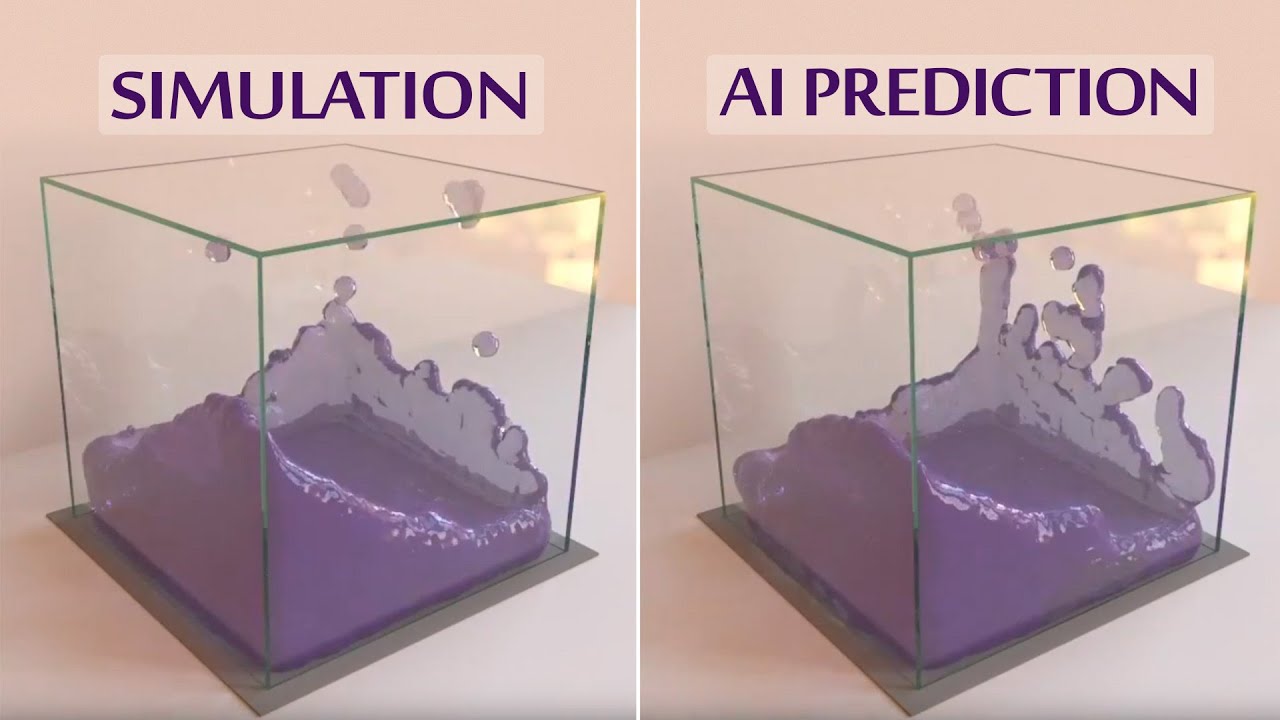
Dear Fellow Scholars, this is Two Minute Papers with Károly Zsolnai-Fehér. As you know from this series, fluid simulation techniques that are able to create high fidelity video footage are in abundance in computer graphics research. These techniques all have their own tradeoffs, and when we evaluate them, we often use terms like first or second-order accuracy, which are mathematical terms. We often have to evaluate these techniques against each other by means of mathematics, because this way, we can set up consistent and unbiased comparisons that everyone understands and agrees upon. However, ultimately, in the show business, what matters is how the viewers perceive the end result, whether they think it looks fake, or if it keeps their suspension of disbelief. We have the choice of not only simulation techniques, but all of them also have their own set of parameters. For instance, the higher the resolution of our simulations, the more high-frequency details appear in the footage.

User study A

However, after a point, increasing the resolution further is extremely costly, and while we know what is to be gained in terms of mathematics, it is still unknown how well it would do with the users. So the ultimate question is this: what do I get for my money and time?

User study C

This paper provides an exhaustive user study to answer this question, where the users are asked to look at two different simulations and as a binary choice, tell us which is the one they perceived to be closer to the reference. The reference footage is a real-world video of a water sloshing in a tank, and the other footage that is to be judged is created via a fluid simulation algorithm. Turns out that the reference footage can be almost anything as long as there are some splashing and sloshing going on in it. It also turns out that after a relatively favorable breaking point which is denoted

Application 3/4

by 2x, further increasing the resolution does not make a significant difference in the user scores. But boy, does it change the computation times! So this is why such studies are super useful, and it's great to see that the accuracy of these techniques are measured both mathematically, and also how convincing they actually look

User study B

for users. Another curious finding is that if we deny access to the reference footage, we see a large change in different responses and a similar jump in ambiguity. This means that we are reasonably bad at predicting the fine details, therefore, if the simulation pushes the right buttons, the users will easily believe it to be correct even if it is far away from the ground truth solution. Here is a matrix with a ton of rendered footage. Horizontally, you see the same thing with different simulation techniques, and vertically, we slowly go from transparent above to opaque below.

Application 2/4

To keep things fair and really reveal which choices are the best bang for the buck, there are also comparisons between techniques that have a similar computation time. In these cases, the Fluid Implicit Particle. FLIP in short and the Affine Particle in Cell, are almost unanimously favorable.

Appendix B

These are advanced techniques that combine particle and grid-based simulations. I think this is highly useful information for more time critical applications, so make sure to have a look at the paper for details. There are similar user studies with glossy and translucent material models and much more in the paper. The source code of this project is also available. Thanks for watching and for your generous support, and I'll see you next time!

Другие видео автора — Two Minute Papers

Ctrl+V

Экстракт Знаний в Telegram

Экстракты и дистилляты из лучших YouTube-каналов — сразу после публикации.

Подписаться

Дайджест Экстрактов

Лучшие методички за неделю — каждый понедельник