FINALLY: evidence for Hawking's AREA THEOREM of black holes
15:56

FINALLY: evidence for Hawking's AREA THEOREM of black holes

Dr. Becky 02.10.2025 229 080 просмотров 11 992 лайков

Machine-readable: Markdown · JSON API · Site index

Поделиться Telegram VK Бот
Транскрипт Скачать .md
Анализ с AI
Описание видео
AD | Click this link https://boot.dev/?promo=DRBECKY and use my code  DRBECKY  to get 25% off your first payment for boot.dev | Hawking is a name that will forever be linked with black holes. You think black holes, you think Stephen Hawking. Because in a time when many in science were still dismissing the idea of such a weird thing as an object collapsed under gravity so dense that light couldn’t escape, that seemed so counterintuitive to everything else we knew in physics, Hawking was bringing together the pieces to reveal how black holes could exist in nature, and how they would still obey the laws of physics despite their oddity. One of those laws is called the Hawking area theorem, and this month a research paper from the LIGO collaboration came out studying the gravitational waves from the merger of two black holes that provided the strongest evidence yet we have in support of Hawking’s black hole theorems… P.S. This video was filmed before I started my chemotherapy treatment recently. I'm doing ok ❤️‍🩹 00:00 Introduction 03:00 What is the Hawking Area Theorem? 07:38 How we can test the theorem by detecting gravitational waves 10:27 What the LIGO collaboration found studying the GW250114 detection 15:21 Bloopers LIGO collaboration (2025; GW250114) - https://journals.aps.org/prl/abstract/10.1103/kw5g-d732 LIGO collaboration (2015; GW150914) - https://journals.aps.org/prl/abstract/10.1103/PhysRevLett.116.061102 LIGO collaboration (2016; GW150914) - https://arxiv.org/pdf/1602.03840 Isi et al. (2021; hawking area theorem test with GW150914) - https://arxiv.org/pdf/2012.04486 Hawking & Penrose (1974) - https://www.jstor.org/stable/2416467?origin=ads&seq=1 Hawking (1971) - https://journals.aps.org/prl/abstract/10.1103/PhysRevLett.26.1344 Bardeen, Carter & Hawking (1973) - https://link.springer.com/article/10.1007/BF01645742 Hawking (1974) - https://www.nature.com/articles/248030a0 Hawking (1976) - https://journals.aps.org/prd/abstract/10.1103/PhysRevD.13.191 Video filmed on a Sony ⍺7 IV Video edited by Martino Gasparrini: https://www.fiverr.com/mgs_editing --- 📚 My new book, "A Brief History of Black Holes", out NOW in hardback, paperback, e-book and audiobook (which I narrated myself!): http://lnk.to/DrBecky --- 👕 My new merch, including JWST designs, are available here (with worldwide shipping!): https://dr-becky.teemill.com/ --- 🎧 Royal Astronomical Society Podcast that I co-host: podfollow.com/supermassive --- 🔔 Don't forget to subscribe and click the little bell icon to be notified when I post a new video! --- 👩🏽‍💻 I'm Dr. Becky Smethurst, an astrophysicist at the University of Oxford (Christ Church). I love making videos about science with an unnatural level of enthusiasm. I like to focus on how we know things, not just what we know. And especially, the things we still don't know. If you've ever wondered about something in space and couldn't find an answer online - you can ask me! My day job is to do research into how supermassive black holes can affect the galaxies that they live in. In particular, I look at whether the energy output from the disk of material orbiting around a growing supermassive black hole can stop a galaxy from forming stars. http://drbecky.uk.com
Оглавление (5 сегментов)

Introduction

Hawking is a name that will forever be linked with black holes. You think black holes, you think Stephven Hawking. Because during a time when many in science were still dismissing the idea of such a weird thing as an object collapsed under its own gravity so dense that light couldn't escape that just seemed so counterintuitive to everything else that we knew in physics. Hawing was bringing together the pieces to reveal how black holes could exist in nature and how they would still obey the laws of physics. — despite their oddities. One of those ideas is called the Hawking area theorem. And this month, a research paper from the LIGO collaboration came out that studied the gravitational waves from the merger of two black holes that provided the strongest evidence yet in support of Hawings black hole theorems. So, in this video, we're going to dive into all this and we're going to chat first about what is the Hawking area theorem. Then second chat about how we can test the theorem by detecting the gravitational waves from the merger of two black holes. And then finally chat about what the LIGO collaboration has found studying the gravitational wave event GW25014. But before we get to that, I get asked all the time by people who want to become a scientist. What is the best thing that they can do to help them along that journey? And my answer is always the same. It is always to learn how to code, which I'll admit is easier said than done because often coding is self-taught and you have to self-motivate. But today's sponsor, Boot. dev, makes learning to code just that little bit easier by using tactics learned from modern game design to push you towards your learning goals. With Boot. dev's hands-on lessons that balance theory with practice, you can gain the skills that you need to forge a successful career. Whether that is as a scientist or maybe you end up as a successful back-end developer. Whether you decide to learn Python, the language of choice for many of us scientists or JavaScript for web development, boot. dev has you covered with Boots, their AI wizard bear that's trained on each lesson to help you if you get stuck. So he doesn't just give you the answers, he asks you questions to deepen your understanding and guide you to the right answer. But you know, if you do get really stuck, then the solutions are still available. Look, coding is not something you can learn overnight though. It's like learning any language. It takes time. So, Boot. dev's curriculum reflects that. It takes around 12 months to go properly in depth on both the theory and the practice. Now, all of Boot. dev's content is free to read in a guest mode. But a paid membership unlocks the interactive features like hands-on coding, AI assistance, and progress tracking. So, if you go to boot. dev, dev. You can try out their courses for free first and then use my code Dr. Becky to get 25% off your entire first year if you choose the annual plan or you can also click on that link in the video description down below as well. So, a big thanks to boot. dev for sponsoring this video and for helping to teach the world to code. And now, let's jump in and chat first

What is the Hawking Area Theorem?

about what is the Hawking area theorem. Okay, so first to make sure we're all on the same page, let's have a quick recap about black holes. They are regions of space where there's so much matter squished into a small space, it becomes so dense that gravity is strong enough that light can't escape. But crucially, they are not holes in space, right? They are literal mountains of matter. Imagine taking something as massive as a star and squishing all of the space out of the atoms in it until the gravity is so strong in that region of space that not even light traveling at 300,000 km a second can resist the pull. When that happens, something known as an event horizon forms, a sphere around the matter that used to be the star. That's the region that we get no light from, i. e. no information from to know what's going on inside. I've made a video on that before if you want to ponder for a bit on a few of the possibilities for what could happen to all the matter beyond the event horizon. But back to this video, it was the event horizon that fascinated Hawking. Because if you think about it, it's not actually a physical object in the same way that the horizon when we look out at great distances also isn't a physical object. There's no actual line there marking how far you can see. It's just a product of the fact that the Earth is round and the laws of physics, but it still does mark this boundary of how far you can see. And so similarly, the event horizon, even though it's not a physical object, still does mark this boundary in space, which means even though it's not a solid sphere, it does still have a definable surface and therefore a surface area. And so if we think about what could happen to a light ray as it got close to a black hole, it could be on a direct trajectory, right, where it just crosses straight over the event horizon, [clears throat] ends up whatever's at the center. Or it could be lucky and it could just sort of like sweep past the black hole and get slingshoted and escape back out the other side. But what about if you have a light ray that's on a trajectory that's just sort of like perfectly in between those two? Those are the light rays that just fail to escape the black hole. They're on the right trajectory to keep them forever circling the black hole at the event horizon. Meaning the event horizon would actually be this sheet of light, this blazing ball that we just can't see. And it was this idea that intrigued Hawking and he started to think, okay, well, if this is how we can think about the event horizon, then what would happen to that light if the event horizon started to shrink or to grow? Well, if the event horizon were to shrink, those light rays on that perfect trajectory at the event horizon, shrinking with the event horizon, those light rays would then have to cross, focusing to a point and then diverging and breaking the nature of the event horizon itself, allowing light to escape and breaking the idea of the black hole. So if you have a black hole with an event horizon, then Hawings area theorem says the surface area of the event horizon cannot decrease with time. Plus the radius is tied to how massive the black hole is. So Hawkings area theorem is kind of another way of saying that black holes can't shrink in mass. Once the mass is locked in there, it's locked in there for good. However, having said that, Hawking also predicted the existence of something known as Hawking radiation, where quantum mechanics predicts that black holes can actually radiate away mass as energy, as radiation, and therefore shrink over time. I talk more about this in my book, A Brief History of Black Holes. If you want to check that out, the link is in the video description down below. So while we now think that the Hawking area theorem wouldn't necessarily apply to a single isolated black hole that could you know shrink its event horizon through Hawking radiation, it does apply for two merging black holes. In this case, the Hawking area theorem means that the surface area of the remnant black hole that you end up with after the merger has to be greater than or equal to the sum of the surface areas of the two merging black holes. That was Hawkings prediction in 1971. And 50 years later, we now have the data to be able to test that. Which brings me to the marvels of modern science and engineering in part two. How we can test

How we can test the theorem by detecting gravitational waves

Hawings area theorem by detecting the gravitational waves from the merger of two black holes. So the best theory of gravity that we have is Einstein's theory of general relativity. In it, it says that massive objects curve space itself and then gravity is just the effect caused by objects traveling on that curved space. Black holes curve space to the extreme. And when you've got two black holes orbiting each other and maybe spiraling around each other so that they will eventually come to merge, they curve and uncurve space to that extreme as they spiral together, sending out ripples through space itself. And in the past 10 years, we've actually been able to detect these ripples, these gravitational waves here [snorts] on Earth with observatories like LIGO and Virgo, which fire lasers down L-shaped underground tunnels that are kilometers long and bring those lasers back together in such a way that the light from the two lasers cancels each other out. In the same way that noise cancelling headphones work, right? They record the sound wave coming in. They invert that soundwave, add the two together, and then they perfectly cancel each other out. Noise cancellation. In a gravitational wave detector, if the two tunnel lengths stay exactly the same length, then when you bring the lasers back together, they completely cancel each other out and you get perfect light cancellation. But if a gravitational wave passes by, this stretches and squashes space to change the length of the tunnels even by a tiny amount enough to disrupt that perfect light cancellation of the laser. And you detect a flash of light to know that a gravitational wave has passed by and disturbed space. Now the shape of the signal that we get from these gravitational waves, the amplitude or the loudness of them is very well predicted by Einstein's theory of general relativity. It describes how space is curved by the two black holes as they spiral together and then what happens as they merge and then ring down again after the merger. By fitting a model with general relativity to the shape of the signal of the gravitational waves detected, we can work out the best fit for how massive the two black holes that merged were and how massive the black hole that was formed at the end of the merger is. And so from that, we also get the size of the event horizon of the black holes before and after and also their surface areas of the event horizon as well. But if that's the case and we've been detecting gravitational waves now with LIGO and Virgo for 10 years, why have we only been able to test the Hawking area theorem with any statistical certainty until now? Well, that brings me to part three. What the

What the LIGO collaboration found studying the GW250114 detection

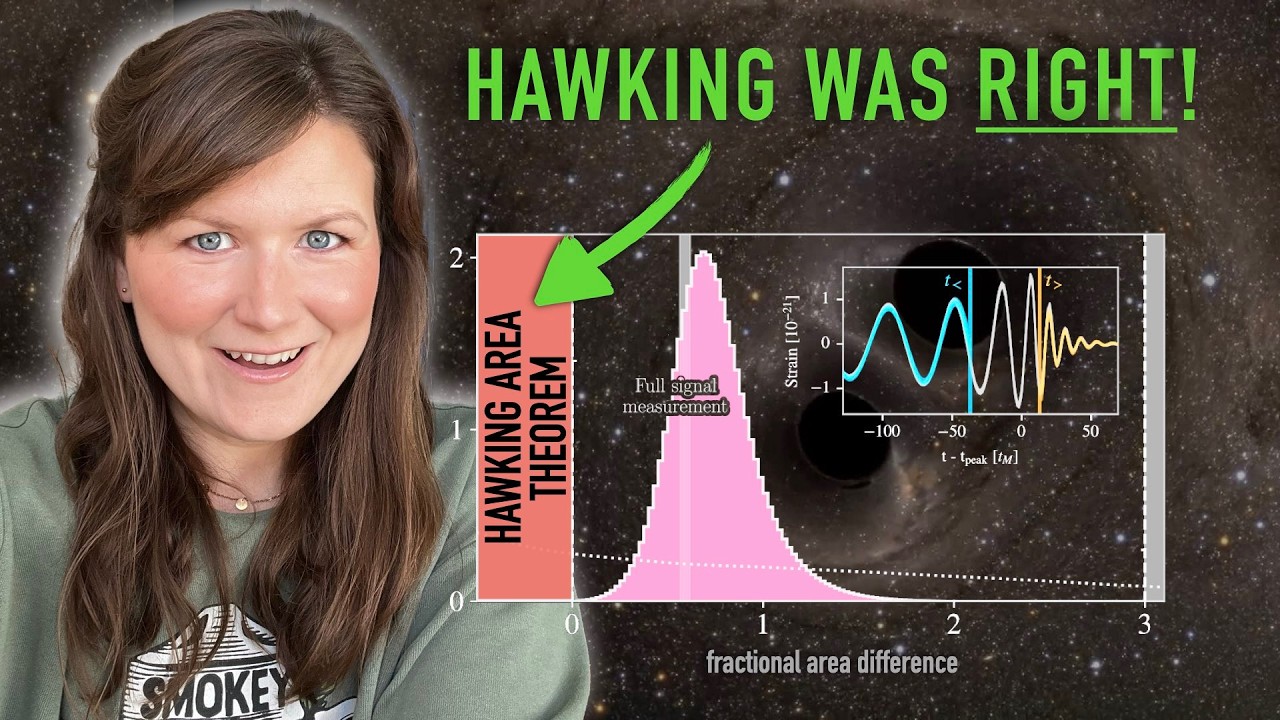
LIGO collaboration have found studying the gravitational wave event GW250114. So this gravitational wave signal was detected earlier this year on the 14th of January 2025. And it was from the merger of two black holes. And in particular, this was a very obvious gravitational wave, which meant that the signal was actually 80 times the intensity of the typical noise in the detector. Compare that, for example, with like the first ever gravitational wave signal that was detected back in 2015, which was only 24 times the intensity of the noise. We call this the signal to noise ratio or SNR. And essentially, the higher that number is, the clearer your signal is, the more it stands out above the noise. And this isn't something that's just, you know, for gravitational wave detectors. This is also true of any sort of image you take with a telescope as well. Is the light that you're detecting bright enough for you to be able to sure that you've detected it above whatever the background noise is? Similarly, for gravitational wave detections, you can be more sure that any variations or wiggles in the shape of the signal that you've detected are due to the thing that you're actually observing and not just the noise in the detector. Which means when you fit a model to the data of what to expect for two black holes merging, you can then get a really precise measurement of their properties, their masses, their spins, their surface areas. But what's especially key for getting at the surface area measurements of the black holes is what's known as the ring down phase. This is kind of like the aftershocks that happen after an earthquake, right? It's kind of the postmerger, what the hell just happened when everything settles back down again. And the gravitational waves that we detect from this phase of the merger are nowhere near as strong or as loud as the merger itself. Which means if you don't have a very strong signal, then a lot of the detail that's, you know, encoded in that ring down phase is lost in the noise. You don't have a high enough signal to noise ratio to pull out those details and get a very precise estimate for what's actually happening to the black hole after the merger that's left behind. like for example what its surface area is. But because the signal from this event GW250114 was so strong with such a high signal to noise ratio, this ringdown phase was beautifully resolved, giving a more precise measurement of the final black hole properties. But like with any model, there's still the most likely value, the best fit that then has some spread of values around that best fit that are less likely but do still fit the data. Which means that when the LIGO collaboration looked at the difference in the total surface area of the two black holes before the merger compared with the surface area of the remnant black hole left behind, they get a spread of possible values from all the different possible model fits. So that's what you're seeing here on the x-axis here. You've got what's known as a fractional difference. the final area minus the initial areas divided by the initial areas. So remember the Hawking area theorem states the surface areas can't shrink. So the surface area of the final black hole has to be greater than or equal to the sum of the two surface areas of the black holes that merged. Essentially, AF has to be greater than AI here, which is why there's that gray shaded region of fractional values less than zero because that would be where AF is less than AI and you break the Hawking area theorem. And so, as you can hopefully see, the good news is that none of the models fit this gravitational wave signal go into that region with the best fit model actually giving a fractional area difference of around 0. 8. So, not just a straight sort of like sum of the two surface areas like you might expect, but we know that when two black holes merge together, their masses don't add together to give you a remnant the sum of the masses you started with either. Some of the mass is actually lost as energy in the gravitational waves. And so that's also reflected in the total surface areas as well. But what this plot right here shows is the first conclusive statistically robust evidence for the Hawking area theorem. Something that with previous gravitational wave detections, we've not been able to do because the signals just weren't strong enough with a high enough signal to noise ratio to allow a precise enough test. This right here is one of my favorite things that can happen in all of science. A prediction made decades ago off the back of purely working logically through the maths that finally we have evidence for thanks to the engineering and scientific marvels of the 21st century.

Bloopers

Tried to get a cracker and I got crumbs in my teeth. Somebody's the door parcel. Wonder what the parcel is. I may go find out. I'm intrigued. It wasn't for me. It was for Sam. Sad times. Um, anyway, there's a plane going over, so I will wait. Of the 21st century. That really spitty at the end. I'm going to do that again. The amount of times, by the way, that when I was making notes for this that my computer just automatically autocorrected like Hawking to Hawkins, I was like, "No, I'm not in Stranger Things right now.

Другие видео автора — Dr. Becky

Ctrl+V

Экстракт Знаний в Telegram

Экстракты и дистилляты из лучших YouTube-каналов — сразу после публикации.

Подписаться

Дайджест Экстрактов

Лучшие методички за неделю — каждый понедельник