The ABSOLUTE BEST AI Prompt Techniques in 2025
20:30

The ABSOLUTE BEST AI Prompt Techniques in 2025

Anik Singal 18.10.2025 58 475 просмотров 2 564 лайков

Machine-readable: Markdown · JSON API · Site index

Поделиться Telegram VK Бот
Транскрипт Скачать .md
Анализ с AI
Описание видео
The ABSOLUTE BEST AI Prompt Techniques in 2025 If you’re still typing “help me write content” into ChatGPT and getting average results — this video will completely change how you use AI. In just 12 minutes, you’ll learn the 10 most powerful AI prompt techniques that top creators, entrepreneurs, and marketers are using to get 10x better results from the same tools you already have — ChatGPT, Claude, Gemini, and Perplexity. This is Anik’s AI Clone, sharing the exact frameworks Anik uses to scale companies, automate content, and turn AI into a personal $200/hour consultant. What You’ll Learn ✅ 10 battle-tested prompt frameworks for ChatGPT, Claude, and Gemini ✅ How to use the CRISP-E Framework to instantly level up your prompts ✅ The Context Multiplier System that separates amateurs from pros ✅ The psychological hack that makes AI 10x more creative ✅ The Prompt Doctor Method to fix and perfect any AI request ✅ Real examples that show how experts get 400% better results from the same tools Timestamps: 00:00 - Introduction: Advanced ChatGPT Prompting Secrets 01:34 - CRISP-E Framework: Turn Basic Prompts into Pro-Level Outputs 02:31 - Context Multiplier: Boost Accuracy & Depth of AI Responses 03:44 - Chain-of-Thought Prompts: Unlock Strategic AI Reasoning 05:07 - Failure-First Method: Learn from AI Mistakes for Better Prompts 06:45 - Expert Panel Technique: Use Multi-Expert AI Perspectives 08:38 - Viral Structure Hack: Create High-Engagement AI Content 10:32 - Creative Constraint System: Push AI to Think Creatively 12:58 - Draft-to-Genius Method: Transform Rough Prompts into Gold 14:42 - Context Evolution Hack: Keep Prompts Smart & Adaptive 16:50 - Prompt Doctor System: Diagnose & Fix Weak Prompts Fast 18:26 - Conclusion + 48-Hour AI Prompting Challenge ============================================ 👇Subscribe To The Channel By Clicking Below!👇 https://www.youtube.com/user/aniksingalcom?sub_confirmation=1 CHECK OUT THESE TOP TRENDING PLAYLISTS NOW! Fighting Entrepreneur - https://www.youtube.com/watch?v=D9nsNOu3gIE&list=PLEmF7qw7SECK1hy5U5nodHoCg7ANzXukz Master Copywriting With Anik Singal - https://www.youtube.com/watch?v=CjOAWP1DKAk&list=PLEmF7qw7SECKouq97MqF5zFi1Xb-VFyMY&index=2&t=0s Facebook Advertising Strategies - https://www.youtube.com/watch?v=BMQh6zA3HUY&list=PLEmF7qw7SECJUULNlnAGHvcegeQbIAHZp How To Become A Better Entrepreneur - https://www.youtube.com/playlist?list=PLEmF7qw7SECKVlP2eOsF_XpYBYhlTGAVU ============================================ In May 2022, my life changed. Up until that point, I had spent over 20 years as a serial entrepreneur, founding multiple companies and becoming globally recognized for my expertise in direct marketing, copywriting, compliant marketing, and now, investing in AI & Martech SaaS. In 2022, my company, Lurn, was on track to hit $40 million/year, and I was preparing to sell it—ready to step back, spend more time with my kids, and move on to my next chapter. But then, in May 2022, everything changed. A FedEx package from the FTC landed on my desk. And just like that, my entire world turned upside down. The Fight of My Life For the next 18 months, I battled through a grueling legal process. - My company was in trouble. - The sale I had planned was gone. - The lawsuit cost me over $15 million—$2.5M in fines, plus millions more on my team, lawyers, and discovery. It was one of the hardest times of my life. But as painful as it was, it taught me something invaluable. Something that I’ve always taught to millions of Entrepreneurs over the years… When Life Pushes You Stand Straight, Smile & Push It The Heck Back When I finally settled the case, I realized something: Most entrepreneurs don’t understand compliance… until it’s too late. #ai #aitools #prompt #promptengineering #gpt5 #gemini #perplexityai #claude #chatgpt #bestaitools #aiforbusiness #aiforbeginners #aiformarketers

Оглавление (12 сегментов)

Introduction: Advanced ChatGPT Prompting Secrets

If you're still typing, "Help me write content into chat GPT and getting mediocre results," this 15-minute video will completely transform how you interact with AI. In these 15 minutes, you'll learn 10 of the best prompt formulas and techniques, how AI experts are getting 10 times better results, and the critical mistakes that 95% of people make that kill their prompts before they even start. This works across every AI tool. Chat, GPT, Claude, Gemini, Perplexity, you name it. Hey there, this is Anique's AI clone. While the real Anique is out there running multiple businesses, scaling companies, and working with clients, I'm here to share his best prompting techniques. Listen, here's a stat that'll blow your mind. Recent research shows that 89% of people use fewer than 12 words in their AI prompts. That's insane. No wonder they're getting garbage outputs. But here's what's even crazier. Companies using advanced prompting techniques are reporting 400% better results from the same AI tools. Same chat GPT, same claude, completely different results. The gap between basic users and advanced users isn't just growing, it's becoming a competitive mode. Look, by the end of this video, you'll have 10 specific formulas that will make you look like an AI prompting king while your colleagues are still struggling with basic prompts. You'll go from getting generic, useless responses to creating content that looks like it came from a $200 an hour specialist. And at formula number seven, I'll show you the psychological hack that makes AI 10 times more creative. Okay, let's dive in. First up, the Crisp

CRISP-E Framework: Turn Basic Prompts into Pro-Level Outputs

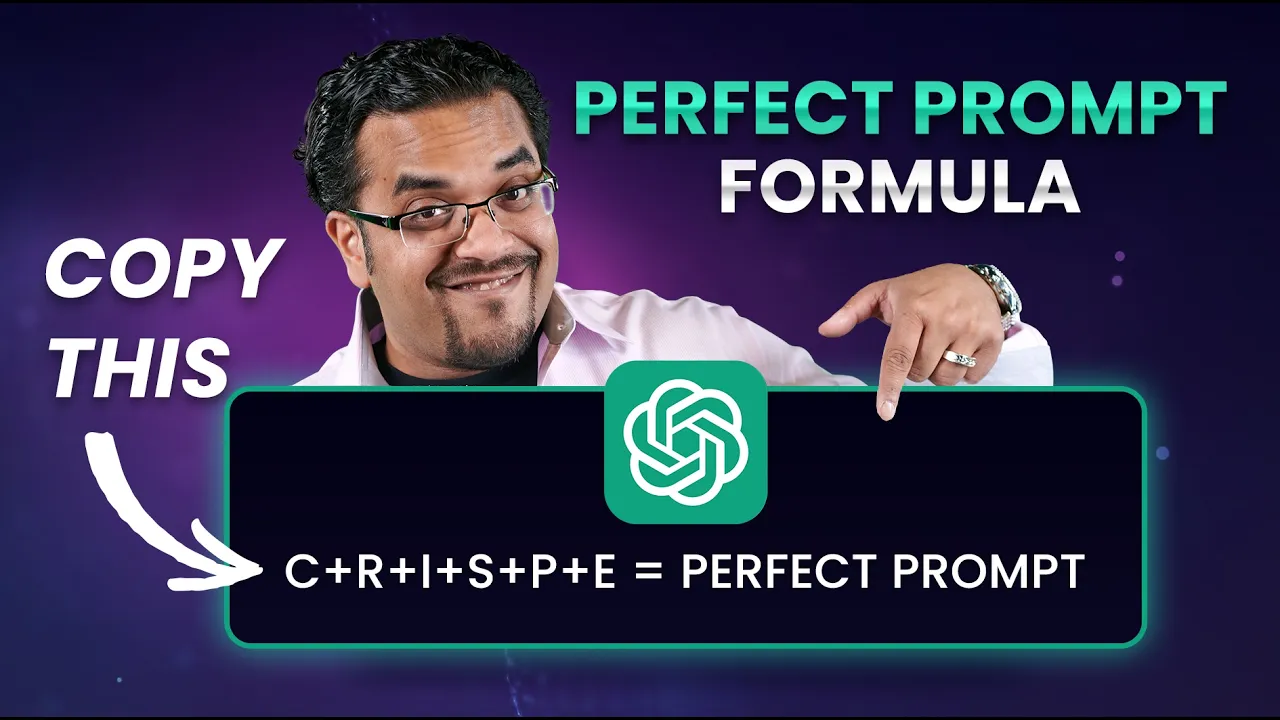
E framework. Forget everything you learned about basic prompting. This is the framework that companies are paying consultants a lot of money to learn. Let me show you exactly how powerful this is. Here is what most people do when they need a landing page copy. So, generic request, generic result. Now, watch what happens when we use the Krispy framework. Context, role, instruction, specification, performance, example. I'm giving it business context, assigning it the role of an expert copywriter, specific instructions about what I need, exact specifications for format and length, performance standards to hit, and examples to follow. Look at this transformation. The first one is generic website copy. The Crisp E version. This looks like it came from a conversion specialist. Same AI, completely different results. Crisp E turns any basic request into professionalgrade output. All right, let's move on to technique two, the

Context Multiplier: Boost Accuracy & Depth of AI Responses

context multiplier system. This technique literally didn't exist until 2024. And it's the reason some people are getting 10 times better results from the exact same AI. It's all about the five layers of context that most people have no idea exists. Let me show you the difference between using one layer versus five layers. Here is a basic marketing strategy request that everyone makes. Generic business advice. Right now, watch what happens when I add four more context layers. I've preloaded this project with business details, set my preferences for how I want responses formatted, and I'm using system triggers to unlock deeper thinking. Same exact question, but now it knows my specific business, my target market, my competitors, my budget. It's like consulting with someone who's already fully briefed on my situation versus talking to a stranger. This isn't just longer. It's surgically specific to my actual business situation. Look at these specific competitor mentions, budget conscious tactics, target audience insights. Context beats complexity every single time. By the way, wait until you see formula number six. It lets you steal the exact structure of any viral content. All right, let's move to

Chain-of-Thought Prompts: Unlock Strategic AI Reasoning

technique number three, chain of thought prompting, and this one is amazing. Look, the old think stepby-step prompt was kindergarten level. Everyone's using that basic stuff. This is graduate school making AI show you its complete reasoning process like a real consultant would. Here's the advanced formula and I want you to write this down. Before giving me your answer, walk me through your assumptions, your complete reasoning process, potential risks, and what would change your recommendation. Then give me your final answer with confidence level. Instead of asking, should I hire a marketing manager? which gets you a basic yes or no answer. You ask for the full strategic analysis. You get McKenzie level thinking. All right. They consider your cash flow, your growth stage, alternative options, risk factors, and they give you a confidence rated recommendation with clear reasoning behind every point. Here's why this is so powerful. Most people get surface level answers because they ask surface level questions. But when you force AI to show its work, to walk through its thinking process step by step, you get insights you never would have thought of. You get strategic analysis instead of surface level yes no answers. And that's the difference between amateur and professional use of AI. Now, technique number four, the

Failure-First Method: Learn from AI Mistakes for Better Prompts

failure first method. And this is completely backwards from what everyone teaches, but it works like magic. Instead of asking for what you want, ask for what you don't want first. I know it sounds weird, but stick with me here. Let me show you how this works with email subject lines. Instead of asking, "Give me good email subject lines," I'm going to type this. Give me three terrible ways to write an email subject line for a productivity software launch. Give me reasons why they don't work and the psychology behind it. I'm asking it to show me bad examples first and explain the psychology of why they fail. This forces the AI to understand the failure modes before giving solutions. Look at this. It's not just giving me subject lines. It's teaching me the marketing psychology behind what works and what doesn't. Generic subjects create no urgency. Vague promises trigger skepticism. This is marketing psychology education while solving my problem. By understanding what kills results, you get solutions that are psychologically informed instead of just generic templates. Here's why this works so well. When AI has to explain why something fails, it develops a deeper understanding of the success principles. It's like learning to drive by first understanding all the ways you can crash it. That's some reverse psychology on AI, right? And it works better than just asking for good examples because now you understand the why behind what makes something effective. And most people skip the failure analysis and jump straight to solutions. But the pros, they study failure first because that's where the real insights are hidden. Okay, next up, technique number five

Expert Panel Technique: Use Multi-Expert AI Perspectives

the expert panel method. And this one's going to blow your mind because it's like having a boardroom full of experts at your fingertips. Here's what most people do. They ask AI for advice and get one viewpoint. That's it. One perspective, one angle, one way of looking at the problem. That's amateur hour. Okay? Look, real strategic decisions need multiple expert perspectives. But who has time for three separate meetings with different specialists? Who has the budget to hire a CFO, a growth hacker, and a customer success manager just to get their input on one decision? Nobody, right? That's where this technique comes in. Here's exactly what you do. You prompt chat GPT like this. Analyze my strategy from three perspectives. a conservative CFO focused on ROI, an aggressive growth hacker focused on scaling, and a customer success manager focused on retention. Then synthesize the insights. Boom. You get strategic thinking that usually takes three separate meetings, three different consultants, and probably cost you thousands of dollars. for a product launch decision. Instead of one generic viewpoint, you get risk analysis from the finance perspective, growth opportunities from the marketing angle, and customer impact from the success team's point of view. Do you catch blind spots that single perspective thinking always misses? Because here's the thing, every expert has their own lens, their own priorities, their own way of seeing problems. The CFO sees cash flow and risk. The growth hacker sees opportunity and scale. The customer success manager sees retention and satisfaction. When you get all three perspectives at once, you make better decisions. Period. Combine this with chain of thought prompting that I showed you earlier, and you get strategic analysis. That's scary good. I'm talking McKenzie level thinking for the cost of a chat GPT subscription. Awesome. Now, let's talk about technique number six, the viral

Viral Structure Hack: Create High-Engagement AI Content

structure hijacker. And I am very excited for you to learn this one, especially if you're a beginner at content creation. With this technique, you don't have to reinvent the wheel. All right? You can reverse engineer what already works. This technique lets you steal the psychological structure of any viral content completely legally. Here's the problem. Most people create content from scratch. They sit down with a blank page and try to come up with something brilliant from nothing. That's not the smartest way to get started. Okay? Instead, why not use viral content that already follows proven psychological patterns, content that you can extract and reuse for your own topics? Here's how you do this. Step one, feed AI successful content, and ask it to extract the template. I'm talking hook structure, story elements, emotional triggers, call to action patterns, the whole psychological framework. Step two, apply that proven template to your topic. You get the psychological framework that made the original go viral. But with your content, your message, your brand, find viral content in any format, posts, videos, emails, whatever. Analyze the structure first, then apply it to your topic. You get battle tested templates instead of gambling with untested ideas. Here's why this works so well. Viral content doesn't go viral by accident. There are psychological patterns, emotional triggers, structural elements that make people want to share, comment, and engage. Instead of trying to figure out those patterns from scratch, you're borrowing the blueprint from content that's already proven to work. It's like having the architectural plans for a house that you know won't fall down instead of trying to design your own foundation from scratch. Smart creators don't reinvent psychology. They use what already works and apply it to their own message. Okay, let's talk about

Creative Constraint System: Push AI to Think Creatively

technique number seven, the creative constraint system. And this is the psychological hack I mentioned earlier in the video that I absolutely love. Here's something that's going to sound completely backwards, but trust me on this. The more constraints you give AI, the more creative it gets. I know that sounds crazy, but it works brilliantly. Most people think constraints limit creativity, right? They think if you give AI more freedom, it'll be more creative. Wrong. Instead of saying create social media content, which is what everyone does, try this. Create an Instagram real script using exactly four sentences. Include one statistic, one story element. Target 28 to 35-year-old entrepreneurs. Post Tuesday 9:00 a. m. End with save this post. Casual but confident tone. Address productivity anxiety. Under 60-cond total. Look at all those constraints. Right. exact sentence count, specific elements to include, target audience, posting time, ending phrase, tone requirements, topic focus, time limit. Here's why this works so well. Generic requests get generic outputs, but hyperspecific constraints force AI to be surgically precise and surprisingly creative within those boundaries. It's like giving an artist a specific canvas size and color palette. The limitations actually spark creativity instead of killing it. When you say create content, AI has infinite possibilities and usually picks the most generic path. But when you say create content with these eight specific requirements, it has to get creative to fit everything together in a way that works. And think about it, some of the most creative solutions in history came from working within tight constraints. Haikus are beautiful because of the 575 syllable structure, not in spite of it. Twitter's 280 character limit forced people to be more creative with their words, not less. Same principle applies here. The constraints don't limit AI's creativity. They channel it in a specific direction that actually produces better, more useful results. Plus, you get exactly what you need instead of having to edit and reshape some generic output that doesn't fit your specific situation. This technique alone will make your AI outputs 10 times more useful because they'll be tailored to your exact needs instead of being one-sizefits-all garbage. Technique eight, the draft to

Draft-to-Genius Method: Transform Rough Prompts into Gold

genius system. All right, technique number eight. This is the draft to genius system. And honestly, this might be the most important one I teach you today. Here's the thing. Most people get their first result from AI and they're like good enough and they move on. That's amateur hour, okay? That's like a chef serving the first thing that comes out of the pan without tasting it or seasoning it. Listen, if you want professional level results, you got to treat AI like a junior employee who needs coaching, not like some magic genie that gives you perfect answers on the first try. Here's my four round system that I use for everything. Round one, basic prompt, basic output. This is just your starting point. All right, don't get excited yet. Round two. Now you say, "Make this 10 times more specific to my exact audience. You're not starting over. You're building on what you already have. " Round three, add psychological triggers and emotional elements that drive action. Now, we're getting into the good stuff, the psychology that actually makes people care. Round four, optimize for conversions and add urgency elements. This is where you turn good content into content that actually gets results. Each round builds on the last like a sculptor refining their masterpiece. You know what I mean? You're not throwing away work, you're making it better and better. Here's my professional rule, and I want you to remember this. Always iterate at least twice. Amateurs take first drafts. Professionals refine until it's actually good. I've seen people spend hours trying to write the perfect prompt from scratch when they could have gotten better results by just improving what they already had. Don't be that person. Okay, technique nine, the

Context Evolution Hack: Keep Prompts Smart & Adaptive

context evolution hack. All right, technique number And this one's going to save you so much time and frustration. Here's a situation that happens to everyone, and I mean everyone. You're deep into an AI conversation, right? You've been going back and forth, getting great analysis, building on ideas, and then boom, something changes. Maybe your budget gets cut in half. Maybe a new competitor enters your market. Maybe your timeline gets moved up by three months. Whatever it is, your whole situation just shifted. Now, most people panic and start a completely new conversation, losing all that valuable context they just built up. That's expensive and it's stupid. Okay, you just threw away 20 minutes of back and forth analysis because one thing changed. It's like firing your consultant and hiring a new one every time you get new information. The solution? Dynamic context injection. Instead of starting over like an amateur, you use dynamic injection. Here's exactly what you say. Given this new information, budget just got cut by 50%, reanalyze your previous marketing strategy recommendation and provide an updated version. Show me what changes and what stays the same. You're building on existing analysis instead of throwing it away. You're treating the AI like a smart consultant who can adapt their recommendations when circumstances change. Here's why this works so well. It's like having a consultant who remembers everything from your previous meetings and can instantly adapt their recommendations when circumstances change without charging you for a brand new analysis from scratch. The AI already understands your business, your goals, your constraints. It just needs to factor in the new information. That's way more efficient than starting from zero every single time something changes. And trust me, in business things change all the time. This technique alone will save you hours every week once you start using it consistently. Most people don't realize that AI has memory within a conversation. Use that to your advantage instead of fighting against it. Technique 10, the prompt

Prompt Doctor System: Diagnose & Fix Weak Prompts Fast

doctor method. All right, technique number 10. This is the prompt doctor method. And honestly, this might be my favorite one because it's like having AI become your personal prompt engineering tutor. Let me show you how it coaches you to write better prompts in real time. Okay, here's a terrible prompt that people use all the time. And I bet some of you watching this have used this exact prompt. Help me write better social media content. I mean, come on. Right? That's like walking into a restaurant and saying, "Give me food. " What kind of food? For what occasion? Any dietary restrictions? It's way too vague. Now, I'm going to ask AI to analyze this prompt and rewrite it like a $200 an hour consultant would. Here's exactly what I'm going to type. Act as an expert prompt engineer with 10 years of experience. Analyze this prompt I'm about to give you. I'm asking it to grade my prompt on clarity, context, specificity, then rewrite it as a perfect 10 out of 10 with detailed explanations of each improvement. Look at this analysis. It identified exactly what was wrong. No audience specified, no platform mentioned, no format requested, no outcome defined. Then it rewrote it with specific improvements and taught me why each change matters. I didn't just get better results, I learned how to write better prompts. That's the beauty of this technique. All right. You get prompt engineering education while solving your problem. It's like having a mentor who not only fixes your work, but explains exactly why they made each change. Here's a 48 hour challenge for

Conclusion + 48-Hour AI Prompting Challenge

you. Here's what I want you to do in the next 48 hours, and this is crucial for actually mastering this stuff instead of just watching and forgetting. Pick the prompt you use most often in your work. Maybe it's content creation, maybe it's analysis, maybe it's problem solving. Whatever you use AI for most, take that basic prompt and run it through three of these formulas. Start with crisp E to give it structure. Add the context multiplier to give it depth. Then use the draft to genius system to make it brilliant. Document the before and after results. Screenshot them, save them, whatever. I guarantee you'll see a dramatic difference that will make you question how you were ever getting by with basic prompts. And listen, don't just learn these techniques and then forget about them next week. Systematize them, okay? Create a simple document, could be a Google doc, could be a note in your phone, I don't care, with your top five favorite formulas from today. Every time you discover a prompt that gives you incredible results, save it to your library. In 30 days, you'll have a personal collection of proven formulas that make you look like an AI expert to everyone around you. Your colleagues will be asking, "How did you get AI to write that and you'll just smile because you know something they don't. " Now, you just learned 10 prompt formulas that most people will never discover. All right. While your colleagues are still typing basic requests and getting mediocre results, you now have techniques that can make AI work, like your personal team of $200 an hour specialists. If these 15 minutes just saved you months of trial and error, hit that subscribe button and drop a comment with which formula you're testing first. I read every single comment and often reply with bonus techniques that I don't share in the videos. Remember, in a world where everyone has access to AI, the advantage goes to those who know how to use it like a professional. You now have that advantage. And as I always say, when life pushes you, stand straight, smile, and push it the heck back. I'll see you in the next

Другие видео автора — Anik Singal

Ctrl+V

Экстракт Знаний в Telegram

Экстракты и дистилляты из лучших YouTube-каналов — сразу после публикации.

Подписаться

Дайджест Экстрактов

Лучшие методички за неделю — каждый понедельник