🧠 Brain.fm is the best focus music I recommend - get 30 days free here: https://brain.fm/justinsung
In this video, I'll provide you with 9 strategies to make learning more enjoyable and effective.
Join my Learning Drops newsletter (free): https://go.icanstudy.com/newsletter-enjoyablelearning
Every week, I distil what really works for improving results, memory, depth of understanding, and knowledge application from over a decade of coaching into bite-sized emails.
=== Guided Training Program ===
I’ve distilled my 13 years of experience as a learning coach into a step-by-step learning skills program.
If you want to be able to learn a high volume of knowledge and skills in a short amount of time, then check out: https://go.icanstudy.com/program-enjoyablelearning
=== About Dr Justin Sung ===
Dr. Justin Sung is a world-renowned expert in self-regulated learning, a certified teacher, a research author, and a former medical doctor. He has guest lectured on learning skills at Monash University for Master’s and PhD students in Education and Medicine. Over the past decade, he has empowered tens of thousands of learners worldwide to dramatically improve their academic performance, learning efficiency, and motivation.
Back in high school, I found learning incredibly boring. I probably spent half my studying time either trying not to fall asleep or actually unconscious. And I thought that was because learning was just a boring thing. But now, after being immersed in learning science for over a decade and coaching so many people, I've realized that the reason I found learning so boring back then was because I just sucked at learning. In fact, whenever one of my students or clients says that they find learning boring, I found that it almost always points to a problem in the way that they learn. And when you fix that problem, not only does it make learning more engaging and enjoyable, it also fixes a lot of other problems like issues with poor retention and memory or not being able to learn concepts deeply enough. So, in this video, I'm going to share with you nine of the most important principles about learning to help you understand what boredom really means and then what you can do to make every learning session more engaging and effective. So, starting with principle number one, boredom is a symptom. If you feel bored when you're learning, it probably means you're not learning. When you look at EEG studies, which is uh electro eneilography, uh and that's when you hook up these electrodes to your head to measure the brain's electrical activity, and you measure what the brain activity looks like between someone who is learning very effectively versus someone who's not learning very effectively, what you find is that the person who doesn't learn very effectively, who's very passive, their electrical activity looks like this. It's very slowwave rhythmic changes. And this is a gross oversimplification, but your brain basically slows down. And this kind of activity is very similar to the type of activity you see in someone who is just about to fall asleep. So when you're lying there in bed, literally trying to make your brain not do anything. That brain activity as you get drowsy is very similar to the type of brain activity you see in a passive learner. And so that drowsy bored feeling is basically your brain saying I am shutting off. Now when we compare this to the brain activity of someone who is learning very effectively we see a completely different pattern. It looks a little bit more like this. It is very chaotic. It's very you know high activity. Basically means that there are signals going back and forth between the brain very quickly. So in short your brain is speeding up. And this happens when we are doing more active, more effective learning. The human brain is actually wired to really enjoy learning. And so most people, even if you don't like learning the topic you're studying right now, you will enjoy learning something else like a hobby or your favorite movie or TV show or something. And so effective learning and feeling bored are actually incompatible with each other. When you do effective learning, boredom is not something that you should feel. On the other hand, if you are feeling bored, it is a sign that you are not engaging in effective learning. And that is actually the second principle, which is that effective learning is always engaging. But what does effective learning actually mean? Think about learning like you're a detective solving a murder mystery. You go to the crime scene, there's all these clues around, and you have to piece it all together to figure out what's going on and find the culprit. And so the brain is in this problem-solving mode where you're taking individual clues and snippets of information and you're comparing them against each other to see if you can find a trend or a pattern, seeing how they fit together. And that process is challenging uh and difficult and takes a little bit of time and mental effort, but that is the process of learning. And this is exactly the same thing for when you're learning any other topic. Your brain doesn't know how anything fits together. It's just random bits of information. At first, we have to engage our brain in such a way that it's able to see those trends and patterns, group them together, and figure out a way to create a network of information rather than just trying to, you know, memorize each piece. And so that process of forming those networks and comparing these ideas, that is effective learning. So any effective learning technique or strategy that you use will involve doing that to different degrees. But the problem is that the way most of us go about learning does not get our brain to do that. And this is the reason why people can find learning to be boring or tedious. And this is principle number three. Your brain loves learning but hates studying. The way we have learned to study is very rarely the best way to study. If you think about the habits of studying that you have, these habits have been built up over years and years of experience, some of those habits were built when you were like five or 6 years old. And the stuff that you are learning and the way you need to use that knowledge is completely different to what you need to learn today. And so, not only is it outdated and no longer fit for you, they were created by like a six-year-old. And the
Segment 2 (05:00 - 10:00)
only reason we feel that that's the way we should go about learning is because we're so used to learning in that way. It's hard to imagine doing it any other way. And this is especially compounded by the fact that in a typical traditional curriculum, a lot of that learning is based on memorization and repetition. And maybe even our teachers uh told us to study a certain way and we just ended up internalizing that and that became a new habit which is potentially actually harmful. And so we've ended up with this huge very complex very ingrained set of habits on learning and studying which is not really based on how your brain likes to learn. It's not really based on any learning science research. Uh and it's mostly just based on these really old traditions of how we thought learning should be done based on like a 10020y old education system. And so there's this huge mismatch between what we need from our knowledge and our learning versus what our habits are actually creating. And we can detect that and our brain detects that. If you think about reading your favorite book series or watching your favorite TV show, you've learned so much about that universe, that world, those characters. And it doesn't feel like learning. You know, you are not turning on your favorite episode and then after every episode creating a set of flash cards for yourself and then repeating it every night before you go to sleep. But the way you can use that knowledge and the level of detail to which you can remember it is extremely deep, probably deeper with a greater level of expertise than stuff that you've spent hours deliberately trying to study. And so while you love doing the first thing, you hate doing the studying because your brain knows this is not effective. You know, you are taking your brain and slamming it repeatedly into this textbook, asking it why don't you enjoy it yet? And where we come to with all of that is that we end up with these certain topics which we find easier to learn because it just feels more relevant or the way it's taught to us makes it feel a little bit more engaging and enjoyable. And so we tell ourselves, okay, I'm only good at this subject. I can't learn this subject because I find it so boring. my brain just doesn't get it. But this is a false belief and you have to crack this which is actually the next principle. Relevance is a skill. Here's what's happening in your brain. When you learn something and you feel like it's so relevant and it's so easy to learn and also more enjoyable and more engaging, your brain, okay, let's say this is magnified inside your brain, right? This is your brain stem. Your brain has a series of connections inside of it, right? this network of connections which is its knowledge, its prior knowledge. And you have this new information. Let's say that you've got a page that you're reading and there's new information on here. And this new information has its own little series of networks. And so you read this information and your brain is looking at it saying, "Hey, how does this new piece of information fit with everything that we've already got here? " and it's looking for ways to try to connect it together. When it's successful at that and it's saying, "Hey, yeah, I can see multiple different ways how this connects and influences what we already know. " Our brain says this is relevant. Now, on the other hand, if we have a piece of information where we're looking at this and we don't see any possible ways that this connects, then we say this feels irrelevant. So, it's not like relevance is this cosmic phenomenon innate in whatever we're learning. It's simply a pattern match between the connections we already have and the new connections we're just discovering. Now, the reason relevance is a skill is because we can control a lot about this process. We can reframe the way that we already use our existing prior knowledge. We might initially say, okay, well, I feel like this concept is going to be related to this concept. And if you don't see any success there, you might say, okay, well, let me try to reframe it. maybe it could be related to this set of concepts instead. So you can be more active in trying to find ways to connect the new piece of information with what you know beyond just what your initial gut feel tells you. And that process of actively trying to find new ways of making it relevant. That increases your brain's activity level. It makes it more engaging and enjoyable because it's more like solving a puzzle, solving a problem. You can also modify this stuff, the stuff that you're consuming. You might have the same three facts A, B, and C. And straight off the bat, you might think, okay, well, I feel like these things are connected in this way. And then you see, is this connected and relevant compared to what you already know? And straight off the bat, you might say, no, I don't feel like there is. So instead of just leaving it like that, you could say, well, what if it's actually connected like this
Segment 3 (10:00 - 15:00)
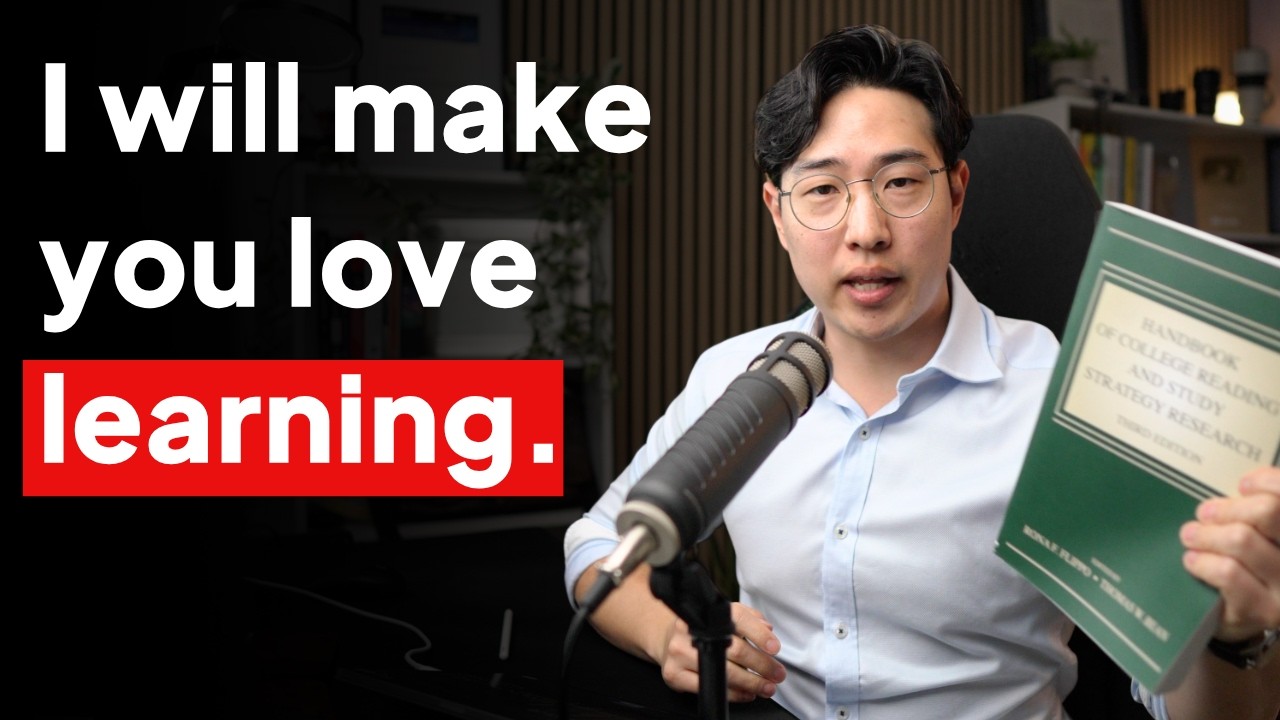
instead? What if it's actually connected like uh you know A and B together create C? Maybe this is the connection. So by actively restructuring and rearranging the new information that we're consuming, it also gives us more chances to be able to connect it to what we already know and therefore making it more relevant. And so if someone says I don't feel like this is relevant for me, my question is well how are you trying to make it relevant? And so two very quick and simple tips that you can try is try to connect it to its purpose or big picture relevance. Why do you need to know this? Why is someone teaching it to you? What is its overall purpose? Secondly, you can try to create analogies. You might be learning something new about medicine uh and a particular type of disease and it might remind you about some principle of how you think about competitive swimming which is a hobby you might have. Those analogies can help you to see the relevance of this new information. And by the way, I'll just mention here that if you are looking for more of these little quick tips and takeaways on how you can increase the relevance of information, how you can make your learning more active and engaging, it would take a very long time to cover everything in this video. So I have other videos talking about those things. Another place that you can try to get that information is in my newsletter. So, I've got a free weekly newsletter where I go through and write out some key insights and perspectives and strategies and quick tips and takeaways that you can use to upgrade your own learning. Uh, it takes about a few minutes to read, get sent to your inbox every single week if you're interested in signing up to that. I'll leave a link in the description below for you to join that. But I'll keep things moving for this video because the next principle is one that makes all of these effective learning strategies just much easier to pull off on a daily basis. And that principle is to learn to stay in flow. Getting into flow state is like the holy grail of all productivity and deep learning. Flow is this word that we use to describe when your brain is entering into its peak cognitive state. It's very focused. It's completely locked in. It's not getting distracted. You're able to do lots of very high quality work very quickly. Time is just flying by. The most productive periods of time that you'll ever have in your life are the periods where you just stay in flow. But the thing is flow is not something you can't just flick a switch and be like cool time for me to enter into flow. Uh there is a series of conditions that need to be met for your brain to be able to enter into flow. This is your brain in flow. Like this activity, this is what your brain looks like in flow. And the reason it's able to have that high level of activity is because it's really focused on a singular task and it's just thinking about this very actively. And so when you do very ineffective passive learning, it's very hard for your brain to enter into flow. So let's take an example. Rereading information is a very bad technique. Okay. So let's say I've got this book that I'm trying to read through. It's the handbook of college reading and study strategy research. Uh, and so I'm reading through this and let's say I've just read through this page and I'm trying to wrap my head around what it's saying. If I'm just reading through this page and then after reading a paragraph, I'm like, hm, okay, I'm going to forget this. Let me read it again and again. That idea of just like reading and rereading is an incredibly passive learning strategy. There's really no place for that type of learning. Like there's no reason you should ever be doing that. And the reason people do that is because the first time they read it, it's not clicking. And so it's basically saying the way that you're trying to process that information is not working. And so rereading it doesn't change anything. You're just doing the same process again. It's the same broken thing that you're doing multiple times. That's not going to result in a different outcome. And so mentally, if we were to break that process down cognitively, what's happening is that we're taking this piece of information that is not very relevant. Your brain is saying, "Hm, there doesn't seem to be any connections here. it's basically not relevant. Let me forget it and bin it. And then you are recognizing, hey, it looks like you forgot it. And you're picking it up and then you're giving it to it again and it's saying, "Yep, it's still not relevant. " And then you're just repeating the cycle over and over again. You can see that's not a very engaging thing. There's nothing for your brain to really focus on. There's no real complex thought process going on there. And so, as a result, your brain is just going to shut down. It's going to slow start daydreaming. Your mind is going to start wandering. you're going to be distracted and all of these things are going to stop you from entering into a state of flow. Now, you contrast that with really engaging learning. So, when we're taking that piece of information and we're saying, "Hey, how does it fit? " And we're actively comparing it and we're looking for different angles that we can try to connect this from. If we can't find that angle, we're trying to compare it with something else. This process is very engaging and as a result, naturally, there's less of these cognitive resources that will start drifting away. more of them will be
Segment 4 (15:00 - 20:00)
locked down into this particular task that you're doing. You're going to get deeper focus and you'll be able to enter into this flow state much more easily. And the difference between the passive learner who's getting bored and the active learner who's in flow is dramatic because not only are you using more effective cognitive learning processes, which means that for the same hour of learning that you do, your retention is going to be double what it was before and your depth of understanding is going to be deeper than you've ever reached. you're also on top of that entering into flow, which means all of those thoughts and those uh back and forth relationships, they're forming faster than you normally would be able to. And because this is actually a more enjoyable process, you're probably more likely to do this more consistently and for longer periods of time. So, you can even work harder than other people more easily. For any learner with a lot to learn and not much time, being able to enter into this flow state using effective learning should be one of your top priorities. And I'll share with you a quick tip that has allowed me to enter into this flow state much more quickly and much more consistently. And that is by creating noise isolation. Sound has this incredibly powerful effect on our brain activity. uh in this brain activity that I've been drawing here, when you actually listen to different types of sounds, sometimes those sounds can actually help to get your brain into this more ideal kind of pattern and break you out of the slower phase. This is a phenomenon called neural entrainment or neural phase locking. And so while you don't need to have those sounds to enter into flow and to get this really active kind of learning, having those sounds and listening to that while also trying to do the same process makes it much easier and faster. So instead of uh sitting there spending like 15 20 minutes trying to enter into that flow of deep work, you can actually enter into it within 2 or 3 minutes. And so by far the best way that I found to be able to do this is by using uh the software called Brain. fm. BrainFM is a sponsor for this video and it's a sponsor that I've actually been really excited to work with because of the fact that I really do love their product and I use it all the time. Their entire business is based on the fact that they have this music which causes this neural phase locking which puts your brain into that more active state. So, I recommend giving it a go. You can use my link which is brain. fm/justins. If you use that link, you get a 30-day free trial which gives you unlimited access to all of their different music. Uh, and when you start, you can select your own neural profile. So, it's basically the level of activity that you're aiming for, and it will recommend sounds suited for that profile. And so, as you use it more, it gets more and more personalized to the types of things you respond better to. I'd recommend getting your study material, blocking out 2, three hours where you're trying to enter into this focus, clearing your desk, creating a good work environment for yourself, turn on brain FM, and then see how it feels. If you don't like it, you can always cancel. Uh, but for anyone who is struggling with flow, entering into focus, especially if you have ADHD, it's definitely worth trying out. Again, brain. fm/just. I'll leave a link to it in the description as well. So, that was about flow. Uh, but the next principle is what to do when you break out of that flow, which is principle number six. Learn when to stay out of flow. A great learner is not someone who studies longer than you. A great learner is the opposite. The great learner is someone who can do really well despite learning for less time. So there are a lot of students that I work with that are very motivated, very driven, and they're studying for like, you know, 10 to, you know, 20 hours every single day. I used to be one of those people. I was studying 20 hours every single day. Extremely sleepd deprived, bad time of my life. And I can genuinely say that I would be able to get the exact same result today by studying probably 3 4 hours a day. And in fact, I would actually say you shouldn't be able to study 10 plus hours a day. And that's because when you do this type of really effective learning, this is really energy consuming. This is mentally very taxing. It's actually really hard to do effective learning for hours and hours in a go. And so what I've seen with some people is that they come from studying 10 20 hours a day. They start learning how to be more effective and they're covering the same amount of stuff in 3 hours that used to take them 10 hours, but because they're so used to studying for longer, they just push themselves to do more hours anyway. And so they have good flow, really great outcome for the first 3 hours. And then afterwards they're finding that learning is not enjoyable. It's very tedious. They're getting bored and they're getting sleepy again. Not because they don't know how to make it enjoyable, but because they're just too tired at that point. And so instead of studying ineffectively for 10 hours, it would be a better idea to study really
Segment 5 (20:00 - 25:00)
effectively for 3 hours, then take a 3hour break and just rest and then do another 2 or 3 hours later in the day if you really feel like it. And so you need to learn to develop this habit of getting into flow, doing really good quality work, but then when you come out of flow, if you feel like you've done great work and you've used a lot of mental effort and your brain is kind of, you know, it's it's hot and you need to give it some time to cool down, give it that time. Take a break, take a rest, go do something else, do some exercise. Learn to prioritize that recovery and that restoration so that you're maximizing the quality of time that you spend, not just the quantity of time. And most of the time when you're maximizing on quantity, you are going to be sacrificing on the quality. And it doesn't change your actual outcome. The only thing that changes is how miserable you feel to achieve that outcome. Remember, you're going to be learning for the rest of your life. You have to learn to love that process, and the people that love that process are the ones that are going to win. Which brings me to the next principle, which is that the best learning strategy is the one that you love. Effective learning doesn't have to look like anything. You can take two people, both excellent learners, but their actual studying and learning method may be completely different. A lot of the students that I work with, their only strategy is just to copy success. They just look at what someone else is doing and they just copy it. But just because it works for one person doesn't mean it's actually going to work for you. Whatever strategy that you use, whether it's teaching or mind mapping or creating analogies, as long as it helps you to feel engaged and connecting with that information, that is the best learning strategy for you. And the thing is that this best learning strategy will also change over time as you and your own processes and your habits and just your preferences evolve over time. And then as your challenges and what you're learning changes over time, the best learning strategy is also going to evolve. So a really detrimental mindset for beginner learners to have is to go out there trying to find like the one best learning strategy where if they learn it, they're sorted for life. That doesn't exist. And people that are thinking that way are really just holding themselves back from making the real changes that they need to make. Because the biggest change most people need to make is to just explore and experiment with different learning strategies. The single best learning strategy is to start understanding how you learn and experimenting with it. Naturally, you will then arrive at something that is deeply personalized, deeply contextual, and works for you really well. And even though I teach all of these different techniques both in my program and on YouTube, these are just ways to stimulate your thought. But I'm giving you examples of what to do so that it gives you more ideas. But at the end of the day, it's up to you to take those and experiment with them. And once you are able to do that and understand how you learn best, that is what gives you true confidence in your learning because you know which levers to push and pull to get different kinds of results. You don't become afraid of challenges. You look forward to those challenges because while everyone else is going to struggle with them, you know exactly how you need to adapt and push through. And that process also is very engaging and very enjoyable. By the way, as a quick reminder, if you are looking for more of these techniques that you want to use to ideulate and do your experimenting, then again that newsletter is where you should start because at the end of each newsletter, I do say like, hey, here's a takeaway that you should experiment with for this week. Or you can just think of the experiments that you want to do for yourself. Either way, the link to the newsletter is in the description. But regardless of how you go about your experiments, you're going to run into the same decision that you need to make. You're trying to make learning less boring. more engaging, and you're understanding more about how your brain works. But sometimes the methods and the strategies you're trying to use feel engaging, feel challenging, but man, they take a lot of time and they are not easy. What do you do? Do you stick with that strategy or do you use a different strategy which is easier for you to do and potentially faster? This is the next principle. Don't confuse enjoyment with easy. I want you to think about something that you really enjoy, something that you're really excited about doing. You're probably not thinking about tying your shoelaces. In fact, there's very few people who would tie their shoelaces and get this deep sense of fulfillment and satisfaction out of that process. And that's because our brain is wired to feel satisfaction after overcoming a challenge. And a challenge by definition is difficult for us. Now, a situation where you might tie your shoes and feel this deep sense of satisfaction is you've just been in a terrible car accident. Your hands have been paralyzed for the last months. You've been focusing on rehab and physio to be able to use your fingers again. And
Segment 6 (25:00 - 30:00)
today is the day that you're finally been being able to tie your shoelaces by yourself. I mean, imagine the level of satisfaction you have with that. And so, overcoming meaningful challenges is part of what makes something engaging and enjoyable. But here's the issue, the problem that I outlined for you before. Let's say that you have a technique that is effective, but on one hand, it is very slow. It takes a long time. This means that it might not be practical for you to use in your actual day-to-day studying. Whereas you have another technique that you can use which is faster and it is easier to do but you also feel like it is less engaging and with the first principles of learning that you know now it also feels like it's less effective overall but you are able to cover more content more quickly. In this scenario it almost feels like it's better to deviate away from the more effective technique and use the one that's a little bit faster because even though it's less effective you're able to cover more material. So overall this should be the better option right? Well no because usually the more effective technique the reason it is slow and it takes more time is because this is not yet a habit for you. And so as you do this technique more and more it becomes a habit and when it becomes a new habit it becomes faster and easier to do. So the thing that you find easier is just based on what you are most used to doing. And especially if you've got this track record where you're spending a lot of time learning and you're not really feeling like you're getting the results that you want. It means the way you are used to doing things is probably not good enough. It needs to be upgraded. So doing the thing that's easier is actually taking you further back to how you were before. And doing the thing that is more difficult is where your improvement is going to be. speed will just come naturally once you get used to that. So if I think about myself in high school in the way that I used to learn or like study at least barely learn anything spending crazy amounts of time trying to study uh trying to enter into medical school my methods back then were extremely passive like that reading rereading thing that I said that there's no situation where you should ever do that. That was like 50% of all my studying. If I wasn't just reading and rereading stuff I was reading it and then writing notes and then rewriting notes which is basically just as bad. And since then, over the last like 15 years, I've rewired all of those habits of learning. And so now I'm able to do that same volume of work and a tenth of the time or less. At this point in my life, it is genuinely much harder for me to study like how I used to because I don't have those habits anymore. It's actually difficult. Like it takes effort for me to be more passive with my learning. And so if you're new to the journey of learning to learn and you look at someone who's an excellent learner that has these habits and these cognitive techniques really dialed in, don't think that they're out of reach. They've just got more reps than you in. They've just had more practice. Like you will get to that point as well. What is difficult for you now will become easier for you eventually. And the final principle that I want to give you is uh one that actually allows you to rewire those habits a little bit more quickly, which is principle number nine. You secretly love tests. I remember in medical school, one of my friends said to me, "I love exams. " Which is shocking to me to hear. Uh he said, "I love exams because if it weren't for exams, I wouldn't learn anything. " And I thought, "There is some truth to that. " And in fact, uh there's been lots of situations where I've entered into an exam and I felt, man, if this wasn't an exam, which I'm kind of stressed about, I feel like this would actually be a kind of enjoyable experience. like being tested on my knowledge and it's like you know this sort of problem-solving gauntlet. It it's kind of fun. And so here's the trick. When you test yourself on your knowledge, it forces your brain to go through this process called knowledge retrieval. That's basically when you are looking at your long-term memory and your brain is then drawing and recalling information from your memory. Now, when you test yourself, it forces your brain to try to recall and use that knowledge in all sorts of different ways. It's complex. It's back and forth. It's very chaotic. And so, it's a very easy way to put yourself into this effective learning mode that we talked about before. Even if you're used to being a really passive learner, when you test yourself in a complex way with a really tough problem to solve, it forces your brain to at least try and think at that level. Now, if you've never thought at that level before, you never learned and studied that topic in that way before, that knowledge is not organized in that way, you're going to try to think at that level and you're not going to be able to solve the problem. You will fail. But that process is enjoyable and it's only stressful if that test matters for something. So the trick is get into the habit of giving yourself tests to force that engagement and learn the patterns and levels of thinking that you
Segment 7 (30:00 - 31:00)
need to try to replicate when you're first learning the information. When you test yourself, it's kind of like saying, "Hey, you need to be able to think about this topic in this kind of way. These types of connections, this type of relationship, you need to be able to do that. " and it makes it easier for you to be able to create that kind of knowledge when you're learning it for the first time. Now, this used to be uh really challenging because you'd have to use a question bank or you know practice papers which are usually limited but now you can just go into your favorite AI program and you can just say hey I'm studying this thing at this level I need you to generate a bunch of test questions for me and so especially if there's a topic that you're really finding it hard to create the relevance for and to connect it and to keep your brain engaged. Sometimes the easier path to take is to say okay let me just test myself. I don't really have a good understanding of the topic yet, but I'm just going to learn through testing, getting things wrong, and learning from that. And then eventually, once you learn more about it, through just repeatedly testing yourself, you might find it easier to create relevance and make it more enjoying even without the testing. So, these are nine of the most important principles about learning that I think can make your learning sessions less boring, but also more effective. And if you like a bit of a big picture understanding about how you should really be going about developing your learning and how you can train yourself with these skills more effectively, you might want to check out this video here where I kind of go through the entire process of becoming a better learner and the steps that you need to take. Especially if you're relatively new on this journey, this is a great video that I'd recommend starting with. But anyway, thanks so much for watching and I'll see you in the next video.