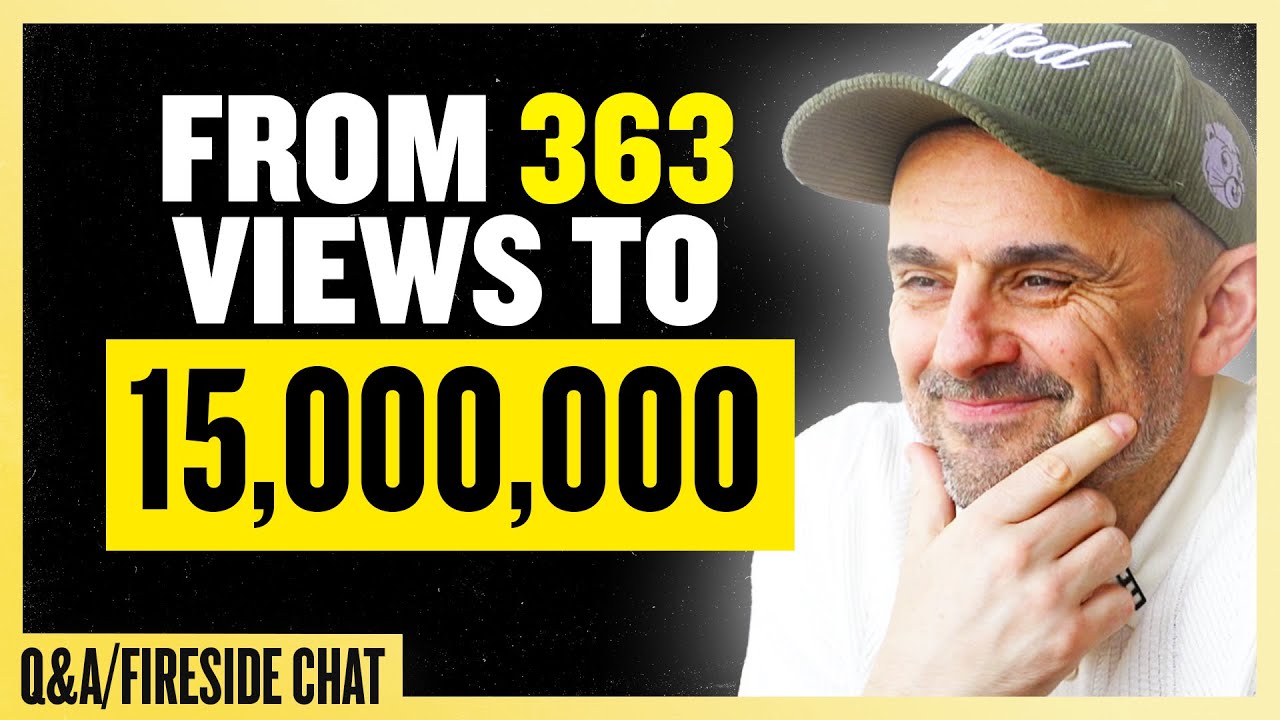
Today's video is a Q&A I did with Sukhmani Mohta, VP of Marketing at Samsung. I talk about what's next in social media, and what I'm most excited about with AI. I tell the story about one of our clients whose views went from 363 to 15 million (and counting) on one post, and share my two cents about how companies can improve their social strategies.
00:00 — Their views went from 363 to 15 million
00:32 — What's next in social media?
03:40 — What are you most excited about with AI?
07:18 — What history teaches us about the advancements of technology
09:40 — How do you think about companies' social strategies?
17:34 — Lessons I've learned from my investment failures
24:45 — Creating scalable, adaptable teams
32:42 — My immigrant roots and its affect on how I do business
#marketing #entrepreneur #business #inspiration #socialmedia
Did you catch my AI & social media playbook for the next 5 years? Check it out here: https://garyvee.com/aspire
—
Thanks for watching!
Join My Discord!: http://www.garyvee.com/discord
Check out another series on my channel:
Gary Vaynerchuk Keynote Speeches: http://www.garyvee.com/keynotespeeches
Gary Vaynerchuk's thoughts on NFTs, Web3, cryptocurrencies and more: http://www.garyvee.com/web3nfts
Life, Business, and Career Advice l Gary Vaynerchuk Original Films: http://www.garyvee.com/gvoriginals
How to Make Money at Garage Sales l TrashTalk: http://www.garyvee.com/trashtalks
Inside the Life of a $300M+ Company's CEO l DailyVee: http://www.garyvee.com/dailyvees
—
Gary Vaynerchuk is a serial entrepreneur and serves as the Chairman of VaynerX, the CEO of VaynerMedia, and the CEO and creator of VeeFriends. Gary is considered one of the leading global minds on what's next in culture, business, and the internet.
Known as "GaryVee," he is described as one of the most forward thinkers in business. He acutely recognizes trends and patterns early to help others understand how shifts in consumer attention impact the realities of the business world today. Gary's approach sits at the intersection of business and pop culture. He keenly understands how to bring brand relevance to the forefront. He is a prolific angel investor with early investments in companies like Facebook, Twitter, Tumblr, Venmo, Snapchat, Coinbase, and Uber.
Gary is an entrepreneur at heart – he builds businesses. Today, he helps Fortune 1000 brands leverage consumer attention through his full-service advertising agency, VaynerMedia, which has offices in New York, Los Angeles, Chicago, Miami, Toronto, Mexico City, London, Amsterdam, Sydney, Singapore, Tokyo, Bangkok, Delhi, and Kuala Lumpur. VaynerMedia is part of the VaynerX holding company, which also includes Eva Nosidam Productions, Gallery Media Group, The Sasha Group, VaynerSpeakers, VaynerCommerce, and Tingley Lane Trading. Gary is the Co-Founder of VaynerSports, VCR Group, VaynerWatt, ArtOfficial, Resy, and Empathy Wines. He guided Resy and Empathy to successful exits -- which he later sold to American Express and Constellation Brands, respectively. He also owns a Major League Pickleball team called the 5s, is part owner of a Big3 basketball team, and is an investor in the revival of the SlamBall League.
In 2021, Gary created VeeFriends, an entertainment company that has become a rising powerhouse in modern entertainment and collectibles. Often described as Pokemon meets Sesame Street, the company leverages stories, games, events, collectibles, and technology to scale its character universe. Vaynerchuk also has negotiated partnerships with brand powerhouses such as Crocs, Fanatics, Macy’s/Toys “R” Us, Mattel’s UNO, Mattel’s Masters of the Universe, Moonbug Entertainment, Reebok, Squishmallows, Topps, and more.
Gary is also the founder and creator of VeeCon – a contemporary super conference that converges business and pop culture with innovation and technology. He is a six-time New York Times bestselling author, with titles including Crush It!, Jab, Jab, Jab, Right Hook, Twelve and a Half and Day Trading Attention. In addition to running multiple businesses, Gary documents his daily life as a CEO through his social media channels, which have more than 45 million followers and garner more than 300 million monthly impressions/views across all platforms. His podcast, "The GaryVee Audio Experience," ranks among the top podcasts globally.
Gary serves on the board of MikMak, Bojangles Restaurants, Global Citizen Forum and Pencils of Promise. He is also a longtime Well Member of charity: water.
Gary's life ambition is to buy the New York Jets.
Оглавление (8 сегментов)
Their views went from 363 to 15 million
I don't know if you guys know what Miraax is, but they're a client of ours right now. They get 363 views on average on their social posts. We have a post this week that got 15 million views in a week. You can see the financial impact. Don't forget that creative can't get views unless people like it or are interested. Marketing is built on relevance, my friends. Relevance leads to consideration. When you consider, then you might buy. For 50 years, we've been trying to figure out if the creative is good. in meetings with me and you, focus groups, animatics, the algorithms have solved this problem for
What's next in social media?
us. What do you see happening? next? Of course, AI. We've been talking about AI all morning and the different tools that are available. We talk about social commerce. What's next? That's like is always when the distribution changes. When the printing press was invented, it changed society. Right now, you had books. And for example, a staggering percentage of the first 10 million books ever made were religious books. And that reinforced the fact that we have a religious society. Then the radio came along. I mean, Winston Churchill's speech over the radio cannot be underestimated on how it potentially changed the world. And that's how the world ran. Whoever was winning on radio had incredible impact. Then the television came along. As recently as the 1960 presidential election, for the people at home that listened to the debate between Nixon and Kennedy, they felt that Nixon won the debate. But the people that watched it on TV felt that JFK won the debate. I don't know if you know this, but JFK is dramatically more handsome than Richard Nixon. And then cable came along and now we're in the internet era and we're in a mature internet where social media whether the people in this audience like it or not or have a political point of view or think it's bad or good, it is the dominant force of our society delivered through a phone. I do not see a world where a phone like you make and your competitors make is the primary device of our society in 20 years. I find it unlikely. Obviously, Facebook has been very aggressive in developing glasses. I would never underestimate Samsung and its competitors on what they're up to in the R& D labs that nobody in this room even knows about because you got to do the retina scan and there's only six people that even know. Well, we just spoke about that. Funny you mentioned that just this morning on something exciting that's coming up. So I believe that the next big change will probably result in when the phone that we carry the way we know it today gets challenged the way that phone did to the television. And just like obviously you have a very big TV business. These things aren't winner take all. They're just a process of where attention goes. So that's on my mind long term. Shortterm I'm infatuated with a lot of things. For example, influencer marketing, if I go very nerdy on marketing, is a very big deal. In fact, that's another thing you guys and gals should be doing more of. But also, while that's growing, AI influencers are growing even faster. Many of you have seen people in your feed that aren't real people already, and we're just getting going. Live social shopping. The QVCification of social media in the West is clearly here. This has been a dominant play in mainland China for a decade. I'm sure it's not lost on anyone who's worked in that market, but we are here now in the US and Europe with whatnot and Tik Tok shop and I'm sure Meta and you and Google are working on that as well. So there's a lot of trends I'm paying attention to. Yeah. Uh and
What are you most excited about with AI?
you mentioned AI. So what are you thinking in terms of when you look at adoption of AI? I know we had a session before as well where we were talking about AI itself and what it's going to do. What are you most excited about or how do you use it today? Well, I use it every day. What I'm most excited about is that the robots are going to kill our children. Um, that should be fascinating to watch. I'm most excited about that when the tractor trailer was invented, almost 80% of the world worked on a farm and everybody was scared because now there's this invention and we don't need people to work on farms. What are all these people going to do? I would argue that the most underrated thing in the world is the human race. We are incredibly good at underestimating our collective selves. I believe AI is about to be here as we can feel it. I think it's going to be dramatically more advanced even as a group like this feels it today. And I believe that it will open up an extraordinary amount of hours for the human to do the next chapter of what she and he does, which is advance our race. And I'm very excited about it. I'm wildly optimistic. I am not naive. Like everything that has ever happened, there will be shortcomings. But I'm not crying for the job reallocation. Nobody cried for all the yellow page salespeople that got blown out by Google. Some poor sap bought 4,000 horses the day Henry Ford's like, I've got an idea. It is what it is. Like again, back to can't cry about what you can't control. We all need to woman and man up. This is innovation. This is technology. Technology is undefeated. So many of my friends and contemporaries are putting their head in the sand with this AI thing. They And you know what people do now? This new phenomenon as the world has become more political. People use politics as a proxy to why they want to be lazy. For the people that wanted to be lazy and do Facebook and Twitter marketing, they just made fun of me and said that's for kids. But when now that Tik Tok came around, the people that want to be lazy, they're like uh China, you know, like AI. I don't believe in AI. You don't need You ask them two questions. I'm like, "How about this and this? " They're like, "What? " I'm like, "You don't not believe in AI. You don't understand AI. You're not taking this to a higher plane. " And more importantly, is anyone here think like this AI thing is just going to stop? Like, what are we doing here? And especially if you're under 30 in this audience, you should be spending every free moment educating yourself on this. This will be your reality. And by the way, and if you're in your mid-4s and 50s and have a good career, you better study it even more because this thing will make you vulnerable. And you've worked hard for 30 years to be in this spot. This is what it is. And the I watched it with my own eyes. I'm now old enough to watch in my own eyes how many people completely disrespected and did not want the internet to happen to their peril. And I ask all of you on a professional level, but even on a personal level for you not to underestimate this is the biggest thing in our world. It is going to change absolutely everything and there will be opportunity and carnage in the professional world cuz that's what always happens when there's big advancements. Yeah, I love that. And I
What history teaches us about the advancements of technology
already see that I've been using my Galaxy Ring and my phone and my monitors and it's already how the interconnectedness of all the technology and how it works, you know, keep me going. I was a really bad student, but for some reason I got really good grades in history and I never understood it until probably about 10 years ago. I'm like, wait a minute. I use history for pattern recognition to see where things are going. We were once cavemen. You know that, right? Yeah. Okay. Well, now we are here today with our technologies and our advancements. Of course, we're going to be robotic in 300 years. So, like what do you think? Time just stops when you happen to be alive. So, yeah, this is all coming. It's coming whether you like it or not. not, but we're still going to be here. Samsung, we invest in R& D and we're being head of All right. Well, we're coming up to time. What's funny about that, if I may, okay, this is an iconic company and but I say this to my clients all the time. I'm like bigger companies than you have gone out of business, right? Like I think that we need to quadruple down on our R& D. I think contemporary marketing. like this is the battleground and it's getting more and more obvious that these two things I mean of course we need every aspect of a business but the R& D and the marketing are incredibly important and I I just I'm fascinated by the missteps of many companies. One of my real admirations for this organization is I've always felt that it was really strong and cared about such um and um kudos to you all. Thank you. We appreciate that. I'm glad you turned that around really well. Uh well, by the way, if you know me at all, I'd be more than happy to not turn that around real well. I like to talk about the truth and it that happens to be the truth. But but like I said earlier, I really want to see you invest a lot more in social organic because you're 80% acts like 120% when you get that machine down because you mitigate the risk of the creative variable which is marketing. Yeah, absolutely. And don't worry, I've given Gary the KPI. He's on it. We will work on that. Well, let's switch gears
How do you think about companies' social strategies?
to social media. Okay. Clearly, you're one of the OG influencers. You have so much content that you build. We have marketers in the room. We all build content. We're all building our personal brand. How do you think about content and building content? I don't think a single person in this room, either if they're building their personal brand on LinkedIn or if they're a marketing executive for Samsung or another company, is spending anywhere close to enough money on social. Why' you say that? Cuz it's underpriced. Because let's use Samsung, such a big company, because I see too much from you in other places and not as much as I would want if I own this company within social. Uh let me give you an example. Who here runs the marketing budget for whatever business you're in? Like you're pretty close to how much you spend on working and non-working dollars. Raise your hands. Just want to see higher. Don't be bashful. That's a good thing. All right. 910. For the 10 people, for example, I believe every business on earth, small business owning one pizza shop all the way up to Samsung, B2B, B TOC, B TOG, running ads and doing creative in LinkedIn. I believe that every company on earth as we sit here today in late March 2025 should be spending 20% of its entire marketing budget on just organic social creative not social media just the content that you post organically as you know cuz you're a marketer that is a staggering number to the way most companies run it right now. What people don't understand in Fortune 5000 land is that when you commit that level of monies to making pictures and videos and written words across the eight platforms right now that have all the attention of society from Tik Tok to LinkedIn and everything in between. The algorithms now work in a way where people in this room who've never posted once on Instagram or Facebook or Tik Tok or Twitter X or YouTube can get many views with no followers. Followers is no longer the primary metric. In fact, I don't even measure my followers or my clients followers at all. I don't even look at reports with followers because people don't even follow anymore because the content is coming to you. In fact, I would argue that we no longer live in social media. We live in interest media where the content's coming to you. Anybody I see all your heads. You all know this. Anybody who's on Instagram, Facebook, or Tik Tok now knows you're getting content coming to especially Tik Tok and Instagram. The content that you're most into right now is coming to you. When you know that and you know how to do that science, what ends up happening is when you start with social organic creative and that level of financial commitment to get that much out again Samsung just let's use one division, the appliance division. The Samsung appliance division I think should be putting out 20 pieces of organic new creative a day. Gary, I love that. That's your new KPI. Let me let me I want to get to the punch line on this because when you see every 18 of those 20 posts get a,000 views cuz that's your norm. When you see the one that gets 18,000 or 400,000. I'll give you an extreme one. I don't know if you guys know what Mirilax is, but they're a client of ours right now. If you know what it is, this won't surprise you. They get 363 views on average on their social posts. We have a post this week that got 15 million views. You can see the impact on its Amazon sales rank. already on the cons in a week. You can see the financial impact when you then know that creative, don't forget that creative can't get views unless people like it or are interested. Marketing is built on relevance, my friends. Relevance leads to consideration. When you consider, then you might buy. For 50 years, we've been trying to figure out if the creative is good. In meetings with me and you, focus groups, animatics, fake reports, the algorithms have solved this problem for us. What happens when you start with that? Now, the 80% of money you have left, now you can amplify that creative. Now you can turn that into a campaign. Working media, the ad dollars, has spent the last 60 years disguising bad creative. It can now amplify great creative. This is the biggest shift in marketing since the advent of the television. That's great. We love it. Well, I want to talk a little bit about content. You create a lot of content and in terms of your personal brand, what you're putting out, especially, you know, LinkedIn, some of the other social media, what's the most meaningful content that you've produced? or that you like producing. Probably the one that's putting pressure on parents to create self-esteem, not fake trophies. I think the content I make that challenges modern parenting around hey instead of overfocusing on straight A's in school which is not a proxy to happiness or success in society you know hey instead of focusing on their popularity or how good they are at sports how about while we've got these little ones for this very small window how about we actually build actual self-esteem which is the only way they will combat all the things that scares the crap out of every parent in this room. That content, especially when it hits and gets 50, 30 million views, when I know that the audience got the message, that's the most fulfilling because that's real life. Your bank account from Uber or not, Uber is not real life. the health and well-being of your family and their general happiness and content. That's real life. And that's disproportionately the content that I'm most passionate about. Well, let's talk about, you know, the investments that you're making. You are a serial entrepreneur. Yes. And so, some of the investments that you've made have been good have been really good. Yes. So, let's talk about some of the positive approaches in terms of how you make some of those investments, what you're looking at. Well, I'm a big fan of when I'm an angel investor to bet on the jockey and the horse. Meaning, at my best, I will like both the entrepreneur, her or him, and her or his idea. At my worst, I am only picking one of those things. Obviously, for especially for the people that really know my career, when you invest in Facebook and Twitter and Snap and Coinbase and like I've had a lot of big wins and they tend to have the same thing, which is I've observed that there's something brewing, but then when I sat down with the leader, it solidified for me. When I invested in Facebook in 2007, I put every dollar I had in my savings account to invest in that company. And that happened three minutes into having dinner with Mark. It was just black and white to me that he understood consumer behavior. And Facebook was far enough along. It wasn't like I was seeing it at the idea phase. So that was easy. Um I wish I had more money back then. Um but yeah, I tend to look for the jockey and the horse. That's great. One of the things I love working about Samsung and we've been talking about R& D, how much we invest in R& D and innovations. One of the things I
Lessons I've learned from my investment failures
also love is that we're not afraid of any kind of failure. We love trying new things, especially within marketing. I love that about my role that we can try new things. So, in terms of failure, there's always so many lessons that you learn that you then are able to deploy and come back stronger, better. If you had to talk on the flip side in terms of some of the failures because you've seen investments like Facebook, but you've also seen investments like Uber for example. Um, Uber hurts. Um, I actually got into Uber fairly early, but I missed the first year and a half, and that cost me somewhere in the ballpark of $400 million. I was investing$25 and $50,000 checks at the time. If you go back to the first book I ever wrote up there, Crush It, it's the first business book I ever wrote. So, it's important, as you can imagine. I literally acknowledge my whole family and one random human being, Travis, the co-founder and CEO of Crush It, because he was in between gigs at the time and he read the book and gave me some good feedback and I thought he contributed. So, I wanted to shout him out. So, if I wrote my normal 25 or $50,000 check, depending on the size of that check today, that would have been worth somewhere between three and $700 million, which, you know, on $25,000 to get $300 to $400 million. That's a pretty good ROI. I missed it and I shouldn't have missed it. What I learned was what I talked about earlier, which is I need to live my truth and eat my own dog food. when Uber came around and I met with Travis and to Travis's credit I passed and he then came back to me at a talk I did in San Francisco met me and asked me again to invest in Uber and I passed again because I was playing defense. I just bought my first apartment, significant apartment in Manhattan. I'd been less liquid than I'd ever been in my life and I played defense and it cost me and I'm very mad at you for bringing it up. Well, where I was going with it, I'm kidding. In fact, I'm sorry to interrupt just to bring value. In fact, it's the best. First of all, in general, the way I live life is like, okay, I would have made that investment clearly with 500 million more dollars in liquid. My life would be different than it's been the last seven years. And I always say to myself, cool, I could have made that investment, but that might have led to me being in different places at different times. And maybe while I was crossing the street in San Francisco at a meeting, I would have been hit by a car and I might be dead right now if I invested in Uber. I mean this I know it's like a giggle giggle, but that's how I think about life. Like the butterfly effect. Like you never know. And so like I don't know. I'm as I sit here today happy everyone in my life is healthy. I'm thrilled I passed on Uber twice and missed out on $500 million because I'm alive. Thank you. Well, I'm glad I brought that up. The single statement that I hate most in society is nice guys finish last. I think it's a very poisonous concept and I believe that kindness is the foundation of my financial success. That's great. And I think people are confused about that. You know, somebody, you know, thank you for those accolades, but I'm empathetic enough to know someone's sitting there right now thinking, you know, I've been kind, but people have walked all over me my whole life. You when if you believe that in this crowd, you have to ask yourself, were you being kind or were you trying to manipulate a situation? A lot of time people a lot of times people give with expectation. True kindness is giving without expectation. When you're giving with expecting something in return, that's closer to manipulation than kindness. How do you see that in terms of a leadership style, right? And especially in a work environment where you're, you know, you need to demand, you need to deliver. Yeah. I mean, you know, right before we did this, I asked you who's in here, CIOS, B2B, partners, sales, marketing, tech. So I was like, "Wow, what a diverse group. " But the one thing I can tell you is for anybody here who has an employee that reports to them that connects all of us in this room. I think a lot about management, you know, I by nature believe in positivity and some of the stuff you're starting to sense from me on stage. On the flip side, I told you earlier, my father navigated management with fear. So I came in my natural self that believes that optimism and hope and kindness is best leadership. And then I watched up close and personal in my formative teenage years somebody who navigated leadership through fear like would come upstairs and curse at employees and be like I'm going to fire you. And I watched it up close and I got to see both contexts. I will I have an agency I have a marketing agency that has about 2,000 people in it. Right now globally it's 15 years old. The company's only 15 years old and we have over a hundred people that have been at the company for over 10 years in the agency business. That is the thing I'm most proud of. The only way I think you can get that is by everyone here in this audience who has an employee underneath them to understand that fear and this is really heavy by show hands. Who's in sales? This is going to really resonate for all of you. Whether it's direct, and I'm sure you've had bosses like that, or whether it's indirect because people are clever. You know, the concept of like if we don't hit the numbers this month, who knows what's going to happen. No, that stuff works to a short term. Fear is an incredibly effective tool for the short term. It is an incredibly vulnerable tool for the long term. And I think parenting, politics, and bosses are very good at deploying fear. And I think for me, it's very obvious that is the wrong path. So I believe accountability. I believe in that. I believe in cander. Something I've actually am great on stage, but have struggled as a manager through my career. But I think we need to I think optimism and hope and joy is a much better weapon. Number two, I will tell everybody for the ones here that feel like they're a good manager or a good leader, the thing I tell all my direct reports and my leadership is I don't need peace time generals. No crap you're nice when all the numbers are coming in. I want to know how you act when it's bad. I think one thing that I would challenge everybody to debate in here is if you want to get to the highest levels, you need to be at your kindest. warmest. You need to be at your best when the [ __ ] is hitting the fan. Thank you.
Creating scalable, adaptable teams
Well, let's stay on leadership. We're talking about leaders. We're talking about style of leadership. We have a number of leaders in here that are working towards and all of us within our organizations are navigating through a lot of changes that are happening. So tariffs, a lot of things that are happening. Yes. How do you think of you know creating highly scalable adaptable uh teams by not crying about things you can't control? Like, and one of the good things about macro changes like a tariff is like, you know, obviously there's some variables to this, but I never cry when we're all in it, you know, it. Mhm. When your competitors have to deal with the same thing. Obviously there's issues where a domestic compet like I understand those variables but for me like for example I my biggest financial booms of my career have been during recessions mainly because I go into double offense in those moments and most people go into defense and so I personally root for economic demise. We have a successful family wine retail store. Yep. and then you join in and make it wildly successful online business. Tell us about that journey. Tell us what that was like. And you worked with your dad who's your boss. Like I have a boss and then already it's tough and then you have the other dynamic. So tell us all about what that was like. I was born in the Soviet Union and that was a tough place to be born. I got very lucky to come to America when I was very young, three, four years old. My father got a job as a stock boy in a liquor store making $2 an hour, which was minimum wage in New Jersey in 1981, and built his American dream by working in that store, eventually becoming the manager, saving money for almost a decade, and then buying his own uh store in Springfield, New Jersey. I was born an entrepreneur. So, by the time I was six, I was three, four lemonade stands running at the same time. By the time I was 12, I was making $1,000 a weekend selling baseball cards in the malls of New Jersey. And then when I turned 14, being the oldest son in an immigrant family, I was dragged into the store, my dad's store. And then he started paying me two bucks an hour. So I went from making a hundred bucks a weekend selling baseball cards to making two bucks an hour bagging ice and stocking shelves for 15 hours a day. It was child labor. Um, it was Soviet energy. My dad was My mom is an angel of sunshine and unicorns and empathy and compassion and joy. She is the hero of my life. She is the foundation of my success. I only sit here because of the way she parented me. It's true. My dad is my man. We're so close. But it was a shock to my system. He was tough. He was not kind to his employees. It took me about 20 years to understand. He grew up in a Soviet environment where everyone stole from the businesses. Unless you're from Cuba or the Soviet Union, it's very hard for you to understand the culture where every citizen is stealing from the government. So he didn't trust anything. He today struggles with it at 72 years old. So it was a shock to the system. But I got very fortunate about a year or two into working in the store. I realized that people collected wine and that was able to connect to my passion around collecting trading cards and memorabilia. And by the time I was 17 years old, I knew everything about wine. Um went head deep. And just like in that video said, in my freshman year of college, I saw the internet and I knew that was going to change the world intuitively, which has been a huge compass in my life. I would argue that intuition is disproportionately the most underestimated and misunderstood attribute in society today. And I think we've spent a lot of time trying to take that out of people. And it's too bad because I can tell you all of the great things that have ever happened to me have been based on that intuition. And that intuition led me to understanding something was about to happen. And you know, I follow my intuition and I follow it up with a lot of work. And in 1997, I launched one of the first e-commerce wine businesses in America. And for context, my father's business was doing $4 million a year topline. It was running on 10% gross profit. So $400,000 before expenses. This was a family business. And in a 5-year window, with no cash infusion, no raising capital, not even having a credit line from the bank cuz my dad didn't believe in it, immigrant stuff. I grew that business from a four to a $65 million business on what is what I do for a living now, which is I day trade attention. I as a marketer, as an operator, as a boss, as a creator, I try to pay attention to where the consumer's attention is versus where we think it is. And I try to become great at storytelling within it. And back then, that was email marketing, having a website, and doing Google Adwords. Today, it's understanding how to do organic, social, creative, AI, influencers, and other things. But that has been the beacon of my career. I love that. I also love what you said about your family and you spoke about your parents, but you've also said that your dad is your true mentor. Yeah. I you know, it's funny. If my dad was sitting here, he's at a point in his life where he would interrupt you and tell you that I'm his mentor and it would make me emotional and it's the biggest compliment I walk on earth for. But the reason I know my father's my mentor is for all my mother's rainbow and sunshines and positivity. She also did a remarkable job in keeping me accountable. One of the great missteps of modern parenting is that we are overcoddling our children. We are not creating consequences. Yeah. And there are people in the crowd who are clapping right now who are still paying for their 24 year old's lifestyle. My parents did not have that problem. But my mom appreciated my gift of gab, my creativity. And that's great to a point. But my mom let me get away with a lot of lying and fibbing cuz she thought it was cute and clever and she knew how to manage me. However, it put me in a place at 14 that all my charisma, all my dynamic capability to communicate, my dad really saved the course of my life because I believe if I had a different father who also didn't see the world he the way he does, which by context, my father thinks a slight embellishment is the great lie of society. He's just like just a hardcore like I remember very early on I was like dad you know we were driving home I'm like dad I sold 86 bottles of what you wanted me to sell. The next day he came home and he was like he looked super scary and he was angry at me and I was like he's like you sold 84. That's who he was. And I will tell you because I did fear my father at that point in my life. Um it scared me straight. And I will tell you that I don't think that I would have been who I am, nor been able to navigate this public life for the last 15 years without that addition of understanding that you've got to keep it real. And I'm very grateful for that because I think a lot of people born with my level of gab um go the wrong way because it's easy because you can get away with it. And I'm very grateful for that. I want to kind of wrap this up. I know you play
My immigrant roots and its affect on how I do business
many roles. You're a serial entrepreneur, you're an investor, you're a marketer, you're an influencer from a you play these different roles. You're a speaker. Is there one that you gravitate towards or who is Gary Vee? Is it all of that? All of it. Just like everybody here. Obviously, I live my life a little bit more publicly, but you know there's like I look in the crowd, you're a mother, you're a sister, you're a daughter, you're an executive, you might be part of a you're part of your church. Like all of us have so many different variables and versions of ourselves. I try not to maximize for money. I try to maximize for the enjoyment of my day-to-day. That has led me to being a lot of things. Many of my most successful billionaire friends like to make fun of me because they're like, "Man, if you, god forbid, ever just focused on one thing, it would be the greatest thing of all time. " I'm like, "That's nice for you. I want to be a Renaissance man. I want to wake up and say, for example, one thing we have not touched on, this is very left field. I'm currently in year four of building what I think is going to be my biggest legacy business, which is Vfriends. V friends was an NFT crypto project that I've now made full multimedia. It is a positive Pokemon. It is my Marvel. It is my Disney. I associate more as I sit on the stage today with Jim Henson and Walt Disney than I do with tech founders or marketers. I just literally flew from Rochester, Minnesota to be here because I've been on an offsite for a week developing the story lines as a for comic books for Patient Panda and Accountable Aunt and Yeah. I mean, and for me, getting the world getting parents and children to fall in love with Accountable Ant through kids books and comics and TV shows and trading cards would be an tremendous accomplishment for me because back to the earlier conversation, my obsession with parenting, I believe the lack of accountability has destroyed our society. We have become remarkable at pointing fingers, but we're bad at pointing thumbs. It's your parents' fault. It's the government's fault. It's your spouse's fault. It's the system's fault. It's the algorithm's fault. My question to all of you in the world is when is it your fault? And so, I have a real strong mission on it. And so, right now, I'm working on that. At the same time that Vayner Media, my marketing agency, is at the tipping point of becoming one of the most significant independent marketing companies in the world. So, all the people around me in that world are like, "No, no, no, like three more years. " And but I'm like, "But that doesn't make me happy. I understand that might and not that I'm not working on that, but I eb and flow. And who am I? It depends on how I wake up tomorrow. I have a sports agency. I have a TV production company. I have a lot of businesses. I own a pickle ball team and I want to win a championship this year. Like I have an obsession to use my gift of communication both on a stage, in book form, and in social to leave a positive impact on a world that's been very good to me. I'm all those things. And most of all, I don't beat myself up when I'm short on any version of myself. My relationship with myself is what makes everything tick. I'm a human. There's not a day that doesn't happen where I'm not making a mistake. Sometimes a big mistake and I if I leave all of the people in this room with anything is you've you need to be kinder to yourself. You if you do not deploy grace to yourself, who's going to do it for you? Everyone here is trying. And I wish you loved yourself more. I love that. Do thank you. Do you know why I wish that? Because everybody else sucks too. Like really though, like please do not put other people on a pedestal, especially if you don't know them. So whatever fantasy you came up with in your mind of how great they are, it's not true. It also means you need to stop judging people. Like envy and jealousy is the fastest way to unhappiness. Stop judging people. You don't know them. Well, on that great note, we're actually going to conclude this session. Just for the record, if my husband watches this later, it's always your fault. But Gary, I just want to thank you for this engaging conversation. It's been an absolute pleasure. Everybody give it up. Gary Vee, thank you. Great.