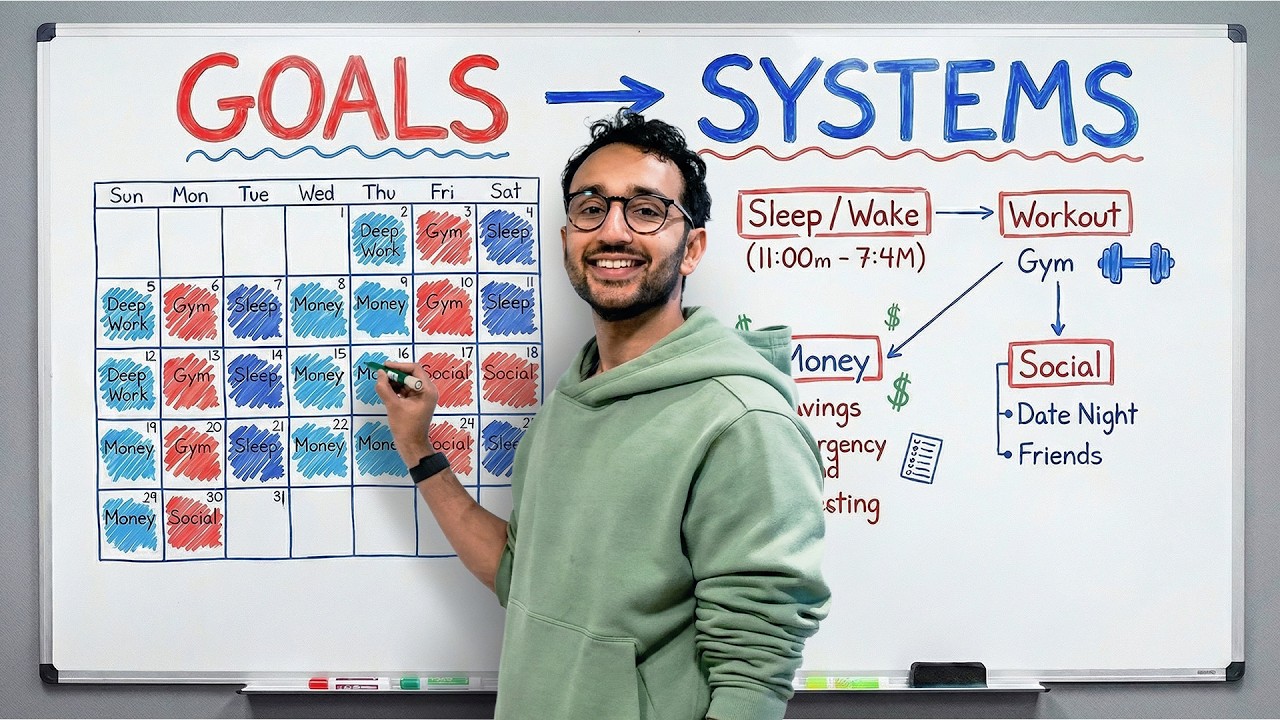
really recommend installing into your life is some kind of time management system. And again, I've made videos about this on the channel. They'll be linked down below if you want to check them out. But when it comes to achieving any goal at all, achieving every goal, as we talked about, is a series of actions. And in order to do those actions, we have to do some work. And there are generally three inputs into work. And that is time, energy, and focus. Assuming you are the one doing the work. If you have a team and you have other team members doing the work, then you have the other metric of money because you're hiring the team and getting them to do the work and stuff. But for the most part, time, energy, and focus are the three fundamental resources that individuals invest in doing work, taking actions to achieve goals, which ultimately, fingers crossed, leads us to success. Whatever that definition of success is for us. And on a very basic level, the most important one of these is time. Time is the primary thing because we only have 168 hours every week to do stuff. 168 hours. Most of us spend like 56 of those sleeping and maybe another 12 of them eating and going to the toilet and stuff. So, what that basically leaves is 100 hours. Nice round number. If you have a job and you have to, I don't know, spend 60, you just, you know, you've literally just got 40 hours left every single week to do all of the things that you want to do. If you imagine that like most people have a screen time of like 6 hours a day, all of those 40 hours suddenly disappear. And so, you realize very quickly, and maybe if you're the sort of person who watches this channel, and if you're at this point in the video, that like there's actually not that many hours in every week to do all of the things that you want to do. Which means that if we want to be able to do the work that helps us take the actions, that helps us get to our goal, that helps us eventually get to success, we want to be good at managing our time. And ideally, instead of having to again make this up as we go along, ideally we have a system that makes it a lot easier for us to manage our time so that we can make time for the important stuff and get rid of the stuff that is less important. But there are three key factors that I think everyone should have. Number one, a good time management system involves time blocking, which is basically where you stick blocks in your calendar for the stuff that is important to you. For example, I have a weekly date night with my wife. That is time blocked. I go to the gym three times a week. I have two filming days a week where I work on YouTube videos. Those are time blocked in the calendar. The more you can intentionally decide how you want to be using your time ahead of time rather than having to make a decision in the moment and then sort of being at the mercy of your mood or your energy levels, the easier it is to reliably do the actions consistently that are going to get you to your goals. That's not to say that you should have no room for spontaneity. You can totally have free time in the calendar as well where you can just do whatever you want. But in general, the people that are most likely to achieve goals are the ones who actually make the time to achieve those goals, perhaps unsurprisingly. Factor number two that every good time management system should have is a method for prioritization. Now, you probably have more things you would like to do compared to the time that you actually have to do them because you're probably an ambitious person and you have lots of goals and you want to live a healthy balanced life. But as you've probably realized, it's actually impossible to do all the things. And so, we need to prioritize what are the few that are the most important. And thirdly, ideally, every good time management system should have some kind of component of reflection where you look at how you've been spending your time, you reflect on it, and then you use that reflection process to adjust your time blocking and prioritization system. For me, I try my best to do a weekly review or reflection. And this is just a series of questions that I ask myself. It takes about 20 minutes and it's a good way of making sure that I'm continually realigning to the goals that I want to achieve and making changes to my schedule if like life happens.
System number three that I think would benefit most people in their life is some kind of health optimization or health operating system. I call mine health OS cuz it's just kind of cute. And what this is a system that you can follow on autopilot that gets you to your health goals. So this involves things like sleep and diet and exercise. Now, before you have some kind of system around your health, you sleep roughly whenever you feel tired and you wake up whenever you want to wake up or with your alarm if you have some kind of like work to go to. Your diet is like you're sort of making it up as you go along. Your exercise, you're sort of doing random stuff whenever you can find the time to do the thing. And this is why most people are on average not particularly healthy. But if you're building a system into your life where you're following a set of processes around your sleep, your diet, your exercise, then you're much more likely to be in a better place. So, what might be the system for optimizing your sleep? Again, we have done videos about it. I'll link them down below, but you know, getting 8 hours a night is generally very helpful. Having the room set to 19° C is generally very helpful. That tends to be the temperature for most people. That optimizes sleep. Defining like when you want bedtime to be, like, hey, I'm going to sleep 10 p. m. to 6:00 a. m. or whatever. Generally helpful. The more you can stick to a consistent bed and wake time, the more your circadian rhythms actually line up and so the less likely you are to be tired or groggy or have low energy throughout the day. Of course, there is the classic tip to view morning sunlight as per Andrew Huberman, which is again helpful for in training our circadian rhythm. You've got things like no phone in the bedroom, getting rid of your phone so that you're not like browsing Tik Tok or Reddit at like 2:00 in the morning, which is another thing that would destroy your sleep. I personally like having a Kindle on my bedside table because then if I'm struggling to go to sleep, I can just read like a spirituality book or something on Kindle and that gets me to sleep pretty quickly. If you want, you can use some kind of sleep tracker. I wear a Whoop. I've got like a I've been using this for the last like 380 days or something. I've got a 380day streak on it and so this gives me a sleep score. And so generally with any kind of system, having some sort of metric that you can look at to see how effective is your system performing and then being able to sort of adjust your system based on the metric is generally quite helpful. It's not absolutely essential, but for most things, having some way to measure the number actually does genuinely help. And all of these is just a series of steps. And sure, most people don't do all of these things absolutely all the time. But having a system, which is sort of a set of defaults that you're going to follow most of the time, is going to be way more likely for you to have healthy sleep. And obviously, we know that sleep is one of those things that like contributes to every other area of our life. When it comes to diet, if for every single meal, you know, three meals a day for like seven days a week, if every single time you had to figure out what you want to do in terms of what you're eating or what you're cooking or what you're buying from the grocery store, a you end up wasting a ton of time in like mental decision fatigue and ordering random takeaways and going to random restaurants and then your calories and macros and all that kind of stuff are off and then you end up being pretty unhealthy. And so what busy people and especially people with kids tend to find is that actually systemizing the household diet is really, really helpful. Like knowing that Tuesdays are like Chinese takeout Tuesdays. Knowing that Thursday is a movie night with the kids and therefore we're going to order pizza. Knowing that like we're going to meal prep on the Sunday and then batch prepare the breakfast for the whole week and batch prepare the lunches so the kids can take them to school or whatever the situation might be. Almost everyone who you consider to be successful probably has some kind of system for their diet and their nutrition. It doesn't have to be fancy. private chef levels, but just having a method that you are following, which means you don't have to think about what the hell am I going to eat for these 21 meals every single week will save you a huge amount of time and also make you way healthier. And then of course having some kind of system that you're following for your exercise. What I do personally is weight training three times per week. I try to do 40 minutes of zone 2 cardio through like casual running about three times a week. I aim to do yoga about one or two times a week for general flexibility and mobility. And of course, I aim to get 10,000 steps per day because there's a good amount of evidence that like the more steps you take, the healthier you're going to be. And so, I have a walking treadmill for my desk some of the time as well. And again, this is a system. The gym sessions are in the calendar. The runs should be more systemized for me cuz they're currently not. I kind of make time for running when I have the time, which is why I'm a lot less consistent with this than I am with the gym where it's actually in the calendar. And so, if you have some kind of system that you're following, some set of default actions that you're taking every week, your health is far more likely to be good compared to someone who does not have that kind of system. And it's like that phrase goes, the healthy man has 99 wishes, the unhealthy man has only one. If you are sick or unhealthy, then that is a massive drain on practically every other area of your life as well. And so you might as well follow some kind of system. Again, if you're not sure, just ask Chad DBT, watch some YouTube tutorials for like, and it doesn't have to be fancy, but it does take a lot of the guesswork and mental decision fatigue out of the process of keeping on top of your health. System
number four that I think everyone would benefit from is some kind of system to keep on top of the relationships that matter to you the most. Now, this is where it can sometimes sound weird being like, "Why would you build a system for relationships? Relationships shouldn't be systemized. " That's just not true. Like, if you ask any like marriage counselor or marriage therapist or read any book about what makes a successful marriage, actually, what a lot of it comes down to is systems. Making sure you have a weekly date night and that it's in the calendar and that both parties know that it happens every Sunday evening, for example. That is an example of a system doing something like regular relationship reviews maybe once a month where you and the spouse or you and your partner sit down and actually reflect on the state of your relationship and if there's any like minor grievances that you haven't had a chance to bring up and you talk about those things. Again, sounds weird but it's incredibly helpful. Me and my wife were seeing a relationship therapist before we got married just cuz I got some advice from a friend saying that like relationship therapists are amazing and he recommended we do relationship reviews. We read a couple of books about how to have a successful marriage that also were bullish on relationship reviews. This is a way of systemizing your relationship so that you do the sensible things without having to think too hard about them. As you become super busy at work, it's generally very helpful to block out holidays in advance. So, a lot of the most successful entrepreneurs I know really take their personal life and their relationships very seriously. And so, at the start of the year before they do any of their business planning, they will block out in the calendar, okay, this is holiday with the spouse, kids, this is we're going to take all of August off for a sbatical. Because if you don't block all of that stuff out in advance, then the work and life commitments will just sort of fill the gaps. And so, you got to be intentional about blocking this stuff out in advance. This is building a system around your relationships. The most social people I know are not just randomly going to social events, especially once they become adults and start having kids and start becoming busy. They start doing standing order social events. One of my friends, Nat, who's very intentional about relationships, he was like living in Austin for a few years. And so, he and his wife set up a weekly meetup at the local lake. anyone was invited. So, they just invited all their friends. They're like, "Hey, we're going to be at this lake 8:00 a. m. every Saturday morning, and then we're going to go for breakfast afterwards. If you can make it, come join us. " And they did this every single week for 4 years. And this was an amazing way for them to maintain relationships and friendships with people that they already knew. And also was a fantastic way to get to know new people because, you know, new people would be, "Oh, you know, my friend Johnny's in town. Like, let's bring him along to this standing order social event, this like 8 a. m. every Saturday lake meetup. " So there's things like that you can do that systemize the stuff that you want to do in your social life as well. This is the value of like a monthly book club or a weekly lads video game night or monthly movie night with your friends and especially when people get busy. Like if you're watching this and you're young and you're like, "Holy I can't believe like why do you have to stick a calendar event for hanging out with your friends? " If you're watching this and you're above the age of 25, you know that you're busy, your friends are busy. Especially if you're watching this and you have kids or your friends have kids, man, it's such a total freaking nightmare trying to schedule people and get them together, which is why having a system around it can really, really help. And I don't know if it's a thing in the rest of the world, but in the UK there's like a real tradition of like sending physical Christmas cards to the people that you know. And so we really suck at this, but like I've got some friends who are really good at sending an annual Christmas card. And it's amazing how such a small thing can actually sustain a friendship for decades and decades because you know you've got this annual touch point where you just send a nice handwritten Christmas card. Maybe there's a photo of the family. Maybe there's a bit of an update about what you're up to. And there is a system around this. The people that remember birthdays, they probably don't have the birthday in your head. They probably have it in their calendar. And the people I know who are the most thoughtful about birthdays not only have your birthday in the calendar, but they'll have a recurring event every year in their to-do list that like 2 weeks before the birthday reminds them that, hey, Ali's birthday is coming up on whatever. And so they'll start thinking about the gift or the card and stuff like 2 weeks in advance. All of these are different examples of systemizing your relationships so that it takes the guesswork out of it. It takes the mental decision fatigue out of it and ultimately it nudges you towards doing the actions that you know are going to make it more likely that you achieve your goal. In this case, it's to maintain a good relationship with your spouse and kids and friends and family and stuff. The final system I want to