How AbbVie accelerates drug discovery with Claude
10:49

How AbbVie accelerates drug discovery with Claude

Anthropic 20.10.2025 6 652 просмотров 146 лайков обн. 18.02.2026
Поделиться Telegram VK Бот
Транскрипт Скачать .md
Анализ с AI
Описание видео
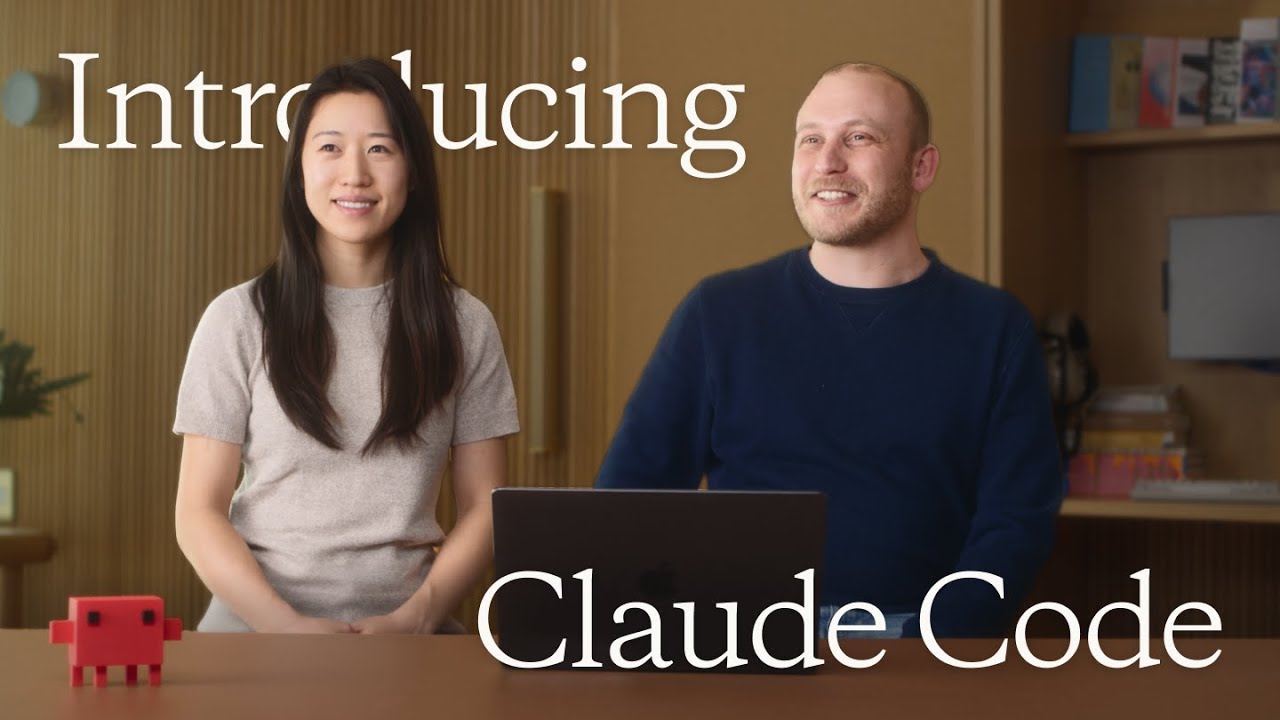
Sarah Nam, VP of AI Strategy and Partnerships at AbbVie, and Anthropic’s Ivy Weng discuss how AbbVie is transforming pharmaceutical research and development with AI. ​​Sarah shares how AbbVie uses Claude for Life Sciences to reimagine drug discovery, from analyzing multimodal biological data to optimizing clinical trials with smarter patient stratification and adaptive protocols. They also explore AbbVie’s approach to bringing AI skills to employees across the entire company. Learn more about what Claude can do for life sciences: https://claude.com/solutions/life-sciences
Оглавление (3 сегментов)

  1. 0:00 Segment 1 (00:00 - 05:00) 829 сл.
  2. 5:00 Segment 2 (05:00 - 10:00) 829 сл.
  3. 10:00 Segment 3 (10:00 - 10:00) 118 сл.
0:00

Segment 1 (00:00 - 05:00)

- There is no other technological shift that has an ability to reimagine every single function within the pharmaceutical industry. And we believe that this is truly a once in a generation opportunity for us to accelerate our progress and our impact for patients. - Hi everyone. I'm Ivy Weng. I'm on the Healthcare & Life Sciences Go-to-Market team here at Anthropic. - Hi everyone. My name is Sarah Nam, and I'm the Vice President of AI Strategy and Partnerships at AbbVie. - Thank you so much for joining us, Sarah. Maybe you could start by telling us a little bit about your role at AbbVie and the remit. - Yes, I'm currently serving in developing a new function called AI Strategy and Partnerships, and the remit of my team is really twofold. The first is to lead our enterprise AI strategy in terms of defining what are our strategic priorities related to AI across our business, as well as many of the cross-cutting enablers that allow us to make that happen from the tech architecture to the data modernization to change management among others. The second hat that I play is around our business development and external innovation at AbbVie. We wanted to stand up an entirely new team that would focus on business development related to AI. And so that's a little bit about the role that I play at AbbVie. - We see AbbVie as a leader in deploying AI in life sciences, and it would be great if you could paint a picture around how AI has been deployed across the biopharma lifecycle. And we're taking a very value chain-based approach to how we do this at AbbVie and really being able to identify what are the core priorities for AI across each function within AbbVie and being able to deploy AI use cases against them. And so I'll walk you through some of the core functions and where we're prioritizing AI. Within drug discovery, we're deeply inspired by the ways in which we can better understand human biology and be able to design, make, test, and validate new therapies at scale much more effectively through AI. We're also focused a lot on multiparametric optimization of human efficacy, safety, and pharmacokinetics when it comes to designing drugs, both in the small molecule and biologic space a lot more effectively. And in addition, we're spending a lot of time around how we do indication expansion in combination studies by really pulling together clinical data, genomic data, and multimodal data of all kinds, to be able to drive that more effectively at scale. And lastly, we're also spending a lot of time around precision medicine, starting first with digital pathology, but really expanding upon the ways in which we could deliver medicines in a much more precise way for our patients. In addition, as we think about clinical development, there is so much that we could do as it relates to how we design and conduct clinical trials. On the design of clinical trials, we're spending time around how we can leverage AI to better inform our inclusion exclusion criteria for trials to how we think about adaptive clinical trial designs and really being able to identify patient subpopulations that are more likely to respond to our drugs for heterogeneous diseases. And then as we think about running the clinical trials, there's also so much that we could do in terms of being able to automate a lot of the processes related to clinical trials, as well as authoring documents that are related to document submission, regulatory requirements among others in that space. And then lastly, there's also a lot that we're doing around data surveillance within the clinical development space, and that we could really be able to leverage AI to look at the types of clinical data that's coming in for our different programs and be able to adjust accordingly. - I mean, what you're describing is exactly the inflection point that we are experiencing where we're moving from acceleration to AI transformation. And it sounds like you're describing this across clinical workflows, commercial workflows, regulatory workflows. Are you able to dive into maybe one or two examples and walk us through that? - A few areas that we've worked together on include, one is around GenAIsys, and GenAIsys is a tool that we've developed that leverages generative AI to really pull forward a lot of the different sales force-related tools that are helping our sales force be much more effective in their call planning. And so this has been a tremendous effort that has allowed our sales reps across AbbVie to be much more effective and efficient in what they do. And early results are showing that there's been very significant improvements in terms of efficiency and effectiveness of our sales force that are enabled by a tool like GenAIsys. In addition, we've partnered on GAIA, which is a clinical development document authoring tool
5:00

Segment 2 (05:00 - 10:00)

whereby we're leveraging large language models to essentially automate the writing and authoring of a lot of our study documents, starting first with NDA and PSUR documents, but really to thousands of different document types. And this has led to roughly 40 to 60% efficiencies in terms of time saving and writing some of these documents across AbbVie. - I think part of what makes Anthropic and the models that we're building so exciting is that we see this as the engine powering all of these different use cases that are applicable to life sciences firms. Something that we think about a lot is, you know, we see coding being adopted and has proliferated, really. And you know, we think that value from coding can be transferred or you know, can be experienced in other industries, too. But I think fundamentally there are some very pragmatic issues or problems when we're working with larger enterprises when there's a lot of change management involved. How do you see that playing out at AbbVie? - It's not only a technology challenge, but it's also really moving people's hearts and minds and also the process management that's needed. And so we have found that focusing on people and processes are equally as important as many of the technology decisions and truly driving an AI transformation at a large enterprise. Some of the ways that we've been focusing on change management in AbbVie include upskilling in terms of doing AI training programs at all levels across the organization from those that are just starting on their journey to learn AI all the way to the more proficient practitioners that are developing the AI solutions on behalf of many of our functions. And in addition, we're focused on demonstrating early wins that by being able to focus on a few use cases that generate near-term ROI, financial returns, impact for our patients that really move the needle on true golden metrics in our business, in each of our functions has been really critical to that change management. And then lastly, it's been really empowering champions within each of our functions that we are standing up small AI teams across each of the functions that serve as true champions that bring forward a lot of the AI transformation in their respective domains. - When your teams are evaluating or looking at new AI technology partners, what are some of the criteria that you use? - Our organization recently developed a detailed diligence framework for how we would evaluate AI-driven partnerships, and there's four key pillars that we focus on. One is really around the strategic fit. How does the actual partnership fit in terms of the strategic objectives of the organization that we have? The second is really around the technical foundation in terms of how differentiated is the AI offering that the partner is providing? What is the actual data generation capabilities, what's the comparative differentiation in the models that they're providing? And really being able to diligence that in a very systematic way. The third pillar that we look at is really around the management team. And so typically, especially with AI-driven drug discovery partnerships, we're looking at ones that truly understand our domain as well as the deep AI and ML experience that we're looking for. And having that kind of bilingualism in terms of the management team is really critical for us. And then the last pillar that we look at is really around external validation. And so looking towards benchmarking real impact in terms of case studies has been really critical for us, primarily around how we evaluate AI-driven drug discovery partners. - I love that framework. If you were to speak with another pharma exec, what would you tell them about, you know, going on their own AI transformation journey? Any advice you have for them? - I think my advice would be to start simple, start to identify a few areas that could serve as quick wins and early demonstrations of impact. And once those are demonstrated in the ROI, in some ways can then self-fund the rest of the AI initiatives, but those early wins will really enable tremendous amount of transformation across the organization. - That really resonates with us. I think something that we think about a lot is the risk of inaction is just too great, and that's not something that I think a lot of companies are willing to take. Given all the innovation in this space, what are you most excited about in the next three to five years around AI and pharma? - I'm very excited about the ways in which AI will push the frontiers of drug discovery in a meaningful way. A few areas that I'm very excited about is one, that generative models can push the frontiers in terms of not only being able to predict molecular properties, but also aid in de novo design of small molecules
10:00

Segment 3 (10:00 - 10:00)

and biologics in a really meaningful way. The second area that I'm very excited about is around being able to develop agentic models that can help us glean and actively reason against multimodal data sets from genomics to proteomics, to transcriptomics, to clinical, to real-world data in a meaningful way, and really be able to integrate those insights to address biological problems that we're working on. And the third is around patient stratification, that this could really help us not only in the discovery of therapeutics, but also in how we design our clinical trials going forward as well. Thank you so much for joining us today. It's been wonderful having you. - Thank you so much, Ivy.

Ещё от Anthropic

Ctrl+V

Экстракт Знаний в Telegram

Транскрипты, идеи, методички — всё самое полезное из лучших YouTube-каналов.

Подписаться