Building more effective AI agents
18:58

Building more effective AI agents

Anthropic 17.10.2025 71 984 просмотров 1 681 лайков обн. 18.02.2026
Поделиться Telegram VK Бот
Транскрипт Скачать .md
Анализ с AI
Описание видео
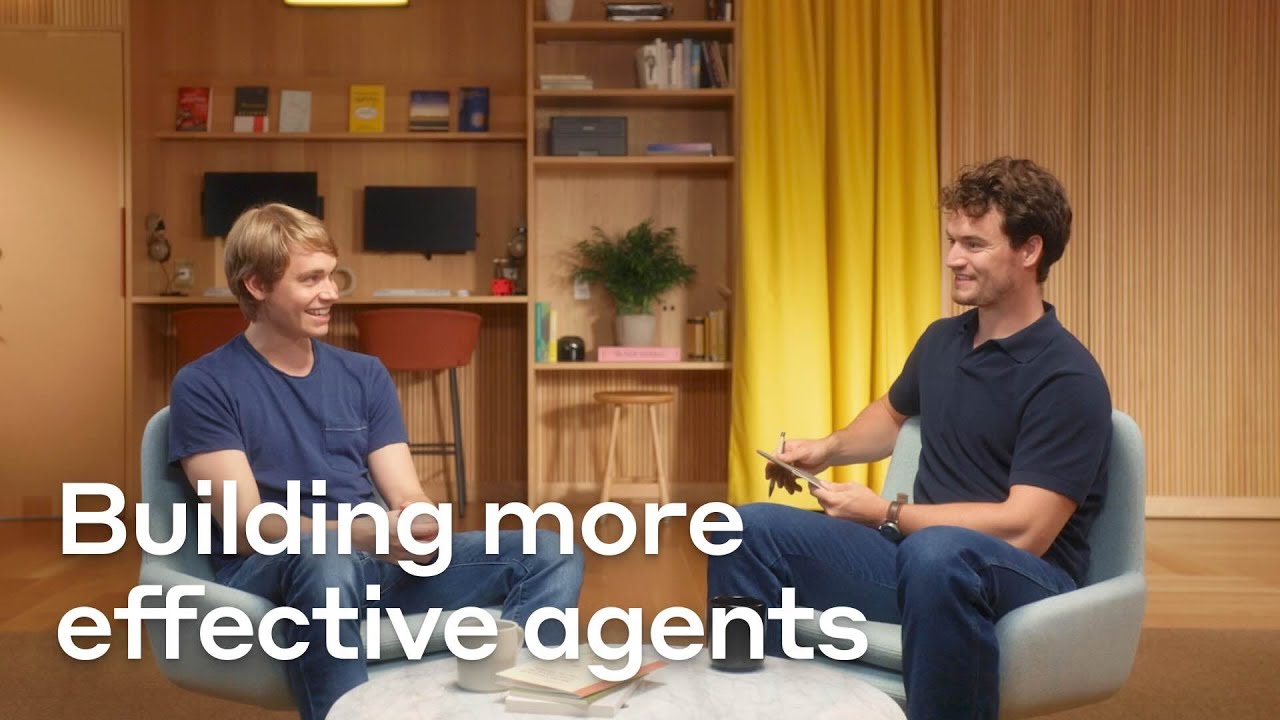
Anthropic’s Alex Albert (Claude Relations) sits down with Erik Schluntz (Multi-Agent Research and co-author of our blog post, Building Effective Agents) for a discussion on the evolution of agents over the past six months, including tips for building multi-agent systems, common multi-agent patterns, and best practices for using skills, MCP servers, and tools. 00:00 - Introductions 00:35 - Training Claude to tackle agentic tasks 1:30 - Making Claude more autonomous with code 3:20 - Using the Claude Agent SDK to build agents 5:00 - Tips for using Agent Skills 6:40 - The evolution of workflows and agents (workflows of agents) 8:30 - The value of simple agent architectures 9:30 - Building multi-agent systems: orchestrators, subagents, and tool calling 11:40 - Training Claude to use subagents 12:25 - Multi-agent use design patterns: parallelization, MapReduce, and test-time compute 13:20 - Coordinating problem solving with tools and subagents 14:15 - Common agent failure modes 15:00 - Best practices for getting started with building agents (context engineering, MCPs, and tools) 17:15 - The future of agents: coding, computer use, and beyond Read the original blog post: https://www.anthropic.com/engineering/building-effective-agents Learn more about Agent Skills: https://www.anthropic.com/engineering/equipping-agents-for-the-real-world-with-agent-skills
Оглавление (14 сегментов)

  1. 0:00 Introductions 108 сл.
  2. 0:35 Training Claude to tackle agentic tasks 180 сл.
  3. 1:30 Making Claude more autonomous with code 393 сл.
  4. 3:20 Using the Claude Agent SDK to build agents 357 сл.
  5. 5:00 Tips for using Agent Skills 362 сл.
  6. 6:40 The evolution of workflows and agents (workflows of agents) 350 сл.
  7. 8:30 The value of simple agent architectures 185 сл.
  8. 9:30 Building multi-agent systems: orchestrators, subagents, and tool calling 433 сл.
  9. 11:40 Training Claude to use subagents 160 сл.
  10. 12:25 Multi-agent use design patterns: parallelization, MapReduce, and test-time compute 188 сл.
  11. 13:20 Coordinating problem solving with tools and subagents 206 сл.
  12. 14:15 Common agent failure modes 147 сл.
  13. 15:00 Best practices for getting started with building agents (context engineering, MCPs, and tools) 447 сл.
  14. 17:15 The future of agents: coding, computer use, and beyond 385 сл.
0:00

Introductions

- I think there's also a lot of interesting things to explore of multi-agent as a form of test time compute. - Basically letting Claude, many Claudes work on a problem can be, you know, get you a better final answer than just one. - Hey, I'm Alex, I lead Claude Relations here at Anthropic. Today we're gonna be talking about building more effective agents and I'm joined by my colleague. - I'm Erik, I work on multi-agent research here at Anthropic. - Erik, to kick us off here, can you just explain why Claude is so good at agent tasks? - Yeah, sure. So during our training
0:35

Training Claude to tackle agentic tasks

we let Claude practice being an agent. We give it open-ended problems for it to work on where it can take many steps and use tools, explore where it is and what it's working on before giving a final answer. And by getting lots of practice at being an agent, Claude becomes really good at this. - Okay, so it's these long running tasks and a variety of domains basically. And through the process of RL and other training mechanisms, Claude is learning an objective of how to do these things with basically limited guidance or feedback. - Exactly, we do lots of RL on coding tasks, on search tasks, lots of things for Claude to practice being an agent in different environments. - There's kind of this conception, I think of Claude models that they're really, really strong in code, but that doesn't always maybe transfer into other domains or that coding is its own separate thing. What are your kind of views on that generally? - So coding has been the first task that we've really focused on
1:30

Making Claude more autonomous with code

but once you have an amazing coding agent, a coding agent can do any other kind of work. - If you need to do search, you can do web search, you know, via APIs, you can plan a weekend by, you know, creating a schedule. So we really see coding as a very fundamental skill for an agent that's gonna have a lot of spillover effect, to be able to make Claude great at all sorts of things and sort of like train on the hardest thing first and then everything else will become easy. - One interesting thing I've seen here recently with a feature that we released in Claude AI on the web was the ability for Claude to create actual files through writing code. So it was like writing a Python script and then the Python script got ran and all of a sudden you have like a Excel sheet that popped out of that. Is that kind of the future direction that we're headed is like Claude's writing scripts and taking actions on computers to create files or do things that are traditionally not code related? - I think that's one of the really effective ways Claude will be able to do these things. Actually, just a few days ago Claude was helping me make some diagrams for a presentation and it was able to create files just by writing out the SVGs, but then I wanted it to make a much more detailed diagram that would need a lot of repetition and so Claude was actually able to do this by writing some code to generate the SVG, which ran much, much faster than Claude itself needing to write you know, it was a very, very repetitive image file with lots and lots of sort of detailed patterns in it. - Yeah. - So, yeah, I think that for a lot of cases writing code to produce some artifact will be much better than just trying to create that artifact directly. So it's one way to do it for harder cases. - Okay, right, yeah. Code allows for kind of this speed up that's not even possible with like a human like clicking and dragging and using their mouse on a computer. Like repeated actions. - Exactly, Claude gets a for loop. - Yeah, if you're a developer
3:20

Using the Claude Agent SDK to build agents

and you're building an agent with Claude, one thing that we've started to see become really popular is this Claude Code SDK. Can you walk me through what that is and how you're seeing developers starting to use that? - Yeah, so we're really excited about developers using the Claude Code SDK. This is something where previously if you wanted to build a coding agent or sort of any agent, you had to really go from nothing but hitting an API endpoint, build the loops yourself, build all the tools, build executing these tools, interacting with files, interacting with MCP. We basically have already built all of that into Claude Code and even though its name is Claude Code, really Claude Code is just a general purpose agent that is most often used for code. Yeah, we are encouraging a lot of developers to use this SDK as the core of their agent loop and that way they don't have to spend a lot of time reinventing the wheel that we've already put a lot of time into polishing and perfecting that core agent loop and instead they can use that and then just add their tools for their own custom business logic or affordances into that via MCP. - Right, so it offers that sort of customizability to where you can remove the coding-specific bits. - Exactly. - And put in whatever sort of prompt or tools that you need, just like slots nicely into the scaffold. - Yeah, I think also the people have been using Claude Code for all sorts of things. I think the, my strangest use of Claude Code is I once had it plan a date for me where I did a bunch of web searches, found interesting activities and restaurants in the area and so not code related at all, but it has all the tools. - How was the date? - It was pretty good. It was great, yeah. - Claude did a good job? - Yeah, Filoli Gardens and then a Chinese restaurant nearby. - Wow, okay. - Claude did a good job. - I'm impressed. - Yeah.
5:00

Tips for using Agent Skills

One other thing on Claude Code that has been another popular feature I've seen a lot of software engineers use lately is Claude MD files. So these are files that you, you know, define within a project and gives Claude relevant information about what your programming style is or like what the layout of the directories are, things like that. We've now launched a similar concept that maybe takes a step further called Skills. Can you explain what Skills are and how we're starting to see developers use them and what they mean for Agents? - Yeah, so Claude Skills are a very exciting extension of Claude MD files where instead of just giving it notes files, you can give it any sort of file. That can be PowerPoint template files, it can be code and like helper scripts that you want it to use. It can be images or assets. And I think this extension of not just instructions but resources for the agent to use is a really, really powerful tool where you might say, not just these in are my instructions for making PowerPoint presentations, but here's, you know, the head shots of all of our company leadership that you might need to reuse in many presentations and just giving it all to Claude in a reusable way. So it has everything it needs right there. - One analogy I've heard used internally that I really, really like is, it's kind of like in "The Matrix" when Neo is learning kung fu for the first time and they like inject him with the Kung Fu information and all of a sudden he is like a Kung Fu master. That feels like very similar to when I give Claude a skill of some type of like, here's how you create spreadsheets. And it's like, oh, all of a sudden Claude's like a banker now and it can create a financial model for me. - That and where they load in all of the racks of equipment and tools and stuff for them to grab. - Yes. - It's like, you know, you can start with these things, not just instructions.
6:40

The evolution of workflows and agents (workflows of agents)

- Yeah, I love that. Switching gears a little bit, so last time we chatted on camera here a few months back and we were talking about Agents and at the time we were in this transition from maybe workflows which are like very defined ways of how you chain together prompts to what was just like a single agent system where you're running a model in a loop. Since then, what's been the evolution in the space? - Yeah, so we've really seen Agents take over from workflows where Claude has gotten so good at responding to feedback and correcting its own work that now Agent loops really dramatically outperform workflows for most things where you care most about absolute quality. Workflows are still great, where you need very low latency and you want Claude to just give a best answer, single shot. Agents are really, really high performance now. I think one of the things that I've seen develop since then is what I call workflows of Agents. Whereas previously an application might have had a workflow that had Claude in single shot write a SQL command in order to load data and then that would go to another step in the workflow where it would then write a chart to display that data. And if the SQL command failed, you know this, it doesn't know that it's not returning any data and then the second step of the workflow-- - Right. - Is kind of screwed. - Completely falls apart. - But now I've seen people where each one of those steps in the workflow is actually a closed loop where instead of just writing a single attempt at a SQL query, it then runs, Claude sees the output and then it can keep iterating and repeat until it knows that it got the right value and then it transitions to the next step in the workflow. - Okay, interesting. So yes, this evolution I guess of like chaining together prompts to now chaining together agents in these loops themself, we'll see where that goes from there.
8:30

The value of simple agent architectures

One other big topic of discussion, I feel like that has taken a lot more chatter as of late is this question around observability and verification. Can you explain what that challenge is and how people are starting to think about it? - Yeah, so observability is very hard for Agents, especially as the systems get more complex and I think that's one of the reasons where I still really believe that even though the models are much more capable today than they were a year ago and they can work better in an agent or even more complex setups, I think that simplicity is still a really important thing and that even though you can build a big workflow of agents, you should still start sort of by from the simplest possible thing and then work up to a more complex solution. And you know, that's first trying single shotting things or trying, you know, single shot prompt to Claude Code SDK, which is now just sort of such a simple, easy thing to use. And then I think only as needed adding layers
9:30

Building multi-agent systems: orchestrators, subagents, and tool calling

and layers of complexity because that's gonna make the absorbability harder. - Another term here maybe in parallel to workflows of agents is multi-agent, is that the same thing or is that something different? - Yeah, so multi-agent is my main area of research now. I'd say it's pretty different from a workflow of agent. - Okay. - Workflows of agents, where sort of an one agent goes, finishes and then it transitions or its output gets sent to the next agent to work on. Multi-agent is where fundamentally you have multiple agents or multiple Claudes working at the same time where maybe one parent agent delegates tasks to five sub-agents that can each then work in parallel. And this is how our deep research search product works is the main orchestrator agent will decide and create several sub-agents. They can do lots of searches in parallel and that's way better for the user because you know, all this happens in parallel and you get the answer back much sooner. We also see things like in Claude Code the model will use a subagent. So if something, if some sub-task is gonna take tens of thousands of tokens, like maybe finding a certain implementation of a class, but the answer really boils down to something very small, it can do that work in a sub-agent to protect the main context from all of that, those tokens that aren't necessary for the main work. So yeah, basically can offload this piece of work and just get back the final answer that it needs. - So are we exposing then this subagent in this case is like a tool that Claude can call upon? - Exactly. - Pass in, it'll pass in the prompt as like a parameter or something? - Exactly, yeah. So to the, to Claude sub-agents look like a tool where it can pass prompts to the sub-agents that will then go and do work. And part of my research is training Claude to be a better manager and know how to-- - Oh interesting. - Give clear instructions to its sub-agents and make sure that they gets the right things and needs out of them. - How is this different than, or is this maybe like a specialized part of tool calling overall or is it different in some ways? - I would say that this uses the framework of tool calling for that communication protocol and it just happens to be a tool that itself is backed by Claude, by another Claude. - Does Claude have like an intuitive understanding
11:40

Training Claude to use subagents

of what a subagent is or do we have to like teach it? Like you're actually talking to another version of yourself, Claude, like don't get freaked out sort of thing? - I would say that Claude makes a lot of the same mistakes that first time managers make of where it will give incomplete or sort of unclear instructions. - Right, right. - To a sub-agent. - Right. - And you know, kind of expect the subagent to have the right context when actually it doesn't. And I think something we've seen during training on sub-agents is that Claude starts to get much more verbose and much more detailed and give its subagent the overall context of what's going on. - Interesting. - So that they can do better work that adds them to the whole, so. I'd say that, you know, it definitely Claude, Claude has a lot to learn and is learning to get better at this.
12:25

Multi-agent use design patterns: parallelization, MapReduce, and test-time compute

- Okay, cool. - Yeah. - What are, what are some of the use cases here? So their search is one in like preserving context, is there other things that people are using multi-agent for right now? - Yeah, I think coding is, there's a lot of subagent use in coding. Anything that can be parallelized or MapReduced. If you have something where you need to produce a lot of output or there's maybe 10 parts of some output you're creating, if you can split that up among 10 sub-agents, that can be really, really effective for saving context and getting faster results. I think there's also a lot of interesting things to explore of multi-agent as a form of test time compute. - Basically letting Claude, many Claudes work on a problem can be, you know, get you a better final answer than just one. Just like with people, you know, a bunch of people putting their heads together can get better results. - In that case, are we specializing these agents in any way? Do we gear them towards like one type of persona or another
13:20

Coordinating problem solving with tools and subagents

or is it just kind of let them take whatever form? - I think you can do either. You know, sometimes it's helpful to give a bunch of people the same exact task and see what the different answers they come up with are. Sometimes it's good to have many people or many agents work from different approaches to the same problem or split it up. One thing I've seen a lot is customers that have a lot of tools, maybe 100 or 200 tools that they want an agent to use, they found that it's really good to split up those tools among sub-agents. So the main agent, all it has to know is hey, I want to use this bucket of tools and then there's a subagent that goes and does the actual work there. So that each subagent just has maybe 20 tools that it needs to understand and know how to use. - Have we tried like scaling agents like all the way up? Like what happens if you have like a thousand versions of Claude all working on one problem? Does it just turn into chaos? - I've not tried that yet. - Okay. - But I'll get back to you.
14:15

Common agent failure modes

- Good research idea right there. What are some of other like failure modes that we're seeing right now with agents or multi-agents? - Yeah, I think just like any sort of complex system, I think it's easy to overbuild something and lose a lot of efficiency and just create sort of a lot of like dead weight. And so I've seen overbuilt multi-agent systems spend too much time just talking back and forth with each other and not actually making progress on the main task, and you know, human agents or human organizations suffer from the stew. As companies get bigger, you have more communication overhead and you know, less and less work is actually, you know, the people on the ground making progress on things. - And so I think that's another interesting thing to study is like how can we make organizations of Claudes
15:00

Best practices for getting started with building agents (context engineering, MCPs, and tools)

very effective while keeping the overhead small? - If I'm a developer and I want to get started with agents, whether I'm building on the Claude Code SDK or just trying to on my own, do you have any tips or best practices that you'd give them? - Yeah, I think the best practices really remain start simple and make sure, you know, you only add complexities you need. I think another really important thing is think from the point of view of your agents. If you are giving Claude tools or prompts or sort of any affordances, put yourself in Claude's shoes and read what it actually gets, what it sees as the model and make sure there's actually enough information there for you to solve the problem. It's very easy to sort of forget, you know, that we're seeing everything and the model only sees what we showed. - Right. - And it's. - Yeah. - Yeah, I feel like it's always important to go back into like the raw transcript of like your tool calls and your logs and everything and just view that. - Exactly, and I think another thing is that as people are building more things like MCPS and trying to connect Claude to more things, I think a very natural first instinct that people have that's very wrong is that an MCP or tools should be one-to-one with your API and I think actually tools for the model or MCPs should be one-to-one with your UI, not your API. Because ultimately the model is a user of these things. It's not, it doesn't work like a traditional program. So if your API might have three separate endpoints for say loading a Slack conversation and turning a user ID into a username and turning a channel ID into a channel name. If those are the tools you give the model to understand Slack, for it to understand anything, it's gonna have to make three tool calls. Versus as a user, you know, we just see everything all nicely rendered. - Oh, that's interesting. - So you wanna create a tool or an MCP for the model that it presents everything all at once with as little interaction as possible. Just like for a user it'll be terrible if every time you had Slack you had to like click on a user ID to see what the name was, et cetera. - Right, I like that. So kind of working back from like the end state almost instead of like just trying to map the technical specs one to one. - Exactly, and sort of surround whatever context you need with it.
17:15

The future of agents: coding, computer use, and beyond

- What do you think the future of Agents has in store for us? Any predictions on these next six to 12 months? - I think Agents are gonna become a lot more pervasive sort of starting in areas that are verifiable like software engineering. You know, coding agents have already changed how I work and how tons of people at Anthropic work and I think there's still a huge amount to be gained there. I think one of the really exciting things is if agents can start getting better at verifying their own work with things like computer use of, they can write a web app, but can they go actually open it up and test it and then find their own bug instead of you needing to do that. I think that's one of the most exciting things. - Yeah. - Is like closing that loop of testing so that I don't have to be Claude's QA engineer. - Right, so kind of combining all these things from the software engineering abilities to the computer use abilities once we put all these pieces together. - Yep, and I think the computer use is also gonna really open up a lot of other avenues and domains where agents have been sort of locked out of so far. - What would be an example of that? - I think that if you want to have Claude sort of do work for you in a Google Doc. - Yeah. - Right now it's, you know, Claude can write for you but you're copy and pasting back and forth. - Right. - But if you have computer use and you say, Hey Claude, can you clean up this Google doc? It can just do it right there for you. Scrolling around, clicking, editing the text and that's just such a nicer experience than needing to copy and paste back and forth. - Yeah. - It's like wherever you are, Claude can be there with you if it has with computer use. - Well I'm very excited to have Claude write my Google Docs and respond to all of my comments for me. - Exactly. - That'd be a very nice future. Erik, this has been great. Thank you so much for the conversation. - Absolutely, thank you.

Ещё от Anthropic

Ctrl+V

Экстракт Знаний в Telegram

Транскрипты, идеи, методички — всё самое полезное из лучших YouTube-каналов.

Подписаться