Diiodoacetylene: Yet Another Unstable Acetylene Derivative
8:05

Diiodoacetylene: Yet Another Unstable Acetylene Derivative

ChemicalForce 20.03.2026 44 508 просмотров 2 343 лайков

Machine-readable: Markdown · JSON API · Site index

Поделиться Telegram VK Бот
Транскрипт Скачать .md
Анализ с AI
Описание видео
In this video, we’ll perform a relatively simple synthesis of an interesting organic compound — diiodoacetylene. I’ll show you several chemical reactions involving this substance, as well as some exclusive photos from my upcoming book __________ 0:00 Intro 0:20 Syntheses 2:31 Recrystallization of Diiodoacetylene 3:18 Reaction with Zinc 3:33 Decomposition 4:00 Decomposition in an inert atmosphere 4:33 Decomposition on the hot surface 4:47 Decomposition on impact 4:58 Frozen acetylene and chlorine vapors 5:10 Solid acetylene and liquid chlorine reaction 5:38 Photos from my upcoming book 5:48 Diiodoacetylene and liquid chlorine reaction 5:58 Decomposition reaction of diiodoacetylene in chlorine vapors 6:55 Question about yellowing of acetone solution 7:42 Outro __________ Support me! 💙 www.patreon.com/c/ChemicalForce
Оглавление (15 сегментов)

Intro

Hey guys, I've got a couple of cool reactions to share with you today. We are going to synthesize diodacetylene, a simple but quite interesting organic substance.

Syntheses

First, we needed to prepare a solution of sodium hypocchloride. To do this, I'll use a classic reaction between potassium permaganate and hydrochloric acid to generate chlorine gas. I'll bubble it directly through a sodium hydroxide solution, which will react with the chlorine to form the sodium hypocchloride we need in this beaker. Next, we need to generate acetylene. For this, I'll be using a classic reaction of calcium carbide with water. I'll add a few pieces of calcium carbide to a two neged flask. I'll fit a dropping funnel with water into the top neck and insert a gas outlet tube into the right neck. Directing the generated acetylene into another flask containing the potassium iodide solution. Next, I'll start cooling the flask containing the potassium iodide and begin adding water to the calcium carbide dropwise to generate the acetylene. As the gas begins to bubble through the potassium iodide solution, I'll start adding the previously prepared sodium hypocchloride solution dropwise. As soon as the two solutions mix, the mixture in the flask turns yellow due to a formation of excess elemental iodine. But in addition to iodine, the hypoiodide ion is also produced in this reaction. The hypodide ion can be considered a source of electrophilic iodine which in alkaline conditions is able to iodinate alkyes. So as we keep adding the sodium hypocchloride solution to the potassium iodide through which we are bubbling acetylene the reaction mixture becomes increasingly basic and over time all the iodine will iinate the acetylene. The solution's color will change from yellow to clear and we'll see the flask fill with a white precipitate. The substance is diodacetylene. So next we need to separate this precipitate. To do this, I'm going to perform the separation using the classic method of vacuum filtration with a per glass filter, which will allow us to collect the precipitate. This type of filtration is much faster and cleaner than using paper. Additionally, vacuum filtration allows the precipitate to dry much more quickly and thoroughly afterwards. And then I'll wash the precipitate of the filter several times with distilled water. After drying, we've obtained this

Recrystallization of Diiodoacetylene

white powder. This is what dried acetylene actually looks like. But we can give this white powder a much more attractive appearance by using cor crystallization. It can be easily dissolved in acetone. Then after the solvent evaporates, we can obtain needle-like crystals of diodacetylene. To demonstrate this quickly and easily, I simply used a heat gun to direct a stream of hot air onto this acetone solution. The solvent evaporates rapidly, leaving behind diodacetylene in the form of fine needle-shaped crystals. The structure becomes especially clear when viewed in ultra macro footage.

Reaction with Zinc

If I dissolve in an acetone and add a bit of zinc powder to the solution, iodine will be released.

Decomposition

When heated, this compound decomposes quite spectacularly into iodine and carbon. Besides the purple iodine vapors and the suit, you can also see a flame forming. That made me curious whether it would

Decomposition in an inert atmosphere

decompose the same way in inert atmosphere. So I carried out the next reaction in an argon atmosphere and the decomposition was exactly the same. This proves that the decomposition of diodacetylene is not combustion involving oxygen but rather internal fully self sustained exothermic decomposition.

Decomposition on the hot surface

And this is how doetylene behaves when poured onto a heated surface. Diodacetylene is also shock sensitive and will explode on impact.

Decomposition on impact

Frozen acetylene is extremely flammable and will ignite on contact with chlorine

Frozen acetylene and chlorine vapors

vapors. Now let's take a look at the reaction

Solid acetylene and liquid chlorine reaction

between solid acetylene and liquid chlorine in slow motion. By the way, for my upcoming book, I've prepared a series of exclusive shots of this experiment. These are unique frames

Photos from my upcoming book

of this and nearly a hundred other reactions that are impossible to catch with a naked eye. Make sure to subscribe to the channel so you don't miss the announcement of the book's release. But

Diiodoacetylene and liquid chlorine reaction

the reaction of liquid chlorine with diodacetylene is not very impressive at all. So, as you might have guessed, I'm going

Decomposition reaction of diiodoacetylene in chlorine vapors

to show you the reaction between diodacetylene and chlorine vapors. To do this, I'll pour liquid chlorine into a flask and then lower the diodacetylene into it using a combustion spoon. in a chlorine atmosphere. Diodacetylene rapidly decomposes and along with a large amount of suit hexacchloroethane is formed as a byproduct.

Question about yellowing of acetone solution

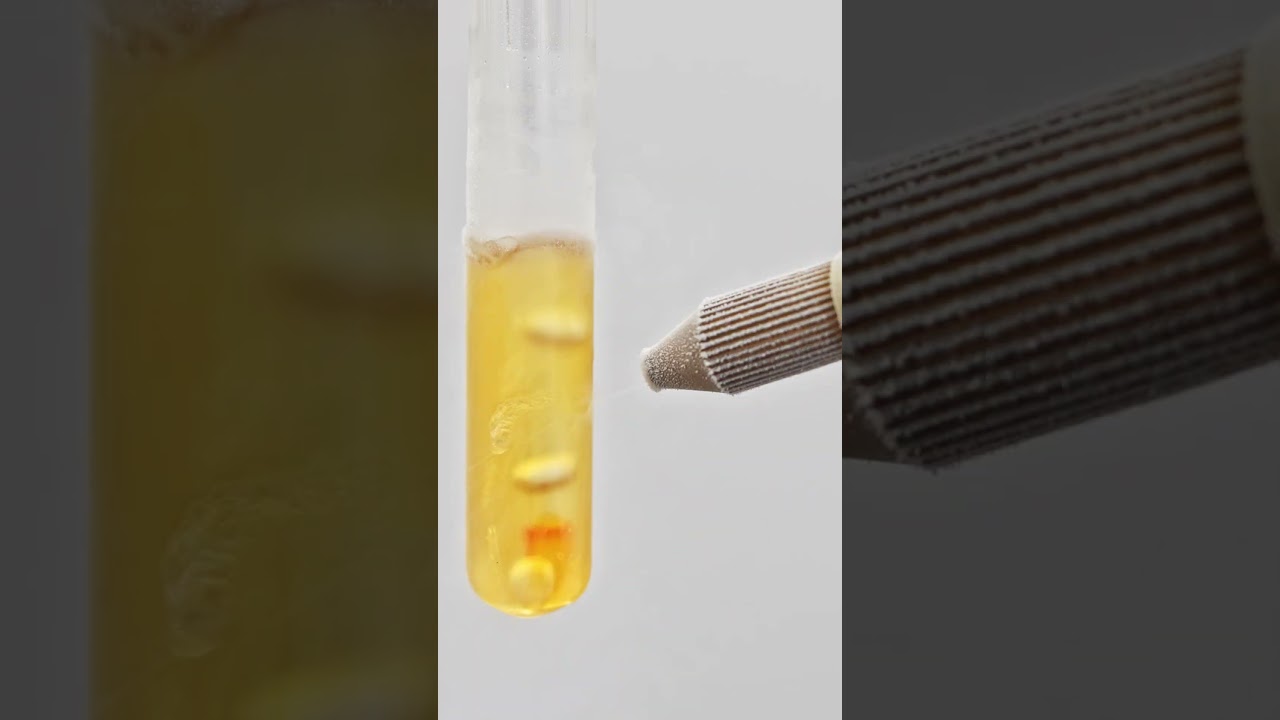
So now I want to show you the next interesting reaction. I've dissolved a small amount of diodacetylene in acetone resulting in a clear solution that remains stable when exposed to air. Next, I'm going to pass chlorine gas into this solution and see what happens. The solution remains clear and stable for now while the gas is bubbling through. But once I stop the flow of chlorine, it quickly begins to turn yellow. However, as soon as I restart the flow of chlorine into the mixture, you can see that the solution quickly becomes perfectly clear again. But the moment I stop the flow, it turns yellow again. Share your thoughts in the comments on why this is happening. And of course

Outro

make sure to subscribe to stay tuned for more experiments. And if you'd like to support my channel, consider supporting me on Patreon. It's thanks to your support that I'm able to keep creating new chemistry content. Thanks for watching. See you in the next video.
Ctrl+V

Экстракт Знаний в Telegram

Экстракты и дистилляты из лучших YouTube-каналов — сразу после публикации.

Подписаться

Дайджест Экстрактов

Лучшие методички за неделю — каждый понедельник