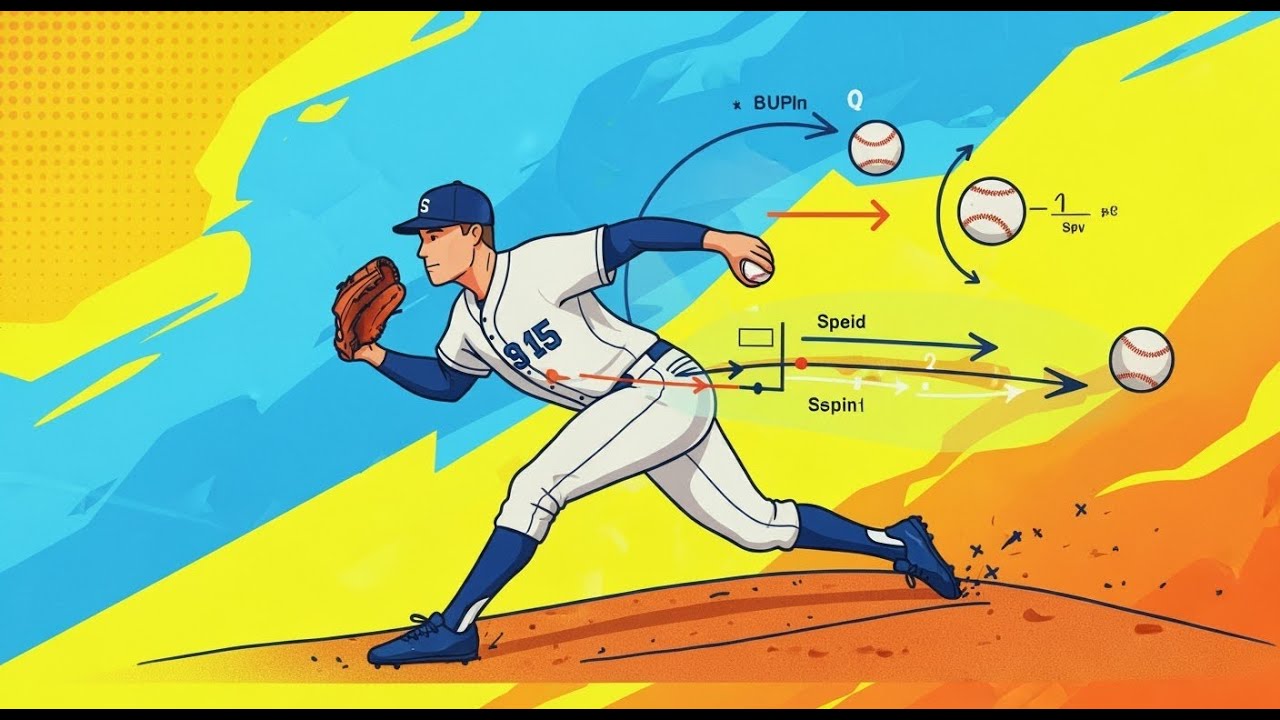
The physics behind a baseball pitch is explored, breaking down the forces and motion involved in throwing a fastball, curveball, and slider. Learn how pitchers use physics to create movement and deception to outsmart batters.
#physics #computationalphysicslab #science
Оглавление (1 сегментов)
Segment 1 (00:00 - 04:00)
Whether you're a baseball fanatic or just curious about the science of sports, you might have wondered, "How do pitchers throw those seemingly magical pitches that defy a batter's expectations? " It's not just about arm strength. There's a lot of physics going on, and understanding it can make the game even more exciting. Fast ball, curveball, slider, change up, knuckle ball. There are several pitches in a pitcher's repertoire. Today, we'll focus on the fundamentals of fastball, curveball, and slider. These pitches showcase the beautiful application of physics and they continue to fascinate both players and fans. Let's start with the force of the fast ball. When a pitcher throws a fast ball, they're generating a significant amount of force to propel the ball toward the plate at high speed. This force is generated by the entire body, including the core and legs, not just the arm. The legs drive forward, rotating the hips and transferring momentum to the upper body. The core, which includes the abdomen and lower back muscles, acts as a stable base for this rotation and helps transfer energy efficiently from the legs to the arms. The pitcher's arm then accelerates the ball, releasing it with considerable speed as it reaches the plate. You can see this in action in slow motion where you can see how the pitcher's body moves forward and the arm comes across in a whip-like motion. Here we've enhanced the footage with graphics to show the ball's speed and trajectory. Notice how the ball is released with high speed and follows a relatively straight path to the plate. This combination of high speed and a straight trajectory makes the fast ball a powerful and challenging pitch for batters. Now, let's unravel the mystery of the curveball is one of the most iconic pitches in baseball. Known for its ability to break late in its trajectory, confounding batters and creating dramatic moments in the game. But have you ever stopped to think about the physics that make this pitch so perplexing? The secret lies in the spin. When the ball spins, it generates a force that pushes against the air on one side and pulls on the other side, creating an aerodynamic force that influences the ball's path. This is why when thrown correctly, the curve ball doesn't just curve, it actually moves laterally towards the pitcher's mound. To execute a curve ball, the pitcher grips the ball on the side with the fingertips, placing the thumb opposite the seams. As they release the ball, they flick the wrist downward, imparting a backspin on the ball. This spin creates the illusion of the ball falling off to the side, making it harder for the batter to track. From the batter's perspective, the curve ball appears to come straight until it suddenly veers off course. And if the batter doesn't react quickly enough, it can result in a swinging strike or a pop-up, giving the fielding team an easy out. Finally, let's talk about the slider. A pitch that's similar to the curve ball, but with its own unique twist. Literally, the slider is a variation of the curve ball that relies on the same spin induced forces to create its movement. However, the grip and the resulting movement differ slightly. To throw a slider, the pitcher will typically grip the ball with the index and middle fingers placed across the seams on the top of the ball. This grip allows for a different spin and movement pattern compared to the curve. When released, the slider moves laterally like the curve ball, but it breaks less dramatically and over a shorter distance. The subtle nature of its movement makes a slider a tricky pitch for batters, often getting them to swing and miss because it looks like a fast ball until the last moment. In summary, pitchers have an arsenal of physics-based pitches at their disposal. Each pitch is designed to look different and to deceive the batter, making it harder for them to hit the ball effectively. The fast ball, curve ball, and slider are some of the most common and fascinating examples of this. The fast ball uses the pitcher's whole body to generate force and momentum. resulting in a speedy delivery that's hard for batters to track. The curveball relies on spin to create a lateral movement that breaks late in its trajectory, confounding batters with its unpredictable path. And the slider, although similar to the curve ball, has a more subtle movement that makes it deceptively difficult to hit. Together, these pitches form part of a pitcher s strategy, and they showcase the beautiful application of physics in the sport of baseball. As technology advances, we're gaining deeper insights into the mechanics of pitching. Pitch tracking systems and biomechanics analysis are helping pitchers and coaches fine-tune their techniques, measure the movement of pitches, and understand how various factors influence a pitcher's effectiveness. The future of pitching might involve even more sophisticated techniques and strategies based on a deeper understanding of the physics involved. Who knows? Maybe we'll see pitchers using advanced techniques that were once thought impossible. Now check out this video over here for more amazing science or click here to see more videos about the science of sports. Don't forget to subscribe to our channel and leave a like for more science in your