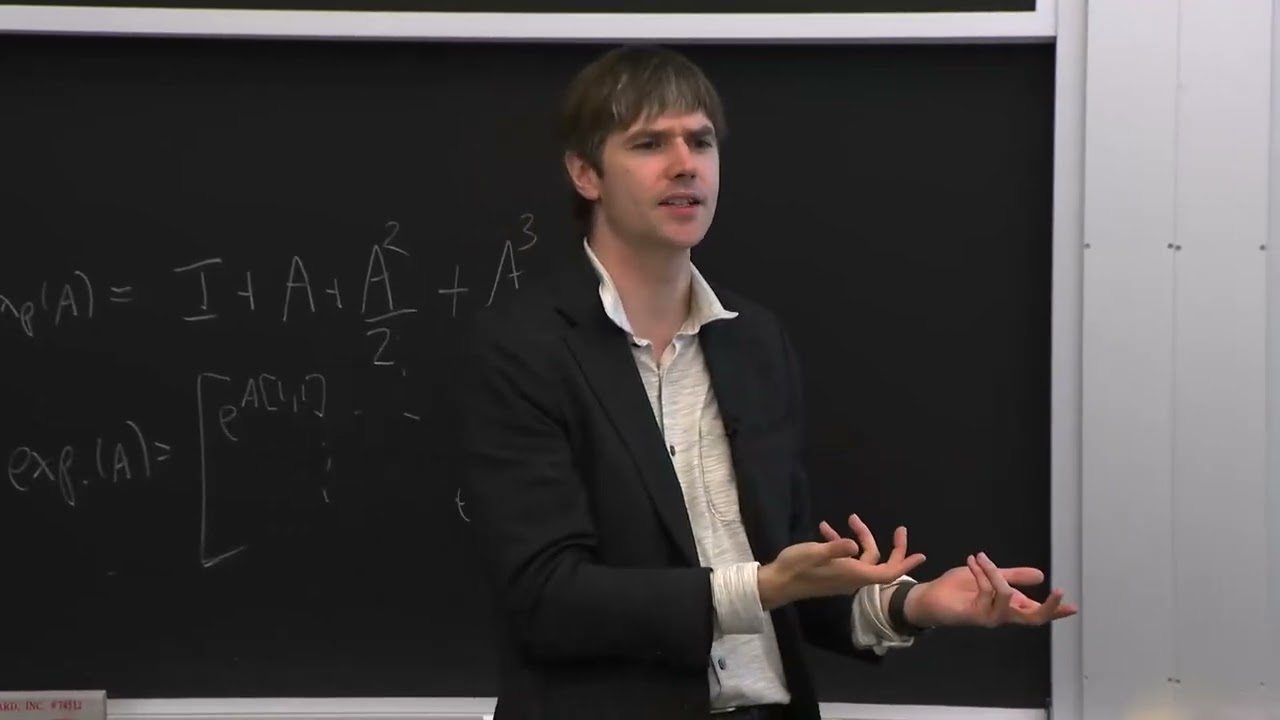
Session 14: Primary Production (2)

Session 14: Primary Production (2)

Machine-readable: Markdown · JSON API · Site index

Поделиться Telegram VK Бот
Транскрипт Скачать .md
Анализ с AI

Оглавление (16 сегментов)

Segment 1 (00:00 - 05:00)

The following content is provided under a Creative Common License. Your support will help MIT Open Courseware continue to offer high-quality educational resources for free. To make a donation or view additional materials from hundreds of MIT courses, visit MIT Open Courseware at ocw. mmit. edu. Um, there were some questions on we had finished up on Thursday. We were talking about spherips critical depth hypothesis and light and I gather from the recitation that there were some questions on that. So I want to go through it a little bit more to give you guys background on that to help you with the exam or with the problem set. And so what the assumptions we're going to make um is that there's some mix layer. So this would be depth. There's some mix layer that's being turbulently mixed and then below that it you know if this was temperature it would drop off like that. Um and that with within that mixed layer you have a phytolanton community and also some uh heterotrophic activity. And the question was, as the mix layer starts to shaw and shallow in the spring, at what point can the phytolanton really bloom? At what point is do they does the light limitation that's been holding them back all winter uh get relieved and you start to see the classic spring bloom that's a very common occurrence, for example, in the North Atlantic. So, there were a couple of of simple equations. If we were going to assume that primary production is going to be proportional to a radiance. So that everywhere within this mix layer there would be some phytolanton and at any instance in time they're going to be seeing an instantaneous light and that the photosynthesis rate at that depth would be some constant of proportionality alpha. this initial slope times an radiance. Now, eventually this would saturate and turn over, but we're going to assume we're on the linear part of the curve. The second assumption that we're going to make is that the radiance at any depth is simply going to be a surface radiance times an exponential function where K is our attenuation coefficient. So K equals attenuation. Now, if you look at this equation, what units does K have to have if it's up in an exponential like that where it's K= or E= minus KZ — one meters — has to have one over meters, right? It length because otherwise there would be a dimension up here and then you can't take the exponential of a dimension. So, K is going to have units of one over meters. We're also going to assume that there's that respiration at any depth is going to be a constant and we'll just call it R0 because it's constant through the mix layer. Is everybody with me so far? Okay. So then we're going to say we want to find the depth the critical depth where and we'll call this ZCR where the integrated respiration just equals the integrated production. And that's going to be the depth where we're going to say when mix layer is greater than critical depth, it's light limited and you get no bloom. And when mix layer is less than that depth, you get a bloom. So if you go ahead and do the math, um the integral on the left hand side is

Segment 2 (05:00 - 10:00)

just r 0 c. Right? We're going to integrate from the surface down to this critical depth. And so that's since r is constant it just turns out to be that um other side is we're going to integrate we'll plug in alpha i 0 e to the minus k z d c dz Z. And if you work this out, you'll get a nonlinear equation where K Z CR 1 - E - K ZCR equals R0 over alpha I0 4 R0 over P 0 where we're just going to set P 0 to find P 0 is equal alpha I0. So if you know your surface of radiance and you know your respiration, [clears throat] you can go ahead and calculate the critical depth. — One more question on that. Um just to clarify the K par that you give. — Yeah. Um, you told me yesterday that surface chlorophyll is what you plug in there. You don't have to plug in different way. — The assumption is that the mix layer is well mixed. Okay? And for most situations, that's a pretty good approximation. If you actually have a turbulent mix layer, the phytolanton concentration can't just can't fight it. It can't grow fast enough. uh the turnover time is fast enough that maintains uh it maintains a homogeneous layer. Okay. So, oops. On we go. Um does everybody have that? Okay. So, what we were going to do today was we did light. Now, we want to look at nutrients is the next one. And typically the way nutrient limitation is formulated is in terms of you'll hear it sometimes called a monod curve. Michaelis Mitten from enzyme kinetics. um it's essentially just a curve that saturates as you get to high nutrients. So if you have some uh uptake of a nutrient plotted against the nutrient, it's going to look something like this. There's going to be a period where it's fairly linear and then it's going to saturate to some maximum value. So, uh, you know, it when you don't have a lot of the nutrient, it's going to slow the uptake down and slow growth down, but if you have the nutrient in abundance, it'll just saturate and they'll be happy and fine and they won't care if you add more nutrient. Um, the typical form of this is that is parameterized as some maximum uptake. So, that would be this Vmax time n / n + k n where kn is a half saturation. And if you think about it, if if n is equal to k, um the denominator is going to have a value of two over one. And so KN really is the value at which the value of N at which uptake is 1/2 Vmax. So this would be KN and this would be 1/2 Vmax.

Segment 3 (10:00 - 15:00)

Now there's lots of nutrients that we worry about. Um so for example the sort of standard macronutrients are nitrogen, phosphorus, uh silicon for datoms. But there's now tremendous interest in various trace metals. So, iron, cobalt, zinc, um perhaps some uh vitamins. A vitamin just being some organic compound that the particular species you're looking at can't manufacture. So, it needs to either get it from heterotrophy or it needs to get it from the environment by taking up some dissolved organic or organic compound. um you need to worry about things like whether for example for nitrogen is it in the form of nitrate ammonia you know it could be in the form of ura some other dissolved organic nitrogen compound um and you're going to have different uptake curves and different behavior depending upon which nutrient you're talking about and in some um and we'll talk about this either today or Thursday um organisms don't use nitrate a organic form that has a the organic nitrogen usually looks a lot more like ammonia in terms of its redux state and there are organisms that are not capable of this of assimilating nitrate and so you need to know not only you know which nutrients are there but whether the organisms you're interested in can actually uh use that particular form of that nutrient. So it's not just enough to know whether there's an inorganic nitrogen but what form it's actually in. And in fact there are in some communities there's inhibition when you have ammonia. Ammonia is much easier to use than nitrate. And if you add ammonia to the system, you'll actually reduce the nitrate uptake because the organisms will switch because they don't have to expend the energy of reducing nitrate. Uh lot of interest now in dissolved organic uh or organic nutrients. So DO also DOP. Um the problem is that those are very heterogeneous pools and you know you have to be very careful that you understand what exactly is being taken up by the organisms. Um you can't just call it a generic DO or a DOP. You would ra really have to start characterizing which compounds within that are being taken up. Typically, we don't think of DIC as being a limiting nutrient. Um but it can be for some organisms in some in some environments and the reason why is that the many organisms can only take up CO2 uh dissolve CO2 gas. Remember most of H2 CO3 star is actually CO2 gas and the ribiscoco enzyme which is the main um uh which is the the main enzyme for CO2 incorporation into the organic matter as part of the photosynthetic pathway uh uses CO2 gas. So if you look if you were to look at a plot of CO2 gas, this is now dissolved in the water. So gas Um versus photosynthesis rate. We're currently somewhere around 10 micro moles per kilogram. That's a that's would be a surface saturation value. Um there are some phytolankton that would have a curve that look like that which would suggest that they are actually sensitive to the DIC concentration or more importantly the CO2 gas concentration. So you'd need to know DIC and alkalinity or DIC and pH

Segment 4 (15:00 - 20:00)

to figure out what the actual partitioning is. Um so for example uh ehox which is a cockalithaphor appears to have a shape like that other organisms and this is — so is this if you're growing something in culture — well yeah the these curves are mostly grown from culture. Okay. So, you can really isolate. — Yes. — Okay. — Yeah. You would do these experiments and culture. Um, but there are many phytolanton that look more like that where they saturate quite quickly at quite low values of CO2 gas. And the EHX curve looks a lot more like the where if you just isolate the enzyme and look at the enzyme activity. So if you're growing so this is you know some plankton and ribiscoco. So in order for these other phytolanton to have this steep saturation curve they have to have some mechanism for concentrating CO2 at the enzyme site. And you'll see this very creative, innovative term called a CCM for a carbon concentrating mechanism. And there are variety of ways you could do this. You know, for example, um having carbonic andhydrates, which is the enzyme that catalyzes the conversion between CO2 gas and H2 CO3, uh the carbonic acid. If you had carbonic andhydrates, as you started to reduce CO2 at the enzyme site, it would catalyze this equation and you could actually draw more carbon out of the inorganic carbon system. Um, another way would be, so this would be our carbonic and hydrates. Um, you can also have active transport where you're actually the cell is expending energy in order to increase the CO2 concentration at the enzyme site. So, there's not actually a tremendous amount known about this right now. It's of some interest because uh, you know, if you were to look into the future, we're going to be somewhere out around you know, we're currently about here. By the end of the century, we're going to be somewhere out here on this curve. If there is a big sens sensitivity to photosynthesis, that's a big deal. But if they're already saturated, yeah, they're already saturated. Who cares? So, there is a lot of interest in this and people are starting to try to look at in different systems to figure out what exactly is going on. Uh the last thing on nutrients is you will often hear of something called Liebig's law or Liebig's law of the minimum. And Liebik was actually an agricultural um I guess agricultural chemist. I don't know. I don't know exactly how to he was dealing with agricultural plants with crops and he was interested in the issue of you know let's say you have multiple limiting nutrients. Um what happens? Well there's a couple of possibilities. One is let's say you have you can say there's some um some function f that as you have this so say a saturation curve um for some nutrient x it can take on a value of somewhere between 0ero to one at zero it would be completely limiting at one it wouldn't be limiting at all so your primary production would be um say it would be f ofx time pax that would be for a single nutrient. Now if you have multiple nutrients it could be that P would be F ofX F of Y F of Z dot dot Pax right so if X was limiting you by 50% and Y Z was limiting you by 50% by the time you're done with that string you know it would

Segment 5 (20:00 - 25:00)

be 0. 5 time. 5 you'd have very low production. What argued was that it actually should be that there's a single limiting nutrient at any time. So you'd look at the limitation due to X, Y, limitation due to Z. You take the one that was the most limiting and that would set the rate. So if you if you don't have enough phosphorus, you know, phosphorus is only there to get you like 20% growth rate of your maximum growth rate. Doesn't matter that nitrogen might be at 30% or silica might be at 40% or it would be set by that single um that single maximum that this has become it's you know it's now called the law. Well, it's an empirical observation and it's a guess that organisms would adapt themselves so that everything else that they would concentrate and be limited only by the thing that was most limiting and that if everything else was a little greater than that, they could survive and and l limp along. Um it doesn't always hold. Sometimes you'll have what's called co-limitation. um particularly if for example a classic co-immitation is um you need this reaction remember that we talked about the nitrogen reduction to ammonia um the reductase the enzyme that does this reduction the enzyme system is ironrich and so you might have a co-imitation where there's an iron limitation on this reductase. And so your rate might depend on both how much nitrate you have there because that's what you're using, but also the iron because the iron is limiting how quickly you can use that nitrate. So there are nutrient coitations. You'll also see nutrient light coitations. Um the min the Liebig's law of the minimum is a good first approximation probably better than the sort of multiplicative approach. This would be the multip multiplicative mult um but it it's not a it's not like the law of gravity. problems with that too. But — yeah, the fifth force — seems to work. — The law of gravity. Yeah. — One never knows. Maybe Congress will repeal it. — They might try. — I don't know. It's an there's an apocryphal story. I don't know if it's actually true, but I read somewhere that the state of Ohio once tried to mandate that the value of pi had to be three because they thought it was too inconvenient for the students that it was a it was an irrational number. But — Ohio, — that might just be one of those. It sounds too good to be true. So, — does sound good. — Okay. Uh the last limitation is temperature. And temperature is an awkward one because people talk about temperature limitation. Um, [snorts] and it depends on what sort of background you come from. If you're a card carrying biologist, we're going to define a parameter called where mu is the uh specific growth rate. And that's simply let's say you're um you're some phytolanton and you were to measure or you're a biologist measuring phytolankton. You don't actually have to be a phytolanton to do this. Um, mu is going to be you're going to look at the growth rate of the of whatever organism you're looking at and then you're going to divide it by the instantaneous biomass that you're keeping track of. So if you're keeping track of moles of carbon in the organism, it would be the rate of change of moles of carbon divided by the moles of carbon in the organism. And so if you look at this the units for mu so this is equal mu have to have

Segment 6 (25:00 - 30:00)

units of one over time. So they're often expressed for phytolankton in days. So like one over day you know one over days because that's about the generation time for phytolankton is you know and bacteria is something like you know half a day to a few days. Um, so that's that's the sort of the common and it's much better than if you just did if you just reported things as DPDT. You know, it would really depend on how rich your um your culture was, how much phytolanton you had there. Um, unfortunately, this is sort of a culture-based view. And the reason why is in the field um we often don't know how much actual biomass there is. So we'll talk about these photosynthesis rates um and you might be able to you might try to normalize it to something but it's often hard to figure out exactly how many viable living phytolanton are there in the field. And so for culture stuff you'll often see it as in the form of mu. Um for a lot of fieldwork you'll just see it as dpdt or um you know just it'll express as just a photosynthesis rate for the temperature. Often what you see for a lot of organisms whether aquatic or terrestrial is that if you plot meu as a function of temperature you'll see some tail where they'll grow pretty low well they'll grow but not well at low temperatures there'll be some optimal temperature band and then it's a very steep falloff if you go above the optimum. So it's asymmetric with respect to the optimal temperature. Um that's great if you're doing individual organisms, but often people are interested in what happens to a community. And the community will actually shift as you move through the seasons. In part because as the temperature warms up, bugs that weren't doing well, bugs, you know, as the temperature shifts and let's say it gets it gets warmer, some of the bugs you've now exceeded their optimal temperature and they die off. Other bugs you're just kind of entering their suboptimal lower temperature range and so they'll start to grow. And so what you'll often see is a curve that looks more like this, which is for a community there's a whole collection of temperatures over which it will grow. Where if you were to sort of plot the upper envelope of that, that upper envelope tends to increase as you get to higher temperatures. So for any particular organism that might not be true, but for the community as you go to warmer and warmer temperatures, growth rates tend to go up. Enzyme reactions go faster. Um is the basic argument that your metabolism can run faster at higher temperatures. Note the presence of warm of warm-blooded endothermic animals in part because their metabolism can run faster. In 72, Epley published an equation that he probably never figured people would use this much. Um, but they do. If you publish a useful approximation, uh, people seem to just flock to it. Where he said that this the upper envelope could be approximated for phytolanton as mu of t in degrees C. Okay, — that's empirical, right? [snorts] — This is purely empirical. Um, and that gives you a pretty useful sense for if you're in cold climates, photosynthesis is going to be low. If you're in warmer climates, it gives a doubling of about every 10° C is approximately a doubling. Yeah, doubling bubbling of growth rate. So what does this all look like if we pull this all together? You know, we sort of talked about

Segment 7 (30:00 - 35:00)

— question from MIT. — What's below 0. 6? Sorry. — Days. Thank you. — Sorry, Virginia, we can't see you. — So, at 0 degrees C, this goes to zero, the um 1. 066. Anything raised to the zero power is one. So, it's 0. 6 days at 0 degrees C. So it would be at 0 goes to 0. 6 one over day for the that's for would be mu. Don't use Kelvin does awful things. So what does this look like? We talked a little bit about um oh well there's sort of what does this look like in terms of seasonal cycles and I think I showed this the other day there's sort of two in members if you were to look at the annual cycle um you know often for the northern hemisphere the mixed layer depth will do something like that, right? So, it's um deeper in the winter, shallower in the summer, deeper in the winter. And you sort of see in some regions like the North Atlantic, you'll see a big bloom of phytolanton in both the spring and the fall. So this would be the this would be your phytolanton. It might be a the proxy for that might be chlorophyll. Um and the nutrients would be might look like that where this is the nutrients. And so the idea is during the winter you have a lot of mixing brings a lot of nutrients up. When the mix layer schoss uh you get a bloom because of the release of light limitation you have lots of nutrients present that draws the nutrients down. You have a period over the summer where you don't have a lot of nutrients. You have a lot of light but not a lot of nutrients. You have some background phytolanton concentration. And then in the winter when you mix down again, you kick up a little bit of nutrients and that tends to drive a fall bloom. So this would be spring and fall. Um, a lot of this is based off of measurements that were made by the Scandinavians uh in the early part of the last century. That was where a lot of biological oceanography really got its start. Um, so that was considered canonical or normal. Uh there are other places that have uh a fairly different seasonality. And oh in this plot the primary production follows phytolankton. So I won't draw it on draw it on there because I'll just confuse an already complicated drawing. But for example, so this would be the North Atlantic. Uh but if you go to parts of the North Pacific, you see a very different pattern there. The nutrients never get drawn all the way down. So there's a there is a seasonality to the nutrients, but they're never reduced all the way down to zero. You see chlorophyll that looks pretty flat through the year. Um but primary production shows a big seasonality. So this would be primary production. And in here something needs to be controlling the chlorophyll or the phytolanton biomass such that even as

Segment 8 (35:00 - 40:00)

the primary production increases sharply uh the biomass doesn't build up. So this is a region where you really have your focused on the you're focused on growth, right? you have these big events where you supply enough nutrients and enough light and off they grow and you're mostly focused on the growth term and it's only after the bloom that you worry about the loss terms. So this is you might call it unbalanced where there's a decoupling between growth and loss. the North Pacific uh the sort of opposite extreme and these are of course obviously caricatures of the real system is more like a steady state where you have growth being balanced by loss. So the biomass isn't changing significantly but the growth term is and so there has to be a corresponding control on loss — one more time like what's causing the peak of phytolank in there. Okay, so let's say your biomass is constant all year and your nutrients, they go down, but they're always saturating. You're always up on that saturating curve. What are a couple of things that could give you seasonality in primary production? We just went through things that control primary production. What could generate seasonality where you get a peak in primary production in the summer? — Light and temperature, right? So, if you had constant biomass and you didn't have seasonality and nutrient limitation, this is what you would expect. You'd expect primary production to go up in the summer because you have more light. And you'd expect primary production to be higher, photosynthesis rates to be higher because you have warmer temperatures. — That makes PP is primary production and not phytolanton. Yeah, sorry. Primary production. — And so why does chlorophyll stay constant? — Chlorophyll case stays constant because somebody has to be eating all the growth. I call this, and this tells you how much I like yard work. This is the suburban lawn hypothesis. That's not actually called any place outside of this class. But to me, this is a classic example of the suburban lawn, which is um during the summer, I have to mow the lawn like twice a week because the lawn's growing like crazy. Um but I maintain as I maintain no change in biomass by going out there every couple of days and mowing it back down flat. Um, so this is a time, this is a system where you have balanced growth, which is the more canonical term, but just doesn't isn't as evocative. Um, so you have balanced growth where the loss terms have to be balancing the growth terms uh fairly closely and maintaining no net change in uh the biomass. the primary production is just like total carbon fixed here. — Yep. Primary production would be total photosynthe Well, yeah, usually it's that net primary production. We're going to talk about techniques in a minute, but it's the total amount of net carbon going into the autootroes going um go going into the photosynthesizers, the phytolanton. — So, when you see a biomass in like primary consumers that — the assumption and I call it an assumption because there's not nearly as much data on the z plankton typically as there are on the phytolanin. The reason is there's a very easy assay for phytolankton which is chlorophyll. It's not the best assay but you know it's that the drunk looking under the lamp post for his keys. We measure phytolanin chlorophyll because it's straightforward and easy. Um if you were to look at z plankton, you would assume that your zop plankton biomass would probably more closely track primary production in the system because there's got to be a much bigger pool of zoplankton in order to keep up with the primary production.

Segment 9 (40:00 - 45:00)

Does that make sense to you guys up there? Yes. No. — Yes. — Okay. Um and we'll get back to later in the course why these two systems are different. Um but the main thought is that one of the things that's different about these is that you have probably more iron limitation in this balanced growth. And the iron limitation basically knocks all of the phytolanton down a little bit. So they can't grow you can't grow as fast. So the z plankton have an easier time of grazing you and keeping you in check. And the bigger phytolanton that tend to bloom, the bloom forming species that are harder for the zop plankton to keep track of um are really limited in this system and really can't grow nearly as fast. And so um that iron limitation is kind of a the approximate cause for this control is grazing but the distal underlying cause is iron limitation on the phytolankton that changes both the primary production rates and the community structure. So, who's there? The taxonomy of who's growing. Okay. Um, we also might want to look at vertical structure. Um remember if we look in depth we tend to have light dropping off as an exponential. So this would be light. Um nutrients often look like this. So you have more nutrients at depth than you do at the surface. And you'll you'll commonly see particularly in the subtropical gy. It's hard to do without color, but color doesn't show up very well on the monitors. um you'll see what's called the deep and the deep chlorophyll maximum can have two causes. It can be caused by actual cell abundance. So it could actually be a real maximum in biomass or cell abundance. And the argument there is well up at the surface I don't have enough nutrients to grow or they the phytolanin grow. There's plenty of light but just no nutrients. Deep in the water column I have nutrients but no light. And the deep chlorophyll maximum which is often somewhere about the euphotic depth. So, you know, commonly around the 1% light level is kind of a happy medium where I might have some nutrients there and some light and I have I need both to grow. And so the deep chlorophyll maximum can be a cell abundance maximum because of the basically living on the interface where you get both light and nutrients. It can also be a um an apparent maximum because cellular chlorophyll to carbon ratios vary through um a process called photoaclamation. Photo acclimation is if you take an individual cell and you if if they are light starved if they don't have enough light they will increase their chlorophyll faster than carbon or you know other components of their cell mechanism because if you're light limited what you need is light and so you devote the you know think about it from an energy point of view you're going to devote energy to manufacturing the chlorophyll in order to boost that up. Uh it can also occur through photo adaptation and these terms are get bandied about a little bit too loosely. Um, it's photo

Segment 10 (45:00 - 50:00)

adaptation I think of as there are some species that are better adapted for low light environments and they tend to grow um in the deep chlorophyll maximum and they have inherent to them higher chlorophyll to carbon ratios because they're adapted to low light. So this is a phys photo acclimation is a physiological response to an individual cell or cell culture. Photo adaptation probably technically is best thought of as a cell succession as a species succession over longer time periods where one species can replace another because it's better acclimated to that niche. Can any phytolankton acclimate to — most phytolankton can show some acclamation? Um, but you know there's some there's a real question about how plastic cells are. So in addition to selling my this book which unfortunately I don't get any money from um I did bring down Um, and just focus on the middle graph or the middle line. Let's do one at a time then. How's that? Is that good? — Good. Yeah. — Okay. Um this is panel is showing the summertime um primary production estimated from space. And the way this is done is you look at the amount of uh you look at visible radiation. You look at the different colors of the radiation. Remember chlorophyll absorbs in what? Chlorophyll is green. So what does it absorb? — It absorbs blue and red leaving green. If you look at the light that's back scattered out of the water some fraction of the sunlight comes down enters the ocean uh some of it gets absorbed by chlorophyll and by phytolanton but some of it of that of the remaining light actually gets back scattered out leaves the ocean surface and you can measure it from a satellite and if you look at the strength of the light in the different wavelength bands in the visible you can actually say well that water looks more green, then it looks blue. Therefore, it has more chlorophyll in it. It's a little more complicated than that, but not that much. And it's very empirical because we don't have excellent models for this. Um, using that, you can come up with the amount of chlorophyll that's there. You can then make assumptions about light limitation and nutrients and temperature, and you can come up with an estimate of primary production. So, this is a seasonal primary production. It's in a on a log scale. uh which I sort of cut off for um for this purposes but maybe we can scan this figure in um and get it in into the notes. Um so there's a almost a factor of a 100 range between the purples which are very low productivity and the reds which are very high productivity. And so what you see is that the to first order primary production maps to regions of upwelling, right? In regions where you're bringing nutrients up to the surface, you have a lot of phytolanton and photosynthesis. So you see maximums maxima along the equator uh in both the Pacific and the Atlantic maxima in the Arabian Sea because of monsunal upwelling. This is the summer. This is the summer season along the Benua and North African coast due to coastal upwelling along Peru because of coastal upwelling and then in the high latitude North Atlantic and North Pacific associated with nutrients that have been brought up by subpolar upwelling and also deep convective mixing in the winter. So you have deep convective mixing during the winter brings nutrients up to the surface. In the summer, the water stratifies and you get a big bloom. If I slide this over without knocking my water off the table. Um, this is the winter season. Um, and what you see is similarly at high latitudes in the winter in the northern hemisphere almost no production because it's very light limited. uh you still see the equatorial bands, the coastal bands and now you see

Segment 11 (50:00 - 55:00)

this band of higher productivity in the southern ocean which is another region of fairly deep mixing where you bring nutrients up from below. Um what's intriguing in the southern ocean is that you do see possible hints depending on which set of data you look at of that the productivity is higher sort of downwind or downstream of land masses. uh and some geo ge subsurface geological features and some of some people are arguing that those patterns are actually controlled by iron. This is a region where there's documented iron limitation. Iron has a fairly high scavenging rates. There's not a lot of iron in the surface layer and so where you have atmospheric deposition of dust. So, for example, off of Patagonia um or downstream of the uh plateau that New Zealand sits on because of iron coming off the sediments, you might have elevated productivity. But those are the general those are basically the general patterns or story of primary production which is a seasonality associated with mixing and temperature and light and then also broad geographic distribution controlled by convective mixing and upwelling of nutrients. I think I have a seaw. — Yeah, there I mean if you just go and you the best satellite out there is sea whiffs. — Oops. Um, and if you just Google sewiffs, you'll start you'll get more images than you want to. Yeah, as long as the instructor doesn't develop Tourette's, we're okay. So, I've been talking about photosynthesis and not really telling you how we measure it. — That really confused you in my comment. — Oh, I'm sorry. There was somebody walking by the window of the classroom making sort of random irrational — I think he was calling Yeah. Kristen thinks he was calling his dog. But — sorry, it's not that I forget you guys are up there, but sometimes the jokes just don't translate through the video link. Um, so we've been talking about photosynthesis, but we haven't really talked photosynthesis and primary production, but we haven't talked about how we measure it. And you know, we're not, this is not a methods class, but what we're going to find in the next couple lectures is that we're going to start defining particular processes and they're somewhat operationally defined. And so you really need to have some understanding of how they're measured. so that you can understand how they're interconnected because you know there are classic things that sound like they should be giving you the same results that they're measuring you know that the the same broad parts of the elephant you know um picture s is a group of blind people walking around an elephant trying to figure out what it is you think you're all measuring the tail but you're measuring it in different ways and then you get inconsistent results and the reason is because you're measure the way you're measuring them is measuring is truly actually measuring different aspects of the system. And so we're going to go through some description of primary production to give you some broad ideas on that. Um there's a few um main ways. One would be if you remember photosynthesis, oops, writing it the wrong way. CO2 plus water goes to carbohydrate plus oxygen. Right? That was the basic equation. So there's a couple ways we could attack this. We could measure the formation of the carbohydrate. loss of CO2. or we could measure the production of oxygen. We're not going to deal with water because it's an aquatic system and it would be way too hard to track the water loss. Um or we could look at light absorption utilization, right? because there actually is a light term in the forward

Segment 12 (55:00 - 60:00)

[snorts] reaction. The sort of initial work was done by Gran starting around the end of the first world war. Um and they were doing incubations of the change in oxygen over time in light and dark bottles. So these would be incubations that were done um in a laboratory. You would put you would inoculate a certain amount of phytolanton. You would then close up the bottle. Well, you would inoculate the phytolankton. Um, measure the amount of oxygen that's there at the beginning time, close the bottle up, either put them in the dark or light, and then measure how much is there um, you know, a day later, for example. And the limitations on this of course are that you need to have a big enough signal so that you can actually measure a draw down of oxygen. So this was pretty good for coastal systems, not so good for open ocean systems because you just didn't have a good enough um a strong enough signal because there just wasn't enough phytolanton there. Also um this was around the time of the introduction of uh or the use of the Winkler O2 titration. So there were fairly good ways good precise ways of measuring changes in oxygen with the Winkler titration. And let's see, Neielson in 1952 introduced the C14 carbon fixation approach. So this is you take and add radial lababeled CO2 to your system. that gets formed into radial lababeled organic matter and you measure how much radio label ends up on particulate organic carbon. So the idea here is you spike something with radial lababeled C14 inorganic. After some period of time, you grow them again in dark and light. So you can look at the the dark as your control to see if there are any effects um due to absorption or problems like that. Um, and then you would then filter the sample and then put it in a centilation counter and count how much radioactivity is on your particles. And you'd have to be very careful to make sure you got rid of all the seawater that's on your filter. So you might actually acidify your filter to drive off any radial label that's ends up in your inorganic carbon pool. Um other than the fact that um well there's two issues with this. One is if you were at you if you do this you're going to be in a constant battle with people who want to measure radiocarbon in the natural environment. Um in fact at HOIE because we have a big accelerator that measures radiocarbon at natural abundance levels. uh there there's sort of a an informal ban from people from walking from one set of buildings to another set of buildings because of crosscontamination issues. It is actually a serious issue, but that's more, you know, that's more social than it is analytical. — Have to change the shoes. — Yeah. Changing your shoes or going home and not coming back until you've showered and changed your clothes. Um, one problem is that you're this technique typically only measures particulate organic carbon. Um, I'm going to want to go on to a next page for this. So you've got this 14 CO2. It gets taken up into

Segment 13 (60:00 - 65:00)

14 C organic matter. Now, if you ran this reaction instantaneously, so if you were able to spike the sample and measure it, you know, a millisecond later, and presumably everything was well mixed, the only reaction you'd be measuring would be this forward reaction, right? Because uh there would be so little production of organic matter that has this radial label. um you use high enough values that you don't worry about the natural background that um you won't have any loss of this. And so that would be an instantaneous measure of gross primary production. Remember gross primary production was photosynthesis. Net primary production is photosynthesis minus aotroof respiration. The problem comes because of the finite duration of the incubation. You have to run it long enough so that you get a big enough signal to actually see. But if you start to run it for let's say 24 hours or 12 hours those are sort of the two common ones are you know 12hour you know you'll hear it as dawn to dusk or 24 hours. Um, some of this or of this radial lababeled organic carbon might have other fates than staying in particulate. It might go to you might start forming radial label DOC and typically you only are looking at the stuff that's filtered onto particles, not onto in the dissolve pool. So if you're doing this technique, the C14 primary production technique, um if there's a substantial production of DOC, you'd actually be underestimating your total photosynthesis rate, right? Because you'd be missing the fraction that ended up in the dissolved organic pool. If you ran it for long enough, you'd actually start having the back reaction. um where some of this organic matter would then be respired and that can be a problem if you have a lot of um photorespiration where you're forming organic matter and then you're respiring it right away. It might not be that the whole cell has to become radial lababeled, but that certain metabolic pathways get radial lababeled and so that you lose organic matter fairly quickly. Those are both complications and the C14 technique generally although it's the most widely used um is somewhere between GPP and MPPP. It's not truly NPP. It's not truly GPP, but it's what is it's what's most commonly measured and what's compared against when they first started doing this about contamination. And this is especially true for open ocean plankton. Um, open ocean plankton are used to relatively low trace metals. Uh, and in a lot of the bottle incubations, you were getting contamination that led to underestimates in primary production um because of trace metal poisoning. And so there's been a lot of effort to uh back in the 1970s to develop trace metal clean techniques for your C-14 work. uh and they think they've gotten around most of the bottle incubation effects. Um but a lot of the older data is suspect. Um where did I get last year?

Segment 14 (65:00 - 70:00)

Okay. Um there a couple of other techniques that are used. There is a an 08 technique and the idea there is remember one of the ways would be to look at oxygen but oxygen production has some of the same issues. Right? If you run an incubation and you're producing oxygen, anybody who's respiring, who has respiration, not just the phytolankton, but also any heterroes are going to be reducing oxygen. So you could have a lot of photosynthesis, but very little growth and oxygen in your container because somebody else is respiring at the same time. But if you spike the water and do this in heavy and then measure the 08 016 ratio in the oxygen, um you can really get at just the forward reaction. And the reason why it's the forward reaction is um so little of your water is being used up that um there's really little effect even if this very little of the water is used up oxygen is changed because if the you have a lot of oxygen typically in this in the container. Um and so you can't really affect or back affect the reaction of your 18 oxygen. um if you use a big enough spike. And so this 08 spiking incubation really is probably one of our best measures of gross primary production. It's not commonly done. It's been done, you know, it's done a handful of times. You know, probably for every hundred C-14, you know, cruises with C14, somebody does 08. Um but it does give some idea where then you can go and look at the correction for GPP to NPP or excuse me GPP to C14 uh NPP. So you could make a correction for what the true gross primary production is relative to the C14 measurements that are being made. that just because it's a lot harder to do that technique. — Yeah, you need um the C14 you can do by centilation counter. This you need to be first off you're dealing with gases. So, you know, before you're just filtering water and putting particles onto filters. Here you actually need to do it in a gastight system where you can keep track of that you're not having gas exchange during the experiment. uh then you need to run this on a gas uh on a gas proportional mass spectrometer. They're not as not nearly as common as a centilation counters. It's just it's a lot more work. Um also and this is expensive. — Just to make sure here um the reason this works is because the oxygen from the water goes into oxygen gas rather than the organic matter. Right. — I just wanted to — Yeah, that [snorts] that's the Yes. — something we were questioning during general. — Yes. In photosynthesis, the oxygen is coming from one of the oxygen in O2 is coming from water. Remember CO2 plus water goes to CH2O plus O2. So it's that um there are there have been a lot of advances in controlling excuse me um in making DIC and also oxygen measurements. So people are starting to do a lot more computercont controlled um uh titrations of the changes in DIC and oxygen. So unlike Gran's original experiments where there just wasn't enough signal for him to measure uh people can start to do uh d look at dal changes dic and oxygen both in incubations

Segment 15 (70:00 - 75:00)

and in the field and gas exchange really isn't fast enough to equilibrate the water on dial time scales. So the sort of DAL draw down if you looked at the DAL cycle in the water you know let's say DIC was high in the morning low and then high then low that would give you um a pretty good estimate for photosynthesis because you could back out and say what respiration was at night. And so people have been trying to do that from the field to get away from doing bottle incubations where anytime you pick up an or, you know, collect an organism from the water column, there's a chance that you're going to screw it up and you're going to perturb the system. And then finally, we're not going to go into a lot of the details for the bio optics, but the basic idea for the bio optics is as follows. Um, you know, you have photons coming in So this would be a photon. There's lots of different pathways that photon can take, right? It can heat the water. It can be absorbed by detridal junk, that gelb stuff. Um, but some of them are actually going to hit a phytolanton and be absorbed. and if you knew how much was absorbed and then what the fate of that absorbed light is. So that can go several pathways. So the absorbed photon it could go to heat. You could just start cooking your phytolankton. Um, some of it could be fluores. That's not spelled right. Um, that's supposed to be fluorescent. Um, basically readmitted at a different wavelength. Remember, chlorophyll absorbs in the blue, emits in the red. um or it could be going to chemical energy for photosynthesis. So if you were able to understand and compute how many of the photons are actually being absorbed by phytolanton and then able to partition how much of those absorbed photons are going into these different pathways, you would be able to then um say something about what photosynthesis how much photosynthesis rates are which is this right here. Now, one of the really clever techniques that's been invented is um it's sometimes called pump and probe um or variable fluoresence. — Variable fluoresence. Um basically it's the idea that let's say you have your chlorophyll antennas Um at any one particular time um many of these antenna are open at the reaction sites and so a photon comes in and some of it's going to get dissipated by heat because it's just a dissipative system. Some of it's going to go to chemical energy. But if you added enough light to the phytolanton, you would actually fill up all the reaction centers. So let's say you're measuring your phytolanton and then you start giving it enough light so that you very quickly on fair you know on short time scales you fill up all the reaction centers so that none of the reaction centers are open. They all have just received a photon. They can't receive another photon. they can't accept another photon for a certain amount of time because it takes for the reaction centers to process that photon and reset

Segment 16 (75:00 - 78:00)

themselves. If you looked at the change in fluoresence before and after you've closed all the reaction antenna, that would give you an idea of how many antenna were actually open and ready to accept a photon, right? Because if you um before you've done this, let's say you know some of them are going to heat and fluoresence photosynthesis. But after you fill the reaction centers, the argument is well the same amount is going to be going to heat. You're then going to have this huge amount going to fluoresence, right? because there's no other pathway for them to go and you'd have zero going to photosynthesis. Um, and by that pathway, you can then back out what the photosynthesis rate would have been before because you now know how many reaction centers were absorbing light. So, it's pretty clever. um it's just being sort of developed over the last 10 or 15 years and it kind of nicely compl complements the C14 work because instead of focusing on the organic products you're now looking at the light. Um I just wanted to show this I can put it on here this last figure. Oops. And then we'll wrap it up for the day. Um this is a plot of a summary plot out of this book I was showing earlier for primary production from uh the seven USJoffs uh process studies and time series sites and so it's primary production or photosynthesis if you like in millim moles carbon per meter squared per day. This is measured by C14 in all cases. Uh these are different environments and the values range from you know down about the triangles are the means, the circles are the maximums. and then there are standard statistical ranges. Typical primary production values are somewhere between say 20 and 30 millm moles carbon per meter squared per day with peak values during say bloom seasons as high as 100 to 150. And so that gives you sort of a scaling for what to expect. Okay, great. So what we'll do is we'll start talking about export production and new production and net community production

Другие видео автора — MIT OpenCourseWare

Ctrl+V

Экстракт Знаний в Telegram

Экстракты и дистилляты из лучших YouTube-каналов — сразу после публикации.

Подписаться

Дайджест Экстрактов

Лучшие методички за неделю — каждый понедельник