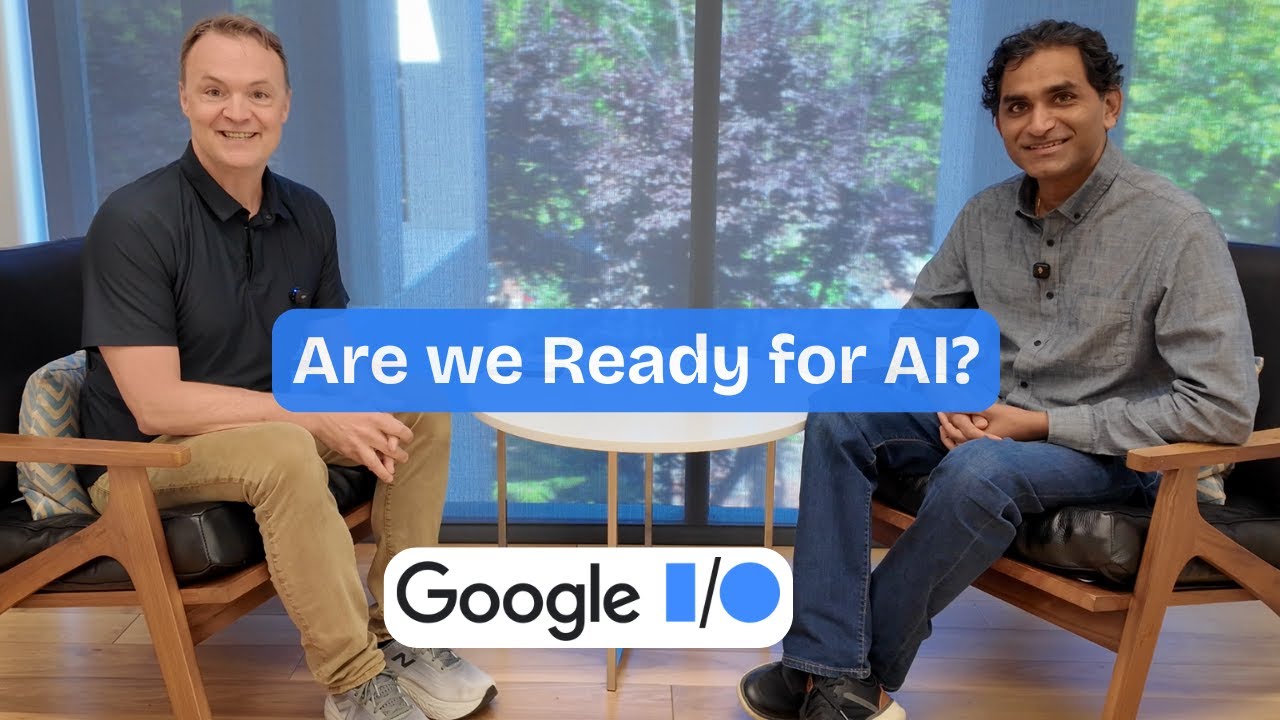
🎥 Watch the full interview with Shantanu Sinha, VP of Google for Education at Google I/O as we explore what it means to be AI-ready in today’s evolving classrooms: how schools can prepare, how students can thrive, and how Google is leading the way.
🔗 Learn more from Google for Education: https://edu.google.com
In this exclusive 20-minute sit-down interview, Jamie from Teachers Tech sits down with Shantanu Sinha to discuss:
✅ What “AI Readiness” really means for educators and school systems
✅ How Google is supporting teachers with AI tools like Gemini and Classroom
✅ Ways AI is transforming teaching, learning, and equity
✅ The future of student skills and how to prepare learners for an AI-powered world
✅ Ethical and responsible AI use in education
Whether you're an educator, administrator, or curious about the future of learning, this conversation is packed with actionable insights and forward-thinking ideas.
⏱️ Timestamps
00:00 Intro
0:28 About Sinha
2:42 Google's role in AI readiness
4:22 How safe is your data with Gemini
6:28 The future of AI in education
12:15 Gemini as a tutor
15:00 Equity and the digital divide
17:15 New tech and multi-modal
20:00 What AI skills will students need?
24:57 How can teachers keep up with AI?
#GoogleForEducation #AIinEducation #TeachersTech #GoogleIO2025 #EducationTechnology #AIReadiness #EdTech #FutureOfLearning #GeminiForEducation
Оглавление (10 сегментов)
Intro
Hey everybody, Jamie here at Teachers Tech. I'm excited to bring you something a little different today. I'm sitting down with Shantine SA uh here at Google and we're going to be talking about AI readiness and uh but before we get into that, I just would like Shantine to explain a little bit about him and how he got here to Google and his path and how he's connected with education. All right. Yeah. So, I'm Shantru. I'm the VP for Google for education and we
About Sinha
focus largely on bringing Google products to schools K12 school K12 schools and higher ed institutions. Um and you know we build products like Google Classroom which is used to help manage a workflow for teachers as well as ensuring that the wide portfolio of Google products Gemini Notebook LM Chromebooks workspace are really optimized for the unique needs of educational institutions. So, um, I've been in the education space about 15 years now. Um, and I got kind of got pulled into it, um, back in 2010 when I helped get Khan Academy started as a founding president and chief operating officer and I've been here at Google now for the last nine years. Oh, cool. And then, so going back u with the Khan Academy, how did that just start? Like how can you kind of give us a little bit about how your connection to education there and Yeah. So, absolutely. So, so I've actually known S um for a good part of my life. We grew up in New Orleans, Louisiana, and we first met in high school. Um and you know, we're really close friends and we went to college roommates and actually moved out to the Bay Area and we're roommates then. So, kind of longtime friends. and he had a YouTube channel that he started in I think 200 four 2005 like really kind of early days of of YouTube that was kind of getting this traction, you know, he was posting these videos for his originally just his cousins and other folks. And um around 2010, it had built up enough of a following uh that we really looked at and said, "Well, we can build a new type of institution here that's really focused on making information as accessible as possible. Uh you know part of the the thought process was uh you have public libraries, you have public schools, you should have publicly available algebra for everybody. You should like this stuff should exist. It's not that hard, you know, and frankly YouTube was taking all the cost of it. So really just making sure that this content existed for the world. So I joined in 2010 as a founding president to help build it as um an organization. Okay. And as I think about
Google's role in AI readiness
this, how you talk about content available for the world, thinking about Google's position with AI. Yeah. And you know, and we're mentioned about AI readiness. Where does Google fit into getting students and teachers ready for this AI? Yeah. So I think you know as you know I'm sure you also um see AI is one of the most transformative technology if not of our lifetimes. uh it has the potential to impact so much of what we do and um with that I think there is an amazing potential for benefit on so many aspects of our lives including in education including how teachers teach and making sure they save time in creating much more richer um learning experiences for students. Um at the same token I think it has to be deployed very responsibly right it comes with it's a new technology it's going to impact things in new ways and we need to go eyes wide open on that so when I think about it you know we often talk about being bold and responsible which is we really want to push the frontier of what this technology can do how it can help people how it can be useful in their lives but we also want to be very responsible in how we roll it out particularly in an educational context we want to make sure that administrators and teachers have the controls that they need, that the technology is really built, that it's going to be helpful for learning and the educational process. And that's a big part of what we think about when we think about how to bring this in um uh with Google for education. Now with
How safe is your data with Gemini
safety like since I work at a school district and just different things I you know people are always worried about privacy and I I' I've talked to people at Google and you know they assured privacy and everything and now how does that work like and just to kind of like let people feel comfortable about knowing if where is this data going into yeah so I think this is where I you know I'm personal proud of Google foration we have a long track record here right we're not this isn't the first time we're going into education we've worked for you know over 15 uh almost 20 years in in the space um and we have very strict control. So when we work with Google for education, we bring products into an educational institution, we treat the data very carefully. Like customer data is customer data. We don't look at the data. We don't, you know, we're really it's really data protected. We put a lot of different controls. We have very strict terms of service for Google for education that are very different than consumer products out there. Um and that's a core part of Google for education. It's when we when we deploy products to schools across Workspace, Gmail, everything. Um, and now with Gemini and Notebook LM and AI, we're really doing the same approach for it. So when schools deploy Gemini, which is now free to all schools, uh, it comes with extra data protections built in. It comes with our enterprisegrade terms of service, which say that, you know, we don't use the data for training. We really make sure that the data is really kept um um, protected. It has all these extra controls for administrators to look at audit logs and really investigate how how things are operating with. So, and that's a core part of what we've always invested with Google for education and a really core part of how we think about the right way to bring AI into schools. It really needs to come with these extra controls for educational institutions. Oh, you know that makes even hearing that will make people feel a lot more comfortable because if everybody's always asking, oh, where's this this that will help a lot. So, if you
The future of AI in education
were jumping ahead, let's say 5 years, 10 years, 15 years, where do you see the path of Google and AI and kind of, you know, I know there's a little bit of imagining to this as well, like where do you see this going? Uh, you mean broadly or in education or uh in education? Yeah. So I think um like I was saying it's a pretty transformative technology and I think that means it is going to create all kinds of um unexpected use cases, unexpected capabilities. uh and I think a big part of it and you know I think even the last 10 years 15 years that I've been working in education I've seen how technology has been embraced by schools and you see how it unlocks different things and people bring Chromebooks and they use classroom you know when they start using all these educational apps that are out there it started to really unlock new capabilities and I think that's really going to accelerate when you go into the future it's actually never been a more exciting time to work in education in my view um now in terms of like where do I see the types of changes? I think all the different stakeholders in education um the teachers, the students, the administrators are there there's different ways that AI can really support them in new ways. So for educators, I think it does provide, you know, we like to think we can give a teacher superpowers, right? we can help them like save their time, help them get what they want done so much faster because you think about you know so many teachers one of the biggest challenges that that you have as you know right is like you're managing a class with so many kids and you only have so much time right and anything I want to do that uh this you know kind of personal attention for this child or or this child it takes a lot of time work any task like even writing an email for each individual student that takes a lot of time. So, um, with AI, I think we really have the potential to speed up many of those tasks. And there's so much that educators can do, whether it's creating content for their for the classroom, quizzes, u getting help writing emails, getting help like, you know, all the different types of tasks that they have that AI can help with, but still put them in control. I think it's so important that they're in control and it's really um they're able to leverage and guide the technology the right way. I think for students what I'm really excited about is how it's going to really create richer different learning and educational experiences. U you know one of the first things that we saw even when YouTube came out is it did start to change the educational experience. out for the first time, you can go online and get an instructional video teaching you exactly what you want to know and you can rewind to exact part of it. You can listen to it until you get it. Like, and that had a tremendous impact on how people learn and how accessible information was and how relevant students can make it because they can learn from so many different types of creators and all of that. I think AI has a potential to turbocharge that in at another level, right? And it starts with when you're stuck, when you don't know what you don't know and you're you're struggling with trying to to learn something. Now, AI can learn and understand that context. It can be grounded in your exact textbook or your exact um school, your teacher's materials that they have. It can um help diagnose what you need to know, what you don't need to know, and really help you get unstuck, right? So it can kind of emulate that kind of tutoring type of experience in many ways. But I think it also can create all kinds of new richer learning experiences for students. Right? When you look at, you know, we just launched uh the newest VO model yesterday. You think about video creation, image creation, you know, the type of projects that you can do in a classroom, which, you know, so I see what my kids are doing now and I think, wow, we were we had nothing when I was growing up because they're able to make such amazing stuff with technology and like have such richer project-based experiences. So, I do think it can really start to redefine what that learning experience can look like for students. And then finally, I think for administrators, for education leaders, uh it also has a tremendous um potential because we now have the ability to understand how technology is being used across districts across uh you know large um uh you know kind of ministries of education like you know around the world um large deployments where educators can now understand well what exactly is happening? how are which students are struggling what's going on in this school versus that school and pull out that data and leverage AI to make sense of it to pull out the insights to be able to understand well now maybe I have to do better professional development in this area because you know students aren't really you know progressing as we'd like to see in this area on the specific topic so it really I think will enable and empower educational leaders with much better insight sites and information so they can better manage their schools and their district. So I think across the board it has tremendous potential. uh it'll impact it in different ways in unexpected ways. But I think it's so important for people to really think about the use cases that exist and how can AI help in those different areas especially like I think now is like real time like that data analysis where you know yesterday at the event they talked about the fires forest fires and then it made me yeah like if you can get that data analysis to help and jump in help a child learn or differentiate things on the fly. Do you see tutoring
Gemini as a tutor
with AI being something that will happen? And I know with Google they have learn LM and I've played around with that. Is there can you add some insights about the possibilities? Yeah, absolutely. So it's definitely something that we think long and hard about which is how do we make sure that we're truly building the best models for learning and it's it takes work, right? It doesn't just happen. And it really is something that uh when you look at how you build these models, we work with experts, educational experts, educators on trying to make sure that we can infuse it with the latest in learning science. So this has been a project that we working on for the last couple of years um around learnm identified a number of learning science principles. We want to make sure that our models can do things like inspire curiosity, like deepen metacognition, really drive active learning, um, and that we're not, you know, we're not just hoping the models do that, but we're actually training the models to be better at that. So, we've worked with a bunch of, um, experts who've done a bunch of research to really build uh, some of the more the most pedagogically infused models. So in addition to just ensuring that they do great on academic benchmarks which everybody looks at and so well can it do you know the hardest uh you know academic um Olympiad questions and you know these models are getting very good at that. We also want to make sure that they're good at these learning science principles. That's something that we've now brought into Gemini 2. 5 Pro and I'm really excited our latest benchmarks we recently um released a paper on it. we see that the model is performing very well on that. Um and in that context I think it really helps us make learning experiences that are fundamentally better for students. Uh and that does allow us to create these tutoring experiences where it's not just about getting the answer. a shortcut to the work. It really is about creating the richest experience possible. So students are understanding the underlying concepts that they're creating uh they're able to experience the material in different way. They're deepening their metacognition. Um and that's a big part of uh what we think is really important to focus on here because uh if when you bring this technology out, you know, people are going to want to use it certain ways, but it is really important that it has the capabilities to be as powerful for learning and having the outcomes that you want and it has the capabilities that the educators and the administrators can really guide the the technology to really do that. So that it is really creating a better learning experience. Now thinking about
Equity and the digital divide
uh just the equity of you know the digital divide and with different schools and different areas like how can Google help you know get you know getting this to since this is such a big uh event I would say the AI and education how can Google help with this? Yeah. So I think with any new technology like this um you have a couple of different trends that happen. So one is the early adopter phenomenon which is in some cases what does happen the first people that embrace technology are the ones that they have technology right they have they may have more means they may be um uh you know they may have more access but I think you also have to look at the long-term trends of the technology and I think one of the things that really excites me about AI is we're seeing the capabilities exponentially increase and we're seeing the costs exponentially decrease and I think that ends up being a really important trend line to look going forward because what it means is we are going to be able to bring these really rich pedagogically deep tutoring ta you know experiences to the world in a way that is really accessible. It's a big reason that we've already made Gemini and Notebook LM free to all Google for Education customers all around the world. Uh because the technology has gotten to a point that we're able to do that and I'm really excited that we are able to do that. But I think we're going to continue to see that. And in some ways, I think it's a similar analogy with YouTube when it first came out, right? well, you had to have streaming and ba like pretty significant bandwidth and the computers to do it were a little bit more advanced. But now we see even, you know, I go to a village in India and when I visited my my father's family and they're all like watching YouTube on their little Android phone and it's like this is a part of the world where you know access like you would think it would take a while but it took only a few years before it got there. I think you're going to see the exact same thing with AI. This stuff's becoming much more accessible and I do think it has the potential to be a global phenomenon in that way. It excited me yesterday uh
New tech and multi-modal
when they announced the live on the devices and now for everybody. I had it on my paid for version before but now and I just think the opportunities with that and then when I see um the glasses the headsets come out. Have you thought of any, you know, like with VR or even the glasses like can helping different students differentiate? Do you see any possibilities there? Yeah, I think I mean I definitely think one of the most exciting things with AI is, you know, it's not this chat experience. I think people associate it with that because that's the first thing that they they've experienced, but AI it's multimodal. It can now see your real world. It can understand your real world and really interesting things. And I think it's one of the things I'm really excited about. you know, Gemini with the first multimotal model and now with live, we've been able to get the latency, the speed of this where you can now start to see these experiences with the full power of that and this goes back to the cost coming down and the speed um accelerating. So um I do think with live and we have this really amazing um demo internally uh with a project team called Astra where you do have that ability to just you know put your camera on whatever you're doing right um your homework or whatnot and it really is like somebody over your shoulder watching you and can say well oh you made a mistake on that step and did you understand that concept and it's a really remarkable thing and Even for myself, just a couple of weeks ago, I was changing the brake lights on my wife's car and I just pulled, you know, back in the day, maybe I would have to do a bunch of searches, find out, look at some user manuals and figure it out. But I literally just opened up live and say, "Well, here's the car. Can you help me figure out like where are the screws to get to the brake lights? How do I do it? How do I pull it out? " And it literally just walked me through the entire process step by step. And it was amazing. It was a remarkable experience, right? And I do think that level of access now like you're saying it's going to be available broadly for people to have this um you know voice and vision built in. I do think you know over time the form factors of that. It doesn't it's not going to have to be because it was I'll be honest like it was really hard I had to get my son to hold my camera while I was doing it because I'm like it's hard to hold your camera while you're changing the glasses the brake lights. But with glasses with new form factors, I think it is going to make that so much more um you know such a richer experience over time. The habit I find like using AI it's like you almost like create the habit of using it and finding ways to have like even with this live like I've had it and I forget I just forget to take it out and I'm like oh after the fact and then it's like you forget how much power you have in your
What AI skills will students need?
pocket with your devices now. when you think about students in moving forward, you know, what are do you think there's certain AI skills that they would need? Like is there something like you know as I look back over the last year people talk prompting and a lot of times now I'm like well you can just ask Gemini what you're saying and then have the conversation now and again seeing all the different things from the IO event yesterday you know what are the skills that you know students or even teachers need to you know what they could learn to help them out to move forward. Yeah, I actually think of this as more of a back to basics of I think such so much of the most important thing that students learn when they're in school are is the ability to problem solve. It's the critical thinking. It's the metacognition. It's the collaboration. It's like figuring out how to be creative and apply it in in new ways and apply concepts in different ways. Like that's what when I think about you know my own three kids like that's the richness of what really happens in the in the classroom. And I think a big part of as AI starts to like you say well AI can do this for me or AI can do that for me like what's the skills um that I need. I think we still go back to those core skills. Those skills are really important. Um, and you know, it reminds me of, you know, when I was teaching my oldest, um, son to ride a bicycle. And, you know, he was like three, four years. I can't remember exactly at the time. And, you know, I b I put training wheels on his bicycle. And he's going from point A to point B. So excited. He's pedaling. And then I couldn't get the training wheels off of his bicycle, right? Because as soon as I took him off, he's like throwing a fit. He's crying. He's like, I it keeps falling down. And you know I had a friend who was visiting me from London and he told me he said you know the problem is you put training wheels on the bicycle because ultimately riding a bicycle is not about learning how to pedal it's balance and if you focus on learning how to pedal anybody can learn that in minutes. Learning how to balance is what takes time. So the technology here the training wheels is actually taking you away from the skill that you're really trying to teach. And I think in many ways when I think about AI, I see a similar analogy, which is if you think the point of education was just getting the answer right on a box or even at this point a five paragraph essay that yes, AI can do a lot of that for you. But that's not the point of those exercises. exercises teach you to critically think. The point of those exercises, the process of learning. The point of the exercise is all of these other things that are happening. And that's what educators need to focus on ensuring the students are building those skills on their own. Students may or may not do it the same way my son may or may not want to take the training wheels off on their own. Right? So it is important and that's why I think the educator is such an plays such an important role there because when it is about writing that paper it's not necessarily about just getting better at prompting. It's about understanding how to judge quality. plan the process. It's about having those richer conversations, those extra drafts, and that's what the education um process should really be more about. So, when I think about the skills for students, I still go back to the basics. We need to make sure that we're we're creating the citizens of the future that have the problem solving, the creativity, the collaboration, the human skills, and they're really good at it, and they're able to use this technology to apply it because that's going to be their reality, right? Their reality is the same way. we have a calculator to do anything that we want in our world. Like you want to calculate the tip sometimes, you know, it's like, oh, let me just take out my calculator. Um, that's going to be their world, right? They're going to have AI that can do so much on their glasses in so many ways. But what is always going to be important is that they have to be good problem solvers for the new thing. In fact, it's more important because the world's going to be changing so fast with AI. They have to be adaptable. They have to be those critical thinkers. And I think to me that's what education that's what the most important skills for students really is. Yeah. That excites me to hear when you talk about the process because that's the same thing. You know the curriculums are a little old. It seems like they they're still thinking about a product but then with the shift I just see this change happening with I want to capture the process and that's the valuable part. the product at the end not so much because when it comes to authentic learning if students are looking to see how does the business world well they're using AI to check this and everything so it's the critical thinking that happens in the process there that really makes a difference and working with other students and the teamwork the collaboration the you know the empathy for the for others like these are the important skills that are going to be really all of it makes such powerful learning and that's what all of us do in our real lives right these are the things that we
How can teachers keep up with AI?
really have to apply so for teachers moving forward. Is there places you can recommend to stay on top of it? Uh like I know Google has lots of different things. Where would you suggest to look for them? Yeah, so I think the first thing I would recommend is play around with the technology. It's moving so fast. Even what you tried a year ago, it's changed since then. Uh so you your your perceptions of like what it's capable of are probably evolving so fast. And I'm constantly blown away by how it's progressing. Like, you know, a couple of weeks ago when Gemini 2. 5 Pro came out with Canvas, you know, I sat with with my son who really likes to play chess and we created, you know, this game Anti-chess, which was actually my final project when I was at MIT like computer science student um where we had to like program an AI to program anti-chess. And we literally created that in 20 minutes. And it was like it blew my mind that I could do my final project when I was a student in 20 minutes with with my son. And so I think like the capabilities are astounding and you could apply them on such different things. So the first thing I would say is play around with it. You have this task. Try it and see what happens if you try to use AI for it. The quality is improving dramatically. The capabilities are improving dramatically. You have to create this document, the slide presentation, whatever it is. Uh play around with it. start to understand where it is because already where the technology is, it would take us years to figure out how to even apply the current state-of-the-art technology and all the different ways it can add value to our day-to-day lives and the technology keeps changing, right? And it's the next video model is better, the next image 2. 5 Pro is better, and it's going to continue to do that. So, I think it is really important to experiment. The other thing I would say is really think about all the different aspects of of what you do where AI can help. Um, you know, one of the things that was really eye- openening for me is we ran this pilot um, uh, with, you know, some folks internationally and they had this really great approach where they asked their teachers that are on the pilot to come up with ideas of what how they can use AI and log it and tell, well, this saves me five minutes of time or an hour of time or a day of time. And after just a few weeks, they had over 600 ideas on this list of ways that you could apply AI. And it blew my mind because often we think about it and say, "Well, these are the things you have to do. You have to help with lesson planning and writing uh you know, an assessment or releveling text or translating. " And we're making it much easier with Google with Gemini in classroom for teachers to do all of those like common use cases. But what it opened my eyes to was there's so much more that AI can do. And in your individual life, there's probably some application that's unique to you or unique to what you're trying to get done. Um, and really think about how AI, you know, what are the 500 different use cases that could exist in your school um that are unique to the to to your school because it is possible that the technology now can help with a lot more than you think it can. That's what I enjoy about using Gemini. I know there's other products out there that kind of fine-tune to the school, but I like with Gemini when I'm showing teachers to learn it well apply this outside of school. Like, you know, just don't think about it in your classroom, but what are all the different ways? And I think as they practice that, then they just understand the possibilities. You're not just focused on this one angle of that. Well, I really appreciate you sitting down with me talking about AI. This is a topic I really like to talk about and it's great to hear kind of the future and your optimistic vibe of it and everything but so thank you for taking the time and I really appreciate it. Yeah, great to be here. Really glad to be able to do this. Thank you. Bye.