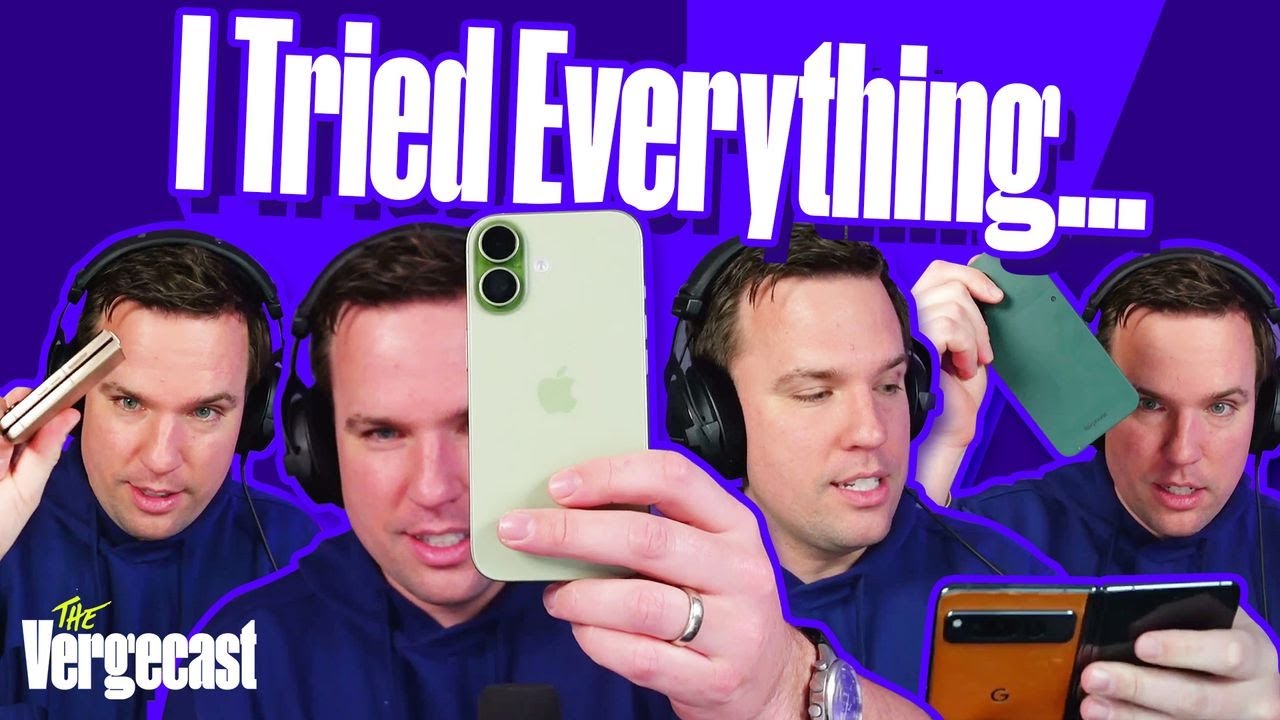
Welcome to the Vergecast, the flagship podcast of weird ideas about smartphones. I'm your friend David Pierce, and I am sitting here reading this book, Apple, the first 50 years by David Pogue. Uh, I got an advanced copy of it, not to brag, but it is exactly what you think it is. It is an epic like 600page tome all about the first 50 years of Apple. Uh, it's fascinating. There's so much in here that I didn't know. Like I I have covered Apple so much as a product company, but understanding what was going on inside of the company and particular the ways in which Steve Jobs was both unbelievably good at his job and managed to drive absolutely everybody insane all of the time. It's just fascinating. There's so much interesting sort of internal machination drama in this story. It's very good. And even if you are somebody who knows a lot about Apple, uh as I like to think that I am, this book is worth a read. It's the 50th anniversary of Apple starting next week. We're going to have a bunch of Apple coverage. Lots to do. Very excited about it. I got to finish this book in part so that I can do all of that coverage. Anyway, today on the broadcast, most of the show is going to be my conversation with Allison Johnson, our senior reviewer, about my phone journey. I've mentioned this a few times, but I've spent the last several months trying like every phone I could get my hands on. I've tried flip phones and foldable phones. I tried a phone with a keyboard. I just tried to go and see if there is something better than the phone everybody just defaults to. Right? I've had an iPhone for forever and was like, well, maybe it's time to see if it is worth the work to go get a different phone. Um, I've had a lot of thoughts. I have done a lot of testing. I've phone switching and uh I just needed somebody to bounce some ideas off of. So, I grabbed Allison and we're going to talk through where we are in the phone world right now. Also, we have a really fun hotline question about AI and vibe coding and how to think about what these tools can actually do for us. All of that is coming up in just a second. But first, I promised myself that every time I sit down to read this book, I'm going to read a chapter without getting distracted by Tik Tok. And so far, it's not going great, but I'm going to keep trying. This is the Verge Cast. We'll be right back. All right, we're back. The Verge is senior phone reviewer Allison Johnson is here. Hi, Alison. — Hello. So, over the last few months, I've been on this wild phone journey that I just imposed on myself because I was really bored of my iPhone 16. And um unlike you, I'm not a phone reviewer anymore. So, I'm not perpetually switching phones. — And I think you and I both agree that when you are a phone reviewer, it warps you slightly. Um and I found myself in this place of like, okay, I've actually had — an iPhone pretty much as my only phone for like four years now, and that's the longest I have gone without being a phone reviewer in a very long time. and I'm just sort of bored of the iPhone. I was like, "Okay, I don't review phones, but also I know a lot of people who will send me phones to test for a couple of weeks. " So, I just did that, called in a bunch of phones. Uh I've tried a whole bunch of them, — and I've come to you with 10 observations. the these are a mix of I would say I have many — but we this may be a six-part podcast we do but I think I'm going to tell you well I'll just tell you where I landed and then I want to get into I have this mix of I would say sort of hot takes about phones that I want to gut check on um and then just a bunch of things I encountered that surprised me that I want to talk about — excited yes I'm — okay so my end point just to say the upsetting part first I bought an iPhone Okay, I knew that was coming. — This is not frankly where I expected to land. And as of not very long ago, it was not where I was going to land. Um, but I went out the other day and I bought an iPhone 17. Uh, it's sage. — It looks lovely. — Oh, great choice. — I love the color. I am medium happy with the phone in the same way that I was medium happy with the iPhone 16. — But you got that high refresh rate screen back. — I did. Um, you're still wrong about the always on display. which is bad. — I love it. You don't Did you turn that the just the picture off? Like — it's better. It is definitely better. And it will You can do it. So, it mostly just shows you the time now, which is what I'm looking for and what I appreciate. It's better. — It's still better on the Pixel. But I think through these 10 things I have for you, I think we can I can start to explain to you why I landed on an iPhone. And then I want you to tell me if you think I made the wrong decision at the end of this process or not. Does it sound good? — Okay. Yes. — Okay. So, thing number one, uh, switching phones is awful. Like, awful, awful, awful. And it's everyone's fault. Uh, and I don't know what to do about it. So, like, just the very first thing I had to do, and I know you have to do this all the time. Um, I had to switch my eSIM from an iPhone to an Android phone. — Oh god. Nightmare. Nightmare process. — Did it work? It worked after I both called a person at Verizon and they were like, "Do you have another phone I can call you back on? " And I was like, "Who
Segment 2 (05:00 - 10:00)
says yes to that? " Like, "No, I have the one phone. What are you talking about? — Like, this is my phone. I have the phone from you. What do you want from me? " — And they were like, "Oh, I see. " I had to have them call my mom to authenticate the account. — So, I literally I had to message my mom from my computer while my phone was off in order for her to authorize them. is insane. So, it's this like 36-hour process just to change my eim. And then I complained about this on the show and I got messages from people who work at Verizon who were like, "Yeah, we know it's awful. " — Yeah, they do. They should feel bad about it and I suffer through it. So, that's why I just I'm like, I'm on EIM. I guess I'm going to have this iPhone for a little bit. — Yeah. No, it's really true. And I think there is something about the pain of switching phones that is part of the lock in of it and even from Android to Android, right? So there's like once you get on to Android, the switching process is much easier. So the first phone I tried was the Motorola Razer Ultra, the Flip phone, because I was like maybe this is the time when flip phones are for me. Um they're not, which we're going to get to. But um — that switch was awful. And then I switched from the Razer to the Pixel and moving the ESIM there was like two taps. Couldn't have been easier. Terrific times. Um, but the process of moving all of your stuff, even though that's getting easier, still takes a while, whatever. But like you have to go and you're logged into some things but not to others. You have to do this horrible process of trying to transfer like WhatsApp data and signal data and that breaks in a bunch of ways. You have to one for me is like I have run out of um downloads on some books on Kindle because I have to go in and manually redo this every time. So, it's just like there is this unknowable amount of things you have to do every time you set up a new phone that with each of these it took like most of a week before it felt like I was just seamlessly using my phone. — Yeah. — How do you do this all the time? time. — I do. Um, so my secret is uh I kind of just yolo and I don't worry about the messaging apps. Like I just lose all my messages every time I switch phones. such a bad outcome. — It's so annoying. My friends are so annoyed cuz I'll text them and be like, "Dude, I don't know. Where's this show tonight? Like, who bought the tickets? It's somewhere. It's on this information is on a phone like — Yeah. They're like, "Scroll up, Allison. " And you're like, "I can't. I literally cannot. " — They're used to it. They understand that this is how I operate. Um Yeah. And in my method, I think, is a little different because I want to make sure I'm not like bringing some baggage from the previous phone to the current phone. So, I just like clean slate, set everything up from scratch, which is worse and like better in some ways. Um, I have the password manager. My life would be um over if I didn't have the password manager to just like autofill everything. — Y — um and yeah, that's just kind of how I live my life. There's like an awful two hours where I'm like logging into stuff and um inevitably it's the parking app. I end up on a street in Seattle downloading the parking app and my husband's like, "Oh my god, we have to do this again. " And — and you have to download it and then you have to log in check your email for the verification thing and God only knows what notification settings you have on your phone so you'll know whether the email came in or not. and then you have to go back and that may or may not have worked because these apps don't talk to each other very like it's just — the number of times you're in an app and then you go to the email client and then you click on the verify link and it opens the browser instead like nightmare and there's so many things and part of me is like okay — I'm not sure I actually think it's a better answer to have all of that stuff so bundled together that I get a new phone and everything is just magically logged in there like — there are security issues with that I think are probably real and valid But it really like switching phones is awful. — Yeah, — it's so awful. — I've been so desensitized and I like offer therapy to my friends when they're like, "It's time to switch phones. " I'm like, "You got this. " — And I had this I had the fun experience of being at the Apple store uh buying the new one that I bought. And I wound up basically just deciding to go through the process at the store, right? Normally like I buy the thing and go home and do it myself. And this time I was like, "I'm a normal person now. let's do it with the Apple representative. Uh it took two hours — and it was not a good time. Um but I got to watch a bunch of people go through this and there were a bunch of people who had come into the Apple store — just to update their software — and there because I think people are like when I make this change something is going to break. — Yeah. — And I I'm kind of like you're probably right about that. — They want to be in a safe space when it happens. — Totally. And I think the fact that is the case and that's how people feel about getting new devices and new software — is such a damning critique of the state of all of these things. — Yeah.
Segment 3 (10:00 - 15:00)
— Sucks. — Yeah. Like I truly I got to the point where I planned to do this with more phones. I wanted to like really go down the rabbit hole of Android phones and I got to the point where I was like if I have to do this stupid signal transfer one more time, I'm going to lose my mind. Um okay. So that's thing number one. Thing number two, uh, you and I have talked about flip phones and fold phones a lot, — and I think I've figured out what's wrong. I think, — okay, — flip phones have a software problem, and foldable phones have a hardware problem. — Uh, I think foldable phones are they're still too big. They're still too clumsy for a lot of things. I think the the I've been using a Pixel Fold and the thing where you can't functionally open it with one hand and still sort of it's just awkward in a way that I don't think is right and they have durability problems. The camera is not usually as good. Like — this thing, if you could just make it a little smoother and a little better, I think the idea of it's more screen — would be more compelling to me because it is more screen and I like the more screen. I do more than I expected honestly. — Yeah. Did you use the ZV 7 is my question? — I didn't. Samsung wouldn't send me one because you have one. Like, if I'm just being honest, that is what happened. They were like, Allison already has one. — All right, I'll bring it to the East Coast next time I'm there. But it's — I also ruled out Samsung at the beginning of this because um just to be perfectly blunt, Samsung's take on Android — is not for me. Like I get that it's for lots of people and there are lots of good reasons to like Samsung phones, but — the way that one UI works on top of Android just feels like mess to me and I have never liked it and I still don't like it now. So I didn't even go very far down the road with any Samsung device, — but I did try to get a ZFold 7 because I know you love it and they wouldn't send me one. — I'm glad you tried. — So that's on the foldable side. I think uh you know I keep saying there's no killer app for it and I still kind of believe that but I can open it up and it is bigger to read on — is cooler than I thought. It just is like it is I enjoyed having big screen more than I expected. — But the trade-off of what it's like to actually use the thing didn't quite feel worth it for me. On the flip side, — this is the right phone hardware. This is the Motorola Razer Pro Ultra. I love the hardware of this phone and I get absolutely nothing out of using it. — Oh no. — Well, so it's like you open it up and everything is like too tall and the keyboard's kind of wacky and nothing's in the right place because everything is still up at the top of this very tall phone and it just doesn't quite work and then you close it and it treats it like it's a completely different phone on the outside. So it's constantly asking permission to use an app on the external screen and like buddy it's my phone. What are we doing here? and then you go to respond to a text message and you it opens up the keyboard and then you can't see the message anymore and like it's it's as if no one at Motorola ever closed the phone when they were developing this thing and it drives me absolutely insane. But I look at this and I'm like there is something about this and the like quick bits of information that it gives you and the stuff you can do with it propped up like this on a table taking pictures like there is stuff here that works for me. It's just none of the software makes any sense — there. Yeah, it's wonky. And if you can believe it, Samsung's is even wonkier. I guess maybe that's a surprise. Uh Motorola is at least like you we'll let you opt into opening an app on the outer screen, you weirdo. It's going to look all strange, right? — Um Samsung makes you download Good Lock, which is an adventure. Yeah, — I know. I mean, I think I like the flips and tend to be a person who's like I'm willing to deal with a little wonkiness and it Yeah, the texting experience on the outside screen is not ideal and I don't want to write all of my texts that way. But I do that thing where I'm like I will actually respond to the text because it's just an option right there and I don't have to like dive into the phone and be come face to face with everything. Um I'm the worst for like I'll see a text and think of a response and send it in a week when I get around to it — or never in my case. — Yeah, probably never. A lot of nevers for me. — It's great. Yeah, my friends all love that too. Um, yeah, that's I think one of my f the camera, being able to prop up and use the outer camera. Um, and the texting from the outer screen are kind of my favorite things, but that was not enough to move the needle for you. It sounds like — like again, those are good examples. There just need to be 50 more of them — for this form factor to really work for me. And it's like there there's just so many little tweaks to bits of the operating system that don't exist. Um I also found I tend to I hold the phone like this kind of grabbed in my
Segment 4 (15:00 - 20:00)
palm when I'm just using it — closed. Um I have brought up Gemini by accident maybe 45,000 times — in the process of doing that. just constantly it's just right where your finger is and then it's like oh I did Gemini again over and over and over again. — Yeah. — Um okay, observation number three. This is just I need a gut check from you on this. Um purely anecdotally, but I get maybe 10 times as many spam calls on an iPhone than I do on Android. Uh it was shocking to me how many of them went away, particularly when I was using the Pixel. And then I like switch back to the iPhone and boom, — there's this one uh it's like a company that calls wanting me to donate blood that calls me like twice a day. — Just gone for weeks thanks to the Pixel and now suddenly back on the iPhone like — Yeah, totally. — Android is better at this. — They are. Yeah. And I think in iPhone settings they've provided more things, but you kind of have to I could be wrong. I don't spend tons and tons of time on iOS, but um you can opt to have like all unknown calls just disappear and go away. Um or like numbers that aren't — right. Yeah, that always scares me a little bit where I'm like, well, maybe someone's going to call me from daycare from a weird number and my kid is bleeding and I need I don't know. Yeah. Um things like that kind of scare me. Yeah. The Pixel in Android in general just seems to be smarter about like either just straight up labeling it with a big like this is probably spam, don't worry about it. — Yep. — Or um just like not bothering you at all, which is good. — Yeah. I got back to near 100% just answering the phone every time it rang on Android, which has not been the case on iPhone for years for me. — Uh yeah, it was just fascinating. Um okay, next one. Um, Gemini is so much better than Siri. It is astounding. And it kind of changes the way I use my phone. — Um, like I I found myself doing things with the voice assistant that I would never even think to do on the iPhone because I would just assume that it's broken. Um, like the joke now is you do things you're like, you know, hey Siri, what's 2 plus2? And it's like, would you like me to ask chat GPT? It's like, well, this is what are we even doing here? So, I have just sort of switched my brain off on all these things that I might do. Uh, you know, instead of like going to Chrome and Googling something to get information, just asking Gemini for that piece of information. Siri is so bad at these basic things that I don't do them anymore. And they slowly started to creep back. Like, I use Gemini a lot on Android to control the phone, to do things, to open apps, to find stuff in the Play Store. Like, — it is a good orchestrator of your phone in a way that Siri just never has been. And I think it's like that might be for me the biggest single advantage of Android over iOS at this point. — Yeah. And it's wild because we've seen it happen in real time. Like Gemini was not great at first and there was a lot of stuff it could not do. But like in the true Google fashion, they've sort of like — fixed things and added things gradually. Um, putting personal intelligence in the mix has like kind of blown my mind where — like a year ago I would argue with Gemini like about where my flight was taking off and it would be like no no you're leaving from San Jose. I'm like it is in my calendar. You can read my calendar. I don't need to do that anymore with Gemini. And it changes how you yeah how you think about like finding information on your phone or just you're wondering something and you know you can ask it. I find myself like when I switch to iOS, I have like I redevelop that muscle in Android where I'm like, I'll just ask Gemini or this is a Gemini thing. And then I look at the iPhone, I'm like, no. Like I can download Gemini, but I try to give Siri the benefit of the doubt and it just No. — Even if you asked Siri to open Gemini, there's like it's like 6040. It wouldn't work. — Oh my god. I didn't even think of doing that. — Yeah. Um, speaking of which, actually, you you've been using a feature I have not yet gotten access to on any of my devices, which is the task automation stuff, which feels like — that's the next step of this certainly for Gemini and also in theory for Siri. Uh, how is that going? Are you actually doing stuff on your phone just by asking Gemini to do it? — Yes, it's going. I am both like my mind is kind of blown um because it's the thing. is like the thing we've been promised. You can ask Gemini like order me a pizza and it's going to open the app and do the thing for you and it works on a phone that I'm holding in my hand that isn't like in a keynote. Um it is wonky. It will sometimes fail at things. It's slow. Um like
Segment 5 (20:00 - 25:00)
painfully slow if you watch it. Yeah. — Um, but the key things to kind of remember like it's sort of it's in beta first of all and whatever. Um, it's designed to work in the background. So you tell it like my uh use case is I'm running around the house trying to get my put socks on my kid and pack all the snacks and do all the things. I've like frequently want to order a Starbucks at that point. That is the time for this feature is to be like, "Hey, order me that thing for pickup from my Starbucks and it will do it. " It's wild. Like, you can watch the phone. Use the phone. Um, so I'm existing in two states of like I don't want to oversell this thing. It is a little wonky and limited right now, but also like holy crap, this is the future, you know? I say like, "Hey, I have a flight tomorrow. schedule me an Uber to get me there on time. — Totally. — And it had a follow-up question I had to answer, but it did it and it like did it right. I'm like, "Oh my god, — that is very cool. " Yeah. I was actually thinking about the food example. Uh for whatever reason, all the restaurants near me use the Toast app uh for pickup and stuff. So, I'm I have basically just like a run of every takeout order I've ever done in Toast. And just the idea of being able to be like, "Order me the usual from the junction, which is the coffee shop down the street. " And it's like just take the I try to take the kids to daycare so I can just sort of pick it up on my way home. And if I could just say that to my phone instead of having to put them in while with one hand scrolling to find the recent orders and do it like — that's the kind of thing that is a relatively small task, but if I can just offload the 12 taps, — it instantly makes my life better. — Yeah, it sounds ridiculous. It sounds like an extreme first world problem, but once you do it and you see it, you're like, "This is this makes so much more sense than the way like tapping around the phone. " I ordered a Starbucks coffee from the wrong Starbucks when I was at the JFK airport. I ordered a coffee a thousand miles away. I welcome a robot doing that for me. Like — 100%. — Yeah. — Every time I go to the Starbucks app, it still defaults to California because that's where I lived when I set up the Starbucks app. We're doing great, everybody. — You live there forever now. — Yeah, apparently. — All right, let's take a break and then we're going to come back and I have some more fiery takes to throw at Allison. We'll be right back. — Support for the show comes from Shopify. Starting a new business, it can be a lonely endeavor, especially in the beginning. And if you're just starting out, it's more important than ever to make sure you have the right tools at hand. If your business includes e-commerce, a great next step is to try Shopify. Shopify is the commerce platform that millions of businesses around the world rely on to sell their products online. You can get started with your own design studio with hundreds of readytouse templates. Shopify helps you build a beautiful online store that matches your brand's style. If you're asking yourself, "What if people haven't heard about my brand? " Shopify helps you find your customers with easy to run email and social media campaigns. And if you get stuck, Shopify is always around to share advice with their award-winning 247 customer support. It's time to turn those whatifs into with Shopify. Today, you can sign up for your $1 per month trial and start selling today at shopify. com/vercast. Go to shopify. com/vercast. That's shopify. com/vercast. Support for the show comes from Granola. Meetings are a mess. A lot of circling backs and we're actually covering that in a different meeting. And whoever's in the car, can you please mute yourself? But for as messy as meetings are, remembering those meetings is even harder. Granola fixes that. Granola is an AI powered notepad built for the way real people actually meet. You simply take rough notes like you normally would and in the background, Granola securely transcribes that meeting. Then it turns everything into clean, structured, actually useful notes when the meeting ends. Granola works through your devices audio, which means it integrates seamlessly into the video conferencing tools you already use. No setup, no awkward bots you need to do your job better. So if meetings are eating up your day, Granola is a no-brainer. You can try it totally free for 3 months. Just head to granola. ai/verge. That's granola. ai/verge to get your time back. Get 3 months free at granola. ai/verge.
Segment 6 (25:00 - 30:00)
All right, we're back. So, back to my phone journey. All of the little AI nudges inside of Android, I think are awesome. Like, — and they're getting increasingly useful, especially for me, in like text messages where if I'm talking to somebody about a thing we're going to do that evening, it just pops up a little thing that's like add this to calendar. — Yeah. Like those just these little sort of subtle nudges about like how to go find more information or add this to something or send this to somewhere or whatever. Like that is the kind of stuff that it just makes my whole phone make more sense to me. And instead of me having to like open up an app and then open up the other app just so I can swipe back to that one, look at the information and then you do the thing where you sort of half swipe so you can see both apps simultaneously so that you can remember the information to type it into the first app — just to be able to hit the thing and hit add to calendar and it just moves the information over to the Google calendar app and starts a new event. — Yeah. — Terrific. like insane that phones have not worked like this the whole time. I know if I love it and yeah on Pixel it's called like magic Q. Yeah. And um I it's been a minute since I used it like regularly but you get some funny kind of false positives where it's suggesting like oh you have a ticket to go park at the zoo parking lot in a week like here. Do you want that? But you just ignore it. And — yeah they're tiny little they're like a little badges that pop up. I have not found them a nuisance at all. Exactly. And when it's helpful, I'm like, "Oh, this actually is helpful because I was going to forget to put it on the calendar or I was going wrong. " Um, it sort of feels like when you see it work all the way through correctly, it feels like the first time you saw like um a one-time password fill in by itself and then just like submit. You're like, "Oh, this yeah, this is easy. Like, do this for me. I love it. " A thing, by the way, that Google does not do as well as iOS. Like, — oh yeah, — the Android thing is fine. You get the text message notification and it prompts you to copy — the code, which is fine, — but just the thing where it pops up and it's like copy for messages and you just go and it pop it pops it into the thing and presses enter for you is like iOS is vastly superior in that way. But — authentication is the next thing on my list. Um, this is maybe my most esoteric phone theory at this moment, which is I think authentication is the biggest problem with day-to-day life of using a mobile phone. — Um, — and this just has come up for me so often because I've had to log into things a million times. But, um, one thing I love about the Pixel again in particular, like again, I'm being very nice to the Pixel and I thought for a very long time I was going to end up picking a Pixel because I actually like this phone a great deal. It has both face unlock and a fingerprint reader, which I think is awesome. — Uh, having that fall back before you get to your passcode is really useful. — Um, a lot of other phones have like less secure face unlock, which I've mostly found really annoying. They're like, "We'll unlock your phone, but we can't do anything actually important with your face. — What are we accomplishing here, guys? " — Yeah. Then you have to re-enter your PIN if you're going to order some — just I don't care for any of that. But having the multiple things is great. But uh across the board, the password app integration is messy and not very good. Uh it sometimes it pops up a suggestion, like open one password, sometimes it pops up nothing at all. — You just don't know. And so the actual experience of trying to log into something is really annoying. And then — when I'm in uh like I log into a bunch of things with an Amazon account for whatever reason. uh like I use the Kindle app, I use the Amazon app, I use Read Wise Reader, which logs in with an Amazon account. — Those things are all entirely unaware of one another — in a way that doesn't make any sense to me. But it's like this phone has I just typed in my Amazon password. — This feels like it should make sense. And if I'm in the Amazon app and then it punts me to Amazon. com for some reason, we have to start this whole experience over. — Yeah. — Uh at least Android's browser is more aware of itself across apps. the whole like inapp browser thing that on iOS every app has a different browser and you have to log into everyone separately. — Yeah. — Full nightmare. But I think so many like little bits of friction for me in every phone experience has been — just trying to be logged into things is so much harder than it should be. — Right. It it's one of those places where I try to calibrate myself because I'm constantly annoyed by logging into things and I'm logging into things way more than any normal human should. — Yeah, I've used eight phones in the last two months. Like this is not a normal Yeah, — you spent 30% of your waking hours like logging into things. Um I I've like adjusted to the Android way of things, which is kind of wonky. It's like sometimes you have to tap the password field or long press it to get the
Segment 7 (30:00 - 35:00)
autofill option and then maybe the one password chip will show up. Maybe it's not and you're going to have to go copy and paste it. But yeah, every time I switch back to iOS, that is one of the things I'm like, "Oh, this is so much smoother. " Like it just the apps know when I'm trying to log in. It I always get the popup for one password and it's Yeah, life is easier. — Um Okay, I have three more. We're getting to the end here. — Okay. Um, one, I think messaging lockin is massively overblown as a problem for switching. Leaving iMessage was not hard and none of my friends are mad at me about it. — Okay, good. — Just not a problem. — Yeah, — I missed a couple of texts. Uh, our friend David Al sent me a screenshot of a couple of text messages that he tried to send me that failed. — Um, — but by and large, I went to the website. I dregistered for iMessage. I switched to my phones. It helps that a lot of my group chats have already moved to platforms like Signal and WhatsApp that are just better for those things. Anyway, — you have better friends. — I do. It's honestly and the thing that really helps honestly, and this is very specific to me, is that my wife uses an Android phone, so we've already broken all of our group chats together. Um, so I think it's definitely a your mileage may vary kind of situation, but at least for me — ditching iMessage was not a problem. — And in fact, in a lot of ways was great. I switched out of iMessage and started using the Beeper app, which integrates really well with Google Messages. Uh, and that's like an all-in-one messaging app that I found really useful and was able to port across phones. The Google Messages web app is really good. So like I didn't miss iMessage at all and no one yelled at me about it. It was fine. — Nice. I Yeah, it's way better than it was even a few years ago. And yeah, the group chats all basically work. I — RCS, I think, has done a lot of the job. Like, you can send good pictures, you get the typing notifications. Like, this stuff works. — Yeah. We're going to tell our children one day about the days before RCS. — Seriously, — all the grainy pictures of them we sent to their grandparents. — Truly. — Okay. I the last two and this is where we come to why did David buy an iPhone. Um I think on balance I like Android better than iOS — and I don't actually think it's super close like just at a pure out of the box operating system perspective. Um a thing that this whole experience made me realize is that notification management is like half the experience of using a phone and Android is really good at it. Uh it's very good at understanding what is and is not an important notification. It's very good at categorizing things for you in such a way that you can triage it in a way that's useful. It's very good at letting you manage what does and doesn't send you notifications in a way that Android is or that iOS is awful at. There's just a lot of little things like autocorrect on Android is better than autocorrect on iOS. I think this sounds stupid, but the fact that you swipe down to get the notification shade and you swipe up to get the apps makes a lot more sense than swiping down from the top and down from the corner and down or from the middle. Like there's just little tiny usability things about Android that just make more sense. I think — iOS is a much more sort of aesthetically consistent operating system, — but I don't care about that. Like — yeah, — Android is easier to use. Like I really earnestly believe that and I think is actually a ser operating system. Like I looked at my phone less on Android than I did on iOS. It bothers me less and that it means something to me. Am I crazy here? — No. The iPhone on my desk has been buzzing this whole time that we've been talking and it's like nothing important is happening. Yeah, I totally feel the notification thing and it is one of those like you just get used to it on Android and there's less things bothering you and you kind of don't even register it cuz they'll just appear as you know in the silent notifications. — Yeah, I really like I open it up and I swipe down and it's like you got these 11 notifications from ESPN that we didn't buzz your phone with every single time. But here's some stuff that's happening that is like that's actually — a thing about push information that I like that it's like here look here's a list of stuff that this app thinks is important but we didn't bother you with it but when you want to check here's a little digest that's a good thing like yes this is what notifications were supposed to be and then we ruined it. — Yeah. I think Apple is just kind of pretending there's not a problem and they're waiting until they can fix it with AI because they're like they have that um yeah some kind of AI focus mode, right? Where it's like we'll just figure it out for you, you know, don't worry about it. — Summaries are bad. Apple intelligence is bad. All of it is bad. — Yeah. I would rather have the deluge of notifications and not miss something important. — Truly — um than trust Apple intelligence right now. — Yeah. But yeah, one fun thing about this project was this was the first time in a long time I have really settled into Android. Even when I've used other
Segment 8 (35:00 - 40:00)
Android phones, it's like for a couple of days for something. This was like I spent months using Android and like really got comfortable with it again and it is better than iOS. Like I really believe that it is. Um except and here is the thing that did it for me. — Android apps are bad and iOS apps are good. It's the whole I it was astonishing to me — how many times I encountered — an app that exists on both platforms and it is always better on iOS. Always like there are the only exception is there are a bunch of things you can do on Android that you can't do on iOS. So like the Pebble app for the smartwatches is better on Android because it just has a level of permissions you can't get on iOS. Um, there are apps like Tasker that let you do things to the operating system that you're not allowed to do on iOS. That's all fine and good and I think a good case for Android again being better than iOS. But any onetoone comparison, I have I literally have never found an Android app that is better than the iOS app just on balance. And then there are a million great iOS apps that don't even exist on Android. This is why I'm back. Half the apps that I like and use every day straight up do not exist on Android or they're web apps or they're like halfbaked. You can tell somebody vibe coded it in an afternoon and they were like this is for Android. Like the app discrepancy there I think shouldn't have surprised me as much as it did cuz I talked to a lot of app developers who were like well there's a big audience on Android but there's no business in the Play Store. All of the money is on iOS. And like I intellectually knew this but it feels sort of disastrous in comparison. — Yeah, it is a thing you like viscerally feel and it is another thing I feel when I'm on Android for a while and I switch over to iOS and I'm like, — "Oh, I see. Okay, like this is your app and you just kind of update the Android app like when you get around to it. " Yes, — I am constantly the person like the Android version of the daycare app will break in some way and I am the person who fills out the feedback form to be like hey there's this bug I'm not getting these notification and like — I don't hear anything back someone fixes it but it's like they don't you know they are developing for iOS and things look beautiful and work you know wonderfully on iOS and then They It's like the Android app is broken until someone is like, "Um, could you guys fix this? It I can't buy I can't check out. " — Yeah. You know, — and there's so many examples that like the built-in video players on Android are mostly bad. — Uh the like little camera things inside of a lot of apps don't work super well. like you're talking about. To me, there's so many apps that look like somebody built them for iOS and then like uploaded them to a website that was like make your iOS app work on android. com and just sort of did whatever happened there. They just shipped it as an APK and never thought about it again. And — I don't know if that's because they think people who use Android don't have any taste or that they won't spend any money or what, — but it is like the discrepancy in quality just absolutely blew my mind. And leaving aside the fact that like I write a newsletter about new apps and the single biggest piece of feedback I get from people is why don't you cover Android apps and the true answer to all of them is that everybody builds their iOS app first and all of the good apps are only on iOS and it's just people don't like that. I don't like it. It's not the answer I was hoping for. But like in this period, probably a dozen apps launched that I was like into and excited about and couldn't test because they didn't work on Android. So like my iOS test flight is just like teeming with cool stuff that I haven't been able to touch in — and that's the thing like I came to the end of this and I was like I would rather — on balance like if you were just like David you have to take a phone out of the box download nothing and use it forever. I think I would have picked a Pixel 10 Pro. Um that is just out of the box. I think that is my favorite phone of all the ones that I've tried. — Yeah. — Um but that's not how it works. And in fact, what I have is 200 apps on my phone that are actually my experience of using my phone. And 195 of those are either better than what's on Android or straight up don't exist on Android. And that was the decision. — Yeah. And it's Yeah. It's like a hate the game not the player kind of thing where we're like — there's only so much that like Google and Android can do and they can make the system you the operating system is wonderful and as useful as we want but then yeah the we are once you open an app you're at the mercy of whether that developer
Segment 9 (40:00 - 45:00)
was given any time to work on the Android app. um when thought about all the different formats and screens and hardware that Android presents and I think it is it it's I have sympathy for them. Android but it does that the sum total of it is like it is cleaner and easier and works better on iOS just like just living your life. — Yeah. One thing I think I do blame Google for in all of this is Google has spent a lot of time trying to convince people to make an Android app that works everywhere on all screens and all devices forever no matter what. Um without — giving people the requisite tools to do that very easily. I think from what I understand from developers, it's very easy to make an Android app that sort of expands and contracts to screen sizes. And how to make an Android app that is — sort of cleanly successfully usable in all of those places, not so much. Whereas Apple is the exact opposite, right? Apple is like incredibly opinionated about how you're supposed to make everything for every platform, which drives some people crazy because if you want to do something new and interesting, you actually have to fight this sort of system that is thrust upon you. Mhm. — I would argue that is a better outcome if what you want to get is a lot of at least pretty good apps than to just be like, — "God help all of you, — right? — You can either have the out the outside of a Razer Ultra or an 85 in television. You figure it out. " And that like that's not it either. — Yeah. And like maybe Google needs fewer screen sizes to care about or maybe it needs to just actually go all the way in on — picking one between foldables and flippables and actually start to develop some opinions about how these things are supposed to work because until then like I don't know the sense I get from every app developer is they have a whole team of people working on iOS and then just like Richard over there on the side building the Android app and Richard is like a high school student who's there for the summer and they're building the Android app — and He has an iPhone. That sucks. — He's building it on his Mac and then just porting it to Android at the end. — He's mad. Yeah. — Yeah. It's just bad. So, that's This is essentially where I've landed. Do you think Did I miss any phones? Did I land in the wrong place? — What do you think? — What a journey. Um I Yeah, I mean the iPhone 17 the base iPhone 17 is so good right now. And it is such a — I have people in my life who are they've bought Samsung phones for the past 15 years and that's just what they're going to do. I'm like great. Okay. I know that that's where you stand and that's what you want. If you are in the iOS ecosystem, it's so hard to argue for anything, but like stick with it. Yeah. It's comfortable. All your stuff is going to work exactly the same way as it did on the last phone. and the base model is finally like very good. Um, I'm not ready to uh declare the death of the book style folding phone yet, but — I'm glad this is a good hill for you to die on. And I do believe you will die on it, but I respect the — We all need one. Yeah. — Yeah. Mine is that somewhere inside of this razor is the phone that I want to use. — Yeah. — And no one will give it to me. No. — And it's just a race to see if you either you or I is right or if we just all end up on iPhones again. — I'm bored by this outcome. Like for all the people who are going to send emails and call the hotline and yell at me about this, please understand this is not the outcome I was hoping for. But I hit a point where there's a bunch of apps I want to use and I have to use the phone that runs the apps. — And it's not my fault. It's theirs. — That's right. — This is where we are. All right, Allison. Thank you. I needed to just get some of this off my chest. And I appreciate you being here to do this with me. — I I've been dying to know. I I'm so happy to like absorb all the emotions for — And if you do want to send me that ZFold 7, please do. And if it I really hope that just blows my mind to pieces and we get to do this all over again. — Yeah. You're going to have to start all over again. — Yeah, it's going to be great. All right, we got to take one more break and then we're going to come back and do a question from the broadcast hotline. We'll be right back. Support for this show comes from whatnot. Whether it's online, in a storefront, full-time, or a side hustle, you already know how hard it can be to sell your product. A lot of the time, you set everything up and then simply have to rely on hope you get noticed. Whatnot flips that. They say they're the live shopping marketplace where you can shop, sell, and connect around the things you love. on whatnot. You can go live and sell directly to people in real time. You show what you've got while buyers
Segment 10 (45:00 - 50:00)
can watch, ask questions, and purchase on the spot. Whether it's beauty, collectibles, electronics, luxury fashion, and yes, even cookies. Sellers are building real thriving businesses. And for a limited time, WhatNot says they'll match your first $150 sold in the first month. You can visit whatnot. com/sell to start selling. That's wh. com/sell. Whatnot. com/sell. Support for the show comes from Hostinger. Every business has its impact, and with AI changing the landscape, the barrier to entry has never been lower. Whether you're starting a side hustle or building the next big thing, Hostinger lets you go live in minutes, not weeks. Hostinger is an all-in-one platform that brings everything into one place. Your domain, website, email marketing, AI tools, and AI agents. You can create websites, online stores, and even custom apps without coding or design skills. Then use AI agents to automate tedious tasks and help grow your business. Turn your one day into day one. Go to hostinger. com/vercast to bring your idea online for under $3 a month. Plus, get an extra 20% off with promo code Vergecast. That's less than the price of a cup of coffee per month. That's hostinger. com/vercast. promo code Vergecast for an extra 20% off. Support for the show comes from MongoDB. If you're tired of database limitations and architectures that break when you scale, it's time to think outside of rows and columns. Because let's be honest, you didn't get into tech to babysit a broken database. You got into it to actually build something. MongoDB lets you do that. It's flexible, developer first, asset compliant, enterprise ready, and built for the AI era. Say goodbye to bottlenecks and legacy code. Start innovating with MongoDB. There's a reason it's trusted by so many of the Fortune 500, and that's because it's a platform built by developers for developers. MongoDB, it's a great freaking database. Start building at mongodb. com/build. All right, we're back. Let's get to a question from the Vergecast hotline. As always, the number is 86611. The email is vergecast tothebridge. com. I'm David Pierce. 11 on Signal. Find us any way you want. I have Threads DMs now. I just downloaded the Threads app for the first time and discovered a pile of DMs. Sorry to everybody who's reached out that I haven't gotten back to. I have Threads DMs now, so get at me. uh were easy to find. This week, our hotline question, as so many of them have been these last few weeks, is about AI. Let me play it for you. — Hey, uh David, this is Dax. So, I work at a pretty big tech company or a company that is pretty big involved pretty involved in tech. And so, anyway, the point is I have to work on I use AI models pretty much every day to help me with my code to automate stuff that I used to have to do manually. And that's all well and good, but often I'll be screen sharing with co-workers of mine and I realized they actually don't really know the basics of Mac OS. Like I had to show someone the other day how to like swipe up three fingers on a trackpad to go to mission control cuz they probably have never heard of that in their lives. And I think I had to tell them here's how you make a new desktop. And that's fine. I like to do that. But it made me realize that maybe am I just like the weird one for knowing how these things work? Or is there something to be said I guess for a lot of tech companies hiring people to work with like Mac OS or Windows or any of these you know OSS that have been around for so long and yet the people using those tools and using those new AI tools can't actually tell how to use something efficiently. You know what I don't know. I've been echoing this all day. What point is what good is a cloud code workspace like workflow automating like a bunch of stuff if you have like five screenshots open and a bunch of stuff all over your desktop. You know who you are and like you know you don't have like multiple desktops. You just have one desktop with a bunch of things. I just it drives me I don't know. It's maybe it's like maybe I'm thinking like abundance politics here. It's like you know abundance is like you got to make government work for you. Maybe I'm like, why don't I make my computer, my technology work for me? Otherwise, what's the point, you know? I don't know. — Okay. I love this question with my whole heart. And if you know me or
Segment 11 (50:00 - 55:00)
have followed anything that I do, you know that as a true like productivity computer hack nerd, this speaks to me. So, I have two big thoughts on this that I just wanted to share that this hotline question made me think about. Um, the first is this interview I did about two years ago with this woman named Laura May Martin, who was at the time the executive productivity adviser at Google, which is a very cool title, but what it means essentially is she was like an internal consultant helping people be more productive inside of Google. And one of her biggest theories is that everybody should spend 10 minutes learning how to use their software. like she had this idea that maybe when you download an app, you should be required by the app to spend 10 minutes mcking around in the settings to get it set up the way that you want or going through a really elaborate setup flow that actually teaches you all the features. It's the sort of thing that I think resonates with me still to this day because of questions like this, right? Most people don't know how to use most of their things, right? you set up Slack, you learn the very bare minimum number of things required to Slack successfully with your colleagues, and then you kind of never think about it again. And what you end up with is this weird mishmash of lots of tools that all kind of do the same thing, but do it slightly differently, and you're not making full use of anything. So, I think I am a big believer in actually it is worth taking the time to learn how something works. Um, one thing I recommend to lots of people and to all of you is go to the YouTube channel of whatever app you download, um, any sufficiently complicated piece of software these days seems to have a YouTube channel where they do a bunch of, you know, explainers or they'll interview users about how they use the app. Uh, Raycast, which I think I've mentioned on the show a few times before, does a particularly good job of this. Notion does it really well. Just like helping you understand what this app is and some reasonable maybe nonobvious ways to use it. Do I think every piece of software should be a lot more obvious about how it works and how you can use it? Yes. But I also loathe the scourge that is like tool tips and pop-ups telling you about all the new features and having it both ways is very hard. So I think spending a few minutes, forcing yourself to spend a few minutes to say, "Okay, how does this thing work and what can I actually do in it goes an incredibly long way. This also happens to be a thing that AI is actually unusually well suited to do. " Um, one thing I think about AI is that it is very good at finding and reading and synthesizing the manual. And I mean the manual in like the broadest possible way, right? If you have a literal manual for a dishwasher, it can find things in that manual very quickly. I know this for a fact because my dishwasher sucks and this happens to me all the time. But you can also get an AI tool like Claude or Gemini or ChachiPT to just give you a sense of what is possible inside of a tool. So like one thing I've been doing a lot is just asking, you know, I need to do XYZ. Here are the apps that I use every day. are any of these apps well suited to doing that thing? I need to a way to quickly text myself reminders. What's a good way to do that? And it'll actually be like, oh, actually Slack is very good at this because you can just set yourself reminders for Slack messages inside of Slack and it will send you reminders. Cool feature most people probably don't know about. Super useful. So asking a tool like this what is possible and how you can do things best with the tools you already have goes a long way towards starting to solve some of this problem, right? And the thing like mission control on the Mac is really complicated because on the Mac there are a thousand ways to switch between apps, right? You can go to the applications folder, doc, you can do command tab, you can do mission control, you can go to the launcher. Like it's feature creep in a way that I don't think is actually very useful. And in general, if you don't know mission control exists on the Mac, I don't know that your life is any worse or you're any worse at your using your computer. But if you are finding little tiny problems that you have, things that you're doing over and over that don't feel right, small things where you're like, "How do I get from here to here? Why am I constantly, you know, copying and pasting? Why can't I find XYZ? " Those are good problems to work with chat bots on because a again they're very good at finding needles in haststacks. Like if AI large language models are good at one thing, it is searching through hastacks to find needles. uh you have to verify that the needle is real and correct, but it's very good at that process in a way that humans I think are not. And frankly, it's not a good use of most people's time. Or a thing that I've discovered is that you can actually start to build tiny bits of software with some of these tools to solve some of these problems for you. Uh in general, a thing that I need a lot is I need markdown links from web pages. Just a small thing I need. I'm constantly pasting them into other
Segment 12 (55:00 - 60:00)
Google Docs where I want them better formatted than just like a bare link. Um, there are a bunch of wacky tools and Chrome extensions and stuff for this, but in 5 minutes and like three prompts, I was able to make one of these with cloud code that now just sits on my computer and I just drag a link into it and it gives me a markdown link. Like, it's great. I drag a I drag a tab, it gives me a markdown link in the clipboard. I put it wherever I need. Perfect. No notes. Um, I spent a lot of time working on different kinds of productivity tools. Like I got really excited about I'm just going to vibe code my perfect productivity app. That went terribly for reasons actually I should talk about on the show, but not here. Um, but then I found something like there's this app called Raindrop, which is a bookmarking app that just lets you save links. Again, I don't know if you've noticed this, a lot of my life is just like moving links from one place to another. Um, Raindrop is great. I think the app itself is really ugly. It's like really good, really stable infrastructure. It saves all the right stuff. It does everything you need. I just don't like looking at the app. But Raindrop has an API. So I just went to Cloud Code in this case and was like, "Hey, I don't like the way Raindrop looks, but I want to use the API. I'm a paid customer. I have all the access I need. Can you just build me a very quick, simple front end? " And now I have a web page that is literally just a super simple front end to raindrop that just makes the thing look better and gives me the two keys I need in order to manage the links in my list. This is the scope of software that I think is really interesting for AI for most people. Like to sit down and say, "Okay, I'm going to rewrite my whole company's HR software so that we don't have to pay for it anymore. " like SAS apocalypse stuff is all fine and good and I think it a largely impossible for most people and b largely irrelevant for most people. But the idea that you can build a little bookmark lit or a little menu bar app or a little tiny utility to accomplish something for you that you do all the time is real. I've done it over and over again and it works. And as long as the scope is pretty narrow and you're very clear on exactly what you need to do, these tools can do it. Um, so I think to the extent that AI can actually help you a figure out how to use your devices and b kind of use them for you and start to solve some of the problems that your devices have, I think that's really powerful. I do believe everybody should spend some time looking at the settings menu, understanding how it works. Watch the YouTube videos. Watch them at like 2x speed even. Well, like breeze through a bunch of YouTube videos, but you'll just get a sense of sort of the list of features that exist that you can start to mess with and play with and think about. That is the stuff that I think goes a long way towards making your computing life better. we tend to sort of reinvent wheels over and try to build new tools because the existing tools don't quite work when at least in my case most of what it is I don't completely understand how to use the existing tools or with some tiny tweak the existing tools can work for me. Um that has made my computing life a lot easier. I find myself blowing everything up much less often and instead just doing little tiny tweaks. Also, I should just say before we get out of here, shout out to Bixby, the Samsung AI assistant that many years ago was based on the idea that actually what your assistant on your phone should do is help you use your phone. It should make it so that you don't have to dig through the settings to find Bluetooth. It should make it so that you don't have to figure out where notification settings are and how to turn them off. It should make it so that you just tell your phone what you need it to do and it can take you there. That is a good and correct and right way for AI to work. And I think the tools that we have now are actually delivering on that idea that Bixby had a long time ago. My computer and the AI on my computer should help me use my computer, should teach me how to use my computer. And as much as they are learning how to use my computer for me, they should just take all of the steps in between me scrolling around and finding things and just take me where I need to be. These LLMs can do that. Claude can do that. Gemini can do that. Chad GBT can do that. It requires a little bit of trust in the system to allow it to sort of run rampant all over your computer. But at least in my case so far, it's been really great. Um, so you know, shout out to Bixby. You were right. Just way too early and way too weird. Anyway, that's it for the show today. Thank you as always for watching and listening. Thank you to Allison for being here listening to my bonkers takes about phones. If you have thoughts about which phone I should have picked, if you're very upset with me for picking an iPhone, please know that A, I understand, and B, I want to hear from you about why and what you think I got wrong. As always, the email is vergecaster. com. The hotline is 866 Verge11. Call, email about anything and everything. We absolutely love hearing from you. The Vergecast is a Verge production and part of the Vox Media Podcast Network. The show is produced by Eric Gomez, Brandon Kefir, and Travis Larchuk. Neil and I will be back on Friday to talk about all of the news. We've got some Apple 50 next week stuff to tell you about to get ready for. Go listen to Decoder. Go listen to the Vergecast. Go listen to Version History.
Segment 13 (60:00 - 60:00)
All of it's ad free if you subscribe to the Verge. The verge. com/subscribe. We will see you next time. Rock and roll.