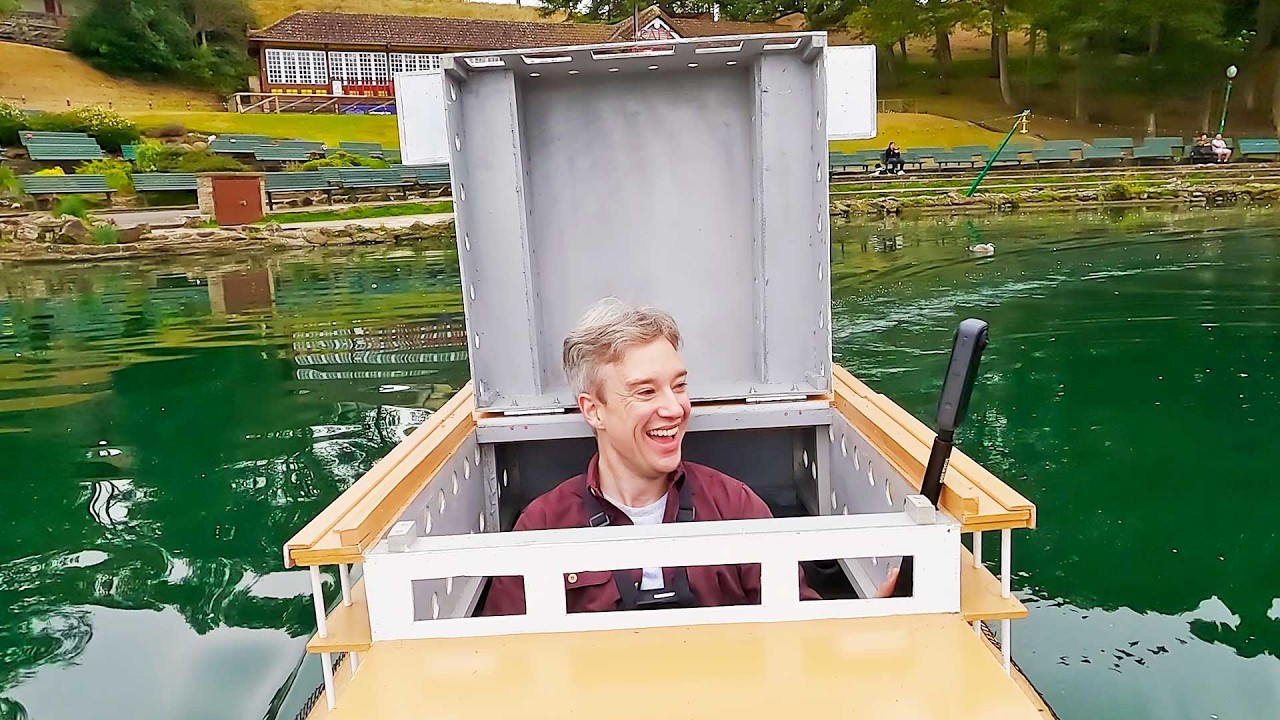
Do you remember that container ship, the Ever Given, that got stuck in the Suez Canal back in 2021? The final report into what happened came out a few months ago, as I record this, and there were a lot of things that went wrong. It was travelling too fast, there were communications problems between the crew and the local pilots, and there was the bank effect. There are two ways to learn what that is. You can get the theoretical explanation that big ships get sucked to the sidewalls by pressure differences when travelling at speed along canals. But if that seems a bit abstract, you can learn it hands-on. Because this is the Port Iława Ship Handling Research and Training Centre in the north of Poland. And this is one of the places where the folks who steer those big ships learn how to do it. Just to be clear, I'm not getting a full training course. That takes days and includes a huge amount of theory work and study as well. I'm just going to drive a miniature container ship for a lap around the lake, and... hopefully not get it stuck in the Suez Canal. We have started our training activity in 1980. In the '90s, we have moved from the old lake towards this one, and practically first training here was realized in 1991, more or less 30 years ago. We are performing training in ship handling. We have a lot of different mockups presenting different waterways. Everything was built using exactly the same scale, 1:24. Deep waters, shallow waters, different restrictions, rivers, canals. And what is more important? Of course, ship models. Permission to come aboard? Granted. (laughs) Okay. This is bigger than I thought it was going to be. It's one of the biggest in the world. 400 metre ship. 400 metre? Scaled down 1:24, that's still... 16 and a half. That's— Okay, this is big, cool. We can proceed. Dead slow ahead. So dead slow ahead? Yep. And steady as she goes. Forward. I assume that means just keep it going straight, okay. These are the tugboat simulators. Oh, I don't feel guilty about you... You've taken the controls here. I'd be on tugboats going out. I was meant to be asking all sorts of questions here, and I'm just slightly nervous about driving a tiny boat. It's not a 400m container ship. Yep. So you have controls there that simulate the effect of tugs on the boat. Right, four tugs. You may make a rather hard to port. Hard to port? I don't know why... but I thought I was going to spin that like the wheel of a pirate ship, and it's just a... Yeah. Alright, so what's our plan now? Okay, so now we can go through the lock if you like. Yeah, absolutely. Basically we go that direction, south of the island. I feel like I need to go left here. Yeah, make it port 10. Port, not left. We have had, in our history, more than 6,000 pilots, masters, and chief officers from more than 50 countries. On average, 220–230 a year. We have beginners, but we have also very experienced masters. Because the lock is very shallow... Yeah. We will have only 2cm of water under the keel. If we have too high a speed, we touch the bottom. So the faster I go in shallow water, the more the boat is going to get sucked down to the ground. More squat you have, yeah. We have to come in line with the lock. Oh! Sooner we do that, more time we have to apply any correction if necessary. That is such a tight spot to navigate through. Hard to starboard for a while. Hard to star— Starboard, starboard. The minute I feel like I've got this... It's all going to fall apart. Uh, midships? Yes, please. Yep. And starboard— yep. Starboard 20. And midships, yep. Oh, I think I've overcorrected there! There's some very strong work being done by the tugboats here, thank you. We have no clearance here! I feel like starboard slightly? Yeah, starboard 20. (winces) I can't see how close we are there. Did we clear that? Yes. I think we cleared that. Yes! (wheezes) Again, solid tugboat work. Midships, surely. Starboard 20. Okay! The basic training program takes five days. A linear scale, 1:24, means that timescale is equal to more or less five. It means everything happens five times faster than in reality. And feeling for a ship may be affected. It's a disadvantage. But on the other hand, five days of training will correspond to 25 days of training in reality. Hard to starboard. I'm more the helmsman than the captain at this point, thank you. Hard to port again. Hard to port. Left hand down a bit! Okay, I think we can make half ahead. We are clear of the lock. Oh, yeah.
Segment 2 (05:00 - 10:00)
Phew! Full ahead. Full ahead! (both laughing) Did I need to slam that forward so dramatically? Absolutely not, but... Our first models were really very simple. Nothing inside. Just wheel, engine telegraph, and that's it. And step by step... we have started to add different facilities. We have electronic navigation. It means a very precise GPS system, which allows to measure a given ship model trajectory with precision equal to one, maybe two centimetres. Suddenly the nerves have gone. Open ocean. Open lake. Starboard 10. 'Cause you've got to cancel out what you've just given it, right? Yeah. We're still going quite strongly to port just because that input from... The wind. Ages ago, and the wind? Due to the wind, yeah. I'm amazed how much the wind is affecting this. You have to imagine that such a ship, fully loaded, has about 20,000 square metres with the windage area. (heavy sigh) Everything during exercises is measured, sent to our classroom, and in case of problems, we can discuss step by step, and we can show where mistakes were made. Ooh!... I'm sorry, I got distracted by a cormorant. (both chuckle) Current, especially in the case of shallow water, is a big problem. It means we have current generators. This current velocity can be changed according to our needs. (metal colliding) I thought we hit something. Oh, we did. That's me, sorry. No problem. (nervous chuckle) It's not like this thing has rear-view mirrors. Okay, half ahead. Half ahead? We're sailing a massive container ship down the Suez Canal. Do I need to put a little bit of rudder in here? Yeah, it's fine. Now you have to go behind Varta. Right. You can make a port 10. Port 10, got it. I think we're clear of the red buoy. Midship. Midships. (winces) No, it's clear. Okay. Port 20. Midships. Okay. And a full ahead. Full ahead, okay! Starboard 20. Because we've got to ease out the turn. Then you will start feeling the bank effect from the starboard wall. Okay. Hard to starboard. So it feels like I could go midships now. We should just go straight down the middle of this canal. Except... The bank effect, you see, bow is coming out. It means the repulsion force pushes the bow. Now you have to make a hard to starboard. Gah, yeah! I'm being sucked towards the port wall! I'm putting full right lock on here. Midships. Midships, okay. You see, again, it's coming. Yep... it is! So we have to make hard to starboard. Hard to starboard, yeah, if I don't do hard to starboard— You would have hit this wall. Yeah. I'm absolutely gonna ram that if we're not careful. Yeah. That's so powerful! Midships. Yep. Yeah, hard to starboard. I was midships. We should have been going straight ahead. And I think... I have to help you with that task. Yeah, you're going to have to help with that. I should've done that earlier. Everybody down. Clear. Oh, cleared?! Midship. Hard to port now. (bewildered laugh) Hard to port. You were lucky, one inch clear. That was more luck than good judgment, that was! Our research is focused on ship handling. It means interaction forces, and... autonomous ships. We have started realisation of research programs three or four years ago, because... autonomous ships will be really very popular. We need at least ten ships' lengths... Yeah... to stop the ship. Ten ships' lengths? And that harbour is here. Oh, I definitely need to put some port in. Yes. Hard to port. Port 20. Hard to port, okay. Everything in case of our training centre is realised in real conditions. You can feel very well wind, current, and everything what deals with weather conditions. Such a situation does not happen in case when using computer simulators. And... especially pilots coming to our training centre for training prefer very often to use models instead of computer simulation. Every driver's instinct in me is going, "I can just slam it in reverse. Take it 'round, it'll be fine. " No, it won't. That's not how this works. Collisions really occur at our training centre. The main difference regarding computers and our models is in computers, in case of problems, you can switch off everything, and you can restart everything. That's okay. In the case of our training centre, the only one thing to do is to... call technical staff for rescue tugs. And quite often, our models are sent directly from the training centre to our "shipyard" for different repairing works. And this psychological effect influences
Segment 3 (10:00 - 10:00)
very much the level of education. People realise everything a little bit differently when comparing with computer simulators. Alright, we are home. (sighs) That was a privilege. Thank you very, very much. I know very few people get to do that. You're welcome, no problem. So thank you so much. Here, every instructor can do that (laughs)... very easily. [Caption+ by JS* caption. plus | @caption_plus] There is one thing I forgot to ask. Can I push the whistle button, please? (blare) Thank you! (laughs)