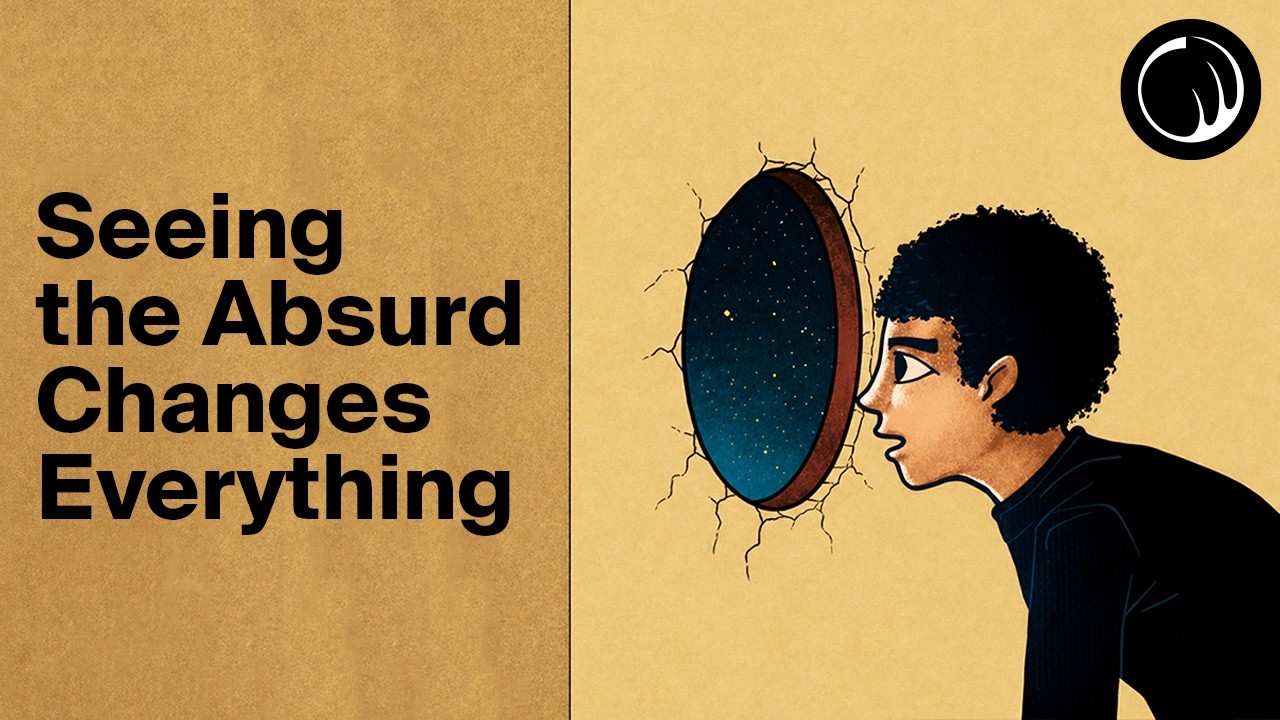
I'm happy to share that I have a new book coming out in March 2026. It's titled The Terrible Paradox of Self-awareness, and it explores many of the same themes found in this video and on the channel. It's available for pre-order now, which you can find through the link in the description. It was likely in a sliding glass door, a window, or a mirror, something you had been around many times prior. Only this time was different. It changed everything. For the first time, likely at some point between the ages of 1 and two, you recognized your reflection. You saw you, a face, clothes, a body, something that belonged to you, that was you. As you aged into and through childhood, your reflection began to lose its potency. It became a commonality of everyday existence. Your concerns with it likely turned mostly superficial. how your hair or makeup looked, if there were any pimples or blemishes on your face, how your clothes draped over you or showcased your tastes. That strange experience of the newness of self-awareness waned into the backdrop of your reflection, though it remains somewhere in frame. Perhaps occasionally, while glancing at a mirror in a bathroom or a car, we might pause and experience an intimation of it. The glance turns into a stare and we wonder, "What is that? Am I really inside there? " made of and contained by this body, a brain lodged somewhere in there asking these questions. How did I end up here? Why and how am I a human? In the words of anthropologist and writer Ernest Becker, we see in plain sight that we are in a heartp pumping, breathasping body, a material fleshy casing that is alien. If we look even closer, perhaps putting our nose almost right up against the reflecting surface, we might suddenly come to the visceral realization that our skin is wrapped around us. We might find our attention on the pores, the small hairs, the flakes or red marks. We might realize how much of us is happening independent of us. The hair is always slowly growing out, the flakes of skin always peeling and falling away, the oil always forming and rearranging. Our eyeballs move around in our skull, observing our reflection as it appears back in their small black pupils, which seem to consume reality like black holes sucking everything up into the singularity of consciousness. Regardless of how frequent or explicit one might experience this kind of moment, arguably all of us do experience a similar kind of phenomenon on a regular basis, just with less conscious intensity and explicitness. Every time we interact with or perceive others, there is at least a faint recognition and awareness that others can or are perceiving us. Depending on who we are, this recognition and awareness might be far more than faint. Regardless, in all cases, a feedback loop of mutual perception and objectification ensues. We perceive and judge each other from the outside, mapping assumptions onto behaviors and behaviors back onto assumptions. Other people become like mirrors. We see our reflection in their gaze and we feel the existential weight of being alive and aware. Describing the way our sense of self emerges through social reflection, sociologist Charles Kulie coined the term the looking glass self, which he defined as a three-fold process. First, we imagine how we appear to others. Second, we imagine how others judge our appearance. And third, we experience some sort of pride or shame associated with these imagined judgments and form our self-concept partly based on these feelings over time. Kulie writes, "As we see our face, figure, and dress in the glass and are interested in them because they are ours, so in imagination, we perceive in another's mind some thought of our appearance, manner, aims, deeds, character, friends, and so on, and are variously affected by it. " This also echoes a core concept in the work of 20th century existentialist philosopher Jean Paul Sartra who argued that our sense of self is significantly shaped by imagining the perspectives that others have of us. Our self-consciousness is revealed, exposed and often distorted through the gaze of others, perhaps creating more of an existential prism than a mirror. And in our attempt to interpret and align with how others see us, we often modify ourselves, including our own self-perception. This was famously explored and expressed in Sartra's play, No Exit, where three characters who have just died find themselves confined inside a small room with no windows or mirrors. At first, they don't fully understand where they are or what's happening. Soon, however, with each person now limited to knowing their appearance and character, only through how the others describe and judge them, it becomes clear they are in hell being tortured by each other. Estelle, one of the three characters, laments at one point. But how can I rely upon your taste? Is it the same as my taste? Oh, how sickening it all is enough to drive one crazy. The torture is their self-nowledge being constrained and affected by the others whose validation and control always seems to elude them.
Segment 2 (05:00 - 09:00)
This is where Sartra's famous line comes from. Hell is other people. Arguably, this is why it can often feel so strange or exhausting to be seen by others. to interact with others. We feel a dependency on their perceptions to understand and form our own. But in this dependency, we are compelled to be hypervigilant over how we come off. And if we want to ensure we come off in a way that is favorable, authentic, or both, we must constantly know, oversee, or modify ourselves. It is as if we are both the artist and security guard in an art gallery that solely contains the sculpture of our being. Everyone that walks by wants it to look a certain way from where they stand. If we fail in our role or feel as though we have, it's not because we aren't good at our job. It's because it's an impossible job to always do well. In the words of psychoanalyst Jacqu Lon, I see only from one point, but in my existence, I am looked at from all sides. Whether it's how we change the way we walk or talk when we encounter strangers. Whether it's how we dress or present our hair and makeup differently around certain people, or whether it's how and why we make decisions in life based on the expectations of those around us. We all experience the often hellish nature of being perceived. But in truth, hell isn't other people. It's us. It's how much we depend on other people seeing us certain ways. It's how much we depend on our reflection coming back to us as beautiful, pristine, controllable, and as expected. Arguably, the root of this dependency and subsequent disqu is the same one that causes the strange, disorienting experience of staring at ourselves closely in a mirror or becoming hyper aware of our body. We suddenly expand the scope of our awareness beyond the surface of our normal unmediated state, burrowing into our being. But ultimately we don't really know or understand what we find in the sense of what we think we are looking for. A solid, clear, consistent, authentic self. We find nothing. Everything dissolves away and only the strange arbitrariness of our existence remains. Often in these moments, we are reminded that our body is something other in constant motion largely beneath our awareness. We are reminded that for the most part, we played no role in forming it or the material that comprises it. We have merely appeared here in this place, in this body, in this mind, in this self. All of which, like the body, are also in constant motion and largely beneath our awareness and control. In our eyes, we see the windows to a vehicle we are fundamentally passengers to. When we loathe or resist this condition, fear or fret. When we yearn for control and to know ourselves in the world in a unified, static, consistent form, when we depend on things and people to always align with our expectations and desires, we stay in hell. Not because we don't find an ideal stable self or world, but because we expect and depend on what can never be had. If instead of fretting over or fighting it, we see and know the flux and absurdity and contingency of all things and we accept and embrace it, then we see that the doors of hell are always open. They are inside our mind and we control and guard them. We can at least on occasion walk out and see beyond the confines of the small room of judgment and fear and ego and hypervigilance. Outside the doors, there's nothing to resolve, nothing to fight, nothing to understand. There's only something to marvel at and wonder about like a 2-year-old child recognizing the reflection for the first time. And if you ever find yourself worried, hell is always there. If this video resonated with you, my new book explores many of the same ideas. The pains and wonders of being aware, the instability of the self, and the possibility of finding meaning and poise despite it all. It's called The Terrible Paradox of Self-awareness, and it's a project I've been working on for a while. Of course, with the book, these ideas have much more room to fully open up and provide you with more space to reflect better than any video format allows. If you've enjoyed Pursuit of Wonder videos or any of my previous books, I think this one might resonate with you the most out of anything. It comes out March 10th, 2026, and is available for pre-order now, which you can find using the link in the description. Pre-orders genuinely make a huge difference for the long-term success of the book. So, if you're interested, it would mean a great deal. And of course, as always, thank you so much for watching in general, and see you next video.