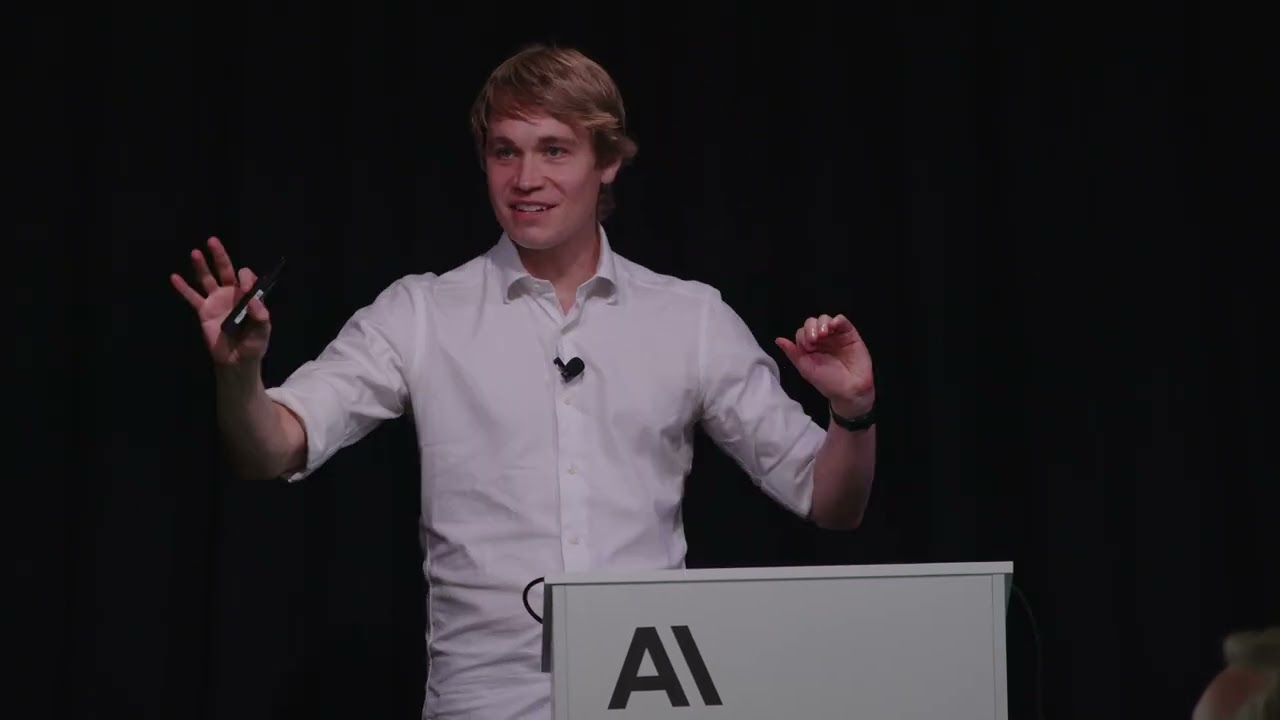
Vibe coding in prod | Code w/ Claude
31:17

Vibe coding in prod | Code w/ Claude

Anthropic 31.07.2025 140 767 просмотров 3 197 лайков обн. 18.02.2026
Поделиться Telegram VK Бот
Транскрипт Скачать .md
Анализ с AI
Описание видео
Presented at Code w/ Claude by @anthropic-ai on May 22, 2025 in San Francisco, CA, USA. Speakers: Erik Schulntz, Member of Technical Staff at @anthropic-ai
Оглавление (7 сегментов)

  1. 0:00 Segment 1 (00:00 - 05:00) 922 сл.
  2. 5:00 Segment 2 (05:00 - 10:00) 897 сл.
  3. 10:00 Segment 3 (10:00 - 15:00) 926 сл.
  4. 15:00 Segment 4 (15:00 - 20:00) 981 сл.
  5. 20:00 Segment 5 (20:00 - 25:00) 929 сл.
  6. 25:00 Segment 6 (25:00 - 30:00) 984 сл.
  7. 30:00 Segment 7 (30:00 - 31:00) 234 сл.
0:00

Segment 1 (00:00 - 05:00)

Hey everyone, welcome. I'm here to talk  about everyone's uh favorite subject,   vibe coding. Uh and somewhat uh controversially,  how to vibe code in prod responsibly. So let's   uh let's talk about vibe coding and like  uh what this even is. So first of all,   I'm Eric. I'm a researcher at Enthropic uh focused  on coding agents. Uh I was the author along with   Barry Zang of building effective agents where we  outlined uh for all of you our best science and   best practices for creating agents no matter  what the application is. Uh this is a subject   that's near and dear to my heart. Uh last year I  actually broke my hand while biking to work and   was in a cast for two months and Claude wrote all  of my code for those two months. And so figuring   out how to make this happen effectively uh was  really important to me and I was luckily able to   figure that out well and sort of help u bring that  into a lot of anthropics other products and in our   models through my research. So let's first start  talking about what is vibe coding. A lot of people   really conflate vibe coding with just extensive  use of AI to generate your code. But I think   this isn't quite true. A lot of people, you know,  they're using cursor, they're using co-pilot. Um,   it's a lot of AI and a lot of the code is coming  from the AI rather than them writing itself. But I   think when you are still in a tight feedback loop  with the model like that, that isn't truly vibe   coding. When I say vibe coding, I think we need  to go to Andre Carpathy's definition where vibe   coding is where you fully give into the vibes,  embrace exponentials, and forget that the code   even exists. I think the key part here is forget  the code even exists. And now the reason this is   important is that vibe coding was when people  outside of the engineering uh industry really   started getting excited about code generation.   Copilot and cursor were great but only sort of for   uh engineers but someone that didn't know how to  code uh suddenly with vibe coding they could find   themselves coding an entire app by themselves.   And this was a really exciting thing and a big   unlock to a lot of people. Now, of course, uh  there were a lot of downsides of this and you   had people coding for the first time and really  without knowing what they were doing at all. Um   and you said, "Hey, you know, random things  are happening, max out usage on my API keys,   people are bypassing the subscription, creating  random [ __ ] on the DB. " Uh, and so, you know,   this is kind of the downside of vibe coding  of what started happening. And the positive sides   of vibe coding that you'd see were all things  that were really kind of low stakes. It was   people building video games, building sort of fun  side projects, things where uh it's okay if there   was a bug. So, you know, why do we even care about  vibe coding if it seems like something where the   stakes are really high if you do it for a real  product? And the most successful cases of it are   kind of these toy examples or fun things where  the stakes are very low. And my answer for why   we should care about vibe coding is because of the  exponential. The length of tasks that AI can do is   doubling every seven months. Right now we're at  about an hour. And that's fine. You don't need to   vibe code. You can have cursor work for you. You  can have clawed code write a feature that would   take an hour. Um, and you can review all that code  and you can be still be intimately involved uh,   as the AI is writing a lot of your code. But  what happens next year? What happens the year   after that? When the AI is powerful enough that  it can be generating an entire day's worth of   work for you at a time or an entire week's worth  of work, there is no way that we're going to be   able to keep up with that if we still need to move  in log stack. lock step. And that means that if we   want to take advantage of this exponential, we  are going to have to find a way to responsibly   give into this and find some way to leverage this  task. Um, I think my favorite analogy here is like   compilers. I'm sure in the early day of compilers,  a lot of developers, you know, really didn't trust   them. They might use a compiler, but they'd still  read the assembly that it would output to make   sure it looks, you know, how they would write the  assembly. But that just doesn't scale. You know,   at a certain point, you start needing to work on  systems that are big enough that you just have   to trust the system. The question though is how  do you do that responsibly? And I think sort of   my challenge to the whole software industry  over the next few years is how will we vibe   code in prod and do it safely? And my answer  to that is that we will forget that the code   exists but not that the product exists. Thinking  again to that compiler analogy, you know, we all
5:00

Segment 2 (05:00 - 10:00)

still know that there's assembly under the hood,  but hopefully most of us don't need to really   think about what the assembly actually is. But we  still, you know, are able to build good software   without understanding that assembly under the  hood. And I think that we will get to that same   level with software. And one thing I really want  to emphasize is that this is not a new problem.    How does a CTO manage an expert in a domain where  the CTO does not is not themselves an expert? How   does a PM review an engineering feature when they  themselves can't read all the code that went into   it? Or how does a CEO check the accountant's  work when they themselves are not an expert   in financial accounting? And these are all, you  know, problems that have existed for hundreds or   thousands of years and we have solutions to  them. A CTO can still write acceptance tests   uh for an expert uh that works for them even if  they don't understand the implementation under   the hood. They can see that these acceptance tests  pass and that the work is high quality. A product   manager can use the product that their engineering  team built and make sure that it works the way   they expected uh even if they're not writing  the code. And a CEO can spot check key facts   that they do understand and slices of the data  so that they can build confidence in the overall   financial model even though they themselves might  not be an expert in how the entire thing flows.    And so thinking about these examples u managing  implementations that you yourself don't understand   is actually a problem as old as civilization. And  every manager in the world is actually already   dealing with this. Just we as software engineers  are not used to this. We are used to being purely   individual contributors where we understand  the full depth down to the stack. But that's   something that in order to become most productive,  we are going to need to let go of in the way that   every manager in order to be most productive is  going to need to let go of some details. And just   like us as software engineers, you know, we let  go of some of the details of like understanding   the assembly itself that's happening under the  hood. And the way that you do this while still   being safe and being responsible is to find an  abstraction layer that you can verify even without   knowing the implementation underneath it. Now I  have one caveat to that today which is tech debt.    So right now there is not a good way to uh measure  or validate tech debt without reading the code   yourself. Most other systems in life you know  like the accountant example uh the PM uh you know   you have ways to verify the things you care about  without knowing the implementation. Tech I think   is one of those rare things where there really  isn't a good way to validate it other than being   an expert in the implementation itself. So that is  the one thing that right now we do not have a good   way to validate. However, that doesn't mean that  we can't do this at all. It just means we need to   be very smart and targeted where aware of where  we can uh take advantage of coding. My answer to   this is to focus on leaf nodes in our codebase.   And what I mean by that is parts of the code and   parts of our system that uh nothing depends on  them. they are kind of the end feature. They're   the end beller whistle. Um rather than things that  are the branch or trunks beneath them like here   in white. Uh here the orange dots are all these  leaf nodes where honestly if you have a system   like this it's kind of okay if there is tectet in  these leaf nodes because nothing else depends on   them. They're unlikely to change. they're unlikely  to have further things built on them versus the   things that are in white here, the trunks and the  underlying branches of your system. That is the   core architecture that we as engineers still need  to deeply understand because that's what's going   to change. That's what other things are going  to be built on and it's very important that   we protect those and make sure that they stay  extensible uh and understandable and flexible.    Now the one thing I will say here is that the  models are getting better all the time and so   we might get to a world where you know this gets  further and further down where we trust the models   more and more to write code um that is extensible  and doesn't have tech debt. Um using uh you know   the clawed 4 models uh over the last week or two  within anthropic has been a really exciting thing   and I've given them much more trust uh than I  did with uh 3. 7. Um, so I think that this is going   to change and sort of more and more of the stack  we will be able to work with in this way. So let's   talk about how to succeed at vibe coding. And my  uh main advice here is ask not what Claude can do
10:00

Segment 3 (10:00 - 15:00)

for you but what you can do for Claude. I think  when you're vibe coding you are basically acting   as a product manager for Claude. So you need to  think like a product manager. What guidance or   context would a new employee on your team need to  succeed at this task? I think a lot of times we're   too used to doing sort of a very quick back  and forth chat with AI of make this feature,   fix this bug, but a human if you know if it was  their first day on the job uh and you just said,   "Hey, implement you know this feature," there's no  way you'd expect them to actually succeed at that.    You need to give them a tour of the codebase. You  need to tell them what are the actual requirements   and specifications and constraints that they need  to understand. And I think that as we vibe code,   that becomes our responsibility to feed that  information into Claude to make sure that it has   all of that same context and is set up to succeed.   When I'm working on features with Claude, I often   spend 15 or 20 minutes collecting guidance into a  single prompt and then let Claude cook after that.    And that 15 or 20 minutes isn't just me, you  know, writing the prompt by hand. This is often   a separate conversation where I'm talking back and  forth with Claude. It's exploring the codebase.    It's looking for files. We're building a plan  together that captures the essence of what I want,   what files are going to need to be changed, what  patterns in the codebase should it follow. And   once I have that artifact, that all of that  information, then I give it to Claude, either   in a new context or say, "Hey, let's go execute  this plan. " And I've typically seen once I put   that effort into collecting all that information,  Claude has a very, very high success rate uh of   being able to complete something in a very good  way. And the other thing I'll say here is that   you need to be able to ask the right questions.   And uh despite the title uh of my talk,   I don't think that vibe coding and prod is for  everybody. I don't think that people that are   fully non-technical should go and try to build  a business fully from scratch. I think that is   dangerous uh because they're not able to ask  the right questions. be an   effective product manager for Claude when they  do that and so they're not going to succeed.    We recently merged a 22,000line change to our  production reinforcement learning codebase   that was written heavily by Claude. So how on  earth did we do this responsibly? Uh and yes,   this is the actual screenshot of like the diff uh  from GitHub for the PR. Um the first thing is we,   you know, asked what we could do for Claude. This  wasn't just a single prompt that we then merged.    There was still days of human work that went  into this of coming up with the requirements,   guiding Claude and figuring out what the system  should be. And we really embraced our roles   as the product manager for Claude uh in this  feature. The change was largely concentrated   in leaf nodes in our codebase where we knew it  was okay for there to be some tech debt because   we didn't expect these parts of the codebase to  need to change in the near future. And the parts   of it that we did think were important that would  need to be extensible, we did heavy human review   of those parts. And lastly, we carefully designed  stress tests for stability. Uh, and we designed   the whole system so that it would have uh very  easily human verifiable inputs and outputs. And   what that let us do these last two pieces is it  let us create these sort of verifiable checkpoints   so that we could make sure that this was correct  even without understanding or reading the full   underlying implementation. Our biggest concern  was stability and we were able to measure that   even without reading the code by creating these  stress tests and running them for long durations.    Uh and we were able to verify correctness based  on the input and outputs of the system that we   designed it to have. So basically we designed  this system to be understandable and verifiable   even without us reading all the code. And  so ultimately by combining those things we were   able to become just as confident in this change  as any other change that we made to our codebase   but deliver it in sort of a tiny fraction of the  time and effort um that it would have taken to   write this entire thing from hand uh by hand and  review sort of every line of it. Um, and I think   one of the really exciting things about this is  is not just that this saved us, you know, a week,   a week's worth of human time, but knowing that we  could do this, it made us think differently about,   you know, our engineering, about what we  could do. And now suddenly when something   costs one day of time instead of two weeks,  you realize that you can go and make, you know,   much bigger features and much bigger changes.   uh sort of like the marginal cost of software   is lower and it lets you consume and build more  software. So I think that was the really exciting
15:00

Segment 4 (15:00 - 20:00)

thing about this is not just saving the time but  now kind of feeling like oh things that are going   to take two weeks let's just do them. It only  it's only going to take a day. Um and that's   that's kind of the exciting thing here. So to  leave you with the closing thoughts about how   to vibe code in prod responsibly. Uh be Claude's  PM. Ask not what Claude can do for you, but what   you can do for Claude. Focus your vibe coding  on the leaf nodes, not the core architecture and   underlying systems so that if there is tech debt,  it's contained and it's not in important areas.    Think about verifiability and how you can know  whether this change is correct without needing to   go read the code yourself. And finally, remember  the exponential. It's okay today if you don't vibe   code, but in a year or two, it's going to be a  huge disadvantage if you yourself are, you   know, demanding that you read every single line  of code uh or write every single line of code.    You're going to not be able to take advantage of  the newest wave of models that are able to produce   very large chunks of work for you. Uh and you  are going to become the bottleneck if we don't get   good at this. So overall that is uh vibe coding  and prod responsibly. uh and I think this is going   to become one of the biggest challenges for the  software engineer for the software engineering   industry over the next few years. Thank you. And  I have uh plenty of time for questions. Yeah, in the past we spent a lot of time dealing with  syntax problems or libraries or connections   amongst components of the code and that was how  we learn by coding like that. But how do we   learn now? How do we become better by coders? How  do we know more to become better product managers   of the agent KI? Yeah, so the uh I think this is  a really interesting question and I think there   are reasons to be very worried about this and also  optimistic about this. I think   the reason to be worried like you mentioned  is that you know we are not going to be there in   the struggle in the grind. Um I think that that  is actually okay. I've met uh you know some of my   professors in college would say like ah man like  coders today aren't as good because they never had   to write their assembly by hand. They don't really  feel the pain of you know how to make something   run really fast. Um I think the positive side of  this is that I have found that I'm able to learn   about things so much more quickly by using these  AI tools. A lot of times when I am coding with   Claude um I'll be reviewing the code and I'll say  hey Claude I've never seen this library before.    Tell me about it. like what is it? Why did you  choose it over another? And having sort of that   always there pair programmer. Um like again I  think what what's going to change is that people   that are lazy are not going to learn. They're  just going to glide by. But if you take the time   and you want to learn, there's all these amazing  resources and like Claude will help you understand   what it vibe coded for you. Um, the other thing  I will say is that for learning some of these   higher level things about what makes a project  go well, what is a feature that gets you product   market fit versus flops, we're going to be able  to take so many more shots on goal. I feel like   uh especially sort of like system engineers or  architects over it takes, you know, oftentimes   like two years to like make a big change in a  codebase and really kind of come to terms with   was that a good architecture decision or not. And  if we can collapse that time down to 6 months,   I think engineers that are investing in their  own time and trying to learn, they're going to be   able to, you know, learn from four times as many  lessons in the same amount of calendar time as   long as they're putting in the effort to trying.   Yeah. Going back to your pre-planning process,   uh, what's the balance between giving it too much  information and too little? Are you giving it a   full product requirement document? Is there kind  of a standardized template that you put together   before you actually move into VIP coding? Yeah.   Um, I think it depends a lot on what you care   about. Um, I would say that uh if it ranges  for there's for things where I don't really   care how it does it, I won't talk at all about  the implementation details. I'll just say these   are my requirements like this is what I want  at the end. There's other times where I know   the codebase well and I will go into much more  depth of like, hey, these are the classes you   should use to implement this logic. Look at this  example of a similar feature. Um, I'd say it all   comes down to sort of what you care about at the  end of the day. Um, I would say though that like   our models do best when you don't over constrain  them. So, um, you know, if you I wouldn't put too   much effort into creating sort of a very rigorous  uh, you know, format or anything. I would just,   you know, think about it as like a junior engineer  what you would give them in order to succeed. So, oh, sorry if I went too loud. Uh, how did  you balance effectiveness and cyber security?
20:00

Segment 5 (20:00 - 25:00)

Like there were reports a couple months back  of like the top 10 vibecoded apps being super   vulnerable and a lot of important information  was released. Well, not released but proven to   be released and the person who did it wasn't  even like a pro hacker and stuff and so   like there's that. How did you balance being able  to keep things secure even at a leaf node level   uh and then also being effective because  something can be effective but not secure? Yeah,   that's a great question and I think that all  comes down to this first point here of like   being Claude's PM and understanding enough about  the context to basically know what is dangerous,   know what's safe, and know where you should be  careful. And I think yeah, the things that   uh get a lot of press about vibe coding are  people that have no business coding at all   uh doing these. And that's fine. That's  great for games. That's great for like   uh creativity and like having people be able  to create. But I think for production systems,   you need to know enough about like what questions  to ask to guide Claude in the right direction. And   for our internal case of this example, um  it was something that's fully offline. And so   we knew there weren't any like there were uh we  were very confident that there was like no   security problems that could happen into this.   Uh in our case it's like run in something that's   that's fully offline. Uh so this is more about  people you're mentioning as like have no business   and maybe I shouldn't have said it like that  but no business vibe coding in production for   an important system. I will say that.   Yeah. But if we look at the numbers right   we Less than 0. 5% of the world's population are  software developers and software is an amazing way   to scale ideas. So how do you think the products  need to change to make it easier for people to   v code and build software while also avoiding  some of the things that we run into with people   leaking API keys and things like that? That's a  really great question and I would be super excited   to see more products and frameworks emerge that  are kind of like provably correct. Uh, and maybe   what I mean by that is I'm sure people could build  some backend systems that the important off parts,   the payment parts are built for you and all you  have to do is sort of fill in the UI layer. Um,   and you know, you can vibe code that and it  basically gives you some nice fill-in-the-blank   sandboxes where to put your code. Um, I feel like  there's tons of things like that could exist.    And maybe like the simplest example is like claude  artifacts where uh Claude can help you write,   you know, code that gets hosted right there um  in Claude AI to display. And of course that is   safe because it is very limited. There is no off  there is no payments. It's front end only.    But uh maybe that's a good like product idea  that someone should do here is build some   way to make like a provably correct hosting system  that can have a backend that you know is safe no   matter what shenanigans happens on the front end.   But yeah, I hope people build good tools that are   complements to vibe coding. Hi. Um so for test  driven development, do you have any tips because   like I often see that cloud just splits out the  entire implementation and then writes test cases.    um sometimes they don't they fail and then I just  want you know I'm trying to prompt it to write the   test cases first but I also don't want to like you  know verify them by myself because I haven't seen   implementation yet so do you have an iteratable  approach that you know have you ever tried it   for yeah test driven development yeah I I  definitely uh test driven development is very   very useful in vibe coding um as long as you can  understand what the test cases are even without   that it helps claude sort of be a little bit more  self consistent even if you yourself don't look   at the tests. Um, but a lot of times, uh, I'd say  it's easy for Claude to go down a rabbit hole of   writing tests that are like too implementation  specific. Um, when I'm trying to do this,   a lot of times I will encourage I will give Claude  examples of like, hey, just write three endto-end   tests and, you know, do the happy path, an  error case, and this other error case. Um,   and I'm kind of like very prescriptive about that.   I want the test to be like general and end to end.    And I think that helps make sure it's something  that I can understand um, and it's something that,   um, uh, that Claude can do without getting too in  the weeds. I'll also say a lot of times uh when   I'm vibe coding the only part of the code or at  least the first that I'll read   is the tests to make sure that you know if I  agree with the tests and the tests pass then   I feel pretty good about the code. Um that works  best if you can encourage Claude to write sort of   very minimalist endto-end tests. Thank you for the  very fascinating talk. Um, I also appreciate that
25:00

Segment 6 (25:00 - 30:00)

you've done what a lot of people haven't done and  tried to interpret one of the more peculiar lines   in Karpathy's original post, embrace exponentials.   So, I wonder if I could pin you down a little more   and say, how would I know if I've embraced the  exponentials? Like, what precisely means following   that advice? And to maybe put it down a  little more in what I think it intends to mean,   it sort of maybe alludes to this, the models  will get better. Um, do you think there's   some legitimacy in saying just the fact that the  models will get better doesn't mean they'll get   better at every conceivable dimension we might be  imagining we hope they'll be in. Yeah. Uh,   so yeah. So how do I embrace exponentials,  sir? Yeah, absolutely. So the uh I think you   got close with sort of the quote of uh keep  assuming the models are going to get better,   but it's a step beyond that. the idea of  the exponential is not just that they're going   to keep getting better, but they're going to get  better faster than we can possibly imagine. Um,   and that's kind of like when you can kind of  see the shape of the dots here. It's not just   that it's getting steadily better, it's that it's  getting better and then it's it goes wild. Um,   I think the other funny quote I heard from this  this was a I think in uh Daario and Mike Kger's   talk is uh machines of loving grace is not science  fiction. It's a product roadmap. uh even though   it sounds like something that's very far out like  when you are on an exponential uh things get wild   very fast and faster than you expect. Um, and  I think, you know, if you talk to someone   that was doing computers in the 90s, it's like,  okay, great. We have a couple kilobytes of RAM.    more kilobytes of RAM. Uh, but  if you fast forward to where we are now, it's like   we have terabytes. And it's like, it's not just  that it got twice as good, it's that things got   millions of times better. And that's what happens  with exponentials over a course of 20 years. So,   we shouldn't think about 20 years from now is like  what happens if these models are twice as good.    We should think about what happens if these models  are a million times smarter and faster than they   are today, which is wild. Like I we can't even  think about what that means. In the same way that   someone working on computers in the 90s, I don't  think they could think about what would happen to   society if a computer was a million times faster  than what they were working with. But that's what   happened. And so that's what we mean by the  exponential is it's going to go bonkers. All   right. Yes. I got a couple well I got one question  but it it's kind of two parts. The first   part when it comes to via coding I have like two  different workflows. I have one where I'm in my   terminal and then I have one when I'm in VS code  or cursor. Um which workflow do you use and   if you're using cloud code in the terminal how  often do you compact? Because what I find is   um my functions will get a new name as the longer  I vibe code or you know just things kind of go   off the rails the longer I go and if I compact  it still happens if I create like a document to   kind of guide it I still have to you know get it  back on track. Yeah. Great question. Um I do   both. I often uh code with uh clawed code open in  my terminal in VS Code. Um, and I'd say that like   clawed code is doing most of the editing and I'm  kind of reviewing the code um as I go in uh in VS   Code, which you know is not true vibe coding in  the sense here. Uh, or maybe I'm reviewing just   the tests uh from it. Um, I like to compact  or just start a new session kind of whenever   I get clawed to a good stopping point where it  kind of feels like, okay, as a human programmer,   like when would I kind of stop and take a break  and maybe like go get lunch and then come back.    If I feel like I'm at that kind of stage, that's  like a good time to compact. So maybe I'll start   off with having Claude find all the relevant files  and make a plan and then I'll say okay like   you know write all this into a document and then  I'll compact and that gets rid of 100k tokens that   it took to create that plan and find all these  files and boils it down to a few thousand tokens. Hey uh so one question is following up uh his  previous question which is uh have you used   other tools along with cloud code to like increase  your speed a little bit more like running multiple   cloud codes together using git work trees and then  like sort of merging few things or stack PRs or   something like that. Is that something that you  like personally follow or would advise to? Second   question is um how do you like how do you very  structurally and like in a very nice engineering   like um like way approach a part of the codebase  that you're not very familiar with but you want to   like ship a PR in it really fast and you want to  do it in a really nice way and not wipe code it.    So yeah like what are the what are your ways  of like using cloud code to help do both these
30:00

Segment 7 (30:00 - 31:00)

things? Yep. Uh, yeah. So, I definitely use clawed  code as well as cursor. Um, and I'd say typically   I'll like start things with clawed code and then  I'll use cursor to fix things up. Or if I was   like if I have very specific changes, if I know  exactly the change that I want to do to this file,   I'll just do it myself uh with cursor and sort of  target the exact lines that I know need to change.    Um the second part of your question was um oh  yeah like uh how to get spun up on a new part   of the codebase. Um before I start trying to write  the feature I use clawed code to help me explore   the codebase. So I might say like tell me where  in this codebase off happens or you know where in   this codebase something happens. Tell me similar  features to this and like have it tell me the file   names. classes that I should  look at. Um, and then kind of use that to try to   build up a mental picture to make sure that I  can do this and not vibe code. Make sure I can   still get like a good sense of what's happening.   And then I go work on the feature with Claude. Uh,   thank you so much. I'll be still around  and can Miller and answer other questions.

Ещё от Anthropic

Ctrl+V

Экстракт Знаний в Telegram

Транскрипты, идеи, методички — всё самое полезное из лучших YouTube-каналов.

Подписаться