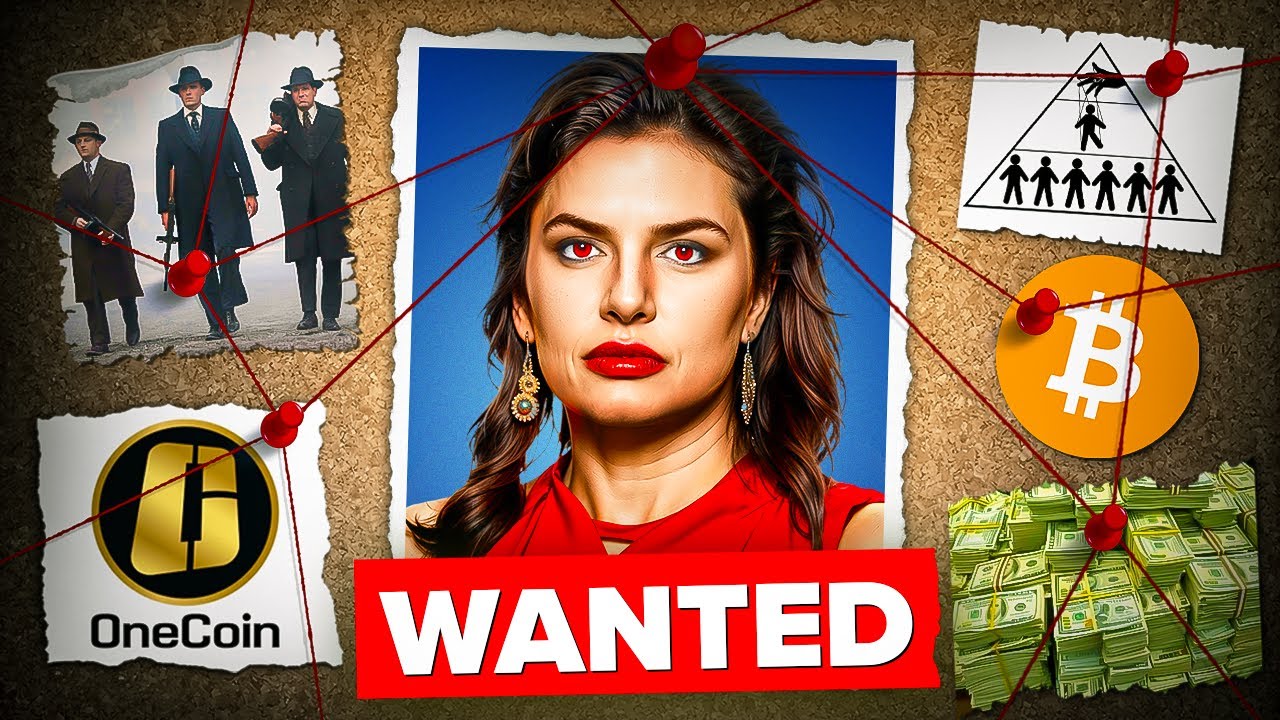
Notorious cryptocurrency scammer Dr. Bruha Ignativa made billions of pounds selling a fake cryptocurrency called OneCoin. This is the only woman on the FBI's most wanted list, and she is responsible for one of the biggest scams in history. She led millions of believers in her cult-like company to trust her with their life savings before abandoning them and escaping with billions. It was basically a get-richqu scheme, a Ponzi scheme, a pyramid scheme, and a crypto scam all combined into one colossal multi-billion dollar fraud. But how did she do it? And where is she now? Even years later, this is a story shrouded in mystery as her whereabouts are still unknown, and there's a $5 million reward if you can find her. One theory says she lives in Dubai with a new name and a new face. Another claims her body sits dismembered at the bottom of the Mediterranean. But either way, evidence suggests she might be one of the wealthiest criminals ever. This is a story filled with gangster hit squads, mafia, espionage, and corrupt Saudi royals. It's a story with betrayal, apartments filled to the ceiling with cash, and a billiondoll empire built on lies and manipulation. This is the sinister true story of OneCoin and the search for the evil queen of crypto. Roua Ignatova was born in a poor Bulgarian city in 1980. But at the age of 10, her family fled to Germany in the hope of a better life. Growing up, Roua was very bright. But that led to her feeling like she was better than everyone else around her. She became increasingly obsessed with the idea of getting rich and vowed to become a millionaire before she was 30. After finishing school, Roua got a scholarship to a German university, then a PhD in law, followed by a degree from Oxford University. With her impressive qualifications, she landed several prestigious jobs. First at the Bulgarian branch of McKenzie, a top consulting firm, and then at Bulgaria's largest investment company. There she became extremely wellconed as sheworked with important business people, politicians, and celebrities. But it still wasn't enough for her. She was now 31 and still not a millionaire. And dealing with wealthy clients and international banks all day only made her more desperate to build her own fortune. So in 2013, she started to seriously research Bitcoin, a new idea in finance that had started to get people's attention. At the time, Bitcoin was only a few years old, but its price had recently been shooting up. Because of Roua's financial background, as well as her extensive network, she was in great demand to speak about cryptocurrency at seminars and events around Europe. And at one seminar in November of 2013, a man called Sebastian Greenwood watched her speak and how well she captured the crowd during her crypto talk. After she left the stage, Sebastian pushed his way over to her and asked a question that would change her life forever. Have you ever considered multilevel marketing? With multi-level marketing companies known as MLMs, you typically buy their product through a seller directly, not from a store or website. That seller isn't an employee of the company earning a salary, but instead they earn a commission on every sale they make. This allows MLM companies to get an army of individual sellers working on their behalf. But that's just one way you can make money. You can also recruit other people to sell and you'll earn commissions on any sales they make. And when those people recruit more people
Segment 2 (05:00 - 10:00)
you earn commissions from them as well, which starts to look a lot like a pyramid. If you get in early, you can make a lot of money. But most people who join MLMs don't. However, at the crypto conference where Roua had been giving a speech, she got chatting with Sebastian about their shared interests, especially about how they both wanted to get rich. Sebastian had already made money from running an MLM before, but he felt the hype around this new crypto technology presented a huge opportunity. What if they teamed up to create their own crypto project, but used multi-level marketing to sell it? There were plenty of MLMs and plenty of new crypto projects, but combining the two together could be powerful. If they had a network of sellers working on commission, it would help drive up the price of the coin, and then coin would help bring more people into the network, creating a powerful growth cycle. Sebastian's MLM expertise meant he could handle sales, whilst Rouger's banking experience and polished look made her the ideal face of the company. They would call it OneCoin. They came up with a plan to target a whole new audience. People who weren't techsavvy, who didn't understand how crypto worked, but understood MLM and wanted to get rich. However, there was one major obstacle in their way. Neither Roua or Sebastian actually knew how to create the blockchain they needed. But then they realized this could be an advantage. By not actually having a blockchain and instead just telling people they did, it would mean they could set the price of their coin to whatever they wanted. Rouger would simply keep a record of how many onecoins someone bought on an SQL database, basically a glorified Excel spreadsheet. With their plan in place, Roua and Sebastian officially registered the company in Jibralta and Dubai. And Roua also opened a physical office in her home city in Bulgaria. They proudly announced that OneCoin would be the Bitcoin killer. But unlike Bitcoin, which had a fixed supply of 21 million, OneCoin would have 2. 1 billion coins. However, the difference between legal multi-level marketing and an illegal pyramid scheme is whether the company has an actual product or not. For example, Herbal Life uses multi-level marketing, but since they have a real tangible product, it's legal. But in 2014, when OneCoin was starting, cryptocurrency regulation was practically non-existent. And so Roua and Sebastian weren't sure that OneCoin would classify as a real product. They definitely didn't want to risk attention from regulators. And so they found a loophole. Instead of people directly buying OneCoin, customers would buy education packages. These contained a basic PDF file with information about finance and investing. The material by itself was pretty poor quality, often had spelling mistakes, and much of it was plagiarized. But that didn't matter because customers were buying these education packages for an entirely different reason. With each package, you also received free tokens which could be exchanged for one coin. Depending on which package someone bought, they got a different number of OneCoin tokens as a free bonus. The more expensive package you bought, the more tokens you got. This way, OneCoin was officially selling a product, these education packages, even though everyone was really buying them for the OneCoin tokens. So, now that they had their product, Roua and Sebastian began persuading MLM sellers to come sell for OneCoin, and they offered a generous commission plan. If you sold someone a OneCoin package, you got a 10% sales commission. But if anyone you refer also makes a sale, you got 10% commission on all their sales, too. For example, you sell your friend a onecoin package worth €5,000. You get €500. But then later, your friend sells someone else a one coin package worth €5,000. Not only does your friend get €500 commission, but since you recruited them, you get €500 from that sale as well, and this can continue indefinitely as people refer others. 60% of commissions would be paid out in real money, and the remaining 40% would be paid out in one coin. It was simple, but lucrative. But finally, there was the extra twist that set OneCoin apart from every other MLM. You could not only make money from selling onecoin and recruiting others, but also from OneCoin
Segment 3 (10:00 - 15:00)
increasing in value over time. Rucha promised that at some point soon, OneCoin would be listed on a crypto exchange platform, so it could be traded at any time for real money. And this is where things started to get crazy. The pitch for buying OneCoin was simple but powerful. Roua said she had taken all of Bitcoin's problems and fix them. Rouger said Onecoin was the people's coin. She said Bitcoin was too complicated as people needed their own wallets and private keys. Whereas OneCoin was simple as you just signed up to their website. She said Bitcoin was about speculation and it was slow and inefficient as a currency whereas OneCocoin was focused on everyday use. She said Bitcoin was anonymous and used by criminals whereas OneCoin was centralized and monitored so it was safe from crime. And finally, Bitcoin's founder was unknown and had disappeared. Whereas the founder of Onecoin had a degree from Oxford and was seemingly a very trustworthy and competent businesswoman. Roua frequently talked about her time working for McKenzie, consulting for Fortune 500 companies, and working with Wall Street banks. So, Roua had everything she needed to make Onecoin seem instantly trustworthy. Roua then began speaking at live events and hosting webinars. She taught the world doing radio shows, interviews, and anything she could to sell people on how Onecoin would change the world. And she always emphasized her PhD, referring to herself only as Dr. Rouger. She essentially created a new public persona. Whereas Roua's fashion sense used to be understated, Dr. Rouger wore bright red lipstick and eye-catching designer dresses. And in videos, she prominently displayed her degrees on the wall behind her and spoke about having lots of money. Now, at this point, one news story was going viral about a man who spent $27 on Bitcoin in 2009. And now that the price had shot up, his crypto made him a millionaire. And there were countless more stories of ordinary people getting in early on Bitcoin and making life-changing money. So, Rouger exploited this fear of missing out as nobody wanted to miss out on the next big crypto. Onecoin felt like people's chance and Roua assured everyone would eventually be even bigger than Bitcoin. Meanwhile, Sebastian recruited more of his connections from the MLM world who were top sellers. Using their networks and OneCoin's lucrative promises, the scam was fully underway. A lot of sales came from parties, lunches, and DMs on Facebook. Many people got introduced to OneCoin from someone they knew with a simple message. Do you know about Bitcoin? Well, I heard about a new cryptocurrency that's going to be even bigger. Little did these people know, they were getting their friends and family to invest in a giant scam. But OneCoin's biggest sales channel of all was public live events. They always reminded the audience how they'd missed out on Bitcoin and that this was a once- ina-lifetime opportunity to get in early on a new and better crypto project. Through a combination of misplaced trust, greed, playing on people's emotions, and fear of missing out, Roua and Sebastian got people from all over the world to start buying OneCoin packages. And of course, those people who bought in then told other people. And so word began to spread and momentum began to build. The combination of emotional manipulation techniques to get crowds excited and the perceived authority and credibility of Dr. Rouger was convincing. Rouger even won Bulgaria's businesswoman of the year award which only accelerated OneCoin's growth. The fact that the entire crypto space was booming at the time also helped. But another tactic OneCoin used to convince investors everything was legitimate was that they distributed copies of Forbes magazine with Dr. Rouger on the cover. How could this be a scam if Rouger was in Forbes magazine? What they didn't realize is that she'd simply paid for an ad in Forbes which appeared a few pages into the magazine and she then tore off the first few pages to make people think she was the cover star. And since it was in the Bulgarian version of Forbes, they couldn't read the disclaimer that said it was a paid ad. Just like everything else about
Segment 4 (15:00 - 20:00)
OneCoin, it was a lie. The reality was OneCoin was a get-richqu scheme from the start, but it was now multiple different frauds allinone. Firstly, it was a Ponzi scheme as the only reason they were able to pay out referral commissions to early investors was by using the money from new investors. Secondly, since OneCoin was nothing but a spreadsheet with madeup prices masquerading as a digital currency, it was essentially a fake crypto scam, merely using crypto terminology to hype up what they were doing as some kind of financial revolution and confuse vulnerable people into not understanding how it works. And thirdly, since they didn't have an actual product, this meant it was also a pyramid scheme. However, Rouer and Sebastian were already discussing what to do if they got caught. Rouger's suggestion was simple. Disappear and let someone else take the blame. In November of 2014, investors packed into a small conference room at a hotel to hear Rouger talk about her vision for OneCoin. And there she made two big announcements. Firstly, starting in 2 months, OneCoin would sell for actual money on their internal exchange site called Xcoin X. And secondly, OneCoin's price was set at 54. A buzz went through the crowd. They did the maths and realized that a $5,000 education package with 48,000 coins would immediately be worth $26,000. So, the investors scrambled to buy packages after the news. By Christmas, 10,000 people had bought packages worth millions of dollars in total. Then in January alone, OneCoin did 15 million in sales. That same month was the official opening of OneCoin's exchange, where people could trade their OneCoin for actual money. But there was a catch. People were only allowed to withdraw a maximum of 1. 5% of their OneCoin into real money each day. And there was an upper withdrawal limit. Roua claimed it was just temporary because she feared a bank run and wanted to protect people's investments. But of course, the truth was far more sinister. People could only cash out a small amount of their coins because the company was a giant Ponzi scheme, simply using the money from new investors to pay up those who were cashing out. That's why instead of listing on a popular crypto exchange like Coinbase or Kraken, OneCoin was using its own internal site called Xcoin X, which they had full control over, which is how Roua was just changing the price to whatever she wanted, which is why it always seemed to go up. However, investors didn't seem to mind the strict withdrawal limits because everyone believed in the promise of OneCoin's future. Sure, it was 54 cents per coin now, but the price would surely increase soon, so why sell now and regret cashing out early? And because people could at least exchange a small amount of OneCoin for cash, it made everything feel legitimate as they were actually trading a small amount of OneCoin for real money. So throughout 2015, OneCoin continued to grow beyond everyone's expectations. 60 million in sales in March, 85 million in April, and then the rate grew even faster in May when Roua announced OneCoin's price had doubled, now $18 per coin. Investors were delighted to see their balance on the OneCoin website jump up so fast. Little did they know, OneCoin's value was just Rou plucking a random number out of thin air. But these regular price increases would be used by Rouger to ensure investors didn't want to withdraw their money. The fear of missing out was very real and it was Rouger's number one tool to keep people hooked on OneCoin. Onecoin also started introducing more expensive education packages like the premium trader package for €12,500 with around €40,000 OneCoin tokens. Sure, €12,500 seemed like a lot, but people could see on the exchange that'd be worth around €40,000, so it seemed like a great deal. OneCoin started packing out arenas with music performances and fireworks and thousands of chanting fans. At these events, OneCoin would sell more education packages. But they'd also put a lot of focus on the top sellers in the company. Those at the top of the pyramid who are now earning hundreds of
Segment 5 (20:00 - 25:00)
thousands a month from selling one coin to others. These top sellers were publicly gifted Rolex watches partly to thank them, but mostly to inspire the lesser sellers to up their game next month and sell more. To many, OneCoin became a family. At events, investors discussed how they'd spend their newfound riches. When OneCoin went public on one of the main crypto exchanges like Coinbase, as at that point they could trade all of their OneCoin for cash, Rouger kept promising they'd be going public very soon. So investors all excitedly shared their dream homes and vacations they were planning to buy. They even created a sign, your finger and thumb in the shape of an O, to show you were part of the family. By October, OneCoin's price had risen again. this time to around $2. 50 per coin. And by November 2015, one year after OneCoin's exchange opened, it hit $1 billion in sales. Money was coming in faster than they could handle it. Roua bought a luxury apartment in Hong Kong simply to store the money stacked floor to ceiling with cash from investors. Thanks to their network of thousands of sellers, all recruiting more sellers, OneCoin just kept growing rapidly. And to help increase the pressure to buy more, OneCoin would frequently have one-time special offers on their education packages. Investors didn't question the huge rise in OneCoin's supposed value because it made sense to them. The hype around one coin was what was bumping up the price. And then the higher prices increased the hype further. Plus, people desperately wanted to believe. For hundreds of thousands of regular people all across the world, OneCoin was a beacon of hope. For some, it represented the opportunity to escape a dangerous country, send their children to college, or finally stop being so worried about money. A family from a council estate in London invested 20,000. A single mother in Tennessee invested a h 100,000. And more than 50,000 Ugandans had joined the pyramid. Some of them selling their homes, their land, and even their animals to get in. But OneCoin was growing far faster than Roua had ever imagined. And this was about to bring some major problems. by the end of 2015, OneCoin was growing too big too quickly. Of all the money coming in, onethird of it was paid out as referral commissions, which meant tens of millions of dollars had to be sent to over a 100 countries around the world. Even with Rouger's financial background, moving millions of dollars each month into her various accounts was bound to attract attention. In one case, a bank in Dubai grew suspicious of these high transactions being paid out to accounts in the Cayman Islands, Uganda, and Malta, places notorious for illegal activity. So, the bank froze $50 million in assets, leaving OneCoin scrambling for cash. So, Roua developed a plan. She contacted a Saudi royal chic, a man who was fascinated by new technology. Roua convinced the chic to give her four USB memory sticks containing 230,000 Bitcoin, which at the time was worth around $50 million. In exchange, she gave the chic a large amount of OneCoin and ownership of her Dubai company. as using his influence, he'd be able to contact the bank and get it unfrozen. But still, Roua needed to find a more permanent answer to these banking problems. And so that's when she reached out to a financeier she knew from her earlier days in banking. Gilbert, Armentor. Gilbert was an international financial expert with experience operating the books for less than legal companies. And so he became Onecoin's private banker and he was very aware exactly what Rouger was asking him to do. In his calendar, Gilbert wrote his first call was to discuss money transfer and laundering issues. As they worked together, Roua and Gilbert grew close, very close. Roua started cheating on her husband with Gilbert. By the end of 2015, Roua and Gilbert set up what became known as the Fiero Funds. Four separate accounts, each with over a hundred million. These
Segment 6 (25:00 - 30:00)
accounts in the British Virgin Islands and the Caymans, helped REA move money around the world easier, without worrying about banks freezing their accounts or asking too many questions. It was essentially a 9 figure money laundering operation. Now, Roua and the OneCoin team were free to spend all the money they were making. Rouger wore necklaces worth hundreds of thousands of dollars. She commissioned a $7. 5 million yacht for private parties. She bought a luxury flat in London and a penthouse in Dubai. But even though Roua had solved her money problems, by the end of 2015, she had an even bigger problem. They were running out of one coin to sell. When Roua created Onecoin, she announced it had a capped amount of 2. 1 billion coins, never imagining she would reach that limit in her lifetime. But growth had been so much faster than she ever imagined. And by mid 2016, she had already sold more than 2. 1 billion. Now, of course, investors believed that OneCoin had its own private blockchain, so it would be impossible to sell more than what was programmed at the start. But in reality, OneCoin didn't have a blockchain, which meant Rouger could sell an infinite amount. The problem was she'd repeated so many times about the hard limit of 2. 1 billion. And if anyone ever worked out they'd sold more than this, OneCoin's perceived credibility would be instantly destroyed. On the flip side, if she stopped selling coins, she wouldn't have any new money coming in. So, she wouldn't be able to afford the tens of millions of payouts she was making every week in referral commissions. Roua knew that unless she came up with a solution, she and her company would both be exposed for the frauds they were. So, Roua came up with an audacious idea. She would announce a new blockchain. This one with 120 billion coins. Changing blockchains completely contradicted everything Rouger had been saying for years about having a fixed supply that could never be altered. She had literally told people at events, "I cannot print more. " But in June 2016, OneCoin hired out Wembley Stadium for a packed crowd of thousands to make a few historic announcements. As with all OneCoin events, there were motivational speeches and hypemen shouting about how everyone was getting rich. And when Dr. Rger came out on stage to Alicia Keys's This Girl is on fire and pyrochnic displays, the crowd erupted in massive cheers. In her speech, she projected the vision of OneCoin that it would soon be bigger than any cryptocurrency. She said that within 2 years, no one would even talk about Bitcoin anymore. And this was when she dropped her big news. Roua said if Onecoin wanted to be the world's number one cryptocurrency, they had to improve their technology and make room for more investors. That's why in a few months time, OneCoin was launching a new blockchain. She said it was more powerful, safer, and instead of 2. 1 billion coins, it would have 120 billion one coins up for grabs. We will retire the old blockchain and switch on the new one. But Roua promised in October when the new blockchain came out, the price per coin would stay the same. And as a thank you to their loyal supporters for getting in early, investors would have their one coins doubled. What we will do as a company, we will double the coins on your accounts. People wept, they cheered, they posted on social media about becoming rich. Investors were so excited by this news that they didn't stop to consider the truth that Roua had just violated every financial, investing, and crypto rule there was. If you significantly increase the supply of coins, the value of each coin should fall drastically. And yet, Roua was somehow saying the price was staying the same. It didn't make any economic sense, but the announcement about their coins being doubled worked as a perfect distraction. But wait, there's more. Rou also announced a new ultimate trader education package that cost a whopping €118,000.
Segment 7 (30:00 - 35:00)
But because Roua made a point to say that people's coins were only ever going to be doubled once, people rushed to buy this useless new education package so they could get double coins. Rouger said the package would give you enough OneCoin to earn €14 million once the new blockchain launched. So people teamed up and took out loans to afford it. And sure enough, in October 2016, OneCoin users logged into their accounts, and as promised, their coins appeared to have doubled. Better yet, OneCoin's price had increased again. It seemed like everything was going perfectly. Of course, in reality, the price of OneCoin was merely a number invented by Roua that she was periodically increasing to keep investors happy. and they could still only sell a tiny fraction of their OneCoin for actual money. But most of OneCoin's non-technical investors were too indoctrinated to question anything, and they didn't want to because when OneCoin finally went public, they'd be set for life. However, outside of OneCoin, this latest stunt from Roua was starting to attract some serious attention. With the massive growth of OneCoin came an increase in skeptics and doubters. People started commenting online that OneCoin's price always seemed to go up unlike a normal coin which would fluctuate. and commenters pointed out that expecting 300% returns within months was ridiculous. One website called behindmlm. com worked hard to expose onecoin and accused it of being a gigantic Ponzi scheme. However, even though there were clearly a lot of red flags, many found it hard to believe a billiondoll cryptocurrency didn't have a blockchain. Besides, Roua had such great credentials and hundreds of thousands of people had invested. So, OneCoin leaders called anyone who questioned their project a hater. Any negative media was dismissed as rumors spread by jealous and uninformed haters trying to destroy OneCoin. Unfortunately, OneCoin's cult-like following of investors trusted Rouger blindly. They had been indoctrinated not to trust outsiders. But as more critics began to grow online, Roua found out she was pregnant and she started thinking about her endgame. By this point in 2016, she was running out of people she could trust. So she fired her PA and hired her brother Constantin as her new personal assistant. Rouer's brother was a forklift operator and a bodybuilder. And until now, he'd been uninvolved and uninterested in OneCoin. But he couldn't help but notice how much money Rouger was throwing around. So he quit his forklift job and naively accepted a position at OneCoin. This was not because his sister wanted to help him. The dark truth was that Roua viewed him as a solution to her problems if everything went wrong. As long as she kept her brother close enough, she could eventually pin everything on him. Since OneCoin had begun, Roua had promised everyone that OneCoin was kept honest and secure through her blockchain technology. Even most of the OneCoin staff were kept in the dark about the reality that there was no actual blockchain. All the records were simply kept on an SQL database and thus could be easily changed. Of course, the entire point of blockchain is that the data is decentralized and someone can't just edit the records. So, it was the exact opposite of what they claimed it to be. Now, most investors didn't fully understand the technology, but they were confident the OneCoin blockchain existed because why wouldn't they? This was a multi-billion dollar company with millions of people invested. It had audit reports. Roua was on magazine covers and they could see their OneCoin balance on the site. But with the increased scrutiny now surrounding OneCoin, Roua felt she desperately needed to create an actual blockchain to try and quieten the doubters. Of course, she couldn't just ask her own IT team to create it, or else she would expose herself as a liar from the start. So, in September 2016, OneCoin sent out
Segment 8 (35:00 - 40:00)
a LinkedIn message to Bjorn Barake, an expert in helping companies transform their old SQL databases into new blockchains. Bjorn had a decade of IT experience with banking, and he was a crypto enthusiast who knew all about blockchains and crypto companies. But there was one problem. Bjön had never heard of OneCoin, and to him, something seemed off about the job offer. Onecoin promised Bjorn a $270,000 salary, plus two furnished luxury apartments in Sophia and London, if he could help them create a new blockchain. Hearing this, Bejorn had even more questions. How could a cryptocurrency like OneCoin exist? It seemed to earn billions. So, how could it not already have a blockchain? It didn't make any sense. But, of course, there's been a lot of transactions already. So, how do I incorporate that into a new blockchain, which is, as we know, uh, completely impossible because there is no coin. It's just transactions, right? So, Bejorn logged on to the OneCoin exchange to find out what was really happening. The website showed a seemingly live display of OneCoin's blockchain, showing all of the transactions as they happened. But if there wasn't a blockchain, then what was really happening here? Bjorn decided to test it. He opened up three monitors, two with OneCoin accounts and the third with the live display. He transferred random amounts between the two accounts and watched the display to see if he could match his transactions. He tried numbers that were easy to spot, like sending 1. 234 coins. In total, he tried around 200 different transactions to track his own movements, but he never saw any of his transactions on the live feed. The disturbing truth soon became clear to Bjorn. OneCoin's live display was just a front, nothing more than a random display of numbers to look good. It was merely a script generating fake transactions between imaginary wallets to fool investors that their coins were held securely on the blockchain rather than meaningless entries on a database controlled by Rouger. No wonder she could double people's coins at will or change the price whenever she wanted. It was just a basic database not driven by supply and demand like an actual cryptocurrency. This scared Bjorn because that meant millions of people owned billions of fake coins. He turned down OneCoin's job offer and instead joined the growing number of people on social media calling out OneCoin as a scam. Behind MLM. com reached out to Bjorn and he agreed to give an interview on the site exposing what OneCoin asked him to do and what he believed was actually happening behind the scenes. The interview started to pick up some traction, and the more people dug, the darker the lies that surfaced. Researchers even uncovered that the auditing company OneCoin used was owned by Roua herself. Everything, it seemed, was fake. And behind MLM. com was exposing it all piece by piece. As for the people who had invested in OneCoin, many of them heard these accusations and started to question OneCoin themselves. But the problem was accepting these accusations meant everything they had believed was a lie and that was too difficult to take. That would mean these people who'd invested their life savings based on Rou's promises had lost everything. They might have wiped out their savings accounts and school funds and loans all on a useless fake coin. And these people who had convinced their own family and friends to join them and buy OneCoin as well would have inadvertently scammed their loved ones. Onecoin investors were so desperate to believe Rouger that many of them doubled down on their belief that OneCoin must be real. It was easier to believe the lie than accept the truth. Rouger promised investors that these outside doubters were just haters. Meanwhile, OneCoin started threatening to shut down people's accounts if they publicly asked too many questions, which helped silence investors who raised concerns. In fact, some people who tried to point out the truth about OneCoin were sent death threats. In January 2017, people logged on to OneCoin's exchange site and saw an ominous
Segment 9 (40:00 - 45:00)
message. This site is under maintenance. At first, people just assumed it was an annoying technical problem that would soon be fixed. But time went on. The exchange stayed down and investors grew increasingly worried. Buyers messaged their recruiters pleading for information. "Don't worry," they would say. "It's just a glitch. " But the recruiters themselves were stalling, unsure themselves what was going on. Days turned into weeks, and OneCoin headquarters stopped taking calls. The truth was, Rouger had shut down the exchange site on purpose without telling anyone the real reason. By now, OneCoin's price was listed at $8. 50 per coin, its highest price ever. This meant Rouger was technically selling $500 million worth of OneCoin every day. It was too much. The scam was slipping out of her control, and she couldn't afford to keep paying people even with the ridiculous withdrawal limits. So, she had to stop people from cashing out their OneCocoin completely. The fact people had always been able to withdraw a small amount of their OneCoin into real money is what gave people confidence it must be real. And their confidence is what helped refer more victims. But now they couldn't withdraw anything as the site was constantly under maintenance. And so the panic started to creep in. People who'd sold land, cars, and borrowed money from family to pay for it now had no way to get any onecoin out. And this should have been the moment that OneCoin collapsed. But Bitcoin then started making a massive run, going from a,000 to $5,000 in months. People grew greedy again, afraid that if they demanded their money, they'd miss out on a similar growth when OneCoin finally broke through. Plus, when Roua finally broke her silence about the exchange being down, she tried to wave away all concerns by offering some good news. Roua claimed that the exchange was simply shut because they were finally having an initial coin offering, launching OneCoin on a public exchange site. Her followers had been waiting for this for years as it would allow many of them to cash out fully and become incredibly wealthy. The only catch was that she said people had to wait a little while longer for the paperwork to go through, but she urged them to be patient. In reality, Roua was stalling and had secretly been planning something very different. She knew that OneCoin was in serious trouble. With all the negativity online and allegations of being a scam, fewer people were buying OneCoin, leaving her with less money to pay out those commissions and cash outs. Just like any Ponzi scheme, it only works until people stopped getting paid. And Rouger knew the end was near. Rouger had never planned for OneCoin to get this big, but now it was too big to disappear under the radar as OneCoin's all-time revenue had recently surpassed €3 billion. So, she grew increasingly stressed and announced to her team she was stepping back temporarily, using the excuse of extended maternity leave after having her baby. Her brother, Constantin, took over in the meantime. Meanwhile, Roua started looking for a way out of the Fiero funds, where she kept $400 million. She used some of her shady connections, including Bulgaria's most prolific drug trafficker of all time, to help move money without alerting anyone. Within a few months, Roua had turned her $400 million into assets she could liquidate easily or use if she wanted. things like investments in Bulgarian tobacco companies, horse racing circuits in Dubai, and a $7 million superyachts. By the spring of 2017, she had emptied the OneCoin accounts into private funds that no one could access but her. Interestingly though, it wasn't the money laundering or the pyramid scheme that would finally topple her empire. It was Rou's affair with OneCoin's banker. For almost 2 years, Roua and Gilbert had been having an affair. And by the summer of 2017, they were talking about leaving their respective spouses and getting married. But whilst Roua was in love with Gilbert, Gilbert kept postponing the decision. After a few months, Roua started getting suspicious that Gilbert was stringing her along to take
Segment 10 (45:00 - 50:00)
advantage of her money. And so she took matters into her own hands. Roua told her lawyer, who used to be a spy at an intelligence agency in Luxembourg, to use some of his old tricks and see if he could find a way to listen in on Gilbert's conversations with his wife. So Rou's lawyer/spy rented the apartment below where Gilbert lived and installed a listening device below his bedroom. When the recordings came in, it was abundantly clear that Gilbert was indeed using Rouger for her money. But they also revealed something else, and it kept Roua up at night. The FBI was investigating Gilbert for an extortion charge that was completely unrelated to OneCoin, but Roua was afraid they would find incriminating documents about her on Gilbert's computers. And it was even worse than Roua feared. In September of 2017, US authorities had already secretly indicted and arrested Gilbert on moneyaundering and extortion charges. and Gilbert turned on Rouger immediately, offering to become an informant to help the feds build their case against OneCoin and Rouger. The FBI started recording all of Gilbert's calls between himself and Rouger. By this point, Roua was very paranoid about OneCoin's future and her escape plan. So, she called Gilbert every day to talk about her money, completely unaware that Gilbert had sold her out and become an FBI informant. even though they used an encrypted line. At one point, Roua scolded Gilbert to be more careful with what they said on the phone. What she didn't realize is that FBI agents were sitting right next to him, listening to her every word. Meanwhile, the OneCoin network was getting noisy and restless, demanding answers. Rouger kept trying to stall for time, promising answers and big plans very soon. But in the midst of all this, in October 2017, Roua called her brother Constantin and demanded he book a flight for her in a few days time to Vienna. The next day, she called him again to book another flight on the exact same day, but this time to Athens. Constantin was confused, but Roua assured him she'd be back soon. On October 25th, 2017, Roua boarded an early morning flight from Sophia to Athens. This was the last time anyone would ever hear from her. Hey legends, it's John here, creator of Magnates Media. I've got three quick exciting updates for you. Firstly, I'm now approaching my 100th documentary on this channel, which means if you like this video, there's a whole lot more on this channel you can go watch after. But I also want to keep leveling the quality of these videos even higher. So, if you want to see the crazy projects I'm working on next, please consider subscribing and turning notifications. Secondly, I'm going to be posting more on Twitter or X. So, if you want behindthe-scenes stuff or you want to grow your own YouTube channel or business, please go follow Magnates Media, link in description. And now the final news. You may know I launched my own YouTube program where I'll help you make money from YouTube by running your own faceless channel about whatever you're interested in. So you don't have to spend years figuring everything out like I did. But I know some of you don't need my full YouTube system. You just want to learn video editing. So you can now get the video editing course by itself for a lower price. You'll learn from start to finish how these videos are made and how you can create viral videos step by step. Click the link in the description now to get your space and I'll see you there. Back at OneCoin, no one, not Sebastian, not OneCoin staff, not even her brother Constantin knew what was going on. No one could reach Roua. She was scheduled to speak at a conference in Lisbon, but she never showed up. News of her disappearance spread throughout the OneCoin community. Although top sellers and staff tried to quiet the panic, nobody had any real answers to give. The exchange website wasn't working. The plans to list on a public exchange were delayed again, and their beloved leader was gone. Finally, in January 2018, Bulgarian police conducted a raid at OneCoin's head office. With warrant in hand, they burst in and took servers, laptops, files, and anything else they could find. Authorities were able to prove that there was no blockchain, no cryptocoin, and no money left in the OneCoin accounts. Many of Onequin's victims were
Segment 11 (50:00 - 55:00)
normal everyday people. As the realization sunk in that they would never get their money back, they grew increasingly depressed and some even threatened to end their lives. There are two ways to count up the losses of this scam. The first is how much people actually spent buying one coin with estimates ranging from 4 billion to 15 billion. The second way is to count up the loss of what people expected they had, which was far higher. For context, with Bernie Maidoff's Ponzi scheme, which lasted for decades and had been considered the largest Ponzi scheme ever, people's paper loss was $60 billion. In comparison, those who weren't able to cash out their OneCoin were owed over a hundred billion. Around 3. 5 million people are believed to have bought into OneCoin. Of those, only 50,000 are believed to have made any money. Within that group, just 5% took almost all of it, and none of them were regular investors. So, there were a tiny fraction of people at the top of the pyramid who got in early and made money just from referring others. But the vast majority of people involved lost everything, and many now faced financial ruin. Onecoin was constantly bombarded with demands for refunds. Refunds they could never give because the billions were gone. Over the next few months, financial analysts working with the international police found that Roua had used just about every trick in the book to conceal the money she was collecting from people. Shell corporations owned other shell corporations, all registered in various countries, and the names of unsuspecting people she had paid to sign the papers. As for Constantin, in Rou's absence, he had become the face of Onecoin. Unfortunately for him, he learned too late that his sister had been planning to put him in this position all along. Back in 2014, before OneCoin had made a single sale, Roua already knew her exit strategy. In a leaked email, Roua wrote that should anything go wrong, she would disappear and leave the blame on someone else. And that person turned out to be her own brother. Even though Constantin valued loyalty to family above all else, he found out his own sister had betrayed him, using him from day one so she could be free with her billions. However, Constantin was definitely not innocent himself. Maybe when he first came into the company, he was. He'd initially just been Rou's assistant, and he knew nothing about running a business or cryptocurrency. But in a leaked message between him and Sebastian, they described people who had invested in OneCoin as idiots. Constantin said, "As you told me, the network would not work with intelligent people. " He was clearly well aware of the scam, just not aware that he was the full guy. And things soon got worse for him. Shortly after Rouger disappeared, Constantin was pushed into a minivan by a Bulgarian gang. They broke one of his fingers and threatened to cut off body parts unless he could come up with their money. A few weeks after that, the motorcycle gang, Hell's Angels, cornered Constantin in a hotel room and put a gun in his mouth. They told him that the money they'd invested in one coin was worth far more than his life. Constantin realized he needed to get money quickly to pay off these dangerous groups coming after him. But without Rouger, he couldn't access any of the funds or shell companies where OneCoin's money had been funneled away. So he decided to do what OneCoin had always done, scam people. He flew to underdeveloped countries in South America, Africa, and Asia, where he gave starving people the opportunity of a lifetime to buy OneCoin's education packages, which were of course completely worthless. But news of OneCoin scam wasn't well publicized in these places. After defrauding more poor and desperate people, Constantin returned home in March 2019. On his way, he stopped for a few days in California where he was arrested by the FBI and taken to a maximum security prison in New York. He paid for the best lawyer money could afford, the same lawyer used by Mexico's most feared drug kingpin. But Constantin was still denied bail and formally charged with wire fraud. In the end, Constantin plead guilty to all the crimes he'd been accused of, signed an agreement to cooperate with the authorities in their search for Roua, and was sentenced to 20 years in prison. A few cell blocks down from Constantin was Sebastian, who'd also been arrested, sentenced to 20 years in prison, and fined $300 million. In fact, all major parties involved in OneCoin have been arrested except for Roua.
Segment 12 (55:00 - 59:00)
Still, no one has seen her. So, where did she go? How can one of the most high-profile criminals just disappear? Before we get to the next chapter, let's talk about how you can save money with today's sponsor, ShipStation. If you're running a business, managing orders can be very chaotic. And that's why I'm a big fan of ShipStation as they make it so easy to automate shipping tasks. ShipStation seamlessly integrates with services and selling channels you already use and so you can manage all your orders on one simple dashboard. But the best part is that ShipStation is the fastest, most affordable way to ship products to your customers. You literally get discounts up to 88% off UPS, DHL Express, and USPS rates. And you also get up to 90% off FedEx rates. So basically, ShipStation can save you time, make your customers happier, and also save you money. That's why over 130,000 companies have grown their e-commerce businesses with ShipStation already. So calm the chaos of order fulfillment with the shipping software that delivers. Go to shipstation. com/magnates to sign up for your free trial. That's shipstation. com/magnates. On October 25th, 2017, Roua took a flight from Sophia in Bulgaria to Athens in Greece. And then she got in a car with some Russian-speaking men. That is all we know for certain. However, around the world, police were trying to find Roua, and investors and journalists have had plenty of theories on where she is. Firstly, Roua surely changed her appearance soon after disappearing. One source claimed she had dyed her hair blonde and possibly had plastic surgery to alter her face. One claim is that she escaped to Dubai, sheltered by her Saudi royal connections, or possibly that she was arrested by Dubai authorities who wanted her to hand over the password for the Bitcoin on those four USB drives that she gave her. Another possibility is that Roua was killed by angry investors that got to her or the Russian and Bulgarian mafia who'd used Onecoin to launder money. Supposedly, one of Bulgaria's crime bosses known as Tachi ordered a hit on Roua a year after her disappearance, and she was thrown into the sea, never to be seen again. But this was just a story passed down with no actual evidence. But as journalists dug in further, they heard anonymous tip offs that Roua had been seen in ports around the Mediterranean, spending most of her time in international waters. However, theories continue to float around and still to this day, Rouger is on the FBI's top 10 most wanted list. The FBI offers $5 million for anyone with information that leads to her capture. Perhaps the most insane part of this story is that if Roua is still alive somewhere, she could still have those four USB drives worth 230,000 Bitcoin. When she got them in 2015, they were worth around 50 million. But as of today, they're worth around 20 billion. So, ironically, despite advertising herself as the Bitcoin killer, she could be one of the largest Bitcoin holders in the world and also one of the wealthiest criminals in history. We hear of crypto scams a lot these days, but none of this size. And to make this much money and not even have a real blockchain is what makes this so unique and crazy. But if you thought Rouger's fake crypto scam was wild, you have to check out the story of the man who sold the Eiffel Tower twice. Just click the thumbnail on screen right now and I'll see you there in a second. Cheers.