For a brief moment, the Apollo program made the Moon feel closer than ever - now, after 50 years, NASA is sending humans back. It may look like just a flyby under the Artemis program - but this time, the long-term plan isn’t to visit. It’s to stay. Hi, I'm Josh and on today's episode of The Infographics Show, we'll reveal how NASA will build a city on the moon. NASA’s Artemis program has already given us some impressive milestones. In 2022, Artemis I sent an uncrewed Orion spacecraft on a successful loop around the Moon and back - proving, at least, that the hardware works. Artemis II, scheduled to launch in 2026. This time, astronauts will be aboard. The mission will retrace that journey around the Moon - testing life support, flight systems, and every human-rated component during a high-stakes lunar flyby. So what comes after the flyby missions? And why does NASA even want to go back to the moon? The truth of it is that NASA isn’t just going back to the Moon - they’re heading somewhere no human has ever set foot before. This time, the target is deeper, darker, and far more extreme. When the Apollo astronauts touched down on lunar soil between 1969 and 1972, they all landed near the lunar equator. And it made sense. The equator had flat terrain and predictable landing conditions - it was a relatively safe environment for 1960s technology. It was the cosmic equivalent of dipping your toes in the shallow end of the pool. Mission accomplished, flags planted, humanity inspired. But future Artemis missions will throw out that entire playbook. Their eventual target is Shackleton Crater, at roughly 89 degrees south - at the Moon’s south pole. And this isn’t random. It’s a calculated pivot to the one location that could make a permanent human presence actually possible. To understand why, you need to grasp one of the most bizarre paradoxes in our solar system. The lunar south pole is a fascinating case study in celestial survivability. Within just a few miles of each other, you’ll find two opposite extremes that shouldn’t coexist. At least not logically. On one hand, you’ve got the Peaks of Eternal Light - mountain rims and crater edges that are bathed in sunlight. Not all day, but pretty close. It’s a lot like living near the parts of Earth’s poles that experience the “Midnight Sun. ” Now, why does this happen? Earth’s poles get 6 months of darkness because our planet tilts at 23. 5 degrees. The moon? Its axial tilt is just 1. 54 degrees. So barely tilted at all. This means the sun never climbs high in the lunar polar sky. It just sort of crawls along the horizon, endlessly circling the same lateral plane. Some peaks catch that low-angle sunlight almost continuously - locations like the rim of Shackleton Crater and Malapert Mountain where the sun basically never sets - unlike the lunar equator. A permanent base at the lunar equator would face around 14 days of pitch-black freezing cold darkness. You’d need a massive battery system just to keep the lights on during those two-week blackouts. It’s an economical and logistical nightmare waiting to happen. But at the south pole, you get near-constant solar power. It’s like finding a cheat code in the Moon’s operating system. And NASA wants to exploit that. Now here’s where things get wild. Just a stone’s throw away from these sunlit peaks, you’ve got the exact opposite. Permanently shadowed craters that haven’t seen a single photon of sunlight in over 2 billion years. That’s not an exaggeration, either. There are hundreds of these permanently shadowed craters known on the moon, each maintaining temperatures lower than -200 degrees Celsius (-328 Fahrenheit) - cold enough to freeze oxygen solid. Anything that’s unlucky enough to drift into one of these shadows will get locked in place, effectively frozen in time for eternity. And that’s what brings us to the Moon’s most valuable resource. Inside these perpetually shadowed regions - scientists call them PSRs - lies something worth infinitely more than Moon rocks… water ice. A NASA probe on India’s Chandrayaan-1 mission detected approximately 600 million metric tons of water ice in just the north polar PSR alone. NASA’s Lunar Prospector estimated 6 billion metric tons scattered across both poles combined. For decades, scientists actually thought the Moon was bone-dry. Analyses of Apollo soil samples seemed to show it was completely anhydrous, or waterless. And that made sense. Any water vapor on the sunlit surface gets instantly decomposed by solar radiation, But those permanently shadowed craters? Total game changer. Lunar water exists in multiple forms. You've got small chunks of ice - maybe 4 inches (10 centimeters) across or smaller - mixed into the regolith, or lunar dust, like frozen gravel in dirt. But there’s another form of water too - chemically bonded with minerals at the molecular level. It’s not pooled or flowing; it’s dispersed, locked into the soil itself. In the top few feet of the lunar regolith, concentrations range from about 5 to 30% by weight. Scientists have even detected trace water molecules in the Moon’s ultra-thin atmosphere and tiny amounts on the sunlit surface - but those pale in comparison to the reserves in the cold traps. Even if we take the most conservative estimate - from 100 million to 1 billion metric tons of water ice per pole - we’re still looking at enough water to sustain lunar operations for a long time.
Segment 2 (05:00 - 10:00)
And that’s what’s making NASA engineers excited. Because on the Moon, water isn’t just water. It’s survival. The difference between a brief visit… and actually living there. Think about what it takes to keep a human alive in space. You need air - specifically oxygen - to breathe. You need propellant and fuel to move spacecraft around. You need shielding from the relentless cosmic radiation. Normally, all of that has to come from Earth - at a huge cost. But water? Water is all three problems solved with one resource. Run an electrical current through it - a process called electrolysis - and you split water into hydrogen and oxygen. That oxygen becomes breathable air. Now you don’t need regular shipments from Earth to breathe. You just need some power, ice, and some relatively simple equipment. And that same hydrogen and oxygen you just produced? Combine them as liquid propellants and you've got Hydrolox - one of the most efficient chemical rocket propellants possibles. Spacecraft can now refuel on the Moon. Then there's radiation. Cosmic rays are a massive problem for long-term lunar habitation. Radiation levels are significantly higher than Earth’s background radiation - up to 100 - 200 times more. They slice through metal, they damage DNA - they're a silent killer. And that’s exactly where water becomes a lifesaver. It’s phenomenal at blocking that radiation. Better than aluminum, better than most materials we could realistically transport. Surround your habitat with water tanks and you've got a radiation shield and a resource reserve. Now, let’s talk dollars - this is where the lunar south pole shifts from a scientific curiosity to strategic goldmine. Historically, launching anything into orbit costs between $10,000 and $25,000 per kilogram. Today, reusable rockets like SpaceX’s Falcon 9 and Falcon Heavy have slashed that figure to roughly $2,000–$5,000 per kilogram under typical commercial pricing. That’s a revolution by historical standards. But space is still brutally unforgiving. Want to send a single ton of water for drinking, life support, or fuel production? You’re still looking at roughly $2–$5 million. All for something that literally falls from the sky on Earth. But the Moon's gravity is one-sixth of ours, about 5. 32 feet per second squared (1. 6 meters per second squared) versus Earth's crushing 32. 2 (9. 8). That’s not only easier to launch, it’s significantly cheaper. Sending a ton of water from the lunar surface takes a fraction of the energy, fuel, and a fraction of the cost compared to launching it from Earth. A mission to Mars needs hundreds of tons of water for drinking, oxygen for breathing, and propellant for the journey. Launch all that from Earth, and you’re looking at billions of dollars in fuel costs alone, fighting gravity every part of the way. Or…you could mine the ice on the Moon, process it into fuel and life support, and launch from a celestial body with one-sixth the gravity. The spacecraft leaves the Moon already fueled, already stocked, and ready for the real journey. Suddenly, the Moon becomes a gas station almost 239,000 miles (384633 km) from Earth. Not only that, but a water treatment plant. A construction yard. And a launchpad. This is why Shackleton Crater matters. The equator has sunlight and pretty vistas. The south pole has infrastructure potential. If Apollo proved we could visit, Artemis hopes to prove we can stay. And that changes everything. But before we can harvest ice and build bases… we first have to face the Moon’s deadliest threat. It’s not meteors. Or the radiation. It’s not even the insane temperature swings. It’s the dust. And it can ruin all of NASA’s plans - it nearly derailed the Apollo program. Lunar regolith - the technical term for Moon dust and soil - is unlike anything on Earth. It's the result of 4 billion years of meteorite impacts relentlessly pulverizing Moon rock into progressively finer particles. Without an atmosphere to burn up projectiles, oceans to absorb impacts, or wind to smooth surfaces, the Moon’s dust is unlike anything on Earth. Jagged and sharp, it ranges from talcum-powder fine to sand-grain size. With a hardness of 5 to 7 - comparable to actual glass. The regolith layer averages between 13 to 16 feet (4 - 5 meters deep) across the Moon’s flat mare regions. That’s just the beginning. It’s 33 to 49 feet (10 - 15 meters) deep in the highlands. Apollo missions measured depths up to 39 feet (12 meters) in some locations. At the granular level it is “sharp, corrosive…potentially fatal,” and since it’s electrically charged, too, well, it also sticks to absolutely everything. Apollo astronauts reported dust penetrating multiple layers of sealed equipment. It got everywhere, eroding layers of their spacesuit boots, camera mechanisms, and sample containers. The vacuum seals on their carefully engineered equipment got compromised. It even scratched their visors. And that’s not the worst part. When Apollo 17 astronauts came back inside the Lunar module and removed their helmets, they inhaled trace amounts of dust. Several moonwalkers reported symptoms - sneezing, watery eyes, sore throat, nasal congestion. Harrison Scmidt called it “lunar hay fever,” and in some cases, it lasted for days.
Segment 3 (10:00 - 15:00)
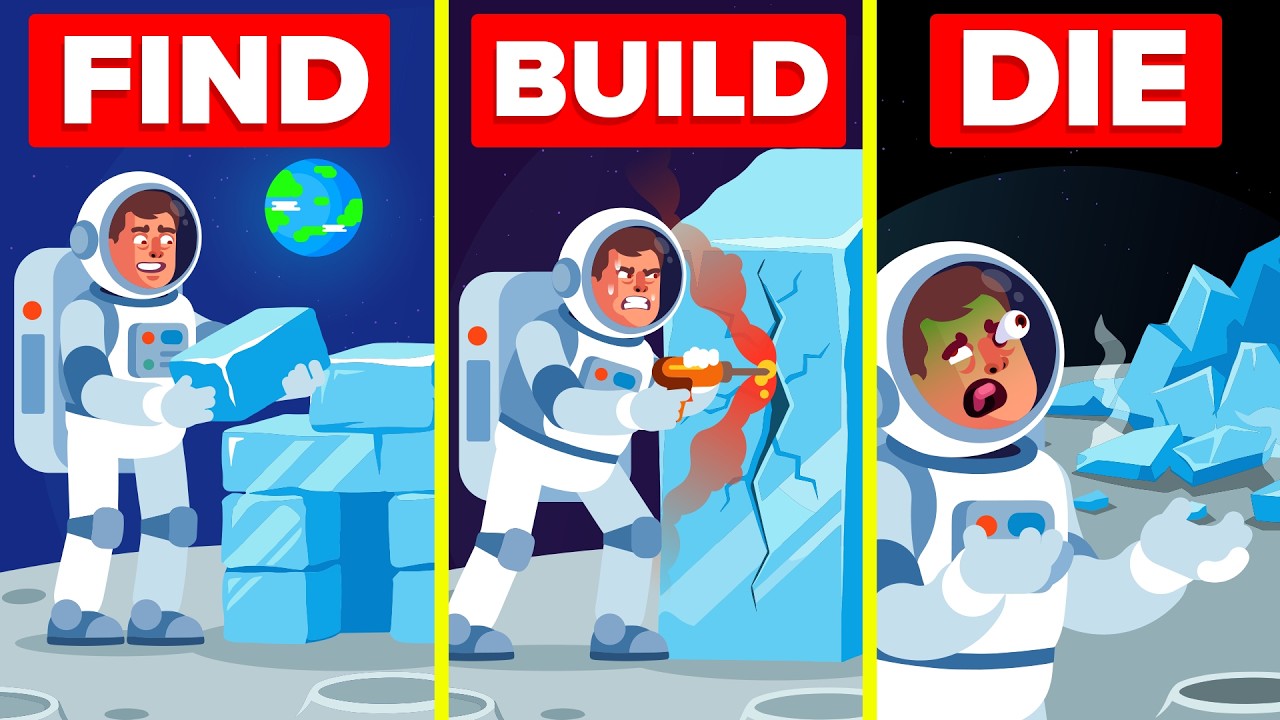
Recent studies show this dust isn’t especially poisonous - you’re more likely to get sick from everyday pollution here on Earth than from lunar regolith. But it does contain sharp crystalline silica particles, the same stuff that causes silicosis - permanent lung scoring - in miners. And in the Moon’s one-sixth gravity, these microscopic particles stay suspended longer and penetrate deeper into lung tissue. But here’s the real problem. When a rocket descends to the lunar surface, its exhaust blasts regolith outward at extreme speeds. During Apollo 12, the Surveyor 3 spacecraft - just 525 feet (160 meters) away - sustained surface damage from the landing debris. In a future Moon settlement, with multiple landers nearby, each touchdown could hurl high-velocity debris, damaging nearby habitats and infrastructure. So…that’s a problem. For long-term habitation, you need a landing pad. But you can’t build a landing pad without landing construction equipment. And you can’t land construction equipment without a landing pad. This is the catch-22 that could halt lunar exploration before it begins. What’s the solution? Enter NASA’s Moon to Mars Architecture Planning program. It’s a comprehensive framework that can fundamentally change how we think about space exploration. The gist of it is simple but revolutionary. Stop visiting; start building. Apollo was flags-and-footprints. Artemis is different. The long-term goal is to incrementally build the infrastructure to use the Moon as a proving ground and launching point for Mars. The Mars to Moon Architecture breaks down into 5 key elements. Transportation, using rockets, landers, and pressurized rovers for long-distance travel. Surface habitation, meaning actual living quarters, storage facilities, and places where humans can work for months - not just days. This is the real game-changer. NASA’s Artemis missions have planned lunar landings and construction roles through the late 2020s. These include early moon landings and the orbital Gateway assembly. But their long-term plans for building key surface infrastructure extends through the 2030s and beyond. Feels like forever away, right? But these plans are coming together in real time. But to get to lunar habitation and Moon bases, we have to go back to the stick problem of those landing pads. The problem of actually building stuff on the Moon. So let’s talk about concrete for a second. On Earth, making concrete is simple. Mix sand, water, cement, and aggregate, pour it, wait for it to harden, and you’re done. We’ve been making concrete for millennia. It’s the bedrock of civilization. But on the Moon, it’s a completely different game. NASA believes it will need something akin to concrete to make reliable, regolith-free landing pads and structures for long-term living on the Moon. The costs of flying the equivalent of dirt and water would be economically impossible. So NASA did something clever. They partnered with ICON, a construction technology company that specializes in 3D printing buildings, and BIG Architects, the firm behind some of the world’s most innovative structures. Together, they launched Project Olympus in October 2020, backed by a $57. 2 million contract awarded in 2022. This is the start of what NASA hopes will be the key to building roads, landing pads, and habitats on the Moon without any imported materials. Just pure regolith, and energy. You can’t just mix regolith with water, even if you had the water to spare. It wouldn’t work. The Moon’s low-pressure environment means water either freezes solid or boils away instantly. Chemical reactions that require liquid water, yeah, they simply don’t happen. NASA soon started experimenting with heat, not water. Specifically, high-powered lasers. Scientists and experts believe you can take the lunar regolith and shape it into whatever form you want using a robotic 3D printer. Just stack it up, layer by layer, like lego bricks. Then you blast it with a focused laser beam that heats the regolith to temperatures between 1,200 and 1,500 degrees Celsius (2,192 - 2,732 Fahrenheit). Hot enough to melt the particles, fusing them together. It’s a process called sintering. The particles don’t fully liquify, they just get hot enough that their surfaces melt and bond to each other. When it cools, you’ve got solid, rock-like material. Strong enough to support structures in the Moon’s gravity. Tough enough to withstand temperature extremes. Dense enough to block radiation. It works because the lunar regolith has metallic iron particles in it that are actually excellent at absorbing laser energy. The stuff that is abrasive and clingy is actually perfect for this application. The sintered regolith’s compressive strength is comparable to weaker forms of concrete on Earth. But the lunar gravity helps, since that means you don’t need the same structural strength. Stack a couple feet of this stuff around your habitat, and you’ve just blocked the vast majority of cosmic radiation. NASA hopes to use this sintering process to build its lunar landing pads first. The design calls for hexagonal pads about 33 - 40 feet (10-15 meters) in diameter. Big enough for a lunar lander with some margin for error. Building this pad could be almost fully autonomous. A robotic lander could touch down - and that first landing? Risky, no question about it. History has already shown just how dangerous it can be. During Apollo 11
Segment 4 (15:00 - 20:00)
Neil Armstrong had about 45 to 50 seconds of fuel remaining as he manually guided Eagle to the surface, skimming over a hazardous boulder field the computer had targeted. Once it lands safely, the robotic lander would deploy a mobile 3D printing system. It would move across the landing zone, laying down regolith layer by layer, fusing it solid with lasers, and constructing the pad in sections over just a few days. Once that first pad is complete, the robot could move to a new location and build the second. The second landing would already be safer because nearby infrastructure is protected. The third will be even safer; the fourth, safer still. MMPACT–that’s Moon-to-Mars Planetary Autonomous Construction Technology–aims for a proof of concept mission by the end of this decade. Its ambitions lay far beyond the landing pad. Habitat walls, curved for structural strength and maximum radiation protection. Roads connecting different base facilities, giving rovers smooth surfaces to travel on instead of churning up dusty, corrosive regolith trails. Blast walls positioned around critical equipment to shield from debris during landings and launches. Berms and embankments to direct regolith spray away from critical areas. Eventually? Vertical structures. Hangars for spacecraft maintenance. Garages for rovers. Safe havens for astronauts during solar storms when radiation spikes to deadly levels. The MMPACT team is already thinking ahead. They’re dreaming bigger. "I want there to be sufficient structures there to make things safe for crew so if we want to build a hotel on the Moon, we could," remarked Jennifer Edmunson, the geologist managing this project. "We could have tourists going there, mining districts pulling rare Earth elements from the Moon. We could do that and get a lot of resources that way. " It would be a lunar economy, in essence. Mining operations. Research stations. Radio telescopes on the far side where there’s zero interference from Earth’s radio noise. All of it enabled by the ability to build using what’s already there. There’s enough regolith scattered across the Moon to build xcities. Multiple cities. But to do that, you’d need the power. This takes us back to the wisdom of landing at the lunar south pole, near the Shackleton Crater rim. There, NASA will harness the eternal sun’s energy to power its regolith-hardening lasers. If NASA can position itself along the right ridge near those Peaks of Eternal Light and catch that endless low-angle sunlight, it might have a shot. Solar panel efficiency is the same on Earth as it is on the Moon, between 15-22% conversion of sunlight to electricity. But on the Moon, you don’t have clouds, seasonal variation, or atmosphere to scatter light. NASA’s design uses vertical solar arrays like walls facing the sun as it circles the horizon. You can even have multiple arrays on different peaks for redundancy. If one dips into the shadows, others compensate. For a small lunar base supporting 4-6 people, you’d need about 40 kilowatts of continuous power, covering life support, heating, cooling, scientific equipment, and everything else required to keep humans alive. It doesn’t sound like much, but that’s basically enough to power 30 average American homes. NASA thinks its vertical solar farms armed with native “follow-the-sun” rotational capabilities might just do the trick. But in those rare moments when the sun goes down at the south pole or equipment breaks, you’d need a reliable backup. You’d need nuclear power. And NASA’s got a solution. They call it the Fission Surface Power Project, a 40kw reactor ready for deployment in the early 2030s. The entire system masses under 6 metric tons and runs for a minimum of 10 years without refueling. That’s enough to power 30 American homes for a decade. It works in total darkness, through dust storms and equipment failures. And the best part? It’s Mars-ready. Since Martian dust-storms can last months, the nuclear reactor has to operate independently and reliably. The complete system - 30-40 kW of solar, and backup fission reactors of 40 kW each, would be enough for a 10-20 person base. To make that a reality, NASA would have to solve one more problem. Water and life support. A single person needs roughly 3-4 liters of drinking water per day, plus things like water for hygiene, food prep, equipment cooling, and oxygen generation. Do the math on a 4-person crew staying for 6 months - it’s thousands of liters, translating to millions of dollars in launch costs. Again, it’s logistically and economically unsustainable. A running theme of humanity’s lunar dreams, it would seem. The solution utilizes the same approach as the problem of laser-concrete. Autonomous rovers. Why send a human into those permanently shadow regions within 1 to 2 miles (1. 6 - 3. 2 km) of the base when you can send a robot to do the work for you? The rovers carry drills or scopes, depending on the terrain. They dig down, targeting the zones where orbital sensors suggest water ice concentrations between 5 and 30% by weight. Again, this isn’t some frozen lake caught in a pitch-black crater. It’s more like cosmic permafrost - tiny fragments of ice, maybe a few inches across, scattered through the dust. And some of that water isn’t even ice at all. It’s chemically bonded to minerals at the molecular level. Meaning…
Segment 5 (20:00 - 24:00)
You don’t mine the ice. You mine dirt. Very, very cold dirt. The rover has to scoop up the regolith at roughly -238ºC (-396 Fahrenheit). The soil gets hauled to a mobile processing unit, where it’s heated to 100-200º C (212 - 392 Fahrenheit) and from there, the ice doesn’t melt. It sublimates. Straight from solid to vapor. That vapor is captured, funneled into cold traps, and condensed back into usable water. Congratulations. You’ve just made drinking water out of Moon dust. Insulated tanks then shuttle that water back to base, covering a few miles before the cargo freezes solid again. On the Moon, even your supply chain is fighting physics. The yield for one ton of processed regolith is anywhere from 110 to 168 pounds (50 to 76 kilograms) of water, or about a hundred bottles of water, depending on the ice concentration. That sounds manageable - until you remember that even with aggressive recycling, a large lunar habitat could require hundreds of liters of water every single day for life support, food prep, hygiene, oxygen production, and thermal control. So, to stay alive, you’re mining anywhere between one and ten tons of lunar soil, every day. That’s a full-blown industrial operation, all in one of the most hostile environments in the solar system. But once that water starts flowing into the base, the real magic begins and survival stops being fragile. NASA’s decades aboard the ISS have turned recycling into an art form. Modern systems recover 98% of all wastewater - urine, sweat, even humidity from every breath - purifying it into water cleaner than most supplies on Earth. As astronauts like to joke: Today’s coffee becomes tomorrow’s coffee. Inside the habitat, conditions must remain relentlessly Earth-like: stable pressure, balanced gases, microscope leak tolerances. Outside is a vacuum. There’s radiation and lethal extremes. Shielding made from compacted regolith keeps space itself at bay. But everything outside is a system at its most unforgiving. Which raises the ultimate question: Can humans truly thrive here? And if so, who would actually go? Early Artemis crews may stay only a week. Brief missions where crewed landers touch, test, and return. But by the mid-2030s, NASA is already projecting missions of 6 to 12 months - the same length as an ISS tour - only this time with no emergency ride home. So who volunteers? Not the thrill-seekers, or tourists. Scientists chasing discoveries that rewrite textbooks will volunteer, as will engineers who want their work stamped across history. Geologists studying planetary origins, physicians exploring low-gravity medicine, and people wired with that deeply human defect of an insatiable curiosity. NASA astronauts earn respectable salaries, comfortable, not extravagant. Even private lunar contractors won’t be handing out billionaire lifestyles. But nobody goes for wealth. They go for meaning. A day in the lunar life won’t be anything to write home about. Personal space will be modest. Probably about the size of a large walk-in closet. Schedules would be unrelentingly unforgiving: Wake, eat, work, maintain, exercise, sleep The 2-hour daily workout is non-negotiable. In one-sixth gravity, bones quietly lose density. Muscles follow suit. Astronauts often undergo intense rehabilitation after returning to Earth to rebuild muscle strength. Food is vastly better than the Apollo era, though “better” remains relative. Hundreds of meal options will be available, though none of them fresh. Hydroponic lettuce becomes less a vegetable and more a morale strategy. And the water? It’s recycled…thoroughly…repeatedly…probably from your own urine. Astronauts learn to appreciate phrases like “molecularly purified. ” Living on the moon would be a psychological gauntlet. Isolation would be the real adversary, with a social circle of just 2 to 6 humans. But ask anyone involved, and the complaints about food, the regolith, and the solar flares will seem inconsequential. The next decade may quietly reshape humanity’s future. Artemis will not mark a return to the Moon, but an arrival. The foundation for permanence, the gateway to Mars, and the first true step beyond Earth. And yet, for something this tangible, this historic, this close, we’re barely talking about it. Apollo gave us footprints; Artemis may give us an extra-terrestrial civilization. And that’s worth exploring. If you thought building a city on the Moon was wild, watch ‘50 Surprising Facts About Space You Didn't Know’. Or click on this video instead.