Lesson 2A: Why do we need AI Fluency? | AI Fluency: Framework & Foundations Course
6:22

Lesson 2A: Why do we need AI Fluency? | AI Fluency: Framework & Foundations Course

Anthropic 12.06.2025 58 786 просмотров 671 лайков обн. 18.02.2026
Поделиться Telegram VK Бот
Транскрипт Скачать .md
Анализ с AI
Описание видео
This video is part of Lesson 2 of AI Fluency: Framework & Foundations, a course developed by Anthropic, Prof. Rick Dakan (Ringling College of Art and Design) and Prof. Joseph Feller (University College Cork). It explores what it really means to be "fluent" with AI and why this matters. View the full free course, including all videos, exercises, and resources, at https://www.anthropic.com/ai-fluency This video is copyright 2025 Rick Dakan, Joseph Feller, and Anthropic PBC. Released under the CC BY-NC-SA 4.0 license. Are you using AI Fluency in your life, work, or classes? Let us know in the comments!

Оглавление (2 сегментов)

  1. 0:00 Segment 1 (00:00 - 05:00) 703 сл.
  2. 5:00 Segment 2 (05:00 - 06:00) 178 сл.
0:00

Segment 1 (00:00 - 05:00)

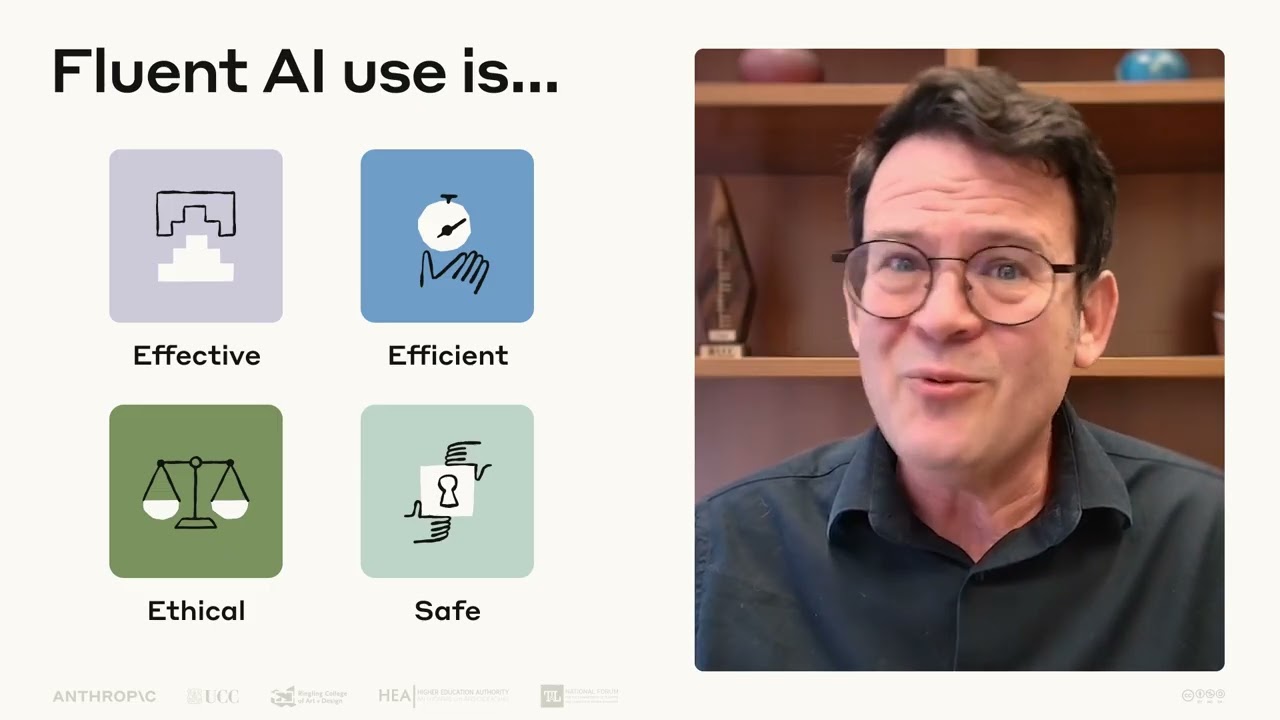
Let's begin our exploration of the AI fluency framework that is central to our learning over the rest of this course. What does it really mean to be fluent with AI? Why does it matter? We're living in a fascinating moment of technological change, one that brings both excitement and uncertainty. AI is reshaping how we communicate, create, learn, and solve problems in both our work and personal lives. Many of us now have versatile assistants and virtual collaborators at our fingertips that can help with writing, brainstorming, researching, decision-m, and much more. But here's the thing. Having these powerful systems doesn't automatically mean we know how to make the most of them or to engage with them responsibly. Think about a time when you got an unexpected response from an AI and you weren't sure how to proceed. Or when you struggled to explain exactly what you needed and left the interaction feeling frustrated. Or perhaps you've wondered if the information you're sharing is being properly protected. All of these moments highlight the gaps between simply having access to AI and truly being fluent with it. So, how do we move beyond just knowing a few prompt tricks to developing a thoughtful and responsible approach that will continue to serve us well as AI keeps evolving? What exactly does AI fluency look like? AI fluency isn't just about being a technical expert or memorizing the 10 best prompts for whatever trending task is popular this month. It's about developing a collection of practical skills, knowledge, insights, and values that reinforce each other and adapt as the technology changes. At its heart, AI fluency means interacting with AI systems in ways that are effective, efficient, ethical, and safe. In other words, really maximizing what you get out of your interactions with AI without wasting time and energy and in an honest and responsible way that protects the privacy and security of yourself and others. Through our research and personal experiences, we found that there are three main ways people engage with AI. Understanding these modes helps us to see why AI fluency needs to go beyond simple prompt engineering. The first way we interact with AI is through automation, where an AI assistant completes a specific task based on your instructions. For example, you might ask an AI to summarize a document for you or draft an email or create an image or plan a trip itinerary. You define what needs to be done and the AI executes it. And it works well when you have a clear outcome in mind. But it can be challenging when you're not quite sure yet what you're actually looking for. The second approach is augmentation where you and the AI assistant collaborate and complete a task together. The AI isn't treated as a machine to automate a task. Instead, it becomes a creative thinking and problem-solving partner. For example, imagine you're developing a character for a story and you're feeling stuck. You might explore this through a conversation with the AI assistant, bouncing ideas back and forth, elaborating on backstories, experimenting with dialogue, and otherwise refining that character. Or perhaps you're working through a difficult architectural problem with an app that you're building. Or maybe you're trying to formulate your thoughts on a complex research topic. In these moments, the AI augments your creativity and thinking. It doesn't do work for you, but helps you do your work better. This approach works best when solutions aren't straightforward and you need space to explore and experiment. The third mode is agency, where AI works independently on your behalf. For instance, you might set up an AI assistant to categorize incoming emails by topic or urgency and maybe even begin drafting responses to the most urgent ones. Or you might create an everchanging interactive experience for visitors to your website or power a dynamically interactive character in a game. The key idea is that rather than defining specific actions, you're establishing the AI's knowledge and behavior patterns. You become less like a script writer giving exact directions and more like a director setting a vision. None of these approaches are inherently better than the others. They serve different
5:00

Segment 2 (05:00 - 06:00)

purposes and excel in different situations. In fact, you might even use all three in a single project. While many start with automation, we found that augmentation and agency are approaches that really take advantage of the unique capabilities of AI and that these modes often lead to the most creative and effective solutions. Understanding these differences helps us recognize that AI isn't just a tool. It's a technology that can act as a tool, but also as a medium or as a partner or co-creator. and sometimes all of these at once. And this shift from mere tool to powerful collaborator gives technology a new role to play in our creative and problem solving work. Which means we also have new roles and need to adapt and develop new skills. These skills are what we describe in the AI fluency framework. Whichever way you engage with AI, there are four key areas of competence to develop and master. They form the core of the AI fluency framework which we'll explore over the rest of this Of course.

Ещё от Anthropic

Ctrl+V

Экстракт Знаний в Telegram

Транскрипты, идеи, методички — всё самое полезное из лучших YouTube-каналов.

Подписаться