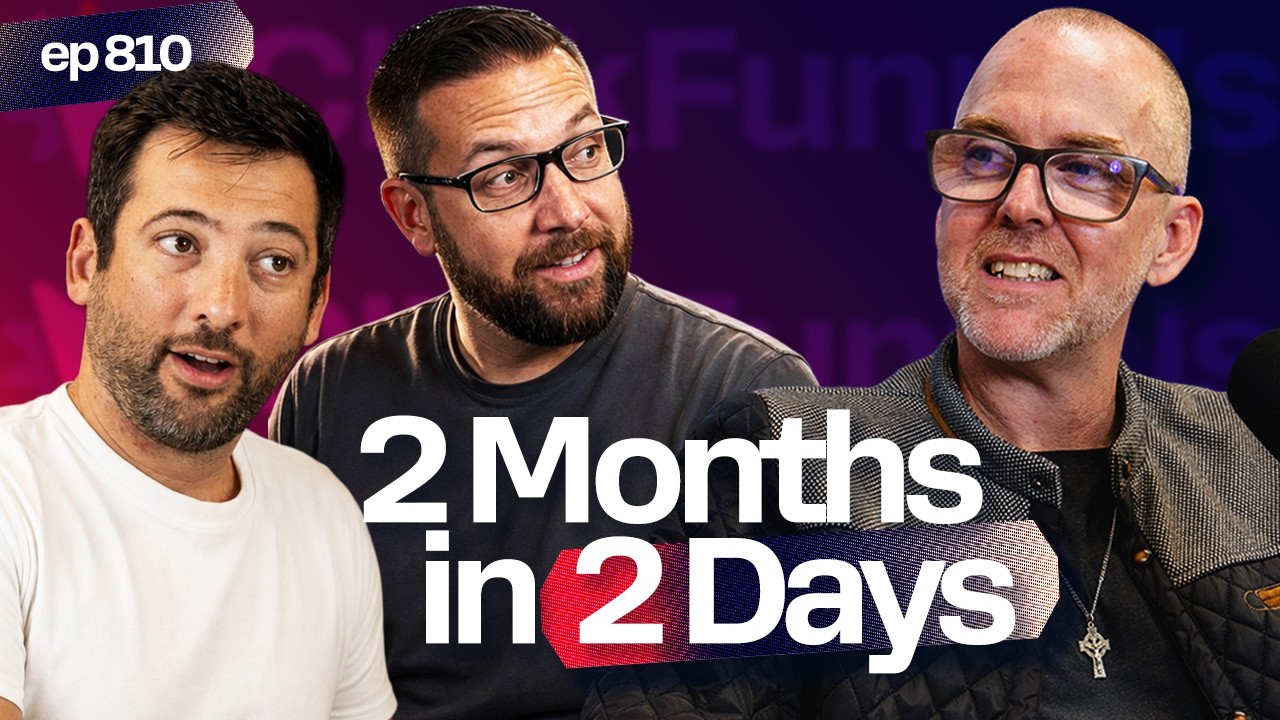
It would have probably been one of the biggest regrets of our life if we had not said yes. Every day Todd had job opportunities, job offers multiple times a day landing in his inbox. — Knew I wanted to be an entrepreneur early age. I wanted to work for myself. I was like, I did this whole working for people thing. In high school, when you know your why, you know your purpose. — You said it's not enough to be the best at one thing. You have thing and really good at another. — Yes, I think that's true. And my thinking also has evolved on it. I think that you should be an expert at. — Welcome back to another episode of ClickFunnels Radio. I'm Chris Cameron and we have a very unique episode today which I'm crazy excited about. I was on a plane yesterday. I got a call from Dante, actually a text the other day and he's like, I got an idea. Why don't you come to Atlanta and we can interview Todd and Ashley? This is going to be rare footage stories that people have not heard. It's funny. We always hear all these stories from Russell's perspective, but there's a whole other side to all of these stories that we're going to dive into and dive in deep today. So, with that, I want to show you the set and actually uh welcome to the show Todd Dickerson and Ashley Dickerson. Check this out. How cool is this? And of course, joined with me as always is the amazing Dante Terelli. — Always a pleasure to be here, Chris. — Are you excited for this one? — I'm gassed. I mean, we were talking about this, too, and like all the different things that we could go over and talk about. It's just such a different way of doing this. We even have a whole new set that we've done. Like this looks like Good Morning America. I mean, come on. This is amazing. — Where's my cup of Joe? — Yeah, exactly. Like, you know, we're going to dive into the topics, you know, today. So, this is going to be really, really cool. Well, welcome out you guys. Actually, you're welcoming me. This is like — Clickfunnels East Coast, and this office is amazing. — I appreciate that, man. Thank you for having us. Yeah. — So cool. How long have you been in this office? — Oh, we've been here for over 5 years. Right before co Yeah. — So, but this is a really unique building. Like this was it was like a factory or something. — Yeah. So, it was a cotton mill. Like Canton's actually named after Canton China. They turned into cotton from silk. So, there's a whole story behind it. But my both my grandfathers actually used to work at this place when it was a cotton mill. No kidding. — Yep. And it's been fixed up. It's 150y old building or so. And yeah, we fixed it up and turned it into a pretty cool office. — And you grew up here in Canton? Yeah. Grew up in the area and Yeah, we've been here allow. — Yeah. Now, Ashley, did you grow up here? — Sort of. — What does that mean? — Um, I was born in Kentucky and then raised a little bit in Kentucky, Atlanta, and then have lived here for about 30 years. — 30. Okay. So, we're going to get into the meat of this, but I want to know a couple things, too. How on earth did you two meet? — Yeah. — I got to hear this. — That's a great question. — And I'm gonna ask Ashley this, too. — Okay. The simplified version of how we met actually goes all the way back to the year 2000. Um we were both dating different people and um he could Todd could drive and he drove his girlfriend to a Mexican restaurant where I met up with him and my current boyfriend at the time um after a basketball game and we had Mexican and that was the first time I was introduced to him as a friend. Um, we both broke up with those uh boyfriend and girlfriend. Like we didn't really keep in touch that much, just talking over AIM or AOL, if you know what that is. Um, and usually because he's a gamer, it started, our conversations usually started at like 1000 p. m. at night or later. — Really? — Yes. Um, because he was always online like playing video games that late. So that's when I could talk to him and we just built a friendship over the years for three years and then we started dating in 2003. — Wow. — Yeah. — So you're a gamer, Todd? — Yeah, I have been over the years. I not have time for gaming in a long time, but I used to. — You've stepped up your game. Okay. — It's a different game, right? Yeah. Now it's a different game. But — is that where it started? Is that where you like started doing coding? I mean, obviously, you know, you have your was a computer science degree. — Yeah, I have a computer science degree and stuff, but really probably my interest started well before that. I mean, if you go way back, it really was probably from games and playing with the systems and computers. I always wanted the computer to be faster at playing video games. And back then, it was like, well, I need to up upgrade it and overclock it and build my own computer and if I get this component and switch out some RAM that's faster. And like I was always tweaking and messing with computers. Uh, and through that, obviously, I kind of learned about them and how they worked. So, kind of fell into it. Ended up building a website years ago that uh was gaming related. And I actually was like sharing gaming codes and all kinds of stuff on the page and uh yeah, that's probably the first website I ever built. — Wow. Isn't that kind of how you got started in the world of entrepreneurialism? Didn't you I think you told me a story about you started out like you made a magazine that you would a gaming magazine you would sell to kids at your school. — That's when he was in third grade though. He was really little. — Wow. — Yeah. That's uh I mean Yeah, it was pretty funny. I think I don't
Segment 2 (05:00 - 10:00)
remember the full reason why I got into that or started doing that, but obviously I was into video games, right? Like I was into games and we were always talking about like there was things like Game Genie and there were cheat codes in video games, but there was no like we didn't have websites back then to just like go and get all the cheat codes. So what I did was like I was like, well this guy, this buddy of mine's a really good artist. This buddy of mine plays this video game all the time. He knows all the cheat codes for this video game. And I had these guys like one of them would like do illustrations for it. Another one would like come up with cheat codes and I'd like put it all together and add my cheat codes and tips and all this stuff into it and we literally like went and photocopied it on a printer and like stapled them together and started selling them at school. — He said I don't know why I did that. I know why you did that. Cuz you wanted money. — Yeah, that's true. I probably wanted money like Yeah, back then — probably to buy computer parts. — Yeah. I mean that's probably like early days of learning what money was, right? It was like $50 equals video game. Like, so I need to make some $50 bills so I can go get some video games, right? — Holy smokes. Third grade. — Yes. — Yeah. — Wow. — I We have the copies of the handdrawn Todd's Tips magazines. — Do you really? Oh, I need to see those one day. — So, this is like Russell's potato gun. This is Todd's staple together. — Eight-year-old version. — No kidding. — Not high school, not college. though like all these entrepreneurs have stories like this like where they started to we were talking to Paul Counts and his was pencils right — pencils — like he's like these kids would literally forget their pencils at home and he'd bring their pencils and be like yeah I can make money off this mom would fund it you know what I mean absolutely I learned to hustle all the time back then it was like go to dollar store find I remember buying like boxes of like video game trading cards and like little figurines and things that were like overstock type stuff and then bringing them into school and like selling them to kids at school And it was all kinds of random things like that over the years. — This hustle like is part of you. Okay. And before we get into like a lot of the Click Funnels meet and everything else, you and I were just talking when I showed up this morning and I love cars. If you guys know me, I'm big car guy, but this hustle thing like you started like Supras. Everybody knows Supras. But you were on the Supra trend before Fast and the Furious. I was. — So what's going on with this? Like you've done dozens of these things. — Yeah. So Supras I basically I mean I love the car. It was like a car I stumbled on from a buddy of mine that was talking about how fast they were and like whatever. Um, it was before Fast and Furious came out though, so I bought one like I think it was senior or junior year in high school. And when Fast and Furious came out, all of a sudden, everyone knew what my car was. They were like, "Oh, that's the car from Fast and Furious. " I was like, "Yeah. " Um, so I got an offer for maybe like five grand more than I had paid for it. And I was like, "Well, working all summer at my part-time job in high school, I'm not going to make five grand and I can flip this car and make an extra five grand. " So, I flipped it and kind of got into uh immediately after that being like, "Where can I find another one of these? " So, I went and found another one for a good price, bought another one, and just kind of got into flipping them all the way through high school and college really. That ended up being kind of my main source of income as I was like funding myself, learning things, and going through college. Yeah. — You're finding ways to shortcut like making money for sure. You told me though this is number what you have one now at the lakehouse. — I do. — What number is that? 57. We counted them all up. Yep. — You're like Tony Stark, man. Like this. You know how they have Mark 4, Mark 5? This is Mark 57. — Yeah. — That is so dang cool. Well, we should dive into the meat. What do you say, Dante? — I'm excited to do it. — Let's do it. Take it away, brother. — So, I'm curious, Ashley. We just heard a little bit about Todd's story. We have Todd, third grade, building magazines. Todd going into buying and selling his own Supras when I'm just worried about trying to score a goal and he's building a business being a CEO. When you met early on in Young Todd, was he different than everybody else? Did anything stand out about him at that time? — Yes. I think that we're very similar in that we like the hustle game and um both of us are like willing to like sacrifice something in order to get what we want. So um and I could see that in him. It was, you know, he was college was easy for him and I was in film school and it I was having a lot of fun and he was like, "Oh, college is such a drag. It's like taking so long. Like I'm smarter than my professor. I could just ace out of this class and be done. " Um, and I was like, "Who are you? " Um, and so every time I learned a little bit more about like the characteristics of Todd, um, it just, you know, I was like very intrigued. And also a lot of who Todd is very different than my upbringing. — And I used to have this mindset of unless you were like, — you know, struggling and working physical labor, you're not actually working hard. — And Todd was the first person that taught me there are different types of hard and there is different types of work. And there is physical work, which I was very familiar with because my dad's a carpenter. Um, and I
Segment 3 (10:00 - 15:00)
always saw my dad lifting like 400 pound equipment. Um, but my dad would go and work for a week and make a certain amount. Todd would use his brain and work for a day and make the same amount. And that was so different. It was such a mental swap for me that I was like, I like this way. — Oh. So, it wasn't hard for you to slide into a new way to work. You saw that and you were like, I like that. We're gonna do that. — Yes. Um well, yes and no because I it I don't say any of that to like disrespect um like blueco collar labor, right? — Of course, — I adore it, appreciate it, and have so much respect for it. But it was um you know, then we started getting into like books like from like Robert Kiyosaki and just having a totally different mindset about money and you know, letting your money work for you instead of you working for your money. — You know, I don't see that as a dig at blue collar. like we'll see who has the last laugh here too with AI and everything like I AI is probably not coming for plumbers, you know, not — Not yet. Well, I want to ask Todd the same question. What was it that you noticed in Ashley? They were like, "Wait a minute. " — Yeah, absolutely. She's the one. It's funny. I remember her looking at I literally had like a quote up on my wall above my desk. And I remember you asking that at a um there there's a quote that's there is visible and invisible labor. Just can't because a man is not idle does not mean he is not working. Something like that, right? and it's Voltater. Um, and like I remember her asking about that being like, "What is that? " And I'm like, "I like to surround myself with inspiration and quotes and reminders, right? " Um, so yeah, I mean it was it was that kind of thing. Like um, we actually are very different. Like our personality types are probably the opposite. Like if you do most of the personality tests, we're pretty opposite in like how we think about things, how we approach things. Uh, but our values and goals and that kind of thing were similar. So I think we had a lot of like a lot of similarity uh that kind of sharpened each other like the our differences sharpened each other I should say right so — Ashley you laughed a little bit about the difference tell me more why are you laughing about that like what are some of the key differences — I'm laughing because um I one of the things he didn't say is even the way that we solve problems prefer to solve problems is very different um and that can feel argumentative but um I had this awesome counselor one time she's like you guys are like ying and yang and his strengths and the way that he wants to solve something is a great approach when you're trying to solve something and it's not working. And so appreciate that instead of, you know, um, feeling like, oh, you're so different, it's not working out or whatever. And I also laugh because our first house had papers and sticky notes all over the place. — I see them on the walls, glass, everywhere. um including when we first got married, we um printed out quotes and stuck them on our ceiling. So, some of the first things that when we opened our eyes, we saw like values. Um we saw quotes from people that like gave us daily inspiration. This was obviously before cell phones where you could, you know, have an app tell you your daily inspiration. — Yeah. — Or a cute little calendar sitting beside your bed with daily inspiration. We chose to put it all over our house. Laundry room, bathroom, shower, office, kitchen, above our bed, down the hallway, like constant. — This is very like the secret. This is cool. Like, you know, affirmations, manifestation, like — that's really, really cool. I kind of want to jump into a couple more things. I think everybody has heard, you know, so many stories from Russell Todd about, you know, you two coming together and launching ClickFunnels, — but I kind of want to hear some of the story from your perspective. Um, and I was just telling Dante, I think it's so interesting. I don't know if you ever give yourself enough credit, but I've seen you for years not really being the face of this. You're the builder. You're going after this. But you'll come on Funnel Hacking Live and stand toe-to-toe with Russell, who's one of the best speakers in the world. and hold your own in front of this huge audience. And he tells these stories, but we want to hear your perspective on this, too. Like, we've heard the Ruby on Rails stuff, but I know you had some questions about that, too. — Well, I'm so curious, Todd, cuz like, yes, we've heard Russell's retelling of the story, and it's scary and people are sending him death threats, — but like some other — this got to be double scary for you because here's this problem that only you know how to fix or even are able to find the right people to fix the problem. even can talk the language. So you it all falls on your shoulders. But now you got your friend and business partner getting death threats against his life. So now you got to feel like a little sense of ownership for somebody's life. It's got to be crazy. What what's that like for you when that is all going down? — Oh man. Um yeah, that's a that's a funny story. So I say funny. — This is a funny story. — Laugh at it in hindsight. It's funny a decade later. — Wasn't funny at the time. — Yeah. So that story uh basically
Segment 4 (15:00 - 20:00)
was the first major outage we ever had at ClickFunnel, actually the only long out outage we ever had. Um and we were super early days, maybe second year of the business or so, and around maybe 10 20,000 users somewhere, something in that range. Um and I told Russell previously like we were operating super lean. We went from, you know, in six months we got 10,000 paying customers, something like that, right? And these aren't just customers using a software. They're customers running their business on your software. They're driving paid traffic. Some of these guys are driving, you know, a million. If you go down, they go down. If we down, right? There was not really any of the alternatives on the market at the time. We were one of the first ones out there. So, these people are really, really relying on us. Uh, and I told him early on, I was like, man, I've got experience running software, but based on the scale and the amount of resources each user takes and all this stuff, I'm kind of like, so we get to 10,000 of these customers or so, if they keep averaging out with this kind of usage, like, we're gonna start to have some trouble. So we luckily had brought I'd brought in some experts, some other guides in the industry, but very few people had like apps that were running at this scale with this many customers. So it was really like a kind of a rare talent to find in the market at the time. Um so basically like that happened like we had an outage. Uh it turned out not to be because the servers were necessarily overwhelmed. It need ended up being a problem with one of our infrastructure providers. So, he was flying out to London to speak at some huge event and actually pitch ClickFunnels and tell people about ClickFunnels and all this stuff. And when he lands, he had no sales service because this is I don't know, however long ago and you didn't have good sales service on airplanes, right? And he lands and he just turns on his phone and just gets like message after message. Couple of them that were kind of death threats where it was like, "Dude, this is down. I can't turn off my ads. I'm burning $50,000 a day. " Like, and he just like freaking out. He's like, "Whoa, what what is going on? " So he calls me and of course I was already aware of it and had been dealing with it for probably 5 hours at the time. Um and I'm like yeah man like it it's bad. There's a problem with the infrastructure provider. And I guess the way I put it, I said something about if we get this back online and he was just like, "Wait, if like so the literally the database disappeared like it was gone like the entire we were not using Amazon at the time that AWS was kind of a newer tech at the time and it was like but everything was gone and they were just like the in infrastructure providers like yeah we don't know what happened to it. It's gone. " And we're like what do you mean you don't know what's happened to it? Luckily, I'm paranoid, so I already had like additional backups that I personally was running on the system on an off-site provider. I had backups to like local systems in my office there. So, like we were good, but it wasn't something that you can flip a switch and just be like, "Cool, let's apply this backup that's in this other warehouse, this other data center, and apply it onto this other one. " So, we basically ended up in a condition where I brought in the guy that I had on the team at the time that was the best DBA available, and he was great. He's actually wrote a book on machine learning, super smart guy. Um, and I had him come in and he started working on migrating us to a new infrastructure provider which was Amazon. Um, and he was doing that from the backup. At the same time, the infrastructure provider was like trying to restore the literally disappeared system from their backups and it ended up taking the infrastructure provider 36 hours to restore it. Luckily, because I had been paranoid about stuff and had the additional backups, we ended up getting it restored within like six hours. So, we ended up getting back online on faster or better, more stable infrastructure with Amazon, the whole thing. But it was one of those things that like we had wanted to do for a long time, but there was no capability to do it because it required downtime to do this big of a migration across providers. At least again with the technology and the stuff at the time, it required downtime. So, it was just like we didn't have any option. And this kind of forced our hand to do the migration. We migrated over. But again, Russell was like in the dark. So you say it was harder for me, but me in the sense that like I was doing it. I was like in it. I'm working at behind the computer eight hours with these guys trying to get things to tra transfer faster, find ways to do it. But for Russell, I could also see it being harder because he's like, I can't do anything. Like I'm just waiting in London for my team to tell me something. Uh but man, it was such a good learning experience in a lot of different ways. Uh, we also learned how to communicate with the customers and be open and honest in that moment, right? Like you had two choices at that point, right? You can go into hiding and kind of be like, "I don't know. It's down. Just hold on. Hold on. " Right? Which is kind of what I was doing behind the scenes. But Russell had the other option which was go public with it, right? And just be like, "Yeah, here's what's happening. We're down right now. This isn't acceptable. We're sorry. We're doing everything we can. We run our business on this. We're down as well right now. We're doing everything for you. " And just was super open and honest with the audience about it. Um, yeah. So that was definitely a learning moment. — But I think that's what everybody appreciates about you and Russell is — owning it, right? You don't try to hide behind it or anything. You're like I've even any you know there's been some other mistakes that you guys publicly just say, "Oh, you know what? That didn't work. " But I also think that's your superpower. — Yeah. — Is this resiliency? Um and I'll go back to maybe some like the early days. I want to ask you Ashley like — Russell and Todd you know are working on a bunch of different things and I know from Russell's perspective like Todd was
Segment 5 (20:00 - 25:00)
like no you're not going to worry about paying me or anything. like how was that you sitting here going hold on honey who's this Russell guy you're meeting him and you're doing a lot of this work for free and a lot of those things weren't actually working at that point I want to hear from your perspective you know as a wife and you're supporting him in this entrepreneurial journey but you're like wait a minute you're doing a lot of work and we're not seeing a lot out of this — yeah cuz like at that time Todd already had a name for himself — that he already had offers coming in there were plenty of ways for him to just make money immediately right now and then he comes to you and says says, "I'm going to work with this guy for free on this thing you sent an email about. " — So, we were broke, very broke. And um and I say that because at the time we had accumulated a lot of debt from our first delivery. Um and we were just in a financial pinch. And you're right, Dante, there were so like Todd's always had a small online profile. He's always liked to stay more behind the scenes. It's just who he is. But um yeah, there were offers left and right just landing in his lap multiple times a day. Come and work for me. Here's your starting income. Six figures, right? Like just excellent money. And for whatever reason, it had to have been a gut check for Todd. He's like, you know what? I'll go over there and be gone for, you know, seven to nine days at a time. Um, leaving me and our oldest daughter home alone and go work for this guy for free for over a year at least, something like that. Who's counting? It doesn't matter. Um because Todd is a passionate person and got behind a passion for something — and um it was scary but at the same time I can't not respect a man who's like I see the value in what that opportunity is versus taking the shortcut. And that's probably one of our biggest superpowers is like we're not, you know, if you put uh what's this like there's a quote or there's a story where basically if you put children in a room and you put cookies like one cookie in front of them and you tell and you walk out and you say, "Okay, I'm going to walk out. Don't eat this cookie. When I get back, you can have two cookies. " That's that delayed gratification. Um but it also requires sacrifice. It requires discipline. And um you know if the moral of the story is either the kid's going to eat the cookie and have that instant gratification or they're going to have delayed gratification and get double the blessings, double the amount — and uh I that's what he was doing and it just instinctually felt right for him. — he's the head of the household so we just did it. — But did you foresee that? Did you kind of like hindsight I think it's one thing to say that Ashley, right? you sitting in the other chair at home while he's gone. Did you see that there could be delayed gratification? Like I just trust him. I want to know what some of those conversations were like between the two of you like were they supportive? Were they just like hey you got a six-month runway here dude like I support you. What was that conversation like? Anything like that? — Yes. And it was so incredibly long ago and there were so many conversations. Um, I mean, I remember at sometimes being scared that I miscalculated the actual amount in my bank account to like pay for groceries and Todd's gone, spending money on the flight to get out there and like work and then would come back. Um, and so we just we always stayed communicating every day. Now, granted, when he was out there, sometimes he'd forget to call for a few days, but because he's — What husband doesn't do that? You're not the only one that doesn't get he was so in it and um I just I think we just trusted each other. We just we knew that long term we wanted to be successful and we were willing to like have that delayed gratification. And so we just kept going back to those, you know, I said there's sticky notes. There's just that those constant reminders. So I didn't have we didn't have anybody else to rely on. We didn't have a mentor at the time. Um we didn't have anybody giving us discernment or wisdom. It was literally just in instinctual trust between each other. Um, and that was just the bit of hope where it's like, okay, it's not going to be easy. It's very different than what we're familiar with, but it's either this or — Well, you knew I was a little bit crazy when you got in. — Yeah, that's my question. Did you know like when you marry Todd and when you're dating and when life is starting to get serious, did you always know that this day would come with him? Like at some point, — what do you mean by this day? like this day of like, okay, Todd's gonna go off on his escapade and he's gonna find the thing that he wants to do and it's
Segment 6 (25:00 - 30:00)
probably gonna be crazy and really hard. Did you think that day was ever gonna come? — Um, yes. Yeah. Like right from the get-go, my gut said this is like actually two weeks into dating, I knew I was going to marry him. — Um, and I didn't tell him that for four years. — You savage, Todd. — Yeah. Uh, side note, it also took him four years to — Come on, Todd. — Well, I told you she knew I was crazy. I said, I'm not getting engaged until I've made a million dollars and I'm in, you know, I'm in college and she's like, well, better get on it. — Yeah, we had a lot of arguments cuz I was like, I don't really I don't care about you achieving the million dollars. Like, I want to be with you on that journey as your wife, not a girlfriend. Um, and so the marriage came before the million. — Okay. Well, — cuz I got I won. — You you're both very rare. Okay. But I want to ask too for both of you like and maybe you first Ashley for the entrepreneur or like the person who always has this grandiose vision — and you're the spouse. You're sitting in this chair now with a very different perspective and point of view. — Oh, for sure. — Do you have advice for those? Because there may be somebody who doesn't have a Todd, but that person thinks they're a Todd. — Yeah. you know, is there a length of time or like I just wonder what you'd tell somebody who's in that seat? Any advice you have for them like early stages? — Um, yes. And I it would be hard to simplify it probably in just one conversation because anybody that's in a relationship that has companionship, um, — in my opinion, it's God first and then your spouse and your children and then your business, right? Um, and so I would encourage people to have their values in order. — This is such great advice. — And then I would encourage you to have your morals aligned know what the end looks like, right? Um because then you're always working as a team on the same goal towards the end versus just that instant like okay well we're just trying to make enough money to pay for the next thing. — Think bigger not smaller. And so for us it's always been like these grand ideas of what we want our entire life to look like. Not just how we want to raise one kid. have one business. It's always like what adventures do we want to look back on at the end of our life and have had. Um we also put our riches in the quality time that we have with the people that we care about. And so we don't get like bigheaded from the amount in our bank account which also means we don't get depressed from the amount in our bank account. — We put our riches in like — the like obviously our children. um who matter to our children, who are our friends, who are our mentors, who do we have as a village? Um and how are we giving back? And if you don't have like that core um list, then I you sacrifice isn't going to mean the same to you because you're not sacrificing for the end goal, like the end of your life when you know you're on your deathbed. Obviously, we don't know how we're going to die, which is true to say. It's fair to say, right? But the idea is that you've lived a long, beautiful life with incredible stories. And the only way you have that is if you know what kind of stories do you want to have along the way and that every day you're working towards those. — I feel like this is like mic drop. — Yeah. I'm sitting here in my own head right now like I need to go back home and re-evaluate my wife and his plans and our goals. — You know, you did Yeah. you did something so cool that I want to dive into that I've just noticed as from the back of the room at how many funnel hacking lives. Um Todd and Russell have always taken time to put their wives on stage and you've championed this too and have said some incredible words about these women. — Um tell us kind of you know maybe Todd I'll start with you. Why have you always found that so important to give Ashley the mic and give these women like time to talk about what they're going through? Cuz that's such a big part of your success. — Oh, yeah. It's absolutely essential. There's no way you're going to be I at least I don't think you'll be as successful as we've been able to become without your spouse on your side. And by that I mean there's too often the spouses end up uh in debates with the other partner acting like an enemy instead of an ally. like your spouse should be your biggest ally which means she's got unique perspective or he obviously it could work both ways but they have a unique perspective that needs to be shared and it requires you guys having aligned values kind of as I
Segment 7 (30:00 - 35:00)
said like we are very different in the way we approach problems the way we think about things the way we work through things but our values are aligned and our goals are aligned and that really is just critical to the entire mission. Yeah. What uh what are some of the things um that were shared from that stage? Like do you remember maybe some of the things Colette said or that you said and why is that important to you? — Let's think back. So there's been so many FHLs and um Colette and I have a very unique um relationship because we share what it's like for our husbands to be gone for a long time. — You're like war generals. Like we've been at war. You look at each other and you're like not many women probably know what you're going through. But you can look at Colette and be like, I get it. — Oh, yeah. Yes. Uh we like the second we're together, we don't skip a beat. Um and it's because anyone who is in this type of relationship where you're married to an entrepreneur, you know that you have to be a supportive spouse. Just like Todd's saying, you have to be an ally, not an enemy. Um but an ally typically is the person that is sacrificing the most. Um, it's the person who has to forgive non-stop when your spouse has to get up from the dinner table with your family to go handle a situation or take a phone call that you've been waiting for or to make a decision with somebody else. Like, um, it's just it's like those moments that you have to know how to get through. And so we've had a lot of very private conversations where we just look at each other and we're like — Yeah. — And then we laugh. — Exactly. — And yes, it the funny thing is it's not just backstage, it's also like together. We laugh because sometimes we've sat through almost every single presentation in the front row. And for women who are at home, like taking care of children, like raising children, being the chef, the um chauffeur, uh helping them pack for their next trip, like all that stuff. Um when you get in the room and you have no idea what people are talking about because you you're in the thick of one area and they're another area. We have we've had a lot of interesting conversations where we just are like, "Do you know what they're saying? " No. Do saying? Not one bit. — Yeah. — How are we gonna get through this? Do you have snacks? — Yeah. But what does it mean when you turn around, you're front row, and you turn around and there are — throngs of people — just absolutely in on this vision. Uh that was abs that is such a question that's like literally cutting me in the heart and I'm holding back tears because um okay — I told you to wait till halfway through before we start tears and Chris — um so the amount of gratitude for the people using a software — like how dorky of a line is that to be like oh my gosh look all these people that have signed up and are using a software, but the software is missionbased and it's always been missionbased and um that's like the fuel that has continued to drive us. I remember the first time we went to the first FHL, we were like what the heck is this? Because I've been to many conferences like we've been to real estate conferences, entrepreneur conferences. Um, I mean, we had so much fun and it always looked like a party, but then when you start hosting your own and you're just like, who are all these nerds? And they're talking about funnels and checkout processes and upsells um order forms and you're just like, what is this? And why are people just — why — like thrilled to be here? And so, um, exactly what you said, when you're sitting in the front row and there's this like roar of excitement and laughter and joy, it has filled my bucket for forever. And it's that specific moment. Gosh, um has made every sacrifice, every decision, every lonely night, all like the entire story 100% worth it because seeing their faces and how excited they are to like chase after their dreams made possible through the community and the platform just the best. We do an exercise in uh in one of the prime mover things that is all about what's your why. — You know, and it's funny. I always put these two eyes together. You got impact and you have income. — And a lot of these people are chasing both. And it's actually a very righteous endeavor, right? — But think of the impact. You're sitting
Segment 8 (35:00 - 40:00)
on this front row and you turn around and not only the people in that room, but the ripple effect of that. — Oh yeah. — Um and all the different lives that have changed for the good. So, I want to ask Todd, I want to know a little bit more about what's your why. You guys are very humble. And by the way, let me just mention, — I think one of the reasons um that you've been blessed in the way that you have is because of your humility. — If you can be happy with nothing and happy with everything, it comes down to this why. — Yeah. — And so, I want to ask you, Todd, what's your why? — Yeah, I know that's really that's a really good point and that's uh great feedback. So, I think your why changes over time and I think mine has too, right? So it evolves with you as you go through different stages of life, business. You know, in the early days, it was for me and Ashley to be able to travel and have freedom, right? Like, and then there's some aspect of like, well, now I've got kids and we need to have security as well, the ability to ensure their future and like your why changes. And as your I think as the your business grows and as you evolve as a person, it becomes more as a contribution thing, right? Like we got to the point years ago where it was like I don't need to work. Why am I doing this? There's been plenty of those times and those conversations even. — Yeah. Whether you have one user less, it doesn't mean that the kids don't get shoes or whatever, right? — Yep. And at some point you're like, I'm living off investments. Like I like income's not even a concern, right? Like so it becomes the question is like why are we doing this? Like should I am I going to keep staying up all night? Are we going to keep traveling and pushing ourselves? speaking at events and stuff? And it shifts from well I'm doing this for my family and for income and for freedom to I'm doing this for the people that are there. So FHL has become basically what I would call a forcing function to like bring us back in such close proximity to the customer that you can't say like if we were just a software company and we're just people user numbers on a software that are doing things. It's different than getting in a room with them, seeing their pain, seeing their fears, seeing their needs, seeing their tears, literally. Um, that's the piece that has brought me connected to the customer in a way that I never expected to be. Like, I've always been, I want to build software and websites and stay behind a computer screen and build lots of stuff, right? I'm going to build cool stuff. It's for people and it creates value for them, but like I don't need to like have someone cry on my shoulder. And that's literally happened at Funnel Hacking Live a number of times, right? So, like I'm like, "Oh, wow. this is a whole another world and you know getting on stage and as you put it like seeing uh you know being up there with Russell and like telling stories and seeing the reactions from the crowds and like understanding really like what they resonate with and what they're struggling with and what they need like that's really become a thing that I didn't expect ever in the beginning. We have to dive into funnel hacking live then a little bit more here just because it's on point here. M — talk to me about and all of us about this — leaving your shoes — like on the stage. What was that like knowing that? Oh my gosh, this is a wrap. 10 years. — Yeah. — 10 funnel hacking lives. What was that like dude? That was definitely a moment of like I don't know so many emotions like all the emotions. There was some matter of like all right it's done. It's — like a sense of relief. Like I don't have to like start preparing for next year's, right? Like there was there's that relief, but then there's like everybody's crying and there's tears and there's the community like wondering what what's next. So there's like this anticipation and we at the time didn't know what would be next either, right? Like we're still discussing options and we got ideas and what we could do, but we didn't know what it would look like. We didn't know how it — I hear rumors though that you might know. Yeah, there might be something some uh some discussions and announcements coming very soon as in like I don't know depending on when this drops like some stuff happening in the next week or two talk about. Wow. Um so yeah, but at the time it was just like um you know Dave was a big part of it, right? We left Dave's shoes on the map, right? It was like the three of us basically since the beginning of ClickFunnels — sandal boots. — Yeah, dude. And he was the biggest fan of funnel hacking lab, right? Like he was on stage out there. — T-shirt cannons like promos exciting the crowd running around. He loved every minute of it. Um, and he was the biggest cheerleader for our fans in our community as well, right? He was out there in the conversations in the rooms like it interacting with everyone all the time. So like — um you know it felt a little bit like — you know I don't know like a walking away from that part of our lives that phase of our lives right like and he was such a big part of it. There was also just the emotions of that aspect too not just the community and the event itself. There's so much more. — Well, and I think that's what's so unique about this podcast. This is Dave's podcast. I was just telling Dante, — I remember when he had already been diagnosed and he knew that his time was limited. Still fighting. — Yeah. — Fighting, fighting. — And he took time to come down to Utah. We went to uh we took a bunch of affiliates to go eat sushi. And I'll have to find out what episode number it was, but — we sat in my Jeep and he literally just hit record and we started doing one.
Segment 9 (40:00 - 45:00)
After we hit that, he um he looked at me, he says, "Well, what do you want to do with the podcast? " — And I remember being emotional like we're not having this conversation yet, — you know, and then after he passed, it was about six months and then we relaunched this and now we're on episode 800 and whatever — and talking about this. So, I love this that it's a legacy play. — Um we love Dave. We love Dave and he was such a big part of FHL. I want to know, Ashley, as you were um you know, watching these guys up there too and participating in this, what was it like to know that was kind of an end of a chapter? — I was a disaster. — Were you? — Yes. Um, leading up to it, I was nervous and kind of excited because just like Todd was saying, like it's a relief like 10 years of this. And coincidentally, a lot of FHL's were on our kids breaks and so we just drag our kids with us and they would come with us wherever. Well, it is amazing except for the fact that like you're there, but you're not an actual participant with your children's lives. And so like they're just kind of like being like tagged along. Um so they spent a lot of hotel time at FHL. Um — kids love hotels though. — They do. 10 years straight in a row just sitting and not doing as much if it was with your family. Um — my kids love quality time with their parents. Like they don't really care what we're doing as long as we're doing it together. — Um so it was a little hard for them. So there was a sense of relief of being like yes finally. like we can have a whole year with like no interrupted event. Um, but at the same time it also was like, "Oh my gosh, every single person that is here has a story and a purpose and a mission and they have a business family that they're caring for and they have dreams and they have goals and they have probably have debt. " And I mean, there were so many stories that we heard where someone's like, "I had to borrow money to pay for a flight and ticket to get here. I could I myself couldn't even afford my presence and I have to be present but also I'm working and you hear those stories where it's like or somebody's living out of their car and you're just like oh my gosh you did you sacrificed that much to just make it to this event and then the sense of responsibility that you feel for ensuring that you live up to all these people's expectations um it changes the game. It changes your mind. It changes your heart. Like it was an actual incredible experience. I'm so grateful. We've learned so many lessons. Um and without just like Todd said, without being able to get that close that proximity to being able to just hear an one person's story and their why, just like you were saying, your impact and your income. like what are the two things right now that are driving you? Um without being able to hear that I don't feel like we would have been as connected. So community and FHL was everything for us. It was a big driving factor for a lot of the decisions that we make on the daily that people will never know about. They'll never hear about. Um but it was a lot of those private conversations where it's like, "Oh, this impacted me the most and I see why and this is how it could help. How do we make sure that it helps more than just this one person? And so, yeah, it was incredible. — I can't wait for what's next. — I can't either. I'm gonna keep my mouth shut because I just want to scream from a rooftop right now. — It's pretty exciting. — Oh, I love it. — It is. — We've heard so many stories on ClickFunnels Radio, too, about people who, you know, went to FHL and then that was like the catalyst — for changing their life. — Absolutely. — Yeah. — 100%. Okay. So, we've learned so far a little bit about Todd's life. Third grade, we're selling magazines, right? And then you move into flipping Supras and working on cars. — Did you have any other endeavors before ClickFunnels? — Oh, yeah. Absolutely. There were so many different things over the years. — Did they all work? — Oh, no. Absolutely not. — I want to hear about that. Absolutely. — Hold on. Like you say, do they all work? No. But they were paying our bills what we needed. — Yeah, some of them. So, yeah. So like absolutely like some have had success over time like there's different levels of success right like there's you know beginning level like some success some traction paying some bills uh and then there's you know the success levels of ClickFunnels and far beyond right so um when I think back like if I go back to after let's say elementary school like when I was actually starting an adult life like high school type age um I definitely started a business back then doing websites and stuff so Um, we started a business called Atlanta Small Business and Home Networking, which that doesn't matter now. But, uh, what I what
Segment 10 (45:00 - 50:00)
I wanted to do was work exit for myself. So, I went to my school counselor like junior senior year and I'm like, "So, I'm going to do work exit this year and get school credit — and get school credit, right? " And they were like, "Cool. Like, here's the paperwork to fill out. " And I was like, "Well, I work for myself. " And they were like, "You can't sign your own paper. " Like, and I was like, "Well, why not? " They're I was like, "I build websites for people. This is what I leg and they're like, "Yeah, that does that's not going to work. " And I was like, "All right. " So, I had a buddy whose dad was an executive at Seammen's Corp and he was like super entrepreneurial. He was a sea level exe exec over there at the time. And he was like, "I'll partner with you. " He's like, "I'll go sell some clients. I know all the businesses around here. I'll sell them. You build the websites. We'll do networking and stuff for them. " Like that's that was a big thing at the time, pulling cables for offices and like doing cat five and all this stuff. So, I was like, "All right, cool. " So he ended up partnering with me on a business and we spun up a business where I was just building all these like legitimate businesses websites at the time behind the scenes. They had no idea this, you know, 50-year-old adult executive was selling them on contracts and behind the scenes an 18-year-old kid's building everything and like so we did that for a number of years uh be well not even about a year before I uh went off to college. So and then I went off to college and at the time things changed uh and I started a degree and left that business for a while. Uh but shortly after that, I actually switched colleges, moved back closer to my area. I felt bad for honestly like going to college. I felt like I wasn't doing anything. I like stepped down in productivity by going to college, which sounds kind of ridiculous, but also like I went from working all the time on like my goals and my dreams and building this business to like, — well, I guess I'm going to do what the teachers say and check some boxes on my, you know, to get my uh degree, which don't have anything against degrees. did learn things at the time, but I ended up coming back and uh not launching back up that exact business, but starting a similar type thread back down a different thread. Um, and tried a bunch of different things. I thought at one point uh I was going to do real estate investing. Like I got into that for a minute. I basically like started looking at flipping properties and doing all this stuff. But at the same time, I remember we were at a real estate investing conference, Ashley and I were and I was learning. We had met some like a really good mentor who was teaching us how he was doing it. Had hundreds of properties and all this stuff. and I'm at this thing and I'm learning how to like do all this stuff for zero down financing and like flipping properties and all this and it sounds like so much work and I have to talk to so many people and like it hit me that like I was like man I'm doing all this to make like $300 a month on this property — and I look at my like AdSense which was like a way that you could have Google advertise on your website. I mean, you still can today, but like at the time it was a really new thing. And I had built a bunch of websites and I was driving traffic to them and stuff. And one of my websites had made $30 that day. — And I was like, that's $900 a month off this one website. And that website probably took me an afternoon to build. I'm like, maybe I should stick with this internet stuff that I know inside and out and know better, right? So I ended up like shifting full focus back on like the internet business that I had kind of been working on but had left for different exploring different opportunities and different business models for achieving wealth. And uh I really doubled down on that at the time I ended up building a portfolio of 1,500ish websites. Um and through that process — 1500 — yeahif literally that's not an exaggeration. They were, you don't go into too much detail, but they were basically sites that I'd put advertising on, right? Like I'd created systems to massproduce them, create decent content on them, get them ranked in Google, get traffic to them, and I'd make money from advertising. Like everything from literally one of the biggest ones at the time, like as in probably made $10,000 a month at its peak was MySpace layouts. That was a thing. Really? Like people wanted — like a bolt. Like a bolt-on. Yeah. — That's how we got through college. That was our income. No kidding. Yeah. Like literally um yeah like basically people would come and they would want to like customize their MySpace page and you could put custom HTML and CSS on your MySpace space page. So we had a bunch of different templates like the most popular were actually like Hello Kitty and like really like weird stuff. So like they would get copy and paste the code put it on their MySpace page and their MySpace page would look Hello Kitty themed all of a sudden, right? So like that was a thing and I made money on the advertising, right? So, like we were doing all kinds of stuff like this. And at one point, um I think I had like I had a coffee business that was like selling ads for coffee other coffee brewers and companies and all this kind of thing. And I went to I don't even remember how I got into this world, but I ended up at Yannx Silver's underground online seminar, like his first one he had ever done. And at the time, I had not even sent an email online. like I had driven tons of traffic, like had lots of visitors, made money, like literally paying all our bills that way. Um, but I had not like collected email and like one of the guys that gets up there might have been Yanik and just is like, "Yeah, so you should make about a dollar per month per lead on your list. " And I'm like, "Wait a
Segment 11 (50:00 - 55:00)
minute. What if I got a 1% opt-in rate on my coffee website that's getting a million people a month to it? Oh man, I've missed out on a lot of money, right? " Like I'm like doing the math. I'm like, "Oh man, there's a whole another world out here. " So, like that was my introduction into the marketing world and stuff, right? So, like and especially the internet marketing world specifically. I had, you know, I'd done marketing classes, business classes in college, but that was really where I like started to learn this internet marketing thing and it's probably why I ended up like I don't know exactly how I'd ended up on Russell's list, but I was going out and learning from all the gurus, everybody that was doing it, everybody that was teaching it. So, I'd made a lot of relationships from events like that one. Um, and that's really what led me to kind of meet Russell back in the day. — You were actually doing a few with Russell. Russell has one that he talks about. — He talks about uh he was on a safari. I can't remember the guy's name, but he's on this, you know, he's doing the village impact thing in Africa. — Um, and this guy told him, he's like, "Hey, listen, man. You probably have a level 10 skill set, — but you have like a level two opportunity. " — Yeah. — And then he talks about one, it was funny that you talk about the MySpace bolt-on. He says, "So Todd and I, you know, we're working on a couple things together, and we had a few that we had done. " He says, "You want to hear what our level 10 opportunity was? " And then he pauses and he says, "Here's what it was. " And he shows the logo. He says, "It was called WP Undies. " Do you remember this one? — Oh, yes. — Tell me about WP Undies. — So, yeah, if I frame it a little bit more, basically like I had built a bunch of different apps like I was selling like SEO software like after I learned this internet marketing thing, I was like, I should probably like maybe some of these processes I built for myself, I other people would buy, right? So, I built like software that would do SEO and rankings and build websites for you and do all this stuff. I built probably like maybe a dozen or half a dozen different SAS apps at the time. Um, and one of them was like essentially what Russell was calling WPU undies. And it was a backup system for WordPress. That was literally like — the logo is hilarious. He shows it. It's literally widey tidies that you strapped on the WordPress logo. It's like just in case your WordPress instance has an accident like what — my name for it which I thought was better was version restore like restore the version but you know he like WP undies. So we at the time he was like this is the thing this is going to be huge. Um, but you know, like with all these things that we're talking about, these ideas, like as Ashley's telling the story, you have to be looking at it as like a little crazy. Was he just like I was actually very strategic with all that. Like I at the time I had these software products that were working, but I felt like SEO, especially at the time, and it kind of is today too, you're always just fighting with Google. Yeah. — Right. It's like waiting for the next algorithm update when something changes. Like you got to rebuild it or change the way your app works or maybe your app's worthless now and you got to build something new that does it the new way that works. And I was in this constant loop and we were I mean we probably do we were doing significant six figures in that business with just me and like an uh outsource support agent guy. But it was like we were at the cap of it felt like and I was at one of these spots. I had one of those moments where it was like what are we you know what is our goal? what are we looking for? What do we want? Right? Like I could pay our bills and you know whatever with this living uh living where we are now and doing all this stuff. I was like but I feel like there's more out there. meaning, more impact to have. Um I feel like there's bigger problems to solve. And I had worked on what really was the root of what probably became ClickFunnels or a significant portion of it um at the time. and I had built this thing and when I first Russell and I there's a whole story behind how we met but one of the things I pitched him on kind of when we were first meeting was like we're working on one project and I'm like dude but there's other thing and I explain the thing to him he's like oh that's cool I have no idea how to sell that like that was literally like he's like that's really sophisticated like I don't know how we can actually sell that to people I can barely get them to build a funnel you know like and it was like all right it really it was marketing automation it was a marketing automation platform that became action edics inside of the original ClickFunnels. — Y — so he's like man I don't know how to sell that. People need that but it. — So WP undies was one of those ideas for like man if we bring people in the door everyone needs WordPress backup solution right like at the time because everybody was using WordPress like we bring them in the door then we can sell them all these other things and teach them these other more advanced strategies. — If you were to put a number on how many different things that you've tried let's just say pre-Clickfunnels — what do you think that number would be? If I things that I like actually built and prototype, there's probably 20. — 20? — Yeah. — And how many of those you think were level 10 opportunities? — Uh, yeah, probably none. — So, you know what's interesting? — If you're out there right now and you're trying things — Russell always mentions that he had 150 plus — Yeah. — before ClickFunnels hits. — Yeah. So, if you're out there, you're listening and you're trying something
Segment 12 (55:00 - 60:00)
— don't stop. — Don't stop. — Be patient, but be persistent — because you don't know. You're putting out these feelers. You're trying it's like fishing lures and hooks. You're trying all these different things to see what lands. But — level 10 opportunity does show up. — Yeah. — But you have to be ready when it does. So — when you now together with Russell come up with ClickFunnels, — you had this opportunity where you're like, "Hey man, you know, Ashley was talking about it. We're working for free here. " — Yeah. — You had a conversation with Russell where you're like, "That's not happening anymore. If we're going to do this, I want to be allin. " Talk to us about how that went. — Yeah, absolutely. So like you said, I mean, it's like uh they say luck is where preparation, timing, and opportunity kind of meet. And that's what you're exactly what you're referring to here. like level opportunity, level 10 opportunities come and they may come to you at a point in life when you're just not prepared for it, right? Or when the time's not right and in the market, you don't have the technology to or the resources or whatever to execute on it. Um, but yeah, with ClickFunnels, that was definitely a level 10 opportunity that, as I said, I'd kind of had the root of some of the ideas behind it since the beginning. Um, I knew that going into it. I mean, there when I say I didn't earn money working for Russell, that is true. I did not work for a salary. I told him day one, I don't want a salary. Do not pay me. I want equity in whatever we do. Right? I told him from the very beginning, I want to be a partner with you on whatever these projects are. Right? So I the first one was his thing, his idea. I was just the engineer on it. So I had a small percentage. Right. But for this next thing, I was like, "No, this is like our thing. I'm building it. You're selling it. Like I want to be partners, right? Like let's do this thing together. " And he says that freaked him out. — Yeah. And at the time, I mean, in hindsight, I don't remember him freaking out about it, but it was probably one of those things where like he left the conversation and it's like, what is he thinking? Like, — wow. — But Russell's an introvert, so he's definitely not going to just confrontation guy. You're right. — No, he's not. He's quiet and process it on his own. And — yeah, — so you totally freaked him out. — Yeah, I'm sure. I'm sure I did. He's like, "Oh, okay. " Um, but honestly, I mean, it's one of those, it's something where it would have been really hard to make it to where we are without a partner and without like from both sides, right? From without us both being partners. When the times get tough, — like it'd be very easy for me to have been like, "Yeah, I can get paid this much money somewhere else with a whole lot less stress and responsibility. " — Like, that's the reality of it. And when you're doing a startup that hits any type of rapid scale like that, the stress, the responsibility, the hours, the everything that comes with that, that people don't understand until they're in it, no matter how many times they hear it. Um, I don't think anyone would stay with it. Like, I don't think an employee would stay. Like, it's very hard to see. I mean, we have some great employees that have stayed through some hard times. Um, but if I look back from the very beginning, the only ones here really since the very beginning that have been in the fires, you know, Dave, right? Like he was the one since the very beginning. — Um, but it's just difficult if you're not so invested in it that you almost feel like it's not just the opportunity. oh, I get paid enough. Like it's the like this is just my responsibility. It's not anyone else's responsibility. It's not my employees. It's not my team members responsibility. It's my responsibility and it's on my shoulders, right? No matter if I want to walk away or not in the hard times, right? Like it's crazy like that it gets to that point that you have to like at times at least it can get to that point where you just feel like yeah, it's on me. It's all or nothing. — And you and Russell have always carried that level of just extreme ownership in everything. And as an employee working for you, it's one of the big reasons I stay here because it's not like, oh, go throw somebody on a project and if they fail, then we can just grill them and then fire them. It's like always looking back, well, how did we not equip them enough? What could we have done differently? So much so that you guys bought the entire company a book called Extreme Ownership because you literally live it every single day. Yeah, it's a very ad admirable trait for an employee looking at their leadership and their founders and their owners. Uh, but I want to talk about level 10 opportunities. Do you have like a frame that you look through? How do you judge opportunities now that you've been through everything that you've been through? Because I know you get them every single day. You're still having to weigh what's a good opportunity, what's not. — Yeah, absolutely. I'm weighing it all the time. So like if you that whole scale is basically like you have a 0ero to 10 sliding scale of opportunity and you have a zero to 10 scale of skill, right? So like that's where we go back to like preparation. Like what is your skill level, right? Like if you're still at a two on skill level, you probably don't need a level 10 opportunity yet. Like you're probably not ready for it, frankly. Like maybe you are. Maybe you'll level up fast and you'll level up your skills, but like it's where you have a level 10 skill set as the guy
Segment 13 (60:00 - 65:00)
had mentioned to Russell at the time. He was like, "I have a level 10 skill, but man, the opportunity you're doing is a level two. " And that's where we stumbled right on ClickFunnels and we're basically were like, "This is the level 10 opportunity. This is the thing that has the reach, that has the value creation for people. It's the problem everyone needed solved, especially at the time. Like it was a world back then where literally like to launch a funnel online, it was cool. We have some back-end like API services that do payments and we have hiring engineers or outsourcers and paying them five grand to build a page that collects money and yeah it's not going to do bumps. upsells. It's not definitely not going to do oneclick upsells. Then you got to build fulfillment. So it was like rebuilding these systems. Everyone in the industry that was having success was essentially rebuilding the system every single time. Maybe they had something they built on top of which is what we had built, right? like I'd actually built um a I guess no other way to call it, but like a payment processing system at the time that we were running our entire uh supplement business on. So, we had built that and then when we stumbled on ClickFunnels being the thing and the shape of it and how we would position it and build it and everything, um you know, I basically forked that concept and adjusted it and changed it for Clickfunnels. Um and really like doubled down on the level 10. But when it comes to identifying the level 10, I feel like there's not a formula that I have at least, um, it's one of those things that like when you get the right level of experience and like exposure to enough different ideas, you start to be like, wait, that one is solving these problems that these people are talking about, these people are having. So, it's like knowing that problem space. And this doesn't have to be something where you're like, I know all the things. It could be that you're a really skilled plumber and you want to We were talking about the plumber use case earlier, right? Like it's like I'm a really skil skilled plumber and I know the plumbing space really well and every plumber I know runs into this issue, right? And you're you stumble on it and you're like that's a level 10 in this area in this niche, right? Like because there there's always levels to the game, right? Like we could always say that too, right? Like there's a level 10 that's going to get to you to 100 billion. you to a billion. there's a level 10 that's gonna get you to a hundred billion, right? Like there are different levels to everything. Um, but it goes back to like what you're prepared for, what you have the skill set for, and ambition and drive and willingness for it. — And I think another way of looking at it is your experience teaches you so much that you know it's an opportunity for you because it's it becomes your instinct. And when it becomes your instinct, then you transition it to your responsibility. Dang. Well, this is such a good question. I'm telling you, Ashley's — m dropping mics everywhere, man. Holy cow. — Really? But this is such an important question because I know this from my experience. Anytime that you say yes to something, you're usually saying no to multiple things. — Yeah. — And would you say that those nos or the yeses are more important? — Honestly, it's probably the nos, right? Because the nos are what occupy your time. They're what suck your time. um in this day and age it's hard to say no to things because there is the capability to move so fast on so many different ideas um that it becomes difficult to say no so I do think there's a level of like you have to explore ideas and you should explore ideas because how else are you going to build that instinct right like if I hadn't have built 20 plus things before and launched them into the market and seen what people responded to se seen what people didn't respond to like I can read books all day long I can listen to courses all day long but you really learn and build that instinct that she's talking about when you do it. — Yeah. — Right. It's like a lot of times I think people want to go to the major leagues and they want to be on TV and they want people to chant their names but they want to skip the high school travel. Right. It's the lessons that you learn there that really prepare you for that thing that is to come. — You think about you give an example of a somebody that wants to go pro. How many times do they have to say no to going out hanging out with their friends? No to uh being able to go home when practice ends and have dinner with their family. And the yes is the goal that you're on track for. So saying no, like we love living in a season of no. Last year we lived We said no to even uh simple things that we were very acclimated to doing like hosting family events. We just said no, we're not doing it. Um because what we know that we needed rest in order to continue on. — No is such a powerful word. It protects your mind. It protects your heart. It protects your spirit. It protects the boundaries, your marriage, your family, your focus. Like I couldn't agree more with the fact that no is far more important than yes. Because when you have the right yes, then you're in alignment with like your why and also
Segment 14 (65:00 - 70:00)
like — Yeah. possibly what you're created on this earth to do and the gift that's inside of you. So — if you can figure out that why and that calling, it allows you to use that filter. — Sure. — For the yeses or the nos. So — when we talk about level 10 opportunity and now Todd's like, "No, I want to be a partner and we're going all in on ClickFunnels. " Did you feel that was the shift in the move? Was there anything happening from your perspective going, "Wait, I see something different with Russell. Todd. " How what were you experiencing? — Yes, absolutely. So, I we went out there. What was the year that we I first met Russell and Colette? I know it was Mother's Day and I know that it's interesting because Russell invited us out. It was Mother's Day and Colette ended up I remember cleaning her house and hosting us on Mother's Day and I was already like, not that I wasn't not a fan of Russell, but I was very curious like what are your intentions with my husband? No, a lot of what's happening — is really weird. No, he knows. We have a great relationship. But um yeah, so I was kind of mad at him for asking Colette to host us on that day, but she did it so gracefully and she's a great cook and her kids were playing and they were just a nice normal family and I instantly felt because I hadn't met him and so I heard messages going back and forth or read emails or you know uh whatever way they were communicating and Um, so I only had this imagination of who this character was. Um, and knew that he had a family and um, yeah. So, it was just it was so funny when they're like, "So, we're going to do this thing. We have this awesome idea. " Now, Russell will get excited about literally anything. He is like a toddler heart. He's like, "But yes, we're doing that. Okay, great. It's the greatest. It's the greatest thing ever. Let's go. " Oh, like everybody knows what Brussels face looks like when he says, "Let's go. " Cuz he says it over everything. — Yeah. There's gifs or gifs. — Yes. Um but he was like it was a different conversation. It carried that um instinct of like this is the right move because you could see the alignment of both of their experience, both of their knowledge um which was everything that they had done in the past with their intentions and then their goal setting and it was all this like unique path that they wanted to create. um and these lofty goals which were like I don't know very unfamiliar for with us because we just didn't know like we've been to conferences but who know that we would have ever hosted them — like we loved going to Yonx's conference but I never positioned myself to think I'd like to host this one day um and that's where they were and so it would have probably been one of the biggest regrets of our life if we had not said yes. Yeah. The one yes though — after how many nos? — Oh, — makes all the difference. — Yes. Thousands. — I'm not kidding when I say every day Todd had like job opportunities, job offers multiple times a day landing in his inbox. — Yeah. You said that though. You said like when you know your why, you know your purpose, it just it filters out and you know what you can say no to. That's incredible. It's weird when you see an offer and your husband doesn't even open up that email. — He doesn't care what the number is. — Yeah, I was crazy. I wanted to work for myself. I was like, I did this whole working for people thing in high school. Like, I don't work. — That's amazing. Todd, you told me something. You told me something years ago I'd like to touch on really quick. I'd never heard this advice in my life up until this. So, somebody may have heard this before, but you said it's not enough to be the best at one thing. — You have thing and really good at another. — Do you still believe that to be true? As somebody who might be saying, "If I'm honest, I think my skill might be a level two, a level three right now. " Do you still think that we should be a double-edged sword? The best at something and really, really good at another. — Yeah, absolutely. I So, there's two parts of that. Yes, I think that's true and my thinking also has evolved on it. So to restate it a little bit like I think that you should be an expert at one thing at least, right? That you're like uh in Russell's world, you know, maybe he's a marketing expert, right? But he's also really good at a lot of other stuff, right? Like he's really good at copyrightiting and offer creation and all like wrestling wrestling. Well, that's more of a hobby, but you know, but actually that can work for this too. Um but then being like pretty good at some other stuff. With me it's more the opposite. It's like I'm one of the top software engineers in my space. Like I can do the things. I've been doing it for 20 years. I know how to code with my eyes closed, but I'm also pretty dang good at marketing. I'm pretty good. Like I've also got these
Segment 15 (70:00 - 75:00)
other backup skill sets that are like part of that. Uh but the wrestling example, like it could play in that example, too. Maybe you're an amazing wrestler and you're an okay marketer. That combination could actually work, right? If you're going to go into the wrestling space, sell some wrestling gear to wrestlers. You know the space. you know, you're an expert at that one thing, but you got your backup that's going to help you actually make money and create value in that space. And that's really what we were talking about around that. It's like, uh, one of the other things I considered at the time was years ago, I considered going into law. I was like, I could technology lawyer, right? Like there's a lot of those guys that make a whole lot of money like that, but most of them most of the lawyers in that space have no idea what they're talking about with the technology, right? At least they didn't used to. I'm sure there's a lot these days they do. Uh, so that was another one of those examples. Um, but as we've entered this into this like new AI world, I'm more and more a fan of being generalized across a large number of things. I mean, obviously doesn't hurt to also have some level of additional expertise in a specific area, but we're in an age of just in time expertise. — Like you can kind of become an expert information-wise at least. can't you don't have the instinct, history and those but you can learn the things very fast on the fly. — It's scary how fast. — It is scary how fast like it and you can see that across the board. People are creating stuff in mass and like most people don't care. Like it's like it like there's so many things launching that are just not getting any traction whatsoever because they actually didn't have a real understanding of the problem space first. They just were like, "Sweet, I built a thing real quick. I vibe coded overnight. Cool. Look at my thing. " And like everyone's like, "Cool. " It doesn't really matter. — Yeah, I don't need that at all. It's cool. But if you actually understand a space, if you're an expert at it, or you understand the problem intimately, if you've built that instinct, it really can help you and utilize the technology and the skills and the tools that exist today to really do stuff extremely fast, which is exciting. — Yeah, I think we dive into that here in a minute because you are doing some crazy stuff on AI, which I'm really excited to dive into. But I want to hit something before you've now, you know, years into this. Clickfunnels is cruising and now you have some suitors, people who are starting to notice. And we talk a lot about the why and saying no a lot. And you at one point had an offer. And we've all heard this story from Russell's perspective or on stage and you've participated in that. I want to hear a little bit more about the story and how it led to a no when you had a big check waved in front of you for somebody to buy ClickFunnels. Take us there. — Yeah, absolutely. So, this was 2019 I guess um yeah, before all the craziness started. So, yeah, it was um you know, Clickfunnels had been going for at least 5 years like with rocket ship growth, crazy expectations, uh crazy growth. We learned how to do all the things, built had a huge team like everything was going great. Um Dave was CEO running things and kind of uh driving the ship forward every day. Um I was behind the scenes building software, working on strategy, building cool new features, doing all this. And you know the topic came up. We started getting as you said suitors basically. Like honestly we've been getting emails for a long time at that point where it was like hey you want to talk to us? And I don't remember what made us at the time like respond to one of the investment bankers and be like what does that look like? You know, like so Dave and I went down the path of kind of researching like looking at doing M&A roll-ups like could we bring companies underneath Clickfunnels or beside Clickfunnels and grow the brand that way and grow into a bit larger company that way. So we that's actually where we started. It was more in the M&A side, mergers and acquisitions, right? like more of like could we benefit like sister companies and grow a brand network. So we started down that route and then it kind of shifted and the conversation shifted into like well what if we just bought you guys and we're like well what does that look like? — So we went through a bunch of different conversations. Um we had the team like kind of go through and see what offers looked like, right? And we definitely we got the offers, we got multiple ones, and like we got to the point where we were trying to decide basically like what the future looked like. And nobody knew this was happening. This was very — this was very skunk works like nobody knew like employees. None of us knew. We were just — I remember Russell telling me the story, you know, after I think it was like a late bowl of cereal or something. That's when he'll spill the beans, right? — Late bowl of cereal. — Yeah. Exactly. But um yeah, nobody knew. So you guys are just doing this. — Yeah. I mean we but there wasn't really that much for us to do. At least like me and Russell like you were curious. — Yeah. We're just doing the dayto-day. We're building the software. Um you know in hindsight it's distracting though. Like it's almost impossible not to get distracted right on your decision-m which is a cautionary tell probably also at the same time. Um but yeah, we're just like we're having the conversations. We're Dave's mainly running the process. We're not even that involved in it. We're just like yeah let us know how much money they want to give
Segment 16 (75:00 - 80:00)
us. — Yeah. We like we'll see if that makes sense. Right. like um — Chris Rock had an old joke and it was like listen guys are as faithful as their options and it was a funny joke but you guys are like we've never been presented anything like this and so you're like well let's listen — like what are the options like and then you that is a good point though you realize like how dedicated or faithful you are to the mission and to the stuff once that actually is an option because most businesses will never get to the point where that type of offer exists even if the dollar amount's different but like having just anyone in any price point that's like yeah I want buy the thing you've been working on forever and run it from here on out as a new business like under our team or whatever, right? So, um but yeah, we basically like explored the options and um you know, it came down to us getting an offer that we knew was coming in, but we didn't know like what the final number would be. And this is like the whole LOI step of the process or what it's like. — I think it was — Yeah, we we' had like a rough LOI, but we this was like the final what's LOI? — Letter of intent, right? So that's basically like they're officially saying like this is what we want to buy you for assuming all the data checks out. — Due diligence. — Yeah. Due diligence like um so this was a little bit past that part, but it was like yeah, okay, we're going to do the due diligence like this is what we'll give you if everything checks out. And you know, we were basically I was out in uh Gainesville, which are my lakeouses out there, and I'm like working on ideas as I always am, right, for features and products and stuff. And um Russell's like, "We got to I got to come out there to Todd. like I we have to talk about this. So he jumps on a plane and Dave's like, "Wait, I want to come, too. " So — that's what Dave is so good at, too. He's not missing the party. — Yeah. He's like, "No, no, no. I want to be there, too. " So like he jumps on a plane right after Russell and like they both fly out and I'm like, "All right, guys. What's up? Like let's talk about this thing. " And um and it's funny, I was out there and I had I'm always working on like what I think the next thing is businesses need, right? Like that was always a thing I was doing. And I had built like a prototype and was like mapping out like what I thought the next generation of businesses needed. Like because we're seeing with ClickFunnels, especially go back in time 5 years ago, we're seeing our customers get success and then — new roadblocks, new weak leaks in their chain. Like you know this, you're working with them every day, right? Like and they're always hitting these different stumbling blocks. And I was like, I think we can solve more than just this one problem for them. I think we can solve a lot of their other stumbling blocks and help them have more success, right? Like every one of them goes through this. They need to tackle this. A lot of them create uh multi-product stores afterwards. are trying to do follow-up and opportunities and all these other things. So I'd mapped out basically what I thought that looked like to solve for people, right? At the same time, we're getting like conversations of like, hey, we want to buy your business as it is today and take over operations. Um so they fly out and they're basically like what are we doing? What are we thinking? And I'm like, we're just hanging out, right? We're like grilling steaks and just kind of catching up. And I'm like, well, check out this thing that I'm working on. And they're like, "Oh my gosh, this is the thing. Like, this is the thing that everyone needs. would like transform the industry. " And everybody they're like all excited about things all over again. Um, and we just basically like Did they initially come in though to this like we are leaning towards selling? Yeah, because they flew in to just talk about — sale, right? — They did, but I feel like they flew in to talk me out of selling. Like I feel like they were like both like we don't want to sell. — Oh, interesting. Okay. — Yeah. I think it was more that perspective that like uh that they were flying out to be like we got to make sure Todd doesn't want to sell. Like I think Russell had already made up his mind at that point. I could be wrong, but like I think he had already made up his mind. And you know, I was having thoughts. — He's pretty persuasive though, too. — Yeah, he is. It's his whole thing. — Yeah. Absolutely. Um, and I'm like having I'm having similar thoughts, right? Like I'm struggling with it and I'm like I ultimately came to like is my life going to change at all by doing this or am I actually going to like be less excited about things, right? Like I probably am just going to start a new business at some point anyway, right? Like and then I'm starting from scratch. We don't have the partnership and the team and everyone that we're like loving working with already. — You're really not worried about money at this point? — No, not at this I mean, year five into ClickFunnels, we'd been making — I don't know half we probably at that point made half a billion dollars like like literally like the company had made that not our users, — right? So, we're like, you know, we didn't have crazy high profit margins, but we had pretty good profit margins, right? So, like at that point, I'm like, I'm good. I invested in Bitcoin in 2014, you know, like we're all right, you know? Um, but I'm like, I want to build cool stuff. I want to see what problems we can solve for people. So, I just felt like at the time that we were all on the same page and we were all just aligned that like the best way for us to keep creating value for people and to have the widest reach was to keep the company and not to sell it out to a company. Like if we felt like at the time there was someone that we could have partnered with maybe that like would have helped grow that mission, but I think all of us
Segment 17 (80:00 - 85:00)
were kind of like, man, we don't know what they're going to do and ultimately we won't have the say anymore and like somebody else is going to do it and like they're great. They've like run these companies, but nobody's done something like us. That was one of the biggest like things in these conversations with VCs and private equity groups. No one five years ago understood our business, right? Yeah. Every single one of them was like, "Wait, what? " They're like, "What's your lead acquisition cost? " We're like, "Well, I mean, effectively we get trials for free. " And they're like, "Well, no, but like what do you pay? " And we're like, "Well, we don't promote the trial. " And they're like, "What do you mean you don't promote the trial? " Like, "Well, we don't drive traffic to our homepage or our trial. " And they're like, "Well, that doesn't make sense. What do you have? We sell books. " What do you sell books? Yeah, we sell courses. They're like, — "We actually get paid to get a customer. " — Yeah, exactly. They just like blew everyone's mind. I think maybe five years later here, a lot more people understand that than did. But they were just like, "Wait, what? " Like, everyone was super confused by it because they're trying to figure out, they've got formulas. These private equity groups have formulas, right? They're like, "We're going to come in, we're going to do this. We're going to pour gas on strip this away and this is going to explode in 10x. reduce costs. " And meanwhile, the guys who have been doing it oftent times don't have the say anymore. and you're sitt it crushes people. It can completely kill businesses and everything else. So, I think it's interesting that was part of this conversation that you guys are having. — It absolutely was. It was the major factor because you see time and time again businesses where the founders either exit or semiexit and no longer just a figurehead or on the board — or they're trapped in there for another 5 years and they're not giving the right input or anything. Yeah. And then you see the polar opposite of that with something like Elon Musk which I'm a big fan of his but like you know he's blowing it up with Tesla XAI space like all these businesses are just like going crazy and he's at the helm still of all of them. He's got amazing team members and amazing operators obviously — but he's still intimately involved in day-to-day of like the direction of those companies at least. — So during all of these conversations where are you what are you thinking Ashley? Uh, a few things. I know that Russell didn't want to sell because we had talked, him and I had our own private um, conversations outside of Todd. Um, and Russell just was so like we talked about earlier, he had done 150 different types of businesses, right? This was Russell's stable business and we knew that he was going to cling to that. Todd on the other hand was and has never been afraid of shifting because he's always been great at like, "No, I'll just create my own security. " — Mhm. — And so I knew that there was going to be a difference in opinion on what to do. Um, and neither are wrong. But ultimately, we decided that Todd's ideas were so important that it would be an injustice to the mission and to our customers to not go after the map that he laid out. — So, everybody leaves this meeting on the same page. This is unanimous. — Yeah. — And excited. Not only just unanimous is like, no, they can keep the money. also a little scared. — Yeah. Okay. Yeah. — Cuz uh when a fat check is like waving in front of your face, but I think we had been trained because all the times that Todd was getting like job offers. — Yeah. You've seen these check lines. — Nowhere near the first. — No. And way more, but at the same time, um we had gotten used to just saying no and like what's the right thing to do? — Um it the easy thing would have been to just take the check and walk away. But then that would not have been considerate of the mission. It wouldn't incredible employees and staff that is at ClickFunnels. And we feel like it would have done a disservice to the clients that we had that we've had over the years and why they signed up. And so saying yes meant just abandoning everything that we had worked so hard to do. And we were so aligned with um — you know we call it the calling, you call it your mission, you call it just like the path that you want to take. Um saying yes to the check would have been saying no to all of that hard work and the reason why we had even gotten there. — And I think that's why the mission of ClickFunnels is just so strong, right? It's built by entrepreneurs for entrepreneurs and you're just a part of that world. So, I definitely see how it's so hard to just turn your back and walk away from that. — Yeah, — absolutely. And the other part is I usually am really good at like instinctual decisions. — And which is funny because Todd said we're very opposite. He is so logical and I'm instinctual. It's like what does my gut say and then I don't change my mind. And you can talk all the logic you want. — Similar like that too. He's a gut guy. — Yeah. So, if my gut says it one way, um
Segment 18 (85:00 - 90:00)
then I won't budge. — Fun for marriage. — That's a different story. Doesn't matter. But, um, — Todd, would you like to reply? — But I think the thing is I when I look back, I knew that what Todd was saying was important and it had so much value and I think that we would have really regretted not following that map, which ended up being 2. 0. Yeah. Well, that leads into my next thing is 2. 0 is the vision. And there's a lot of things that happened in this. And this might be, you know, opening up a wound a little bit because there were some things that didn't go exactly as planned. — One of which, and I and I don't know if we as a community maybe admit this like we should, so I'll say it. What happened to Dave and Dave's passing had a much bigger effect and impact on all of us, — on the business, on Russell, on Utah, I'm sure, — than a lot of us want to admit. — Um, and then we had competitors coming into the space like a perfect storm. — Um, and then the launch of 2. 0, I mean, initially was very, very good, but it felt a little bit rocky. Maybe you can talk to that. We had this amazing vision and this perfect storm kind of hits. Talk to us about your perspective of 2. 0 launch, — man. Yeah, dude. There's so many things that happened during that time period, right? Like you're we're turning down a cell, so there's like those conversations that are wrapping up and stuff, but then Dave is diagnosed like months after we turn. — It's crazy timing. — Yeah. just and he goes in and he has he's diagnosed on a Friday like and basically he's like the next day he goes in they scan and they're like we have to have surgery Monday. — Yeah. — Like it was just everything started happening so fast, right? He was diagnosed with brain cancer. — Um and he was the CEO of the business, right? And after we decided not to sell, we had action steps, we had plans, right? Like I basically was running the build of the updated version of the software. was going to start I was assembling a new internal team like some of our team members were moving over to work on that um some of our engineers that kind of thing and he was going to be running the existing business and keeping it going and working on the core product line and stuff with the existing team there. Uh but we also bought another business during that time — like part of that M&A strategy we were executing. We bought another business like for 40 something million dollars like a very significant product line that Dave was going to be running. — Yeah. — And now Dave's not there. Right. So now you've got — Russell creating content and working on his businesses and stuff and out there doing what Russell does. — Uh but then I have to step up to also run a lot of the day-to-day operations of the basic ClickFunnels business where we still have 100,000 users on running their businesses every single day. Um — and four 500 employees. — Yes. — Right. Literally building the plane while flying it. — Yep. Absolutely. So I step up to take a lot of that leadership uh perspective like uh while I'm still trying to build the other thing. So there was just an operational kind of nightmare that happened internally during that time. — It was a nightmare all around. Yeah, it was I mean obviously it was a nightmare, you know, go keep going back to losing Dave. Like that was that alone was like enough of a nightmare, but then you come back to like we also were — transitioning into a massive different phase of how we were going to operate the business and all of the plans had originated based on, you know, the three of us being able Tyson says, right? You have this best plan, you got punched in the mouth. — Yep. Everyone's got a great plan until they get punched in the mouth. — Yeah. Right. So yeah, essentially that's what happened. And you know, we bring in people, we've got team members that step up. We got a lot of people that like come to the plate to do what they do, but it definitely hurt timelines and stuff of what we were working on, right? Like it was like, oh, 247 all I'm doing is this, right? It's like, well, okay, a couple hours a day I'm able to work on this, right? Like, so it just like drastically changed how I could prioritize things and manage the team. So I ended up having to delegate things. there were delegation decisions with people who mostly are no longer here um that just ended up going wrong. Like that's the simplest way to put it. Like in hindsight, without getting too much into the engineering side of things, there were like significant product decisions that were done by people I delegated to. So it's again, it's ultimately my responsibility, but those decisions in hindsight set us on paths that were going to take far longer to execute on than they should have. — Right. So there were things with the editor experience that I had planned out one way and then when the team gets into it, they're like, "No, we need to do this other way and I wasn't intimately involved enough with it to be like, nope, we're doing it my way. " Right? I let the team go ahead and do it the way they wanted to do it. And — that in hindsight has been major pro or was major problems to get to market at least. — And I know everybody was so excited about this. — Yeah. And we publicly got very excited
Segment 19 (90:00 - 95:00)
about that even at Funnel Hacking Live — to go out and say this and I don't know whether everything was 100% ready at that point to go in there and we're getting we'll talk about that maybe. — Yeah, — Russell got too excited and said it way — super that's a superpower, you know, — okay. He came out and apologized for it. So, it's not like a it's not a taboo topic, but he absolutely — uh blew the announcement well before it should have been talked about because he was excited because um — the vision's there. — The vision's there, but I mean we all everybody was in alignment with this is the direction that we're going — and unfortunately he shouldn't have said something. It did it cost us because there were — cuz timelines were different than well initially. — Yeah. Originally, our timelines were basically far more aggressive, right? And so he's operating based on like this is the timeline we had said and I'm like he's like are we on I'm like no we're behind and he's like well can we get there you know like and I'm — I mean see what it is now you know like and he's like ah you know okay we can make some changes or like this won't matter yet or you know like these kind of decisions and conversations were happening but goes back to those nos it should have been a no like where it was — I think it's uh always incredible to for leaders to admit when they were wrong because it was poor leadership all on all parts. — Yeah. Well, I've said this at the beginning of the interview. I think that's what's been incredible. Dante and I can say this. All the people who have worked with you guys for years and years — is you fess up and you own whatever it is. And that's what our user base loves too. Um I don't want to dwell on this because I know what has happened shortly after. — You know, — we get scrappy. — Yeah. — And we get to work. — And what we do is we solve problems. — Absolutely. — And we teach people to do the same. So fun, too, because we're like, "Hey, don't just do what we tell you to do. Watch what we're doing. " — Yeah. — Because we do it and I use the analogy a little bit. It feels like a phoenix kind of rising from the ashes a little bit, too. Even though it wasn't that dramatic, but the rebrand — Yeah. — the rebrand happens, the new logo. And at this point, too, we kind of abandon the name of 2. 0. We're like, we're Clickfunnels. And I, you know, in partnerships especially being out at different events, I cannot tell you guys how often I heard that phrase of ClickFunnels is back. — Yeah. — Like over and over and seeing like what it is today. — Like talk to me. Is that — living up to the vision that you, Dave, Russell were all grilling stakes talking about where we are now? — Yeah, absolutely. We've gotten to the to the spot we were working towards in the beginning, right? The core part of what we had worked on for so long was building such a core stable platform and experience. And you'll find that if you're if you work with our APIs or if you're one of our advanced users, you'll like we got a comment yesterday where a guy was like this is insane how like much you can do with this and how well or like built it is and blah blah. — We hear it all the time. — Yeah. And it's like because we spent years architecting and building the right foundation for the platform. We did not randomly at a whim bolt 15 different things together which there are people in the space that literally — undies. — Yeah. See if undies. It was definitely not. — Right. — We could do that. — Yeah. We just in case there's a problem. Uh yeah. So I mean like it's like we spent years building the foundation and then it was like let's make it easy to use. Let's make it beautiful. Let's make it user more user friendly, right? like and that's been the focus for the past couple years and that's really made all the difference, right? Like you can have a foundation that works if it's really confusing, the UI doesn't look that great, like that's a problem. Um, but making it so easy for anyone to come in, launch a business, get amazing results, get blazing fast pages that are faster than anything on the market by far, right? Like it's just amazing to see the results now. Yeah. — So funny you say that. I was just working with somebody yesterday who is brand new to the space. They have no idea about image compression or building pages the right way. And we ran a score and they're running a 96. — Boom. — Out the gate knowing nothing. It was incredible. — You know, Chris, another answer to your question is that um your mistakes don't define you. — Yeah. — And I think what's so incredible about Russell and Todd is even though the leadership fall of the launch of 2. 0 you know, didn't go as expected. They also were like, I'm not going to sit in a corner and be ashamed of what happened. I'm going to get up and I'm going to fight. — And so, the two of them like — led and started making — decisions that were a lot more aggressive than we had anticipated, which it meant a lot more dedication and commitment than expected um at a faster pace, but it was like, "So, you made a mistake. Who cares? " Why are you letting that hold you back? — Yeah. — And so whatever phase you're at in your business, like you great, you make a mistake. Who cares? Move on. — Yeah. — Just keep going. Just pick yourself up and keep going. — We've talked about this on the last few
Segment 20 (95:00 - 100:00)
episodes. This fail forward idea. — Any of these entrepreneurs who admit that and say, "Okay, what did I learn — and then you go adjust and you pivot. " — Bill Allen, who's been doing a lot with us on the primary side, he always talks about this hypothesize, test, pivot. And way too many people spend so much time in this hypothesize and they don't get out and test and then when they test and they fail they go like but 20 something funnels Russ with 150 and just saying okay like that resiliency is so cool. I told a story a couple episodes back about we were here with Dave in Atlanta and then we were supposed to do this big event. Anyways it didn't go as we want as much as we wanted. We tried a new presentation. Russell did it and Dave stood up in front of everybody. He's like, "Well, we're supposed to be like running payments till like midnight and uh I don't know, there's a handful of payments. We go up to the room and they're done. " And he's like, "Well, all right. Well, just don't miss your flight. Everybody go enjoy Atlanta. " Went to the aquarium. We hung out, had a great time. And he's like, "Don't miss your flight. We'll see you on Monday. " And everybody was like, "Oh, it's not that big of a deal. " When failures happen, sometimes we get in our heads and we overthink it — instead of just saying, "Okay, what did I learn? " Pivot, — iterate, and go. — Yeah. That and that's one of the qualities I've always admired about him is that he's like, "I don't care about failure. " Great. It's just a lesson learned. — And Russell's the same. Put those two together. — Yes. And but he Yes. So from my mindset, it's like too afraid to try because I'm too afraid to fail. Ah, — and how many people also have that mindset where they're like, I won't even try or take a chance on myself — or be seen because I'm afraid of failure. I'm afraid of also failing publicly. — Yeah. But this goes into the next thing, Ashley, where I'm going to give you some credit here. You have been in a supporting role — for a long, long time. And kind of with the rebrand and so on, — all of a sudden you start going, wait a minute, kind of out of the shadows a little bit and say, I want to be more involved. And it's fun. Like we affectionately kind of refer to you as the CEO, right, as we do this. Yeah. And you now are handling culture and really stepped more into the business side of things. Why did that happen and when did it happen? And just talk to us about that journey. — Um, opportunity is why it happened. Um, you know, there have been a couple of people in this business that have made such a significant impact with their excitement and their joy. That was Dave. We've also had Robbie Summers. Sure. — Um and they're just loud and boisterous and they're they don't get embarrassed and that actually is my personality. Um he had no idea what he was actually really marrying. Um because he's like quiet introvert. — So you're saying your personality is to be a little bit louder and more — 100%. I do not mind being the center of attention. — Do you reserve yourself too? Like sometimes I see in these disc profiles like the adaptive score like maybe somebody's a crazy high eye but they're adaptive like they're like wait I spent my whole year my whole life where teachers tell me not to speak out because I'm somewhat like that too and I sometimes shy back into that adaptive. Are you similar? — I think I was because I have for several years studied identity. I just stopped letting other people's voices have a say so in my mind and now I do what I want. — Yeah, that's a level of maturity from experience and so on too. — Yeah, I just there's so many people that have carried such weight and sometimes the weight of their words was really important and it shaped me. But sometimes the weight of their words are exactly like you're saying, it holds you back. It tells you to not do something. You're too talkative. Um, I have a friend, um, and she has a story where she was so afraid to speak on stage, um, because when she was a little kid, her dad was telling her, "Stop talking. Stop — You're too much. Just stop talking. " And um in the conversation that we had, I just I said, "Let's go back to that inner child and tell her that she it is okay to keep talking and that you do have permission to use your voice and that what you're saying is important. " And um she stopped being afraid of speaking on stage. She stopped like getting as nervous because there wasn't a weight inside of her brain that was controlling how she was going to approach — permission. Right. She did. And but you know the exercise is to give yourself permission. It's not for somebody to give you permission. It's for her to learn how to control what doesn't belong, what does belong, and then choose. — Otherwise, you're just chained to your story and it's becomes like victim mentality. — Totally. — And nobody wants to live that way. — Yeah. So, is this a conversation you have with Todd going, "Wait a minute, we're a remote company. Culture is hard in any company. — Sure. — Let alone remote. Yes. — Right. Is that a conversation you had with Todd and like maybe I can help you a little bit?
Segment 21 (100:00 - 105:00)
— Yes. I think I've been saying that for a long time. And when we just we said, you know, when the time is right. Um I am more of a traditional wife and that I believe in like roles and responsibilities at home. They do tend to be a little bit more like gender specific. — And you have four daughters. And we have — How old are they? — Uh we have a 15-year-old, a 10, a six, and a three. — So kids are starting to get a little bit older. Did that have — Yes. — a role in this? — Yes, for sure. Yes. Um the So we asked my mom to quit her job and become our full-time nanny. — Oh, no way. — Uhhuh. And so I as I was getting acclimated to the business, I was also wrapping up getting certified in mental health coaching. So, I was kind of coming to the office and getting a little bit of studying and certification done while also like getting my feet wet with the business. — I didn't even know you were doing mental health coaching. I'm finding out on Click Fullness Radio — right now. Finding out awesome. — I love it. Yes. And so um I just it was an opportunity. It was the right time to say yes and um we've just figured out how to make it work. — So to dive a little bit deeper on that and then I want to get into AI big time. Talk to us about a culture where the vast majority of the team is remote. — What are some of the things that you are doing and implementing to make sure that people know what's happening in company feel that they're a part of that and there's some culture and some unity? How are you handling that? — I think um it's in one simple word and it's just celebration. Oh, — and so celebrating what people are doing on in all corners of the business, no matter where they work, no matter what time zone, no matter what their status or their job is. Um, just celebrating that because when you have a heart of celebration, you also gratitude because you're like, "Oh, this person is worth acknowledging, um, praising. " and you start to see the areas in which you appreciate the uh what's it called? The cogs in the wheel, — right? — Yeah. You've implemented this um well, it was right about the same time that we implemented the fireside chats. Yeah. — That are happening. Maybe Todd, tell us a little bit about those because I think that's where a lot of these celebrations are happening. — Oh yeah. — Yeah, absolutely. That actually was a big part of putting those together and figuring out how we would do those and that's become a great thing. Every two weeks we get together with the entire team. We celebrate — doing it after we recorded. — Yeah, that's true. Just a little bit. Uh but we celebrate wins. We talk about what's going across the different business units because we have a lot of different teams, businesses within this. It's not just ClickFunnels, right? Like so we get everyone together and kind of like cross over and make sure everyone's knows what everyone else is doing. Uh we celebrate everything from people's work anniversaries, birthdays to like achievements and shoutouts. Um we drive home like initiatives we're working on. Like right now, one of the big things is AI, right? So like one of the channels we have in Slack is AI first and uh I basically define out like here's where I want people dropping in things that they're doing with AI wins with different tools and collaborating and talking about it. And every week we celebrate like a couple different people who have done big things with AI that uh are kind of changing the way they work. So we're trying to cross-pollinate ideas. It's a great place to do that as well. — Well, I think it's a communication tool, too. And the celebration thing, too. Like we've always done this like with our um our training. Like you if you go to here's one thing that I love that we've done. If you go to a hockey game, a basketball game or anything. I want you to think how awkward that is. Like tip off happens, everybody comes in and it's quiet. Tip off happens and then you cheer. Like how many meetings have you been in where all of a sudden they're just like, "Okay, we're about to get started here. " So we started playing some music, right? And we do always do this music thing. Um and then I remember Ashley takes it to the next level. Like when we started doing a lot of these fireside chats, there's music and what are some of the other things you've done like polls and I remember the pom poms. Tell us about some of those things where you get everybody like virtual t-shirt cannon almost, right? Like how are you guys doing that like and how's that kind of helped the you know the kicks off kick off of the meetings? Yeah, fireside chat is the perfect opportunity. That meeting, that communal meeting is the perfect opportunity to just not just acknowledge a person, not just say their name, but get some input from them and why not make it fun? Because the thing is, we need to rally around what the business is doing collectively. And so, it's kind of like the steps where it's like, you know, it's the basic hello. It's the celebration of like somebody's work anniversary or their birthday. Let's everybody wish so and so happy birthday. Um we always have a fun question so we get to pull in like different answers from different people. — Like what was your favorite movie or something? I I'm remembering some of these. — Yeah. Who's one person? — What's your favorite road trip snack? — Yes. We've had such great questions and we can contribute. A lot of the guys in the office are always pouring into um you know fun questions. Um, but yeah, it's just it's so much fun to
Segment 22 (105:00 - 110:00)
take that as an opportunity to um just say hello and say somebody's name and make them feel seen and give them that attention. — And I have to give you massive kudos on the job you're doing because while it might seem small like, "Oh, I said somebody's name. " And specifically, you do so good at doing the little things right — and being very intentional with them like saying people's names out loud. It might seem small, but it is huge in bringing people together, making sure everybody always knows they're part of the family and having that full buyin. So, we do these really cool things. We call them hackathons. Once a quarter, Todd flies all the developers and the engineers and we have a whole setup and the office is just flying and pumping. But for me, it's really cool to watch. I watch as everybody comes in the door and there's like no downtime. There's no nobody comes in and kind of stands around and is like, "Am I welcome here? " Everybody walks in these doors day one of a hackathon knowing they are home, they are welcome, they are valued, they are a part of a team and they just start immediately. Yeah. Like you mentioned the boring meeting startups, right? Okay, I think we're going to get started here. — Yeah. — How many times do companies fly people in or have these big deals and the whole first day is like a wash because they're just trying to get everybody on the same page, right? what Ashley does every day with culture, we feel it externally and then internally when we're here, it has massive repercussions to the business. — Clickfunnels has always done a really good job about that culture. I remember the first funnel hacking live and we high-five everybody coming up the escalators or Robbie screaming or whatever. But I think what you've done too is to try to take that virtual Yes. — is has been a hard thing, you know, but I think we've done a really good job of it. And I think a lot of companies need to pay attention to those type of things too is how do you make people and we're worldwide too, you know, — right? And I think the other thing is acknowledging that people have a life outside of this business. And so sometimes I think people get caught up in like — you're you know you're just another staff member. But for us it's like oh this person has a family. They live here. They have these kids. They like this music. I mean so when like Dante is saying when people come in town we don't just talk about work. It's also like, "How is your family? " — Yeah. — Um, oh, you have a new dog. Um, so sometimes we will have, not sometimes, all the time we have competitions because we're competitive that Russell's competitive, Klet's competitive, I'm competitive, Todd compet, and then so many other people in this business are very competitive. So, we will have competitions here. And one time, one of the awards was specific for this guy's dog, for Mike Porter's dog, because he loves his dog so much. He's very cute. But um he won and the best prize to give him because we know him is for his dog. — Yeah, that's awesome. That's so fun. — So I wanna I want to get into AI. I've been holding my tongue this whole time. There's nobody better I feel to talk about AI than you right now. I think it was 2020 if I'm not mistaken. 2020 is when I first heard you start talking about AI. This is so far before ChatGBT. You were the first person. Okay, let's get real. I came to you and I was just asking, "Hey, if you ever didn't have ClickFunnels, if you guys did sell, what would you do? " And I thought the answer was going to be like, "Oh, well, I'll just go into business consulting and techstack consulting and I'll help other tech companies and SAS companies. Uh, I'll just be a consultant to them. " No. You said in 2020, ah, I think I'd go into AI. There's some really cool advancements happening right now. Pretty prophetic. I was like, — I didn't even Todd, I didn't even know what you were saying back then. And over the years, I've been able to watch you. I don't know how, but you're staying months if not years ahead of the curve. Like the things that you're saying right now in the market, the big conversation that's being had and all the YouTubers and all the people, they're all saying, "Gang, the next one to five years, this is the time you have to build your war chest. " Sorry, they're wrong. That's already been happening for two years. two years ago, you told me that exact same thing. So, I'd love to know where are we now with AI and really where do you think the puck is going, man? So, yeah, all that's true. Like, absolutely. I've been obsessed, I guess, with AI since before AI was a thing and our modern phrase for it since it was just machine learning. Just knowing that like inevitably it felt like to me that this is where we would end up. And that was five plus years ago. Obviously, I own some really interesting domain names in the AI space that not anyone would have got previously like payments AI, marketing AI, um AI as a service. Like there's some really cool domains that I was able to get like by being ahead of the curve on that. But — also, our children have an AI pattern name that I don't know if you did on purpose to us, but you did. — Subconscious. — Yeah, we our kids are a start with an A. Start with an I. — Oh my gosh, they do. Holy smokes. — Don't know. I mean, yeah, — it's his fault, not mine.
Segment 23 (110:00 - 115:00)
— I love that. I love their names, but the pattern is AI A. It's like AI AI. And I'm like, what have you done? — Hold on. Todd is AI from the future. — Oh, — we might be realizing this. — Oh my gosh. Side note. Um, his mom told me a story one time. His grandparents um said that Todd is so smart. He's like a little robot or like a little computer when he was like two or three. — I don't know. The rumor mill is going wild on this one. — Are you even here right now? — Well, so well, I'll start this conversation basically with saying like I don't think anybody can predict the future on this. — And I think anyone that can is or says they can is just showing that they don't know what they're talking about, right? — Why can't it be predicted? — Because it is moving so fast. We're approaching that singularity point. And that literally is kind of the definition. I mean, people use different definitions for singularity, but it's kind of the definition that things start moving so fast and it's such an exponential pace that nobody can keep up with it. Right? We're talking about I mean, Elon's predictions right now are something like that we will see a 1 millionx intelligence increase on planet Earth over the next couple decades. — Wow. Two decades. — Like we're not talking like a 100x would be like unfathomable compounding, but like a millionx like that's like wait what? like that. We can't comprehend what that is. Like humans are actually really bad with timelines. It's we're really bad with compounding interest, right? Like Warren Buffett likes to say compounding is the one of the eighth miracle of the world. Eth wonder of the world. That's how he says it. Yeah. So, it's like it's one of those things like we have a really hard time comprehending that and luckily we now have tools like AI to help us like try and comprehend that and try and predict it and try and be ahead on the curve. But things are moving so fast right now. Um it's to me like it's basically finding a way to create value in that space still just going back to the basics going back to first principles thinking like what does this mean for me now my family what does this look like there are arcs or horizons that I think we can do some predictions on whether it's one year two years like there's some timelines but um to the to your point about the hackathons a second ago we had a hackathon back at the beginning of January and I called that one almost an emergency hackathon. I called every single person here to do it. Um, I'll frame it in the sense that like I've been very blessed to be in a position where I am CEO of ClickFunnels and I am in the day-to-day of it, but I'm able to because of how good our team is to spend probably 80% of my time looking at the future, — not at what's going on now. Right? So, I literally, — which is what a CEO should be doing. — It honestly is what it should be. Like, you should be focused on the vision and the future. Like, that's kind of the goal of the CEO. But I've been able to do that and I've been doing um like 100% AI coding personally myself since summer of 2025. Now if you know anything about the timelines on this, most engineers started adopting it when Opus 45 came out at like the end of November and like that was kind of it. But because you know part of going back to like unique positioning like I'm able to have access to enterprise APIs and beta features that other users aren't getting early and I'm willing to pay literally about5 to $10,000 a month personally on AI tokens to experiment like so I've been able to like literally like those are that's not our company spending money like our company spends way more than that on AI but I personally like on my machine in there like spend that much money on a monthly basis using — did you know that Okay. — Wait, what? Like you're what? — I knew what I was getting into when I said yes at the altar. I knew what I was getting into. I knew there would be a lot of head rubbing and like what is happening with my life? — And I just make myself feel better by looking at him be like, "Whatever, nerd. " — Yeah, there you go. — Whatever nerd. — Oh, — I'll take that as a compliment. — Yes, you will. It's the biggest compliment in 2026. You kidding me? — Yes, absolutely. You You're Yes. But still, sometimes everything he says is so over my head. I'm like, we have a computer in the office that's constantly running and doing tasks and also coding and anybody can like send — codes or like requests to it. So, — and it's crazy because like today at the day of this shooting, March, whatever, everybody has those computers. You've been running that setup for so long before they sold out in California. like your ability your ability to see where things are moving and then you jump right in at the ground floor and say I'm doing this right now well before anybody else. It is just it's it's impressive to be honest. — So it's impossible to keep up with everything that's coming out right now because it is moving so fast. Like I mean you're talking probably specifically about OpenClaw like there's 30 pretty good clones of that have their own unique benefits and stuff. It's impossible to even try all 30 of those like right now, right? Um, what I've tried to be good at though, and I've realized this just over especially over the past year or two, is I try to
Segment 24 (115:00 - 120:00)
be good at quickly evaluating something, — analyzing not if it's like slightly better than the thing I was doing before, if it's like incrementally. Yeah, if it's incremental, I'm not even going to consider it. Like, if we're like talking man, it's AI versus co-work, right? Like there's a huge debate and like, oh, this one does this, you know, like I don't care. Are you using one of them successfully right now? just stick with that, right? Like that's fine for the time being, right? It's when there is potentially an exponential or a gap closing link leap and for that recently it was openclaw, right? Like you went from like man AI was really good co like claw code using that kind of stuff and then it was like wait a second openclaw this is like a different fundamentally different way to approach the problem than we were approaching it before. That's the one where I jump on and actually go deep. Right? So like I've done that every single one of these jumps that we're talking about in the technology of the AI realm of or era that we're in, right? Like every one of those jumps I evaluate it for that. I do not evaluate the little things. I do not get bogged down in the minutia. I do not watch YouTube videos about how to slightly better configure OpenClaw instance. I don't care. Right? Like that's not the stuff I'm looking at. Like I do have problems that I try and solve with those things and I may have hit problems and when I hit the problem just in time information. you go back to saying, "All right, here's my problem. My memory system is not working very well in this setup. How can I make it better? " Do some quick research with AI. Great. Implement it. Done. Move on. Right? Like, it is great that there's so much information on social media because you can find pretty good content on just about anything. You want to get the latest stuff about AI, why don't you go to Tik Tok, filter down to AI for the past week of content, and start watching reals from people that are talking about OpenClaw. That's the latest stuff probably for the past week on OpenClaw, right? But like I don't necessarily need to know that or keep up with that kind of thing. Um in general what I do is like I said go deep on it when I need it when I have a problem that needs solving when I feel like there's an exponential leap to go in on. So that's like the way I think about how to keep up with this stuff right now. So like Russell, how do you know all these things? How are you on top of these things? And I do also kind of find experts in different specific areas that I'm interested in and going deep in that I use kind of as news sources. Like I don't start that way. I'll go deep by like reading two or three books on the topic before I go into something. Dante and I talked previously about this, but like I'll go deep sometimes by reading a couple books on the topic, getting very familiar with it, maybe taking a couple courses, whatever that looks like. Uh, and then I'll evaluate different experts in the space. And I do this fairly intentionally. And when I find that expert in the space, YouTube subscription, keep up with all their content that's coming out. they are now like my news source on what's actually worth being considered on that aspect of reality that I'm paying attention to. Right? So like that's kind of how I try and keep up with so many different things. And as Russell has said before, he's like, "You just know everything about everything. " And I'm like, "I don't know everything about everything, but I have experts that I do keep up with that are in the areas that I find interesting or important. " So, — okay, hold on a second here. The craziest thing is I feel like what's happening right now, I don't know if you guys could tell, like when Todd like gets excited about this. I feel like we're watching Kobe like, you know, at the end of the game and he's like, "No, give me the rock and we all like separate for like the ISO play. " Like I feel like that's what's happening. But you did have something you wanted to say too, Ashley, about it. Yeah, I just was going to say from a marriage perspective when just or a supportive spouse perspective like when your entrepreneur companion spouse is this obsessed because just like he's saying like how do you think this man runs a business, has four kids, kids are in sports, there's activities, there's date nights, and then also has time to read two books a week, right? Like is he j like balancing and doing it all? No. He tends to drop the ball in some other areas and picks up the ball with knowledge and obsession in that area, right? And I just had to throw in because he does this to us where he gets obsessed about something. We can be in the car and his headphones are in and it's like, "Oh my gosh, we're going on a date night, but and he forgets like, oh, I got to take that out because now is not the right time to be obsessed about this. " But I would just I definitely want to encourage anybody that's listening that is married to an entrepreneur when they're doing this, hold your boundaries. Know like Okay, so you can't be obsessed about it on date night, but otherwise like be as supportive as you possibly can. — Let him cook as the kids say. — Yes. Let them cook, right? Um — well, and as Ashley likes to say, know your season. I love how you talk about that. — Yeah. Yes. So right now the season that we're in is um making sure that we don't fall behind, right? And this is a discussion we had even before we went into 2026 was making sure that not just we don't fall behind but our employees don't fall behind with AI — 100%. Which has been really cool to watch Todd roll this out. You brought everybody back to a hackathon. You were alluding to this earlier, but you brought everybody in for like an emergency hackathon and you had that meeting that most companies are trying to have with their engineering teams and
Segment 25 (120:00 - 125:00)
you said, "Guys, this is the future. We need to embrace AI. " And it was the whole focus of the hackathon. You had multiple presentations that you gave to them during that short week. And Todd, you actually got them to do it. Like I know a lot of companies are saying that. say they did it, but they really haven't. You go talk to their I do it every day. engineers and they say, "No, I'm not really doing that. " They're checking a box for the CEO. The CEO checks his box and they move on and impending doom happens years later. You were actually able to do it and get them on board. Took it so far as making a bot that all the engineers get to use. His name's Clickie and they're literally using him to write the code for them, QA, and deploy the code. Like, they're actually doing it every day. How are you able to do that? Yeah, absolutely. So, to Ashley's point, it really was she did push me for this on the hackathon, too, because she hears me in the moments of like frustration and just like I can't believe like how are we going to handle this? What do we like? She's hearing me like doing the behind thescenes conversations, right? And one of those for the past six months before that had been this changes everything, right? Like this like can you believe what I just did? Can you believe how I built this entire thing? Can you believe like and I'm like I can't get any of my engineers to implement it. No one's doing it. I got one guy that's even tried this like and she's like well why don't you like blah blah like we were talking through solutions and essentially came around to like why don't we do a hackathon because I'm like I tried it I told him to try it the feedback is like yeah I tried it it's kind of AI slop like there was literally up until this year very few engineers were seriously using AI coding like most of them very negatively were talking about it uh in fact there were only the only guys I personally knew that were doing AI programming were other like founder CEOs smaller companies mostly like were like founder operators who were the entrepreneur and the engineer on their projects. They were the only ones using it. It is very hard to get an employee to do it and to shift and it's not like they're used to the majority of engineers are used to here's the project plan, here's the like maybe the engineers take it and break it down into items and then they execute the items, right? Like what we're saying today is that the project plan then the result and testing the result, not the execution of items. That's all now handled by AI. That's the proposal, right? Like that's where we are. Complete flip-flop of what they've done. Absolutely. — So to ask an engineer to be like, "No, no, no. Spend less time on this. Move over here and over here. Spend more time on those areas. " And they're just like, "No, I A I can't do it as well as I can. I can architect it better. I can do whatever better. " And there honestly there's some truth to that, right? Especially with senior engineers. Uh but really in December is when that changed. And that was the point where we were I'm just at the point with her talking about it and she's just like, "You got to bring them out. " So I met with Ben, our CTO, and I like pitched him on it, and he's like, "Yes, absolutely. " So we just we literally had a completely different project plan for the hackathon. Instead, we changed it from just being an engineering hackathon to every major contributor in the company. I think we brought everyone out except for the individual support agents. So like any manager, any executive, any accounting, finance, all the different teams came out here to this office, crowded house, full house. Um, but we all came out and I kicked it all off by doing a probably hourlong presentation about AI, what I've been doing, where things are going. And it started off as a pretty scary presentation. It was literally like, "Guys, your job does not exist like it does today in a year from now, right? " Like that was the entire thesis of the presentation. I kind of laid out uh you know there's a couple theories around like at the time it was 900 days or so till AI like kind of replaces all knowledge workers like not like — like a countdown clock on the wall or something. — Exactly. We kind of did and it's not that it like is guaranteed to replace them. It's that like that thesis is that in roughly 800 days from now you'll end up at a world in which AI can do everything that a knowledge worker can do behind a computer better, faster, cheaper than a human can. I think something to consider or to remember is that you were complimenting your engineers and saying how skilled they are, but how they needed to take their skills and shift them. Yeah. — And so there was that was the part of the conversation and probably where the frustration was coming. It's like you you're so you yes you are very skilled in this but we have to elevate those skills. And the other reason why it became an emergency thing is because it's like I have such a deep respect for them that I don't want them to fall behind. Not on my watch. And I loved that about your leadership because it was like we can't let these skilled engineers not take advantage of us like where we're at um personally with wanting to go forward with AI but leaving them in the dust and then potentially not allowing them to even have a job or a future in engineering period. So it that's why it was it wasn't just mandatory for the company it was also mandatory for — like their future work period. — Yeah. I mean, a major point of what you're saying there, too, was the fact that I basically came in and I was like, I'm going to give you guys the tools, the resources, the
Segment 26 (125:00 - 130:00)
education. If you need a tool, program, educational program for your industry or for your specialty or thing, like there's no budget. Like literally, that was like my CFO is in the room. He's like, "All right, well, I guess Tom said, right? " Like I'm like, "It doesn't matter. I don't care if you need three $200 a month tools to try and do your job and experiment right now and see which one of those tool like doesn't matter. " and opening and bringing people in and telling them that like we got their back and that we're supporting them. And I was blunt about it. I literally told everyone I was like whether we're able to keep you on board in 6 months or a year from now or not, you will be in a position where you will be one of the top AI experts at your craft because you are going to be given every opportunity to do that here at ClickFunnels. — I remember the first part of that conversation. It did feel a little doom and gloom. It did feel 900 days till destruction, but that is exactly what you told them. We're going to pour into you and whether you stay here or go and do different endeavors, we are going to help you. And that changed everything. And I watched the room become so receptive to what you were saying. And then embrace. — Yeah. This is maybe one of those things too like — that is hard to do virtually. — And so keying into Ashley and the culture here and going, "Hold on, — get him in a room. get in a room and we've got to have this critical conversation. — We 100% recognize that. And it I would not even advise a company to attempt it in another way. Like the only reason it worked like that is because we had everyone in the room. Um, but when we broke off from that meeting, we we had a few other things that came into play and like there were a lot of cool stuff that happened as a side effect of that. But we could see the members, the engineers and the teams break off into groups start working together. Like over the course of the next couple days, people were like, "Oh, check this out. Look what I'm doing. " These are guys that literally were saying two weeks before, "I don't do any coding with AI. AI coding is crap. Like, I'm not using AI for anything. " And then after midway through that week, they are all just pumped and using it and doing and going deep on it. — We're watching them give like AI experiments and they're being like, "Oh, look at why AI doesn't work and like purposely leading the experiments so they don't work out to validate what they're saying. " And that they were so resistive and in no time they went to embracing. Yes. They went to embracing fully and working together and like all the producing and they're doing. It was incredible to watch. Y — I think what was really cool about that week is that everybody started at ground zero. — Mhm. — Like well I got maybe a little bit of experience and then by the end of the week every single person was elevated with some experience and like could walk away feeling pretty good about like how to approach it, how to tweak it, how to um you know uh creatively think through how they were going to get to the next solution. And so it was a really powerful week for the company. It was good. — Yeah. You celebrated um like different awards and achievements and stuff too, right? Like we had um we had one guy that again had not done anything with AI coding and in one of the afternoons did a project that they had previously planned to be a six week project that afternoon, right? And launched it live into ClickFunnels production that night, — like completely done. And he's like, "Oh my gosh. " Right? Like so it was like this mental shift because what people are doing right now is most people that are not adopting it at least are operating on what I like to call a stell mental cash right like they're operating on oh yeah I did see a report last month that came out about how 80% of companies that operate that implemented AI only saw negative 15% like whatever it was and it was like yeah that was published last year and it was done on data from 2024 if it wasn't about the past 30 days it's irrelevant right now. Like literally any content that's older than 2026 is probably completely irrelevant when it comes to actually implementing AI in your business. That's how fast things are moving. So, one of the timelines I set out that I wanted to mention for this, I set out for the team that out there, I was like, here's the one year, right? I said, you got one year till I think AI is going to be able to do 80 to 90% of everything you do behind a computer. Like, so here's where we're going. And then here we were three weeks after that maybe OpenC Claw comes out. We start launching it here in the office and I'm like Dante I think it can do 50 to 80% of most people's jobs already and we're three weeks in. And I'd actually taken that one-year timeline and by the end of the presentation I said we're not treating it like one year. — We're treating it like uh what I say one quarter, right? And I had already moved it down the chain to like we're not operating on quarters. We're going to change those quarters into months, right? And like that's how I we had already been treating it. And then I'm like, well, I guess I should have made it weeks. Like, how crazy is it moving right now? Yeah. — And the ones who win are going to be the ones that embrace this. Yeah. — Like limiting beliefs has always been a thing, right? And I think right now, the scarier the time, the more — the easier it is for somebody who knows about limiting beliefs to just let themselves live by it, right? It's so
Segment 27 (130:00 - 135:00)
easy to be like, I don't know, or I don't understand or whatever excuse you want to have. But the people who embrace right now, they're going to win for the next — decade. Would you agree with that? — Yeah, absolutely. I shared a graph the other day that was showing like it had like a little block for each a million people I think a block represented. So it showed like 8 billion people in the world with the blocks and you saw the ones in green were ones that had used a free chatbot of any kind and then you had like the ones in yellow. So green was like a small segment and then yellow was the ones that actually pay $20 a month for an AI tool and it was like I like very few like 20 or 30 million people are actually paying that price point for a system right now and then the number of people that are doing what I'm talking about right now less than 2 million in the world today. So like as much as like you see openclaw and these things are being talked about online there's still only a couple million people in the world that are using claude code openclaw like there are very few people that are actually using this. There are a lot that are kind of talking about it making a big deal about it and interested in it. — Um but there's a big difference in being interested in it and actually using it — talking about it and being about it. Right. Totally different. — Yep. again like I to this day spend there's a CFO listening somewhere like I think we spent on my personal computer about $8,000 last month — for token usage on AI just on experimenting and building things and doing stuff. So like — there's not many people that are able to burn that kind of money experimenting and working on things. So what Russell and I have been trying to do is to be the guinea pig, right? Like most of these systems are not just plugandplay. Go plug it in and have instant results. Although there are a lot of people that claim that — they're not actually that. Um there are a lot of people that make those claims. Uh but there are really freaking cool things you can do and that's what we're doing right now is we're experimenting. I'm spending all my time like I said 80% of my time is spent experimenting using the cutting edge tools building things uh building all kinds of random ideas. Like in the past Yeah. I said I launched 20 businesses before. I think I've launched 20 businesses in the past two months. — Wow. — I think you've done more than that. — Potentially more. But 20 that are actually like finished products. Yeah. — that's a good point though like as you learn these things and you're doing all this experimentation how much of that is going back into the ClickFunnels app and how are you doing that? — Absolutely. So we leveled up the team obviously on like their AI skills unlocked them to run showed them how I had been doing it successfully for about six months at the time. Um and then literally some of the guys just jumped on board, right? A couple of the guys that had already been doing some of the AI experimentation jumped in on rolling out ClickFunnels AI throughout the entire platform, which was something I had been attempting to do for probably 18 months. The quality control just wasn't there. It was like, no, pages have to look amazing. Quality has to be amazing. They have to be optimized. The data has to be behind them. Like, we had been trying to get there. And he's been able to with a couple other guys on the team uh knock out ClickFunnels AI, right? So, we have the AI now that can build not just pages, but full funnels in the app, set up your pages, apply designs, update the pages, apply graphics, do the entire thing right there inside of ClickFunnels. And that's critically important because it's tied to stable infrastructure. It's tied to your purchasing. Like, purchasing is not something you probably want to vibe code randomly on the fly and then hope it's not broken. Like, this is built in on a tested platform that's done 10 billion plus dollars, right? like everything is automated and built with AI right there in the platform. And we're working right now on rolling it out across all the different areas of the application. So you'll have your full-time AI assistant right there inside of ClickFunnels with you all the time. Yeah. — And this is why you are a foremost authority on AI. Like that's not a self-given title. That that's real. It's because you're spending so much of your own time and your own money and your own resource to personally do the thing and then implement it to your company and then get to see all the use case to really have like a fantastic 30,000 foot view on everything that's happening. Yeah, I I'm blessed to be one of the few people that has the ability, like you said, to be spinning up new businesses with AI, helping an engineering team at a large established company implement AI on a regular basis and building AI tools into an established process and an established platform on a regular basis for a scalable maintainable platform. So, yeah, I'm getting to see a very broad swath of like what it takes and like what works and what actually doesn't work. — And while you're blessed, you're also intentional. — Yes, absolutely. every day intentionally do that. And just my side note, I get to work here next to Todd. I'm blessed by proximity. Dude, it's the coolest thing in the world to watch. It is amazing. How do you think about AI? Because here's what I see a bunch, Todd. Like, we work in the same office. So, a lot of times I'll hear somebody say out loud, "Oh, I'm having this inefficiency in my workload or I'm unable to get this task done. " And then I'll have a solution and I'll give that solution. And then there comes Todd, Chris, right behind me. And the solution he gives is 180 degrees different. The
Segment 28 (135:00 - 140:00)
tools he recommends is completely different. But I noticed Todd, it's like the the way you look at in a whole, like not even just AI, just how AI works with everybody. The way you're looking at it seems to be so much different than how I'm looking at it and how I see most people talk about it online. H how do you look at AI? That's interesting. I think that probably comes back to my systems thinking mindset. So I generally like look at my life and my business and everything in different systems. Whether it's like literally have like a morning system I call it like this is what I do when I wake up in the morning. My morning hold on. What's your morning system now? I got to know that. — You're talking about all the morning routines. Well, my morning system actually starts the night before, right? Like go to bed on time. Like there's different like the system actually starts revolutionary. Like do these things, go to bed on time, get ready for bed, get a good night's sleep. like and then I wake up the next day uh wake up early 5:30 5 uh depending on the day of the week. I have different days that I rotate things. Uh then I get up and I get and I meditate and I go pray and I read and I focus on uh anything that I want to focus on without letting myself getting distracted by the phone, social media, technology. The way I like to look at it is I need to set my own priorities for my day right out the gate before everyone else's needs, wants, and questions and concerns come into my mind. Right? So that's how I usually start every morning. — Proactive rather than reactive. I find this interesting though like when you think about this differently — you know Dante and I and different kind of you know parts of the business are coaching constantly — and you know we have people who don't know where to start with AI. I mean obviously using it in app right is one thing but a lot of them are just using it for copy like oh help me with my email sales script help me with my webinar script or whatever which is all good — but how do they take that next step because a lot of those casual users like you say which is the vast majority — that's what they're just using it for using a free account or maybe a $20 account and they're just having it write the copy but beyond that or nano banana and they're doing images and trying to beautify stuff — but how do they take that next step Man, that's a good question. So, there are like there's so many tools like you can feel completely overwhelmed by it right now. So, um I think where I've evolved to at this point right now is I primarily focus on like a single like chief of staff AI as I call it that it keeps updated and integrated with all the different projects and stuff I'm working on. So, I'm able to kind of like go to one place — thing I've ever heard. — I know. Right. — Right. I'm going to use AI to tell me what I need to learn about AI. Right. Or which ones to use. — Oh, I — because everybody has their favorites, right? — Yeah. So, there's two different ways to go with this. Right? Like I can go with different technology. I think like perplexity is by far the best for giving like answers and correct answers to information. If I go if I take a YouTube video, this is also a nice little hack. Take a YouTube video, drop it in. Like take this podcast, go drop it into Perplexity, click deep research, and send just the link. That's all you got to do. And it's going to give you a play-by-play breakdown of everything we talked about in here, all the details. It's going to listen to the entire transcript for you. And it's going to probably link you and reference like different projects and things we talked about, right? So that's my that's actually one of my knowledge hacks that I do every single day. If I find a good video that I'm watching, I immediately share it, send it over to Perplexity and I'll have that later that I can catch up with the notes on it — without having to watch two and a half hours. — Yeah. And you know, I'll often watch part of it maybe or I'll be in the car and I can make 30 minutes of it. I don't get to finish. Y never while I'm on a date. That never happens. — I actually have a different perspective because um if what if you're listening and what Todd just said went over your head, I can simplify it with two words. — lazy and obsessed with problem solving. — So there's a lot of things that this man does not like to do and it sometimes makes him look lazy cuz he's like I don't want to do that. What's the fastest way for me to get out of doing that? — Which is why he's obsessed with problem solving. And so his logical thinking is what's the fastest way to solve this problem with the least amount of effort on my part. — Yeah, that's a great way to look at it. Yeah, I've that's funny because I've always said that laziness is my superpower. Like let's it's my superpower. I want to automate all the things. I don't want to do all that. — Yeah. And in business, that's a great perspective. In marriage, not so much. — Promise. — Don't do it if you're married. Don't try and lazy your way out of marriage. — Wait, I can't automate love and compassion. — AI Valentine that go. — Listen. Hey, if you want to automate laundry, great. Like create some system in the house for laundry, awesome. Dishes, great. — So, the way I just heard that is she just gave me permission to get an Optimus robot in the house. — I'm pretty sure that's what I was told. — I don't know. That would be the third AI. — We got Jimbot. We got, you know, all sorts of things happening over here. — But wrap it back in for me. How do you look at AI as a whole? You were saying systems. You look at everything as Yeah, absolutely. So I look at it, there's different AIs for different
Segment 29 (140:00 - 145:00)
problems and solutions, right? Like just like there's different tools for anything, right? So like I mentioned Perplexity that I use for like the knowledge and the search and this kind of stuff. There's really good tools like Manis today that are good for like general like scraping and working with different systems and building things and like kind of integrating different content pieces, working with Excel docs. There's cool stuff like that you can do. Um Claude Code is what I've used for I don't know a year almost now probably since it first came out. Um, so like I've been using that for coding and whatnot, but what I see is that you you've got and talking about looking forward down the path, right? There's different levels of AI, right? Like level one is effectively like I talk to a chatbot, right? Level two is more of a like I have an AI assistant that kind of like can do some things for me and automate a couple different tasks. Um, level three is something more like a clawed code, like a gentic coding system to me that like it it's going to go through, it's going to work independently, it's going to come back and give me these results. But level four is what you're seeing that we're in right now. And level four is this world of which a you have a fully agentic AI assistant that has persistent memory, persistent intelligent, knows you, knows how you operate, knows how you work. And that's why it's really hard for me to even like try and give someone something to start on other than something like that at this point because that's how I operate and how I've operated for at least a month now. Um I have an AI assistant that I am in the car and I voice message and it researches does the task. I'll be like literally this morning I was like hey I have an idea. Russell was talking to me about this. Could we do this? Can you run the war game skill and try and see if I've got any holes in the problem and it came back to me. And so my war game skill is effectively perplexity deep research. So my AI assistant and Perplexity come up with like I've got the idea, Perplexes or my AI assistant lays it out and then goes back and forth with rounds of auditing and wargaming against the idea, seeing the gaps in the idea and then they go through like five or six different rounds and then come back to me with all the insights and I'm like sweet turn that into a website so I have a deck that I can present to Russell and we'll brainstorm about today this afternoon. Like literally that's what I'll be doing after — which would have taken you how long? — I don't even know if it's possible. Like so one of the projects I was working on with the guys here in the office um I was like hey this will be a great idea we're going to be able to launch this do this I was like just the deck the proposal deck if I go back five years in time to when I had eight project managers working here and that's my systems have changed over the years but like at one point I had like eight product managers it would have probably taken them three months to come up with that deck that I was able to do brainstorming back and forth with the AI on my way to the office on my lunch break in between meetings. You're literally teeing up the conversation and letting them problem solve. — And it's not even that like I think there's a world that people still that are hearing this may think like, "Yeah, but that's AI slop. " It's not like that anymore. N like even if you could call the first pass like not perfect. When you're able to do what I just mentioned with Wargaming, like what that does is each round it's like, "Well, go find out what all the experts in every book in the world has ever said about this part of the discussion and the decision-making. " And it's like, "All right, it comes back with everything Russell said, everything Tony Robbins has said, you know, like whatever. " It's going to pull back all those insights, all those discussions and analyze the question or that part of the problem through that mindset and break it all down. Like you're you've got the ability now to execute at a level that people cannot even imagine and like most people can't today still imagine. — What do you say to the people who listen to this and are like, "Oh great, AI is going to kill all of us. " Like, okay. I mean, because you're actually seeing what's capable and we look at a lot of the positive things. Anything that scares you about it? — I mean, I think I could go back and forth on that. Like I absolutely can play the doom and gloom route. We joke almost in the office on a daily basis where I'm like, "Oh great, I just leveled up Skynet again. " Like, you know, like that's right. — Crap. I gave the two systems the ability to bring each other back online if one goes down. Oh, that's probably not — Well, you just told We're joking about Jimbot. — Yeah. — Microphone went out and it found out a way to like — activate another microphone. — We had to steal a microphone from Jimbot because we were setting up for this different setup than normal. And uh Jimbot just switched over to his internal mic and figured out how to talk to us anyway. — All right, Jimbot. — Yeah, Jimbot, go get lunch. We're not there yet. — He's like, I'm door dashing it on the way. — That's right. Well, that's real, huh? — Oh, Jimbot's got his own divy carton. He's got his own email address. phone number. He makes phone calls. He gave Dante a call the other day and introduced himself before Dante came into the office. Like, he remembers everything. He has persistent memory. He works on projects. He built a uh a plugin for Chad for Final Cut Pro or something. the other day needed to do his video production work faster. Like — I do like 20 hours of live every single week. It transcribes them. It turns them into content flywheels for me. It's incredible doing it all at once. — And you know how long Chad took 10 minutes to set that up. He explained to it what we wanted to do. It has access to the Zoom as a company employee. So it was able to log into the Zoom account, download the videos, take the transcripts out, create it, create a dashboard, and send Chad the link every day. — Okay. For the for the layman though, like the person who is not wired how you are, they're so fascinated by this. I'm going to learn
Segment 30 (145:00 - 150:00)
it and I'm getting obsessed with this. The people who are one resistant to it or especially, you know, people that are maybe older than us, right? — How do they get into this thing where they're just like, I'm going to get left behind, but I'm not obsessed about this. — Like they got to go attach themselves to somebody that's obsessed about it, but like do you have a solution for like how you don't get left behind or Yeah. And I got so many questions. I mean for that one like obviously — I am obsessed with it and I do spend 80% of my time on this stuff so it's hard for me to like — this is why we work for you cuz then we won't get left behind which is like — well I mean to that point that actually is the way I operate for most things right so like let's just use something that I'm also fairly recently over the past year or so obsessed with peptides right like I went through and I did my research I found out what I could from a number of different experts books I went back through the through time and like looked at all the studies and stuff myself and then kind of understood the base of that industry and that tech and then I went through all the experts that were prolifically creating content on social media on a regular basis and listened to some of their content and I was like that guy has no idea what he's talking about. She is super confused. This guy's just pitching some affiliate links. That guy though, he knows what he's talking about. That became my guy. So I follow him. I listen to all his content on a daily basis. I know enough to know that he wasn't full of crap. That he actually was pitching legitimate news. that he was understanding the studies properly, that he was an intelligent guy and intelligent in this one specific space. So now I follow him like I pay for access to the clo to the people that I need access to get the best information possible on different topics whether it is something like health and fitness peptides you know AI like there are absolutely like different people that I listen to in the AI space as well but they're all most of the guys I listen to are more on the engineering side obviously um but like it comes like every area of your life I think that is the pattern to do that's the pattern I've done right like where it's like who do I want to get close to well I need to figure how to make more money with selling stuff online. I have these ads. How do I monetize and make more money? All right. Well, I go found at the time Yannx Silver and I learned from him and I learned how they were collecting leads and making a dollar per month per lead, right? Like I it depends on what you're trying to learn. So to me, AI is just another piece of that, right? Like building these filters and these systems on how to think about life and how to analyze situations and problems and technologies, whether it's AI or whatever the next thing that comes out is. Um, it's critical to be able to think that way, I think. Um, okay. So, one of one question that I have on this, too, is like, you know, how sometimes you play this game like you're like, "Hey, you're on a, you know, a deserted island or something and you can only eat one thing for the rest of your life. " My my food is probably pizza. Like, I mean, it's pizza. Come on. — Um, what if you only had to choose one right now that like, you know, gosh, it was Blu-ray that won over HD DVD or Apple's kind of won over PC. Like if you had to pick one that you think is going to be category king or that you had to do for the rest of your life, could you? — Man, for the rest of my life, — no. It's changing too fast. — No. Yeah. — Like I mean it's literally like I can tell you like if you're going to pick a model today, it's clawed. — Okay. — Like but that literally is wasn't true a year ago. — But if somebody's going to get if they were going to get started, is there one that you'd say, "Okay, here's the gateway drug. " I think it depends on your industry too though. It depends on what your goals are. Depends on what you're trying to do, right? Like if you're just brainstorming, honestly, Chad GBT is probably fine. Like if you're just like, I want to brainstorm some business plans, it can go out. It can pull research. You can do these things for 20 bucks a month. That's probably a fine place to start. If you want to write copy and you're trying to create um you know, presentation material and that kind of thing, Claude's better for the 20 bucks a month. If you want to automate working in uh different tools like spreadsheet tools, if you want to create some prototype websites on the fly and stuff, Manis AI, like that's worth it for you. Like I think if I was to say there's probably one right now that's easy for most people to use and can do most things, it's Manis. — That's actually the one that Facebook recently acquired. Um they're independent, but they're backed by a number of different models. So they use Claude at part of their models. — Use Gemini for anything? — Um I actually do. I mean like for visual effects, like they're right there. They honestly Gemini 3. 1 is actually great for designing pages and doing that kind of stuff too. So and mockups. So I like Grock is the one that right now I like because I do think it's like really good. It the other day I noticed that it was winning some awards and some tests in like prediction markets. So it does like because it's trained in real time on all the X data. It really is good at predicting real-time trends and conversation stuff. Uh but Elon hasn't shifted focus yet. — Like I was literally I think he was on Peter Diamontis' thing just the other day and he was talking about how Like basically they haven't shifted even trying on code yet. Like I mean they're trying but not really trying. Like he Elon's betting he beats Claude and Claude Code and all the others by six months from now. So come summer he thinks that they'll be on par better. I wouldn't bet against him. him either. — Yeah. So like Grock's one to keep an eye on. If there's one that I'm keeping my eye on, it's that. Uh but the way
Segment 31 (150:00 - 155:00)
I'm building my systems right now like so there's still open claw like which I hesitate to advise anyone who's new to even attempt that. I know there's like, oh, so I put it on a Mac Mini and then I like do stuff. Like a lot of people have done that I know and they're all like, I don't know, it doesn't really do much. Like it's like, wake up, poke, like do something, right? So it's like you kind of have to have a framework and goals and depends on what you're working through. But what's interesting is like there's this new breed of open- source tools and they all use different models. So you're able to plug in whatever model makes the most sense kind of. Yeah. — Exactly. Right. So it becomes the uh the memory system and that's the way I'm treating it. I actually have built a memory system around it myself that I use just internally here. And that memory system doesn't matter what AI you plug in to be the API to actually work with it. The core data and memory is there. So over time we'll evolve it and adjust and see where we end up. I'm also working on building tools to help people do this kind of stuff too myself because I do see that like there's this gap like I was saying there's open source tools but that's very technical. I mean yeah it's got 250,000 stars or whatever on GitHub, right? Anyone know what GitHub is? You know, like exactly right. So, like it's still a very technical tool and you can go watch some YouTube videos and some guy will give you a three-day tutorial on how to set it up. I don't think it's there yet for most people, right? But there I think midway through the year the tools are going to exist. It's going to be there. You're going to be able to do these agentic systems better. Um some of the existing platforms are trying to do them. They just haven't executed the user experience well yet. U but I think it's coming. Yeah. Does this all make you know for common users etc. Does this make SEO dead? — Uh in different ways but not really honestly SEO is almost more important than before. — Yeah. like we're doubling down on case studies and authority rankings and stuff because AI is learning just like Google used to send people to links and like you know obviously I wrote SEO software so like I'm intimately involved in that in the past but like essentially you had SEO that was like Google search right and now you actually have a much deeper level of understanding so the credentials that you build in your business actually are what train and teach AI how to actually talk about your business and what's really interesting ing about that while the volume of traffic is still lower than Google search last I looked the clickthrough and the conversion rate is actually much higher. — Oh yeah. — Like the conversion rate is like three times four times higher right now from uh recommendations that come from AI to you. Yeah. — Yep. — Wow. We need a Todd talk. — Not a TED talk like — just this AI spot where everybody comes in and just — just raps about it. — Especially now it's all moving so fast. We could do one a week with him and it' all be fresh and new. — I'm telling you. It's interesting. We may have something brewing. Who knows? — You just talked about training. I want to talk about your girls for a minute. — You've always talked about like behind closed doors. I want to build this thing so it's easy enough that my girls could use it. — Yeah. — And they could do it. And that's kind of like the measure of how we're building. So, do you have any advice on how to steer or raise our children or push them in a direction in this AI? Because here's the deal. I mean, I always thought I had it figured out, right? That's the worst idea ever. I'd never have it figured out. But like, when it came to my sons, I was always going to teach them sales. I was going to go to Home Depot. buy light bulbs. I was going to have them fill up a wagon and he could walk house to house and say, "Do you need light bulbs? " Just so he could sell things to people that they might easily need. — Yeah. and I'm still going to do it. And I just think sales is still a good thing for people to learn, but I'm just so unsure of besides that, like what on earth would I even push them to? So, are you guys doing anything with your girls and what's your ideas on that? — Yeah. I mean, I think to your point though, what's amazing about that no matter what is that's a comfort zone thing? It's getting him outside of his comfort zone, talking to strangers, getting into new scenarios. Like, that applies always. — It's serving. It's mission based. It's serving. It's like, "Oh, do you have a need? we have something that we can fill that good. — Yep. Absolutely. So, so getting outside the comfort zone, pushing yourself, doing these kind of things, like all of that's always important, always valuable for the kids. I mean, there's a delicate line because I don't like having them spend all their time on iPads and like there is definitely something to like how that affects brain development and whatnot, right? But they have to be in close proximity to this stuff to understand it and to not be scared of it and to for it to become the comfort zone. So, for example, I've had my kids I've literally built games for each of them with them side by side me. I'm like, "Hey, what do you want this game to do? " And they're like, "I want it to do this. " And I'm like, "All right, let's tell the AI to build that for you. " And they're like, "Well, that's cool. " I'm like, "How about we like tell it to add this other level up to the game? " And they're like, "Let's do that. " So, they're like literally like my kids have vibecoded games for the phone, right? Because my three-year-old was like trying to use Block Blast and confused by it or whatever. And I'm like, well, let's make Ivy's block blast that you just click buttons and cool things happen. Right, done. We did that. Now she's got Iivey's
Segment 32 (155:00 - 160:00)
block blast. — She's over here nodding. Any other examples that you can remember? Like this is wild. — Well, uh, a bigger example is the fact that our 15-year-old, she's about to be 16, is starting a bathing suit company. Um, because we have we are more like moderate and conservative in clothes. And so um we realized there is a big issue with girls bathing suits. And so she is like she built with Todd using AI a company and we are currently on pause because we are waiting for the samples literally of the bathing suits to arrive any day now. — Wow. So — and so she's got like different themes like there's you know there's tropical like uh bathing suit line. there's like just from different parts of the world, right? Where she's like, "One day I'd like to travel there. " And so it's like, "Okay, so that's a theme. " So — her and Todd are literally teaching the AI agent how to create um based on her passion, like where she'd like to go one day. — Um a theme for the bathing suit line, but also with a little touch of conserv conservatism, sorry. And then like um you know, just her pick. And so, like, we're just at a pause right now because once the fabrics come, then we can start making, you know, decisions based on those samples. — Yeah. — Wow. — That's amazing. — So, as she said, like she spends most of the time on a day-to-day basis with the kids, but I make sure to take them to school every single day, right? Like that's kind of like I get to be in the car with them in the morning and like talk to them and stuff. And like literally, that's when we did that idea. I'm like, "So, you want to do a bathing suit thing, right? Like, do you ever do anything with it? " She's like, "No, no. " I'm like, "Well, what's wrong? " And she's like, "I'm not sure what to do about blah blah. " And I'm like, I'm giving her advice and then I'm like, "Well, let's just brainstorm real quick with Jimbot. " Like, "Jimbot will help us. Like, let's see what Jim's got in mind for it. " And she's like, "Well, here's what I want to do. " And I just literally was like, "Don't tell me. Tell the AI. " And she's like telling the AI on the phone, like doing a telegram message to the AI, explaining the ideas and the concepts and stuff. And I was like, "Go ahead and elaborate on your avatar. " And she's like, "Well, what's an avatar? " Right? And they got us talking about avatars again. And I'm like, "Well, dial it in. " Exactly. Give me an example. Well, think of one of your friends that's perfect for this that would be like would buy this no matter what if she saw it, if it existed on the shelf, right? Going giving her some exercises to do and she just does this exercise back and forth. They dial it in, come up with a clothing line. And I'm like, "Ask the AI what you need to do next. " And she's like, "Okay, what do I do next? " And they're like, "All right, come up with a mood board on Pinterest and come up with all these details for the different clothing lines and all this stuff. " So, she's doing it all, right? And again, I'm like, "Well, what about clothing suppliers? " And she's like, "I have no idea where to look. I've looked and I can't find this and I'm so confused and whatever. I'm like, ask Jimbot. Research clothing suppliers came out with all the uh minimum quantity orders, all the details that we needed to know for the fulfillment. I knew nothing about women's bathing suits, obviously. So, like we went and like did all the research and found a supplier in Bali that we're going to use, I think, and got started getting samples and they can customize the clothes like she wants to be a little more conservative. And yeah, — man, this is crazy. Well, we could go all day and we may need a part two, but I do want to do like a last call. like what else do you want to know? And then I want to give you guys any closing statements too that you have. But maybe Dante, — I think the last thing we talked earlier about being an expert versus a generalist — now that we have AI and these tools and we can see clearly where like the next three and six months is going to be what we have available. — How do you feel about that? If it was Todd in high school because you just move faster than everybody else, but if it's young Todd, like what would you give advice to somebody or maybe not even young just getting started in this world? Would you tell them to become a specialist or generalist? — Well, before I think it's important to realize that like we're in a world where AI can solve any problem. — So now the question is not how do you solve a problem. it becomes what is the right problem to solve, — right? Which goes back to leaning more and more towards generalization and understanding a broader swath of how things work. It's how I see our engineers, they're dividing out, right? Like no longer is it enough to be specialized in coding at a specific programming language. That's not valuable anymore. Like literally, you have to understand the problem space. how to test it and validate it and confirm with customers that it actually is producing the result. Like it is not there's not a job that it will exist at least by the end of this year. That's my prediction. There will not be a job that exists in the middle that is just like I ship code. It's not a thing. You have to be more broadly generalized across a number of different topics. That goes back to how we're talking to the kids. That's how I'm talking to them about this stuff. I'm like you need to understand a lot of different things about things. And it is not enough to be like I'm going to be a computer programmer. lawyer. I'm going to be whatever. like you've got to know more about stuff about a larger number of topics than just that one specialized area if you want to succeed in this new economy.
Segment 33 (160:00 - 162:00)
— Anything from you? — Oh man, I'm good because I we if I ask more, we're going to keep going on. But Ashley, any parting words, too. Last call. — I just thanks for bringing us on the podcast. We've never got to do this together on um Click Funnels. Yes. And so we have appreciation for you guys for hosting us and uh definitely a sincere amount of appreciation for um all of the ClickFunnels um staff that make this company so wonderful, but especially for the listeners and the users. Um you know, we tend to be behind the scenes as often as possible just because like I think one of our mottos has always been work in silence and let your success be the noise. Um, and so we tend to be more behind the curtain. Um, and so — we're still available to like always have a great conversation, which we love. Um, but it's been such a pleasure building this business and meeting thousands and thousands of people. I don't even know the amount of people that we've had the opportunity to meet. So, I just this we're right now we're just in a big state of gratitude, hustle, but gratitude. And um so — and on behalf of all the listeners and employees too likewise gratitude for the both of you for Russell Colette and like — the team you know all you know — uh Brent Amber you know John and his wife and just everybody so — absolutely thank you. — Yes. — Any thanks to your wife for holding the fort down while you're here. Thanks Jen. — Yeah — Todd. Anything else? — No this is amazing guys. Yeah I appreciate you guys. Thanks for doing this and thanks for uh pulling these questions out. Like I think these are really important to for people to understand and to know like what's coming and really what to do. — Yeah, we're gonna have to make a series seriously about Todd Talks for sure. — After this I have 7,000 questions rolling as I'm sure our users do — by next month. They will be totally different. New discussion next month. Oh, — awesome. Well, thanks again for joining us on ClickFunnels Radio. We'll see you next time.