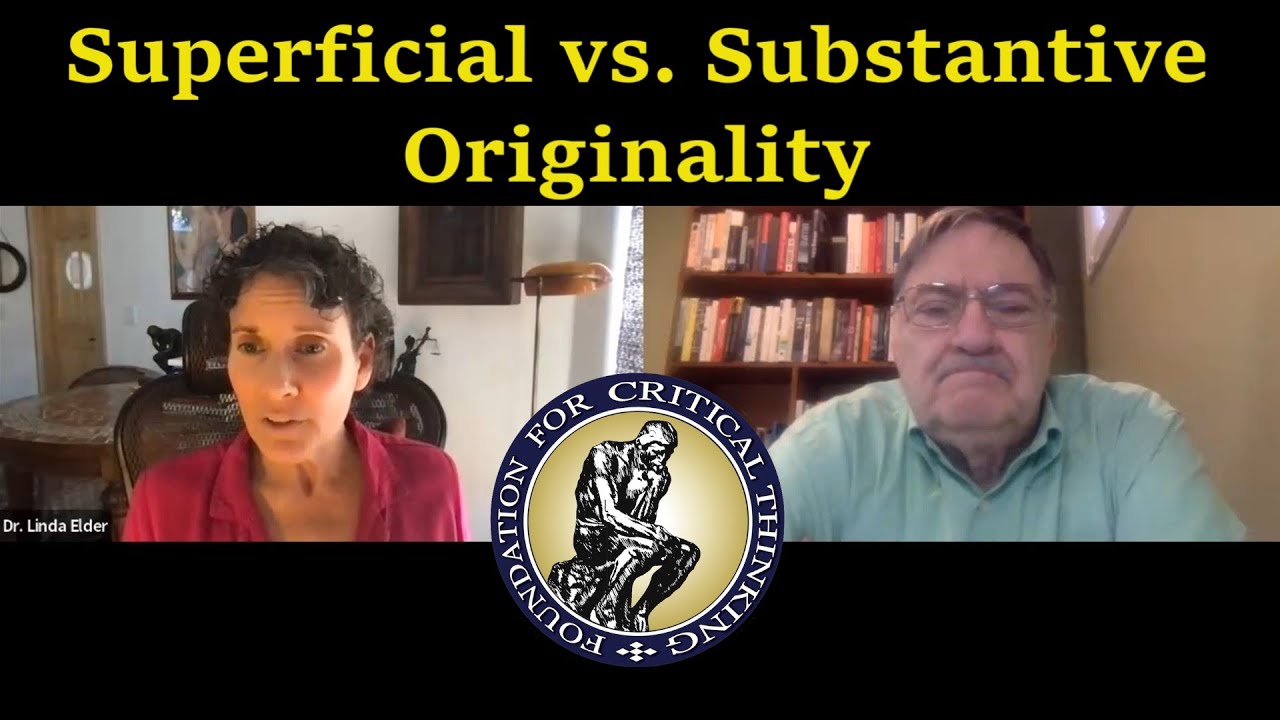
(Ep. 11) The Analysis of Reasoning: Going Deeper - Concepts

(Ep. 11) The Analysis of Reasoning: Going Deeper - Concepts

Machine-readable: Markdown · JSON API · Site index

Поделиться Telegram VK Бот
Транскрипт Скачать .md
Анализ с AI

Оглавление (14 сегментов)

Segment 1 (00:00 - 05:00)

Hello, I'm Linda Elder. This is August the 26, 2022. I am here with my colleague, Dr. Gerald Nosich. Hello, Gerald. — Hi, Linda. — We are coming to you from the Foundation for Critical Thinking, a 501c3 nonprofit organization in California. — [snorts] — We are focused in this series on the analysis of reasoning going deeper. And in this session we are focusing on concepts in thinking. And um as a reminder concepts is one of the elements of reasoning — and we can discuss the relationship between con the con concepts and the other elements. So it's one of the elements of reasoning and the others are purpose, question, information, interpretation or inference, assumptions, implications and point of view. So we can burrow into the concept of concepts — in multiple ways. But let's begin um Gerald if we could with uh just a brief explanation if you would on what a concept is in your view how you think of concept. — Yeah. So I'm glad to do this uh because uh in my judgment concept is uh maybe of the eight elements the one we focus on least. I don't mean we at the foundation for critical thinking but when we as or as regular people are thinking about something. Uh another one that we don't think about that much is assumptions but concepts kind of tends to lie under our radar. So um the eight elements are each of them map out a different aspect of thinking or of thinking well and um but in English often we use those eight element the terms for those eight elements in overlapping ways. So point of view and assumption and conclusion are often used interchangeably. My point of view in this matter is and then I say something political u whereas that's really probably a conclusion or an assumption. uh whereas point of view is a way of looking at things. So you and I for instance might uh have this might we have we might have identical assumptions about what's going on and we might have identical conclusions yet you're going to be seeing it from Linda Elder's point of view and I'm going to be seeing it from Gerald Nosuch's point of view. So I use that as an illustration because that's especially true with concepts. We use the word concepts for all kinds of things and there's a way in which there's nothing especially wrong with it. But one of the things it does is it prevents us from focusing in on one of the prime meanings of concept. So for me a concept an essential idea about a concept is that it's a category. It's a kind of thing. Um, that's not really very helpful, but I can another way of saying it is that if you're looking for a concept, you're wondering about the meanings of key terms. Um, now both Richard and I have tr have uh antipathy to the concept of meaning because we both come from a philosophy background. Uh, but if I make it plural, meanings of key terms, it means it's uh to it's to ask so what do you mean by that? So that seems to me a good question that leads you essentially into concepts most of the time. So we're talking about whether democracy is being undermined in the United States today or we're talking about uh whether Putin is a dictator or let me switch fields. We are talking about the effects of gravity on something uh and uh or we're talking about uh the big bang and how things come from that. or we're talking about cognitive dissonance in the social sciences and uh and so we talk about cognitive science or we talk about the big bang democracy and whether this is leading to democratic or undemocratic processes but often we don't stop and ask ourselves what do we mean by democracy that is what's your concept of democracy what's your concept what do you mean by gravity that's turns out to be a particularly difficult one and uh actually all those years of using the concept of gravity, nobody knew what it was. Newton famously said, "I don't know. I'm not going to make any hypothesis about what in the world gravity is. " So, um uh so what's a concept? A concept is

Segment 2 (05:00 - 10:00)

you take the key terms that you're using when you're describing something or when you're coming to a decision and you ask yourself, "What do I mean by that? " So if I take the eight elements, purpose, question and issue, assumptions, each one of those is a concept, right? And uh so I can ask so what do you mean by purpose or an assumption? inference? Or another way of saying that is not just what do you mean but what is an inference? What is a conclusion? What is an interpretation? And when you're asking that kind of question, you're getting at something like uh a description of what it means. Another way of saying it is you're looking sometimes for a definition. But for me, definition is often too narrow because people then mean it's got to be spelled out completely. And that would be nice. But for many concepts, you can't quite spell them out completely. you can give but you can get them a much clearer more precise idea of what a democracy is. Um and of course for any of these uh there can be multiple points of view on what the concept means. Um I remember uh some years ago people were talking about vitamin K that is uh vi biologists and nutritionists were talking about vitamin K and the topic came up well what's a vitamin and in particular what is vitamin K and that's a that became a topic in uh in journals for several years. Notice that's a question about concepts. But you could very well go on talking about vitamins all the time without ever asking yourself, wait a minute, let me step back from that question and ask what do I mean by a vitamin? What is a vitamin? So it's a part of critical thinking that we often overlook a great deal. So um that to me is a core concept of of a concept. Um and I want to distinguish it from something else. Um it's uh contrasting. So a concept is the meaning of a key term say or the meanings and it's not so I'm now gonna say something kind of linguistic but it's not really about linguistics. If I put a concept in a sentence like uh democracy is preferable to dictatorship, right? I'm saying something definite and limited. Whereas if I ask myself what's the concept of democracy, I can apply that all over the place, not just in relation to dictatorships or this government or that government or when it occurred or when it started in ancient Greece and how it flourished in Florence. So one of the things about concept as I'm using this term is that it's extremely flexible. So it enlightens all over the time. A sentence is limited. So I can say um uh well I'll just take one of the elements. Identify your purpose. Notice that's a sentence, right? And what it leads you to do is one particular thing. Identify your purpose. Whereas the concept of purpose, the concept by itself without saying identify the concept, the concept of purpose goes all over the place. Identify your concept. Evaluate your concept. Compare, excuse me, purpose. Identify your purpose. Evaluate your purpose. Assess it. Compare it to my purpose. Work out how your purposes and my purposes can be reconciled to one another. So the fact that you make it a concept, the meaning of a key term means it's extremely flexible. Um whereas uh if I embed it in a sentence, it becomes much more limited. Anyhow, that's my take on concepts. First, what they are and second of all, why they are so incredibly useful. It's it's um fascinating to listen to how you would initially explain a concept. — And it's reminding me of how many different ways there are to say something that is similar. Mhm. — And so now let me just add to what you've said. — And um I I'll start with the way that I think of usually explain — and way that I think of a concept. Mhm. — So a concept is an idea in a mind

Segment 3 (10:00 - 15:00)

— and that could be include inclusive of other species. — So it's an idea in a mind and so for our purposes it's an idea in a human mind. — Right? And so and therefore obviously it connects to your concept of categories. So it we have concepts or ideas that guide our thinking according to category. So for example if I think of um police officers. So if you say the term police officer, — right, what do you think of in your mind when somebody mentions that term? — And so you remember back in the time of let's say the 60s and the 70s when the term pig was used and cop. Mhm. — So we have derogatory terms — that arise out of the way that people conceptualize, — right, — a given thing such as the police. Mhm. — So it's an idea in a human mind and therefore you can see right away that if somebody is let's say we're around in a room and people are talking about the police everyone in the room has got a slightly different concept — guiding their thinking and that concept comes from their li their lives as it has been lived their life has been lived to that point. In other words, the things that they've learned along the way, the what they have read into situations, their own critical thinking abilities, so many variables, right, will affect how we're conceptualizing in a given situation. — So again, the simplest way of thinking for me about a concept concepts is it's an idea in a mind. Therefore, by implication, it has no standards. In other words, it doesn't automatically utilize intellectual standards as we know. So in other words, I can have a very poor concept of the police. — Yeah. Right. — And um so then uh we so but the ideas are always there, you know, they're percolating. They're guiding us. And now some concepts are easier much easier to u articulate obviously than others. So you gave the example of democracy — and you were talking about that the complexities in utilizing or thinking about that term — and then we can so that's going to democracy is a paradigm — um case of a complex concept. — Yeah. We can take also a paradigm case of a concrete concept and I'm going to say for the our purposes a simple concept. — The concept of an ink pen if you've ever been exposed to one — very is basic. Now there are many different types of ink pens but there is something you think of and we basically have a similar idea. We don't need to really be arguing about what an ink pen is unless you're a manufacturer and I'm a manufacturer and I think my way is better than yours. I mean, you can always see how you can if you change the context ever so slightly, then as you were mentioning, then we've got to deal with those new realities. But we've got to be able to think of some concepts as simple and some more complex. And if nobody if people won't grant that it's fairly simple to think of what an ink pen is, then they're trying to just make every concept complex and there's no point in that. — So um we have the simple or the concrete and those aren't the same one and the same but I'm just using them together moment for the moment. And then we have the much more complex. Now um Vickenstein said something like don't ask uh the meaning of a term but ask how it is used. — Right. And so I think of uses of terms and of course I'm completely comfortable with your use of the term meaning

Segment 4 (15:00 - 20:00)

— I'm not uh bothered by that any kind of philosophical background there but I do think use is more helpful Because if you think of uses then you would ask well how is the term used in educated usage and we have a way of answering that which is through a dictionary. Now, dictionaries give us definitions, not concepts, — right? — Because a concept is in a mind. — And a dictionary is something that we read — and it gives us an overview of what the way certain lexographers have articulated — the main uses of terms. Mhm. — So, but the usefulness of dictionaries um cannot be underemphasized because it gives it they give us a starting place for thinking in a disciplined way — about concepts. — So, let's take a concept like the concept of love. there are certain now this is actually one of the hardest I think concepts — for one you don't find a very good dictionary definitions of the term — right — but what you are going to find in any reasonable use of the term love is a concern for the well-being of the other [snorts] and that's of course a minimal condition. — So if someone is abusing you and also telling you that they love you, then they're actually just manipulating you through language and they themselves are probably also very confused. So it's we are as you said it's the ele one of the elements of reasoning that we tend we humans tend to ignore more than ones like let's say purpose and question and even people who don't think at a very high level will often you know realize that they have a question that they're trying to answer and they realize that they have a purpose — right — and if you ask them what their purpose was they could probably articulate it then you said what are the concepts guiding your thinking Right. — Then that would be then they would be usually in the deep end without knowing how to swim. — Yeah. — So and so because concepts are like the air we breathe. They're they're the ideas we're thinking through. We're using to think through everything else. And of course they're connected to our assumptions and our point of view. I think of those as something of a triad which in which we are uh we're basically unaware of these three and they're interacting in an intimate ways and concepts and point of view — and then they're guiding the way we see — the information — so that and the way that we make inferences. — So here's another example. So, let's say that you have a situation in which you have a reasonable man and a an unreasonable woman in an intimate relationship. — And the man is telling the woman um is g is giving her a good argument for needing to rethink something that she's doing. Mhm. — And then the woman thinks, "Oh, you know, he he's just picking on me. He's he doesn't love me. He's why would he treat me like that if — you love me? " So in this case, it can be woman, man, woman, any gender that you like. So the point is that person A and person B and person A it has one reason has a reasonable intention. Person B is misreading that — and thinking if he wouldn't treat me that way if he really loved me. — So this person B is using the concept of love in the in an inappropriate way in this scenario because remember I started with person B being giving a reasonable argument — and as it were being a reasonable person. I'm trying to make this a paradigm case without any actual, you

Segment 5 (20:00 - 25:00)

know, example, you know, specific example. But the point is that you're using concepts to determine how you interpret the world, — right? — And those concepts can be very skewed and um you can be misreading. And actually in this case it is it is let's say because he does love you that he is telling you — you need to rethink the way you're thinking this. — And if he didn't love you see then he wouldn't be telling you that something like that. In other words it's through the love — that um this um person is bringing this to your attention. — Right? So you see this shows our discussion so far should illuminate to us all how difficult this terrain is, — right? — Because we have trouble even explaining what a concept is. And that's not just to us. That's anyone who's trying to explain a concept. It's not an easy thing to discuss. It's like this. It's connected to this idea which is that we are highly linguistic — right — and we see things h we humans see things from a highly linguistic point of view not strictly linguistic because we also have the physical dimension but even that has a linguistic dimension every part of our lives we can't take language out of human life and where you have language would you have concepts, — right? — So, we're living through them. We come to the world with uh people around us telling us by implication how to think through the concepts they're using, — right? — And we have no notion that we are using concepts. — We don't have any idea that we're actually forming concepts. So we don't have the idea that we have the choice to form the concept in a different way. — So let me now pause Gerald and see — I just want I wanted to say um uh yeah that I I think that that's a that's an admirable explanation of both concepts and its use and its uh its difficulty its complexity to it as well. I as you were saying this last piece um I was thinking um seems to me reasonable though not certain seems to be reasonable to think that uh nonhumans often have concepts um I think a rabbit think you can explicate a rabbit's behavior as having the concept of a predator um uh because they react to certain kinds of things in a certain kind of way. It doesn't seem to be purely instinctual. It's partly learned, partly experiential and everything. And I'm not saying that's for sure, but um but it fits with my idea of a concept and it seems to me to fit with yours. It's an idea in the mind and that that's primarily the mind of humans, but doesn't necessarily have to be that. But I wanted also to talk about your the one of love you meant and the hypothetical example you gave. And I so I have a personal example. So I used to I used to sit in a group of uh of men of all males um maybe five or six men who we'd meet every two weeks or so and we'd be talking about emotional things in life and uh and there's a lot of risk to it. So, um, and at one point, this a while ago now, um, I got worried that one of these people whom I care about very deeply, um, was angry at me. And he said, "I see something on your face. " And I said, "Well, I'm worried that you're angry at me. " And he said, "Uh," he said, "Well, first, Gerald, uh, I'm not angry at you, but second, even if I were angry at you, that wouldn't mean that I don't love you. And that was enlightening for me because an assumption I think probably based in my childhood is that if some that when somebody's angry at you it means they don't love you. Notice it's an assumption and a point of view as you mentioned in that triad and that they were linked to me. And that broke that linkage for me between anger and love. And uh and now I realize well of course you can be very angry at someone you love. And that doesn't diminish the love. They're on two separate tracks. uh you might it might be important very important to reconcile them to talk it through and everything like that but it does show how even after a lifetime of critical thinking and of examining concepts um the concepts can become to use your word

Segment 6 (25:00 - 30:00)

skewed um so that I assimilated one to the other anyhow that's an example of what you were saying I thought — yes so there are many ways to enter then point of uh to enter concepts — and now you were I had I should resist this but I won't — you mentioned other animals — right — and then you went to your second point but I was still a bit thinking about your first point — and the reason why I shouldn't probably do this is because We there there's so many things we don't know about what other animals think. Even though we think we know, we've always made that mistake. — So, — first it was they don't have emotions. Now, we're maybe going in the other direction. We're trying to figure out now whether uh animals whether dogs tear up when they see their ah — right um when they their owner. — So there but so there's, you know, increasing research in these kinds of areas and [clears throat] the anyone who's ever had a dog or a cat — can get can give examples of many concepts that they've seen their animals sort of using as it were. And so that I saw this video for example of this cat who as it was a little hand massager that was being used by this owner. And so the cat the owner was trying to tame the cat. And so she was, you know, using this on the cat, this little massager kind of goes like that its head. And so, um, after she had done this a few times, she put this, um, massager in a drawer. So, now when the cat wants a massage, — he goes over and sits in front of the drawer, looks back at the owner. — Okay. Now, we all we can do is observe the behavior, — right? — And then she gets the cat. So, she gets the thing out. She gets the massager out while the cat's watching, and he jumps up on the bed. And then you watch, you see, first she tries to pet the cat and the cat swats her — and then she starts to use this thing on the cat. The cat's just, you know, really enjoying. You can see his eyes are. So I'm saying that these are ideas in the mind that you could you can — be pretty certain of at least the ballpark idea that the animal is using, — right? — And that tells me that there is a whole lot more to that than we can ever know. And we can try to know certain things about animals in this regard. And so we share this with our other species to some extent, — right? — And um but of course their language is more primitive. — Yeah. [snorts] — And in any case, it's still language. They're still communicating things to each other, things that we are not aware of. — [snorts] — So now the — just an anecdote um and that is Koko the gorilla that was raised in a family and uh learned I think 600 words and could use them really adeptly. Well Koko was raised in a family and it did the dishes every night. So it did that regularly but it never someone after a while realized it never got the concept of making the dishes clean. all the — washing the dishes. So, it's a way in which we can read things in, but we're often uncertain about where the limits are. — Yeah. — Well, that the Well, we we're right because we project our concepts into the animal. So you can see this when somebody is walking a dog and the dog is trying to stop every two seconds and sniff — and the owner wants to walk and the two are incompatible and it's a consistent pattern that you see — and it's because the dogs are attracted to the urine of the other dogs, you know, because they're marking, right? — So one scientist, one uh I guess you could say dog scientist uh was using this analogy. So when dogs do that, when they urinate, like say on a tree or whatever, they're marking their territory in the same way that you would

Segment 7 (30:00 - 35:00)

put up your business card. Okay? So that means that if you can imagine somebody a dog is walking along and there are like a ton of business cards right there and if you've ever had a dog and they just pull you over and they just they're just sniffing and they're just now in that moment I can't understand the concept the dog is using because I that's not I don't have a parallel — way of understanding that but I know that there's there are concepts being used — and I That's all I mean I don't necessarily need to know right what the dog or the animal is thinking to know that there is there are concepts — right — being used now with humans of course it's so much more complicated because think of all the different ways in which we use concepts the many distort concepts for various reasons — right — um the way in which we can make ourselves believe anything so to speak — that we can believe that say anything that what we do to someone is justified or justifiable. — Yeah. — This is all conceptual thinking. — Yeah. — And so when you're torturing someone, what is the concept that you're using? The concept, it's not just one. What are the concepts? So, you're using the concept of let's say this is not a person that I'm torturing. This is someone who is trying to harm and we've got to get something out. You see, it's all this language that you're using to justify the behavior you're engaging in, which is torture. — So, you don't go home and say, "Yeah, I you know, spent a all day long torturing people. " [snorts] — You go home and you feel fine. you're able to live because you're telling yourself everything's okay about this through the concepts and the only way you can justify this — is through distorted concepts. — Yeah. Mhm. — So that means that it in a it leads us to the question, well then how do we know we're using concepts um reasonably? — Reasonably. Yeah. uh and it's a difficult one, but so what I'm going to say now is right off the top of my head, but it's uh I think it's not essentially different from how we know whether we're making a reasonable assumption or whether we're drawing a reasonable conclusion. So I don't know that it's especially difficult with concepts. It's not as if you can go to a an assumption dictionary and uh say okay let me see if this is one of the correct assumptions by looking it up on page 646. Um uh so there's so we have the we have a similar nest of difficulties I think with all the elements of reasoning and also with the with the standards. Um — well I think it's I think concepts and assumptions and point of view are the hardest and then inferences. But you see you c you can say what okay tell me what you're what conclusions you're coming to and then you tell me that. So let listen let's ask if that's logical. So that seems like a fairly easy move in comparison to what concepts are driving your thinking right now. — That go ahead. Sorry. — Well, I just say I think because concepts like assumptions are taken for granted. So anything that we're taking for granted and we wouldn't we have to take our concepts for granted. I mean we're we're assuming a con a concept base in other words — we're assuming that all of let's just speak for myself. I'm assuming that all of the concepts in my mind are perfectly sound as far as it goes. Because if I didn't think that, I will be changing my concepts. thinking. — Well, though I believe that that's true, I think that's true for all the elements of research. That is I take it for granted that my that what I that I have a purposes that they're set, that my point of view is valid, that I have the information to back up what I say. Even

Segment 8 (35:00 - 40:00)

if I don't, I'm kind of a I take it for granted that I do. And if you press me on it, I can either dredge up some information or even make something up without even realizing I'm making it up. Um so but uh but your major point I would say about uh about say conclusions being clear or clearer than concept to me that's — easier to access and I would say that that's um that's uh dependent on the context. — So take one that's really clear like purpose. What's your purpose in doing this? someone might say it. Um my purpose in doing this uh in uh well take uh take people who cut themselves for the — emotional satisfaction it gives them. Um or they might say I do it my it because it makes me feel good and it feels good and that's my purpose and it might be considerably difficult to realize that perhaps I'm doing it my real purpose is to get back at my parents. It might take years for me to come to a conclusion like that's what my real purpose is underneath. So partly I'm saying it depends on context and the depth with which you go into purpose or assumptions or uh even question and issue. Um uh question and issue maybe not but there always these questions under the questions you're asking right. Um — well it's a you could say it's a conundrum but I think that what um mostly what I would what I think is important to understand about concepts mainly is that they're ideas that are driving our lives. — Yeah. — And we can access them. — Right. And that critical thinking provides ways into accessing the ideas guiding our thinking. — And of course it is true for all of the elements of reasoning, — right? — And so the let's get into if we could a few examples of concepts that guide people's thinking where maybe they're not thinking of the concept. they're not aware of the concept but it's still guiding their thinking. — Right? — So for example let's take um the concept of an inferiority complex. — Okay. So let's say that you actually are engaging in that you have that concept going on in your mind — and it's continually defeating you — this idea — right — um but you may have no awareness — right — that this is guiding your life. So you let for example you may blame other people for your inability to let's say achieve what you want to achieve and so you need to understand the concepts you're actually using — right — thinking — right — so the flip side of that the opposite of that is a person who is has you could just say embodies self-efficacy or in other words has belief in their ability to achieve within their capacity and they're not concerned about what they can't achieve. They're not worried They know that there are many things they that every human cannot achieve. They're focusing what they on what they can achieve and that's driving their thinking, — right? — And they may not be uh necessarily it may not these achievements may not come easily to them but they are still the concept guiding their thinking is I can achieve. — I will achieve. — It can be done. I will do it. — And — yeah, — right. So that's what I think people really need to see is that you could ask yourself, in other words, what are the key ideas, — right, — that are driving my behavior

Segment 9 (40:00 - 45:00)

— right? So another example of this would be um a parent dominating a child. So imagine a person a good parent. The child when the child is small everything's fine. The parents doing his or her best and then the child turns into a teenager and then it becomes difficult and before you know it the parent is has developed bad habits of let's say yelling at screaming at the child even becoming physical becoming physically abusive violent however far that may go. Mhm. — I'm just giving one possible, you know, one possibility where you're you over time this has grown up in you. You didn't ever intend it to happen, but it did happen. Now it's become a habit in your thinking. And so now you're actually a dominator of your children and they are either fearful of you or they avoid you or they just go along with you and behind your back they say what they think or they can't wait to leave your presence or your house or whatever it is that they're thinking. — So that's another example. So in other words, I can look at my life and I can say what are the ideas that guide my parenting? What are the main ideas? ideas that guide my intimate life so to speak or the way I think about intimacy? What are the ideas that guide my um the way that I think about the earth itself? — So for me the earth is very important. So I always um want to be in nature when I can. So that's an idea that's always in my mind. the idea of go outside and feel just be outside for a few minutes. So that idea is in me. You see it's not in everyone. — So what are the ideas within you? And sometimes those ideas can lead you in the wrong direction. So you want those ideas to be leading you in the right direction for you. — Right. Yeah. And um and as I was thinking of your example of the inferiority complex, I was thinking of how um it can shift my idea of the way concepts work in our lives a little because as you know I I'm work in history a lot. I'm very interested in history and if I think of inferiority complex um the that term is less than 150 years old. I think it's the whole idea think of complexes that I don't know who that comes from. I think Jung maybe but so before 150 years ago it seems to be quite clear that there were people who had inferiority complexes but there was no term and there's a sense in which there was no concept. So you could say to somebody, well, what's guiding your behavior? And there's no hope of coming up with that inferiority complex. So, and I can't actually think of examples. I think that's because the people who we know historically are those who had the opposite kind of complex. So if I think of grandiosity, we didn't have that concept before very recently till I think the 19 1940s or 50s. Um and there are lots of people in history who whose behavior was motivated by grandiosity but there was no such word and I think that's true for virtually all our psychological penetrating terms uh not depression that was always there but uh but manic or manic depression or bipolar or schizophrenia um hallucination or I mean virtually all of those are really recent terms and humans have been experiencing them all along. So um it it uh yeah so I think it Yeah, go ahead. — Well, so in other words, when you sorry to interrupt, but so when you're label so when you it leads to a lot of ideas. One is so that once behavior or behavioral patterns are labeled — then there then it's a new ball game so to speak, — right? Now we have uses and misuses, — And I was hesitant um to use the term it is even as my example — inferiority complex. — Yeah. veryord complex because I think that one of the um disservices

Segment 10 (45:00 - 50:00)

that's been done in the psychiatric and the psychological community is um the idea that we need to label people, — right? Yeah. — And so the very idea of labeling itself is problematic. Mhm. — So what so take the concept of a schizophrenic. — So we don't understand that very well. We lump a lot of people together, — right? based on patterns that seem similar. — And we want we we're we seek a genetic component — and yet we also know that people often you see look at it this way. We have created a world, humans, the human world, which is very significantly pathological in many ways. — And so we're born into this while we're being told that it's everything's fine, right? As children, we're not told, look, it's the world is full of potholes. Be careful. There will people that be will that will want to harm you and there will be people that who do figure out ways to harm you and there will be people that will use you and there will be uh there will be a system a monetary system within which you will have to live and make a certain amount of money in order to survive and you will have you see these are harsh realities and then we're going to thrust you into these groups and those groups and these other groups with their different ideologies and we're going to tell you to believe these ideologies without question. So many people who are born into this do not accept these realities. — Right? — Not to mention the poisons within an individual family that exists. — Right? So if you have a highly sensitive person within or even not just anyone within very harsh conditions in childhood where they're being made to feel paranoid or whatever is happening any whatever strange things that people want to do to each other and sick things that they do to one another. you see that can lead to a person just saying I'm going to just create then an alternate reality if you don't mind — and in this some theoreticians of course have said and it's perfectly understandable that they've done this — now of course this is not true for all people that we label schizophrenics or he having schizophrenia of course I'm only speaking of one potential type — right — so what I'm saying is if you're thrust into a a world which is so poisonous, how do you yourself survive in that — intact — and grow into adulthood with a reasonable mind so to speak. — Yeah. — So these are the concepts coming at you that you are having to work within. Some of them you manage to see through. deflect, I guess, or get around. Some of them you soak up uncritically. Take the there the concept of critical thinking itself, you're talking about new concepts that have sprung up over the past 100 years or more. The concept of critical thinking itself is significant because think if we were automatically thinking critically we would have no need for the term critical thinking. It would just be implied — right. Yeah. — So we had to create the term because people were not thinking critically enough. — Right. — And we didn't have this in the educational systems. Mhm. — So if you understand these these moves that we're making then you begin to see all kinds of things that you were not able to see before. So you could I could ask you anyone myself included to for example at the end of today I could ask what concepts guided my thinking today. What ideas were driving you? — So for example, one person might say the main idea that was driving me today was

Segment 11 (50:00 - 55:00)

how to make ends meet for my family, — right? — And that is a major one. — Actually, I was either working all day long on that or I was worried about it. — So if that's the concept that is always guiding your thinking, then what is the quality of your life going to be? And we can't just say, well, just change your concept because that won't work. The fact is you have to if there's any way, you've got to change your circumstances. — But often there isn't a way or there doesn't seem to be a way. Mhm. Well, if if I uh if I think too strongly about the chaos of the concepts we grow up with and how far off they are. So just a term to incur in to include it all is the complexity of it including the pathologies of the world. Um there's a sense in which I can sometimes feel discouraged and I know that in webinars and in workshops a number of teachers feel discouraged. For instance, when students come in and uh will not countenance uh evolution by natural selection. I mean they're just dead set against it. And the teachers wonder how can I change their minds? How can I get them to see that this is the one that's evidence-based? and uh the fallback position for me which I often say to myself and to other people is that we always got we always have to do the best we can right I mean we can't expect — uh — perfect results we can't even expect near to perfect results we do the best we can and keeping in mind the standards what's my best way of finding out what's accurate um uh how deep do I need to go into this question in order to address the purpose of asking the question in the first place and or to answer the question and um doing the best I can is a nice good is a good fallback position for me so as not to get overwhelmed by the complexity or the pathologies and uh that surround me so much the dysfunctionalities. Yeah. So — now that's um important in many ways and this is not what you're saying but I'm just going to add to this. — There is a feeling that we are just becoming a dystopian society or that we have a dystopian future. So there's a sense of hopelessness — that people are embracing it's understandable from the point of view of realism — but um mental health and the point of view of trying to do what we can to make things good as we can, so to speak, while we can. Uh these things are pushed under the rug. And so what we want to do, you see, it doesn't make any sense to give up hope, right? — Because you're you've only got a short life to live in any case. And no matter how many years you have and there's so much to be enjoyed and appreciated so many things that are beautiful, — but you have to see the beauty in them. There's the concept — where this con the conceptual side comes into play. Mhm. — But we've also got to create a world which is much more sane and m much more palatable — to the human mind — which is very complicated. So yes, I think we cannot give up hope, — right? — And it's sometimes it feels like especially when we think about the earth, the sustainability of the earth — seems like we are too late. — Yeah. — But we still have to do what we can, — right? Yeah. And um I'm going to put the earth one aside because strike that seems to me to have much more empirical evidence behind it than what I'm now going to say. So there are these nice historical

Segment 12 (55:00 - 60:00)

studies again history in which virtually every age has thought it was dystopian and that things were going to get worse. uh nothing like when I was a child then the world was much better and uh in previous ages there were golden ages where things were very much better we've just deteriorated since well it turn well it turns out that virtually every age has thought that and that gives me some reassurance and thinking well mine my negative thoughts are just partaking of this kind of constancy in negative thoughts like um I read also read linguistics a lot and it all and all ages since uh even before Shakespeare's time everybody thought the language was falling apart um that uh we're not going to be able to express ourselves anymore. We're losing all these terms and it turns out it's never falling apart. That is new terms come in, old terms fall away. we say things in different ways and the ways that uh that uh I'll say English teachers uh of the 1850s said were utterly incorrect are now just kind of standard. Um uh — Fury Dickens he says don't rather than doesn't. And now he would be he would have a red mark in the margin by his uh — writing teacher. And um so I got some reassurance from the relativity of the negative conclusions. Um so — I do see your point. I mean I and but I uh I think that you see if we give up hope then there is no hope. — Oh right, right. And actually those earlier ages some of them were facing destruction of the earth's resources but they also were not admitting to it — right remember I put aside the earth question uh that when — well you see that's the part that though we can't put aside conceptually — and so that's the part where I think it's hard not to feel um like it's over the problems are overwhelming that we we've failed to think critically about them and now we're way behind the curve. — And but you see when we have a sense of and this is also related to mental health. When we have a sense that we can make a difference, — then we are going to be more likely to save the ship. — Indeed. Right. — And we've got to have people saying we can do this. We can create things that can take the get the plastic out of the ocean and we can create things to get the carbon uh out of the atmosphere. Whatever we need to do, we can create these things. So, let's get it done. We can create solar panels that are much more efficient and use recycled materials or whatever the case may be. — And there are a lot of incredible um advances in the green movement. — Right. Indeed. Yeah. — Right. But we do have the problem of the old regime pushing the old system which is already there for gas and oil. Right. So those systems are still controlling — right — conceptually the way we think about — yeah the entrenched interests have permeated all of society. Yeah that's right. So this comes back to uh the problem of unbridled capitalism and that's a concept that we are basically have just accepted. — And notice I'm saying unbridled capitalism. I'm not of the mind that we can't have any capitalistic system that would be workable. I do think it's entirely possible, but it's got to be reconceptualized. And just this is there's so many again ways that you can go with concepts. So think about the concept of a utopian community. — right. So, over time, periodically, groups have said, "We we want to create that utopian community. " And — it never has quite worked. — I don't think — but the ingredients are u valuable. So for example, the idea of communities uh working together under certain conditions, — right? — And you know, for example, having a community garden, having a theater building, — right? — Having a community center, things that

Segment 13 (60:00 - 65:00)

you know and having resources for people in the community. Mhm. — Um and then again the concept of um say business but small business. — So everybody can have a small business up to a certain point and that's would give a lot of leeway there because we want to encourage people who want to work all day and all night, — right? — So in other words, we don't have to throw it out, — right? of capitalism entirely. But we do need to re we need to get control of that concept. We need to decide how we as humans want the future to look. — So just think we humans do not have a conceptual road mapap for our future. — And um so now we've got the threat of nuclear a nuclear meltdown right now — is this Ukrainian war — and we've never faced this before. where there's it's this antiquated nuclear power plant is in the middle of a war zone, — right? — And now we've got to think very well. The world has well right now conceptually. — Yeah. And uh in terms of government, every country needs to come together and say we agree to have our nuclear everything that's nuclear um overseen by a government, a world government agency. See, these are concepts that we could create — and if we don't create them, we could be in trouble. — Right? — So, I think we should bring this to a close there. Just so many ways we can go with this. We haven't talked about many other examples for and just as I think about this in kind of closing. So I think about for example the you could ask yourself am I using do I use concepts that are fundamentally reasonable? That is am I fundamentally a reasonable person using reasonable concepts — or to what extent am I egocentric which means I'm using egocentric concepts — right — right so I may be rationalizing I may be projecting I may be stereotyping — and all through selfdeception in the same way I may be let's see if we're being sociocentric then we're going along with the proud, — right? — So the concept of acceptance, being accepted, that concept, that's a concept that really drives many people. — Sure does. and can drive you, as it were, out of your mind — because you you want to center yourself in reasonable concepts, not in concepts that are going to cause you to have emotional trauma and emotional drama. Right? So, I've always got to be liked by someone else. I've got to be validated by someone else. They've got to tell me that I'm, you know, the best this and the best that and wonderful at this and wonderful at that. Now, obviously, we do need connection, human connection, but we can ask ourselves, what are the concepts guiding my human connections? — Yeah. Yes. — So, concepts are very enjoyable as a concept. — I think so too. Um, — and difficult. — Yeah. Yes. And we have not only concepts but then we even talked about going broader belief systems — right — so entire belief systems theories these are developed concepts so to speak that go in many directions. — So you may have an ideology guiding the way that you think in within your profession. So in other words, let's say if people who are a certain type of psychologist think in a certain way, then I might find myself thinking in that way. — Right. — Because they think in that way, — right? Right. — And so I'm buying into the ideology, the belief system that has come been laid down for me, let's say, as a student coming into this, — right? that I've accepted everything and that's just one example. So we have religious ideologies, we have ideologies about our country, — right? The way belief system is about our own country being the best. — Um so we when we burrow into concepts there is a tremendous amount there.

Segment 14 (65:00 - 65:00)

— Very rewarding to do that. Uh I find — almost all the time. um sometimes it doesn't pan out and sometimes the deeper analysis can kind of lead me astray a little bit or es especially temporarily um but uh yeah I think concepts are a very rich source to understand our own thinking and consequently the way the world around us works. Well, thank you, Gerald. It's been — very enjoyable as always. It — has been sharing this with you. — Okay, good. Linda, — take care. — You too. — Thank you to everyone who's been joining us. — Thank you. Good night.

Другие видео автора — The Foundation for Critical Thinking

Ctrl+V

Экстракт Знаний в Telegram

Экстракты и дистилляты из лучших YouTube-каналов — сразу после публикации.

Подписаться

Дайджест Экстрактов

Лучшие методички за неделю — каждый понедельник