Can your business thrive in today’s landscape?

Can your business thrive in today’s landscape?

Machine-readable: Markdown · JSON API · Site index

Поделиться Telegram VK Бот
Транскрипт Скачать .md
Анализ с AI

Оглавление (7 сегментов)

Segment 1 (00:00 - 05:00)

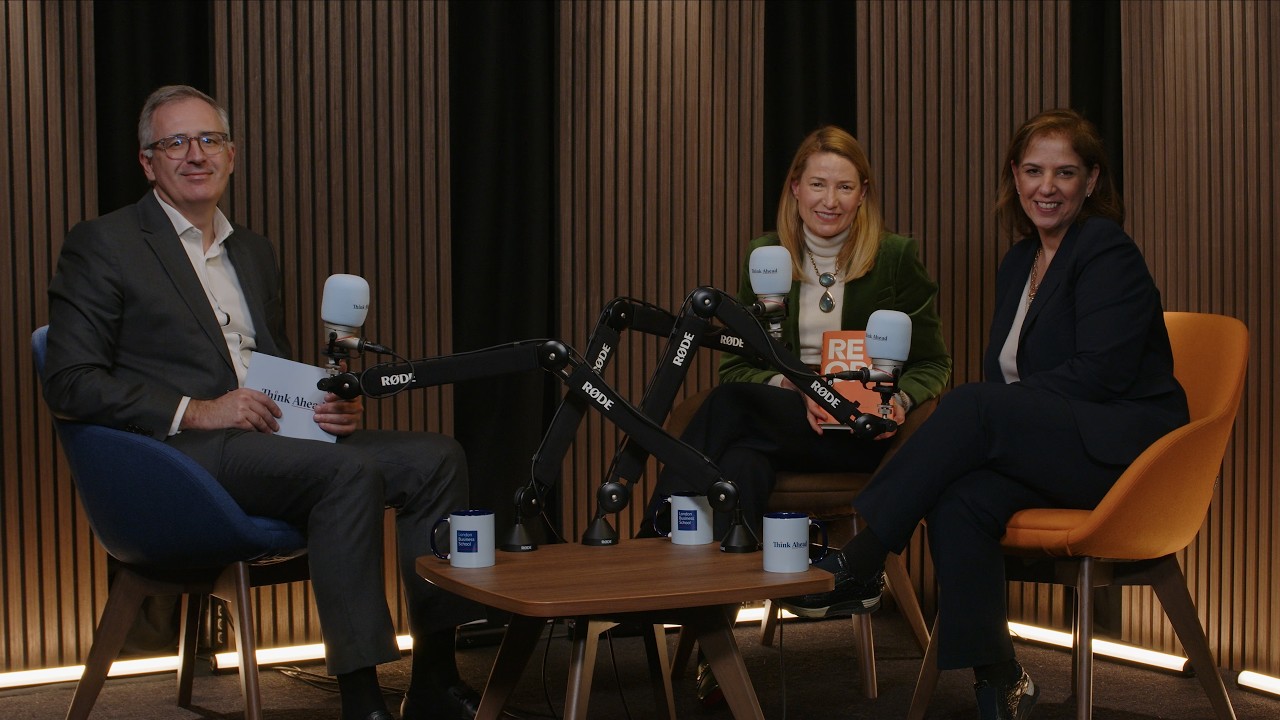
Welcome to Think Ahead, the podcast from London Business School that brings you cutting edge research and real world insights to help leaders navigate today's most pressing challenges. I'm Sergey Gurif, professor of economics and dean at London Business School. Together, we are exploring leadership in times of chaos and how to strategically weather those storms. We will explore organizational structures and how agility could be embedded without sacrificing clarity and long-term purpose. Today we are joined by two exceptional guests, Jessica Spangin, ajun professor of strategy and entrepreneurship at London Business School and Suzanne Haywood, chief operating officer at Exor and Chair of CH Industrial and Evaca Group. Suzanne, Jessica, welcome to the podcast. — Thank you. Jessica, could you tell us more about your work at uh London Business School where you teach uh strategy and innovation? What are the latest insights that our students are benefiting from? — Yes. So uh I've been teaching here for the last 17 years. Um and what's been really interesting over the course of those 17 years is the transition from uh the focus on strategy as a market and a resource discipline. you know, how do I allocate resources in a clear and make conscious choices to um the challenge of how you do it when the market is moving fast, the industry is moving fast, um disruptors and new business models are coming along and when I think about the strategy I learned 30 years ago, I use the same textbook uh Robert Grant and uh that textbook from 30 years ago is uh the first five chapters of the textbook I use now which shows you how the discipline of strategy has exploded over the last 30 years to cope with the nature of markets changing. — Suzanne uh you've had a distinguished career both in civil service and private sector. You also worked in McKenzie where you also were a senior partner. Uh now you're in several organizations on in the board and executive roles. Um can you share a little bit about your experience on uh advising companies on strategy, executing strategy? What's been your experience in recent decades? — So my experience has been very similar to Jessica. Uh I think the speed at which organizations need to act has increased. Um we're seeing that particularly over the last 12 months with everything that's been happening geopolitically. uh we are now finding that literally overnight the context for a company can change. So these geopolitical changes mean that you need to make very quick decisions on you know where are you exporting from, where are you importing from, how are you adjusting to different tariff regimes and so on. So all of this means that organizations need to respond much more quickly than they did in the past. The levers that you can use to do that are going to be less around structure and more around processes and more around people because frankly you just can't change structures very quickly. — Yes, we'll talk about structures but indeed the main challenge that you identified is that we live in the world where change is fast, environment is complex. You mentioned geopolitics uh and supply chains which are directly affected by tariffs and conflicts. Uh we also have technological disruption due to AI. Uh climate change has not disappeared. Uh and that also affects businesses including the ones where uh you work. So uh how do we combine this agility that we need to build up as a key capability in organizations with a long-term focus on strategy and commitment to a course of action which probably needs to remain long term. — So in the industrial companies where I work, I think it's still very important to lay out a multi-year plan. So we would always lay out usually a threeyear plan. five-year plans. I'm less certain that they're helpful, but certainly a kind of three-year plan. Uh these companies, for example, I'm the executive chair of Case New Holland, which is a big agriculture OEM. We make agriculture equipment, construction equipment. We will lay out a three-year plan. We'll do a capital markets day, investor day, uh and take people through that. that will have long-term ambitions in it, including what we're intending around technological changes, possibly kind some of the footprint changes that we're making, changes around quality and so on. It's very important that the company has those long-term targets and that we continue to keep those in mind. But then on a more of a quartertoarter

Segment 2 (05:00 - 10:00)

almost monthtomonth or week to week uh basis, we then need to be able to make adjustments to changes that are happening in the world. So the company needs to be very responsive in the short term while still keeping hold of what those long-term commitments are that they've made to investors and that I think is the challenge for both kind of management executive and non-executive today. — Jessica, you're working with many companies advising many boards. Uh how would you answer this question? How do we combine agility? How we build agility and still commit to a long-term plan? — Yes. So I think um I usually cook off most of my strategy uh classes and my sessions with clients and top teams with the you know uh what is strategy and the majority of the time plan comes up as the big central word cloud uh and the problem is if you then ask people did you execute the plan 95% of the time what actually happens isn't the actual plan um so I uh find that I end up talking to people about the paradox of strategy. The paradox of strategy is good theory tells you make some choices, write it down in a plan, hold people to targets, make the tradeoffs, the difficult decisions. But in reality, what happens is no plan survives contact with the enemy. And therefore, the challenge is how to unmake the decisions as the world around you changes. and being flexible enough not to keep straight down the road of this is the decision, this is what I'm going to execute. People want clarity, but in reality that's not how the world unfolds. And I think that's the challenge you face as the actual chairman or CIO which is how do I continue to give clarity when I know the world is changing — and the management teams need clarity because you need to coordinate their expectations you need to provide guidance on where to invest uh what the priorities are what uh direction we are taking and which directions we are not taking right so how do you combine this agility with avoiding chaos and still uh achieving this clarity. — Well, it's very tricky because the issue is that if you change your plan every time the world changes, uh first of all, you you'll never get where you're intending to get to. And secondly, as Jessica will kind of also be, you know, there's always 101 reasons why you can't achieve a plan. You know, there's always something that happens. There is a very tricky balancing act that particularly a board needs to do in relation to a company but also an executive team which is keeping the focus on what you've committed to do unless it's absolutely impossible to achieve whilst being relatively flexible on how you get there because the can change. But what you don't want to do is just keep on throwing out what you had because otherwise you'll never achieve what you set out to achieve. uh and frankly then the kind of market and the street loses any sort of confidence in what the company is trying to do. So it's a delicate balancing act. — I mean I remember a student saying to me uh when I you know launched the it was one of our executive education uh courses and they said well we did get there. He said it was a telecom's company and he said we had a plan. We knew we wanted to enter this market and we had a plan. He said but by the time we entered it was 5G not 4G. So technically we didn't execute the plan but in practice we did. We just had to adapt the plan and I think that is the challenge that I think S Suzanne's picking up which is at Mackenzie we used to call it tolerance for ambiguity. You know you want managers and I think this comes back to Suzanne's point about it's about the people. You need to have key managers who are capable of not executing to the letter of the law and seeing that the general direction with adaptation is good enough. — I guess my question is around what Suzanne has identified the level at which you keep the long-term targets, the long-term plan. What is the actual vision for the organization? uh and uh what is more operational where you uh are prepared to uh change things uh different approaches uh how to uh get there. So I think for any student or executive education participants for our uh listeners the question is where to draw a line between what stays the same or is supposed to stay more or less the same and where you can actually innovate and change. Yes. Where how do we draw this line? Well, I think one of the things I would say my biggest health

Segment 3 (10:00 - 15:00)

warning I'd love to hear Suzanne's view on where to draw the line, but one of the biggest issues I see in companies, the thing I most often get asked in is our strategy is not working. There must be something wrong with the organization. Come fix the organization. And the first problem usually is it's not a strategy. It's uh a group of executives have gone away for an offsite. They've hugged trees together. They've, you know, got some flip charts and some post-it notes. Some facilitator who doesn't understand their industry has grouped it together in themes and then they've turned it into a mouse matter t-shirt, a mug, and a Greek temple picture of the pillars and the foundations and the vision and goals on the top. That's not a strategy. That's useful for saying this is the context in which we're operating. To me, strategy has always been around key choices and tradeoffs that you make about how you allocate resources given the nature of how the market's changing, your own internal resources and capabilities and where you see change and growth coming from those that dimension is what I think is a true strategy and I think people think doing the vision is enough and I don't think it is. No, but as a strategy is a plan how to re reallocate the resources across priorities, how to address those trade-offs. The question is, is reallocating tens of millions a strategic choice or allocating hundreds of millions as strategic choice? to what extent the bigger uh resource priorities are part of the strategy which should remain the same as Suzanne has told us — and the smaller choices are also about resource allocation but are operational. So if I run an organization what is strategic for me — and what is tactical is always a challenge right and uh where the plan should be followed precisely and where it's not. — First of all I think there is a big difference between a vision or a mission statement or a set of values and a strategy. Uh those are all good things to have by the way. I have no objection to them and good organizations have them. But a strategy, as Jessica says, is about being clear where you want to get to and then having a series of actions that are going to get you from here to there. And then the question comes, okay, well, when the world changes, what do you change? Do you change where you're trying to get to or do you change the things that you are going to try and do to try and get there? And for me, it's less about what's the size of the resource allocation. I mean there may be big choices financially or small choices financially. The question is do you change the actions and I think it's you know organizations now need to be quite flexible about reooking at those actions. It makes no sense as a leadership team to continue pursuing actions that you know now just you know are going to be counterproductive in the environment that you operate in. uh at the point at which the tariff regime changed between the US and China, it made no sense to export anything from China to the US and then the tariff regime changed and the situation changed. Again, that doesn't mean that the long-term objectives of the company or where it's trying to get to have changed, but you're making a short-term decision because the environment has changed. Now sometimes the change in the environment might be so significant uh that actually you have to change where what the goal is of your strategy. So it may well be that consumer preferences have changed significantly. The environment has changed significantly and permanently and therefore you need to stop and reassess what the ultimate goal is of your strategy. You know maybe it's not right to have London and Dubai. I don't know. Or maybe with one of my companies we actually need to change our ambition. which comp which countries we're focusing on, which products, which consumer groups and so on. But usually for me, it's much more around changing the actions that we're taking to get to that objective because if a strategy is well done, it actually is relatively rare that you're changing your fundamental goal. You that will occasionally happen, but usually it's not. So normally it's about reassessing the actions, dep prioritizing actions, stopping actions, starting new things because the world has changed and now things don't make the same sense as they did before. — Yes. I mean building on that, it made me think of um something I teach in technology and innovation strategy when we talk about um Julian Burkenshaw's work on uh why incumbents survive and thrive. uh you know the major narrative is disruptors come and kill the incumbents and the incumbents don't respond and we have at business school we consistently teach disaster stories cuz they're good teaching mechanisms right so you tell the story of Kodak now there's a classic story of someone who saw digital photography and couldn't

Segment 4 (15:00 - 20:00)

change their operating model and was obsessed with the printing side of it and the imaging side and the chemical side of that business and didn't adapt fast enough and died and actually if you look at Julian's work and lots of stories at the same time you had Fuji Fujifilm right and instead of saying we'll double down on digital photography and printing Fuji went what do we we do images and where are images still going to be needed well medical imaging and Fuji is now one of the largest medical imaging companies in the world and having done that they got into injecting dice high stuff vaccines and they survived and Kodak died because they did change their fundamental view of what they did because they looked at it from the Gary Hamill's perspective of what resources and capabilities have I got to play with and they had a different perspective. I mean I would always argue that with an incumbent although there are some very interesting examples of incumbents who did not move and died and you know we know those examples there are many examples as you say of incumbents that have moved and survived. Uh and incumbents have huge advantages over the new entrant. I mean the incumbents have all the resources they have a lot of the skills. You know if you're in a manufacturing kind of sector then they have all the manufacturing base and everything else. So they have massive advantages over the newcomers. What they often don't have is agility and they also have a huge reluctance to self cannibalization for all sorts of different reasons. And one things that I have often pushed is look you shouldn't worry about self-cannibalizing because if you don't somebody else is going to. So you know it's a complete it's completely wrong to look at this and say well I can't do this because it's going to kill my current business. Well, frankly, if you don't do this, somebody else is going to do this. And it's a lot better that you do it yourself. Um, so there's no reason why an incumbent can't move, and move quickly. A lot of it comes down to what we're talking about here, which is whether or not the organization has the agility to do that, to reook, as we were talking about before, reook at its overall goals and to say the world has changed and now the goal, you know, was this and now it's this. Most of the time you do know where you're trying to get to as a company. As I say the it's the actions of how you're trying to get there that need to become much more flexible. — We do have more examples in recent times. Microsoft reinventing itself. Amazon looking at its capabilities and deciding we are no longer an online bookstore. We are going to be something much bigger and we are also going to provide cloud services. Right? So there are examples where they do reinvent themselves. There are also more recent examples. You mentioned China. European automotive industry seems to have lost its way and was asleep uh during this uh electric car uh revolution in China and we are now facing this European automotive crisis uh which is no longer competitive. Right. So we have examples on both in both on both sides of this uh debate uh even in very recent uh years. — Yes, you're absolutely right. I mean I use I teach the business resilience course and uh one of the things we talk about is how does strategic resilience it's a course which does operational resilience financial resilience personal resilience and strategic resilience it's kind of across all of our functional areas and in the strategic area I actually use IBM as an example right it's in the tech space which moves incredibly fast and if you look at what IBM who's been a executive education client here at London Business School for many is, you know, they were incredibly good at spotting the scurve of the next technology revolution before it died. You adapt as you get successful to define yourself broader across an industry, particularly in an evolving industry. And we see that now in AI as well. I don't know whether you guys are touching on AI and how you incorporate it but you see the cross investments and the uh the way in which people are owning both chips and energy and uh access to silicon and water and raw metals right people are understanding that if you don't have this you won't have this and it needs to work together — I'm pretty sure that no organization can neglect AI a disruption uh in 2026, not even speaking years ahead, the three-year plan that uh Suzanne was talking about. But let me actually move forward and ask you about uh organizational change, structural change that sometimes needs to support new strategy and strategic innovation. Both of you worked in McKenzie. You were

Segment 5 (20:00 - 25:00)

senior partners advising many companies on organizational change. And of course organizational change is hard as all of us know but sometimes it becomes unavoidable needs to support uh strategic uh choices. Uh what are the main rules of thumb for strategic reorganization? If there is some simple advice you can give to a co like myself who's doing both a new strategy start with the first thing that we both said organizational change. Well, I mean the first thing that we always say is as you just indicated, you don't start there. But sometimes you do need to go there. So Jessica and I would always say, you know, start by looking at people, processes. These are easier and faster things to change. Um it is always very tempting to change the boxes and lines in an organization. Uh and I think people like it because it's very visual. You know, you can see it. you know, kind of A used to report to B and now is reporting to C and that feels like a kind of real and tangible change. And what I've often said to people is you need to bear in mind that the fact that A is now reporting to B and not to C might matter to A, but for everybody reporting to A, it's completely irrelevant. When I come in to work tomorrow, the fact that my boss's boss is now reporting to somebody else makes no difference whatsoever to me. So it is often misunderstood particularly at the top of organizations uh that the you know people often think that by changing these boxes and lines it's going to make a very big difference but on its own it doesn't that all having been said there are times where you need to do it and certainly in the companies I work with we do reorganizations there are times when you just need to do it uh often because frankly there's been quite a fundamental change in how the organization needs to operate for example the organization might not have been very geographically focused but it needs to be much more geographically focused possibly because of you know some of the geopolitical things that are happening and therefore you need to change the structure so that the accountabilities are much clearer uh more geographically now in terms of how you do it as you know you mentioned in the kind of intro a few years ago I wrote a book with Steven Hadari Robinson called reorg and the idea of that book was to try and lay out some relatively simple princip principles for how you do this because what we realized having done reorganization some of which Jessica and I did together for many years in McKenzie there wasn't really a simple guide out there to how to do it. It tended to be either very complicated and therefore people didn't read it or people just assume they knew how to do it. I mean what's complicated about changing boxes and lines? It turns out it's very easy to get it wrong. First of all, you often find that people don't do enough diagnosis. Uh so that's kind of one big failing. So we discuss in the book and Jessica knows very well as well you know the type of diagnosis that you need to do to come up with the right sort of answer. Uh communication around these things is really important. One of the things that you learn when you look at the literature and the research is you know people hate change but they really hate uncertainty. So one of the big mistakes that often happens when an organization is going to change is they don't communicate until they know the final answer. And that leaves people in a huge with a huge degree of uncertainty and often you'll have your best performers leave during that period. So it is actually really important to communicate even if you're not communicating very much even if you're communicating about the fact that you don't have very much to communicate but you're going to tell people the timetable and the principles and so on that is really important. Uh we think it's very important to always look at at least a couple of competing models and trade off the different models. It forces you to be critical about your preferred model. In fact, a very good exercise that I've often used is to split a group of people and to get people to advocate for multiple different models. uh quite often putting people not on their favorite model because as you know when you're doing a reorganization there's always somebody who says well the answer just has to be whatever it is. So split them, put them on, you know, create three different models, get people to actually tell you all the positive reasons for each model. And that is often an incredibly useful exercise apart from anything else it changes mindsets. You know, I found the best way to get people to be open to an alternative solution is to force them to advocate for it. So that is very helpful. So there are some principles of how to do it. Well, — thank you, Suzan. Jessica. — Yeah. Well, I mean, I think I'd be a little less uh diplomatic than Suzanne. I would say don't do it. Uh unless you absolutely have to. Uh research we did years ago suggests if you start and announce you're going to do a massive reorganization. What happens is you everybody in the organization freezes because the first thing that goes

Segment 6 (25:00 - 30:00)

through their head is will I have a job? Will my boss friend have a job? How long will it be? D and you lose 18 months of performance and actually start performing underperforming and you don't come back up to where you were on the day you announced until 18 months later. But I do think if you are going to do it, Suzanne is absolutely right. You say we're going to do it. We don't know what the answer is, but we'll tell you what the answer is on this date. And then on this date, you will then do we will then do this thing. and then by this point we will do X and therefore it will all be done by Y. I often do an exercise with my clients where I get them to close their eyes and imagine that they're all on a burning platform out to see you know Brighton pier or something and what are you doing? Well the smart people are jumping into the sea you know they are not land standing together passing buckets and putting the fire out. Good people leave if you aren't uh if you create burning platforms and desire for change and because they have options. The best people have options. That having been said, if you're going to do organization design, you need to understand the theory of how organizations work. difference between lines and boxes and processes and culture and incentives and how it all fits together in a linkage pyramid of all the various different levers you can use because lines and boxes is divisible and there's a whole bunch of stuff under the iceberg that you need to understand. So you need to learn the theory. The second thing you need is you need um a masses amount of knowledge, case studies, stories, read biographies, do examples, talk to people from other organizations. Every organization is different, every person is different. You cannot copy, but you do it because it gives you the menu from which you can choose to create the three options that you then war game. If you can get into the rhythm of we adapt, we pull China and we make it a country ahead and all of a sudden we've got a hybrid organization, we centralize R&D for a couple of years because we want to do a big innovation push and then we decentralize it again. If you have organization and people in the organization, some people in the organization who have that tolerance for ambiguity and you recruit and staff up and make that happen and build an environment and a culture where clarity, not having clarity is okay for some things, then you have a greater chance of adapting as you do it. — Yeah. It's almost like you're saying don't do organizational change but switch into a mode where you do organizational change all the time. Right? So and in that sense it links back to your argument that great organizations actually uh go up and down supply chain sometimes uh outsource sometimes centralize sometimes sell whole departments. Right? when we talked about uh those examples in a sense uh organizational structure may change on the go and this is part of the agility that uh you are talking about and unfortunately today's environment is changing so fast that it may be a necessity for organizations that want to thrive so as we are coming to the end of this podcast I always ask a signature question on this think ahead podcast uh today the question is thinking ahead what is the single most important thing that uh business leaders should do to ensure the balance between agility and adaptability without sacrificing clarity. — For me, the single thing is people. Uh what has become increasingly clear to me over my career is having the right people. And in most organizations it is I mean there's a lot of people who matter but there will be you know fewer than a dozen that really matter. getting the right people in the right roles that enables you to have a lot of flexibility even in a very large company uh and enables a company to respond very quickly. It's important alongside that to have the right people in a board governance because otherwise you know working well a board will help the company be uh flexible and agile and to think through things uh correctly. working incorrectly, a board can actually slow an organization down quite significantly. So, so for me, the bit that really matters is the people. — Jessica, — well, I was going to say that, you know, people organizations don't do strategy. People do, but let me build on that. It's people uh and it which reminds me of when we wrote the article on complexity, the pivotal roles point. It's people who have the ability to handle the complexity, who have the

Segment 7 (30:00 - 31:00)

ability to see things from multiple angles and are have a high tolerance for ambiguity. And it doesn't have to be everybody in the organization. It has to be people who sit at the key interfaces of your pain points. I think that getting those people right and the culture around those interfaces right gives you so much more flexibility than constantly changing rigid lines and boxes. I think that's what I would say. — Thank you very much Jessica. Suzanne and thank you our audience for joining us on this episode of Think Ahead with Jessica and Suzanne. We've explored how leaders can respond to disruption, redesign organization unnecessary and unavoidable and use governance uh right people at the top or in the pain points as a strategic assets. Please share your thoughts using think ahead hashtag and visit london. edu/think for more insights from our faculty and global business leaders. Don't forget to subscribe so you never miss an episode and until next time, keep thinking ahead.

Другие видео автора — London Business School

Ctrl+V

Экстракт Знаний в Telegram

Экстракты и дистилляты из лучших YouTube-каналов — сразу после публикации.

Подписаться

Дайджест Экстрактов

Лучшие методички за неделю — каждый понедельник