How I would learn to code (if I could start over)
13:27

How I would learn to code (if I could start over)

Tina Huang 25.04.2021 3 449 134 просмотров 185 373 лайков обн. 18.02.2026
Поделиться Telegram VK Бот
Транскрипт Скачать .md
Анализ с AI
Описание видео
Want to get ahead in your career using AI? Join my FREE workshop: https://www.lonelyoctopus.com/workshop It's about learning, coding, and generally how to get your sh*t together c: In this video, I give you my step by step process on how I would learn to code if I could start over again. I also provide you with some of my recommended resources, explain how to choose a project, and specific projects to do. Perhaps most importantly, I give you tips on adopting the correct mindset and mentality that will help you learn to code faster and become better faster (these were my mistakes). ✉️ NEWSLETTER: https://tinahuang.substack.com/ 🔗Affiliates ======================== Python for everyone on Coursera: https://coursera.pxf.io/gbeaxB My SQL for data science interviews course (10 full interviews): https://365datascience.com/learn-sql-for-data-science-interviews/ 365 Data Science: https://365datascience.pxf.io/WD0za3 (link for 57% discount for their complete data science training) Check out StrataScratch for data science interview prep: https://stratascratch.com/?via=tina 🎥 My Filming Setup ======================== 📷 camera: https://amzn.to/3LHbi7N 🎤 mic: https://amzn.to/3LqoFJb 🔭 tripod: https://amzn.to/3DkjGHe 💡 lights: https://amzn.to/3LmOhqk ⏰Timestamps ======================== 00:00 intro 00:56 why choose python 01:14 what to learn 01:31 recommended resources 02:21 how to use resources efficiently 03:36 timeline for learning basics 04:20 how to choose your first project 05:02 example projects! 07:59 what to learn next 08:29 data structures and algorithms project 08:39 what to learn next 09:26 correct mindset 11:39 how to learn even faster 💻Links mentioned in video ======================== freeCodeCamp: https://www.freecodecamp.org/ Codecademy: https://www.codecademy.com/ Python for everyone on Coursera: https://coursera.pxf.io/gbeaxB learn python the hard way: https://www.amazon.com/Learn-Python-Hard-Way-Introduction/dp/0321884914 python crash course: https://www.amazon.com/dp/B07J4521M3/ref=dp-kindle-redirect?_encoding=UTF8&btkr=1 blackjack starter tutorial: https://towardsdatascience.com/lets-play-blackjack-with-python-913ec66c732f poker starter tutorial: https://towardsdatascience.com/poker-with-python-how-to-score-all-hands-in-texas-holdem-6fd750ef73d tic tac toe starter tutorial: https://medium.com/byte-tales/the-classic-tic-tac-toe-game-in-python-3-1427c68b8874 snake starter tutorial: https://www.edureka.co/blog/snake-game-with-pygame/ maze tutorial: https://medium.com/swlh/fun-with-python-1-maze-generator-931639b4fb7e 🔗Affiliates ======================== 365 Data Science: https://bit.ly/3tIUBCY (link for 57% discount for their complete data science training) Check out StrataScratch for data science interview prep: https://stratascratch.com/?via=tina 📲Socials ======================== instagram: https://www.instagram.com/hellotinah/ linkedin: https://www.linkedin.com/in/tinaw-h/ discord: https://discord.gg/5mMAtprshX 🤯Study with Tina ======================== Study with Tina channel: https://www.youtube.com/channel/UCI8JpGrDmtggrryhml8kFGw How to make a studying scoreboard: https://www.youtube.com/watch?v=KAVw910mIrI Scoreboard website: scoreboardswithtina.com livestreaming google calendar: https://bit.ly/3wvPzHB 🎥Other videos you might be interested in ======================== How I consistently study with a full time job: https://www.youtube.com/watch?v=INymz5VwLmk How I would learn to code (if I could start over): https://www.youtube.com/watch?v=MHPGeQD8TvI&t=84s 🐈‍⬛🐈‍⬛About me ======================== Hi, my name is Tina and I'm a data scientist at a FAANG company. I was pre-med studying pharmacology at the University of Toronto until I finally accepted that I would make a terrible doctor. I didn't know what to do with myself so I worked for a year as a research assistant for a bioinformatics lab where I learned how to code and became interested in data science. I then did a masters in computer science (MCIT) at the University of Pennsylvania before ending up at my current job in tech :) 📧Contact ======================== youtube: youtube comments are by far the best way to get a response from me! linkedin: https://www.linkedin.com/in/tinaw-h/ email for business inquiries only: hellotinah@gmail.com ======================== Some links are affiliate links and I may receive a small portion of sales price at no cost to you. I really appreciate your support in helping improve this channel! :) #learntocode #howtolearntocode #TinaHuang
Оглавление (13 сегментов)

  1. 0:00 intro 192 сл.
  2. 0:56 why choose python 58 сл.
  3. 1:14 what to learn 43 сл.
  4. 1:31 recommended resources 183 сл.
  5. 2:21 how to use resources efficiently 269 сл.
  6. 3:36 timeline for learning basics 163 сл.
  7. 4:20 how to choose your first project 145 сл.
  8. 5:02 example projects! 642 сл.
  9. 7:59 what to learn next 97 сл.
  10. 8:29 data structures and algorithms project 33 сл.
  11. 8:39 what to learn next 154 сл.
  12. 9:26 correct mindset 507 сл.
  13. 11:39 how to learn even faster 398 сл.
0:00

intro

Hey guys, how's it going? So, I've been coding for 5 years now. So, there were things that I did right from the very beginning, but there were also a lot of things that I didn't do correct and I had to like kind of figure it out. So, this is the video that I wish that I had when I was starting off and how I would learn coding if I were to do it all over again. So, in this video, I'm going to go through my step-by-step approach to learning coding, as well as an approximate timeline. I'll also be recommending some resources and going through how to pick projects, including some example projects. And then I'll be talking about the correct mentality or mindset as you learn to code, which is something that I got really, really wrong um from the very beginning. And it actually took me years to adapt to the correct mindset. Finally, I'll be sharing with you guys a supercharged tactic to learn to code faster after you've covered the basics. My recommended language to start coding in is Python. Python is an extremely
0:56

why choose python

beginnerfriendly language because it's very versatile and the syntax is also very simple to understand. It's also an extremely popular language. So there's great documentation for it and it's easy for you to get help. So here's the basics to cover. First, you should cover variables and then move on to simple data types like strings, floats, ints
1:14

what to learn

as well as arrays. Then you should cover loops, functions, and if statements. And you should also learn the concepts of objectoriented programming and that should be enough to get you started. In terms of resources, I recommend interactive websites or platforms like
1:31

recommended resources

free code camp and code academy. This is my preference because you don't have to spend a lot of time downloading everything and setting up your environment, which by the way I still think is like the hardest part of coding today. And it's also very hands-on. So you immediately get to implement the things that you learned and you get instant feedback on it. and you know immediately if you got the answer correct or not. I go into a lot more detail about why learning through application is extremely important for technical things in my how to learn technical things video. So do check that out and I'll link it above if you want to hear a more in-depth reasoning for this. If you do prefer books for videos that is totally cool as well. And here are some good resources that I recommend. My one piece of advice is that if you do choose to learn through video or through books, make sure that you also practice everything it is that you're learning and you're not just like sitting there
2:21

how to use resources efficiently

and reading your book or something and just trying to like consume that information and remember it. So that application is going to be more on you. Another general piece of advice, regardless of what where it is that you're learning from is that make sure that when you're practicing and implementing, try to play around with things a little bit and actually explore outside of what it is that you're told to do just from that resource. I'll give you an example. So, say that a question is telling you to print something, right? Like print um I don't know, hello world, for example. And then you're like, okay, so I'm printing hello world and that's a string data type, right? So what happens if I put in an int data type? Well, if you try doing that, you'll realize that hey, it actually would throw an error. So what you actually have to do is that you have to transform that int into a string data type. And that really solidifies the idea of different data types as well as the fact that functions will take specific kinds of data types. So, I'll be going into a lot more depth about mentality later on in the video, but just for now, I wanted to kind of bring that up that exploring and just playing around with things while you're coding is a really good way of solidifying information is also going to be what makes you a better programmer faster. In terms of timeline, I recommend that you go through these basics fairly quickly. Say if you're
3:36

timeline for learning basics

able to dedicate 4 hours a day, like four proper hours to studying, I think this will take you around 2 weeks to cover all these basics. You might be thinking to yourself, "Wow, that is a pretty short period of time. " And yeah, it is. If you've never learned technical things before, you might fall into the trap of wanting to like understand exactly every single little detail and trying to take a bunch of notes about the syntax, but that is a big trap. It's also a mistake that I made. Trust me, you would be wasting a lot of your time if you tried to do that. You really need to focus on understanding these fundamental concepts by trying them out yourself. And don't focus too much on the details. So after you've covered these basic topics, it is now time to do your first project. Learning to code is all about doing projects. So congrats, you're ready to
4:20

how to choose your first project

start your first one. Now some platforms or classes will give you some sample projects to do. So feel free to do those. Although I still recommend that you also choose some of your own projects to do as well. And these are my criteria for choosing your first coding project. Number one is to choose something that you find interesting and slash or useful. And number two is to start small. In fact, don't be afraid to do a project that someone has actually done already. It actually might be quite helpful because if you get stuck, you can reference some of the material that they did and that can help unstick you along the way. Just make sure that you're not copying code from another resource without actually understanding it or attempting it for yourself first because that will not help you learn.
5:02

example projects!

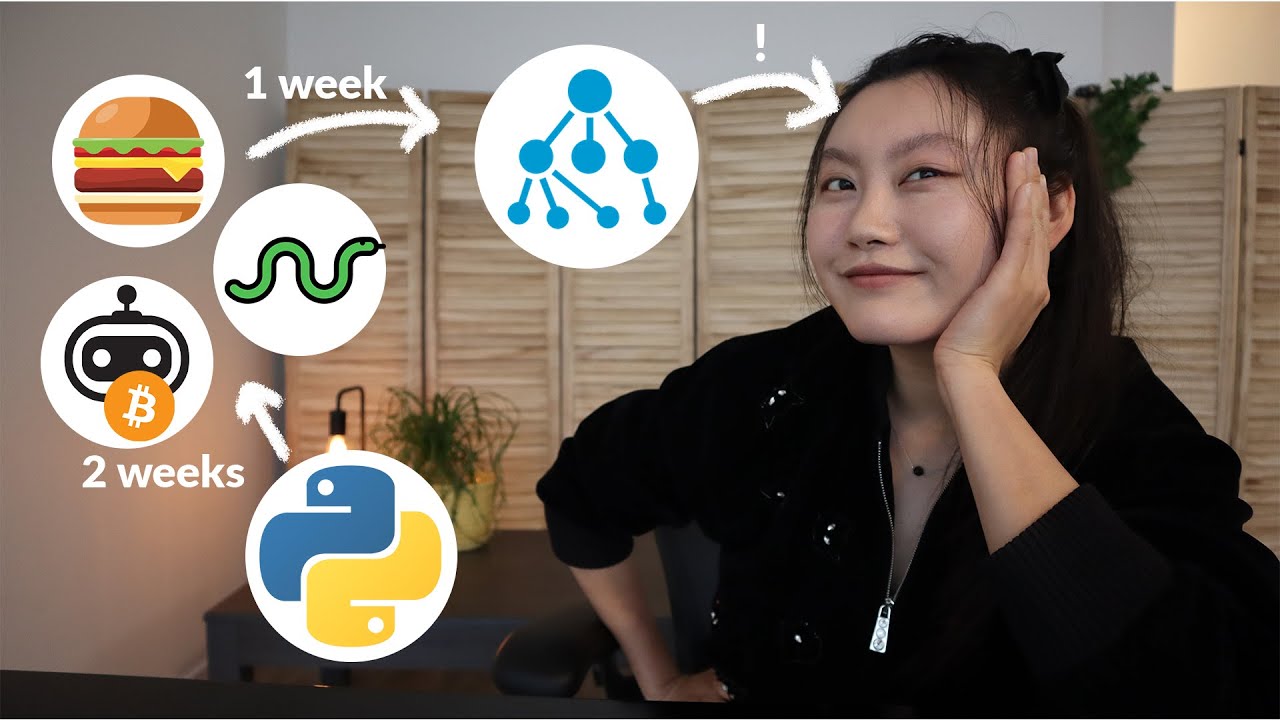
So, here are some example projects. One of the first projects that I did was a random food recommendation system. I'm the kind of person that never knows what I want to eat. So, what I did was that I had an array and I put all the meals that I knew how to cook um and that I usually like eating and I put them into an array and then there's a random module in Python and you can call a function that is able to randomly index that array and get the food item um and print it out as a recommendation for what I should cook that day. After writing that core function, I then made it into a program that was able to take in inputs from the user about what I actually had in the fridge and I was able to add some logic. So, it would only recommend recipes that contain certain ingredients. This project was pretty great because it was useful to me and it also covered a lot of the basics um that I just learned and I was able to practice implementing. Another great category of starter projects is simple games. For example, like blackjack and poker. These games are really great for practicing object-oriented programming. You can also do like tic-tac-toe or snake, which I think are great because you can actually display a simple UI. It's pretty exciting cuz you can actually like visually play your game. Another great starter project is kind of like a scoped down version of what I'm working on right now, which is a stock trading bot. My project is a little bit more complex because we're getting the data um doing some logic on it, and then we have to connect back to the brokerage so that we can put in trades. But if you're interested in the stock market and trading in general, we can do a scope down version pretty easily. For example, you can have some arrays with the prices um of a stock that you're interested in as well as maybe like volatility for example. And then you can do some logic like if the average price is equal to this, then we should sell, we should buy. And you can also do like other technical indicators like RSI for example. After you do that, you might be like, hm, wouldn't it be nice if I can actually get the data instead of just manually inputting into arrays? And that's when you can start learning about the Pandanda's data frame, which is for storing tables of data as well as APIs, which stands for applied programming interfaces, which is when you have different pieces of software interacting with each other. So, in this case, your code or your software is getting that data from another piece of software. And that's how you make your beginner project into an intermediate where you in an advanced project. This is actually a great example that illustrates a fundamental concept of learning how to code. You start off with this simple project and you start iterating on it and making it better and better as you learn more and you become a better programmer and over time your projects also get better and better. It's a little bit harder to give a timeline and how long it will take for you to finish your first project because like I was saying you can start off with a simple project and you can keep building upon that, iterating upon that. But I would say like to build that simple project from the very beginning. That would probably take you maybe around like a week or so. So say that you learn everything in two weeks and then you probably have like another week or so in
7:59

what to learn next

which you implement the first version of that project. My advice after finishing your first project is that if you haven't already to start learning more about algorithms and data structures. Again, there's a lot of resources about this and wherever it is that you learn the basics probably also has a section on algorithms and data structures. Data structures come in pretty handy and I wouldn't be surprised if you kind of just ran into them already and learned what they are. These include dictionaries, link lists, cues, heaps, trees, graphs. I think that's most of
8:29

data structures and algorithms project

them. A fun visual project you can do that really gets you implementing these data structures and algorithms is building a maze and algorithms to solve it. I'll link some resources in the
8:39

what to learn next

descriptions that can get you started. I also recommend focusing on learning how APIs work. Understanding APIs is really important because a lot of the code that you'll be writing is not going to be in isolation. You'll actually be writing code to interact with multiple pieces of other software to ultimately create a project that does the thing that you want to do. Also recommend spending time learning how to read documentation cuz you're going to be spending a lot of time reading documentation. So at this point you've covered the basics, you've done your first project, you learn about data structures, algorithms, APIs. At this point, it's just going to be all about learning more topics and implementing them on more projects. Depending on your interest, you might start looking more into web development, for example, app development. We're playing around with AI random. The world is your oyster, and the possibilities
9:26

correct mindset

are endless. All right, now we're on to the section about mentality and the correct mindset to learn how to code. I mentioned this one previously. It's about the importance of implementation and application as opposed to the theory and concepts. Yeah, knowing all the things isn't going to help you that much in doing the things. I've already touched on number two as well, which is staying curious and really exploring things outside of what is exactly prescribed in a resource. I gave the example of that print statement earlier and that's kind of how you start um learning about a lot of these like other concepts and also more deeply understanding the concepts that you do know. The best programmers that I've met are the tinkerers. They're the people who play around with their code and just like try a bunch of different things and that makes them really deeply understand what it is that they're doing and that also reveals topics that they can later delve deeper into. Number three is when you get stuck and you need to learn how to solve your own problems. When you really boil it down, programming is all about problem solving. And you can ask any programmer, even super experienced ones that have been coding for like 10 years or 20 years, Stack Overflow is probably still their best friend. It's a forum style website in which people ask coding questions and it's the first place that you should look when you run into a problem. When I was a beginner and also what I noticed a lot in beginners is that when they run into a problem, when you get like an error message or something, they like don't know what to do and then they kind of just like freak out and don't know how to solve the problem. But often times if you just take that error message that you get and just Google it, uh the first link that pops up is probably from Stack Overflow and if you read the answers that people give, it would probably tell you what your problem is. and then you can go back and actually solve it. Number four is getting comfortable with not knowing things and being okay and staying calm and actually figuring it out. I'm not kidding when I say that if I write a piece of code and it actually runs without any errors the first time, I become extremely suspicious that something must have went wrong. My default state is that whatever code I'm running is probably has an error in it. But you know that's okay. Like I just have to look through it and just fix the problem so that I eventually get it to work. This is an extremely crucial mindset to get into because if you freak out and just can't deal every time you run into an error, then you are going to have a huge problem learning to code and just being a programmer in
11:39

how to learn even faster

general. All right, so how to supercharge your learning? After you've covered the basics and maybe did a project or two, I highly recommend that you find a community to work on projects together. Or even better, get a job in which you code on a job. For example, a software engineer, data scientist, something like that. It'll let you learn from experienced programmers and you will learn so much just from interacting with these people. Plus, it gives you a great boost of accountability because if you get stuck in whatever, you can't just give up because it's literally your job. Learning how to code is really a neverending process. You start with the basics, build out your first project, and then you become an intermediate coder at some point, and you just build more and more projects, learn more and more things. There's never going to be a time in which you're like, "All right, I am a master coder now. um I never have to learn anything again. No, that's literally never going to happen because in this field it's also evolving so quickly. There's always going to be like new tools that are being released um and just things just keep getting better and better. If you wish to take this further and even build a career out of coding, then that's something that you need to embrace. Embrace the learning process and embrace making projects. For myself, I really have to say learning how to code is one of the best decisions I've ever made. It's such a powerful tool in your toolbox in our day and age. And it also gave me a lot of freedom because say like I'm interested in a certain project or you know I'm just like curious about something. It's easy for me because I know how to code to actually go do it myself, right? I don't need to rely on other people to do the implementation for me. Well, that's all I've got for today's video on how I would learn to code if I were to do it again. I hope this video is helpful for you. hopefully gets you more excited about coding and gives you a path on how to get started on learning the basics and doing your first project. I'll see you guys in the next video or live stream.

Ещё от Tina Huang

Ctrl+V

Экстракт Знаний в Telegram

Транскрипты, идеи, методички — всё самое полезное из лучших YouTube-каналов.

Подписаться