The Temple of Artemis at Ephesus | Lost for 1,500 Years

The Temple of Artemis at Ephesus | Lost for 1,500 Years

Machine-readable: Markdown · JSON API · Site index

Поделиться Telegram VK Бот
Транскрипт Скачать .md
Анализ с AI

Оглавление (3 сегментов)

Segment 1 (00:00 - 05:00)

There were 127 columns around the temple of Aremis. Today, only one survives, cobbled together from fragments to about 3/4 of its original height. The rest of the site is a ruin field from which fragments of marble protrude. Otherwise, there's little left to show that a wonder of the ancient world stood here. Like all the Greek gods and goddesses, Artemis had many forms. Though most often worshiped as a youthful huntress, the guardian of wild places, she was also identified with Seleni, whose crown was the crescent of the moon, and with Hecati, the queen of ghosts. In her various forms, the goddess was revered at countless temples and shrines. The most famous of these was also the most spectacular of all Greek sanctuaries, the temple of Artemis at Ephesus. The cult image of the Ephesian Artemis based apparently on an ancient wooden statue or on the timeworn sculptures of Egypt was unique. It stood rigid as a column. The serene face framed by cascades of earrings and a towering crown. The torso bulged with dozens of protrances, possibly breasts, but more likely meant to represent bowl testicles or bags filled with offerings. This was Artemis as seen from the east in the guise of an Anatolian mother goddess. The first temple of Artemis at Ephesus rose in the 8th century BC on a site that had long been sacred. After this structure was destroyed by a flood, a far more magnificent temple rose in its place, financed by the proverbally wealthy Lydian king Cus. The colossal new temple, the first in the Greek world to be built entirely of marble, was ringed by a forest of 40ft columns. The bases of some columns were decorated with vividly painted reliefs which must have shimmerred through the clouds of smoke and incense drifting from the great altar. For two centuries, the temple built by Cusus drew crowds of pilgrims and visitors. But in 356 BC, on the very day it was later said that Alexander the Great was born in Macedon, it was burned to the ground by a madman named Hirostraatus, who wanted to be remembered forever. Or so the Ephesians claimed. Marble buildings are not easy to burn, and some scholars suspect that the priests, aware that the temple's foundations had settled beyond repair, set the fire themselves. The site was cleared and a new temple, even more magnificent than its predecessor, was begun. Construction was well underway by the time Alexander the Great added Ephesus to his expanding empire. The conqueror offered to pay for the temple's completion if the Ephesians would inscribe his name on the pediment. The offer was politely declined. Work continued for more than a century. Long before it was done, the temple was recognized as a wonder of the world. The new temple of Artemis was raised above its floodprone site on a platform ringed by 13 steps. The building was nearly four times the size of the Parthonon and more than twice as tall. According to Plym the Elder, there were no fewer than 127 columns, each 60 ft high. Above soared the gleaming marble pediment centered on a tall window where images of the goddess were displayed. The temple stood honored by honestic kings and Roman emperors for more than half a millennium. It was damaged by marauding Goths at the height of the 3rd century crisis. Not long after with the Christianization of Ephesus and the rest of the Roman world, it began to be plundered for building material. A later legend claimed that some columns were sent to Constantinople to adorn Justinians Hagia Sophia. The stones that were not plundered gradually vanished beneath mud laid down by floods of the local river. By the time Western travelers began visiting Ephesus in the early modern period, the site of the temple had been lost. The most prominent ruins near the ancient harbor, which actually belonged to a Roman bath complex, were mistaken for those of the temple. We'll explore

Segment 2 (05:00 - 10:00)

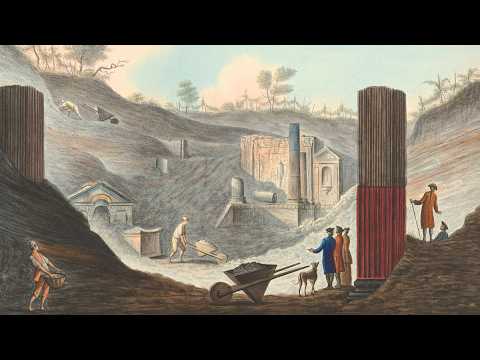
the epic quest to rediscover and excavate the temple of Artemis after a brief word about our partner. Holless makes watches and jewelry for men and women. Their products are manufactured in limited quantities from the finest natural materials. This, for example, is the gifted watch with a leather strap and green marble face. Like all Holleskarn products, it comes with a 2-year guarantee. Whether you buy a watch, ring, necklace, or anything else, Holless Kern offers free express shipping, typically reaching customers in the US in 5 to 9 business days. to showcase your style or give an unforgettable gift. Follow the link in the description and use the code stone to save 15% on all Holskarn products. Returning to our topic, the Temple of Artemis was rediscovered by a British railroad engineer with the eminently Victorian name of John Turtle Wood. Wood began with no clear idea about where to look. Ruins sprawled for miles around the swamp that had once been the great harbor of Ephesus. References in ancient texts stated only that the temple had been built on low ground near a river a short distance outside the city center. At first, Wood dug almost randomly, sinking a series of test pits at various points around the city. He found inscriptions and tombs, but nothing that pointed the way to the temple. Pit by pit, year after year, despite frequent bouts of malaria and setbacks ranging from a broken collarbone to murderous bandits, Wood soldiered on. He began to excavate in the city theater, hoping against hope for a clue to the temple's whereabouts. Incredibly, he found one. On one of the parados walls was a long inscription from the reign of Trejan which described a procession from the theater to the temple of Artemis. The processional route had been circular, exiting from one of the main city gates and entering through the other. If he dug from those gates, Wood reasoned he would eventually reach the temple. He concentrated on the road leading from the Magnesian gate, which he found to have been lined with thousands of tombs. After 2 years, just as the last of his money ran out, his workman found a wall of massive blocks and an inscription identifying it as the precinct of the Temple of Artemis. On the final day of December 1869, 6 years after the search began, they struck the first stones of the temple itself. Wood's excavation continued for another 4 years at a total cost of 16,000, equivalent to about $2 million today. Even by 19th century standards, it was not a model of painstaking archaeology. At one point, Wood used gunpowder to blow up the remains of a Byzantine church. When not assisted by dynamite, progress was slow since the sand and mud that had covered the temple were water logged. Trench walls repeatedly collapsed, killing one workman and injuring others. It took 15 men 15 full days to clear a single column drum. A subterranean spring flooded the excavations. Mice ate the inscription squeezes. A ship filled with fines sank. But in the end, would managed to clear the sight of the temple, an area of 500x 300 ft from beneath 25 ft of sediment and debris. By his calculation, the workmen moved 132,221 cub y of earth. Although little of the temple's superructure had survived, wood was able to salvage fragments both of the classical building and of its archaic predecessor. The most famous find now displayed in the British Museum was a column base from the classical temple with reliefs of Hermes, Phantos, and other figures from myth. A generation after Wood concluded his excavations, the British Museum invited David George Hogarth to return to the Temple of Artemis and clarify the building's history. Finding the hole dug by woods workmen filled to the brim, Hogarth used a steam pump lent by the Ottoman Railway Company to remove 100,000 cubic meters of water. Even

Segment 3 (10:00 - 12:00)

after the pool had been drained, his workmen had to spend every morning pumping the previous night's seepage so that they could dig thigh deep in mud all afternoon. Beneath the muck, Hogarth discovered the foundation deposit of the archaic temple, buried in the time of Cus. Almost as soon as the first finds surfaced, however, the winter rains set in, and the nights turned cold enough to freeze the pools in which the workmen toiled. Hoggarth had to wait until spring to recover the rest of the treasure. fistfuls of electrum coins, earrings and scarabs of precious metal and upwards of a thousand gemstones. Since 1965, the Austrian Archaeological Institute has continued work on the site of the Artemisian, revealing among much else the original temple of the 8th century BC. In 1973, the Austrians reerected a single incomplete column pieced together from fragments found around the site. It stands sentinel over the puddles and broken stones that mark the site of the temple of Aremis at Ephesus. For a tour of the temple's remains, follow the link on screen and in the description. You can learn Coptic, the language of the pharaohs with Dr. Lydia Bremer McCullum at the Religion Department, an online learning platform associated with the Religion for Breakfast channel. Follow the link in the description to learn more. You'll also find links in the description for my spring 2026 group tours, the Roman ruins of Spain, and In the Footsteps of Alexander. Please check out the Tonestone Patreon. Don't forget my other channels, Tonestone Footnotes and Synic Roots to the Past. And as always, thanks for watching.

Другие видео автора — toldinstone

Ctrl+V

Экстракт Знаний в Telegram

Экстракты и дистилляты из лучших YouTube-каналов — сразу после публикации.

Подписаться

Дайджест Экстрактов

Лучшие методички за неделю — каждый понедельник