Advanced Vocabulary and Fluency Practice with the News

Advanced Vocabulary and Fluency Practice with the News

Machine-readable: Markdown · JSON API · Site index

Поделиться Telegram VK Бот
Транскрипт Скачать .md
Анализ с AI

Оглавление (4 сегментов)

Segment 1 (00:00 - 05:00)

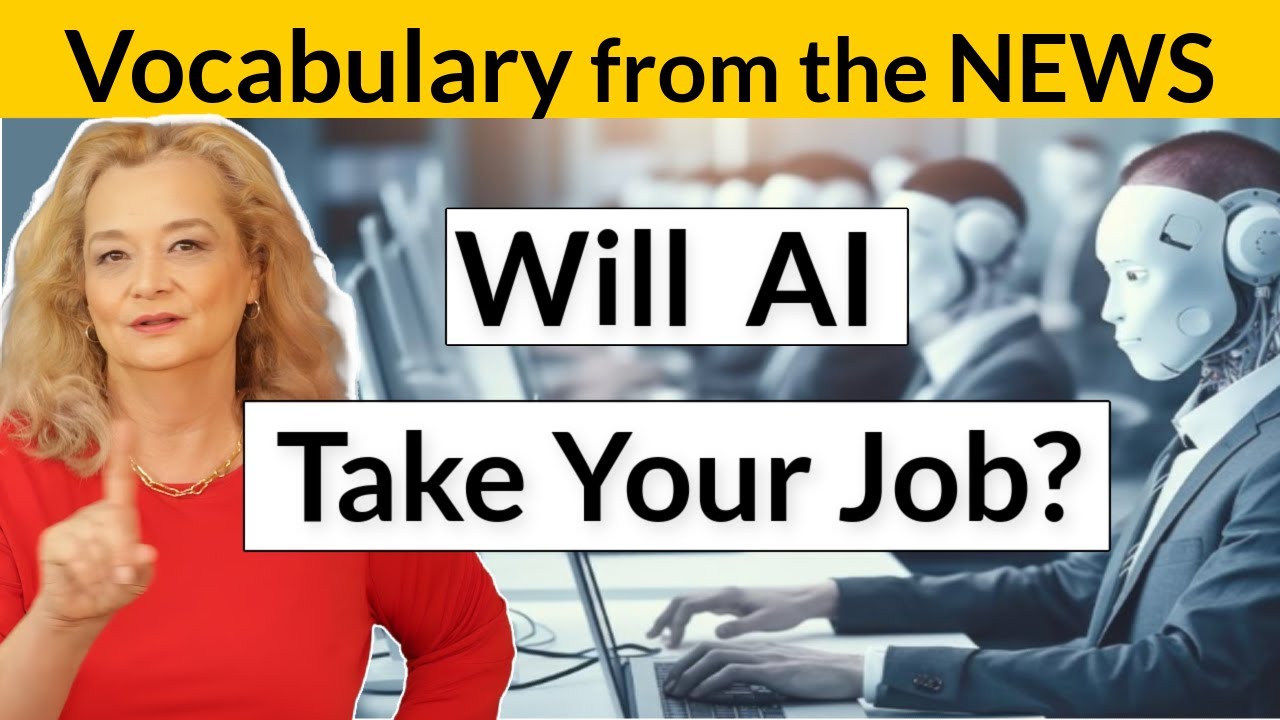
Let's improve your professional English by learning advanced vocabulary and expressions from a recent news article. At the end of the lesson, I will read parts of the article and you will have a chance to repeat after me so that you can improve your speaking fluency and your accent. This article is from the Los Angeles Times. The article talks about the fact that 50% of all American workers are worried that AI, artificial intelligence, will take their job. What about you? Do you think that AI could replace your job in the future? Do you think that your job is in danger because of AI? The title of the article is companies keep slashing jobs. How worried should workers be about AI replacing them? To slash means to cut or to reduce something drastically or suddenly. So when companies slash jobs, they are laying off a large number of employees, usually to save money. Before we look at the first paragraph, I want to quickly let you know that this entire lesson is available as a downloadable PDF. If you've already purchased my course, 400 Advanced Words You Must Know for Fluent English, you now have access to a free bonus section called Free Bonus Lessons: Mastering Vocabulary from Today's News. This free bonus course includes 11 recent newspaper articles that I covered in my previous videos, and it includes all of the definitions and practice exercises that I'm teaching you in this video. plus extra speaking questions to help you use the words in your own sentences and that way you're much more likely to remember them. If you haven't joined the course yet, be sure to check out the link below to get more information. The course includes 7 hours of video content, downloadable PDFs for all of the lessons, quizzes to test your progress, and I talk a lot about the American accent. I go over key pronunciation rules to help you sound more natural and more confident when you're using these new words. Okay, let's get started with the first part of the article. Tech executives, economists, and other experts say that AI could automate mundane and tedious tasks and also create new roles. Tech companies that are cutting jobs and leaning more on artificial intelligence are also disrupting themselves. Let's look at the word mundane. It says AI could automate mundane and tedious tasks. Mundane means boring or repetitive tasks. If something is mundane, it's ordinary and not interesting. For example, you can say washing dishes can feel mundane. His job became mundane after many years. Or we can say she got tired of doing the same mundane tasks every day. Let's listen to how some other people used it. — To feel like things are just mundane or monotonous — and focusing on something so mundane and so unimportant. — Even experts spend most of their time doing mundane repetitive tasks. — Let's look at tedious. Mundane and tedious tasks. And if something is tedious, it takes a long time and it's boring. And we can say copying data by hand is a tedious job. That lecture was long and tedious. It was a tedious task to clean every corner of the house. Is your work tedious? — This can be a very slow, frustrating, tedious process. — Well, this is a tedious, incredibly timeconsuming process. The labs were so tedious. I said, "This is not for me. " So, I switched to English. — Let's look at leaning. Cutting jobs and leaning more on artificial intelligence. That means they're depending on it more. To lean on is to depend on or to rely on something or someone. For example, I can say, "I can always lean on my friends for support. " Many people lean on technology to help them work. Do you have someone in your life that you can lean on? And you can tell your friends, you can lean on me. And that means, I'm always available for you. I'm here if you need me. You can lean on me. And do you know the name of this very famous tower? It's the leaning tower of Pisa. Let's look at the next paragraph. At Salesforce, a software company that helps businesses manage customer relationships, chief executive Mark Beni off said last week that AI is already doing 30 to 50% of the company's work. Other tech leaders have chimed in. Earlier this year, Anthropic, an AI

Segment 2 (05:00 - 10:00)

startup, flashed a big warning. AI could wipe out more than half of all entry-level white collar jobs in the next 1 to 5 years. Let's look at to chime in. Other tech leaders chimed in and that means they gave their opinion. To chime in is to join or to add your comment in a conversation. For example, we can say he chimed in with his thoughts during the meeting. If you would like to add something, please chime in. Let's listen to how some other people use to chime in. — Allison and Teresa, I invite you both to chime in. — Let me start and then Richard can um chime in. — Want to chime in on that, Randy? — And let's look at to wipe out. AI could wipe out more than half of all entry-level white collar jobs. To wipe out means to completely remove or to destroy. We can say one bad investment wiped out all of his savings. The flood wiped out the village. Let's look at entry-level white collar jobs. These are the types of jobs that AI may replace. First, a white collar job is an office job. And an entry-level job is a job that you do when you first start your career. We can say he's looking for an entry-level job in finance. She got an entry-level white collar job at the bank. Let's look at the next paragraph. Ready or not, AI is reshaping, displacing, and creating new roles as technologies impact on the job market ripples across multiple sectors. The AI frenzy has fueled anxiety from workers who fear their jobs could be automated. Roughly half of US workers are worried about how AI may be used in the workplace in the future, and few think AI will lead to more job opportunities in the long run. According to a Pew Research Center report, let's look at the verb to ripple. The article says, as technologies impact on the job market ripples across multiple sectors, AI's impact is rippling across industries and that means it is spreading and it is affecting many areas. So to ripple is to spread out slowly like waves. This is a ripple. We can say the wind created small ripples on the surface of the lake. But you can also use to ripple this way. The news rippled through the company or we can say a ripple effect. The new policy had a ripple effect on all departments. And let's look at frenzy. The article says the AI frenzy has fueled anxiety from workers. Frenzy is anxiety or excitement. For example, we can say a buying frenzy. The holiday sales caused a shopping frenzy. We can also say a frenzy of excitement or a frenzy of fear panic. Let's look at the verb to fuel. The AI frenzy has fueled anxiety from workers. And if you fuel something, you make it stronger and it grows faster. And we usually use it this way. To fuel a fire. Dry wood and leaves helped fuel the fire or to fuel a car. They stopped to fuel the car before continuing their journey. But we can also use to fuel this way to fuel growth. Technology continues to fuel economic growth. We can also say to fuel anger, to fuel fear, or to fuel ambition. Her struggles fueled her ambition to succeed. If you've been watching my videos recently, then you know the meaning of the next word roughly. Roughly half of US workers are worried. Roughly means approximately or about. You can say roughly 30 people came to the meeting. The trip cost roughly $500. And let's look at few. Do you know the difference between few and a few? It's a pretty big difference. Let's look at this example. What is the difference between these two sentences? I have a few problems or I have few problems. Which one is preferable? Which one is better? It's better to have few problems. That means you have very few problems. You don't have very many problems. You want to express the fact that there's a lack of problems. But if you say I have a few problems, then it means you do have some problems. So that little article uh completely changes the meaning. The article says few think that AI will lead to more job opportunities. And that means that almost nobody thinks

Segment 3 (10:00 - 15:00)

that AI will lead to more job opportunities. In fact, it's the opposite. They think that there will be fewer jobs because of AI. They're pessimistic about it. Have you ever used the idiomatic expression in the long run? The article states will lead to more job opportunities in the long run. In the long run means over a long period of time. For example, you can say it may be hard now, but it's better in the long run. Saving money is smart in the long run. It's a very common expression. Let's listen to how some other people used it. But right now, as much as it hurts, in the long run, you're going to be happy that you did it. — What do you think might happen in the long run, Eric? — So, you might as well live by your values because in the long run, that's the best way to live. — Let's look at another paragraph. The heightened fear comes as major tech companies such as Microsoft, Intel, Amazon, and Meta cut workers push for more efficiency, and promote their AI tools. Tech companies have rolled out AI powered features that can generate code, analyze data, develop apps, and help complete other tedious tasks. AI isn't just taking jobs. It's really rewriting the rule book on what work even looks like right now, said Robert Lucido, senior director of strategic advisory at Magnet, a company based in Folsam, California. To heighten is a verb and the past tense is heightened and it's also an adjective. Heightened. Let's pronounce it correctly first. Repeat after me. Heightened. Heightened fear. Heightened means increased or made stronger. We can say the news heightened my anxiety. His speech heightened our awareness. Let's look at the phrasal verb to roll out. Tech companies have rolled out AI powered features and that means tech companies are rolling out new AI tools. They are releasing them. To roll out is to introduce or to launch something new. We can say the company rolled out a new product. They will roll out the service next week. The school rolled out a new program. Let's look at the idiomatic expression to rewrite the rule book. AI is rewriting the rule book. To rewrite the rule book is to change the normal way that things are done. For example, we can say he rewrote the rule book on how to run a business. He did it in his own way. an original way. We can say her new way of teaching is rewriting the rule book in education. And AI for many jobs. And now let's read parts of the article again to practice your accent. I will read and I will pause to give you a chance to repeat. And pay attention to which words I'm stressing. how I'm connecting the words and where I'm pausing. And try to do exactly the same thing so that your accent can sound natural. And of course, pay attention to the pronunciation of the words also. Okay, repeat after me. Tech executives, economists, and other experts say that AI could automate mundane and tedious tasks and also create new roles. tech companies that are cutting jobs and leaning more on artificial intelligence are also disrupting themselves at Salesforce, a software company that helps businesses manage customer relationships. Chief Executive Mark Beyov said last week that AI is already doing 30 to 50% of the company's work. Other tech leaders have chimed in. Earlier this year, Anthropic, an AI startup, flashed a big warning. AI could wipe out more than half of all entry-level white collar jobs in the next 1 to 5 years. Ready or not, AI is reshaping

Segment 4 (15:00 - 17:00)

displacing, and creating new roles. As technologies impact on the job market ripples across multiple sectors, the AI frenzy has fueled anxiety from workers. who fear their jobs could be automated. Roughly half of US workers are worried about how AI may be used in the workplace in the future. And few think AI will lead to more job opportunities in the long run. According to a Pew Research Center report, the heightened fear comes as major tech companies such as Microsoft, Intel, Amazon, and Meta. Cut workers push for more efficiency and promote their AI tools. Tech companies have rolled out AI powered features that can generate code, analyze data, develop apps, and help complete other tedious tasks. AI isn't just taking jobs. It's really rewriting the rule book on what work even looks like right now. And remember, this whole lesson is available as a downloadable PDF, plus the lessons of 10 other previous videos that I made on YouTube where I was teaching you expressions and vocabulary from the newspaper. And this is a free bonus section to the course 400 advanced words you must know for fluent English. To learn more about that course, plus the other Accurate English courses, go to accurateenglish. com. Thanks for watching and keep practicing your

Другие видео автора — AccurateEnglish

Ctrl+V

Экстракт Знаний в Telegram

Экстракты и дистилляты из лучших YouTube-каналов — сразу после публикации.

Подписаться

Дайджест Экстрактов

Лучшие методички за неделю — каждый понедельник