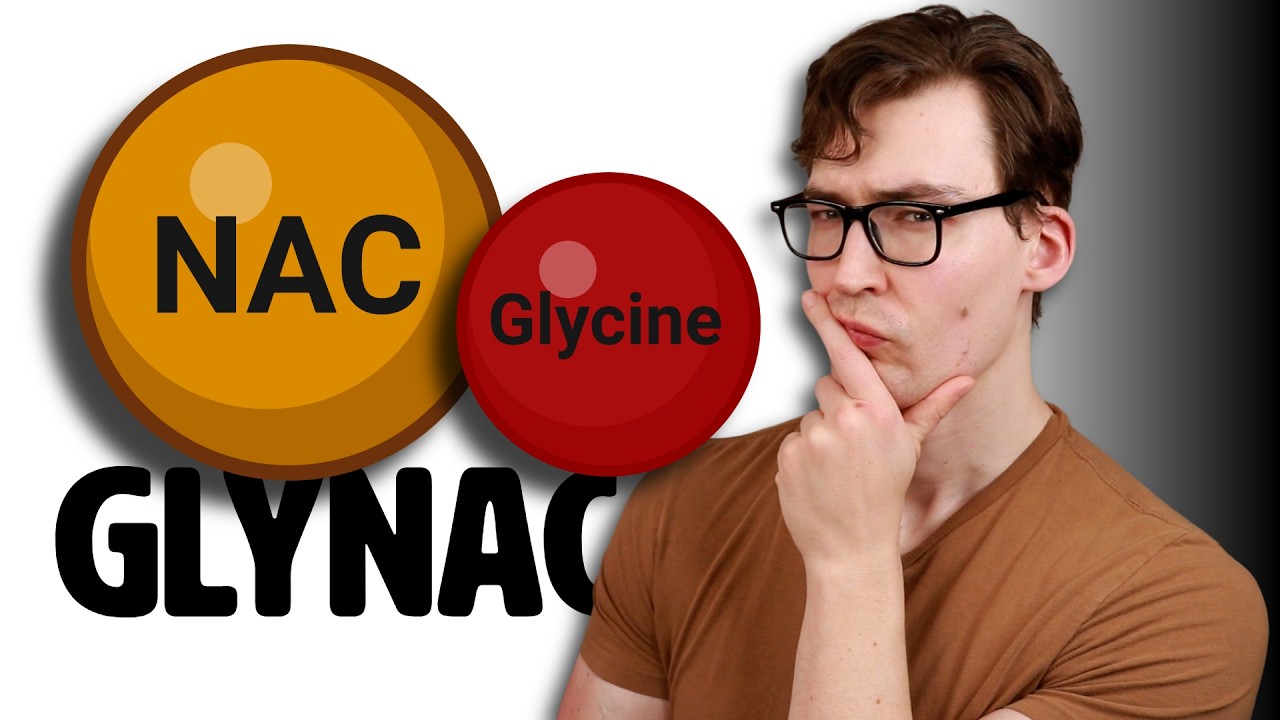
I covered Glinax several years ago. In fact, when Physionic was a wee brand, unbeknownst to most of you, and this one video that I did blew up. Anyway, at the time, there was some incredibly compelling evidence for GLEAC supplementation, otherwise known as glycine and an acetylcyine, hitherto unto thee, called Glinac Masher. But that was a few years ago. And what is the evidence now? Is Gleax still a great recommendation? Why is it a waste of money for a lot of people? Well, we'll get into that. Now, this video is sponsored by the Physionic Insiders, but more on them later. We both know you're going to skip through that ad later, too, but let's smile and pretend. So, GLYAC again, that's a dual combination of the amino acid glycine plus the molecule N acetylcyine took the health supplement world by storm when studies began emerging on its incredible potential. For example, in mice, glyc extended lifespan. All you need to know is that if the lines extend further to the right, they live longer. So, ooh, we clearly see the green line. The Gleak group lived much longer. Now, the proposed reason for this life extension potential, and don't worry, we'll get into some human evidence shortly, is due to the potent ability for glyc facilitate the production of a master antioxidant in our cells called glutathione. This antioxidant, glutathione, is a tripeptide, meaning it's made of three amino acids. And guess what two of them are? You're sharp as a hammer. Glycine and cyine. The reason that we focus on these two is because the third one is not rate limiting. Now, I'm going to swerve the biochemistry here and just say that we don't need to supplement with it. So, glutathione is potent in that it interacts with damaging molecules produced in our body called free radicals like reactive oxygen species that interact with components of our cells and damage them. So, naturally neutralizing them would be a net benefit. That's where glutathione sacrifices itself to protect your inards. We'll return to this because it's important to understand why many people should not supplement with glo. For now, we should be asking, well, fine. But do we have any evidence that glyc works through glutathione? In short, yes, as seen across three different tissues. This is three different versions of glutathione. We're looking at total, reduced, and oxidized. That means that the total amount, if that's reduced or oxidized. The reduced is the version that is capable of acting as an antioxidant. And the oxidized is the spent glutathione, like a spent shell casing. Naturally, we want total and reduced to be high, so higher bars. And we don't really care about the oxidized spent glutathione. But I'll go ahead and mention that nothing changes on that front anyway. So let's forget about it. The blue bars are the young and the red are the old and the green are the glyax supplemented. We're seeing across multiple tissues, heart, liver, kidney that glutathione is significantly increased with gleac supplementation. Now they really had to wrestle these people down and tie them down before removing their organs. And three, two, one. I kid, this was a mice. Still not wonderful, but scientists don't abduct people and experiment on them. At least not the ones that I know. The main point from all this is to say that in animals we can extend lifespan drastically and we believe that it could be through huge rebounds in glutathione. Though technically we need more experiments to really make that last statement absolute. Now, while you are cute, you don't look like a rodent to me. Though the story gets far more interesting when we bring in studies that are done on people. Now if you were to have a group of people supplementing on a placebo substance i. e. not gleac and have another group of people supplement with glyc what happens? Do we see similar results like what we did in our squeakier subjects? Well, look for yourself. We're measuring glutathione in muscle transformed here for your viewing pleasure. In red, we have the glyax supplementing group and in gray, the placebo. The higher the bars go, the more glutathione is in the tissue. We're measuring at baseline two weeks later and 16 weeks later. Now, it's obvious that muscle glutathione is hugely increased with supplementation, the same results as in mice. And I'll mention too that other measures also indicate this to be true in other accessible areas like red blood cells. And when looking at the direct impact as in the improvements in the number of these oxidizing molecules, remember that's the
Segment 2 (05:00 - 10:00)
reactive oxygen species, we see huge declines. So while the placebo group is being bombarded by multiplefold more of these damaging molecules, the gllinac condition gets a significant reprieve. Now I'll be returning to this later too because I'm actually being a little deceptive with the data that I'm presenting to you right now. But hang tight. I'll turn myself in soon. These kinds of results are also seen in other measures like inflammation. The point here being that we have parody between the animal data and the human data as it relates to cellular effects of glyc supplementation. Now in truth though most supplement research tends to focus on these kinds of outcomes. What's happening on a biochemical a cellular and maybe on features of disease like blood pressure. But few measures actually measure function as in does your body function better. A common measure of bodily function and frailty is something called gate speed test which assesses the speed at which you walk translating to improved power coordination and more. Well, across multiple measures of physical function like the gate test, but also grip strength, chair rise tests, Klein provided remarkable improvements in just 16 weeks. Now, there's plenty of other measures, but the bottom line is that GLINE doesn't just help a bit in obscure cellular measures, but in direct dayto-day scenarios as well. Now, I mentioned a bit of deception on my part. And what I meant is that the research that we've been looking at is in older individuals, people in their 70s, and I've been keeping the data in younger individuals in their 20s out. So all the positive results that we've covered up to now have been in older individuals, but here's an example of the data including the youngans. Now we're looking at glutathione levels again. This is the same striking data as before, but I've added the complete data set including the young in blue there on the left. The reason I'm bringing this up is not because it diminishes our impressions of Glac. It actually further impresses. We're seeing here that people 50 years older who take GLAC are able to achieve glutathione levels similar to people five decades younger. And I'll let you in on another little not so secret. This wasn't the only time that they had similar data. Across many measures, older individuals supplementing Gleak had massive improvements similar to young. Now to rain it in a bit, it was not universal. Some measures were improved, but not quite to the same level of younger participants. But keep these data in mind because they tell us another critical clue that I'll get into in just a minute. Now, there's much more that Glac does. So, if you're interested in mitochondrial health, cardiovascular health, autophagy, and the impact that GLAC has, then check out the full version of this video that you're watching. It's part of the Physionic Insiders. I told you I'd give you something to skip. At any rate, all of my work is there. It's a premium research review with 100 plus investigations, articles that accompany all of my videos, shorten summaries, and if you're looking for reputable sources for supplements, I have a master supplement list that includes glycine and NAC. There's a lot more perks like these, but I'm talking to myself at this point, so I'll go ahead and check back to the material. Now, back in 2023, I was unaware of another Glimax study in humans that had also been released, but the participants were people with type 2 diabetes. Now, I won't drag you through the figures, but oh, by the way, I forgot to mention that if you're interested in checking out the Physionic Insiders for my full analysis on GLAC and more, the link is in the description. Didn't expect that, did you? You skipper. Okay, the bottom line is that diabetes uh study that I'm talking about is that GLEAC also helped these individuals substantially. Okay, I'm bringing this up, sure, for more evidence in humans, but also because I stated multiple times that I think GLEAC only helps select people, two groups of people to be specific. One, as we saw, older individuals. Now, I said a relatively arbitrary cut off of 60 years old, but it's not like if you're 59, you have to count down the days for your birthday before you you're allowed to take GLIAC. And two, I predicted that it would help people who were younger than 60, but maybe dealing with chronic health issues. And guess what? This study is exactly that. These people are in their early 50s, some even in their 40s. And it's cool being able to predict something and then seeing clear evidence of that prediction being correct. Okay
Segment 3 (10:00 - 12:00)
so those are the two groups, older individuals on average and younger individuals with some form of chronic health issues. Now, there's a lot of wiggle room for nuances there, but we just don't have the data to refine that right now except for some new dementia trials. Why not others? Like a person who's 32 but not dealing with serious chronic health issues? Well, because if you think back to this graph, the second bar there is for younger individuals supplementing with Gleak. And you can see that well, nothing happens. Granted, it's only 2 weeks, but if we use the same comparison for older folks, there's a sizable rise in just two weeks. So, the evidence, though limited, indicates that Glinac is not worth it for people who are quite a bit younger. So, here's how I'd approach it. If I'm around 60 or older, it might be worth it. Though, I would have you listen to what I'll be saying next because there's two important things to know. If I'm any age, but dealing with chronic health issues, though, we don't have specifics, it might be worthwhile, especially against uh insulin resistance. Now, if you're neither of those camps, I probably wouldn't bother. Now, the dose used in these studies is staggering. We're talking 100 mg per kilogram of weight per day of each. Those are huge amounts. Now with the insiders a year or so ago, we did a bit of math and estimated based on the NAC specific studies that dose could be reasonably reduced to 2 g per day total for each and we should still see effectiveness. That's much more manageable, but keep in mind it's a shot in the dark. As more data releases, I hope to refine those numbers. Now to the accept. Here's the thing that I should mention. There are multiple randomized control trials on GLIAC. So on the face of it, that's great news, congruence in the literature. But the big thing still holding me back from jumping completely on board is the fact that every single RCT, randomized control trial that has been done has come out of one laboratory. It's a reputable lab out of Baylor Medicine. But until I see some of these results replicated by other labs, I'm a little hesitant yet. You may not feel that way, and I think that's perfectly reasonable response. But regardless, I think it should be acknowledged. That said, what's this? Another video on Quaba. If you want to learn some more with me, then check it out. I've heard this one is a good one. Though, I also have no idea what I'm going to be linking here yet, so I could be completely wrong. Maybe I'll add the supplement routine that I designed for my dad if you're interested. At any rate, thanks for tuning in. Catch you in the next one.