The Hidden Worlds of the South Pacific Islands | BBC Earth

The Hidden Worlds of the South Pacific Islands | BBC Earth

Machine-readable: Markdown · JSON API · Site index
Поделиться Telegram VK Бот
Транскрипт Скачать .md
Анализ с AI

Оглавление (14 сегментов)

Segment 1 (00:00 - 05:00)

In Bengal Lagoon in Fiji, the local people are proving that sharks can be more valuable alive than dead. Tourists will pay good money for an encounter with real live sharks. This is a communityowned reef and some of the money goes to the local villages. A big incentive not to kill the main attraction. Fagians have long had an affinity with sharks. Their ancestors worshiped a shark god who they believed kept them safe from harm. They would feed sharks, not hunt them. And these divers continue the tradition. First to the feast are Tory nurse sharks. But these sharks are scavengers. It's the big predators the tourists want to see. Bull sharks. Growing up to 3 and 1/2 m long. These sharks are one of the ocean's top predators with an aggressive reputation. The chief shark feeder is from a village where the shark god is still worshiped. So he has no fear. A bowl of shark fin soup can sell for over $100. But here, each tourist pays that to see these sharks alive. And dives take place several times each week. To protect the sharks, this reef has now been declared a marine reserve with the added bonus that other fish are protected too. Before the reserve was established, this reef had been fished out. Even a single giant travali of this size was a rarity. Today the divers are in for a special treat. A 5 m tiger shark. The dive leaders have named her Scarface. She turns up once a month or so. She's inquisitive but not aggressive. The Antipedian or wandering albatross is found in the waters around New Zealand, home to the most diverse seabird community in the world. These are rich fishing grounds for fishermen, too. The birds know that where there are fishermen, a free lunch is sure to follow. So, how does this get them into trouble? With a wingspan over 3 m, an albatross is built to soar thousands of kilometers across the ocean in its quest for food.

Segment 2 (05:00 - 10:00)

As it might go for days with nothing, it can't afford to be choosy. Anything near the surface is snapped up. Unfortunately, not everything a fisherman casts overboard is a healthy meal. Far out at sea, a long line fishing vessel is setting its line. It's longline vessels in particular that have been held responsible for the decline of the albatross. The fishermen pay out a line 50 km long across the surface of the ocean and every few meters they attach a secondary line with a hook baited with a fish or squid. Every night, this vessel casts over a thousand hooks overboard, and it is just one of many long liners plying the Pacific, some with lines over 100 km long. But this fisherman is well aware of the threat to the seabirds. And to prevent them from swallowing his hooks, he has adopted bird friendly fishing methods. It's why he sets his lines at night when the albatross are sleeping. And he deploys Tory lines. These simple streamers are remarkably effective at scaring birds away from the hooks. He also thors out his bait before hooking it so it sinks out of sight quickly. His bird catch is now virtually zero. In Fiji, biologists are working with fishermen to bring the fish back by replanting the reefs. This is a coral nursery. But with wild corals already struggling, where have these coral seedlings come from? The coral gardeners monitor the reef, looking for corals that need a helping hand. Despite all this real estate, many corals end up clustered together. Crowded out, they will eventually die. So, the gardeners uproot them, creating more space for some and giving the uprooted ones a fresh start. Each coral head is broken down into a dozen or more fingers, and each of these is tied onto a concrete disc. As every gardener knows, vigorous growth requires sunlight, plenty of nutrients, and the right temperature. So, the coral gardeners choose just the spot. Within 6 months, the corals are branching out. They're spaced out onto adjacent tables and a year or two after planting they're ready for harvesting. The coral heads are broken down once more. In the space of 2 years, a single finger of coral has multiplied into 50 or more. Some of these will be replanted on fresh discs, while others will be returned to the reef. If replicated, coral gardening could help restore reefs throughout the Pacific. But its biggest success may be in sewing the seeds of conservation in the local

Segment 3 (10:00 - 15:00)

fishermen. Within days, these cutings will have stuck themselves to the reef, while reefs that were replanted a year ago are already starting to bloom. In a few more years, this area should be a wash with Evenings Island. 2 and 12 km of rock protruding from the ocean. It's home to a living fossil, a relic barely changed for over 100 million years. the Chuittara and half the world's population survive on this one island refuge. During the reign of the dinosaurs, the ancestors of the Chittara were everywhere. They survived the cataclysm that killed off the dinosaurs, but then couldn't compete with the mammals and died out. everywhere except on what was then a mammal-free New Zealand. Unlike mammals, touittara live life in the slow lane. Days can pass when they barely move a muscle. Sometimes taking just one breath an hour. They feed on wetters, beetles, and other invertebrates, but don't appear very good at catching them. Even after millions of years of practice, eye mouth coordination is not what it could be. Survival of the fittest just doesn't seem to apply here. The Chuittara's survival, first on New Zealand, now on Steven's Island, proves a point. Islands are pretty safe places to be, at least until invaded. Fortunately for the Stevens Island Chuittara, it did survive a brief mammal invasion. But for some of the other wildlife here, the invasion was rather more catastrophic. Lives a bird that is about as unbirdlike as it is possible for a bird to be. It's nocturnal, though it sometimes wakes up before sunset. It has whiskers, so it can feel its way in the dark. It's a parrot and weighing up to 4 kilos, it's the world's heaviest. And yes, you've guessed it. It can't fly. Meet the kakao. Too heavy and short-winged to get airborne, it climbs trees instead. Kakapo were once one of the most successful and abundant herbivores in New Zealand. The kiwi equivalent of our rabbit. In 1899, explorer Charlie Douglas wrote, "They could be caught in the moonlight by simply shaking the tree or bush until they tumbled to the ground, like shaking down apples. Its favorite food is up above the tiny seeds of the Remu tree. This fruit fuels kakapo reproduction and they only breed when the trees produce a bumper crop. So about once every four years.

Segment 4 (15:00 - 20:00)

Kakapo breed slower than any other bird, but they also live longer, sometimes more than a 100red years. The male's song is as peculiar as the bird itself. More frog than parrot. It can be heard up to 5 km away. In a breeding season, he will boom non-stop for 8 hours every night for up to 3 months. But a female will only respond if there are plenty of Remu seeds about. So while these birds may nest in burrows like rabbits, unfortunately they don't breed like them and their numbers have dwindled dramatically. Today fewer than 100 kakapo survive. New Guinea is a vast island nestled close to the continental landmass of Australia. As we move south and east to smaller, more distant islands, the wildlife becomes even more unusual. The little known island of New Calonia is a small sliver of Australia that was cast a drift over 60 million years ago. It's home to a creature that seems to have evolved quite strangely. It has wings, but it can't fly. It is the Kagu. Kagu families stick together with young from previous years helping to declare the family territory. All intruders are chased away. It's the breeding season when males rekindle the flame with their lifelong partners. It's hard to know what the kagu is related. ated to a heron, a rail, or maybe a pigeon. Its closest relative may actually be the sunbitten of South America, 11,000 km to the east. She may not seem too impressed, but then kagos always keep their feet very firmly on the ground. — In the shallow waters around an island's base, coral reefs rise towards the surface. Of all the formations in the Pacific, these reefs are by far the richest in life. There are hundreds of different kinds of coral and all are made up of millions of tiny creatures called polyp, each covered in a hard skeleton. Reefs are home to thousands of specialists like these razor fish that blend into the stagghorn coral around them.

Segment 5 (20:00 - 25:00)

But not all animals here need to blend in. Gray reef sharks. The reef's top predators. These sharks patrol the waters on strong currents. But without all the life on the reef here, they could never exist in such numbers. They may be idle right now, but they won't remain this way for long. As night falls, it's feeding time. Needlefish stalk the coral shallows in search of food. Predators by day, at night they become the prey. Speeding away at 30 km an hour, the needlefish give the chasing sharks a run for their money. But it's hard to escape from so many Daylight reveals another reef predator. Crown of thorns starfish. Coral killers. Climbing over their prey, they secrete digestive juices that turn the inside of the coral to liquid. Then they suck out the nutrients, leaving nothing behind but a ghostly skeleton. In only a few days, they can kill huge swaves of the reef. Fortunately, Coral has an unlikely ally, the Triton's trumpet. Believe it or not, this is a predator on the prowl. Its killer pounce revealed only when time is speeded up. An unlikely hero perhaps, but the Triton's trumpet is an invaluable control on these starfish. And the crown of thorns isn't the only coral killer on the reef. Southeast of Hawaii, straddling the equator, lie the Galapagus Islands. As on Hawaii, some of the volcanoes here are still very active.

Segment 6 (25:00 - 30:00)

The coastline of Isabella, the largest island, is covered in volcanic rock. Here, a very different kind of animal can be found in the rocky tubes. The chicks of Galapagus penguins. Without the lava tubes, they wouldn't survive. Cool and sheltered, the tubes are the perfect nursery, protecting the chicks from the unforgiving temperatures outside. Unforgiving if you're a penguin, that is. Adult Galapagus penguins only cope by doing something the chicks can't yet do. They take a dip. The adults plunge into cool waters that have traveled all the way from the Antarctic. Who says penguins can't fly? There's lots of food here as schools of fish are drawn to the shelter of these rocky volcanic shores. But while the parents are out fishing, their chicks are home alone. Back in the lava tube, there's something creeping around. A Sally Lightfoot crab has penguin on its mind. It's dark, so the crab can't be sure exactly what it's up against. This time it's taken on more than it can handle. Had the encounter been just a few days earlier, the outcome might have been very different. Crabs are major predators of baby penguins. The long tenacious roots of the Oia wend their way through the cracks and penetrate deep into the rock in search of trapped water and nutrients. Their quest leads them to a remarkable subterranean world. Once a raging torrent of lava flowed right through here. When it stopped, this was all that remained. A lava tube. Pitch black, constantly damp, and very cold. Can anything survive in this harsh world?

Segment 7 (30:00 - 35:00)

Amazingly, yes. Patches of bacteria line the walls, feeding on the minerals in the volcanic rock itself. But that's not all. This is the smalleyed, big eyed hunting spider. A curious name for any spider, let alone one whose eyes barely function. But in total darkness, eyes are little use. Although he can't see it, the spider has company. Rare crickets scale the rocks. While translucent earwigs and milky millipedes forage for food, these are cave specialists or trogloites and they never leave the lava tube. Over time, most have lost their eyes and color, like this plant hopper. Its tail has a curious function. Any predator biting it from behind will be left with nothing but a mouthful of irritating waxy hair. This is a place of ghostly stillness. A definite advantage for the smalleyed bigeyed hunting spider. With its super sensitive leg hairs, it can pick up the slightest movement in the air. And it senses the cricket's presence long before it's close enough to ambush. As prey are few and far between, this may be its last meal for some time. With no light and little vegetation, only the specialists survive here. But that isn't the case for all lava tubes. These 7-month-old blackfooted albatross chicks have recently been abandoned by their parents. And now, driven by hunger, it's their time to get airborne. Unfortunately, with space at a premium, there is little room for maneuver, and they must make their maiden flights over water. But this is no place for a paddle. Tiger sharks. A dozen sharks, each over 3 m long, have crossed hundreds of kilometers of open ocean to attend this annual feast. Uncannily, these fearsome predators often arrive on the same day as the first chicks take to the air.

Segment 8 (35:00 - 40:00)

Nothing could have prepared these chicks for such an encounter. Yet, despite looking like sitting ducks, inexperienced sharks find them hard to sink their teeth into. In an ocean where food is so hard to come by, the sharks can't afford to keep missing. They must quickly perfect their technique. Heat. For these albatross chicks, running the gauntlet of sharks may seem an impossible challenge, but the vast majority make it to a life in the open ocean. A pod of 12 bull sperm whales has become fatally stranded. Was this stranding caused by one whale making a navigational error? No one knows. But with social bonds so strong, the other whales can't help but follow. One whale is still alive, but without sufficient water to support his incredible bulk, his internal organs will be crushed. Left like this, he will die within days. Thankfully, our attitude to sperm whales has changed from exploitation to conservation. So, a rescue team tries to dislodge him with waves from the bow of their boat. But he's held fast. His sunburnt skin quickly blisters. The only option left is to use nets. At last, he's free. — Badly weakened, he's chaperoned towards the harbor entrance. — But he's not out of trouble yet. First, he must negotiate the rocky heads of the bay. His

Segment 9 (40:00 - 45:00)

sensitive skin, never designed to touch rock, is badly lacerated. He's through and back into the safety of the endless blue. Each sea lion needs over 6 kg of fish a day. With shaws this size, it shouldn't be too difficult. But it's not easy picking one fish out of the crowd. The fish know there's safety in numbers. So for the sea lions, the trick is to snip the shaw into smaller and smaller balls. Finally, a fish breaks for cover. It's what the sea lions have been waiting for. Crevices in the reef might seem to offer shelter, but that's no problem for the sea lions who simply scare them out with bubbles. With the sea lions distracted, the fish regroup and the chase starts all over again. No matter how remote the Hawaiian and islands are or how hostile. There is one creature that has reached almost all of them. The morning gecko. It is the ultimate castaway. the marathon winner on the long journey from New Guinea. Incredibly, the female morning gecko has done away with the need for a mate. Instead, she simply produces eggs that need no fertilization. So, one single female washed up on an island could start a whole population. Along with this extraordinary ability, these thick-skinned and saltresistant geckos could also survive long sea passages on rafts and even the force of cyclones. But there is more to the gecko story than this. Less than 2,000 years ago, something happened that was to revolutionize the spread of plants and animals. Taking to their sailing boats once more, descendants of the Lepita left the central Pacific and set off again in search of new lands into the great unknown. As pioneers, they took everything they

Segment 10 (45:00 - 50:00)

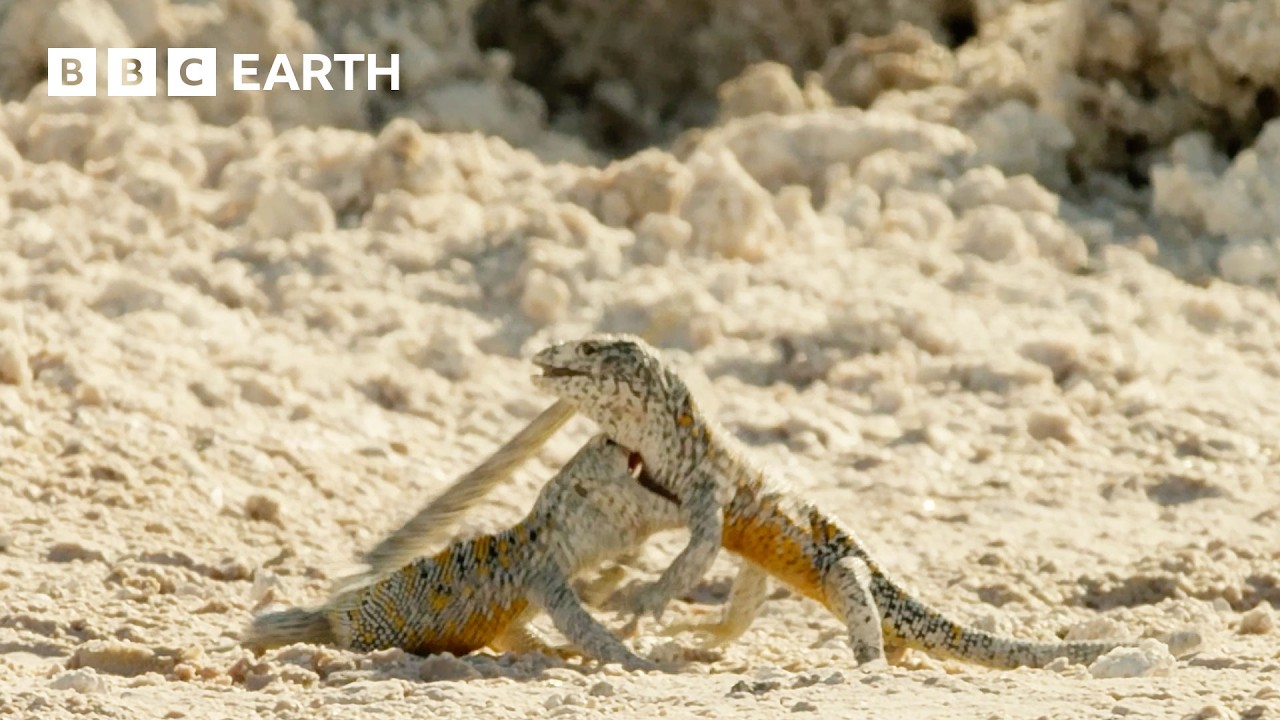
would need to start their lives. A fresh livestock, plants for cultivation, even the coconut. — But they would also have taken a long list of stowaways. Like the morning gecko, — this lizard was just one castaway which no longer had to rely on its stamina and luck to reach new lands. It could now hitch a free ride. — In a series of epic voyages, the descendants of the Lapita, the people we now call the Polynesians, succeeded in colonizing the far corners of the South Pacific. from Hawaii to New Zealand, even to Easter Island, over 11,000 kilometers east of New Guinea. In doing so, animal castaways now reach new islands at a rate never seen before, changing the nature of the South Pacific forever. maybe the same way as Fiji's most intriguing castaway of all. Discovered only 30 years ago, Fiji's largest surviving reptile was marooned on a handful of its outer islands. Crested iguanas, they're one of the toughest and most saltwater tolerant lizards around. In the breeding season, males nearly a meter long battle it out for a mate. They begin with a gentle bout of competitive head bobbing. If no one backs down, things become more animated. The loser scrambles for cover. So, where did these large lizards come from? Some speculate Asia, over 6,000 km to the west. Others the Americas, 8,000 km to the east. But how did they end up here in Fiji? One answer is that the iguanas, the frogs, and the millipedes were all carried here by powerful oceanic forces. Every day, large waves beat down on tiny islands across the Pacific. Imposing as they may be, these have little impact on island life. But every year, much larger waves rise out of the ocean. They're generated by underwater landslides and earthquakes known as tsunamis. They can flatten coastlines. Yet, these destructive forces may have also brought life to some islands. — As tsunamis strike the coast, rafts of vegetation could be cast a drift. Perhaps animals were caught up in those

Segment 11 (50:00 - 55:00)

rafts, too. Could this have been the answer to how these animals made it to Fiji? After all, they are the hardiest of their kind and could have survived long sea journeys. Fiji's first animals washed up tens of millions of years ago. Almost all animal castaways would have died of exposure, hunger, or thirst long before reaching French Polynesia in the Eastern Pacific. Reaching land here was a matter of extraordinary luck. Unlike Fiji, there are no bats in French Polynesia, no frogs, and only a handful of lizards. The most successful travelers were the longhaul flyers, si turns. Incredibly, they can stay in the air for 4 years without landing. But to breed, they must return to nesting sites on remote islands. And when they do, they introduce new life. Sticky or barbed seeds fasten onto their feathers and hitch rides across oceans. On some islands, 75% of plants arrived with the birds. Seeds are even carried in the stomachs of some birds. As if getting a lift wasn't enough for these seeds, seabirds also provide them with something else. The seafood these birds bring back to the islands is turned into nutrientrich guano, plant fertilizer. And there's enough of it to transform barren coral atals into fertile groves. There is one plant castaway that needs no help in finding new land. A plant that has probably done more to change the fortunes of island life than any other. And one of the greatest long-distance travelers of all time. The humble coconut. Its seed is a compact survival capsule. Buoyant and filled with food for germination. It can survive for up to 2 months at sea. Long enough to float from one remote island to the next. On arrival, it lays down roots into bare sand and taps into the reservoirs of underground fresh water. Without coconuts, most of the tropical islands in the South Pacific would have remained uninhabitable for both animals and people. Isolated by kilome of ocean, human colonizers also develop different ways of life. Each culture has its own customs and some are truly bizarre. — The locals are in celebratory mood. This man is about to perform one of the strangest rituals in the world.

Segment 12 (55:00 - 60:00)

— It's a tradition that tests the metal of the most courageous men. — Having a head for heights is only the start. Forest vines are tied around his ankles. — They will be his lifeline. For centuries, Pentecost men have been leaping headirst from wooden scaffolds with only forest vines to break their fall. A tradition that inspired modern bungee jumping. No follow. The jumps may look like acts of madness, but the festival's origins have a serious side. They celebrate the annual harvest of their staple crop. And with up to nine cyclones pounding the South Pacific a year, a successful harvest is worth celebrating. The close calls with mother earth are not miscalculations. The divers's hair is actually meant to brush the ground in a symbolic act of fertilization. And it's believed the closer the jumper gets to the ground, the taller the crops will grow the next year. For an animal to be sucked up by storm winds, carried across the ocean, and dumped here alive was a matter of extraordinary luck. Yet, that's what happened to the ancestor of this insect. It's a kind of fruitly, but no ordinary one. Hawaii's fruit flies are the birds of paradise of the insect world. They attract females with elaborate courtship rituals and have a sophisticated range of territorial behavior. Male hammerhead flies use their heads as battering rams. A male cleavveriti fruitfly fans sex pherommones from his raised abdomen. His extended tongue is an added attraction. Since that first colonizer, they have evolved into nearly a thousand species, many with their own unique behavior.

Segment 13 (60:00 - 65:00)

When it comes to choosing a mate, females are very fussy. One wrong move by her suitor and she's off. Hawaii's isolation has had a curious effect on the evolution of some of its other wildlife, too. Crawling around these ferns are caterpillars. They're the lavi of a moth and look ordinary enough, but these tiny caterpillars are perhaps the strangest of their kind in the world. When one finds the right spot, it settles down to chew through a leaf. So far, so normal. But the caterpillar is not actually swallowing the bits of leaf. It's channeling a gap between the segments. When finished, it'll tuck itself into the space. So, what is so strange about this animal? Well, those are not your typical caterpillar feet. And what follows is behavior. This is a carnivorous caterpillar with a vicelike hold and a bite to match. Hawaii's numerous fruit flies were just too good an opportunity to ignore. And the stick-like camouflage of another kind of meat eating caterpillar is just as effective when ambushing prey. Nobody knows what set Hawaii's carnivorous caterpillars on this extraordinary path, but it's the sort of quirky evolution that's common on isolated islands. Crabs may not seem unusual, but there's one kind here that's like no other. On this little island in Vanuatu lives a real oddity. It's the largest terrestrial invertebrate on Earth. The robber crab. The biggest can weigh up to 4 kg, the same as a newborn baby, and have a leg span of 1 meter. It's a hermit crab on steroids. At night, the huge robbers really come alive. Although these crabs are found throughout the Pacific, it's only on undisturbed islands that you can see them in such numbers. Exactly why rubber crabs have grown so big is a mystery. But with so few creatures making it to these remote islands, the giant crustation seemed to have filled a niche normally taken by medium-sized mammals. And with almost no competition from other native animals, the crab's huge size allows them to make the most of another great colonizer, something found here in abundance. Coconuts are one of their favorite foods. It's why they're also called coconut crabs. And they've been known to carry them as far as 5 km back to a favorite den.

Segment 14 (65:00 - 66:00)

Robber crabs are perhaps the only animals in the world able to break into a coconut. The husk is ripped off by powerful pincers. Other legs drill through the germinating holes on the seed itself until the nut finally cracks. The whole process can take several hours, but the reward is a meal rich in protein. Rubber crabs may rule the land, but they're no masters of the sea. An adult crab would drown in a few minutes. Which raises the question, how did these monsters get to so many of the South Pacific's most isolated islands? This female carries the answer. Thousands of eggs which will soon be left to the mercy of the ocean current. A few shakes of her tail are all that's needed to send them on their way. The eggs will hatch immediately. Then the lavi will have just 50 days to find a new home above the water. The Animal.

Другие видео автора — BBC Earth

Ctrl+V

Экстракт Знаний в Telegram

Экстракты и дистилляты из лучших YouTube-каналов — сразу после публикации.

Подписаться

Дайджест Экстрактов

Лучшие методички за неделю — каждый понедельник