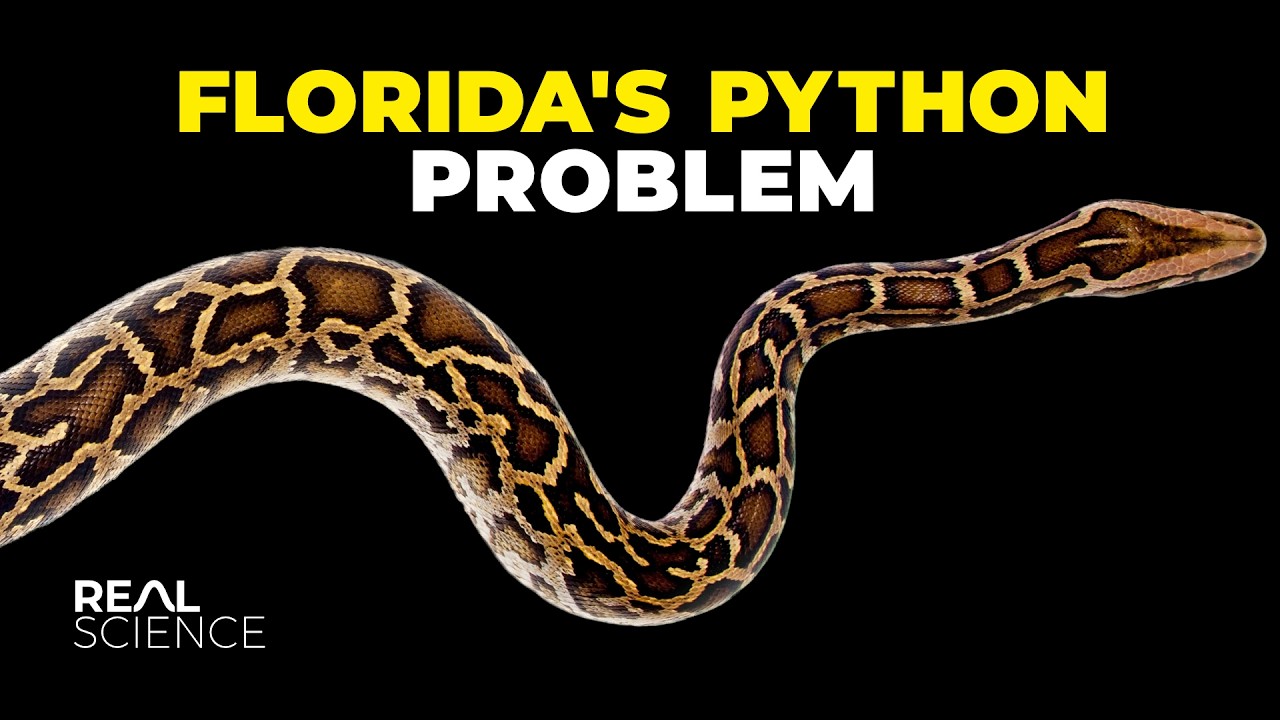
Sometimes a door gets opened in nature that can never be closed again. And what escapes is catastrophic. An animal so destructive it rewrites an entire ecosystem. This is the dark story currently unfolding in the Florida Everglades where just a handful of Burmese pythons released in the 80s and '90s have multiplied into an unstoppable population of hundreds of thousands. Many species of reptile have been introduced to Florida before, but none have taken over quite like the Burmese python has. It's not just their numbers that are alarming. It's the destruction that they cause. Since they've taken hold, there's been a near total disappearance of small and medium-sized mammals across large areas of the Everglades. For these native animals, the apocalypse has come in the form of a giant snake's endless appetite. For years, the pythons reproduced and spread unnoticed, hidden by the dense vegetation. But now, we're paying attention. And now, there are people trying to do something about it. — I saw like a little tiny bit of its pattern, and I followed it up a couple feet to the biggest head I've ever seen. And so, I jump on her. I was like, "Oh my gosh, what am I doing? I think I'm insane. " Python hunters go out into the swamp every day with one mission. find and dispatch as many pythons as humanly possible. It's a brutal and difficult job, but is it effective? Will this method of control ever be enough to fully eradicate this monstrous invasive species? And what about this snake's biology makes it so devastatingly successful at killing things in Florida in the first place? How did it get here? And why has it become an unstoppable force? The Burmese python is one of the largest snake species in the world. Native to Southeast Asia and southern China, these snakes inhabit a variety of warm, humid environments, including tropical forests, marshes, river valleys, grasslands, and swamps. Often staying close to water sources, Burmese pythons are known for their massive size, and unbelievable raw power. Adults typically measure between 12 and 16 feet or 3. 6 to 4. 9 m in length with some individuals exceeding 18 ft or 5 1/2 m. They usually weigh between 200 lb or 45 to 90 kg with adult females being heavier. Their bodies are thick and muscular designed for constriction. They often lie in weight, camouflaged by vegetation or submerged in water until an unsuspecting animal comes close. Then it strikes with lightning speed. It launches its muscular body forward to seize the prey with its backward curving teeth. Pythons are not venomous, so they don't have the classic snake fangs you might be familiar with, but their teeth do not mess around. They have approximately 100 insanely sharp teeth. Two rows on the top and one row on the bottom. Once it has a firm grip, the python quickly coils its powerful body around the animal, tightening its grip each time the prey animal exhales. This process, known as constriction, is not about crushing bones or about suffocation. It's about stopping blood flow to the brain. After the prey is dead, the snake begins the slow process of swallowing the animal hole head first. You've probably heard that these snakes unhinge their jaw, but that isn't really how it works. Their jaw is made up of four movable parts connected by flexible ligaments. These stretchy ligaments allow the four parts to move apart independently. The lower two jaw parts can swing open over 120°. For a long time, scientists believed Burmese pythons could open their mouths a staggering 22 cm or 8. 6 in. But they recently realized their maximum gape diameter is more like 26 cm or 10. 2 in. Scientists were led to this realization when they found a Burmese python in Florida eating a full-sized white-tailed deer bigger than they had seen in the past. This discovery serves as another warning sign of the threat imposed by these Burmese pythons in Florida. There are very few native animals there that are big enough to be safe. Pythons have even been seen eating alligators, but sometimes they do miscalculate and they do explode. In 2005, Everglades Park officials found a 13- foot long Burmese python that had attempted to swallow a 6-foot alligator, but it exploded and both animals died. But if the python successfully do not explode, the prey is digested over days or even weeks, during which time the python becomes largely inactive. An apex predator that eats
Segment 2 (05:00 - 10:00)
deer and alligators isn't one that I would personally want as a pet. Yet, some people really, really do. Compared to some of the other constrictors, Burmese pythons have a mild temperament. They're not very aggressive. They move slowly and are sort of okay with being handled. And this is how the problem in the Everglades began. — It's 100% the pet industry. However you look at it, whatever theory you believe, it's because of the pet industry. This is Amy Seawi, a professional python hunter and guide in Florida. She began her career as a state contracted python hunter and now runs her own python hunting guide business. Some people say it's because people release their pets, which people 100% release their pets. When the pythons got to be too big to house, feed, and handle, you know, they said, "Oh, let's let them go in the Everglades to live a long healthy happy life. " But the reason that we've got this epic problem is because there was a breeding facility that was in Miami that got destroyed during Hurricane Andrew in 1992. Hurricane Andrew, which struck in August 1992, was one of the most devastating hurricanes in US history, particularly for South Florida. It made landfall as a category 5 hurricane with sustained winds of 165 mph or 266 km per hour. The destruction it caused was catastrophic. 63,000 homes were destroyed and 65 people died — when it sent 900 baby pythons to the same general vicinity of the Everglades. — But how does 900 snakes become 500,000 in just a few decades? The first step in this recipe towards disaster is the fact that female Burmese pythons can lay a lot of eggs. The average is stated to be 35 eggs per clutch, which they lay once per year, but the big females can lay a lot more, like up to 100. The record is 122. Let's compare this to the Everglades largest native snake, the eastern indigo snake, which can grow to be 5 to 7 feet or 1. 5 to 2. 1 m long. It lays 4 to 12 eggs per clutch once per year. That's nothing in comparison to the python. And unlike many reptiles, female pythons guard their eggs, increasing hatching success. So, even if only a fraction of female pythons successfully reproduce, the napkin math suggests it would only take a few generations to go from a few hundred to a few hundred thousand. And making it worse, when Burmese pythons hatch, there are already over 2 ft or half a meter long, the size of many adult native snakes in Florida. Some native Everglades predators can eat these babies, sure, and many do get eaten, but clearly not enough of them. And those big babies also got to eat a lot of creatures to reach their enormous final size. It takes a python just three years to get to be 10 ft or 3 m long. And it takes eating hundreds of animals for it to get there. And this leads to the second step in this recipe for disaster. Pythons can and do eat basically everything. They can consume nearly every small to medium-sized animal in the Everglades. And the impact is so devastating, it's hard to wrap my head around. A 2012 study showed a 99. 3% decline in raccoons, a 98. 9% decline in apossums, an 87. 5% decline in bobcats. Another study reported a 94. 1% decline in white-tailed deer, and a 100% decline in rabbits and foxes. And the birds aren't safe either. Birds constitute approximately 25% of the python's diet in the Everglades. Researchers have found over 58 different bird species from small rens to large herand in python digestive tracts including many of their eggs. And while that 6-foot gator made the python explode, a 5ft one was found in a python's stomach. The research on the impact of pythons on reptile and amphibian populations hasn't been finished, but I think we can guess that the numbers won't look good. — Unfortunately, these pythons have voracious appetites, so they're eating everything, and the decline in the mammal and now bird populations is really devastating. All of this does make me wonder though, what's so different about Florida versus their native range that makes the pythons so destructive? Pythons in their native habitat in Southeast Asia don't cause a 90% decline in the population of their prey. The answer to this question is the third step in this recipe for disaster. Native Florida animals don't have a natural instinct to be afraid of these giant snakes, whereas the prey animals
Segment 3 (10:00 - 15:00)
in their native range do. Those animals have evolved alongside this snake and know to be on alert for this sneaky massive python. And the fourth step in this recipe towards total python devastation is that in Florida, adult pythons have no significant natural predators. In Asia, what are those predators keeping pythons in check? Big cats are one thing, like tigers and leopards. They prey on young or smaller pythons. Florida panthers might eat some of the smaller pythons, too, but wouldn't be capable of eating the big ones. And there's only like 200 panthers left in the Everglades, so they won't be doing any of the heavy lifting. Crocodiles are another animal that eats the pythons in their native range. They can easily overpower the pythons in the water. In Florida, alligators do eat pythons, but only the biggest ones succeed. It's actually a pretty amazing back and forth battle between these two species, but again, there aren't enough massive alligators to fully get rid of the pythons. And finally, in Asia, there are the king cobras. These are the largest venomous snakes in the world at 18 ft or 5 1/2 m, whose diet is primarily other snakes. They are the main predators of Burmese and reticulated pythons in Asia, playing a crucial role in controlling their numbers and maintaining a balanced ecosystem. There's nothing like this in Florida. Should we introduce it? Go full cane toad and introduce another non-native species to control the pythons. I don't think anyone wants that. So, without these predators in Florida, nothing is keeping the pythons in check. However, there is one more predator we need to consider. One predator that's the goat of killing stuff, humans. Humans are the main threat to pythons in Asia, largely because of habitat loss, but also because they get hunted for their skin. Ironically, Burmese pythons are a threatened species there. So, could we simply play the game humans seem to be so good at hunting and killing the pythons out of existence in Florida? For now, that is the plan. And that is what Amy Seiwe spends all day or sometimes all night doing. It sounds like a simple idea, but it's way more challenging than I would have ever guessed. It takes an average of 12 hours. That's collectively all the agencies to catch one python. So that's a lot of time and a lot of manpower to get not a lot of snakes. — So what is the most effective way of both finding them and then capturing them? Finding them is the biggest issue, right? This environment is so perfectly conducive for them for so many reasons, but they are so camouflaged. We were beyond the ability to even control this problem before we even knew it was a problem because we just you just don't see them. I mean, I am an experienced python hunter. I can pick them out even in the grass, you know, when they're hiding, things like that. But the problem is so many places are inaccessible in the summer. We have to stay on the roads. If you just go out into the swamp and start walking, you're never going to find a python ever. And they spend 85% of their time not moving. So, we have to wait for them to be on the move. So, that's why we go down the roads waiting for them to go from the woods and the swamps into the canals. And they the canals all run parallel to the main roads. So, we're catching them when they're crossing the road. — It's all about being in the right place at the right time, waiting for the snakes to pop out — because the python could be buried. He could be sleeping under this, you know, debris pile right by the road. He might come out tonight. in 2 weeks. We don't know. He might come out 30 seconds after I pass it. You know, I mean, that's the problem with this is that they're just so hard to find. — So then once you do spot one, what happens next? — Uh, well, we yell python and jump out of the truck. You catch them behind the head like right up to the jaws. If they're smaller, it's pretty easy. You know, if they're bigger, it can be quite a battle. And then we do have to dispatch. We have to euthanize them. — Yeah. I'm sure it's one of those things that doesn't feel awesome, but just has to happen. — Oh, I hate it. I totally hate it. I wish there was another way. If there was another way, I would absolutely do that. But unfortunately, we're at this point. We don't have a choice. — And the bigger risk to you, is it more getting bit or more getting wrapped up? Uh, the biggest risk is probably getting bitten. Even though they're not venomous, they have a mouth full of razor sharp teeth. The good news is that we are not on the menu. They don't want to eat people. When they strike at us, it's a defensive strike. They're not biting and trying to wrap us. If I get in a situation that like I've got the python and it's wrapping me and I'm uncomfortable, all I have to do is let go and then the python will unravel and take off. — What's the biggest python that you've caught? Do you record and measure them all, I assume? — Oh, yes, absolutely. The biggest one is
Segment 4 (15:00 - 20:00)
173, 110 pounds. And I actually caught her by myself. I get out of my truck. I see this thing periscoping. So it's like when they raise up a little bit off the ground, and you can see their white belly. So I see it. I pull the truck over. In the meantime, it goes down. This is takes me like 30 seconds. I grab my bag. I grab my GoPro. I get over to it. This thing is 17 ft. I know where it is. And I still could not find it for like 2 minutes. That's how And it's right by the highway, you know. And so finally I saw like a little tiny bit of um its pattern through the grass and I followed it up a couple feet to the biggest head I've ever seen. This is big insane. I was like, "Oh my gosh, what am I doing? I think I'm insane. " And I'm standing there with my little 6x6 headbag like what am I doing? But you know, you can't hesitate with these things. So I've got her I'm like kind of straddling her and she's trying to shimmy back between my legs to get back into the swamp. So I'm like using my lower legs. I'm like squatting her up. So, I'm using all of my strength to keep this python from going back behind me because if she goes back, like it's done, while I'm also trying to get this headbag on her head. Before finding this monster, Amy had figured out that putting a bag over the python's head nearly completely subdues them. This would become critical to what she was about to accomplish. And so, as soon as I got the headbag all the way over her, she stopped. And I was like, "Oh, thank God. " because I was getting to the point that it was going to be who could outlast who, you know, it wasn't this big wrestling match or anything. It was like a battle of strength. That was crazy. But that just shows you like so many things like how camouflaged they are. You know, how hard it is to get them. I had a lot of things going my way. If I didn't have that headbag, there's no way I would have been able to get that snake. I can't out muscle a 17oot python. Most people can't, right? Even guys, they can't outmuscle them. And so it's a matter of wearing them out, but also having these tricks that you can use to help you so you don't have to let the python go because everybody has their the one that got away story. — How many python hunters are out there in the Everglades? — Okay, so the python programs through the state, there are hundred and they're not going to hire more than that just because of access. There's just not enough roads basically to handle more people, which the Python challenge is happening tonight. So that's a whole another story. But there's probably about 30 other people like me that not guides necessarily, but that go out on a regular basis that aren't part of the state. And the reason I'm not part of the state is because I made as a top hunter for the state of Florida, I made less than $20,000 a year and I needed to make money. So I started a guiding business and the state said, "Sorry, you can't do both. " So other people like me that just go out for fun is probably about 30. But then you have now that python hunting is becoming pretty popular and people see it on TV and on social media and sometimes, you know, it looks really easy because we've been doing it for long enough. We've already made all the mistakes and we know how to do it now. So we have so many people out there now that think they can hunt pythons and it's just a disaster. — Yeah. I can only imagine. You mentioned briefly the python challenge. Can you explain what that is and how it's different? — Sure. So, the Python challenge is put on by the state. It is a 10day competition and there's prizes, like $30,000 worth of prizes. So, people from all over the actually world, we get people from other countries that come. You have to pay 25 bucks to sign up and then take a little I don't know course online through FWC and then 10 days everybody's out there, 1500 people in an area that there should only be like 50. So, it gets a little overwhelming. The problem with it, a few things. First of all, the pythons, there's so much traffic that the pythons don't take on their normal behavioral patterns. So, if they would normally be coming up to the road, they won't do that anymore. 2 years ago, I did it. In the 2 weeks before the challenge, I caught 31 pythons. During the challenge of 10 days, I caught three because they just don't come out. But then also, snake identification is not easy. I mean, you can look at it on a screen or in a book or whatever and it's like, "Oh, yeah, that's what this is. I can tell the difference when they're like right next to each other. " But when you're in the field and it's dark and you're you have to try to remember what is what when you don't see these snakes very often, and there are so many people that come from outside of Florida that don't know our native snakes anyways. They might know their native snakes, but not ours. And baby pythons, like I said, are 2 ft out of the egg. and they're all hatching out right now. So, we get people that kill water snakes and cotton mouths and, you know, corn snakes and all of these wonderful native snakes that we have that are part of our ecosystem because they think they're pythons and they can't tell the difference. So, that's the worst part of
Segment 5 (20:00 - 25:00)
this for me. — That's absolutely tragic. I hadn't even thought of that angle. — Yeah, that's a great way to put it. Yep. — So, what could the state do to support the more qualified python hunters like yourself? Maybe just paying them more. I think taking that out of the equation, I think that because that goes without saying no matter what you're talking about, but I think the most effective thing since we are and we're not very effective, you know, one every 12 hours would be to have territories like specific territories that people hunt each night. And you know, it could be switched around or whatever. People could do different territories. But the problem is there is this whole big area and people can just go out and hunt wherever they want. So there might be a ton of people over here and nobody over here. Nobody catches over here. So we're like, "Oh, so this, you know, it was this temperature, this humidity, and nobody's catching anything. " Okay, well maybe they were moving, but nobody was there when they were moving over on this side, you know? So there's just a lot. I think we could get a lot more accurate data as far as their behavior and when they move if we could strategically hunt instead of just willy-nilly whenever you can. — Yeah, that makes a lot of sense. Sort of like organizing your efforts. And that seems doable, too. — Changes like this could make a big difference in our fight against these invasive snakes. But with all of the crazy stories of Python captures and all of the people spending tons of time working towards Python removal, I have to wonder, is it even helping? — So, I don't know if you have this data, but do you know if python hunting has made a dent? — No. I mean, in some areas, yeah, probably. But, okay, here are some figures. So, these programs started in 2017. Since then, collectively being generous, 27,000 pythons have been caught. That's in 8 years. There's an estimated 500,000 of them out there. They lay 20 to 40 eggs a year. The big ones over 100. So, do the math. It's not pretty. But here's the thing, though. It takes a python 3 years to get to be 10 ft, and it takes 200 animals for it to get there, right? So every single one that we're taking out is definitely making a difference and saving the lives of hundreds of our native animals, right? So then you look at it and say, okay, well, is this worth it? Are we just prolonging the extinction of a lot of our native animals? Possibly. But there is, like I said earlier, tons of research going on. so much research and all over the country to try to get this problem figured out and a more effective solution than just hunting. So, if we can prolong that extinction until they can get this figured out, obviously, you know, it's worth it. It's worth it anyways, but you know, we can't just say, "Okay, pythons, you win. " You know, like we can't do that. So, we we've got to do something because it'll be on the cusp. Like, there's got to be something on the cusp that they're like, "We got this. " It's like we got this figured out. — So Amy sees it as holding the line for as long as possible while new technology gets rolled out. And there are new developments happening all the time. One thing being used more and more in the field is Edna detection. Snakes leave behind DNA when they shed skin, poop, or just move through the water. Using very sensitive lab tests, researchers can detect even the smallest amount of python DNA in a sample. This method's been a big breakthrough. It can show where pythons are living, even in places where none have been spotted yet, at the invasion frontier. Scientists have found python DNA in certain areas years before anyone actually saw a python there. It's also much more effective than looking for snakes visually. Another new technique involves the use of scout snakes, dramatically nicknamed Judith snakes. These are usually male pythons that are captured, fitted with radio transmitters, and then released back into the wild. During the breeding season, male pythons naturally seek out females. So, scientists use them to lead search teams to hidden groups of other pythons. Once the scout snake finds a mate, or sometimes several, biologists follow the radio signal to its location and remove all of the pythons they find there. This method is especially powerful because it can help remove large breeding females and has even led to the discovery of large breeding clusters, resulting in the removal of hundreds of pythons in a single season. Scientists are also able to collect a lot of behavioral data from these radio tagged snakes. But both of these methods still ultimately rely on manual removal. Is there any hope for something more powerful? something that gets rid of the snakes once and for all. There could be, but it's still very much just an idea, and it's tricky. It's possible that scientists could create a gene drive to
Segment 6 (25:00 - 29:00)
eliminate the pythons. A gene drive is a genetic tool that forces a particular trait to spread quickly through a population. It's been used successfully in lab settings with mosquitoes to dramatically reduce their numbers. In theory, scientists could apply a similar strategy to pythons by engineering a gene that either makes them sterile or causes them to produce mostly males, eventually shrinking the population. However, doing this in pythons comes with big scientific and ethical challenges. Unlike mosquitoes, pythons reproduce slowly, so a gene drive would take much longer to spread. Their genetics and reproductive biology also aren't as well understood, making gene editing more complicated. Plus, releasing genetically modified snakes into the wild could have unintended consequences. And once a gene drive is out there, it's hard to take back. And this could be a problem if we're not careful. A gene drive in pythons could spread to related species, either other snakes in Florida or other pythons in their native range. For now, this is all theoretical, but seeing the devastation that the pythons are causing in Florida, I'm personally all for doing the research to see if this might be a long-term solution. Unfortunately, there will be no easy fix. And unfortunately, there's no easy way to find the pythons or even to learn about their ecology in Florida since it's all so new and all so cryptic. But if you want to get good at another kind of Python, the kind that runs on code and doesn't hide in a swamp, that's where Brilliant comes in. Brilliant is a learning app that helps you become a better thinker and problem solver with thousands of visual interactive lessons in math, science, programming, data analysis, and AI. It's built to be uniquely effective. Python jokes aside, the critical thinking skills that Brilliant helps you develop through problem solving is exactly what is needed to solve this Python problem in Florida. With Brilliant, instead of passively watching lectures, you'll dive into hands-on problem solving that helps you actively engage with the material, a method shown to be up to six times more effective. Brilliant helps you build real understanding from the ground up with a perfect balance of challenging problems, motivational features, and daily progress tracking. Each course is created by an award-winning team of educators, scientists, and engineers from places like Stanford, MIT, Caltech, Microsoft, and Google. Building skills in data analysis and programming can help you be at the forefront of problem solving and conservation. Programming the radio tags on scout snakes, analyzing the data of Edna, and modeling to understand the python's future impact. These will all be crucial in the fight against this invasive species and are all things you can build skills with on Brilliant. The data courses are particularly useful when trying to understand how to best study wildlife. They cover everything from basics like data visualizations to advanced topics like algorithms and regression models. Regression can help scientists predict population growth or model how environmental factors like temperature or rainfall affect Python movement. Classification is useful for automatically identifying python sightings, analyzing camera trap footage, or sorting Edna samples to confirm species presence, and clustering helps uncover hidden patterns in the data, like identifying hotspots of python activity based on GPS tracking or community reports. Protecting wildlife isn't just about boots on the ground. It's about data, modeling, and being able to interpret the science that drives smart conservation. Brilliant can help you build those skills. So to learn for free on Brilliant, go to brilliant. org/realcience, scan the QR code on screen, or click the link in the description. Brilliant's also given our viewers 20% off an annual premium subscription, which gives you unlimited daily access to everything on Brilliant.