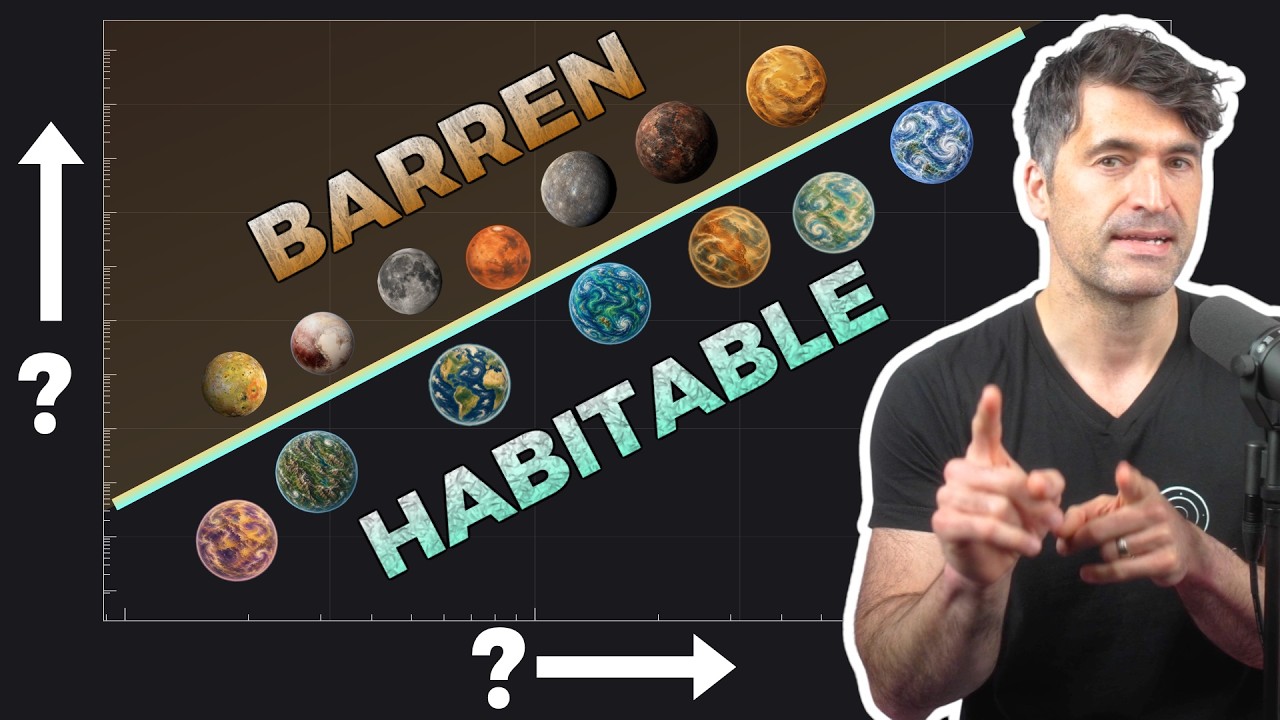
What has an orange got to do with God? Well, perhaps more than you might think. We live in a universe which is clearly capable of developing self-aware beings such as ourselves, but as far as we can tell, there's no reason why this had to be so. The fundamental constants of the universe could have been different, and it wouldn't have taken much perturbation for the effects to have been ruinous to the prospects of life. On the face of it, then it looks like the universe has been finally tuned to accommodate our existence. And to some, this is the best evidence of God available to us. An idea known as intelligent design. In popular discourse, finetuning is often framed purely in terms of his effect on how habitable the universe is. But I want to highlight that physicists use the term much more broadly than that. There are numerous parameters in fundamental physics that have no bearing on cosmic habitability and yet still appear finely tuned or the same. For example, the electric dipole moment of a neutron has been experimentally constrained to be 10 billion times smaller than that which we would naively expect from quantum field theory and thus it seems suspiciously close to being exactly zero. This is technically known as the strong CP problem in QCD. But fortunately, whether neutrons have the electric dipole moment that we would expect or not has no apparent bearing on the existence of atoms or molecules or life. But consider instead the neutron proton mass difference, the two building blocks of atomic nuclei. Neutrons are just. 14% heavier than protons. But if that difference were even a tiny bit larger, say. 3% or more, then even neutrons bound up inside atomic nuclei would decay into protons via the process of beta decay. The result would be a universe where the only atoms possible were hydrogen, no helium, no heavier elements, which means no fusion, no stars. But if the situation were reversed and instead neutrons were slightly lighter than protons, then protons would decay into neutrons via beta decay and there'd be no atoms at all. In either case, there's no chemistry, no stars, and very likely no life. Physics can't justify why the neutron proton mass difference is so perfectly balanced for our existence. It's almost as if somebody tuned it to enable our emergence. It turns out that there are a lot of these finely two numbers in physics from cosmology to particle physics and we did a podcast episode all about this with Grant Lewis that I recommend you check out. There are at least 26 fundamental parameters in our current understanding of modern physics. Numbers which we have no abinio explanation for their given value. And yet these numbers to varying degrees affect the habitability of our universe. Ethan Seagull has a great article summarizing these, and I'll link to it down below in the description. So, here's where things get interesting. Enter a legendary cosmologist, Dennis Skama, who had an ingenious way of thinking about the fine-tuning problem, one that challenges intelligent design directly. Now, I have not seen this discussed anywhere on YouTube before. So, today, let's break down Scammer's argument, then give a recent update to it, and finally, I'll give my own two cents on this at the end. And by the way, yes, thank you for noticing. This is a new Cool Worlds winter design t-shirt. You see, we've got the comment here. I kind of helped come up with this cuz, you know, 3II Atlas is grabbing everyone's attention right now. Seemed appropriate. If you're interested in grabbing this t-shirt, you can check out our merch store down below. It's on the shelf as well. So, maybe a good winter gift for someone. Okay, so here it is. In Scammer's argument, one can first imagine a 26dimensional volume of parameter space with each axis representing one of the fundamental parameters. Obviously, I can't show you all 26 dimensions on screen, but you get the idea. Each location in this hyperdimensional volume would represent a different universe, ones with different physical constants, and thus the vast majority of them would be completely inhospitable to living beings. It would be a vast desolate wasteland of sterile universes. But there would be oases which we might imagine as an island in this volume that permits atoms, molecules, and chemistry. Universes located on the shore of this island would be barely habitable, on the cusp of being sterile, and universes near the core would be optimally habitable. Intelligent design proponents usually make the argument that our universe is exquisitly finely tuned for us. And thus in that picture, we should expect to live in the center of this island, not near the shore. But Skama devised an ingenious counter proposal to this claim. One that leveraged the so-called concentration of measure principle. Instead of 26 dimensions
Segment 2 (05:00 - 10:00)
imagine we just had two and our island looked like a circle. Whatever the overall distribution of these two parameters, this habitable island is presumably a very small region compared to the full landscape and thus the distributions will look uniform in this local region. So we can thus populate the island with habitable universes from a uniform distribution just like this. Let's now count what fraction of these habitable islands live on the shoreline which we will define to be those which are within 5% of the diameter of the boundary. Adding it up we find that 19% of our randomly selected samples live here. In fact this fraction is simply 1 minus. 9 squared because we have two dimensions. Now if we go to three dimensions instead of two the fraction of habitable universes living on the shore within 5% of the boundary becomes 1 -. 9 cubed which is 27%. And this scales with dimensionality such that by the time we reach 26 dimensions, a whopping 93. 5% of universes live on the shoreline. So what this means is that for a hyperdimensional orange, the vast majority of its volume lives on the peel rather than in the fruit. What's particularly remarkable is that the argument works whatever the shape of the island. It doesn't have to be a ball. For example, make it a square and you get the same answer. So using this logic, Skama seems to have found a compelling argument that most universes capable of sustaining humans are only barely habitable. If we accept this argument, it implies two profound consequences. burst. Whereas intelligent design proponents would argue that we're most likely to live in the center of this cosmic habitable island, the naturalistic view would predict that we're more likely to live on the cosmic shoreline. And thus, we might in principle have a way of testing intelligent design. Second, the implication that we live in a barely habitable universe might explain the Fermy paradox. No wonder we don't see many aliens out there because we live in a universe that's only just barely habitable. It's a beautiful and elegant argument and I have to admit that when I first encountered it, it took me a few readroughs to get my head around just quite how powerful it really is. But there has been a recent update to this argument presented by Xiwi Wang and Sam Brawnstein. And this update actually threatens to flip the entire narrative on its head. Before I blow your mind with that, this episode is supported by Incogn who can't help you navigate the multiverse, but can help you in the human verse. I have been using incogn for years now. It is an amazing service that works to delete your information online. Every time you fill in a form, your personal info gets stored somewhere. And greedy companies love making an extra book by selling that on to someone else without your permission. Before you know it, there's a runaway effect. And your personal information is everywhere online. So, incognite back for you. They scour public databases for your information and then get it deleted on your behalf. I'm now at 1,390 completed requests, saving me over 1,000 hours of trying to track this down by myself. What's even better is that if you find your information somewhere online that you don't like, just copy and paste the link into the custom removals feature and incogn. This is a core tool for staying safe online for me and my family. So, I'm partnering with them to offer you a 60% discount off their annual plan. Just head to incogn. com/coolworlds and use our codec coolworlds. Once again, that's incogn. com/coolworlds and use the codec coolworlds. Now, back to the video. Okay, so let's look at this update to Skama's reasoning. The argument begins by pointing out that we could be ignorant of some fundamental parameters. The 26 that we know of could just be a subset of even more fundamental parameters that we are yet to discover. For example, if dark energy is changing over time, as hinted at by recent experiments, that would require additional parameters to describe its evolution. So Wang and Bronstein take the view that the true number of fundamental parameters is likely to be much higher than the 26 that we know of, possibly even hundreds. So let's say there are n true fundamental parameters in total, but we only see m of them. Well, Wang and Bronstein show that the m that we see are just a projection of the larger n, which you can think of as a bit like taking an x-ray of the
Segment 3 (10:00 - 15:00)
n-dimensional hyperball. Even if the n parameters are locally uniformly distributed as we might have in scammer's argument, the projected subset of these m terms won't be. Instead, we will have a concentration to the center as a result of this projection effect. So what this means is that when we look at our m= 26 physical constants, we will appear to land right in the center of this habit island in spite of scammer's reasoning. For example, if n equals 42, which is always a fun number to choose, then skimmer would reason that there would be a 99% probability of landing within 5% of the boundary. In other words, of being in the orange peel rather than the orange itself. But when we project this down to m= 26 dimensions, which maybe is a little bit like taking the shadow, right, of an orange, maybe my light's not quite bright enough to see this, but in that shadow space, that's what we really see. That's the projection. Now, the probability of landing within the edge within the shoreline drops to just a few%. So if we one day proved that we lived in the center but ignored this subtle point, theists might naively celebrate our apparent centrality as proof of God of intelligent design. But in truth, this is merely an effect of geometry. Now recall that in Scammer's original argument, the shape of the island didn't really matter. But when we include these projection effects, it actually does. We assumed earlier that the island was a hyperbore. And indeed in that case the projection effect causes strong focusing towards the center. But there are counter cases. For example, a uniformly sampled hyper cube island projects neatly into another uniformly sampled hyper cube. No concentration effect occurs. However, Wang and Bronstein show that if you tip this n-dimensional hyper cube just a little, the projection into m dimensional space again exhibits a central concentration. So barring some special cases, they consider the focusing effect to still be the general scenario. So I had not encountered these arguments before until Sam Bronstein sent them my way. And so thank you to that Sam. And I wanted to share them with you because I just think they are wonderful brain food. They really get you thinking. But let me finish with four open questions. First, it's not obvious to me that N must be much greater than M as Wang and Bronstein assume. Perhaps n is actually smaller. Maybe using just 10 numbers, you could derive the 26 we observed using some set of physical rules, a theory of everything. I have to admit though, I give this somewhat low credence because physicists have been trying to do this for decades now without much success. Most physicists would really like this to be true. But as Feman taught us, nature has no obligation to be neat and tidy. It could just be like an onion with countless almost fractal-like layers of complexity. A second issue I have here is the whole implicit multiverse business and the rules that govern them. For example, Scammer originally assumed that each of these different universes would have the same laws of physics but just different physical constants. But why should that be so? It's difficult to argue that this is truly expected, even if string theory enters the chat. yet more. Perhaps there isn't a multiverse at all, although most theories of inflation strongly implicate its existence. You can see our recent podcast episode with Will Kenny for more on that. Third, and this one's a bit subtle, these arguments tacitly assume equal waiting amongst all of these human compatible universes. So, recall that in Scammer's original argument, most human compatible universes are on the shoreline, barely habitable. Therefore, we should expect to live in such a universe. But that final logical leap that therefore is questionable for the universes near the core should be far more habitable and thus have far more civilizations in them. So one might advocate for what Nick Bostonramm calls the self-indication assumption that you should pick scenarios with more observers in them over ones with few. By that reasoning, we'd live in the core even ignoring the projection effect business. Side note, I did email Sam my concerns about this and he strongly disagrees with this one. He thinks it only matters that each universe has one observer. So, I'll let you guys decide for yourselves on this one. And finally, infinities. Man, do I hate infinities. You see, in each of these imagined universes, they are presumably infinite in scale. And thus, even the barely habitable ones right on that shoreline would still contain an infinite number of observers within them. So, how can we possibly hope to make useful probabistic statements about which universe we're more likely to live in when we have all of these infinities kicking around? The
Segment 4 (15:00 - 16:00)
math breaks down. Now, it might be possible to do some kind of clever renormalization here, but to my knowledge, no one has pulled that off yet. So, this still bothers me. So, those are my concerns, but I'm sure you have your own thoughts. Do you think that we could ever test intelligent design? And what is your explanation for the fine-tuning problem? Let me know down below in the comments section. And as always, stay thoughtful and stay curious. Thanks so much for watching this video, guys. I hope you enjoyed it. If you did, as always, please do drop us a like and subscribe. It really does help. And if you want to support our research at the Cool Worlds Lab and help make these videos, the best way to do that is use the link above and down below where from the price of a coffee per month, you can support what we do here at Cool Worlds. Just like our latest supporter, that is Craig Frederick. Thank you so much for your support, Craig. So, till next time, guys. Stay safe out there.