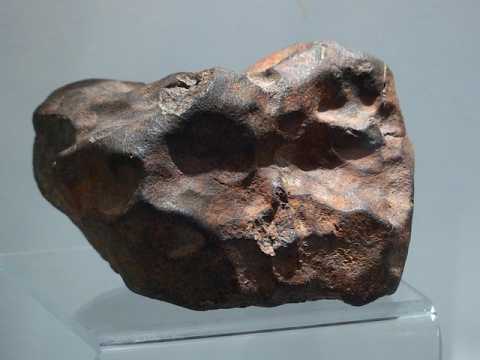
It's no secret that Earth and space are intimately connected. Often it can seem disconnected. Space and the planets and stars are out there and we're down here. And there can be a seeming disconnect. But anyone that has ever experienced a total solar eclipse knows that at that particular point in time, you feel, or at least I felt, that the solar system had come down to Earth and became somehow more tangible. But the dinosaurs had it worse, and they really took one for team Earth when the solar system literally smacked into them and caused their extinction. And one thing that asteroid impact did was leave fingerprints of itself in Earth's geology. A buried crater, fossil evidence, the Cretaceous tertiary boundary, its weird iridium levels, which should not be where they are, unless a huge asteroid hit, and so on. But also something else, impact glass. So when something like that happens in a crater forming asteroid smacks the seafloor or a continent as what happened with the end Cretaceous event, the material vaporizes and very effectively becomes glass. As an aside, it actually is amazing how good Earth's geologic processes were to make really pure silicon dioxide sand. The stuff often exceeds 95% purity, allowing for things like manufacturing clear glass. Not a lot of bodies in the solar system, certainly not the moon, can boast that. As a result though, Earth can make natural glass and can do it a number of ways, from obsidian and volcanic flows to fulgarites formed when lightning strikes sand. But asteroid impacts sometimes can do it, too. And that led to one of the strangest and longlasting mysteries in science, with parts of it still not solved. So the glass droplets that the end cretaceous impact caused are called tectites and in that case they are microscopic inside the telltale end cretaceous geological layer along with the iridium. But other albeit generally smaller impact vents in the more recent history of earth have produced much larger tectites and so many of them numerically that I have little doubt that many of you own one. I myself have a collection of them and they can be inexpensively found from reputable dealers and often show clear markings of having flown through the atmosphere in a molten state. But there was one aspect of tectites not totally understood that was initially outright strange. Tectites have been known since antiquity. There was actually a piece of jewelry carved from an impact glass, not really a tectite, much smaller impact, but related in the tomb of Tuton Common. But decades ago, there was an American scientist named HH Ninger, often called the father of meteoritics, who recovered and studied meteorites intensively for years. He contributed greatly to the early study of that field. But he also came across tectites and they perplexed him because they are not meteorites by any definition. They are glass that was thrown through the air while molten whereas meteorites are rocks. Ninger and a number of others before him had suggested that this might represent formerly molten glass from impacts on the moon. The prevailing hypothesis for the origin of tectites today, which often have strewn fields that cover enormous swaths of the Earth, including Europe, North America, Africa, Australia, Asia, and Antarctica, included asteroid impacts as a simple answer, but where are the craters? Back then, very few impact craters were evident on Earth. Niner knew that compositionally, tectites are very dry. They have very little water, unlike Earth's other natural glasses, which it turns out is actually a product of their formation somehow, but it's still not known exactly how they lose water. But Nature wondered if this could be due to them being blasted off the very dry moon instead of an impact on Earth. Today, this hypothesis is no longer standing. There's too much evidence that these are melted earth materials, but it certainly was a viable hypothesis in the 1940s before we'd ever been to the moon. Not only now do we have samples and actual meteorites blasted from the moon, we also know that the tectites are not from there and match the composition of Earth rocks like shells and sedimentary rocks, but contrast greatly with volcanic glasses, which do contain water and have a completely different composition, having come from deep below the earth. Tecttites can look like volcanic glass, but compositionally they do not, and they are distributed far too widely for a volcano to have done it. The world's great tectite fields are mostly linked to known buried craters like the uncretaceious Yucatan crater and others. But there is one group of tectites that are an elephant in the room because they
Segment 2 (05:00 - 10:00)
comprise in area the largest and most varied tectite strewn field on Earth. These tectites are known as Indochinites and they are found all over Indochina, Vietnam, Cambodia, the Pacific Islands, Australia, even Antarctica and often show the characteristics of atmospheric flight like splashes of molten glass tossed into the air except one type of them which are layered and appear to have formed rapidly in stages of heating and cooling events during the impact, most likely close to the crater, but more on that in a bit. But here's the problem. There appears to be no impact crater to have caused them. There should be evidence of a massive crater, probably somewhere in Central or East Asia, that splashed these molten bits of glass out, and there simply does not seem to be one there. The solid black pieces of glass, which interestingly contrast to Europe's beautiful green mulivites, which do have a linked crater in Germany, seem to have formed about 700,000 years ago from magma created in the impact. There were candidate craters later found, but none fit to this day. What's also perplexing here is that the Indochinaite tectite group all seem to have formed chemically from very specific sediments laid down much earlier during the Jurassic period. Think potentially melted dinosaur bones and these things. And it's a very specific geological formation, which means that it can't have been multiple smaller impacts. Though there has been a relatively recent paper reporting that a subset of the tectites in Australia do not appear to be related to the rest and represent a much older impact event from another undiscovered crater. Another weird aspect of this is that there are impacts that produce no glass at all, even big ones. There are many small craters on Earth that have no associated glass. Yet occasionally out of those small ones, there is glass, but the impact isn't large enough to fling it across continents. King Tut's glass was just such a glass. Probably associated with a known glass producing crater in North Africa known as Libyan desert glass. But sometimes even very large impacts produce no glass at all, suggesting that the formation of tectites is very situational and subject to a number of unknown factors and more. How the water goes away is unknown as well. Whatever formed the endochinite strewn field, however, seems like it should be obvious. But even with our mapping techniques today and satellite imagery and ability to identify buried craters, a good candidate has not emerged, leading to some speculation that the crater may be buried under materials we simply cannot see through. But there is no obvious answer here. And within this is a further mystery. So, there are also known impact craters, no shortage of them, that are thought to have had the condition, so far as anyone understands them, to have produced tectites, but none have ever been found, making these a very enigmatic piece of geological history for Earth. The other question is, do these things form on other planets in the solar system? Does Mars have tectite fields? Does the moon? Rock certainly melts in those places and impacts, but the moon has no atmosphere and Mars has an atmosphere very different from Earth. So future question is how does that affect the formation of these things? But there are also instances where there are tectite fields on Earth that we never knew existed. One possibility here is Central America. There are recent reports of tectites being recovered in the area of a group of villages in western Bise that are of unknown origin. There also were apparent tectites of an age of 820,000 years found in the ancient Mayan city of Teal that are very likely related. This has led to a hypothesis that there is a tectite strewn field covering Bise, Honduras, Guatemala, southern Mexico, and Nicaragua. Lending credence to another theory that a strange geological feature, a depression in Nicaragua called the Pantasma Crater might in fact be a relatively young impact crater that produced these tectites. but apparently not in the great numbers that some of the other impacts did or possibly that most of them are buried or unnoticed. This too has happened before. One of the tectite fields is located in the Ivory Coast and is associated with a crater. But the tectites there are very rare as are tectites found in Texas and Georgia in the US associated with an impact structure called the Chesapeake Crater significantly north of those states. That goes to show how far an asteroid can throw molten glass. Anyway, just a fun and somewhat still mysterious area of space science not often talked about in popular science videos. Thanks for listening. I am futurist and science fiction author John Michael
Segment 3 (10:00 - 10:00)
Godier. currently glad that the moon does not throw molten glass at us periodically. Though there is another question. It's full of craters and impacts still happen. Why doesn't it? It physically could. Nager knew that, but we don't seem to see that. And there actually is a further mystery. Meteorites of lunar origin are certainly found, but are comparatively quite rare as opposed to solar system asteroid material. This issue is so marketked that there are meteorite falls that are completely separate from each other but chemically all originated from the same parent body. We have more rocks from the distant asteroid Vesta than we know what to do with yet the moon much rarer. No one really knows why the disparity. And be sure to check out my books at your favorite online book retailer and subscribe to my channel for regular in-depth explorations into the interesting, weird, and unknown aspects of this amazing universe in which we live.