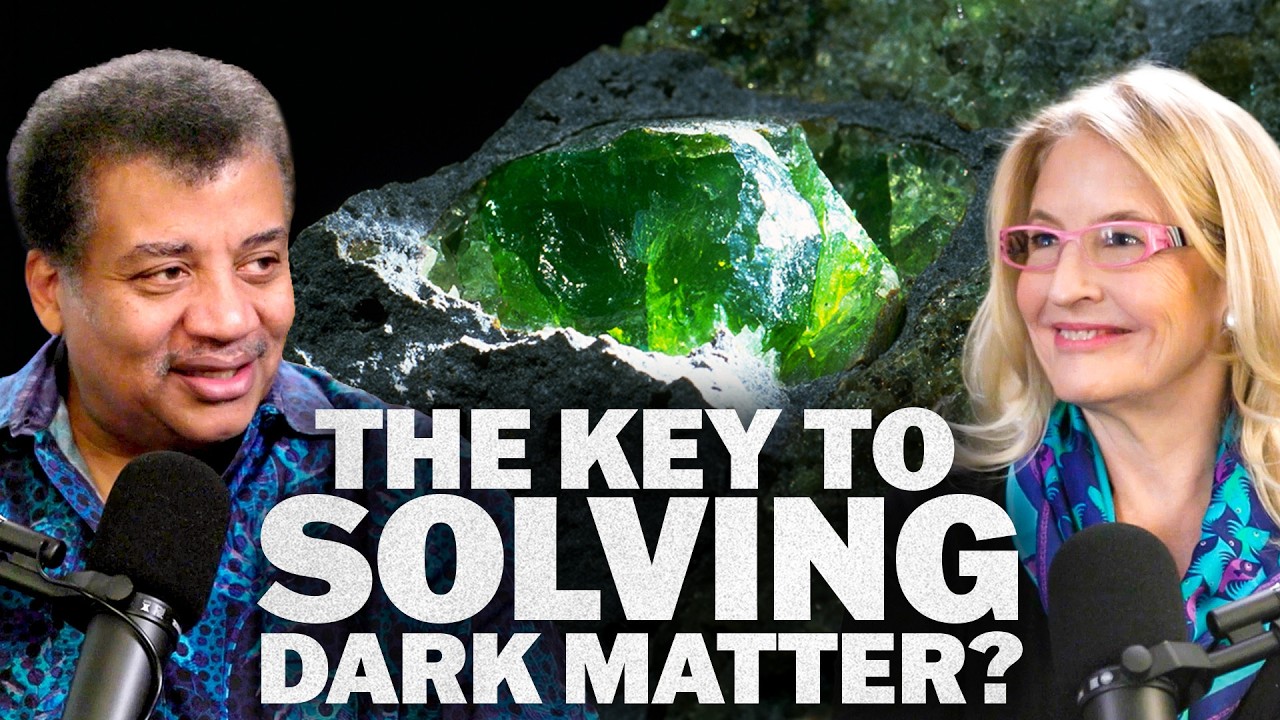
You're telling me that there are protogalactic dark matter galaxies out there? — There were in the early universe and then ordinary matter felt in there. — It wouldn't so much be dark cuz that would imply it absorbed light. But they don't interact with light. They would just be invisible. — Well made of dark matter, right? So — There's nothing to see. — Well, except No, no. If if it doesn't interact with light, — then the dark matter thing itself — will be invisible to you, right? — Ooh, that's cool. Chuck, have you met my dark matter friend? — This is Star Talk. Neil deGrasse Tyson, your personal astrophysicist. This is going to be a cosmic queries edition on cosmology. — There's no end of cosmic queries we can do on cosmology. — I suppose there is not. — This is Chuck Nice right here. — That's right. — Professional comedian, stand-up comedian. There is an end to me. — So, cosmology. — Yes. — So, we're broadening our stable of cosmologists to whom we can reach out. — Yes. — For our queries, — right? — And today we have a second timer. — That's right. — The one and only Katie Freeze. Katie, welcome back. — Yay. — Welcome back to Star Talk. — Thank you. — Last time you were here, I think we talked about the search for dark matter and uh — we did. — We did. because that's cosmology writ large and we just we poked your brain about all manner of things and this is going to be a cosmic queries where we have told our Patreon supporters that you're going to be on — and they they're fans of yours and they've written in or they became fans of yours when they saw your expertise and they wrote in and the questions are here. — Well, thanks a lot. I haven't seen these queries. — Well, neither have I. He's the only one who's seen them. — Yes. So, and I'm the only one who can't answer them. — That may be true. — That is kind of funny. The only people who can't answer them haven't seen it and the one who can't answer it has. — They have. — So, — a couple of times people have asked questions that no one has been able to answer. — Like with the quark one, going into a black hole. — Into a black hole — that we still don't know the deal. — that one. Everybody says Katie knows. We can find out. We should find out. Yeah. But let me get your bio here. Uh director of the Weineberg Institute for Theoretical Physics, UT Austin. That's uh Stevie Wonder. Steven Weinberg. — Yes. Right. — So Steve Weineberg, my hero, one of the founders of the standard model of particle physics. — Yes. — He was the greatest physicist of our time in the opinion of many, including me. His office was three doors down from — He recruited me to UT Austin. Maybe that's why I think he's the greatest. playing this. — That helps. Who gave you the good job, right? Right. But it was only named No, seriously. — He was only named in his death, obviously. — Yeah. He died about 3 years ago. — Yeah. Okay. — And we started the institute in his honor. — And now he's more a hero for me than he is for you. — Why is that? — Cuz he went to my high school. — Oh, — bada bing. — Oh. Bronx Science. — Bron the Bronx High School of Science. Both he and Shelley Glacho. Yeah. — Went were in the same class. — They were classmates. and both shared the Nobel Prize. — Okay, so the moral of the story is when are you getting your Nobel Prize? — Yeah, I didn't mean to set it up that way. That was not So, what else do I have here? And you spent some time at Stockholm University and that's ending coming up very shortly. — 10 years. They gave me a really The Swedish government gave me a $15 million grant over 10 years to do cosmo particle theory and that was so much fun. — Wow. — Oh, wow. — Did you have students too and everything with a budget to go back? I did. Yeah. So, I had uh I had students and I had post-graduate fellows and everybody running up and down the halls having great ideas and having fun. It was awesome. — Wow. — Yeah. — Okay. Cuz in fact, when we last interviewed you, you were like fully up and running with them. And what else? Oh, and I'd love this back now 10 years ago. Uh the cosmic cocktail. — Can you get a better title than that? — Shake it nuts. I don't think three parts dark matter. — Yeah, — that's about right. — That's pretty cool, man. — You know, the amazing thing about that book is that I still give public lectures about it and people are still buying lots of them. In fact, Amazon ran out again. — Whoa. — And that was a book I wrote 10 years ago. So, good for you. — I guess it was a good one. — And you wrote a blurb for it. You said, what did you say? Um, I don't know, three parts dark matter, seven parts memoir or something like that. — Right. because it was folded into your life. — It was. — Yes. Very important feature of that. Thanks for reminding me. It just made it a much more interesting account. — Yeah. — Right. Cool. — Here's another plug for it. — Thank you.
Segment 2 (05:00 - 10:00)
— May Amazon run out of — So, we're going to chat for a bit before we go to Q&A. Catch us up on a couple of things. The James Web, there's been a lot of talk about these early galaxies that it has discovered in a zone of the early universe where you're not supposed to. So wait, you're talking about the James Webb Space Telescope? — Yeah. Not the administrator of NASA during the 1960s. Yes. After whom the telescope was named. — Yes. — You know, he was an accountant. — James Webb? — Yeah. — I didn't one of the rare non-scientists after whom a telescope is named. — An accountant. — I think that's was his main training. — That's pretty wild. — I got to say — I guess he was he important for in NASA. — He was head was the head of HR taken — while we went to the moon. He was head of NASA. — So it was a give a little back to that — look at that — fact because you need good administrators not just good scientists to make stuff happen — when you're in bureaucracy damn good administrator when they start naming stuff after you. — So what's this we hear about paleo detectors? What is that? Is that a thing? — Yeah. — What is that? — Well the paleo part means that they've been around for a billion years. And so these Let me back up. We're trying to figure out what dark matter is made of. Yes. And we think it's some kind of particle we haven't identified yet. — Yes. — And most of the experiments now involve these giant tons and tons of uh liquid xenon. And so the idea is okay instead of having — that's what xenon has some probability of interacting with a dark matter particle. — Yeah. Dark matter particles flying around in the galaxy. And by the way, there would be billions going through your body every second. — Yeah. But it's okay. Only one a month hits you. Oh yeah, I thought I felt tired for a reason. — Wait, wait. You know, there's a lot of elements on the periodic table. Why do you know that xenon might work when we otherwise know nothing about dark matter? — The the way these detectors work is the dark matter comes along, hits one of these xenon atoms, deflects off of it, and the xenon gets some energy deposited in it, and they're able to detect that. So there's you have to have a detector design that works, and with xenon, we know how to do it. — Okay. So it could be any particle that would happen to, but xenon has some other convenient properties. — So the kind of the kind of interactions we're looking for is from the weak force, — very weakly interacting particles, — hence the name — weakly interacting massive particles and uh and there's people need to build detectors that are that they know. You need to know how to build the damn detector. I don't know how to answer this one, Neil. — Um no, no. So let's say differently um a nutrino detector for example that uses vats of liquid uses like some kind of chlorine molecule but not xenon. So where is where are these xenon detectors? — They're deep underground. — Okay. — One of them is underneath the Aenine Mountains outside of Rome. Okay. — You know the Aenine Mountains on the moon — named after those. I was going to say that you've actually said that Italy came after the mountains here. — I the reason why I know them and the reason why they are important is the phase of the moon that's best for telescopic views is half moon. — Okay? — Cuz shadows are the longest and the aenine mountains crosses the half moon divider — the terminator and so aan just pop on a first sighting of the moon. So, so I have a So, to me, the Appani Mountains are on the moon, not in Italy. — All right. Okay. All right. — Well, if you could build something on the moon, that would be even better because the reason you have to go underground is to get away from cosmic rays. — Okay. — Right. — And there's a million cosmic rays for every one of these dark matter particles if you're on the surface of the Earth. So, we go deep underground because the cosmic rays don't make it down there. — But the dark matter particle would. particles would. — Okay. based on what we think dark matter particles would be like. — Well, because they're only weakly interacting. — Okay. — And normal particles — would interact electromagnetically. — If you and I collide, we're not getting very far. — No, that's right. We have we don't pass through each other. — other, — right? — Mhm. — I'll tell you something about xenon makes a hell of a headlight. — Just wanted to contribute something. I don't know. I'll tell you want to hear another something about xenon. What? — There's another thing about xenon. It's become very expensive because the xenon experiments have bought the entire world supply. — Get out. — No, I'm serious. — Wow. I wish I'm serious. — Now you tell us. You should have told us before these experiments started got in on the cornering of the xenon market. — Oh my god, that's true. — Yeah. — Which is why we want to propose an alternative. So instead of these instead of giant detectors, we're going to dig up little rocks from deep underground
Segment 3 (10:00 - 15:00)
and they've been collecting dark matter tracks for a billion years. — So we're replacing volume with time. — Isn't that cool? Hence paleo. — Oh, — okay. Now that is first of all that's very smart. But yeah. — Wait. So how do you know which rock to get or any rock? Oh, well we had to talk to a lot of geologists and you know this was the first a paper with a few theorists when in 2018 and next thing you know — this was so in 2018 that was only a proposal — it was yeah we wrote a bunch of theory papers and not every day does this stuff turn into reality. I've done it twice now you know the underground detectors I wrote papers that got that going and now with paleo detectors that's actually becoming an major experimental effort. Isn't that cool? — And it's a cool t name for a detector too. — Yeah. So they tell you which rocks would best respond to this, right? — Yes. And the answer is olivine. — Oh, — I know. Olivine. — You do? — Yes. — Okay. — There's a class of meteorite called palites — where Oh my gosh. You So where do you get a meteorite from? It's a smashed whatever it used to be. Right. Okay. So if it's a protolanet it meant it partially as the geologists would say differentiated because at some point in its formation the heavy stuff would fall to the middle the lighter stuff would float to the top. Okay. — If however it cools before it fully segregates then the metallic inards can trap olivine crystals. — Oh wow. within it as they were slowly bubbling their way up to the top. — And so a slice of these meteorites rear lit if it's thin enough the thickness of an alivan crystal. You see the metallic meteorite and these green crystals glowing through. And we have a sample of one in our whole of the universe. — It's called a palace. — Oh, I got to see this. — I I'll take you down right after this. So, so in other words, it's rare because the boundary layer between the dense middle of a protolanet and the lighter things that float up is very thin. — Mhm. — And so when you smash the whole thing, you have a lot of rocky stuff, less metallic stuff, and even less at the boundary layer. — So, — well, can we borrow your olivine to look for dark matter tracks? — I You got to know somebody. — Okay. — somebody who works here. Thought I did. — Yeah. No, we can totally explore them. That could be the key — sitting under our noses, but it's been here for 25 years. — Well, then it's been collecting cosmic ray tracks. — Yeah. No, we didn't have it. — Sad. — Yeah. Do you guys have any like deep under the earth here? Like is there a secret? — But it still has to get through the building. — We want to know about the subbase. It — still has to get through the building though. The cosmic rays have to get through the building. — Yeah. I will — that'll block some of them, right? — Nah. — All right. So, congratulations on this that this is now a burgeoning next — next step in this. — So, why a billion years and not 100 million or 50 million? Does it matter? — Well, we have to go deep enough to get away from cosmic rays. And that's actually like 5 kilometers. — Oh, that's deep. — That's deep. And then the other idea is if we get rocks from different ages, we are also can study nutrinos because nutrinos will also leave tracks. The tracks will be different. Okay. So you can tell the difference, but then you can figure out how many supernova went off in the galaxy at if you look in the past a different amount of time. Isn't that cool? — Wow man. — And that is because the supernova that's where the nutrinos come from. — Copious. — Oh, I forgot to say that. Yeah. Nutrinos give off a lot OF SUPERNOVA. NO. NO, NO. SUPERNOVA nutrinos and so you which supernova which are dying exploding stars and you can look for the nutrinos from the supernovi. — Right. Cool man. — And nutrinos are once again your weekly inter interacting. — Yeah. They're also weekly interacting particles. Yeah. — Most unfortunate. — Now the other thing you can do with — weekly interact matching particles. Yeah. Okay. — Well, we know who named him that. — Who named him? I forgot. — Uh Mike Turner. Is that right? — Ike Turner physician. — That would have made sense if you said I Turner. — Whoa. — The word autonomous comes to mind. — T-Mobile 5G home internet has some big news you should know about. They now have the fastest 5G home internet according to the experts at UCLA speed test. Now, in practical terms, it means photo backups happen faster. Streaming a documentary doesn't stall halfway through. The physics of waiting reduced. What's also notable is that this jump in speed doesn't come with added complexity. Setup is simple. You plug it in and you're online in less than 15 minutes. And the value side of the equation holds up too with a plan
Segment 4 (15:00 - 20:00)
price that's backed by a 5year price guarantee. So if you want the fastest 5G home internet with a simple setup and savings that stick, get T-Mobile 5G home internet, just visit t-mobile. com/home internet to check availability today. Price guarantee exclusions like taxes and fees apply. fastest based on UCLA speed test intelligence data second half 2025. All rights reserved. — So I got one more question before we go to Q&A. Some of the results of the James Webb Space Telescope and other sources suggest that we cannot reconcile the age we have derived for the universe by these different methods. One of them is from the CMBB cosmic microwave background. Others is from galaxies at other times. And it has been suggested that you can reconcile them if dark energy changes over time. — The biggest en the biggest evidence for dark energy changing over time comes from a different experiment, the Desi experiment. — Okay. — And what they're looking at — Lucy and Desi — dark matter, you got some explainer to do. — Oh, that's good. That was good. But Desi, so other than Lucy and Desi, what does Desi stand for astrophysically? — The dark energy spectroscopic instrument. — Okay. All right. Clean and simple. — And what does that tell us? — What they're looking at is based on some physics from the early universe. And there were waves which froze out at the same time the cosmic microwave background was produced. So that's 400,000 years after the Big Bang, which is like I don't know a thousandth of a percent of the age of the universe today. And what those waves did was leave an imprint that throughout the rest of time, galaxies form in these spheres left over from those waves. And so as time goes on, you look at how big are those spheres and that tells you about the expansion of the universe. — Yes. — And what they're saying is — because spheres would grow with the universe. — Yeah. Yes. — Yeah. And so the by studying that you can figure out is the expansion what the expansion is doing is it accelerating what is it doing and what they claim is that the dark energy which everybody the vanilla model is that it doesn't change in time but it definitely affects the overall expansion of the universe no matter what it's causing the acceleration. So we think and what they're claiming is that that the acceleration is slowing down. Oh, — so it's a decrease in the dark energy contribution to the universe. So now can I put it in a plug for my own work because — please — we look so my collaborator Yun Wang and I so we looked at the same data and we looked at it differently with a simpler way of interpreting the data and we do not find that evidence to be very strong actually. So I don't think it's happening but big picture there's a big debate. Is it real? Is the dark energy changing with time or not? Is it time varying or not? And different people have different opinions. — If you found a simpler way to look at it where the effect goes away. Yep. — And we were betting on the likelihood of one truth or another. I'm betting with a simpler explanation. — Thank you. — Mhm. — Well, me too, obviously. — That I mean that taps AAM's razor, you Well, from the data, we're directly extracting — the dark energy density, the amount of dark energy instead of going through a — secondary — a secondary thing which is called the uh dark energy equation of state. So, we're doing it more directly. So, that's why I like what we're doing better. — So, you know about a razor you — uh if let me just think um removing all other considerations, the simplest answer is the most likely. — That's a modern interpretation. What he actually said was, — "Go ahead. — Multiplicity ought not be posited without necessity. " — Oh, wow. — Damn. — So, AAM named for William of Akam. He goes way back. — Okay. — Yeah. Like 700 years. — Wow. — But so, so he had some insights into nature that persist to this day. William of AAM. — Sure enough. He knows how to turn a phrase, that's for sure. — So, so I'm betting on Katie on this one. Definitely. So, but let me exit this before we get to the questions with a related question. — Okay. — You said the vanilla version of dark energy is that it does not change over time. — Yeah. — That's how it appears in Einstein's general relativity. Yeah. — It is a constant. — Yeah. — If cosmological constant, — right? If you want to start making that not constant, then it's no longer Einstein's general theory of relativity. It's some modification to it. — No, it doesn't. How does he accommodate? How can his formulation of general
Segment 5 (20:00 - 25:00)
relativity accommodate a cosmological constant that's not constant? — I just want to say about dark energy, it is a complete mystery to all of us. We have no idea what's going on to be honest. Okay, we could call it gobbledegook. — I've already named it dark matter and dark energy or Fred and Wilma. — Okay, — because it doesn't have any bias at all. They're just two words. Well, I don't know because we know dark matter exists. I'm not so sure about dark energy. I want Wilman to exist. But anyway, — but so dark energy, there's two possibilities. One is, as you said, you have to modify Einstein's equations, — and that feels wrong to me. — Well, you know, I actually had an idea for how to do that in two 2002, but let's not go there. I want to talk about the other way, which is we stick with Einstein. — In 2002, you had a way to modify Einstein's general theory of relativity. Well, more specifically the evolution equation for the universe. — Yeah. — The Freriedman What I we had been working in extra dimensions. If you have string theory — as one would do. — Yeah. As one would do because — As one does. So in string theory you have to have 10 spatial dimensions instead of the XYZ the normal ones that we usually work with. And if you do that, it's possible that well, our universe is a three-dimensional surface in there and there could be another one and the stuff in between which we call the bulk is pulling on our surface and causing the equations to change. — Oh, interesting. — So, okay. So, so the equations would be sound within the universe left to its own devices but influenced outside of it. You got to give it some slack. — Yeah, you do. You got to add these other terms into the equations which describe the evolution of our three-dimensional universe. — She just called our universe a slice. — I did. Yeah, — I believe that. — It's kind of an interesting slice. I like it. — Yeah, it's a dimensional slice. — that's a dig if I ever heard one. — I don't know. Like during my Iaska trip, I met some beings that told me that there were dimensions alongside of our dimension, like more than we could ever know. Dimension. dimension and that there were dimensions above and dimensions below. I don't want anyway I don't even know why I said this. Let's but yeah — but you know what they're called in uh in physics? They're called brains. B R A N E. — Okay. — Which is short for membrane. — Membrane. Short for me. Just like Yeah. — So they're like thin little dividers. — So the question you're asking, do some other of these brains contain B R A I N? — Mhm. Ooh. — And we don't know — because we know ours does, — right? I mean — I think so. — We say if you want to call it that — we use the term loosely in our dimension. — So on the can I tell you what I called this theory? — What — I called it Kardashian cosmology and the reason is that Lisa Randall was going on about the warp factor which I thought — another physicist up at Harvard. — Oh yeah. She's great. And so she was talking about the warp factor in her theory and I thought they came from Star Trek but actually it's just a relativity term that I had heard called something else. And so I thought well I'm going to go to Star Trek. So I went for the Kardashians. So I called it Kardashian expansion because everything would be made of ordinary matter ordinary radiation ordinary stuff. No weird dark energy but the equations would be different. And so like the Kardashians, they are they weird looking, but they're made of the same, but they're too biped like we are. And their goal is accelerated expansion of their evil empire. — Correct. That's right. They're quite draconian and their whole purpose is to take over everything. — Yeah. — Well, Kardashian. — Yeah. The Kardashians. Yeah. — Yeah. Well, — all right. So, you got questions for — We got Let's get to it. Let's jump right in. These are directly for uh — And you haven't seen these questions? I No, that's not fair. — Why would you know? That's the whole thing here. All right. — Well, this first question is from Anthropoc Dylan who basically says, "Hey. " Yeah. He says, "How do dark stars work? What would they be like to visit? And how do they impact extra solar systems and potentially astrobiology? " So, he's just he wants you to just answer everything. — Answer it all. — Let me prepend that. Go ahead. In was it the 1800s or late 1700s there was a calculation done by a physicist who said to himself the gravity on a star uh is whatever it is but if the star shrinks the surface gravity goes up there'll be a point where the surface gravity prevents light from escaping and the star will disappear from the universe. — In other words what we call now black holes. — Exactly. So it was like the first attempt at thinking about what we now
Segment 6 (25:00 - 30:00)
would call a black hole. But so that technically would be a dark star. But I don't think that's what this question is about. I think they're asking if matter can make planets. Can dark matter make planets? — No. I mean, I think he's asking about my work on dark stars. — Oh, — and dark stars are not made of dark matter. They're the first stars that form and they would be made of ordinary stuff. Ordinary hydrogen, ordinary helium almost entirely. But they're powered by the dark matter that's inside them. But doesn't So it's ordinary matter powered by dark matter. — This is one of your early papers. — It's in instead of by there's no fusion. It's dark matter power. — Wow. — Yeah. — That's some crazy — these things if they exist these things. I'm so excited because we have candidates for them in the James Web Space Telescope. I'm so excited. They would start out at about the same mass as the sun, but then they would grow until they become a million times as massive as the sun and a billion times as bright. — They grow because they're absorbing dark matter. No, because they're absorbing ordinary matter. Normal stars can't keep growing because their surfaces are hot. You know, they have fusion. Fusion's hot, — right? — And then so they blow stuff off. But dark stars are cool. Oh, in radius, they're 10 times the distance between the Earth and the sun. — So they're huge. — They're huge and they're cool, which means they can keep accreing matter. They grow, grow, and they get really, really big. — So there's no pressure on the outer surface to prevent new matter from accreting to it. — Yeah. Exactly. Exactly right. Yeah. So they can get really big. And we have candidates in the James Web Space Telescope for some of those really early objects that are super bright and they don't know how to explain them. Well, we'll take them. — You'll take them. — Whoa. — Yeah. I'm excited. — When you win your Nobel Prize, will you come back and on our show? — WAS THAT A KISS OFF? — NO. — OKAY. DID YOU read the body language there? That was a very like No, he's still learning social cues. Oh, I meant the opposite. — Okay, cool. Yeah. No, — I'll tell you this much. Once you He's right. That is Nobel Stuff right there, man. That's fantastic. — But so the — you know the thing about Astro about my field is that you can have a great idea and you know, let me back up. Usually when you have a great idea, you kill it in 10 minutes because it violates some observation. Occasionally it not only survives those first 10 minutes, but then people start telling you, "Did you know you solved this problem? Did that problem? And that's what's going on here. We keep solving problems. — So, dark stars could explain a lot of things. They could explain once they die the super massive black holes that you see in the early universe. They could explain the blue monsters. And little red dots. And I figured you'd like those terms. — Wow. — Yeah. — These all they're very bluntly descriptive of stuff we see in the early universe cuz there's nothing nearby that we have a counterpart to. There's a red dot. It's a red dot. — Okay. That's what we call dark. Now, what about the blue monster? And where did you get that reference? — Blue monsters are really, really bright objects way early in the history of the universe. — Yeah. It should be like the formation of galaxies. I mean, we know they're blue. They don't look blue. They look very infrared because that blue has been redshifted to the sweet spot of the James Webb telescope. — Yeah. — But yeah, that's very cool. — Mhm. — All right. Okay. Well, hey, what a great question. Anthropog. — So, she said she's coming back after her Nobel Prize. — Absolutely. Now, here's the best question. Can I wear your Nobel Prize when you come back? — So, here's the best line related to that. It was from Hoop Dreams. Do you know the line? — I don't know. I don't know the movie. — You know this line? You know the movie? — I don't think I know Poop Dreams. Go ahead, — dude. It's a documentary. — You don't know Hoop Dreams? — I do not know Hoop Your Dreams, but Go ahead. — Yeah. It's a documentary of following high school students, some who have ambitions to play in the NBA. — Oh, okay. — Okay. And the social dynamic that surrounds it. documentary, but here's the line. When you're rich and famous, will you remember us? — Mhm. — As one of them goes off, — and he says, "If I'm not rich and famous, will you remember me? " — Oh, that's good. — That's really good. — I tell you, the answer to both those questions is — ouch. — No. — The answer no. — And to both. All right, let's move on. This is Nate. And Nate says, "Hello, Dr. Tyson, Dr. Freeze, and Lord Nice. " Uh, this is Nate from Southern Idaho. If dark energy has gravitational effects on everything just like regular matter does, why does it not coalesce and push away from itself? This seems counterintuitive considering the fundamental nature of gravity is to pull things together by bending spaceime. Does dark energy abide by its own rules where it can cause gravity, but it isn't affected by it? This would imply that it is not influenced by the curvature of spaceime in which it causes. This guy did some thinking here
Segment 7 (30:00 - 35:00)
— freaking Nate, bro. — Whoa, — dude. — Whoa. So, let's start from scratch. — Yeah, — we're calling it dark energy — because it's a placeholder term. We don't know what the hell it is, right? — But if it's energy at all, then it has a mass equivalent and it should have gravity. So, does dark energy have gravity? — The definition of matter is that it feels gravitational attraction. — So, that's true. For ordinary matter, that would be you and me and you. — I was going to say, thanks. He's not — He's not ordinary matter. And it would be dark matter. So, all of that stuff clumps together is attracted together. — But and energy contains a matter equivalent. — No. You know, for ordinary matter and energy that is true, but for dark energy, it is completely different from matter. It is something that's causing a repulsive behavior. It's pushing things apart from one. — That's why we should call it just Wilma. Something that doesn't have the word energy in it. — Yeah. So, it's not so it's confusing because matter and energy in the ordinary world are related, but dark matter and dark energy are probably not. — Okay. So the foundation of this question is not valid because the it's assuming that it's participating in the curvature of spaceime. And if it's helping to make it, why isn't it responding to it? Why is it spreading things out rather than pulling things in? — Well, I mean, it does fit into Einstein's theory of general relativity. It's just that if you have this vacuum energy, it causes repulsion rather than attraction. It causes acceleration. So it's a completely different type of — Yeah, but that we calculated with that and you're off — by like — Oh, 10 to the 120 — power — in the Yeah. In the exponent. Yeah. Well, I'm not saying we understand it. can calculate it. — That's funny. Isn't that the biggest mismatch between a theory and a calculation ever? — Yeah. It's really It's just unbelievable. Vacuum energy. What does that mean? Well, what it means Oh, by the way, there's vacuum energy in this room that you could measure. There are particle ant it doesn't mean there's nothing. It means particle antiparticle pairs that pop into existence. Yes. They last infinite decimal amount of time and then they disappear again. But that serves as an energy. — Mhm. — And it has been measured. There's been two plates that are — It's not the the casemir effect. — Yes. The Casmir effect. — It's the Casemir effect. Absolutely. — This is where two in a vacuum two parallel plates you bring them very close together and there's a point where — they just attract. Right. They just yep, yep. It's the same vacuum. The same exactly the same thing. — That's uh that's pretty wild. — But if you do the mathematical calculation, your answer is too big by 10 to the 120 in the exponent. So if you add up all the contributions from all those particles, it gets the wrong answer. And that's considered one of the biggest — it gets the very wrong answer. Yeah. — One of the deepest unsolved problems in all of physics. — All right. — Wow. — And it get but it gets worse. People thought, well, yeah, look, somehow somebody will figure out how to bring that number down to zero and we'll be good. No, all of a sudden it looks like there's a small amount left over. Well, it's it's not that small for our universe, but compared to 10 to the 120, there's dark energy, which means there is some vacuum left over that's driving acceleration, it's neither the big answer, nor is it zero. It's somewhere in between. What the heck? — All right. I'm talking too much. — no, we love it. — That's the whole point of why you're on it. — Exactly. Yeah. — Oh, wow. — If you're talking a lot, it means I have less to add. — Oh, — so it is — your words and ideas and brilliance are gracing the stage. — You're a real expert. — All right. On some things. — Nope. That's lame. Mhm. Ready? Do you harbor questions about the universe? Some longheld bit of cosmic curiosity lingering within you or questions about anything at all? You can become a Patreon supporter of Star Talk. You have access to our exclusive question line on our website. Those are where we draw our questions for our cosmic — some of the most extreme objects in the universe. Star Talk is a work in progress where we every month come up with some new way, some new idea, some new understanding of how to bring the universe down to earth and we could not do that without your support. Thank you and as always keep looking up. All right, let's go to uh Sumit Sharma who says, "Hello, Dr. Tyson, Dr. Freeze Lord. " Nice. This is Sumit from Delhi. I am a new member here. Okay. Patreon member and welcome. Well, go ahead. You do it. — Welcome to the universe. — There you go. You got an official welcome there in — my cosmos voice. — That's right. I want to know where does
Segment 8 (35:00 - 40:00)
the scientific consensus stand on WIMP as an alternative hypothesis to dark matter today. I don't understand that. But anyway, I don't understand. — Wimp is the abbreviation. We can — interacting mass particles. — It's a candidate for the dark matter. — Oh, okay. But it can't be a substitute. But anyway, — no, it is a type of dark matter. — It's a type, right? That's what that's a type of dark matter. Also, since dark matter is invisible and hard to detect directly and what indirectly what indirect properties or effects of dark matter are scientists currently studying and by what methods? I love that. Like, yeah. So, what's the deal? It doesn't interact with anything. How are you guys measuring it? How are you figuring out anything about it? — You know, the thing about dark matter is we've got about 20 different candidate particles that it could be. — Okay. Some of them are well motivated and some are not as much. So my favorite three would be wimps, axons and primordial black holes. — Okay. — So wimps the weakly interacting massive particles they do have an interaction which is the weak interaction the weak force. — Okay. — And a axons what they do is that they can actually in the presence of a magnetic field they turn into photons into light. So they can switch axon, photon, axion, photon and then you can detect that light. Now primordial black holes, they would be black holes that formed very early in the history of the universe. — They don't evaporate right away. — The some of them do. So they have to be bigger than that the smallest ones do. — Mhm. — But there would be some left over and they form wherever there's some region of the universe that has more an excess of stuff in it and over density that collapses into a black hole. And that for example could be at some phase transition in the early universe. This is like when water boils it switches from liquid to gas. And that's where you get these fluctuations and boom you would make primordial black holes. And the reason people care nowadays is because gravitational wave detectors are seeing merging black holes and some of those could be primordial black holes. — So people got all excited about primordial black holes again. — Okay. As far as wimps go, there's Oh, you can either to find them, you can make it, shake it, or break it. — Right on. Go ahead. Do your thing. — Shake what your mama gave me. — We're not doing the Let's talk about the make it. — Shake it or break it. — Yeah. Make it. So, the make it is in particle accelerators such as the large add-on collider at CERN. You shoot really rapidly moving protons into each other moving nearly at the speed of light and out come potentially dark matter particles like wimps and you look for them that way. No discovery yet. Okay. — So it would have a signature you that you couldn't otherwise identify and you would ascribe it to dark matter. — Yeah. — Because you otherwise know what you're supposed to get out of it, — right? — Yeah. If it's ordinary stuff then you know what to expect. But if you're making some kind of new particles, then they might ex escape from the detector without and you you'd see that as missing energy. — Okay. — You'd add up all the energy of all the particles coming out. — Right. Right. Right on. Right. Okay. There you go. — And do you want to hear about the shake it? — Yes. — And break. I mean, yeah. — Now, we got to make it. We can't you can't leave without shaking it and breaking it. — All right. Okay. So, the shake it is you've got your detector deep underground — and the particle comes along, hits your detector, gives it a little bit of energy, and you look for that energy deposit. So, it's shaking that nucleus. — It's like a little vibration. — Exactly. In some cases, that's exactly what they're looking for in some cases. — Gotcha. — Or some light that comes off or whatever. So, that's what they're doing. — Okay. — And then the break it. That's called indirect detection. And that's when well dark matter particles these wimps can be their own antimatter and that means when they hit each other they annihilate and turn into something else. And what you got to do is measure that something else. So people are looking for nutrinos. You know where they look where those detectors are underneath the ice at the South Pole. — That's Ice Cube. — Yep. Two miles. — Straight out of Compton. I mean straight out of South Pole. — That's good. That's good. Yeah, — cuz Ice Cube was in Straight Out of Compton. Yes, he was. The actor. Yes. — Yeah. Yeah, that's good. — The rapper. — We like that. Yeah. — All right. Yeah, that was great. That was what a great question Sue made for your first time asking anything here on Star Talk. And what a From Old Delhi. — From Old Delhi. Make it, shake it, or break it. Just remember that. All right. This is Chris Hampton. He says, "Uh, dear Lord, nice or barren. " — Christopher Hampton that was a — is a playwright. — Really? Okay. I'm not familiar with him. — Yes. Oh, — very cool.
Segment 9 (40:00 - 45:00)
— Is it a living playright? — I think so. — Okay. So, it could be him. — Mhm. — Okay. Treat him nice. — There you go. He says, "Dear Lord, nice or Baron. " No, actually, you dubbed Paul Mccurial Baron. So, he I It's just Which, by the way, I found out they're kind of the same, the titles, which, you know, we're going to have to demote Paul. Um, — I'm joking. I love him. Uh, could dark energy be caused by a constant inflow of space-time itself, perhaps through black holes from a parent universe? In other words, we're bringing more in than there is flowing out like a Britta flat iron system. Okay. — Oh, wow. — Yeah. — Not sure how to answer that one. — Britta flat iron system. — Yeah. What the heck is that? — I don't know what a brida flat iron system is. I have a Br at home. I put water in it — and it flows through and then I drink it. But um — I mean you know what Einstein had to do to get a static universe? He had to have material somehow bubbling into our universe and appearing out of nowhere on a regular basis. So that is not an insane idea. People have thought about that. — He knew you know what Isaac Newton's solution to that was? — Go ahead. — It was if the universe were just finite then all the galaxies would collapse to each other. — Okay. He didn't think of the universe as expanding. But — he said the only way out of this is if the universe is infinite. — Infinite, right? — Then you can't favor one point or another. — Oh, really? Newton said that? — Yes. — Wow. Yes. — Smart guy. — Damn. — That's why he's sitting right over there on my desk. — Did he know the Oh, but that's cuz he didn't know the universe was expanding, right? — No, no. No, no. That was 1929 that the thing that I — expanding universe did not like it. — Yeah. Expanding universe was too weird for everybody. What did Einstein say? Something about God or playing — He's always talking about God. — That was quantum mechanics. — That was quantum. God playing dice, but the expanding universe. Yeah. — He didn't like the quantum mechanics. expanding universe. Isn't that interesting that which a lot of this is? — These are fields of physics that he started crumbs that fell off his plate. — From the stuff that he was just like the Nobel Prize is given to crumbs that fell off his plate. — Well, I don't know what the hell this is, but whatever. Let's move on. That's him. — Wow. That's amazing. That's pretty wild. All right. But when he says a constant inflow of spaceime itself, — no. — I don't that doesn't make any sense to me. So, I'm going to just say no. — So spaceime can't come from another brain, — right? — Spacetime wouldn't would to me wouldn't include all of that stuff. — Gotcha. — We're all living in within space. So — I'm a little uncomfortable with that notion. — Okay. Listen, I'll accept that because we are all living in spaceime. So, you know, that's pretty simple to accept. Greetings, STEM nerds. Mike from Thanks for the Compliment. — Yeah, there you go, buddy. Uh, Mike from Colorado here. Since the time of Edwin Hubble, we look at distant galaxies and calculate their speed based on the red shift we measure, which we attribute to the Doppler effect. However, we also know that photons lose energy when traveling out of the gravitational field, which also exhibits as a red shift. Given that dark matter accounts for some 80% of the gravitation in the universe, how do we know how much red shift is due to the Doppler effect and how much is due to gravitation? Is it possible that the speeds we calculate for distant galaxies are just an upper bound on their actual speeds? Well, there are on the average galaxies are moving apart from one another. That's the Hubble expansion. M — that causes light between some distant past and us now to stretch. The wavelength of light stretches, — right? — However, there's no question when you go, for example, some of that light if it goes through a galaxy on the way here or goes through a cluster of galaxies, that also changes its wavelength. — And in fact, we use that to figure out where a cluster is or what a cluster is doing. So, it's useful information. And we're very aware that you have both effects going on at the same time. — So our if you're inside our galaxy like in this room, we're not feeling the expansion. We're not feeling it. But — because I'm feeling it. — Yeah. You're feeling it. — Uh so this reminds me of what they used to call the tired light model. — Okay. — The light just too tired, — right? — Come through. — I don't been through a lot, y'all. I'm telling you. Traveling between these galaxies. Y'all don't know this is Lord. It's killing me, man. Killing me. — Such tired light because it, you know, — I don't even have mass. I feel so damn heavy. — Oh, y'all don't know. — So, — okay. — Very funny. — So, tire would be reened, — right? — Okay. It would be reened. However, uh
Segment 10 (45:00 - 50:00)
there's also spectral features of elements within the spectrum. So you could take regular light and it would reen. But if it's the expanding universe — Mhm. — and it's Doppler shifted, the lines would shift. — Yeah. — They would shift and nothing to do with red or anything. They would just shift. — And they shift. — Yeah. They sure do. — They sure do. And so you can still have tired light, but you can't blame that redness on the expanding universe. — Very cool. That's a good answer. — And if we animate Star Talk, you will be the voice of the photon. — I don't had a hug. — Wait, now who's going to be the wimp? — Oh, and then of course before that there were the machos. — Oh, that's right. massive compact object, right? — So for a while we had machos. — Macho and wimp. — Yeah, we did. — Just show that men were naming things. — Yeah. Right. Yeah. — And the experiments looking for machos. Ogle. — Augle. Yeah. — Aeros. Augle. Aeros and macho. — Yeah. — Okay. — Augle. Optical gravitational lens experiment. — Okay. — And — Aeros. E R O S. — What did that stand for? — I don't know. The god. the god of love like Cupid. — Yeah. Yeah. — It's the only one I like. — What's wrong with Venus? — Well, first you augle and that causes arrows. — We got time for one last question if you can answer it fast. Okay, go. — Okay, here we go. Uh, this is Brian Wheeling. — It's a test of you. — Brian Wheelen says, "Hello, Dr. Tyson Freeze and Lord Nice. Captain Ben from Sag Harbor here. Reaching Alf 30,000 35,000 ft in route home. " Oh, he's he's actually in the cockpit sending us this message. — Oh, cuz he's captain. — He's captain. Wait, should you be flying a plane? — Well, no. At 35,000 ft, the plane flies itself time. — Uh, he goes, "Still. " — Yeah. Still. Yeah. This doesn't inspire confidence. Okay. — That's all we're saying. — Okay. All right. I'd rather you be drinking. — All right. — Drinking. We're still paying attention. — Exactly. He says, "Listen, I've been wondering, does dark matter coalesce and condense similarly to regular matter? And if not, why not? It doesn't interact electromagnetically, but would gravity do something similar? " Sending this message also on my birthday. Happy birthday, Captain Wheeling. — Captain Wheeling. So, that has some overlap with the previous question, but let me tune that a little better. All right. If it interacts weekly, that's still an interaction. — Mhm. So why doesn't it just make weak planets instead of regular planets? — Well, I'm going to answer I'm going to say something else first, which is that without dark matter, we wouldn't exist. It had to collapse and clump and make proto galaxies before ordinary matter could do it. And then ordinary ma matter falls into — You're telling me that there protogalactic dark matter galaxies out there? — There were in the early universe and then ordinary matter fell in there. But is it possible there are some purely dark galaxies that don't have any stars in them? Yes. And people are looking for that for sure. — Wow. — Isn't that cool? — Wait, wait. Okay. Yes. Is — very cool. So, wouldn't it wouldn't so much be dark because that would imply it absorbed light, but they don't interact with light. They would just be invisible. — Well, made of dark matter, right? So, — There's nothing to see. — Well, except — No, no. If it if if it doesn't interact with light, right, — then light just passes through rendering them transparent. — No, because of Einstein's lensing, gravitational lensing. — Oh, you see the lensing effects. — You see distant galaxies, the light from behind the dark galaxies will get bent. — Okay. So, it gets bent. — But the galaxy itself or the dark matter thing itself — would be invisible to you, right? — You could just walk through it and you wouldn't even know. — Yes. That's cool. — There's some serious science fiction material there. — There is. — Yes. — Interesting. I love it. — Chuck, have you met my dark matter friend? — Oh, well, he looks like a black rabbit. — What's a black rabbit? — Harvey the rabbit. — There you go. Oh, — Harvey was a white rabbit. He's dark matter. He's a black rabbit. — Oh, sorry. Okay. — I just went too far too fast. I This is what happens. — Well, Katie, thanks for joining us again. — Thank you. That was fun. That was really fun. Another great show. — Now, if I remember correctly, you have kin in the city. So, you get — my boy. My son. — Your son. So, you get through town every now and then. — I do all the time. — We will nab you 100% of the time. — I have a rent stabilized apartment. I just signed a two-year lease, so I'll be here. — Whoa. All right. — Whoa. Yeah. — Okay. We will. Every time you come back here, you coming right. You're going to
Segment 11 (50:00 - 51:00)
sit right there. — And actually, those queries were fun. — See, even though you hadn't heard or seen them before. — That's right. We're good. — All right. Good. Well, the audience knows you now, so believe me, they got a lot more questions for you. — Sounds great. And you guys are so much fun. — Oh, well, thank you. Yeah. — Well, there. Give me a fist bump on that. All right. — We'll take it. — This has been another Star Talk Cosmic Queries, a cosmology edition. I'm loving these. — Nice. — And how many cosmologists we got? We got Janna. We got Brian — Jan 11, just so you know, was my first graduate student. — Whoa. Yeah. — Very cool. Look at that. — Okay. And we have the two Brian. — We have Brian Cox and Brian Green. That's What more do you need? We got — We got Chuck Lou, too. — Oh, Charles, I not deep cosmology. He's extragalactic guy. — Extragalactic. — Yeah. Yeah. — All right. — We got enough. — Yes. Enough. Definitely. — Anybody else out there? Come on. — All right. We got to call it quits there. Chuck, always good to have you. — Always a pleasure. — Katie, you're going to be a regular from now on. — That sounds great. — All right, love it. — You got it. Neil deGrasse Tyson, your personal astrophysicist, as always, bidding you to keep looking up.