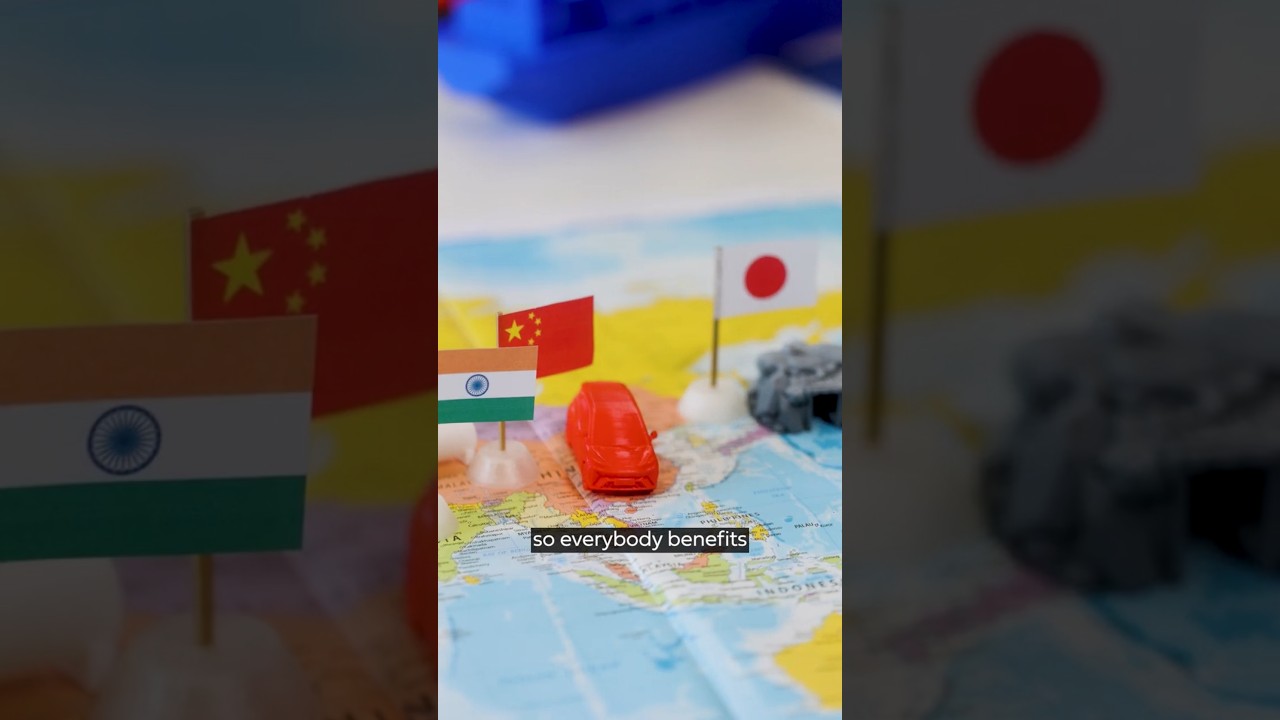
Here's an interesting stat for you. From 2015 to 2024, over 93% of the growth in global carbon emissions came from just two places. The power grids of India and China, which makes sense, right? There's almost 3 billion people between those two countries. They're nearly a third of the world's population, and they're both rapidly industrializing and historically have industrialized using fossil fuels, notably coal. And if you plot China and India's emissions on a graph and compare them to other continents, you can see that well in North America emissions have been in structural decline for about two decades. In Europe about the same, in South America they're much lower, but they're also declining. And in Oceanania, they're basically flatlining. Overall, emissions are mostly coming from Asia, but also emissions growth is primarily coming from Asia. Not just Asia. In Africa, emissions are also slightly increasing, but they're starting from a much lower baseline. And in countries other than India and China, there's also emissions growth. But the way that these two countries industrialize and develop their economies this century will overwhelmingly determine the emissions trajectory that we go on. And of the two, China is definitely further ahead in its development. Like they have a larger economy. One way that you could measure that would be the gross domestic product. So the total value of all the goods and services produced in the country. You could even scale it if you like by the purchasing power parity. So accounting for the fact that different goods cost different amounts in different places. And whether you're comparing the total GDP of the country or dividing that by the population to give you the GDP per capita, India is definitely not as far along the development curve as China is. And when you bear that in mind, looking at China's trajectory on this graph is quite scary. Like for the past 20 years or so, their emissions have just skyrocketed. But bear in mind, this chart only goes up to 2024, which is significant because Carbon Brief just released their report that shows that China's emissions have been flatlining or decreasing for close to 2 years now. And I'll leave a link to this article down below, but basically there's a complicated picture when it comes to China's emissions, but across most sectors, emissions are down. I mean, in this chart, for example, you can see that in cement, they've been in structural decline for quite a while now. In transport, you're seeing emissions start to decrease because electric vehicles now making up a larger and larger share. Most vehicles sold in China last year were EVs. But connected to those two points and more importantly, China has been rolling out a colossal amount of renewables, solar and wind, representing half or more than half actually of all the world's deployment of renewables. And they've deployed so many that even though electricity demand has increased, the amount of generation from renewables has increased even more, which has displaced some fossil generation. So you can see in this chart that coal use for electricity generation has resulted in a big reduction in emissions. Though this isn't the case across all sectors, notably from the chemicals industry, there's been a large increase in emissions from both oil and coal use, which I didn't know was a thing. I'll leave a link again. Check out the article below. But the net result is that China's emissions have probably peaked. Experts at Carbon Brief and elsewhere are pretty confident that their emissions are now in systemic decline. And to be clear, that's really good news. Emissions peaking is good. It's not good enough. Like, we don't win by peaking emissions. We win by bringing emissions down to well, net zero. And unfortunately, while they have peaked, they peaked at a very high level. Though last year, for the first time, we did hear that China is now targeting an absolute emissions reduction. Previously, policy said they were targeting an emissions intensity reduction. So that intensity refers to the amount of CO2 you put into the atmosphere for every unit of GDP that's generated. And in the past 5 years, that's actually decreased by 12%, which is admittedly less than they targeted, but still a pretty significant reduction. In fact, hang on. In fact, a quick Google has just brought me to the carbon brief China country profile page, which again I'll link below because there's tons of interesting stuff here. And what this was saying was that from 2005 to 2010, China's CO2 intensity reduced by 48. 4%. I feel like more people should know that. That's amazing. And in March, we're going to see the next 5-year plan from China. This is the big planning document which will hopefully contain more details about how they're going to reach those emissions reductions. couldn't even guess about what's going to be in there, but whatever it is, it's going to be very significant. But again, just to restate, China's emissions have peaked, but have peaked at a very high level. And the reason for that is they built out their economy on fossil fuels and specifically decades of coal. Which raises the question of what about India? Is India going to follow the same trajectory that China did with this explosive growth in its economy combined with explosive growth in emissions? Which brings me to why I wanted to make this video, a new bit of analysis from Ember. Now, if you're not familiar, Ember is a think tank that focuses on the clean energy transition. They have a couple of uh big reviews that they release through the year that you've probably seen coverage of. They get coverage in places like BBC News, but they actually release stuff all through the year and a lot of it's really interesting, including this article the other day that caught my eye about India's electrotte fast track. This article's got a bunch of interesting figures that I want to talk you through, but there's one in particular that I want to go through in a bit of detail because I've actually never seen a graph quite like it. So this is what's called a turnary chart and you've got three different axes going on here representing three different sources of
Segment 2 (05:00 - 10:00)
energy. What we're plotting on here is the share of final energy demand. So to remind you final energy is the type of energy that gets delivered to the consumer. So the example in transport would be like electrons in an electric vehicle battery or petrol in an internal combustion engine vehicle. We made a whole video about the differences between final energy, primary energy, and useful energy a while back. Go and check that out. It's quite a good video. And this is plotting data sets for three different countries showing where they get their share of final energy from over the past 123 years. And the three sources of primary energy that you're plotting on this are biological. So that basically means like burning wood or charcoal for heating or for cooking or for I guess technically transport if you had like a woodf fired train. At the bottom here, you've got fossil sources of energy. So coal, oil, and natural gas, methane. This line here then represents a system getting different fractions of its energy from biological sources versus fossil sources. So all the way up here at the top, you'd have 100% of your energy coming from biological sources. All the way at the bottom, 100% of your energy comes from fossil sources. If you're here, for example, then you get 60% of your energy from biological, 40% from fossil sources. But then you've got your third source of energy. You've got electrons. So that refers to clean electricity. In other words, from renewables or hydro and so not from burning fossil fuels. And I'll be real with you, I still find graphs like this quite difficult to read. So if you're on this axis at the top, that means that your energy system gets 100% of its energy from biological or clean electron sources. So here for example, you'd be getting 40% of your energy from uh clean electrons and 60% from biological sources. You can go down to that axis here. So to give you an example with three different sources of energy like let's say this point this means that your energy system is getting 20% of its energy from uh biological sources. You're getting 40% from fossil sources and 40% from clean electrons. Can't believe I did that right first time. And so what Ember did in this graph is plot three different countries trajectories from 1900 to 2023 showing where their share of final energy came from. The first country they looked at was the United States. Their trajectory looks like this. So in the year 1900 the US got about 35% of its energy from biological sources with the 65% remainder being from fossil sources and that fossil fraction only increased as the century went on up to a maximum of about 90% of final energy coming from fossil sources but then started moving up towards the clean electrons. So just eyeballing this at the end of this data set the US gets about 70% of its final energy from fossil sources less than 10% from biological and a little bit over 20 from uh electrons clean electrons. But then let's look at a different country. Let's look at China. So interestingly this has in the year 1900 100% of China's final energy coming from biological sources which I find difficult to believe because uh as I read in coal human history by Barbara Freeze which is excellent. Um, China's been burning coal for a very, very long time. Uh, far ahead of the West. But according to this data set, anyway, that share of biological sources rapidly decreased across the 20th century as they burn more and more fossil fuels. But what's interesting is they never got to quite the same like saturation of fossil fuels in the energy system as the United States did. It topped out at maybe 70ish, just less than 70%. And then what we've seen in the past couple of years is as China has been rolling out spectacular amounts of solar and wind, they've rapidly moved up towards the clean electrons part of the graph. So doing the same thing as the US, but their energy system was never quite so dominated by fossil fuels. I'm guessing this kick here is like was either going to be World War II or Mousetong. Okay, so that was the US and China and then they plotted India which looks like this. So what's interesting here is India is doing the same thing as China in that it went in the same direction towards the fossil generation but it never went quite as deep as China and certainly nowhere near dear deep as the US and started moving towards clean electrons much sooner in the data set and the way that Ember describes this is the US in particular but I guess other developed economies as having taken the fossil detour and India taking the electrotech fast track. So in other words, never going close to the fossil part of the diagram and instead moving more smoothly from biological sources to clean electrons. And a lot of the rest of the Ember report is basically about India being very unlikely to pull out of this shallow trajectory. It's not going to develop in the same way as China. Certainly not the US. But just again, this is showing the share of final energy demand. So this isn't showing you how the total amount of energy demand is increasing, which it is in all of those economies, especially those ones that are rapidly developing. What this is showing is that the way India is powering its development is fundamentally different to China and the US and a prime example is this one right so looking at on the horizontal axis GDP per capita so scaling for purchasing power parity again you're comparing India and China at the same level of economic development at least by that metric and on the left side vertical axis you've got solar generation per
Segment 3 (10:00 - 15:00)
person in kilowatt hours per capita so scaling by the size of the country and then on the right hand side coal generation per person. And yes, those are very different scales. You're looking at 700 kwatt hours at the top versus 5,000 for solar and coal, respectively. But that's not the point. The point is that at the same level of development, India is generating far more solar per person than China was. And it's generating far less electricity from coal than China was. And actually, just scrolling down the page a little bit, um, looking at electrification, right? So electricity is just one form of final energy. It's the way that you can get clean final energy because you can get it from clean sources whereas you can't for example get you know clean petrol and China's long been held up as this incredible example of how you electrify a country their electrification percentage of total final energy is only going up and India is matching it right the electrification by income level is matching China's trajectory and there's actually some interesting analysis underneath sort of explaining partly why that's the case um one of reason is buildings uh so in India India's is climate means that you're not so interested in heating as much as in cooling and cooling is just dominated by electric sources right you like air conditioning whereas in China you actually have to do a lot of heating because Chinese winters are cold and that isn't just provided by electricity you can obviously burn coal you can burn gas in order to do that and they also make the point here that China's economy is more skewed towards heavy industry which is just more difficult to electrify India's got more of a service sector another interesting chart here is simultaneously showing EV sales and oil demand per person so that's like a proxy for um petrol use when it comes to transport and you can see that the oil demand per capita in India at the same level of economic development as China is way lower and actually the EVs hit their 5% of car sales in India they think last year in China that didn't happen until their gross domestic product per person was way higher what like 17 $18,000 per person versus about 12,000 and actually related to the point I made previously about EV sales now becoming dominant in China you can the oil demand per person dropping off and actually related to transport there was a really interesting stat let me just find it yeah here we go so um when we think of electrification of transport we tend to think of cars right because in the west we have a very car dominated culture but in a lot of places in Asia that's not the case in fact like two wheelers and three-wheelers are really important and in the three-wheeler category India now has 60% of sales being electric what and in two wheelers electric vehicle sales have quadrupled in four years and of course the Reason for all of this is that the technology and economics of clean energy are totally different now compared to when China was at the same level of economic development. So by the measure of GDP per capita, China was as developed as India is now in 2012. And back in 2012, a solar panel would cost you $18 per watt. Meanwhile, in 2024, which is the latest data I had in the same data set, it costs 26. So the average price has come down by a factor of four. Meanwhile, in battery tech in 2012, a kilowatt hour of battery storage would cost you at least $300. In 2025, that figure is $60. So at least a factor of five difference. And much of that has been made possible by China. And a lot of the stuff today is of course being produced in China, both solar panels and batteries, which might make you think, okay, India's developing like this, but now it's dependent on Chinese imports, right? And I probably would have agreed but then in the article they make this point that India is seizing the opportunity in sort of developing its electronic sector and specifically solar module production now stands at 120 gawatt. a 12fold increase over the previous decade and they now produce enough solar panels to make India self-sufficient which I did not know and that's something that's been supported by smart government policy and this speaks to a broader point about the clean energy transition which that it improves your energy security because what we're seeing in Cuba right now is that Trump is blockading the island and not letting any oil in and in an economy that's dependent on fossil fuels like oil that's devastating whereas if you build an economy that's based on solar energy for example Unless you're Mr. Burns, take one last look at the sun, Springfield, — you're not going to blockade that economy's source of energy. And actually, they make this point down at the bottom of the article. They sort of highlight three uh key advantages of what India is doing compared to China. One of them is this point about energy security and sovereignty. Um at the moment, India spends 5% of GDP on fossil fuels, which is obviously a lot of money, and it leaves their economy exposed to price shocks. What we saw in the UK for example is that after Russia invaded Ukraine, our price of our electricity went up massively because our price of electricity was so dependent on imported gas. And what they say is by taking the fast track, India can develop with a far lower fossil fuel dependency than China has today. They also make this point about scaling your energy system fast and the fact that you can just roll solar out so incredibly quickly and at various different scales. And the last point is perhaps the most important about legacy costs. So, as I said earlier, China built out these huge grids of coal fired generation. And
Segment 4 (15:00 - 20:00)
what's happening now is they're increasingly just sort of sitting idle because the renewables are just much cheaper once they're installed. You don't have to pay anything. And obviously, there's problems with intermittency and storage, but the utilization rate of coal plants is just going down. And what they actually say here is that they estimate that by 2031 over a third of India's installed coal capacity could be operating at under 40% utilization. So, most of the time it's just sat there idle. And what that means is people spent a lot of money building something that's not used most of the time. And knowing that undermines the case for building more of these things, which is good, but it is also a problem because once you've built this stuff, well, you're not going to make money back. And it's actually quite a painful thing to sit on your ledgers. And the point they're making is that by not taking that fossil fuel detour and going for this electrottech fast track or whatever you want to call it, fewer stranded assets you're going to have and the less economic pain you're going to go through as you make that progression towards cleaner, cheaper energy. And this is really good stuff, right? Like it's really good for India for all these advantages that they just listed in the article, but it's also really good for these other countries in Asia that are also developing cuz looking back at the emissions graph, we're seeing that other countries in Asia are also developing. places like Thailand and Vietnam and Indonesia. All of these places are rapidly developing. And what this analysis shows is that the way that they do that is now just fundamentally different in the 21st century to the way that you would have done that in the 20th century. And certainly the way that you do it in the 19th century. The way that you improve the human condition is no longer tied to the development of fossil fuels. And that is amazingly good news. However, just to restate this, this is good news, but it's not good enough news. like it's really good that all of this is happening and that emissions growth is going to drop off and actually emissions are now on a trajectory to decrease. That is the trajectory that we are on. In fact, just recently the IEA which is historically very conservative just announced we've passed peak coal usage. Something that's backed up by recent carbon brief analysis showing that coal use in both China and India dropped for the first time in what half a century. This is a nice graph as well actually showing that look this is happening because clean energy sources are just being rolled out more because they just make more sense. So again good news our emissions may have peaked already and they are certainly on a trajectory to decrease but the rate of decrease is not sufficient at the moment to avoid two degrees of warming and it's super important to hammer home the impact of 2° or more of warming on our planet on our various systems and on society. But solely doing so ignores half of the story of this century. Because yes, I think about half this century is going to be defined by those impacts. The other half the truly unprecedented transformation of our energy systems that is happening and as this article demonstrates is happening really quickly. Focusing on one of those things and not the other is just not a representation of reality. They're two sides of the same coin and you have to be aware of both stories. Now, I started this video by telling you something interesting, that stat about India and China. But how about I now show you something interesting. This is what the oldest rocks on Earth look like. They're over 4 billion years old. And I can show you them because they were recently visited by Joe Scott. Some of you might be aware of Joe's videos. He makes really interesting stuff across science. Actually, he did one recently on the impacts of a collapsed am. But you may not be aware that he self-funded a featurelength documentary called Oldest and Newest in which he visits the oldest rocks on Earth and the newest. And it's available to watch right now on the streaming service that actually values its creators, has no advertising, and hundreds of hours of exclusive documentaries and videos. Nebula. Nebula is home to some of the most creative, thought-provoking, and just plain fun videos on the internet. And it's the streaming service that's operated by the creators that upload to it, including me. And we get to determine what it looks like. For example, we don't like watching content with adverts in it. So, we made Nebula a subscription model where you pay a subscription every month or every year or once for your lifetime access and then we divide that revenue between creators based on the fraction of watch time their content generated. Also siphoning off a bit to fund original content such as abolish everything that's now in its second season. And if you get an annual subscription this month, you will get 50% off with my link which is go. nebula. tv/simonclark TV/SimonClark, which is linked down in the description and somewhere on the screen, which works out to £30 for a year of access. Though, if you prefer, you can pay monthly, and of course, you can pay in dollars or euros. And if you do want to be wild and get lifetime access, you get 40% off with that link, which is a pretty significant saving. Go nebula. tv/simonclark, check out Joe's documentary, or just have a surf through Nebula because I guarantee you, you will find something you will want to watch. Thank you so much for watching the video. This was a topic that was chosen by my patrons. Producer tier patrons and higher get to vote on a topic for me to cover every month and um I'm very glad they chose this one because this was a really interesting report to dive through. Patreon is my largest and most important source of revenue. And if you would like to help me make more videos, please do consider supporting at patreon. com/simon oxfizz where you get early access to videos, you get exclusive content every month, and producers get to have a say
Segment 5 (20:00 - 20:00)
in the videos that I make. Every episode I shout out three randomly chosen patrons. Well, I say randomly chosen. I put the names of all of my patrons into a marble race. And this video, the winners were Angelo Cardio, Max Strikeberger, and Igor Franchettic. Thank you for your support. This is still very much an experimental format for me. The idea is these are more casual videos that frees up more time for bigger projects, one of which you've either just seen or you're about to see. And um hopefully you'll agree that it's worth diverting some of the energy and resources. But let me know what you thought down below in the comments. Do the YouTube pleasantries. uh like, subscribe, all that kind of stuff. And if you'd like to see something else from me next, then here's two videos I prepared earlier. Which just leads me to say, thank you again for watching. I'll see you in the next