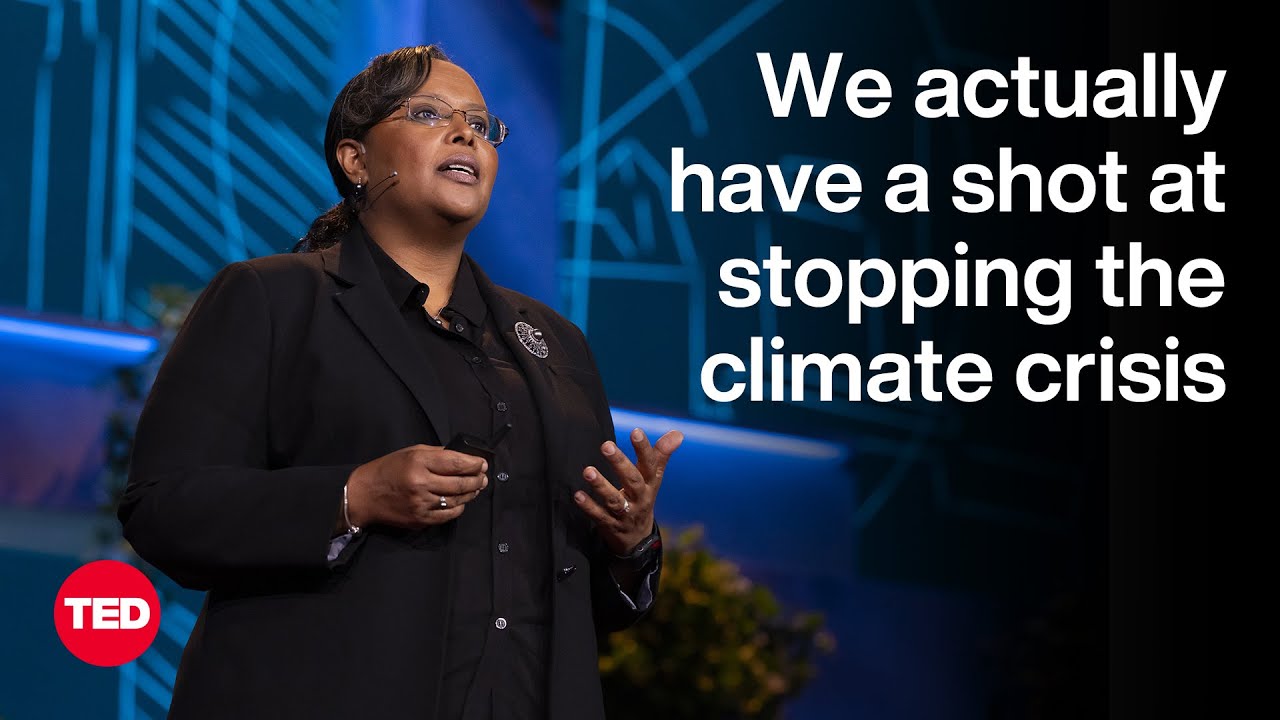
We Actually Have a Shot at Stopping the Climate Crisis | Asmeret Asefaw Berhe | TED
6:57

We Actually Have a Shot at Stopping the Climate Crisis | Asmeret Asefaw Berhe | TED

TED 16.10.2023 36 403 просмотров 743 лайков обн. 18.02.2026
Поделиться Telegram VK Бот
Транскрипт Скачать .md
Анализ с AI
Описание видео
How is the US going to reach net zero by 2050? That's the question Asmeret Asefaw Berhe, director of the Office of Science for the US Department of Energy, is urgently trying to answer. She shares the thinking behind what her team is calling "Energy Earthshots" — projects designed to accelerate innovation in the fight against climate change, from nature-based solutions in the soil to the creation of brand-new technologies – and calls for innovative, equitable policies backed by science. Countdown is TED's global initiative to accelerate solutions to the climate crisis. The goal: to build a better future by cutting greenhouse gas emissions in half by 2030, in the race to a zero-carbon world. Get involved at https://countdown.ted.com/sign-up Learn more about #TEDCountdown: Twitter: https://twitter.com/TEDCountdown Instagram: https://www.instagram.com/tedcountdown Facebook: https://www.facebook.com/TED Website: https://countdown.ted.com If you love watching TED Talks like this one, become a TED Member to support our mission of spreading ideas: https://ted.com/membership Follow TED! Twitter: https://twitter.com/TEDTalks Instagram: https://www.instagram.com/ted Facebook: https://facebook.com/TED LinkedIn: https://www.linkedin.com/company/ted-conferences TikTok: https://www.tiktok.com/@tedtoks The TED Talks channel features talks, performances and original series from the world's leading thinkers and doers. Subscribe to our channel for videos on Technology, Entertainment and Design — plus science, business, global issues, the arts and more. Visit https://TED.com to get our entire library of TED Talks, transcripts, translations, personalized talk recommendations and more. Watch more: https://go.ted.com/asmeretasefawberhe23 https://youtu.be/RB0zvhRZu-0 TED's videos may be used for non-commercial purposes under a Creative Commons License, Attribution–Non Commercial–No Derivatives (or the CC BY – NC – ND 4.0 International) and in accordance with our TED Talks Usage Policy: https://www.ted.com/about/our-organization/our-policies-terms/ted-talks-usage-policy. For more information on using TED for commercial purposes (e.g. employee learning, in a film or online course), please submit a Media Request at https://media-requests.ted.com #TED #TEDTalks #Earthshots

Оглавление (2 сегментов)

  1. 0:00 Segment 1 (00:00 - 05:00) 563 сл.
  2. 5:00 Segment 2 (05:00 - 06:00) 226 сл.
0:00

Segment 1 (00:00 - 05:00)

Eighty percent filthy. That's how much energy the American population still derives from fossil fuels. Deployment of clean energy, even at today's rapidly accelerating pace, is simply not enough to halt the climate crisis. Going forward, if we're going to reduce the risk of overshoot of global temperature beyond two degrees C, we also have to reduce the amount of CO2 that remains in the atmosphere. The team I lead, the US Department of Energy's Office of Science, is part of an unprecedented national effort to get us to net-zero emissions by 2050. To achieve our goals, we're aiming to establish a transformative ecosystem of innovation that achieves major innovations in science and technology for carbon dioxide removal. Innovations and policy and regulations to enable the nascent sector on carbon dioxide removal to grow and innovations to engage more people in our quest to finding and implementing sweeping solutions. We need major breakthroughs across multiple arenas, and we need it fast. So how do we go about this? Energy Earthshots. The Biden-Harris administration's Earthshot initiative is inspired by President Kennedy's Moonshot initiative that aimed to land a man on the moon. I think that's a perfect model for what we need to achieve here. To achieve the goals of the Moonshot initiative, the nation needed to establish a new, expansive ecosystem of innovation in space technologies. It required an all-hands-on-deck approach that included government, included educators, private sector, industry and, of course, scientists and engineers and more. Now with the Department of Energy, we're launching a similarly ambitious effort to enable a portfolio of approaches that range from basic science to application of science to technology development and for large-scale deployment. These approaches are needed to balance the benefits, trade offs and limitations of several climate and clean energy pathways that are needed to accelerate the timeline for achieving the solutions that we need. We've launched seven Earthshots so far. But as a soil scientist, I'm particularly excited to tell you today about the Carbon Negative Shot. This shot depends on a strong science foundation to enable durable, scalable and responsible carbon dioxide removal from the atmosphere at a cost of less than 100 dollars per metric ton of CO2 equivalent, including accounting for full life cycle of emissions within a decade. But we need to be able to measure and verify it too. Achieving the goals of the Carbon Negative Shot requires that we advance and employ nature-based solutions and engineer new technologies. On one hand, we get to learn from nature to enhance the ability of plants to take up atmospheric CO2 and promote soil carbon sequestration, which we can enable via land use change and land management. On the other hand, we aim to advance fundamental material and chemical sciences to develop capabilities for energy-efficient capture of CO2 from dilute sources. This includes development of direct air capture sorbents for ambient CO2 and systems that are needed to durably store the captured carbon. But that's not all we need. We also need a human-centered component to the Carbon Negative Shot to ensure an equitable transition towards a decarbonized energy system. We need to make sure that we realize the full benefits of all these capabilities we're putting out. And in addition to removing legacy CO2 from the atmosphere, the goals that we're pursuing as part of the Carbon Negative Shot
5:00

Segment 2 (05:00 - 06:00)

also have multiple potential additional co-benefits, including improving soil health for communities who depend on soil for their livelihood, reducing air pollution and creation of good jobs. But to realize all these benefits, we need to make sure that people from all walks of life are at the table when critical decisions are being made about our climate goals and how we achieve these goals. For me, as an academic, and now a leader for a major science agency for the nation, this means we need to significantly revamp our support for broadening participation efforts in STEM. We need to continue to contribute towards building a vibrant STEM workforce for the nation. A workforce that will abide by principles of environmental justice at every step of the process. We need this to make sure that the science we're enabling works for society. Achieving our global climate goals requires rapid acceleration of deployment of clean energy and innovations in carbon dioxide removal. I'm convinced the Earthshots are our best shot for achieving our goals. Just like the Moonshot landed us on the Moon, ahead of schedule. And any success that we register on these efforts will not just contribute to removing legacy CO2 from the atmosphere and halting the climate crisis. It will also contribute to building a better, more equitable and cleaner world. Thank you. (Applause)

Ещё от TED

Ctrl+V

Экстракт Знаний в Telegram

Транскрипты, идеи, методички — всё самое полезное из лучших YouTube-каналов.

Подписаться