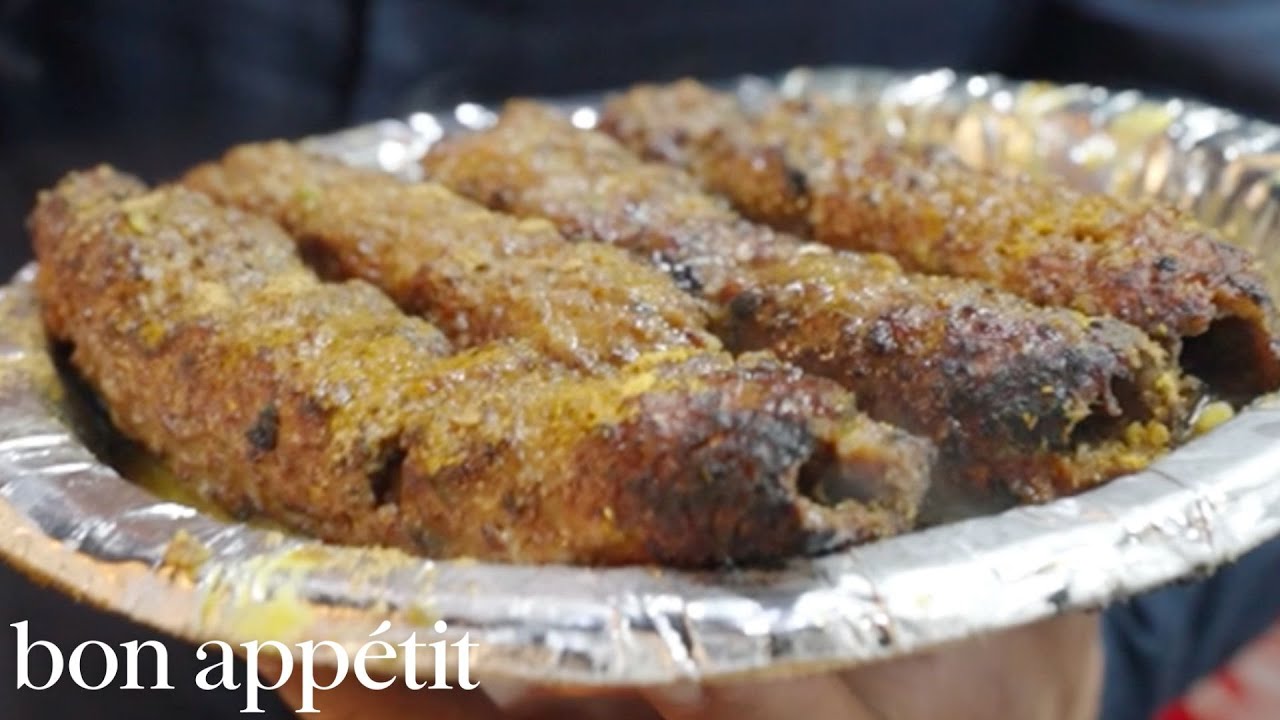
I'm salivating right now. It's evening in Delhi. Hundreds of people are streaming out of their offices hungry. And for 40 years, Sardarji Parathal has been serving beautiful hot buttery flaky parathas up to all these hungry people lining the streets. A paratha is essentially a flatbread, a stuffed flatbread, but the magic is in the butteriness of it. It's a meal in one. It's a snack. It's comfort food. Let's go see what's going on. Unclear. Careful. This is a live operation. Don't knock over a propane tank or we're all in trouble. Ah, just the smell is incredible. This is a three generation family business. When he was about 10 to 12 years old, he used to help his dad out, just like his son, happy right now, is helping out and expediting. Once his father passed away, he took over the seat. And now he sits here in the same place that his father sat. He's got one, two, three, four bowls of stuffings. Aloo. — Okay. And this way you get a little bit of all the flavors all incorporated into it. Lots of fresh onion. And you can see just the mountain that's been cut back there and piled up in the bags ready for the next order. The cutting board is basically 2x4 that's been worked over so that you can actually see where it's sort of got hollowed out in the middle a little bit. Here we go. There's the cutting board. Somewhere there's a fence missing a post and it'll be back here. But the magic is in what's happening right now. Let's see him go. Here we go. Made into a ball, dusted in flour, hollowed out, little stuffing the inside. It's moving so fast I can barely keep track of what he's doing. And then rolled out without tearing the dough. 40 years of practice, right? And this is how it looks and straight on the grill. I mean, what's blowing my mind is that he's putting in jagged bits of onions and potatoes, stuff that if I try to do at home would just tear right through the paratha. Obviously, with the technique that he's got going, these parathas are not tearing. The ingredients are not poking through and bursting. So, he's grabbing a handful of dough. looks about just somewhere between a golf ball and a tennis ball in size. He's really almost massaging it in his hands to get it super smooth. A liberal dusting of the flower and then in this just really amazing sort of movement. He's hollowing it out, stuffing it, pinching off a little bit of the extra in the top. You can see the part that he pinched off. And then he's got probably the amount of pressure that he needs to make this paratha down to an art form. By stuffing it in the middle and then enclosing it and pushing it down and rolling it out, he's making sure that the stuffing spreads perfectly even so that all the way to the edge the potato stuffing fills that paratha, you know, in that thin little disc. This is nothing like a crepe or a pancake with toppings. He's not making something and then just sprinkling stuff and folding it over. But it's essential to the nature of the paratha is that the stuffing's inside and that it's flattened to this disc and cooked. Ghee, clarified butter. It's got a very high smoke point. And you can see how hot the tawa is. Butter would scorch on this, which is why they're using ghee. The smoke point of this is extremely high. You're not going to burn it. They don't skimp on the ghee. It's sort of partly grling, partly frying. I mean, think of, you know, pancakes with butter on a flat top. Just think of how the butter helps the pancake just become golden and fluffy and crispy. And yet it's not greasy. So he's making sure that it doesn't burn on either side. It's cooking perfectly. This is so hot. Once the internal temperature gets to the right temperature, it starts puffing. And what he's doing by pressing is essentially helping create the air pockets inside from one side to the other. And it'll start to puff up slowly. From the rolling to a paratha hitting that plate, I'm estimating about a minute 10 seconds. refuses to count. — He doesn't have time to count. It's just happening. But we can estimate. We can take a guess. We can just take a guess based on what time he starts and what time he finishes at a part about a minute going out. Look at the puff. Look And that's what the pressing on the sides does. Forces the air into the middle. And that steam, that pocket on the inside is making sure that the stuffing is perfectly cooked and moist and delicious. The top burners are cast iron. I mean, he's probably cranking 150 200,000 BTUs per burner. I mean, it is insane. I know I'm exaggerating a little bit. It's the same reason why pizza cooked in a 900° oven. It's got that butteriness to it, that softness to the chew cuz the dough is cooked in about 90 seconds. So, you got the dough cooked but while it's still retaining its pliability. I am so envious, so jealous of cooking on the streets of India. I mean, you got a propane tank in the middle of the street. These tables look like, you know, they're about one bump away from collapsing. This rolling block of his made out of marble is balanced on just some watered up
Segment 2 (05:00 - 10:00)
newspaper over there, but probably at the perfect angle for him to work. Um, the rolling pin rests perfectly on the top. It's about economy of motion. placement. It's about essentially everything being within arms reach and keeping it compact. I often argue that our American kitchens, professional kitchens are too big. They're just too big. There's too much movement back and forth. If you could just stand in one place and rotate and reach everything you need, um that's essentially what street cooking looks like, you know, without worrying about regulations, fire safety drills. On this little phone here is streaming a live feed from the Golden Temple in Umbred, one of the holiest sites for sikism. This is their why. This is their purpose. He rolled the incense by himself by hand in the morning. But of course, the takeout ordering is announcing right next to it. So, you know, religion, commerce, I mean, you can do both, right? So, let's go around this side. It's make what all do we have in here? Mhm. Mixaraji. It's just a nice pungent, spicy, sour, tart, acidic condiment, a pickle to counterbalance the, you know, the sort of ghillay and paratha so it cuts to it. So there you see a plate being made. — And then a little bit of green chutney on the side. — I'm losing it. I got to order one cuz if I don't, I'm just going to be starting to slobber all over my face. So let me go in and place. So one aloo paratha. — One aloo paratha — with some right there on the side. — No green chutney. — Okay. — Thank you. Oh, I'm getting the special butter paratha treatment. All right. Well, this is going to be — You see the difference in the smoke point between the ghee and the butter. The ghee immediately the butter immediately smoked up. I can smell the browning of the butter, but he's moving fast and making sure that way I don't end up with a charred butter paratha, but a delicious butter paratha. All right, let's go get my paratha. Come on over for the condiments. And there's my raita. And there's my pickle. And just a sprinkle of that masala, the uh raita masala on top. — You can pretty much eat this any way you want. You can eat it just by itself, baked it, or you could add a little bit of pickle to rita to it. My favorite is the double dunk. I'm going to make sure it gets a little pickle on one side, and of the raita on the other side. And I'm salivating right now. — This is the real deal, guys. It's comfort food. This is mac and cheese. Whether it's butter or whether it's ghee, the way it hits that hot tawa and smokes and browns, it adds a nuttiness to the bread. I mean, you can see the color of the paratha is completely changed. It's those milk solids in there that are caramelizing and becoming a part of the whole experience. So, I just discovered that the under paratha, the egg paratha is not what I thought it was going to be. I just thought they like put an egg inside the paratha, like maybe an omelette or a scramble or something. No, they cook it in a very special way. Let's go take a look at how they do it. All right. So, mix under here. And what did you put in there? Chili powder and salt. — Oh, he pokes a hole. Pours it in the Oh. Oh, I love it. Yeah. Must say I thought I thought. Wow. Okay. I thought he was going to put the egg on the flat top and then put the paratha on it which basically would make it like a cotti roll type paratha. But no, the eggs inside. Wow. So now just the eggs cooking the inside along with the pas. — Just plain aloo. — Aloo. Okay. So this is a potato with the egg added to the inside of this. I guess he doesn't need to salt it because probably the potatoes are already well seasoned. There's a lot of salt going on already. And this is the cool part. Poke into the hole. Perfect for not a drop outside the paratha. Man, I can barely pour chai into a cup straight. In this case, putting two eggs in the inside of a sleeve, a pocket gives the idea of a hot pocket a whole new definition. The last one was a single egg. I got the double egg. Uh what's the difference in price? — 20 rupees. — 20 rupees more. — Single egg for 50 rupees and double egg for 70. — Amazing. A aloo paratha made by hand from scratch. We saw every step of the process with two eggs in it. It's 70 rupees. That is about maybe 60 cents. 70 rupees. Less than a dollar. This is new to me. It's the first time I've seen an egg cooked inside of a paratha. God dang, that's hot. Poof. Oh. Oh, that's beautiful. That looks gorgeous. — Spiced paratha good. Spiced potatoes good. Buttered paratha good. Egg good.
Segment 3 (10:00 - 10:00)
All three together good. Fantastic. So they say in the restaurant business, location, location. Well, this location is kind of remarkable. We've got a main highway right behind us where folks can see the path being made. They know where the place is, so they can pull off on one of the feeder roads, park, and come over here. We associate going out with going to a restaurant, right? That's what dining out in our minds is, an eery, a place to eat. But I would argue that the street itself is a restaurant. There's something, I don't know, like cozy about just standing next to a stranger, sharing an experience, making small talk. I see families. I wouldn't trade this for a Michelin starred restaurant. To me, this is the experience that I'm constantly seeking, that I'm constantly looking for. Eating on the street.