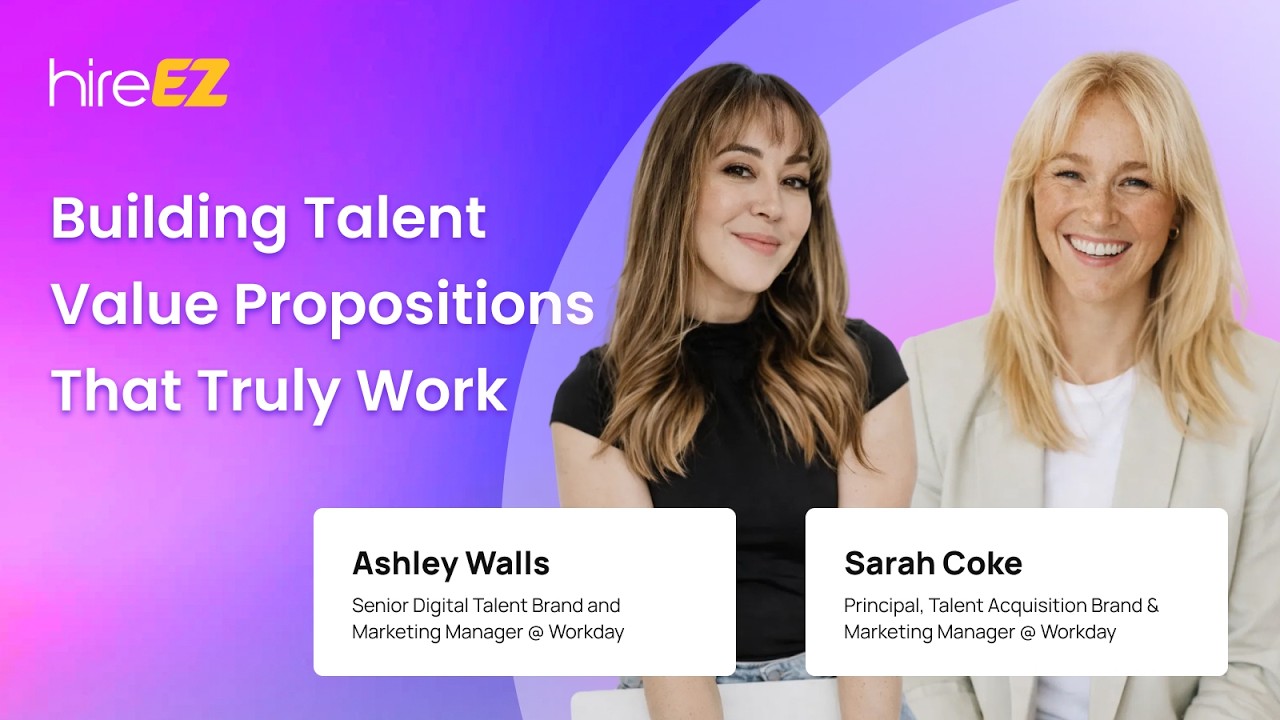
Uh, hi everyone. Sarah and I are thrilled to be kicking off the FRBR conference today to talk about tailored talent brands and how this has evolved for us from talent value propositions into something much bigger. At its core, this work is about futurep proofing your talent brand so it can flex with the market while staying rooted in a clear and consistent foundation. Over the next 20 minutes, which I'm sure will fly by, uh we'll share how we approach this at workday and what we learned along the way. So, I'm just going to jump right in and I'll make my intro very short since Dan queued us up so graciously, but again, I'm Ashley Walls. I'm the global talent marketing manager at Workday. I have been a workmate as we call ourselves for almost 5 years now coming up in March and I currently lead our global social content and advocacy strategies with a bit of career site and web strategy woven in as well. Joining me from the other side of the country is my colleague Sarah Ko and I will let her introduce herself before we get started. — Hi everyone. That was quite the intro from Dan. I really have no notes to add to that about me. Um, I have been with Workday going into my eighth year here and loving every single one of them. Um, I manage all our delivery functions. So, actually taking all of our EVPs, our tailored talent brands, and bringing them to life. I specifically oversee the North America market. Um, and I have counterparts in AMIA and APJ. And a fun fact about our team is we are located all the way from Sydney, Australia to Seattle, Seattle to Boulder to London. And so one of the things that we did very early on is like we built a strong foundation as a team and how we communicate and work across the time zones and across the business flexibility. So today I'm super excited to be joined by Ash to talk to you about how we build some of that foundation when it comes to our EVP and then how we flex adjust for the business um and move with those cycles. So with that Ash I'll turn it back over to you. Sounds good. All right. I really want to start us today by grounding us in the business context because as recruiters and TA professionals, you feel these shifts first and you also feel the gaps when the brand hasn't quite caught up yet. Since launching our EVP back in 2022, which feels like a lifetime ago. Um, our EVP is your work days are brighter here, which we will show you in just a moment here. Uh, we launched that in 2022 and since then workday has transformed significantly. I think that might even be an understatement. We've had new executive leadership, uh, a faster and, um, quicker shift to more performance-driven culture, global expansion, acquisitions, and like many of your organizations, we've been navigating the AI revolution in real time. And when the business changes, candidate expectations change, too, as well as the talent that we're trying to attract. But this is where the struggle often comes in. There is a disconnect between brand intent and what's actually happening on the ground. The brand may say one thing, but recruiters are having conversations that reflect a completely different reality. Candidates are asking more nuanced questions about skills, growth, relevance, and the messaging doesn't always give recruiters the tools to answer those questions for specific talent in a meaningful way. Um, I want to preface this by I am a former recruiter myself and now that I'm on the brand side, I do have the empathy and recognizing that um, often the brand enthusiasts come to you and say, "Hey, we have this beautiful brand. Here you go. This is going to help you attract talent. " And then when you're on the ground, you're kind of like, "This looks nice, but what is this going to do for me? How is this really going to help me? " So, I'm hoping that we can showcase the impact that building tailored talent brands can help you with today. um while also showing some examples from a recruiter standpoint. But we saw this happening and we knew our talent brand really needed to evolve, not necessarily to replace our northstar, but to make it more usable and more real for recruiters to bring it to life every day. And many of you are familiar with talent value propositions. We started there, too. But we quickly learned that traditional TVPPS for short are kind of static and they require a point in time while the business, the market and candidate expectations continue to move. So we realized we needed something much more dynamic, something that could flex alongside the business and start to close that gap between brand and reality. And that's what led us to tailor talent brands. This approach allowed us to stay rooted in our core truth while equipping recruiters and hiring managers across the business with messaging that reflects what's actually happening in the business. So they could tell a story that candidates believe and we're showing them rather than telling them. Which leads me to the next slide, please. Setting the scene where we began our EVP. We started with our employer value proposition. Your work days are brighter
Segment 2 (05:00 - 10:00)
here. And this is our global promise. And you may have seen messages in the market that communicate this. I hope you have. Our team works really, really hard to get this out in the market. Uh, but it reflects who we are at our core and why workday is a great place to build a career. But like many global EVPs, it was designed to speak to everyone we're trying to attract. And because of that, it couldn't necessarily always speak deeply to anyone. And as recruiters and TA professionals, you know that an engineer, a seller, an early career candidate, they're all motivated by different things. They ask different questions. They're evaluating different trade-offs. And while our EVP gave us a very strong foundation to work with, it wasn't enough to fully answer why workday for each of these audiences. And our goal wasn't to replace our EVP. It was to continue to build on it. So to go deeper for those key talent segments that drive our business forward, especially in highly competitive and skills-based areas where we're competing for top talent against other companies. The solution for us was to evolve from a single universal message to a more tailored approach. One that allowed us to speak to talent groups in their own language, connect to what they care about most, and articulate the specific growth, impact, and opportunities available to them in these roles. And this allowed us to flex our talent brand at scale while still staying rooted in that same core promise that your work days are brighter here. And thus, you can see on the screen, our tailored talent brands were born. We built these based on where the business was going, not just where it had been. And we looked very closely at our hiring demand, our most critical skill areas, and where Workday needed to compete hardest for talent. For us, four areas very quickly emerged from that research, and they were these four. engineering, sales, customer experience, and early career talent. And these were the talent segments that would define our ability to scale the company and compete in the future. And when we did this research, it went beyond org charts and looking at job families and job profiles. We went very deep into the talent mindset research to understand how these audiences think, what motivates them, what they're really evaluating and considering in their next role. I remember even having conversations with people throughout this and just saying frankly, hey, I know that you've probably interviewed somewhere else. Why do you stay here? Or what would it take for you to stay here? And just asking the hard-hitting questions, which I think they were a little taken aback by, but they answered very authentically. And it what it allowed us to do was equip ourselves with the ammo to be able to go back and build these brands that were going to be sustainable and scalable in the future. So, if you look at this for sales talent, the focus was career, mobility, and trust in the product. They wanted to know where they can go from here and you know asking the question can I stand behind what I'm selling? Do I believe in the product? They're motivated by momentum and impact and the opportunity to drive meaningful outcomes. For engineer the message was very clear and very different. They wanted to build and not maintain. and engineers. We're looking for environments where they can solve real challenges, continue learning, and grow their technical depth alongside strong and collaborative teams. For customer experience and consulting talent, individuality and creativity mattered deeply to them, and they wanted to bring their own perspective and style that helped customers succeed, not follow a rigid playbook that was handed to them by a company. And for early career talent, it was critical that we avoided positioning this talent segment as junior. And rather than that, we focused on their ability to contribute meaningfully, learn from experienced colleagues, and accelerate their growth from day one. And all these insights and the research that we did didn't necessarily just shape the messaging. They shaped the entire brand expression. So, as you can see on here, each tailored talent brand has its own visual identity, tone, and energy. Sales very bold, energetic, confident. Engineering embraces a darker technical aesthetic that reflects that builder mindset. Customer experience emphasizes collaboration and individuality. An early career uses high energy visuals that reflect potential and momentum. And this allowed us to create talent brands that felt very authentic to each audience while still being unmistakably workday. If you look at the workday brand, if you go to our. com site, our career site, you'll see that all of this feels cohesive and connected to workday. And this is all great and I know as TA professionals, you look at this and you're like, it looks nice. It's beautiful. These taglines are cool to see, but how do you take this and bring it into focus? You focus on activating, embedding and enabling throughout the candidate journey, doing the same thing throughout the business and internally and keeping consistency at its core, but flexing to keep you relevant and durable. So Sarah is going to talk about how to do that and how we brought this to life in market. Sarah, over to you.
Segment 3 (10:00 - 15:00)
You're on mute. What is Are we 2026 and it's still happening, y'all? Here we are. Thank you, Ash. Um, I'm super excited to bring us home, which these 20 minute sessions just go so fast. Um, and I would be remiss if I didn't just give a quick shout out to Ash and the rest of the brand team um, in Workday that worked tirelessly to build that beautiful brand. All the photography you're seeing here in this deck today is all workmates. Um, and it's beautiful to see all of the brands in life, but you're like, "Okay, this is awesome, but like, how do I actually bring this to life? How do I make this happen? " whether you're a recruiter or maybe you're swinging and doing some employer branding and you're holding a couple racks, how do we actually bring this to life? Um so that's what we're going to talk about today um in the last 10 minutes here is how these frameworks really become real. So I think the most important thing to remember out of Ash's sessions is like consistency remains key. That foundation never moves. Your values, no matter how much change has happened within workday, our core values and our identity never shifted. And that was something that allowed us to really build from there. So where can you start to find flexibility at the edges? And this really starts where you start putting yourself in the shoes of the candidate is asking yourself, who am I really speaking to? Um and that allows you to really come with some purpose-built questions around the why. So like Ash mentioned, every single talent segment is going to have different motivators. um what's going to motivate a engineer for impact is definitely going to maybe motivate a seller for their compensation package a little bit differently. And you can have a good idea when you're doing research focus groups around the why. But when you really start to spend time with your teams and you really start to answer that why of why this growth, why this autonomy, why did they stay? To Ash's point, we're not afraid to ask, hey, I know you've interviewed, why here? And once you have those wise, they're really, really personal to that specific persona. And then that's where you demonstrate those through activation, which we'll talk about on the next slide, and blogs and whatnot. But when you actually start to work on the why and put yourself in the candidate shoes, this is where you get to have those lived experiences, those motivations that are unique to those specific personas. And this allowed you to stay rooted in your core research, but then actually change maybe your topics, maybe the questions you ask within a quarter to be really, really relevant to those specific personas. Um, lastly here is localization. Obviously, workday for us, we're 20,000 plus worldwide. We hire thousands of roles per year. However, it's really important for us to stay local and to stay relevant within that market. um how we recruit for a culture, the office culture might be different from the Pleasanton HQ um versus how we recruit in our Toronto office that's mainly engineering. And so what you are allow what you can do with localization is again finding those key contacts in those office. Maybe it's a hiring manager you've recruited for, maybe it's a new hire that you're like, I know they're going to be a great fit. And you start to get some of those little tidbits about what makes that office a little bit different. And then you start to embed that into some of your communications into how you speak with some of your managers and your taps and really staying up to date on that local nuance as well as anything culturally relevant as well. So by allowing us to ground in that your work days are brighter here that core foundation we've been able to flex a little bit. Um, you know, for example, we are just building some brand new messaging in our Toronto office right now around engineering because the market changed and we needed to flex to that. So, we have our engineering brand built solid and then we're able to add on for that market nuance and as technologies um and business decisions change. So, the second section here is all about sustainability, right? We've talked about that foundation being able to flex and what are some other ways that you can do this too. So if you're working at even small or large companies, typically your job profiles are going to have like you got your job family and then you got a couple different profiles, right? We all have our AES, sellers, but then there's so many different profiles that support that as well. There's the solution architect, maybe the data analyst, revenue operations, and as the need for AEES and sellers rises, the need for all of those supporting functions sometimes rise, sometimes we're were um staffed accordingly, right? but you need to be able to flex to those skill clusters. So, what we've done is we've been able to anchor in those core foundational profiles and then from there um be able to build skill clusters for some of these other profiles that support some of those um larger more high volume roles, but making sure that we're not just focusing on the one driver, but we're focusing on the entire business motion that's going to get us to those goals. Um, the next bullet here, continually pressure testing and market research. This is where you all come in. Any of my recruiters on the call
Segment 4 (15:00 - 20:00)
they're like, "Yeah, I'm not in brand. This ain't for me. This is for you. " Um, this is so important to co-create. I ask my other counterparts in AM and APJ, we meet with our recruiters regularly. We're on the team calls um, and we're a part of the team. But most importantly, those recruiters are bringing those local nuances and cultural nuances to us as well. They're the ones coming to us to say, "Hey, this motivator isn't really working in the market, or I've had this competitor come up over and over again when I'm trying to get them to come in for interview. " And so this is where you can really co-create some of those brand pillars with your brand team um in partnership by bringing what you're hearing with the rec with the candidates and how the current brand is resonating in the market. And then lastly um we live in an era of AI. We always pressure test and do market research. So every single quarter um I have a prompt that I run in AI talking about give me u the biggest the best trends in sales in North America in engineering. What are they talking about? What are some of the big publications? And then I actually pull that into some of the recruiter outreach and the resources that I build for the tops to make sure that okay we know that we're competing with this one competitor. what how are we winning in that market and why would someone want to come sell workday over that other competitor? Um and so that's where just regular market research comes into play. You cannot remain static. You have to be agile with the business and that does take the due diligence of making sure that you're doing your own market research. Okay, this is our last slide here. Um and I'm looking at the clock like wow it really flies here. Um, so you can have a creative, you can meet with focus groups, you can build a tailored talent brand or as an individual recruiter, you can do this for the profiles that you focus on the most as well. Um, if you have the creative, it's really important that you continue to think about how you can actually embed this into the business. A lot of companies will stop with the creative and say, "Hey, it's in market. Maybe it's up on our career site and we have some new outreaches with our recruiters. " And that's really where the ball stops. And we want to make this sticky. So much work goes into actually making this resonate and demonstrating what we offer to our candidates. And so again, starting with how you can make sure that this is sticky within your organization, starting with the research, um we spent almost a full year building our four tailored talent brands. that's not always available to everyone, but we pulled um uh candidate sentiment, employee sentiment data, we did focus groups, we met with ecom, we met pulled reports with HR of the top 10 to 15% um performers in our organization and went and sat with them and asked them those tough why questions. Now, some examples, you can do this with one person. You can set up maybe five separate interviews if you're in a smaller organization and understand what are those patterns that every seller is saying and then how can I make that pattern become that talent truth. You're listening for the repetitive things that each of these folks are saying that you can say all right this is something that motivates them and I can insert that into various forms of communication um or potentially social and branding opportunities. Next is really activating. I mean, we all have our slide decks and we all have this knowledge, but if it's not visible to the candidate, it really doesn't matter. So, if you have access to your career site, making sure that some of those proof points, um, some of those really specific why answers that you've gotten are displayed maybe on your LinkedIn, on your career site, um, and they're visible in the candidate conversation. So, this is where h it actually comes to life. Um, and you're making sure that wherever they go to see a potential opportunity at your company, they're having the same message and seeing the same um, motivators. And then next, this is where we embed. So, this is where that shows up across all of those different touch points within the candidate. This is where you're really bringing in your hiring managers, bringing in your recruiters to make sure that they can articulate what is your EVP. Let's just start there. Do they understand what that is? And then if they are hiring for sellers, do they understand what are those big seller motivators? And can they repeat that back to you? Maybe not in a polished way, but in you know, uh, let's say like B+ answer. And if they have a general understanding of your EVP or your talent brand, um, you've landed and it's stuck. And then lastly, enabling. You know, you can't just stop with embedding it into the programs. You have to make sure that you're revisiting this regularly. Just like the research and the messaging pillars that you develop, you got to go back and pressure test. Like we are moving so fast in an era of technology and everything has to come back and revisit and making sure that it's still um relevant, that it's still the right motivators. So making sure that you're coming back to enable your teams. Every quarter you're looking at those
Segment 5 (20:00 - 20:00)
motivators. Maybe this is doing some 15minute um enablement sessions. If you have access to e-learnings, we've seen great success by building internal e-learnings for our recruiters, for hiring managers to better understand what that talent brand is and those motivators so they can go to market with a similar message. All right, thank you so much for listening today. Hopefully you all understand by listening deeply to your teams, finding those proof points, embedding constantly, and enabling across all of the hiring functions, you'll be able to bring some of your employer brands into measurable impact as well. Thank you. — Thanks everyone.