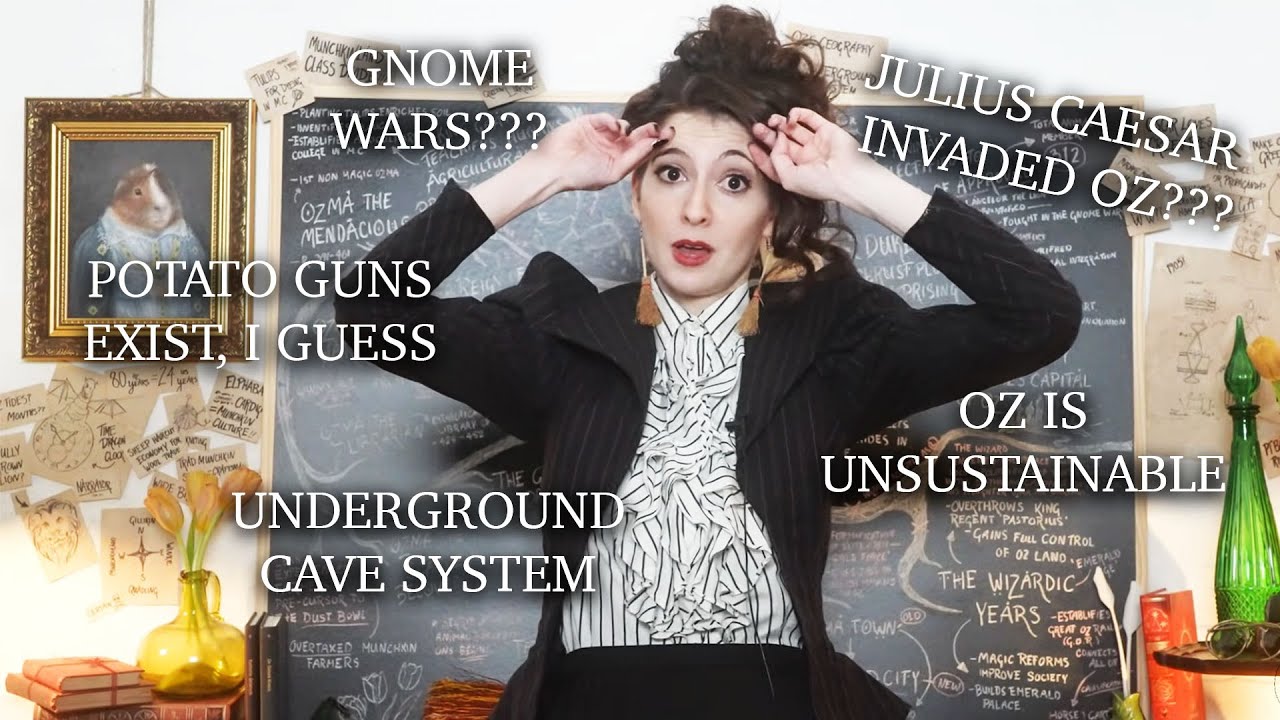
Fellow Azians, as boring as history is, let us put aside our boredness for one day and engage in a minimally hinged thought experiment, wherein we apply the historians's analysis to the land of Oz, whereby examining only primary source evidence we have given to us on screen, we shall come to form an understanding of the culture, society, politics, and characteristics of Oz as if it is actual history. What happened to the gnome wars? Oz is inherently unsustainable. Archduke Winky Fred is assassinated with a potato gun. The way that I like am speaking so seriously about this is like, okay, please be seated. In order to begin our study, we must first define our sources so that we can be sure to consult only the most credible. Wicked the film is based on a musical which set of books film which is based on another set of books. So there is a lot of source material all of which overlaps and contradicts in ways that can complicate our study. So for the purposes of this investigation that is focusing on the world of the wicked films specifically the only primary source we have are the films themselves. The films do borrow elements from all of the aforementioned properties but there are enough elements that diverge too significantly to the point where we can't really argue that they're linked to the same timeline. For example, we have confirmation of the Osma reign which appears in the LFrank Bomb books and the Maguire books. But according to the timelines that we can see in the film, the Osma timeline is truncated. So it isn't exactly the same as in either of the books. The movies are quite literally based on the Broadway musical, which is in turn loosely based on the Maguire books. But as anyone who has read the books will know, they are so different in character and tone and major plot points that they're fundamentally a different story at the end of the day. That is all to say that since there are some pretty significant differences between all properties, we can't take the content of any of them as canon evidence to definitively support or disprove any theories we may come up with in regards to the films. I've ranked the Broadway musical as a secondary source due to its general agreement with the major events, details, and characters of the films. So, it can believably stand in as a slightly divergent telling of the history from within the same time period. But the Magguire books, the 1939 film, The Wizard of Oz, the spin-off musical The Whiz, and the Elrank Bomb books are all tertiary sources, which may be examined for comparison or to hypothesize where literally no other information is available to us, but they can't be relied upon to make any definitive claims. It is also important to be aware of who is writing the history that we're looking at so that we can take into account any potential biases. The story of Wicked on surface level is told by Glenda, meaning that the events would in theory be reliant on Glenda's memory and interpretation. But the musical is actually a story within a story. Because the precenium arch is built to portray the clock of the time dragon, which is mentioned in like line one of the first film. — According to the time dragon clock, the melting occurred at the 13th hour. The Time Dragon is this prophetic omnipotent clock tower in the Magguire books that performs scathingly poignant little puppet shows. So the whole musical is supposed to be one of these little prophecy things. We don't have the benefit of a precenium arch in a film. So, we don't have this told to us outright that the films do take place within the time dragon, but if you listen closely, we do have a noticeable mechanical creaking and the tolling of a bell which does not toll enough times to indicate the 13th hour mentioned in Glenda's speech. — The melting occurred at the 13th hour. — These mechanical noises are coming from nowhere. a stone castle. Why? Except possibly the time dragon clock that we are watching. So, while Glenda is a central narrative voice during the story, it is also likely that the clock itself is the real record keeper here. I know we've got a lot of nerds out there today, which is why I'm very excited to take a moment to thank the sponsor of today's video, June's Journey. June's Journey, if you are new here, is a cozy hidden objects mystery game that you can play right from your phone. It has a delightful storyline following our main character, Detective June Parker, who incidentally is probably living contemporaneously with the wizard in Oz, as we will discuss later. The story starts off in glamorous Jazz Age New York. And as you play through the scenes and discover clues, you get to join June on her travels all over the world. As you find clues, you earn coins and materials which you can use to swankify your own personal island. And there's always so many exciting mini games and events that crop up to constantly keep things exciting and fresh. And I'm even more excited to get to share it with all of you.
Segment 2 (05:00 - 10:00)
Oh my god, why do I do this? Download June's Journey for free by clicking the link in the description box below or by scanning the QR code on screen. And now let's have a look at some Aussian prehistory. We are very kindly supplied with the fictional historian's holy grail in the first film, a history lesson. In the background of which is a blackboard with a timeline of Azian history. The details of this are a little dubious. It required much scouring of the internet to be able to decode this blackboard in the first place. The dating isn't wholly consistent and it doesn't seem to start from any sort of beginning or formation, establishment or creation of Oz. It starts with the reign of King Goat who is the first animal king. And in this world, for those of you who aren't super familiar, animals with the uppercase A means that they are highly intelligent and speaking anthropomorphic in a kind of way. But we will come back to this because we do have some tentative early Azian mythology presented during the tale of the wise ones in one short day which since it's not mentioned on the timeline leads me to believe that these possible events happened before. We're not really given any context or explanation as to who these wise ones are, but I do have a theory. In the Magguire books, which again is not necessarily canon here, there is one proposed creation myth of sorts, which the essentially pagans of Oz believe that Oz was created by the fairy Lerene. It could be that the wise ones are the film's understanding of this early magical beginning of Oz, indicating an earlier time period during which magic flourished and perhaps dominated in influencing technology and advancement. There is another possibility again looking at narrative because this performance of the wise one's tale is being performed quite literally outside the wizard's palace and contentwise celebrates him as this sort of divinely chosen figure. Clearly, it's a very propagandized myth performed probably with the intention to reinforce the belief of the wizard's divine right to rule. There has to be a clear and lovable mythology to strengthen the legitimacy of the grim. Also to discredit any pre-existing belief system that may create opposition to the wizard's rule. We certainly can't have Oz created by a magical fairy if that magical isn't ultimately in service of prophecying the arrival of the more superior system of human ingenuity. But we will get to that. There is a note on the Shiz University website of a queen Lurine as being the genesis of alchemy in Oz, which is a slightly different spelling from Lurline and a slightly different magical practice since there is otherwise no mention of Lurline being an alchemist specifically. And of course, no confirmation of Lurine being of fairy origin, nor of being associated with any Aussian creation. So, it could be a Mc Beth situation where the figure did exist historically, but has been so dramatized as to become much more than she was in actual reality. Whether this Queen Lorine was a heathen queen replaced by the more palatable myth of the wise ones or whether she was a regular queen in her own right post wise ones, we can't be 100% sure. So, we have some sort of murky mythologized dawn of Oz during which magic is a dominating force. the wise ones disappear and there become fewer and fewer people who can read the grammar text. Perhaps suggesting that magical knowledge and practice starts to dwindle at this point. I'm not sure how far that line overlaps with when Dr. Dillimman's timeline comes into effect. Whether the dwindling happens over centuries and doesn't fully complete until the reign of the Osmas or whether magic has become fully uncommon before the Osmas come into power. Regardless, magic doesn't completely go away in the present day, as we are still told that Madame Morble teaches her magic seminar, albeit infrequently. I simply must get into her seminar. — Current magical practitioners, we are also told, can only read a couple of words of the grim, but struggle to decipher anything meaningful. So perhaps the lyric, — all those who could read it. implies that no one can read the grim anymore is a bit of hyperbole intended to once again strengthen the wizard's importance. So we pick up at some point in early recorded Oussian history with the ascension of King Goat, the first animal prince to the Aussian throne. It's important to note that at this point Oz is not yet surrounded by impassible desert, but is presumably open to passage between other lands. We're not entirely sure where King Goat comes from, whether he's a native Aussian or whether he's come from another land and been appointed ruler. We don't know the circumstances by which he comes to the throne. But this is another possible period during which the diminishment of magic could have really started taking effect. Because
Segment 3 (10:00 - 15:00)
King Goat is known for inventing the plow and teaching humans about agriculture, he establishes the agricultural college in Munchkinland and introduces the tulip planting initiative which serves not only to enrich the soil but also will to go on to be a huge industry and economic benefit to Munchkinland specifically. Mima Barban is a Winky bear nurse. We do know she originates from Winky country who was also very influential during this period for making significant advancements in Aussian medicine. She's known for healing many poor Azians and even established the OS, the Aussian Health Service. All of this implies that the animals had great knowledge and more sophisticated advancement in certain practical areas like agriculture and medicine, while perhaps the humans were more advanced in magical studies, and that there was perhaps a more equal exchange of culture and intellect. Or possibly that the animals even did more of the intellectual lifting since on the old plaque at Chis only depicts animal scholars, no humans before it is later covered over by a plaque of the wizard. There is a period of no wars during King Goat's reign, but more importantly for later, Archduke Winky Fred is assassinated with a potato gun by a rogue munchkin student, which I initially read as a rogue chicken nugget, and I really had to just sit for a moment with the reality of how easy it is to misread historical texts and start some truly wild myths. This spurs on the arch duke's son, the now Duke Yanet Crust Plancc to retaliate against the Winkies in what becomes the Vinko Munchkin War. The the way that I like am speaking so seriously about this is like, okay, which tells us two very important things. one that the word winky and winky country is in fact a corruption of the word vinkus which is apparently a more archaic spelling as it is only ever referred to as winky country during the periods we're concerned with. But B, Crust Blanc was incidentally staunchly against animal integration for reasons we're not really privy to. It could be that since Winky country is more rocky and mountainous and therefore not as suitable for agriculture as say the flat and fertile Munchkin land, they didn't take to the agricultural practice introduced by King Goat quite as readily and weren't working alongside and relying on animal farmers as much as the Munchkinlanders were. And as the Munchkinlanders in this case were the enemy, so too possibly were the animals. — It's important to note that we specifically have mention of there being no involvement from the Quadlings in the south that this was purely a conflict between Winky and Munchkin countries. Some historians have speculated that this could suggest some animosity between the Quadlings and the Munchkins in the Quadlings refusal to offer assistance to the Munchkin landers, but we also don't hear of the Gillicanines to the north getting involved. And the Quadlings also don't offer assistance to the Winkies. So, I think this is mostly just speculation or possibly evidence of an earlier attempt to implicate the Quadlings in some disparaging activity. History is written by the winners, they say. And since we have no written record of the outcome of this war, nor of what happened to King Goat, the ruling animal lineage, or the no wars for that matter, we can only infer that there were no winners that came out of any of this, except perhaps the farmers, or that the results of any of these conflicts were just not beneficial to the subsequent ruling line, the Osmas. Herein is where we start getting recorded dates for events suggesting that the Osmas valued a system of recordkeeping adherent to a chronological timeline where previous Ozian history did not. Time is a weird thing in Oz. We will touch on more of that in a bit. So perhaps this tracks the first Osma, Queen Osma ascends to the throne in the year 298. — The Osma entries on this timeline seem to append the events in her reign by signifying the year that she died. But we don't have a marking on the points at which she is born or ruled in relation to other events. So it is likely actually that the Venko Munchkin war happened during the reign of Queen Osma, but this can't be confirmed. some undesirable event, whether it was the Venko Munchkin War or something else, must have occurred during her reign since the only detail we have of Queen Osma's reign is that she was beheaded in the year 362, ruling for 64 Aussian years. She is succeeded by Osma I, who rules between 362 and 391. Although once again, we have no indication of what events occurred or achievements she accomplished during her reign. The introduction of the Osmo rule does bring forward two important points though. One, a matrinear ruling line within Oz and thus a matriarchal society at least within this period of Ozian history. And as it is specifically noted later on, these first two Osmas were magicians. Once again, we are not sure what the status of magic in
Segment 4 (15:00 - 20:00)
Oz was at this point. Whether it was actively diminishing and therefore a ruling line of magicians would have provided a sense of hope for magical restoration to Ozians or whether magic was still common practice and the Osman were just especially skilled in their arts. But the third Osma, Osma the Mandacius, who ruled briefly between 391 and 401, is specifically noted as being the first non-magical Osma. She is noted as having been a Mont, which is the Aussian equivalent of a nun, although we are not sure what deity she was devoted to or what the specific Aussian demands of a Mont would have been. I know we have clues as to what all of this entails in the Maguire books, but again, we cannot necessarily make assumptions and bring these into the world of the films. It does raise the question of whether the Osma line was genealogical, though, or whether the new Osma was chosen through some other sort of divine selection. It could be presumed that Osma the Mandacius's reign was cut short due to the warrior uprising. Warriors from where and fighting for what? We are not sure. And she is succeeded by Osma the warrior from Quadling country. Osma the warrior is the only Quadling representation I believe we ever hear of during the films for some reason. Osma the librarian succeeds in 428 establishing the library of Oz and is followed by Osma the scarcely beloved in an unrecorded year. imposes some pretty fierce taxes on munchkin farmers which will transpire to append pretty much everything. These taxes encourage less experienced farmers across the country to start picking up agricultural demands and they start implementing some pretty poor farming techniques which depletes the soil and water resources and eventually results in the great drought of Oz. This presumably causes strife between the humans and the animals especially in Munchkin land who previously had collaborated in the field of agriculture and the animals began to be segregated officially from humans. — There have been some great changes throughout Oz with the rejection of animal culture — possibly to prevent any of them from instilling any sort of anarctic behavior against Osma rule which was hostile to agricultural practice. When and why did this change? — From what I've read, the great drought. — Precisely. — The Great Drought has devastating effects on Oz. Mass famine, panic, uncertainty, the formation of the impassible desert for hundreds of miles around Oz, isolating it from the rest of the world. At some point during this period, Osma the scarcely beloved either dies or is killed and is succeeded by King Regent Pastorius in place of the new baby Osma the unready. So we have set the stage. Oz the land is in a state of decay. Its people are starving and wedges of animosity are being driven between the populations. The ruling line is unpopular or in the case of Pastorius, not even an Osma. And the Osma herself is quite literally unready. So a great storm in the year 502 bringing a balloon and a strange seemingly magical man results expectedly in a radical change in regime. But there is more to the wizard's rule than the story books and pantoimes published by the Emerald City will tell you. Because during Defying Gravity, we end up in his attic storage room and see in the background crates and suitcases and banners and set pieces and cages and carts, [snorts] items lifted presumably according to their labels from the Omaha State Fair. But it's more stuff than can fit into a hot air balloon and still allow it to fly in one trip. So, pre- rise to wizardship, carnival man Oscar Diggs has made a number of trips back and forth to Oz. This theory is further supported by the fact that the Nebraska State Fair, which is the only fair affiliation printed on the Wizards Old Acre, only ran in Omaha in alternate years between 1872 and 1901. But there are binder clips on the stacks of papers that Alphaba sets the Grimmory on, and those weren't invented in the US until 1910, patented in 1915. Oscar Diggs was many things before his immigration to Oz. a carney, a performer, and a snake oil salesman, as evidenced by the disused potent and portables cart in the attic. The method or reason for the wizard's initial trip to Oz is unknown, but it stands to reason that Oz would have provided several enticing business opportunities. First, with the closing of his local state fair at the turn of the century, he could set up and run his own in a land which may not have had a state fair. Second, upon discovery of talking animals in Oz, he may have begun a scheme to perhaps overthrow the dynasty of PT Barnum by capturing and transporting these highly intelligent
Segment 5 (20:00 - 25:00)
speaking animals back to his homeland and starting his own exhibition. The wizard is nothing if not an enterprising man, and either opportunity would explain the steady accumulation of carnival materials, set pieces, and animal cages in Oz. It's likely that the wizard was initially coming and going discreetly from Munchkin land, using his charm and wit to gain allies who could help him with storage and getting to know the region and the population. As is suggested by the wizards affair with Alphaba's mother, a fortuitous initial journey landing him in Munchkin land would have very quickly exposed him not only to the significant population of animals, but demonstrated their usefulness not just in intelligence, but also in manual labor. The storm of 502 shakes up these plans a bit. He's blown off course and enters Oz not through Munchkin Land as probably intended, but from the Winky country, as the story books relate. Strange man descending in a balloon through a fierce storm gets noticed this time. If we are to believe the myth of the wise ones and the heavy belief in the prophecy of the grim pre- wizard, he's given the book to test his magical ability. But he's a performer, perhaps a bit of a con man, and he's aware that no one here has heard of Nebraska. So he chants, "Oh my" — in his most ominous voice and successfully persuades the population into believing that he's magical. This population didn't have the same technologies that the wizard had access to in the United States and were probably primed to believe that the wizard's ideas and his balloon were feats of some hitherto unknown magic. Despite the wizard's previous endeavors, he was literally handed a better enterprise than he ever could have schemed on his own. Thus began the wizard's rule, which through the facade of magic actually ushered in an era of reliance on human technology to Oz. The first order of business was to lead a coup, storming the palace in the central city of Osma town to dethrone Pastorius. There is no record of what happened to Pastorius or Osma the Unready, possibly due to repression by the succeeding administration. The wizard gains full control of Azian government, and Osma Town is renamed to the Emerald City after having been rebuilt in spectacular greens and embellished with emeralds mined from the hills. Now, the wizard's fondness for the color green is an interesting thing to explore. We do see his previous carnival banners depicting a cartoon of him wearing green and things like his state fair branded sandbags are also green. Probably just had a pre-existing fondness for green. But there is also an opportunity for this fondness to double as a symbolic rallying cry to shift himself into favor with the population. The country is dry and brown at this point, having once been lush, fertile, and green. The wizard's decision to build a town of green is a promise to make Oz green again or maga if you will. And he is going to do this as we might expect in the most self-interested and backhandedly destructive way that he possibly can. The irony that he is greenifying the country by extracting resources from the ground and thus further depleting the land should not be lost on us. But we will get to the environmental destruction and unsustainability of Oz in a bit. The wizard brought about many significant changes to Oz. And historians have begun referring to this new period as the Emerald Age. During this period, the Emerald City becomes not only the capital of Oz, but also the center of art, culture, science, and innovation, and controls all media outlets. Azian law becomes centralized under the wizard's rule. And he introduces magic reforms, which are said to have improved society, quite possibly in the realm of harnessing weather magic to revitalize and sustain the land after the drought. He also establishes the Gale Force, a local Emerald City army, which is celebrated for having brought jobs to the chimps, although it is unclear if this was a volunteer or a conscription service. A railway is built to connect all the countries of Oz. and in either 581 or 681. The numbering is slightly unclear on the blackboard. This results in the horse and cart strike. The date of the strike is the last date we're given on the Ozian timeline. But with the wizard's discovery being in 502, this puts him in power anywhere from 80 to 180 years from arrival to the building of the railways, which is not even the beginning of the films. As will be well established during this exploration, time works very differently in Oz than it does in our world. In ways
Segment 6 (25:00 - 30:00)
that we have yet to fully define, but can only speculate upon. The fourth Maguire book does provide an explanation which might give us a clue as to how time might work in the film world. Years are counted more just on vibes based on how long a season lasts and whether everyone remembers to tick over another year. But the inhabitants of Oz still age faster than the inhabitants of our world. Our years are not just temporally longer, but physically as well. Dorothy first arrives in Oz in the first book at 10 years old and returns to Oz in the fourth book at 16. Meanwhile, the character Lear ages from about similar age to Dorothy into his 30s, putting time in Oz, moving almost three times faster than time in our world. I'm no mathematician, but if we can rely on the Maguire time laws, the wizard's 80 oz years would be about 24ish our world years. And 180 years would be about 54 our world years. Well within the span of our world human lifespans, but plenty of time still to accomplish generationally spanning society changing schemes in Oz years. So, in a way, it makes sense both that the Azians would see the wizard as this immortal, long-life being, even though he's just living his normal life, but it also makes sense that he seems to have had so much influence over the minds and cultures of generations of Aussians throughout his reign, despite being just one normal, not even that incredibly old guy. There is a small time jump between the first and the second films. We are given a vague 12 tides from Madamorable in regards to how long the witch has been terrorizing Oz. Although since Oz is completely landlocked and hasn't seen oceans in hundreds of years, we can't really know what length of time is signified by a tide. The writers have suggested in an interview that one year has passed between the first and second films, putting a tide at the length of one month, and thus that Oz also follows a 12-month year, which terrifyingly implies the existence of a Roman Empire in Oz. But I need to pocket that thought for now. If anyone is looking for a PhD topic, this area of Aussian history has been woefully underexplored. and a proper study looking into any possible evidence of this would contribute substantially to the scholarship. There is a further complication of the lion having aged to maturity during this time which in our years generally takes about four years for a male lion. Although if the writers are accurate in their statement, the lion seems to have accomplished this entire process of maturing in just one Aussian year. Again, Aussian time is something potentially worth conducting a separate study on. During this time, the yellow brick road is built and the country is plunged into a manufactured terror of the so-called wicked witch of the west. That's us mostly caught up on Aussian history for now. We get glimpses of several maps throughout the films which are very useful. One on the wall in Dr. Dillamman's room, in Alphaba's hideout, and one in the wizard's study. They're similar roughly, although not exactly, to the maps from the show and the Magguire books. Some key differences, like Shiz being located at the very top of the Gillican instead of a small city outside the Emerald City, means that we cannot use these pre-existing maps for reference, and we have to scour the films for little bits and screenshots of maps. Thankfully, there is a clearer version of a map listed on the Shiz University site, which is supposed to follow movie cannon. So we will use this for reference. The land of Oz is comprised of four countries. Gillicanin country in the north, Munchkin land in the east, Quadlin country in the south, and Winky country historically known as the Vinkus in the west with the Emerald City in the center. Despite not covering a huge amount of space, each of these regions has landscapes, traditions, and cultures, some of which we have a much clearer idea of than others. As far as Oz as a whole goes, we do know that scientists understand the world to be round, as we can see from the globe in the wizard's office, despite them not knowing exactly what lies beyond the boundaries of the impassible desert. I do think it's interesting that there doesn't seem to be any record of these lands beyond the desert, despite it only having been formed within the last century or two, which to me implies that the wizard's coup was perhaps a bit more violent than is led on. The destruction of Osma city in order to build the Emerald City probably also resulted in a lot of considered destruction of Osma era recordkeeping in an effort to curate the beliefs of the population. If there is one thing we know about the wizards
Segment 7 (30:00 - 35:00)
regime, it is that the propaganda machine he runs is powerful. Press secretary Madam Morble seems to have intercom access to every home in every corner of Oz. The technology to produce masses of flyers and magazines and tabloids and building sized banners at rapid speed seems to rely on technology unmatched in our world. If there is one technology that the wizard has most heavily invested in excelling, it is the propaganda machine. People do truly believe in the wonderful wizard. Citizens of the entire country are ready to celebrate his wins and rally against his enemies seemingly at a moment's notice with very little convincing. And those in marginalized groups believe and mass that their only option is to comply or to take their chance out of Oz. That the wizard and thus the people cannot be fought. It is literally public knowledge that the EC controls the media and no one but Alphaba seems to be taking any concern with that. Anyway, the world is round, but the globe shows Oz as the only habitable land mass on the planet full of desert, despite having relatively recently been connected to other realms, which suggests a concerted effort to destroy this knowledge, possibly in an effort to keep the people dependent on Oz and thinking they have nowhere else to go but certain death, which makes the animals decision to leave Oz rather than fight the wizard in part two devastatingly indicative of their treatment. Munchkinland is the region we have the most information on given that we spend a huge portion of the beginning of the first film in Munchkinland. It's a largely rural country with just one central village where the opening number takes place. This seems to be the most convenient gathering point for Munchkinlanders and thus the place that Glenda visits when she needs to address the country. But what I find interesting is that this city center of Munchkinland isn't reserved for the upper classes. The buildings that we see primarily house the dying and textile processing industries with some citizens living on the upper floors. Now, Munchkin Land definitively has a class divide as we can see in the crowd. There is one subset of people who I will call the traditional munchkin landers who tend to wear bright colors, incorporate lots of patterns and weaves and textures and layers into their clothes. They tend to have textured hair and generally wear widebrimmed hats of felt or straw. The clothing of these Trad Munchkins is both stylish and well-crafted, but practical. They're clearly showing off lots of craftsmanship and lots of it in all the layers of clothes that they wear. But it all serves a purpose. Wide-brimmed hats to keep the sun out of their eyes, possibly for working outdoors. Knitted waist coats and jackets and shawls. Dressing for unpredictable temperatures again to prepare for outdoor work perhaps. There are munchkins wearing sleeve covers that would protect sleeves that would be harder to clean. Hardwearing overgarments are reinforced with a sashiko like running stitch to strengthen the material. And almost everyone has a belt pouch or two because every practical munchkin lander needs pockets. The fabrics appear to be natural fiber, cotton, linens, and a lot of wools, which makes sense with the primary industry in Munchkinland being agricultural and the long history of animal munchkin collaboration in a country where animals are highly intelligent. I would wager that there is a whole culture of sheep who look forward to their spring trim so they can sell off a little wool and get a nice little tax return. We can learn so much from what these traditional munchkin lenders are wearing. The deepness and richness of the colors in their dyes. Basically, no one here is wearing plain white. This indicates a thriving dye industry, which isn't something we need the clothes to tell us. — Several of the houses in Munchkin Village are used as active dye houses with large dye vats and drying racks displaying skins of freshly dyed yarns and cloth. And we even get to see strainers holding variously colored flower petals which tracks with the fields and fields of flowers that surround Munchkin Village. There's a long history of tulip cultivation in Oz, dating way back to the reign of King Goat, who first brought the practice to the humans of Oz. The tulips, it seems, are grown for their potent pigments. Something I should note which is specific to the Aussian variety. We technically can dye with tulip petals in our world, but the dyes wouldn't come out nearly this strong or varied. Flowers and flower dying have become such a lucrative industry in Munchkinland that flowers have assumed a national significance of their own. They're used in decor all over the city and bright colors are preferred in Munchkinlander aesthetics due to such a ready availability of potent dye stuffs.
Segment 8 (35:00 - 40:00)
Whatever the dying process, I assume because it uses flowers and probably doesn't mant with urine or something, the smell and pollution aren't significant. Dyers and tanners in our world were generally relegated to the outskirts of industrial villages historically due to their levels of pollution and stink. So it is worth noting that whatever process the Munchkinlanders are using is not disruptive, but it has a beauty and a community tradition associated with it to the point where the diehouses are centralized to the primary gathering spot in the country. This is the Munchkin land that they want represented to visitors from other regions. Munchkin Landers excel at textile crafts of all sorts. Spinning and weaving to produce extraordinarily patterned and textured fabrics and trims, knitting and crocheting, smoking and gathering and pleading and braiding. We even see some spectacular quilting and piecing and a general attempt to utilize even the smallest scraps of material. The Munchkin Landers having produced these items understand the value of the labor and therefore don't let the things go to waste and all this extends to crafts beyond textiles. Thatching and building are done sculpturally and even the farming is done with an eye for color. There seems to be a cultural pride in what they make with an emphasis on making practical things beautiful. But the Munchkinland crowds depict two very different sorts of people. the Trad Munchkins who are interacting with the village going about their work and seem to be the locals who live in the village. Other crowd members are distinctly differently dressed in plain cloth, lighter shades and smoother textures. Their garments look to be made from fine worsted suiting wools and silks. Their hair is worn styled up or quafted but straight and their hats are small and decorative. These styles align more with the styles we'll see in other regions of Oz later on in the show, suggesting that either these folks are immigrants to Munchkin land or visitors, having come in to visit Munchkin village from the outer countryides of bordering Quadling or Gillicanin countries, or that they're Munchkin Landers who follow the fashions of greater Oz over their local dress traditions. The outfits are far less practical for physical work. The fabrics are fine and wouldn't really do well around water, so puts them well out of the dying industries. The women's skirts are long, ruffled, and bustled. Sleeves are large and puffed, which would make agricultural work difficult. These more osmopolitan citizens I don't think are racially munchkins since Governor Nessa Rose's later ban on munchkin mobility seem to ban only those wearing traditional munchkin dress and styles from rail travel which suggests two things firstly that Nessa and the throp family aren't genetically munchkins and secondly that munchkin land is governed by non-munchkins traditionally since the governorhip seems to be hereditary rather than elective. There is an interesting linguistic feature to ponder in the name Munchkinland itself. This is the only country in Oz using the suffix land rather than country. This could suggest an earlier settlement or influence from another region, possibly from elsewhere in the world, or perhaps that there was an earlier geographical or cultural isolation from the rest of Oz. kind of like how in England we get different suffixes for Anglo-Saxon place names in the west and Nordic suffixes for east as a result of Viking settlement. Munchkin's cultural development had vastly different influences from the rest of Oz despite being part of Oz geographically. This all probably occurred a very long time ago per Ozian history and we can see plenty of instances in the two styles of dress mixing. an Aussian native wearing some Munchkinlander pieces, perhaps born and raised in Munchkin Land, but socialized elsewhere in Oz. While I am of the belief that historical Munchkin land was one of the more cooperative regions of Oz in regards to animal relations, the opening scene we must remember is at the very end of Alphaba's story after Nessa Rose has signed the animal motility bill and restricted the ability for animals to move around freely throughout Oz. which explains why the crowd here is homogeneously human until the very end of the second film. Before this, however, we have a line in the second film during the scene in Nessa's office that tells us Munchkinland is the only Aussian country that hasn't yet signed the animal motility bill. Nessa, I think, understands that this would be controversial amongst a population that has historically worked alongside animal citizens, although I suppose she gets around this by ultimately restricting both animals and munchkins, both for internally selfish reasons. We have a much less diverse view of Gillicanin country in the North of Oz
Segment 9 (40:00 - 45:00)
since the only glimpse of true Gillicanin country that we see is in the flashback of Glenda's childhood birthday party. Glenda is, I think, a sort of figure of nobility, which we'll touch more on in a bit. So, we can really only speak for this one particular highclass family. But of note are lots of ruffles and details in the clothing and lots of pastel colors, both among Glinda's family as well as on all the children in attendance. It's possible that the Gillicanines, or at least those of the upper classes, have taken to wearing paler colors in an effort to differentiate themselves from manufacturers in the lower countries, especially those in neighboring Munchkin Land and Winky country. And we know the Munchkin Landers are really into their deep and bright colors just by means of ready access. The uplands, which are all the way up in the way north of the Gillican, are in theory more difficult to reach, but this doesn't seem to impede the import of copious other goods to the Upland family residents, especially with the new railways. So, it doesn't really strike me as a practical inability to import dye stuffs. Perhaps at one time historically, it might have been, and the pastel fashions remained just out of tradition. Shiz University is also located in the very north of Gillicanin country. So although it offers a relatively diverse view of Aussian students, not strictly Gillicanines, it can give us some more clues into Gillicanines culture. Once again, we're relatively limited to our scope of evidence by the fact that Shiz is an elite university, and a good proportion of the student body appears to come from fairly well-off circumstances. There are definitely clear guidelines as to what students are required to wear. And while there does seem to be a mass-produced range of garments that students do seem to have the option to buy, there are also a number of one-off unique garments that still fit visually within the uniform standard. Students seem to be required to wear a specific shade of turquoise, slate, gray, pinstripe, or orange, use a specific set of fabrics, or knit items according to a specific style. Within those constraints, however, students seem also to have the option to design and wear garments in whatever fashion they choose. This suggests that the supplier of Shiz University uniform materials may sell ready-made garments. Certainly, we do see a couple of students in the background wearing standard symmetrical jackets and shorts and sweater vests and socks and things. These are probably the students who either aren't too fussed about clothing and or those who might be at Shiz on scholarship but don't have the means for more expensive option which many of the students particularly our leading or featured characters seem to have opted for. Purchasing the Shiz approved materials and then taking them to a tailor to have them made up into a style of their choice. Asymmetry is a huge part of Aussian fashion, at least in the Emerald City and Gillicanin and Winky countries where there seem to be prominent figures of royalty or nobility. Munchkin Land is run by a governor and we know nothing about the government of Quadling country, but it's interesting to see how asymmetry does not play a significant role in Munchkinlander fashion. We see this on display in the student body of Shiz really prominently with Munchkinlander students maybe occasionally trying out something a skew but largely sticking to symmetry in their uniforms. The rest of the students seem to have a fondness for half kilts and half waist coats worn only on one side of the body. Asymmetrical hems on skirts and jackets, even irregular weave patterns in the stripes. Glenda's pre-wedding rhyme. Something old, something new, something bartered, something a skew. — Something oldish, something new, something bartered, and something a skew. I need something a skew — is further proof not just of a fashionable, but a timehonored tradition of asymmetry in urban areas of Oz. And we can speculate as to the practical reasons for this. A society that has machinery to do all sorts of repetitive tasks from brick laying to pamphlet distribution also very likely has machines to take on some of the more repetitive tasks in textile work like weaving and pleading perhaps. Oz definitely has invented some variety of sewing machine firstly as the quantity of clothing seen throughout both films suggests but also as the perfectly uniform row of stitching on Alphaba's book belt shows. In a society where labor hours and thus cost can't be shown off by mere quantity of garments anymore, this cost has to be demonstrated in another way that does show off labor hours. We saw this happen in our world in the mid to late 19th century with the invention of the sewing machine. Since the garments themselves didn't take as long to hand sew, people started adding huge quantities of detail with ruffles, pleats, and gathers and bustling. putting those freed up labor hours to work in other ways. And by the
Segment 10 (45:00 - 50:00)
turn of the 20th century, there was a resurgence in appreciation for hand sewed details in the now novel amounts of labor required. I think we can hypothesize a similar phenomenon for Oz here. Since the garments and possibly the decoration can all be sped up by employment of machinery, fashionable Azian societies had to find other ways to demonstrate the cost and craftsmanship of their clothing. And one process that cannot be mechanized is cutting. The process of measuring and drafting and sculpting a garment to fit each unique human or animal is one that can only be achieved by the skilled hand of a trained tailor. Drafting a well-fitted symmetrical pattern takes an amount of work. Sure, but one pattern piece can be duplicated and used for both sides of the body, saving a step. It takes a whole extra amount of work to reddraft the entire second half of a garment on an asymmetrical garment, especially one with three or four differently placed lapels. And that's work that has to be done by the hands of skilled craftseople with opposable thumbs. It's interesting then to be able to look at the different students and to be able to pick out well really just the Munchkinlanders since that's really the only culture we get a really good look at elsewhere in the films. Munchkinlander students according to their tradition seem to be opting more for the knitted options which simultaneously caters towards their affinity for knitwear. But the Shiz uniform knits are also designed with the most patterns and incorporate the bright orange secondary color. Again, catering well to the cultural preference for bright warm colors. Another interesting detail that we begin to notice upon the narrative move to Shiz is the oified language. — Surrenderable words, pessimistic, — hideodious, scandalous. This is not something we really notice amongst the Munchkin Landers, but is used profusely within Chis in writing around the university and most abundantly in the lines of both Glenda and Madame Morble. — Congratulations. — Pronouncify my name — ceremoniously — a linguification — and Alphaba when she's mocking Glenda's complaint about the misprononification of her name. I had a thought at first that this was possibly a Gillicanin specific dialect used by the Gillicanines and within their own country. However, Fiero's use of swankified in his first hour walking onto the Shiz campus. — So, what's the most swankified person? — Makes me think that this is just an upper class Aussian thing. Perhaps a slightly antiquated way of speaking that the Munchkinlanders with their different linguistic background never culturally adopted. Shiz is an interesting case for animal politics, though. While there are a couple of animal faculty members, possibly tenured or at least the best in their teaching fields, so can't easily be replaced by humans, there are no animal students currently enrolled at Shiz. Even before things become obviously hostile to the animals partway through part one with Dr. Dillman's arrest, the signs of animals being unwelcome on campus are already there. There's the suppression of animal history in the university's facade and architecture. And the Shiz University map has a separate label for animal faculty on the outskirts of campus, presumably accordingly labeled because this is segregated from the human faculty quarters. We can't be entirely sure if this is reflective of attitudes towards animals in Gillicanin country as a whole. whether this does indicate some precedent for animals, especially intellectuals, remaining somewhat integral to Gillicanin society, or whether Shiz is an anomaly within an animal hostile country. I think there's a complicated history and relationship between animals and clothing that is also worth exploring because there is some contradicting evidence that can lead us down a couple of different paths. The first thing that we noticed during the course of the films is that the animals are generally wearing clothes, especially in the academic setting, whether or not they require it for practicality like humans do. And it's not just the formality or dress requirement per university regulation, since we see Dr. Dillamant in his accommodation late one night wearing a nice chunky sweater whilst meeting with other cozily dressed animals. These garments are animal-shaped, certainly made specifically to accommodate the various sizes and anatomical configurations of any given species. But the logistics of them are puzzling. Dr. Dillamin's garments seem often to fasten around the belly with a buckle, and one of his collars closes with a tiny white button, both of which require a manual dexterity too complicated for a hoof to fasten. And while we do see specifically fitted animal tools to help accomplish some more fine motor requiring tasks in the classroom, tools that fit over a paw or a hoof designed to hold chalk or a dustpan or a teacup, we don't see one of these designed to mimic the general
Segment 11 (50:00 - 55:00)
function of a hand. It raises the question of whether each animal has to have an array of hyperspecific tools fitted to each of their hoof or paw sizes in order to accomplish an infinite number of tasks. Be it writing or button hooking or sweeping up or holding a pen or wielding a screwdriver or somehow doing up a belt buckle or whether they're relying on humans to do this for them. We do see a number of gadgets that help animals to operate within a very human- ccentric society. pedals to operate the projection apparatus in Dr. Gyllamman's classroom and a teac kettle set on a swivel for hoof accessible pouring. But again, one has to wonder who makes these intricately assembled accessibility tools designed to retrofit diverse animal anatomy into an anthropocentric society. human manufacturers, possibly, or perhaps monkeys would perhaps be more sympathetic to the animal mindset, which might explain why so many monkeys were recruited or conscripted by the wizard for service in his army. But anyway, not to get too political, what's really interesting is that in all the projection slides of the historical period pre-animal segregation, which we now know would have been sometime before the reign of Osma, the scarcely beloved, several oz centuries ago. None of the animals are dressed. They interact with clothed humans, but otherwise rely on their natural coats and thermmorreulation systems for practical means of staying warm. It is possible that clothing was worn in ceremonial or otherwise special circumstances since the pre-wizzardic plaque in the main courtyard shows animals dressed in academic gowns similar to the ones worn by today's Aussian professors. So we have to take a moment to ponder why the change in choice to dress daily even in casual and animal only settings. It could be a saratoral law requiring animals to dress as a means of conforming with human society or possibly subjugating or subtly demeaning them. It could also have been a cultural choice or a slow development over the centuries in a society increasingly hostile towards their presence. Having some sort of visual conformity to the dominating social group could have helped the animals to mentally align themselves with humans and thus hopefully escape some discrimination. It could also have been a far more benign cultural choice. Humans don't always wear clothing for practicality either. Sometimes we wear certain garments as a means of personal expression, and so too could the animals have adopted clothing for the same reasons. Interestingly though, all the animals escaping Oz in the second film have done away with their clothing, except for Dulce Bear's Shaw. I'm not entirely convinced that this was done as a means of disguise since they're all carrying huge packs containing all their belongings rattling around. They are not exactly subtle this way. We also don't really have evidence to suggest that there are non-speaking lowercase animals in this world which they might be trying to pass as since Alphabet does have that line about — can you imagine a world where animals are kept in cages and they never learn to speak — suggesting that such a thing does not exist in this world. This could be a decision made for practicality. If clothes were purely a means of personal expression or conformity to the hostile society from which they are trying to escape. clothing would not be an essential worth packing. It could also be a more personal means of attempting to reclaim their bodily autonomy after centuries of having their bodies either socially or legally redecorated to the tastes of a society which values neither their intellect, skill, nor basic presence. What's interesting then, and what might throw a spanner into my theory here, is that the animals who are captured and caged in the second film have all been stripped of their clothes. This might be a new development introduced by the wizard who has come from a world where animals mostly do not wear clothes or speak, especially when in cages. This, I imagine, would be quite a departure from the Aussian view on animals who historically seem to have preferred the unclothed state in their comfortable everyday environments, but who have adopted clothing under either human command or social pressure. Thankfully, we do not get to see the knock-on effect of this on animal society because once discovered, the animals are promptly released. — Run, [screaming] — where they immediately proceed to make an appearance in all their traditionally animal unclothedness to the most highly anticipated ceremonial and high society human exclusive event of the year. Unfortunately, the other two countries of Oz do not feature so heavily in our accounts and so we don't have as much evidence to go on for them, but we do have some. Winky country, we can see from the maps and the landscape footage, is very mountainous and devoid of much vegetation. A prop
Segment 12 (55:00 - 60:00)
tabloid tells us a bit about Winky country and culture in the process of sharing the latest gossip about Prince Fier coming to attend Shiz. Although the legitimacy of this piece is more than dubious since it speaks simultaneously about Prince Fiero being on Sh's campus whilst also referencing Dorothy and the Wicked Witch of the West, by which time we know Fiero was technically dead. But aside from the questionable sequencing of events here, there are some interesting tidbits of Winky culture sprinkled throughout that I think would be difficult to forge in a readership, probably familiar to some degree with Winky country if they have a basic interest in the history of FO's time at Shiz. The Winkies are said to be excellent crafts people, although the particular crafts are not specified in the article. We do have mention of the substantial mining and smithing industries with a particular call out for tin smithing as well as just a general cultural love for jewels which implies craft work centering around metal and stonework which is also corroborated by the shots of the castle at Kamo Co and its extraordinary feat of stone-based architecture. The article also makes a reference to yellow being a traditional color, possibly representative of gold or even brass, which is made from tin, or perhaps an ochre or some other such mineral-based dye, or an abundance of a yellow dye plant, which is able to grow in rocky or mountainous terrain. We can't reliably hypothesize as to what the specific source of this pigment might be since as with Munchkinland and their highly pigmented tulips. It's highly likely that this pigment does not exist in our world and we might just not know what it is. There are two other interesting points that can be further gleaned from the article. The fondness of the royal family for wearing tweeds in the countryside and their fondness for a sport called shoeing. Because although Winky Country may have a rocky history with animal integration, I imagine it still wouldn't be considered very respectable to be shooting a section of the population for sport. Winky country may have at least some population of sheep and a resulting wool industry. Or these could be imported from other countries, possibly from Munchkin Land in an effort to aestheticize an idealized pastoral Munchkin land during their countryside jaunts. It looks to me like Winky Country has experienced some degree of segregation, perhaps beginning way back with the Vinko Munchkin War and Crust Plunk's notable distaste for the animals. Bear Towers and Squirrel Kingdom, two places named specifically for the animals, are located in the south and very near to the Quadling country border. The seat of the royal family is as north as it can possibly be without crossing over into the affluent Gillicanin country. While the other castle, Kiamok Co, which is not used by the royal family according to Fiero. — Where [snorts] do you live? — The other castle, — of course, — remains disused in the more animal populated south. There is even littleer evidence provided to us of life in Quadling country, aside from the mention of the Quadling background of Osma the warrior and a quadling quorum, which hopes to honor Glenda the good in a correspondence at the beginning of part two. Uh, — the Quadling Quorum wants to honor you. They're just not sure for what yet. Good to hear. — The best piece of evidence, strangely, is a photograph of a record on the Shiz University website, the label of which mentions Quadling manufacturer. So at the very least we know that there is manufacturing industry located in Quadlink country and either Oz has laws mandating that products must clearly print where manufacturing has taken place thus sort of accidentally giving Quadling country a shout out or Quadling manufacturer has such an excellent reputation as to be a selling point worth printing on a product. We can also speculate on the seeming absence of quadling students at schiz since all of our main characters are native either to the Gillicanin Munchkin land or winky country. Either our sample has excluded quadlings by random chance or the pool of quadling students is significantly low enough to make this statistically probable. A lower number of quadling students could either be a result of lower economic status or it could simply be a geographic coincidence since they are the furthest region from the northernmost tip of the Gillicanin where Shiz is located and perhaps there are other university options throughout Oz at a closer distance. For example, the College of Agriculture and Munchkinland. The Emerald City is an interesting little microcosm of its own. Despite not being classified as a full Aussian country, it still maintains borders independent of any of the four established Aussian countries. Being the capital of Oz and thus benefiting from the trade and influence of all Aussian culture, it has unique access to all the resources of the lands while also being the center of artistic and political influence. I want to take a moment to talk about Aussian fashion history because the Emerald City being a center of history
Segment 13 (60:00 - 65:00)
and tradition in and of itself is a really good place for us to look for little glimpses of past Aussian styles. Certain elements of certain historical dress get fossilized into traditional costume which can be found in ceremonial and court dress as well as in uniform and livery in some cases. So, taking some of these examples into consideration, the ceremonial guards outside the wizard's palace, the academic gowns at Shiz, and the choir outfits. Weirdly, one thing that all of these have in common is this sort of roughlike collar comprised of accordionfolded multi-layered collars. Nobody else wears this outside of ceremonial occasion, but we do see it in multiple different occasions throughout the film, leading us to conclude that this is an antiquated style that has evolved to convey an era of pomp and authority. This folding or origami method of folding stiffened textiles into sculptural decor elements is continued in other areas of ceremonial dress as well. It's all over the ceremonial guards outside the wizard's palace and in the militant guards hats with similar geometric shapes made in the crowns of the train conductors and the policemen, suggesting a wider earlier tradition of elaborate folding or geometric shape creation methods in historical Aussian court and fashionable dress. I think there could even be a tie between the origami garments and the gowns depicted on the wise ones with their layers and layers of vertical individually cut shapes. These could be a potential interpretation of like biblical Aussian dress they're trying to put on a show with like period costume in it. The costumes being from a time period in which magic dominated as a technology and could work all sorts of ineffable wonders. These sheer fine fabrics, I believe, are something that we don't see anywhere else except for on Glinda and in the Gillicanin. This perhaps suggests that these are made through an antiquated magical spinning technique used to produce such fine and translucent materials, but one that's been largely forgotten as a craft, except for maybe an inferior quality of sheer that is able to be produced in the current technological era. And perhaps these neo shears are fashionable in the Gillicans still. This sort of modern quality product is used in the wise ones costumes to represent what they would have been wearing historically. Of course, there's no such thing as historical accuracy. So, we can't 100% say that this is exactly what biblical Aussian dress would have looked like. Anyway, this method of cutting and layering dozens or hundreds of shapes to create voluminous yet weightless gowns is something that would require tons of fabric. As magic began to dwindle and the Aussians began to rely more on invention methods, methods for mass-producing such a material may have fallen by the wayside. A focus on stiffer materials may have prompted a shift towards folding said materials into similar high volume and uniquely shaped silhouettes whilst requiring less material. I think it's also interesting that the ceremonial guards are wearing shoes with upturned points. While we do see this elsewhere a couple of times throughout the films, the majority of shoes throughout the film are either square to which is a very popular style at Shiz, although not mandated by the uniform because we do see people in other toe shapes, or shoes are round toed. Most of the upturned toes we see are in Munchkin land or are worn by Munchkin Landers elsewhere, suggesting that this might be a method of shoe making native to Munchkin Land. And due to the highly respectable nature of Munchkinlander crafts, these have been exported for wear in other parts of Oz. Glinda even owns a pair of these Munchkinlander made slippers and wears them during popular. I think it's an interesting touch for the ceremonial guards to be wearing such an outstanding example of traditional Azian, specifically Munchkinlander craftsmanship as part of their uniform. Moving into the present day, we can once again gain a possible understanding of what is considered traditional or respectable dress amongst Emerald City elite society and thus what would have been emulated by all social strata below by looking at the crowd during Glenda's wedding. This is the perfect example of a high-profile but respectable event in a capital city which would have people wearing their finest but most respectable outfits. All of the women but none of the men are behated. And as is to be expected, everyone is in various shades of green, leaning towards the warmer and yellow green shades. In other outdoor, more casual scenes, we do see a bit more relaxed dress. All shades of green imaginable, of course, but also some yellows, turquoises, borderline blues, and the undeniable pop of a specific shade of magenta, which
Segment 14 (65:00 - 70:00)
I think is a deliberate inclusion in the Emerald City dress code, specifically so that even the after image when you look away from someone is wearing some amount of green. I only came up with that theory after seeing the world in entirely shades of magenta after wearing green glasses for a bit. Anyway, it makes one wonder about the Emerald City mindset and how the Wizards government have so successfully managed to get every inhabitant to adhere to such a specific dress code. Like there's not one single non-conformist in the Emerald City apparently. And maybe if there is, we're not seeing them for a reason. It could be a social thing and stringent social rules within the city dictate that a person will be ridiculed or excluded for deviating from the wizard preferred color scheme. Again, the propaganda machine in Oz is robust. There could be widespread superstition at work with the population having been told that green must be worn in order to maintain the abundance of oz and to keep drought away. It could also be a saratoral law imposed by the wizards government dictating what inhabitants of the city central must wear. This must only apply to those living within the city though since Alphaba and Glenda don't seem to be checked and made to change their clothes upon entering the city boundaries and they are certainly scrutinized to some degree by some form of authority upon getting off the train. So, they were allowed to pass. Emerald City fashionable dress is big. It's pepleums and long cloaks and circle skirts and layers upon layers. I swear to Lerene, the fivepiece suit must be a standard of the Emerald City business dress. Seven piece suit like can you have a seven piece suit because I bet Oz would try. It's one thing for such excess to be displayed at a high society wedding. It's an entirely different poignant fact for this to be the standard of dress amongst every random citizen on the streets of the city. Although to be fair, I think we do stay pretty relegated to the Midtown and central of the Emerald City. We're given a pretty touristy view and never venture into any more neighborly or even dare I say potentially more red light districts. Can you even have a red light district in the Emerald City? — Magenta light district. Mag the magenta light district. Ooh. But amongst the people that we do see on the streets, and we do see a variety from working people to folks at leisure, everyone is wearing a substantial quality of well-fitted and highly fabric consumptive garments. To give us a little perspective, the silhouettes in the Emerald City are very similar to Dior's new look silhouette, which was launched in 1947 post World War II in our world. And these high fashion garments, which were introduced following nearly a decade of wartime austerity and rationing, were heavily protested by some groups of people conscious of resource consumption. The fact that nearly every visible citizen in the Emerald City is dressed in either a new look style gown or an 1890s balloon sleeve which consumes an equally huge amount of fabric and multiple layers of garments is quite telling. And then there is the question of the green dye. We can't be 100% confident that Munchkinland is the only source of dye stuffs in the country and that Oz hasn't invented some sort of analene dye. I will say that this shade of magenta in our world would have had to be made synthetically. But again, dyes seem to have a different quality and potency here in Oz. So we can't say that for 100% certain. It is possible that analine dyes have just recently been introduced into Oz as this poster advertising brand new color options for nail varnishes could suggest. But the Emerald City has continued to rely on Munchkin Land for yellow dye to color the bricks as the art director has confirmed in their choice to plant more and more yellow tulips in Munchkin land to demonstrate this increased demand. If the government had access to an easily producable massmanufacturable synthetic yellow dye, this sort of dependence on Munchkin land would not be necessary. And also if the dyes are this potent and this good like what would be the incentive to go making synthetic dyes. So if tulips are our dye stuffs and we either have a potent magenta natural dye or have just managed an analine magenta, we may also have an analine green. But again, we can't be entirely sure that this exists and in what quantities. What I can tell is that we don't see green tulips being grown in the fields. Green dye would be easy enough to make. Just mix yellow and blue dyes to whatever percentage desired to have any variety of green shade you want. But this does require twice the amount of dye, labor, and probably twice the cost. So we have
Segment 15 (70:00 - 75:00)
a whole population extravagantly consuming textiles made with dyes that require either twice the amount of land or monocrop farm for a singular color or require a chemical process which will either consume or pump chemicals into Oz's already limited water system. They live in a city which has been built up to the sky with stones and metals and emeralds extracted from the ground that drops multi-story banners from buildings to suit their latest propagandic whims. The textile consumption demonstrated in the Emerald City alone is staggering. But when we start to think about the resources that have already been extracted from the limited usable land to build a city in the first place, Oz is inherently unsustainable. So, we have to touch for a moment on environmentalism in Oz because this potentially points to a big operation running behind the scenes to sustain the Aussian lifestyle we see on screen. I'm in way too deep, guys. First of all, interesting that while we have plenty of accounts and theories as to why the great drought was caused, we do not have a substantial record specifically of how the drought was solved beyond the vague suggestion of wizardly magic. And I do think to be fair there is a good amount of truth to that. Azians live abundant lives. We've already touched on the long large skirts, the elaborately folded and pleated uniforms, and the layers and layers of clothing that indicate an urge towards abundant textile consumption. There's certainly some outfit repeating in the crowd, occasionally with Glenda and definitely with Alphaba, meaning that we don't have an entirely throwaway society here, especially in Munchkin land where textiles and crafts are abundant and so the resources are there. And we also see people using up the scraps to as much degree as possible. But there's further evidence of excess consumption just in the cut of fashionable clothes all over Oz, especially with the asymmetry which encourages huge amounts of fabric wastage. The gathered skirts and aprons and the knitted garments fashionable in Munchkin Land are pretty minimal waist garments. The whole length of fabric can just be gathered and used up in a skirt. And knitted garments are very easily knit to shape. Garments cut on curves immediately start to introduce wastage. And Glenda's fashionable affinity for garments cut in circles and in spirals, let alone her huge gowns, indicate huge amounts of textile consumption. And it's not just the clothes. Oz is not that big. Alphaba is flying from Kiamoko all the way in the west of Winky country to central Munchkin land in less than an overnight. And someone who knows about physics can probably do some calculations to find out how fast a person could fly raw on a broomstick with the drag of a massive cloak before their face starts to peel off. There's a limit to how many natural resources Oz could have in the ground and how much is left over after building a huge city full of skyscrapers and decorated with emeralds. Then there is the issue of water. The most abundant source of water in Oz seems to be the rivers. But there are no oceans or glaciers in Oz. We do see on the map that the source of these rivers sort of disappears into the ground which is a thing that happens in our world. However, this does indicate that there is an underground cave system at work which is providing the source of the water. And since basically every river all over Oz terminates into the ground, Oz is inherently built on a giant underground cave system. Who or what else lives down in the caves? Is it the gnomes? What happened to the gnome wars? I still have questions. Anyway, all has rivers, swamps, and marshes, but seems only to have one substantial lake, which is located in the Gillican. I'm told by my meteorologically inclined colleagues that in order for a water cycle to work in the absence of a large body of water, for example, an ocean, Oz would have to have a pretty strict barrier around the desert to prevent any moisture from escaping since little to no moisture is going to manage to cross the impassible desert from any oceans elsewhere in the world, which we do think there are oceans in the world because there is wind in Oz. And apparently in order to create wind, you have to have the pressure system from the temperature change something. Go look up how meteorology works. This is not my wheelhouse. All I know is that I have been told that somewhere on the planet there's probably an ocean that creates all the wind. But that's beside the point because the Aussians don't know that. So where is Oz getting rain? How is Munchkinland watering their crops? There's a diagram of some sort of rain cycle on Dr. Nick's blackboard, which is too potato quality for any of us to have successfully deciphered. But from the illustration, there does appear to be some sort of barrier at the edge
Segment 16 (75:00 - 80:00)
of the desert which acts to keep evaporation within the bounds of Oz. Although whether this is natural or magically occurring, we can't know for sure, but we can theorize. There is also the ongoing question of farming. We are not sure about the agricultural practices being put to use in the current era and whether the farmers were able to course correct following the great drought. But by looking at the landscape in Munchkin land, we do see huge sways of land taken up by tulips, a huge part of munchkin land industry as we've discussed, but just a singular crop. It's further stated by the art department that they increasingly planted again more and more yellow tulips as the films progressed to indicate again a mandate by the wizard for Munchkinland to supply the yellow pigments needed to dye the yellow bricks. So we've got this attitude of abundance and consumption amongst Ozians perhaps fueled and encouraged by the government to build a belief in a prosperous Oz despite the clear evidence that Oz is using resources it doesn't have. Oz is not just headed for another environmental crisis. It should already be having one. And the fact that it's not suggests to me that there is another force at work. Isn't it convenient that Madame Morble is a powerful sorcerer specialist in weather magic and tight with the wizard? I would postulate that the wizard has been working all this time with some sort of sorcerer or department of sorcerers to maintain the land to ensure rainfall to create that barrier around the desert to keep the evaporation in and thus to keep Oz artificially out of drought. This cannot be public knowledge lest the illusion of an all powerful wizard be shattered. He's not doing the magic himself because he can't. But having the literal health of the land under governmental control is a huge asset. Listen to the wizard and do what he says and the system in power can prove the efficacy of this. Defy the wizard and question the government and oops, how hard would it be to just have a little bit less rainfall in Oz and the environmental situation without the artificial assistance is now far worse off than it was before the drought. This tactic, I think, is merely a corruption of the traditional Aussian collaboration between ingenuity and magic that has distinguished Aussian progress in one way or another since before recorded history. I want to take a moment to talk specifically about the technology in Oz and the different technological influences we might be working with. First, and probably originally, if we can believe the wise one's tale, was spellwork or sorcery. — We never get any concrete explanation as to how the physics of magic work, nor do we have much understanding of how magic has been used in the past. But however much magic seems to have fallen off from being a substantial, if not dominant part of Aussian technology, it is still very much alive and well. Morble may not teach her sorcery seminar every semester, but she does still teach it when the right person comes along. Whether that means someone with magical inclination or someone she believes can be persuaded to use magic in the wizard's service only, regardless of the presence of magical talent elsewhere, is something that can be debated. It's entirely possible that magic alone has simply fallen out of favor as other technologies arose, but that magic in the wizard's regime is particularly guarded for private use. Even in the present day, we do seem to see a lot of balance between magic and human or animal invention in Oz. And since we have mention of the time dragon clock, I would put forward a guess that the prevailent technology that superseded magic before the wizard arrived was tick- tockery. This is described much more thoroughly in the Magguire books, so I'm not certain how much of this can be applied to the films. But the time dragon clock is possibly the first but definitely the most well-known feat of tick tockery and oz and its specific mention in the films feels deliberate. Essentially, it's a piece of clockwork infused with some degree of magic which ends up sparking a whole movement towards invention of all sorts of gadgets and automatons which have an odd mechanical sentience to them. Magic in combination with machinery could explain a decline in magic alone. There also seems to be copious evidence of both steam and electrical power being used throughout Oz. The technologies for both of these seeming to be rooted in a turn of the 20th century in our world time period in its reliance on both which makes sense for the wizard's time period having theoretically come and gone from Oz for a few years between the late 19th and early 20th centuries and with him being a skilled inventor thus having paid attention to these technologies in our world. It's entirely possible that he brought a lot of our world technologies over to Oz, if not in physical form, than at least in concept. For example, Oz has gramophones and
Segment 17 (80:00 - 85:00)
records, which in style and appearance seem to mimic the ones in our world. But there's also some semblance of a typewriter used by Madam Morble in part two, which feels like very much something that somebody might invent if they were only given vague descriptions and kind of an essence of a vibe of how a typewriter is actually made. and then just kind of made to get to work reproducing one just on vibes alone. I would also posit the possibility that the very 1890s influence seen on fashionable Aussians throughout the film is also an import brought over by the wizard who perhaps had a particular fondness for that time period and influenced Azians to adopt the fashion. This hyper reliance on human ingenuity could very well be an introduction by the wizard signifying a new technological era which relies at least on surface level less on magic and more on machine which of course in most cases requires the intricate dexterity of the human hand to make and to operate. That is not to say that the animals are left entirely without any part to play in the wizard's new society since we have the additional labor force of animal slavery at work. Harnessing a herd of rhino looking guys and working them to collapse in order to run your brick laying machine when you literally have steam power and electricity and a genius inventor running your country feels not like the most efficient means of accomplishing a task or even the most cost effective given the amount of personnel required to make sure that those rhinos don't slack off. But anyway, this is a very clear and deliberate means of oppression. We know this. So it is understood although not really I guess that time is a completely different beast in Oz. This is reflected in the way that the clocks are built. Oz uses a system called cidural time as the clock face of the time dragon in the musical informs us not cidurial. And I don't think this is an Aussian misspelling since the math also doesn't really track with cidurial days being only 4 minutes shorter than solar days. Unless Oz is truly just in a whole different solar system where somehow this does work out in which case they are probably indeed using a whole different system called sidural time. In any case, side time is measured with the top of the hour beginning with two and counting 13 total hours. Although it is unclear whether this means that Oz runs by a 13 or a 26-hour day since the only hour I think we're ever made to hear referred to is the 13th hour. So now that we have a wider understanding of the social, political, cultural, and environmental context of Oz, let's examine how various characters throughout the story fit into the world and what we can learn about them from the clothes that they wear. Alphaba, first of all, despite being ostracized from her peers in Munchkinland, is such a good reflection of Munchkinlander culture. Her very first shot is stepping off the boat in what looks to me like a variation on Munchkinlander shoemaking, and she only gains more and more enthusiasm for her crafts and textile work as the films progress in a way that no other character seems to really reflect. Designer Paul Tazwell has stated in interviews that she's a bit of a DIY queen. She upcycles and repairs her coat over and over again until it becomes the intricate patchwork creation that she wears in the second film. She keeps a loom in her hideaway treehouse thing where presumably she's been experimenting with weaving her own cloth. And she's even got up to a bit of knitting, although the internet remains heatedly divided over the quality of said knitting ability. There needs to be a big title card here that says in defense of the cardigan because that's what I'm about to do. I love the cardigan. It's chunky. It's rough spun. It's undyed. It looks very much like what someone would make if they were living in a treehouse and trying to learn a million crafts at once. Alphabet has always been fonded of a knitted bed gown, as we can see during Loathing when she slips on this beautifully finkit black spiderwebby thing. Knits like this are beautiful, but all the open space and the finness of the yarn makes it really prone to snagging and breaking easily. This cardigan probably didn't last very long and needed replacing, especially when spending so much time around raw tree branches. The original dressing gown, which was probably brought with her from Munchkin Land, was likely made for her whilst living in the governor's mansion by an expert knit worker. Because one thing about Alphaba is that she may have been hated by her father, but she was still darn well going to be dressed impeccably in well-fitting, well-made clothing and given impeccable hair braiding in an effort to present as best as possible the image of
Segment 18 (85:00 - 90:00)
a put together appearance befitting a governor's daughter. And she was clearly given say in the style of garments being made for her. Given her propensity for wearing black, not just upon arrival from Munchkin Land, but persistently throughout the film. It's clearly a color that she chooses herself to be wearing and not a color that she's put in or forced into by other influences. So, she may not have been taught these crafts specifically growing up, but she certainly spent enough time around well-crafted items and skilled crafts people to form an appreciation for them. Handcrafting means less reliance on machinery, much of which was introduced by or at least is very representative of the wizards regime. Her urgency to start handcrafting her own items and clothing are not just a means of practicality whilst of course living in exile, but also I think a reflection of her morals. The cardigan is such a fitting representation of that. It is, in my opinion, the lingerie underneath the cardigan that the internet should be so up in arms about. Where did she get that? Clearly, she didn't make it given the inconsistency of quality with the rest of her wardrobe. Honestly, it was probably a gift from Glenda if we're being perfectly truthful. Alphaba's time at Shiz shows an interesting journey of her psyche. sounds so much more serious than I think this actually warrants. Anyway, first of all, Bestie is always cold, which so relatable. She shows up to Shiz in a long woolen black coat whilst everyone around her is in light jackets and shorts, which could to some degree reflect a desire to cover up her green skin. She certainly does go through an evolution, even in uniform, as she becomes more and more accepted and comfortable at Shiz. She starts to vary her outfit pieces, presumably having more items made as she gets more comfortable in student life and really starts to settle in, although most of these remain pretty symmetrical in accordance with her native Munchkinlander tastes. And she eventually starts to play with shorter skirts, lighter long sleeved shirts instead of layers of jackets and waste coats. But she still asks Glenda to close the window in their room to keep the breeze out. And Glenda eventually has to drape a huge velvet cloak around her during Defying Gravity because she starts trembling with the cold. Look, girls just want to be cozy. I get it. Glenda's name, Glenda Upland of the Upper Uplands, reads to me not like a surname, but like some sort of title of nobility, like the Duke of York. Glenda is the Upland family of the Upper Uplands. If this is the case, then her insistence on wearing and owning everything pink could actually have more of a political reason as well, since we also see her parents, her boat, all her monogrammed luggage, and later her dedicated train car all colored in pink. This could be a reflection of Upland House colors, distinguishing them from other Gillicanin and Aussie noble families. The pastel preferences of the Gillicanin set them specifically as northerners with a specific pink denoting them as uplands of the upper uplands. It would certainly explain why she seems to be one of the only students allowed special dispensation to wear pink throughout the entire time at Shiz despite it not being part of the uniform color palette and no other student seeming to be allowed to deviate except for her and Fiero. Not even Alphaba and Nessa as governor's daughters are allowed to deviate from the uniform. But Fiero, who is also a figure of royalty, is Glenda's ascension to Emerald City politics brings on some interesting changes in her wardrobe. While she generally sticks to pinks in her everyday wardrobe, she also begins to include other pastel shades of blues and purples into her wardrobe, but never green. Despite working as a figure head for the Emerald City, she never chooses or is made to adopt the mandatory city greens, which does raise some questions. Clearly, she is a figure of influence, deliberately placed on a pedestal, used as a figurehead, and heavily propagandized to be this beacon of goodness, someone that Aussians should emulate. We know all too well the human instinct to take influence from those who inspire us and to express ourselves through dress. Wouldn't she in theory have an adverse effect on emerald citizens? Perhaps incentivizing them to start questioning the green. Look, the question as to how an entire population of a city can be driven to such intense levels of conformity is a question that is still in my mind and is very much explainable through the very heavy propaganda machine that we very clearly see throughout the film. For now, that's the explanation I'll go with. Emerald City aside though, we do start to see her influence creep into the wardrobes of other country folk, particularly in the scene launching the yellow brick road in Munchkin Land.
Segment 19 (90:00 - 95:00)
Militant energy has been infused through the citizens of Oz by this point, who have been fed constant warnings to be vigilant of the witch. We start to see some citizens adopting militarystyle dress, braided jackets, and long trousers in the crowd. quite a deviation from the traditional Munchkin Lander britches for the men. Other citizens have taken inspiration not from the military but from its figure head Glenda the Good by incorporating more of these pastels, particularly the blues and the pinks into their wardrobe. Perhaps then Glenda is made to keep to her house colors in an effort to maintain her noble and thus authoritative affiliation, albeit not too strictly, so as not to alienate the populations of other countries who may not have as much stake in Gillicanin nobility. Just a hypothesis, as is this whole video. Fiero. Fiero is an interesting case being himself also a figure of royalty. Despite us having been told that yellow is a traditional Winky country color, the prince of Winky country himself wears almost exclusively shades of dark blue until of course he moves into the Emerald City military and wears exclusively green and gold. This is marketkedly different from Shiz turquoise and is a shade that again no other student is seen wearing. So it isn't a reflection of the Shiz uniform. I'm thus led to believe that he's also allowed some sort of special dispensation to wear this particular shade of blue, indicating possibly another house color situation. His clothing also includes lots of metallic embroidery and trimming in geometric motifs and in multiple shades, perhaps meant to reflect the pride of Winky mining culture. Metallic braiding, trimming, and weaving could be another industry of Winky country. Or metallic threads could be an export to Munchkin Land's weaving industry, assuming that the Vinko Munchkin war was far enough in the past that there doesn't remain any serious animosity between the two countries. This is certainly suggested by the governor of Munchkin Land's possession of jeweled shoes, which he eventually gives to Nessa. These jewels likely would have come from the jewel mining industry in Winky country and so not only would have reflected expensive craftsmanship but also import from the furthest regions of Oz from Munchkin Land. Fiero is also the only character we ever see wearing this sort of crossover undershirt suggesting again that this is a particular style native to Winky country while other countries seem to prefer button closures. Boach. I weirdly get the sense that Bach comes from a very well-off Munchkinlander household. He arrives with this beautiful monogrammed luggage, not to mention the fact that he's attending the very prestigious Shiz University instead of the more local Munchkinlander College of Agriculture. I get the sense that there is lots of opportunity for munchkin landers to make quite a decent living from the abundance and high cultural demand of their crops and crafts or at least that there is some pre-established system of generational wealth for highly productive Munchkinlander families in the past who earned their fortune before the wizard's arrival and the introduction of new technologies and animal segregation that may have disrupted the munchkinlander economy. Buck is a very traditional Munchkinlander as we can see in his dress. His preference for knits, his abundance of handkerchiefs, his classically munchkinlander made upturn shoes. I think these all point towards a more traditional and thus perhaps maybe a little bit of an old money munchkinlander happening here. I think we also get another glimpse at some historical munchkinlander dress elements when he later takes up a position in Nessa's household. The peaked shoulders are not only a feature of his livery, but also feature on Nessa's very austere governor's gown. Once again, livery is a great place to look for fossilized elements of historical dress. And Nessa, who is now a figurehead of Munchkin Land, could be wanting to emulate a more rooted sense of Munchkinlander tradition in her dress. I spent a lot of time contemplating box tin man era though. Given that we see him being constructed out of Nessa's tea set while later explicitly referring to himself as made of tin. Does this mean that Nessa has a tin tea set? Is tin a scarce resource in Oz to the point where it would be precious and fancy enough to make a tea set for the governor of Munchkinland? There is explicit mention of tin mining industry in Winky country which perhaps makes it a valuable import. It's also possible that the T- set could be made of highly polished pewtor, which would have significant tin content. Or as an even fancier option, could be pewtor plated in silver. So, he's still mostly tin. If tin is not as precious in Oz as we've hypothesized, Bach's lyric about being made of tin, — IT'S DUE TO HER I'M made of tin — could potentially also double as a dig at Nessa's taste in homeares since being made of her tea set, he's not even made of pure silver. Madam Morble is an urban elite Aussian through and through. I might hazard a guess that she's originally Gillicanines
Segment 20 (95:00 - 97:00)
since she uses that ozified language that we've hypothesized could be a Gillicanin dialect, but of course the Emerald City and Chis adoption of this language as well means that she could have easily picked it up purely through years of living in the cities. Her outfits impeccable craftsmanship peak asymmetry there layers layered. Although for all her attempt at a saratoral proclamation of status, she still does have to operate on a professor's salary. She repeats looks a couple of times throughout both films. So these are very much garments that she wears on a regular basis and that she cherishes and uses. They're not one-off showy ceremonial pieces. Perhaps with the exception of the armor inspired look that she wears at the yellow brick road opening, which would be more of a statement piece. She does even have casual clothes which she can wear on less public-f facing days. We see her very briefly in a simple jacket and leggings situation during one of Alphaba's lessons which makes her decision to get fully dressed and made up and hair done in the middle of the night just to go drop off Glenda's wand for some reason so hilarious and very to me fashionably conscious elite Azian. I didn't even bother to write a conclusion for this video because this was 25 pages of a dissertation on Aussian history. I hope you enjoyed because I might have gone a little bit insane writing it. Anyway, if for any reason you have not had enough of this insane, nerdy, nerdy ranting about, you know, the history of fictional worlds, you might be interested in hearing my past investigations into the worlds of Game of Thrones and Doctor Who. They are not quite this long. And if you would like to see more of this, uh, I don't know, subscribe, I guess. And if you would like to, I don't know, maybe support this content, we got a Patreon if you would like to join us over there for some exclusive behind the-scenes content. Marley, our production manager, who did all this wonderful business, usually writes up some cool behind the scenes newsletter, image, blog posts kind of stuff. I actually have no idea what she's going to write. I'm looking forward to seeing it because quite honestly, I don't know what's going on anymore. Anyway, thanks once again to June's Journey for sponsoring this video. And with that, class dismissed.