Building the Institutional Core

Building the Institutional Core

Machine-readable: Markdown · JSON API · Site index

Поделиться Telegram VK Бот
Транскрипт Скачать .md
Анализ с AI

Оглавление (5 сегментов)

Segment 1 (00:00 - 05:00)

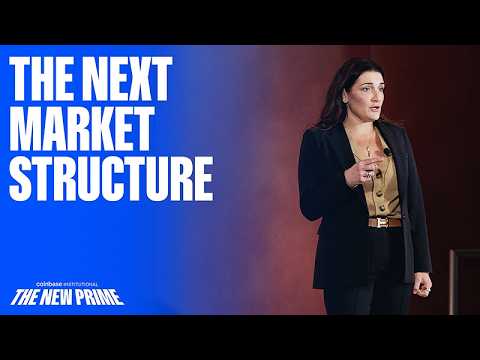
Hey everybody, I'm Brett Tespaul, co-CEO of Coinbase Institutional. Um, you got three things to remember. Okay, first thing, Coinbase is absolutely the dominant institutional platform in the world. Okay. Two, we are the ultimate platform play for capital efficiency, operational efficiency. Okay. And number three, we are absolutely the best partner to choose. Okay. So with that, I welcome Alicia Hos to stage. — Hello everybody. Brad, how did we get chairs? — I don't know. It's kind of cool. — We kind of got cozy up here. Settle in for a nice fireside chat. Okay. Well, — here we are. All right. So, start us off big picture. You're the CFO of this amazing public company. Talk to us a little bit about the big picture and our financial health. How are we doing? — We're doing great. No, I think that we had a solid 2025. We doubled total trading volume on the backs of a lot of growth on institutional. So, thank you. on the backs of diversifying our revenue, growing USDC from 6 billion on our platform to $18 billion on our platform, doubling our trading volume market share on the backs of acquiring Darabit and diversifying our product offering deeper into derivatives, adding options. We have a fortress balance sheet for a crypto company of over 11 billion dollar of cash and cash equivalents which gives us the opportunistic power to be acquisitive to invest to find opportunity to build organically to put capital to work in our financing business. Lots of opportunity for us to be really diligent in how we use our balance sheets strategically. We saw great growth in our institutional business which now comprises about 20% of our total revenue. I mean Brett when you and I started like — zero — maybe. Yeah, we were rounding errors like um fun fact Brett was my last human contact before COVID. We left the office and both went home. So, you know, it's been a good fiveyear run on going from zero to 20% of revenue. Um so we're in a strong place. We're really excited for the foundation and really what we're seeing is the shift into utility and that is a big story that we're heading into in 2026 and beyond. — Second fun fact because you made me think of it. We were the first two to do a financing trade at Coinbase. — That was you and me. — Good job. — Awesome. All right. So, uh, let's go a level lower. So, let's talk where are we in the institutional adoption cycle? But I'm going to make it a little trickier question. We have two elephants in the room. Elephant number one is just this uh volatile market environment. And elephant number two is the global regulatory landscape. — What are your thoughts on both of those? — Look, we are in a volatile environment, but Coinbase, those of you in the room, we are no strangers to volatility in crypto. What we are seeing is this is the first cycle that has been led predominantly by institutions. And it's honestly no surprise with the significant growth of ETFs. We see a lot more institutional capital in the market than we did in the 2022 sell-off. And institutional capital is highly correlated with the macro events, the interest rate environment, tariffs, and so we have seen deleveraging broadly. We have seen a sell-off. However, when we peel back and we look what's underneath the hood, we're really heartened to see our retail traders behaving as they've always done in periods of volatility. They are hodlers. The vast majority are holding and not participating in the market. And those that are active are actually net buyers. and we see retail buying the dip. Coinbase is also buying We've also seen significant stability in stable coins and it really shows that we are moving into a utility phase of crypto. So while you've seen headwinds and 20% price sell-offs in total price of some crypto assets, USDC we're in singledigit declines and so it's showing that USDC is becoming uncorrelated with just a trading asset and it's starting to be a part of other business needs. So we will fare through this. Bitcoin is still the best performing asset over the last 10 years. In the short term, we do see higher correlation with equity markets, but this is a very short-term phenomenon. And zooming out, we see that there's broader technology trends. It's also important to show that crypto when you look against the internet, when you look at other technology adoption, AI included, it's ahead of the growth curve. So short-term noise, we're building through it. Our heads are down. — Okay. So, we're in good financial shape. We've seen volatility before. We're a good counterparty credit. Let's double quick on regulation. So, we've got the Genius Act. I think that I've been saying it's been a giant catalyst to institutional adoption, but yet the market shifted its focus now and

Segment 2 (05:00 - 10:00)

it's looking at the market structure bill. What's your big picture on that? — Yes, we need clarity for clarity. Um, we are very optimistic that we will get legislation passed this spring. We are at the table. We think we have a win-win strategy to bring crypto and banks together to drive forward legislation. It may require compromise, but the we think these are going to be net good for Americans. We think this is crypto and good for crypto adoption. And this will give us the rules that we need to bring in more institutional capital just like we saw with Genius where it brought additional flown flows into stable coins. I think we're going to see more fund flows into tokens in generally and I think it gives us the catalyst to drive tokenization markets forward which is I think the next big trend in crypto. — Yeah, we'll get there. We're going to talk more about that in a second. — I'll pause. — I think this is you. — Oh yeah. I wanted to ask you a question here while we're up here. Um gosh, like you know it's fun for me to be in the audience. I'm normally not the audience member and while I do sit in a lot of product updates, it's fun to hear our product leaders pitch. So Rick, Justin, Alec, great job. But Brett, for you, — you talk to our clients all day long. You were the one along with Lauren who were meeting with many of you. And so how do does the client feedback influence the institutional strategy? Why do we believe that what we just presented, the integration of all these products, the tech stack that we've built, how is that going to serve our clients needs and why do we think that's going to create outsized growth and market that will accumulate on our platform? — Great question, Alicia. — Thanks, Brett. — Well, when we started this thing, really all we had was custody at the beginning. You remember — which is the bedrock. And if just to interject, — yeah, — custody is the core of our flywheel. As we accumulate assets, our clients tend to trade more. They tend to use more value added products. We can turn that into revenue that grows our business that builds more of the fortress balance sheet and drives our counterparty strength. So that is the flywheel of custody. But custody is the bedrock. — It's at the center. But I remember the first people that had custody were venture funds, a few high net worth, — those who needed it. — They needed it. Then we had the first wave of hedge funds and they wanted to do a little bit more. We said you can store it but you couldn't buy it at a particularly good price and you were captive to the Coinbase retail exchange. So the first thing we did was actually the acquisition at Tomi. We've made five acquisitions over the years but that's how Greg and I came together and since then we added smart order routing. Then we did another acquisition and we started staking. So then you could hold it, you could stake it. Then you and I did the first financing trades. They were one-off trades. We were doing sort of an allocart version until we bu we built what we've got today. Then we made another acquisition which is FEX at the time and we added dated futures. Then we made another acquisition uh and we you know built along the way of course u but then we bought liquify actually to do the frontto back of the cycle of investment into protocols and cap table management and then of course we did another acquisition which was derabit which was the key the last really key part of actually adding options and then of course along the way we launched Intex as well. So for a while now we've had all the products but we've had them in different places and so the main feedback loop from everyone that we speak to is everything in one place. I want to be able to execute end to end within the qualified custodian. I want to be able to do and we're getting there but we're going to be able to do cross margin across all the entire surface right from spot to options dated futures per you know and so on. And so it's super exciting for me to get to this point where we're not sort of on our back heels and saying, "Oh, yes, but we can kind of live with the core custody product and then we can do this add-on business. " We've now got a frontto back um which is bulletproof. Um and that's just fantastic. And so I guess we're at a point now where I can be a little bit more front-footed about, you know, with the clients and saying, "You really ought to partner with us. You really must partner with us. uh and we're getting to a point with tokenization as a bridge into our old world of being able to say even for those use cases and payments is the is you know is a driving case uh for everyone that we are the partner of choice so that's I feel chapter — it's super exciting about okay so what's next — and I was a CFO of a hedge fund before so I know the fun of the back office and I have to tell you like from the ops standpoint and even from my own ops at Coinbase the ability to reconcile the crypto, the ability to reduce the settlement risk, it's huge. It just takes away a lot of the complexity and risk that I've seen in the past in the Trafy world. — Cool. So, all right. — Again, so now we've got all these products. I still want you to reflect

Segment 3 (10:00 - 15:00)

about the whole firm because your job is the whole thing. — Um, what have you noticed over the past couple years about any shifts to multiclient activation? What have you seen to our shift to revenue? Um and the other big things that we announced were we want to be international, we want to do more derivatives. So a lot there, but like what are your top of mind reflections? — All right, revenue diversification has been one of our core goals now for the past six years and institutional has been a big driver of that diversification. I mentioned earlier that it's about 20% of our total revenue in 2025. But more importantly, I want to dive into like the number of products that are underpinning that revenue growth. We have 12 products that generate over a hund00 million of annualized revenue. We have six products then that are over 250. Two that are over a billion dollars of annualized revenue. And of that portfolio of 12, six of those products were institutionallyled products that over the last two years have joined that $100 million of annualized revenue club. So the growth and the scaling of the institutional platform, adding options, adding derivatives, growing USDC frankly on the institutional and embedding that within the international exchange have been core drivers of our revenue growth and diversification and on international absolutely I would point to our derivative strategy international as one of our significant growth drivers obviously augmented by the acquisition of Darabit and bringing now together the futures and options product on the international exchange in the coming quarters gives us the foothold the product suite to really start to build that liquidity and depth in the international market. — I love it. So convincing. I — All fact. I love all fact. — Before fact, all previously disclosed. — Okay. Now, let's talk a little bit about um credit efficiency. Let's talk about stable coins and tokenization. — Um personally, I think it resonates the most with clients if we're not like, "Hey, here's the big dream. Let's see if we can do something. " but rather here's some things we can point to that have actually happened — and so maybe drawing out some reflections for me — I call these as green shoots — and green shoots turn into saplings — okay so let's talk — where are green shoots — let's go city bank as you know in this theme stable coin — payments talk to me a little bit about what we're doing and also while you're there touch on the importance of banking partners actually facilitating this whole cycle Sure. Digital dollars like these are so exciting. I firmly believe that individuals, businesses want the highest rewarding, lowest risk, lowest transaction cost, highest speed, most globally accepted programmable dollar. It is the best dollar out there. It is better than any dollar that we've had before. And we are finding now an increasing number of customers want that. We also see a number of individuals that want that. And so some of the early proof points what we're seeing and it speaks to the partnership with city is their corporate customers were coming to them and saying I have a customer or they have their customers saying I have people that I need to pay out in a disperate number of regions around the world and those people around the world are wanting US dollars. I want to pay them in USDC. However, city you've been my primary bank account. You handle all my treasury for my overall business but I need USDC now. How do I do that? And so City came to us and said, "We want to partner with you, Coinbase for the payin payout of USDC. " And now it's a very symbiotic relationship where City powers our fiat payin payout for certain accounts, we power their USDC payin payout for their account. these worlds are coming together and you're starting to see people who have business needs because the either they have employees or vendors who want to hold US dollar accounts in countries where they don't have access to a dollar bank account or they just need speed of payment and it's too many steps too many correspondent banks to kind of work through to permeate to drive payouts to a number of countries that are demanding stable coins because they are borderless they are fast they are cheap to make transaction payments. So those are kind of starting to drive partnerships. We are also seeing corporates who want to just manage their internal treasury more efficiently. So for our own treasury, we obviously have 25 subsidiaries around the world. It's a complex structure. Many of you have multiple funds in many jurisdictions. When you need to move money through your corporate ecosystem, it is much easier to do it in one interface like Prime where we just showed you, you can move money 247 through a number of different accounts. Very easy. reduces friction, lowers cost, lowers settlement risk. So, we're seeing that on one side of the payment side, but going kind of where you were going, USDC in itself, I would say that is one tailwind and growth driver of payments USDC. There's two others, one being agent commerce and the other just being collateral and the use of stable coins as the payment leg of any onchain trade type. Those are the other two kind of big catalysts that I

Segment 4 (15:00 - 20:00)

see to overall stable coin growth and adoption. Yeah, I'd say the big picture point for me on this whole stable coin and payments is that um I would say the second wave of institutions that are coming in that didn't necessarily activate during the investment uh use case and I want to own Bitcoin or and deploy capital have really come unmasked and they've come now and crypto has for an industry for a long term. When I first came to Coinbase six years ago, we talked about stable coin payments. We talked about remittances and if we're honest it never really scaled. Um — it was always a matter of when not if. It required some preconditions around scalable infrastructure getting to the regulatory clarity on like what are appropriate reserves behind the payment stable coin. But now we're there — and then genius happened and genius was the moment that all of a sudden the pipelines shot up and that's why you know one thing to remember for the room we have five of the top global banks in the world five out of 20 that have already signed on announced part partnerships with Coinbase. So it's a huge deal. So you're right that moment has come. Let's touch just briefly on tokenization. Uh so a couple things that we've done we did a tokenization of the Mubata credit fund. We've done a tokenization of an Apollo credit fund. Um we've worked with some combination of Salana and Galaxy and JP Morgan and others all doing the first tokenizations. We've seen JP actually uh do one such trade using a nonJP Morgan blockchain on a third party you know custodian using USDC. So draw for me from here the significance of having these global powerhouses talking about Larry Frink as an example like tokenizing everything. What do you see? Well, I think what's important for all the names that you see publicly, there's a long tale of people that are not publicly stating what they're doing in this space and the large the preponderance of large companies now are discussing what is their tokenization strategy? What does that mean to their back office? distribution capabilities? What does that mean for the infrastructure, the partnerships that they need to strike? How do they choose a protocol? stable coin? How do they choose a custody partner? Those conversations are now rampant across all teams. Um, and what I think that you'll see is in a postclarity, a post SEC rulemaking, that will be the catalyst to drive many more tokenization projects forward and give us the rule set for how do we enable secondary trading for these assets? What are the different market participants that need to be established for service providers to then have transactions? We can build that into our assets that we can trade in Prime. We are just beginning to scratch the surface. we are like here in the inflection point of setting the foundation. Um but I think that we are starting to get all of the conditions precedent that this could be the next catalyst of diversification of assets on chain bringing the crypto economy together with the traditional economies. — Well said. So let's talk just our last p oint on like the durability of institutional adoption. So we we've drawn out these teams. We just showed an an end to end. Do you think this is this moment that we're in? Is it all contingent on just regulation? Bitcoin price? Or do you see this trend continuing? — Bitcoin is first. Bitcoin is important, but there's a big story beyond Bitcoin. And I think it's so important that you look at the growth of stable coins and the payment use cases. The theme of tokenization, the theme of just moving actual assets on chain and is bigger than Bitcoin and Ethereum in itself. We are clearly starting to see breakout winners in the protocol conversations. You were definitely seeing developers choose base as a protocol to build on. You can also see developers building on Salana. Those two have a head start. But you might have noticed there's a many well-funded companies now that want to have their own layer one chains. We're in what I would consider the fragmentation part of technology and you're going to see many people try to become the platforms upon which this future economy will be built. We believe that there will be consolidation and winner takes most markets as these underlying tech stacks become the building blocks that we all need for network effect and interoperability. And so that's sort of where I think we are in the cycle. As we get there though, what you'll start to see is just more and more assets brought on chain, tradable alongside, prediction markets, equities, crypto, derivatives, more capital efficiency, less settlement risk, better operational rhythms and I think that is a durable trend. I think water flows downhill. I think believe in faster, cheaper things get adopted when they have the right infrastructure and control support. So the volatility in the short term, it's noise. This is a long-term tailwind that we should all get behind. — You know, as a client facing guy for a long time, you know, the moments come

Segment 5 (20:00 - 21:00)

when it's your clients become the loudest voices, right? And so now I've got some amazing salespeople out there. Um, I think I'll reference Larry again and Grace Gill has been there for a long time, but it it's amazing when your clients are sending the message to the world of what they're doing and why. and it's better, faster, cheaper, and they're choosing Coinbase. You know, your moments come. So, I think that's a great place to leave it. I want to go back to the beginning. So, you're meant to remember three things. That's you, the audience. One, Coinbase is absolutely the number one most dominant profile, sorry, dominant platform, you know, in the world for institutions. Number two is we are the ultimate platform play. And I was really excited to have this moment today to actually demonstrate that we've actually solved all the major problems. We solved the NDM. We have the operational and capital efficiency. And number three, please choose Coinbase as your partner. So, thank you for joining us today. We'll see you all upstairs. Thank you. Thank you, Alicia.

Другие видео автора — Coinbase

Ctrl+V

Экстракт Знаний в Telegram

Экстракты и дистилляты из лучших YouTube-каналов — сразу после публикации.

Подписаться

Дайджест Экстрактов

Лучшие методички за неделю — каждый понедельник