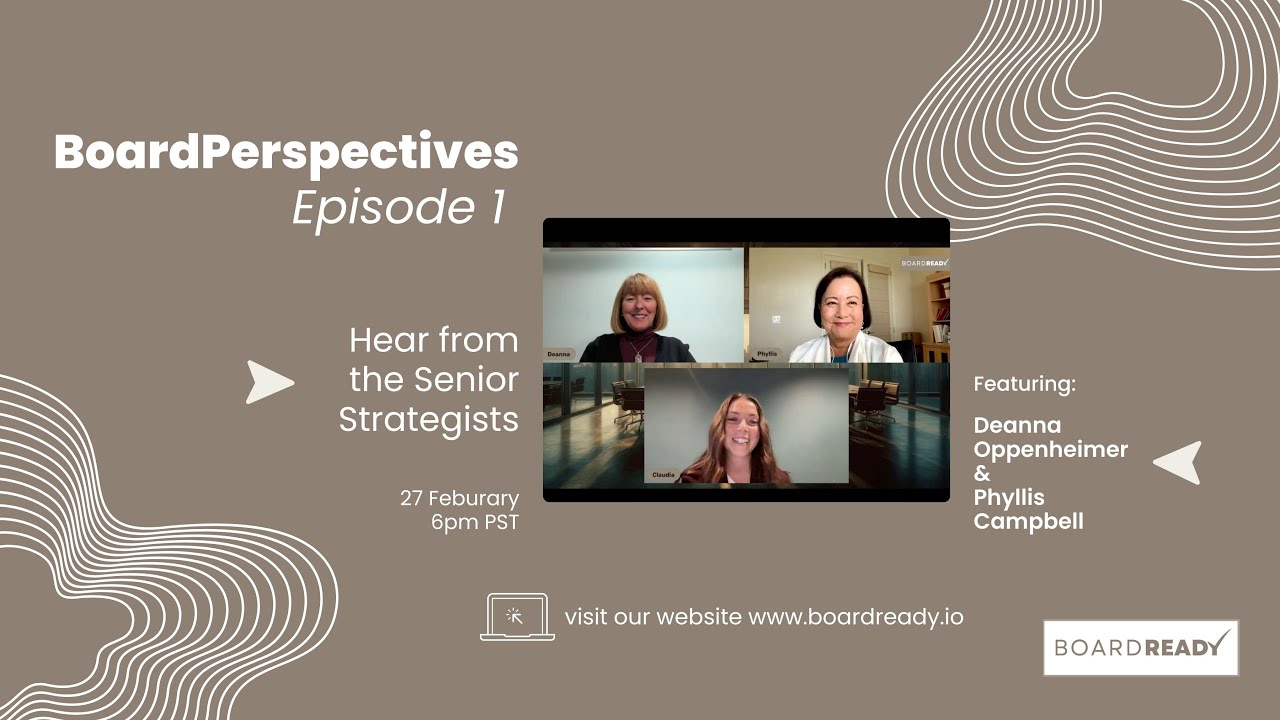
Episode 1: Hear from the Strategists
45:10

Episode 1: Hear from the Strategists

BoardReady 09.05.2024 14 просмотров

Machine-readable: Markdown · JSON API · Site index

Поделиться Telegram VK Бот
Транскрипт Скачать .md
Анализ с AI
Описание видео
On episode one of BoardPerspectives, we sat down with BoardReady's founder, Deanna Oppenheimer, and Senior Strategist, Phyllis Campbell, to talk about their journeys to the boardroom and the lessons they learned along the way. Tune into this 45 minute conversation to hear all about points of entry, the impact of inclusionary boardroom practices, and more!
Оглавление (10 сегментов)

Segment 1 (00:00 - 05:00)

good evening everyone thank you all so much for joining us tonight for our first ever discussion in our board perspective series we have over a hundred of you joining tonight from all ranges of the country even in the UK so if it's 2 am and you're tuning in thank you for being here we are excited to Dive Right In um our goal with this webinar series is to sit down with folks that are equally as passionate about our mission as we are and we really want to provide some meaningful content and extended networking opportunities to our talent Vault members and also if you're not in our talent Vault inquire more because we'd love to have you um for tonight's session no better way to kick this off than starting with our two senior strategists Deanna Oppenheimer and Phyllis Campbell before I turn it over to them I will provide some brief intros highlight the focus of our work here at board ready and then after our discussion with both Phyllis and Deana we will have a moment for Q& A so if you have any questions that come up as both phis and danan are chatting feel free to drop it in the chat and we'd love to answer those um if we haven't had the chance to connect my name is Claudia Longo I am the program associate here at board ready um I started last year coming off my undergraduate degree at the University of Washington where I studied neuroscience and played soccer so a bit of a pivot to board ready but I am loving it and I could not be more stoked um and speaking of board ready for those who maybe don't know our mission is to diversify corporate boardrooms and we do that in varying ways board boost is our way to connect corporate clients with board ready individuals in our talent Vault um we also have events and webinars like this one we are doing and we also focus on thought leadership so back in 2021 the team published a report um called lessons from the pandemic examining the link between you know board diversity and certain performance measures so more to come on that um stay tuned but back to tonight's webinar as I said we have our senior strategist Diana and Phyllis um Deanna has quite an extensive career in fining cial services that she then brought to boardrooms both in the US and in Europe um Diana correct me if any of this is wrong but you are currently the chair for IHG hotels a non-executive director at Thompson Reuters and at solom um previously was at bar Clays and then also sat on other boards such as Tesco whitbred Joshua green Corporation and many others but for the sake of time um I will move on to Phyllis whose story also paints a similar picture um she's currently a board member at remitly and the air Transport Services Group um an Advisory Board member at San Mar and the Allen Institute um last spring she retired from her role as Vice chairman and Regional chair of the Pacific Northwest for JP Morgan Chase um I use the word retired lately as that's has not retired um and as you know we know Phyllis andiana they show no signs of slowing down anytime soon in my humble opinion I think boardrooms companies and the World At Large are all better places because of these two so super excited to turn it over to them and I will start it off by di asking you um I know I just gave a bit of a background but tell us more about what you're currently up to both in your professional career and your personal life well Claudia first off I think that one of the greatest accomplishments um that I've had recently is finding you to bring you into board ready so thanks so much for that great introduction but thank you for all the work and all the Innovation that you're bringing um to our task here so um like Phyllis uh one of the reasons that we have so much fun working together is we were Bankers together for many decades um back uh when there weren't a lot of women bankers and uh so we've known each other back from our executive career but now over the last decade in my non-executive career I've been doing three things one is um focused on board work and the second is uh focused on trying to stay current um and uh keep learning myself and I've done that through a number of exciting ways one is slalom right now who does so much work in Ai and in technology but the third is the give back and that is trying to help others that are really incredibly capable uh to get to have their chance around a boardroom table and to diversify boards and that's what we're doing um here at board ready so it's been a great opportunity to do that and uh a lot of fun on the side I'm having some fun traveling spending some time with family and uh all those good things that we like to do awesome and Phyllis what about you well uh first of all I just want to Claudia take a moment too and say thank you to you I have to say uh bringing Claudia a board as a colleague for board ready was all agree with Deana the

Segment 2 (05:00 - 10:00)

best thing that could have happened at board ready so if you want to get to know someone who's important at board ready that's Claudia Deana and I just sit back and generate lots of ideas and Claudia actually implements them so thank you Claudia and thanks for organizing today and also I want to say thank you to everybody who's joined because I know a number of you sent me notes saying I'm going to join the webinar I'm excited about it but I also would say back at all of you you're Paving the way as well many of you are already on boards uh some of you are looking for your second or third board so you are Paving the way too and I just want to say I know so many of you out there that are giving back and you know really carrying the torch that Dean and I are and Claudia are carrying here so just quickly Claudia um I'm just GNA sort of go to Deanna's three things uh we have very parallel career paths very parallel lives we're good friends as well which is wonderful but my you know number one is you just said Claudia I'm serving on uh a number of boards right now and have much of my executive career which has been wonderful and actually it's been um as I've learned as much as I've given and I think that's one of my criteria for joining boards is you know I know I'm going to give back but what am I going to learn so I tend to pick you know different kinds of Industries and businesses throughout my board career and we can talk about that later but that's probably the first thing the second thing I'm doing is what Deana just said you know continuous learning and uh you know I've started a small Consulting practice a Bowtique Consulting and I'm helping mostly family-owned businesses I'm finding form boards um and think about succession uh in their management as well as on the board and it's really been rewarding and I found that there's so many great businesses out there that again I've learned so much and been inspired by as I uh engage in my own Consulting practice and then the third one Dean just said give back which has always been important to me and obviously board ready is the one give back as we've just talked about but uh Claudia mentioned the Allen Institute and Claudia I know your major was neurology at in at the University and you know I just absolutely love learning from the smart scientist I'm inspired by the work that Paul Allen started 20 years ago with open Team science around mostly neurology so it's just you know I think that's kind of to close the loop what de is really saying which is an important theme for today is you know never stop learning but you know just keep everything read everything you know which I do and I try to connect the dots but more than anything I just try to learn new things every day so it's a lot of fun having fun and I'm trying to play a little golf but not very good very good golf no that's great well just as you guys say you're learning something new every day I have something new to learn from you both every day and I know everyone on the stream feels the same way so I want to rewind it now kind of go back to 2017 de walk us through what starting board ready looked like what was your inspiration I know you kind of touched on a little bit of that but really take us back there um and talk to us about that well you know it really is interesting because uh these ideas kind of hatch around in your head for all of you who have started something you know how that works kind of going I don't know about this but it crystallized and culminated at a breakfast that um Phyllis and I were at with uh some other really interesting women um that were doing board work as well and we were starting to compare notes and we sat there and we said you know we're getting a lot of calls for boards and um what we're hearing from all these people that are coming in is saying well there's nobody else you know if you won't do it there's nobody else that's out there and I sat there and we chatted and we came up with a list of many many diverse candidates that um had an incredible ability to serve on boards that just were not known and so we thought that there was a real not problem with the supply but basically with the demand and matching the supply and demand and that's what caused us to start board ready was to try and connect up one the importance and back in 2017 board still needed to understand the importance of what diversity brings it's amazing to think that there were many people that we talked with weren't there Phyllis that um why do I diversify my boards but that basically needed to be able to bring together the diversity of what they needed on their board with people that could serve and that's how we started and uh slowly but surely we built up a number of different um people in our

Segment 3 (10:00 - 15:00)

talent Vault and uh boards that we worked with yeah no that's great and I would love to hear from Phyllis too um you know obviously you had started with Diana back then but now in 2024 the conversation is still continuing so what inspires you number one to have involved back then but continue your involvement now well that's a really good question Claud and I think reflecting on some of Deanna's comments you know there was some progress there for a period of time they're sort of in spurts from 2017 and I I'll tell I'd say Deanna Bor ready deserves some credit but there were a lot of other organizations uh that were working on it obviously NASDAQ uh demanded you know some diversity with their listed companies we've got um you know some of the uh proxy advisory firms that are pressuring uh companies to have more diversity on the board so there's a lot of forces that came together uh different state laws and so on so I think all of this kind of came together caused a spurt in more diverse placements uh in particularly for women which is great and then the George Floyd unfortunately incident happened in 2020 and that forred you know much a much greater call for ethnic diversity especially for black directors which caused another you know I would say well needed and well timed um you know and well-placed emphasis on more black directors and other directors of color so I think there's just been good progress but not great if I sit here today and to your question Claudia you know I think the reason we form board ready is a nonprofit Deanna and Deanna in particular said we need to be a nonprofit is because we really want to say look this is not about us this is not a self-serving uh Mission at all this is about the greater cause of diversity of thought on corporate boards which is really like lacking and it's still lacking today and I look at boards at least in the US Indiana you can talk about the UK in a bit is there's no pressurization for turnover of directors so there's still a preponderance of you know white males on boards usually older usually you know have been there for a very long time and so that has not changed a lot and now we stalled out this last year the statistics show that there were not a significant number of appointments of women or people of color so I guess what I'm worried about is that and then I'm worried about the Dei push back because now we're getting State uh Attorneys General who are you know raising their I guess banners saying look corporations you can't set goals you can't you know look at diverse pushes favoring women and minorities because quote it's you know not it's not quote legal which is that's not true the higher ed ruling is not applicable to corporations but I'm begin to hear that gee maybe we you know what why do we need more diversity we're just fine so there's now kind of a complacency that's set in and I think you know we the three of us have talked about it along with our other colleagues on board ready and we said you know we've now got to start raising our game raising the visibility of the issue again all under the banner of diversity of thought and diversity of you know what I would say is voices that really add to the you know to the I guess good go forward strategy for the companies that are out there I think one of the comments that I'd pick up on as well is inclusion the real opportunity here is that we are facing now into a world that is changing faster than it's ever changed before and uh that is basically coming into a way that is really challenging and that means we need all voices around a board table um to be heard to be included and we need as much diversity as phis says as possible because what we did in the past is not going to be 100% applicable for the future and we will need to move at a speed of pace I think one of the things that we've really enjoyed with Phyllis and I have both done um a lot of is mentoring and um as a mentor you get a lot more from the person particularly if it's a multi-generational side of it that you are learning than what you're doing um kind of coming back so I do think that this topic as Phyllis says you can't be complacent um and that whatever uh diverse thought that you are bringing we need to have a lot of inclusion around the board table and I you know I just sort of make one quick note to your point Di that's where a good lead director or independent chair

Segment 4 (15:00 - 20:00)

really earn his or her money in my view is because that person typically sits at the board table and really listens for the voices that need to be heard that sometimes like my voice sometimes I'm quieter I tend to think before I talk but you know I think part of it is um some people need to really think through their ideas and sometimes they don't get air time at the board table so having you I'm just sort of including this as a footnote if you become a independent director chair of the board and de has been in that position many times because she's a superb listener she gets inclusion she gets every voice heard at the table and that's to me an important role that women play by the way because I think we just tend to listen more yeah absolutely and I love how you guys talk about diversity of thought I think that's so important everyone kind of uses the term diversity but no it's really diversity of thought and that's kind of all-encompassing um I know you both touched on kind of being a chair or lead director and all of that so let's rewind um Phyllis bring us back what was your first role in The Boardroom and for individuals um in this webinar looking to land their first seat what would you highlight as three key points of entry three key points um okay thank you for having me boil it down okay well I think the first thing was my point of entry and that actually is a significant point though I do get stereotyped in the audit risk committee because of my financial services background I'm actually okay with that because I it is a good entry point for boards and for those of you that have either an audit background or financial background or risk background it's a great entry point because every board in the world is looking for especially you know audit yes but especially the risk um notion and particularly for those of you that are cyber experts that's such a great entry point so you know I I would say that would be one is what's your kind of core expertise comp um you know there's so many uh needs out there that boards are looking for everybody's talking about gen AI so what's your point of entry and mine just happens to be audit risk so that's kind of0 one Plum I'd say point two is that you know I think I had a good Network I I've always you know I really think that the network has really mattered and I've shown up at places and I actually got my first board which is your question from sitting on the Seattle Chamber board and when I spoke I think one person came up to me and said I love the way you frame not just thoughts but good questions and I just thinking would you be interested in you know standing for election in our board of directors and it never occurred to me that you know I was I was not certainly not in the market for a board at that time but it was being observed I guess in these nonprofit board settings and really getting people to know who you are how you think and that really mattered for my first one or two uh board appointments and then the third thing I'd say Claudia is since you're having me boil it down is you know I I do think that uh everybody's looking for back to deana's original point about learning everything the point and uh just being intellectually curious is people are really looking for how relevant are you and I you know I think one of the things that I've always prided myself in my day job but outside my day job is just being intellectually curious so a lot of times with people I just follow up and I say you know you said something in that meeting could I get buy you a cup of coffee I'm really interested in what you had to say and follow up and develop those relationships more importantly trying to find out more and you know again that led to somebody saying to me you know you asked you're always curious about the next thing and the next thing I know you're really thinking about it in a strategic framework so you know figure out ways to demonstrate that because every one of you on this call I know has that I've learned so much from Dean for sure in that context but I think part of it is just having um a place to show up and be seen and then have people get familiar with you and that's that again has probably led to a lot of open doors for me yeah that's great di anything to add no I think that uh Phyllis really hit on one thing that is important as I talked to a lot of people that want to get on boards um one of the analogies that I use is it's like you throw a PEB Pebble in to the water and there's ripples you have to start with the ripples that are closest to your experience and that means that if you've had a big career in financial services as both and I have had I've had the good fortune on serving on many other boards in other Industries

Segment 5 (20:00 - 25:00)

but it started with financial services the first time I got picked was because I had a background in mortgage and lending and for the board that I went on to so it's really important that you understand what your core competencies are and then you look at opportunities to match those and you have an elevator pitch about yourself so when you do get an opportunity to talk to somebody about a board you don't wander all around with everything else and all the things you'd like to see and all those things it's you know these are the three things that I would bring to your board and I've looked at your background of your company and you've articulated in your annual report that these are important things for you so I think it's that match close to your expertise to get started yeah and could I add something because you asked about the first board and I was just reflecting back on my thinking you know my first board I think there was one other woman on the board in a 12 person board it was pretty large board by today's standards and I remember though thinking to myself being a woman person of color couple times I got ignored couple times you know this just happens right but I think part of it was I really had to summon my self-confidence to say look I was asked to be on this board I do have a right to have a seat at the table and just because I said something and it got ignored and it was said five minutes later by a guy at the table everybody thought it was a great point you know that does should not diminish my sense of saying to myself oh you know do you didn't say it right or you know your selft talk kicks in so I would the observation I'd probably share which is a little bit about Deanna's elevator pitch is have a very confident elevator pitch but to me I would say I had to believe it too and I had to really believe it when I sat at that board table and you know I was new I was one of the few there sitting there and that's not an easy place to be when you're both new and different than everybody else at the table but I think you know just having that self-confidence at the table to say look you were asked to be there you've got a point of view you've got experience that's needed speak up uh make sure that you know you ask good questions yes but I think more over for me it was just get getting my self-confidence on my sea legs you know to say hey I actually have a place at this table yeah I like that we say okay so you have the confidence you have your elevator pitch how do individuals you know rewind how do they what do they do to take the next steps in their board Journeys what are good ways that they can start showing people that they want to be on these boards they have all these tools they're ready to take the next steps what should they be doing well I think the first thing is that um one I'll put in another selfless pitch here join the talent Vault I think that's always a good thing here for board ready um but it's really again important that you think about what type of board it is and what type of organization it is that you are going to serve on so if you have never had any public company experience and you have never been a public company executive ever served on a public company board picking General Motors as your first Target is probably not what you want to be doing but if you have started up some tech firms and you've been a part of a startup and you've LED some of those you've maybe ipoed at company you start to look at those areas that have companies that have characteristics that you share that same experience with so again I know I'm probably beating a dead horse on this point but it's the same thing true on how you target the boards the second thing is I heard a great example from one of our talent Vault people who went out and she said she had public company experience she had IPOs experience uh really a great Tech leader and she wanted a private board public board so she basically went through all the work and it's a lot of work of targeting all those private companies seeing all the ones that had board members that were moving along and actually also then looking at where the needs that she could meet she did the same thing on public boards and she methodically networked then to start meeting people through search firms through other board members through um forums like this and finally she ended up at the end of you know probably too long a period of time from her standpoint but definitely getting that

Segment 6 (25:00 - 30:00)

boarded so networking is crucial uh meeting with introductions of everybody that you see is crucial um but again really understanding that match is important and being able to start where there is a need for your skills and then working your way through that the final thing I'll say here too f is board work is not for everybody um I often say a board member the difference is um between an executive and a board member is like the difference between a parent and a grandparent parent and an executive you're calling all the shots you're making all the decisions you are working through everything as a non-executive director you are the grandparent you are stepping in and helping to shape things that are very important you are not instructing you are emphasizing and you are helping people learn um and if things go really bad you do need to step in but it's a very different approach because there is nothing more frustrating than the executive that walks into a boardroom and says well we used to do it this way at ABC company or we used to do that um so again Phyllis talked about the importance of framing questions that becomes really crucial as well yeah I want to pick up uh Claud on one of Dan's points and I have a couple more maybe to add the one point is a board is not for everybody and I talk to a lot of people who say well how many hours a week do you spend on a board uh here it's maybe two to three hours a week on average and I say yes that's true uh however to Deanna's point if there's an issue a problem a merger a spin-off an activist mean honest to God I think in on some boards or a CEO change or sudden succession unplanned succession you can be up to sometimes 10 12 15 hours a week with phone calls with you know just all kinds of things special committees if there's a problem you know there's generally special committees that are formed of the board and it can be almost a full-time job with to Point not the influence and necessarily Authority NE to to make the change but you know really you're just in there recommending trying to get things back on on even ke and if it's a merger there's just lots and lots of analysis that goes into that so I guess what I would um say is just go in with eyes wide open on average that's probably true that it's you know a part-time job it's very rewarding there's in my view more benefits than there are downsides to serving on a board but boy uh the time you have to have the time and you have to you know when I had a full-time working career as you were saying Claudia you know juggling even two outside public company boards uh most weeks fine but some weeks wow I was working weekends evenings um you know I'm putting in very long hours outside of my day job so it is just something to think about and just make sure that you have the time and as I Dean and I always like to say don't collect boards like postage stamps because you know just putting checks on the wall and saying oh I have now four or five public company boards that to me is a well it's a big flag and also the SEC thinks these days but it can take a lot of time so I did want to make that point and underscore de what you said and then the second Point uh about um things to think about which is what Dean just said is when you decide you want to serve on a board be very targeted What's the culture of the company who are you aligning your reput with and that to me is extremely important because you're aligning your own personal reputation your whole history that you built up with the board members you're serving with and with the company and the executives uh on Whose board you're serving and I can assure you we can all look back on the you know the Wall of Shame of all these companies that have not succeeded and done well and have had major problems and everybody looks to the board and says where was that board and I have to say that's a really an important consideration so do think about that and then when you do decide you know these are the three or four companies that I'm interested in to deana's point you know really going at it in a surgical way who do I know on the gnom committee do I know the CEO do I know some of the management team that could you know add where I could get to know them maybe add some value they get to know me and then over time maybe the board uh becomes open to me the board opportunity so I think just being really surgical about

Segment 7 (30:00 - 35:00)

it and looking at the four or five companies that are aligned with your values and your culture and that you'll learn something and all your criteria then go for it and there's no reason to not be very assertive about why you would be a good addition and I would say to you having chaired govn committees guys are much more forward about saying you know I want to be on your board and here's why I'm qualified end a story you know here's my resume and I don't see a lot of women doing that and I am not recommending being that aggressive but I think there's a way to go about it and to be more assertive to say you know I don't know if there would be an opportunity but if there is I wanted you know I'm very interested in your company to D this point I've done my research I'm very interested I think I can add value in these areas would you keep me on a list and that's it's really almost as simple as that and I know it's hard sometimes to do that but you got to do it so um that's I think the next thing I would say and then probably the last thing I'd say is um yeah as Dean already said don't exclude private companies privately held companies I get I get the privilege of working with a number of them and they are really looking for good board members and honestly they actually are more flexible uh you know you're not spending all your half your meeting with SEC requirements and reading 10ks and you know trying to check all the boxes with all of the you know really all of the regulatory things that uh publicly traded companies uh tend to put you through so privately heeld family businesses there's a lot of really good ones around you know don't exclude that there's some private Equity funded companies that are really good too but you know again I think just do your homework ask yourself is this a place I want to you know spend some time could be a considerable amount of time or these people I want to hang out with this a place I want to lend my reputation to and you know if you do it's a very rewarding experience I would say I always felt it made me a better executive and I'm sure de you'd say the same thing exactly and in fact I think that for those of you that are Executives if you can sit on one outside board if your company will let you have the time to do it really is a great opportunity because one it gives you board experience so if you do want to leave when you leave executive life and do a portfolio like Phyllis and I are do you already have that one under your belt that helps you with but the second thing is that you can see how another HR department works how another Finance organization prints its numbers and what it does how other Executives interact and so you take a lot of those learnings back for yourself which is important um in terms of your network there's two key areas that I want to make sure in addition to the company themselves that you make sure you focus on one are search firms um I think in places like the UK uh 90% plus of the searches are done by a search firm for board work that's because there's a corporate governance code that actually stipulates a number of different things that's one of them that you either must advertise um out in the public or you must have a search firm outside of just the board itself but even in the US there's a growing preponderance of search firms uh searches that are being done by search firms and that's because it's tougher to find you don't just look at all the past CEOs that have retired out you now need people like digital expertise cyber that philis talked about earlier and a number of different expertises so if you are an executive and you've worked with a search firm uh to hire other people in your organization certainly go back to that individual and um ask to introduced to their people who focus on board work within their firm so um that's one area the second area is like board ready where we provide networks and things that we want to do with our talent Vault and members and connect that into various things there are a plethora of other organizations that are doing that today now for diverse candidates and many of them are on our website as our partners so we'd encourage you to go on to the Board ready. website and look at those Partnerships and just find them yourselves but the best part is um I think that you know Phyllis said it earlier how you show up in what you're doing she showed up in a nonprofit board and somebody noticed and said that's a skill set I'd like around my company board table so um there's a number of different ways that you can go out and start to really build your Network back into the

Segment 8 (35:00 - 40:00)

Border yeah it's a process definitely not that I would know but based on what you guys have all told me right um this actually ties into a question that we received um coming back to obviously you guys were in operating roles and then you kind of transitioned into advising rules one of the questions we have is how is a seat in the boardroom different like how do you manage your portfolio as more of an advisor vers when you were in this operating role so let's make one clarification there so there are two types of boards and Phyllis and I have both been on them and one is a fiduciary board and that is the one that Phyllis is talking about where she's served as a nomv chair where she has you know been a lead independent director I chair Intercontinental Hotel Group and Resorts those are fiduciary boards that's part of the governance those have investors that are holding that board accountable for um ultimately the strategy culture and performance of the company that is um that is a fiduciary board rle the second though which are really fun and interesting and both Phyllis and I have served on advisory boards and Claudia that's what you have just talked about there which is where there's a CEO that usually it's private company that he wants to have he or she wants to have a board that is not a fiduciary you're not sitting there signing off the numbers or doing anything but they want a sounding board and they want to be able to talk with them and learn a lot about what's out there so those are two types they are different they take uh different amounts of risk for the individual board member as well so um so you'll want to be looking at that so when you start to transition you look at first do I want to be accountable um for the performance of a company where I am not making every decision you know again as a board you're a team sport this is like soccer when you're on the soccer pitch you know you don't control every move that all your teammates are making so you want to make sure that is that something that I'm uh want to be doing and then two you start to look at classes there's some incredible classes available there are some incredible resources available and you really need to learn um the craft of what it means to be a good director yeah and the only thing that I would say is there is um there is with the fiduciary boards you are also liable and so that's the other side of the coin is I hate to say it but there's a lot of U you know litigation firms out there that specializ in litigating every time you buy a company or sell a company or subsidiary you're going to get sued and I've been sued four five times luckily the dno insurance covered it we had good legal council but it is just the way of life with a fiduciary board you're responsible accountable you're liable um again dno Insurance uh would most you know in almost all cases covers it but it's a pain you know when you have to go through that process the Advisory Board as Deana said is more giving advice you may be just as engaged which I am right now with sanar as an advisory director just as engaged we have the same kinds of formal agendas you know we go through strategy succession talent management comp all the things that the board goes through but we're not sitting there dealing with SEC matters and all you know all the things that Deana just articulated the other part of your qu the question though Claudia is a little bit may not have been part of the question but I wanted to touch on it is one of the hardest things though on sitting on any board is to you know the nose in fingers out and the nose in is you have the right to ask any question of management to question assumptions to ask those questions we talked about earlier you don't have the right to run the business and so what I found hard was you know I'm an operator I've always been an operator up until a year ago and you know I just want to get in there and say if you just did that and that you know everything would just be fine and this is the way you know it needs to be done but that's not my role on a board so there's a fine line and it's a it's an art as much as a science and the CEO and usually the lead director tend to set the pace there but it's sometimes hard to kind of respect that line and I would say I've had to learn over the years that you know it is a fine line and there's places when I need to back off or I've been told to back off appropriately yeah no I definitely like that distinction of nose in fingers out kind of along those lines as you're leaning in the boardroom um one of our other questions that was asked is what strategies do you use to stay

Segment 9 (40:00 - 45:00)

informed about Trends and best practices relevant to your board responsibilities oh that's a great question and you know I said earlier be curious about everything and you know I really do enjoy reading uh probably 70% of what I read is you know the economist and Business magazines and obviously try to watch CNBC Bloomberg News NHK I mean I tend to just consume media as much as I can on Daily News but I think the thing that um what I really then try to do is to pause and then think about how do can this affect my company how can this affect you know how does one thing affect another if it's you know a war in the Middle East what is it doing to supply chain you know all the questions that come up I mean obviously the economic and geopolitical consequences affect everything in this world today so I think part of it is just being really aware of not just consuming lots of sources of data but connecting the dots and asking how one thing affects another and so that's that sort of intellectual I guess agility I would say yeah and I think that this is one of the really big advantages of getting to serve on boards is you have board colleagues that if you have picked the right board as Phillis talked about earlier there are some really smart people and that's where you know um kind of the Fingers um out those in analogy works but it's also the you know two ears one mouth listening to a lot of your colleagues you are going to learn a lot and that is very exciting then there's some great resources you know again University of Washington uh you're onma moer where Phyllis is out as a fritzky chair right now they have some incredible resources uh classes and things for board director s um nasd which is again a Association has a lot of um really terrific um information so you can get information but um also as you go into a portfolio that's one of the big advantages is you'll learn something on one board that will apply to another and or you'll learn something if you're in your executive career that will apply to that board so it is really vital that um you not only read you not only attend webinars and a variety of different things but you listen to a lot of the fascinating people around you yeah that's a great Point listening and learning that's what I do with both of you to so well I like dian's two ears one mouth that's a good one the nfo and two ears one mouth I think everybody will at least take away a couple things yeah absolutely some good analogies too I know the mom versus the grandma kind of anal good way to put it so doesn't resonate with me quite yet but I know da it does with you as you have uh two little grandchildren now too which is super exciting but um unfortunately this is we are coming to the end of this webinar and that was the last question we had time for but thank you all so much for joining here tonight um really insightful conversations really great questions coming into the chat um just wanted everyone to know that again this is our first session so if you have any feedback um or anything that you want to see moving forward in the future we are very open to any of that again this is designed for you all as members of our talent Vault and we are just so excited to kick it off so wanted to turn it over to you Dan and Phyllis if you guys have any last second thoughts well the thing that I would just say and uh one thank you all for tuning in again um we will keep resources coming out of not only our LinkedIn board ready uh postings that we have but also off of our website and looking at more information coming out that side so I'd encourage you to come into that but thanks for taking the time to listen um we're kind of novices in here going in with this LinkedIn chat so your feedback would be absolutely uh brilliant and appreciated yes and we'd love to hear from you through Claudia or through Linkedin what other subjects would you like to hear throughout the year because we're going to continue this we're going to have some fantastic speakers as part of this series but I would just say thank you uh for being mentors and opening doors to all of you I mean de and I are certainly uh out there all the time we're working as de said being mentors ourselves but all of you too are making a difference and I think every one of us opening a door for somebody else and putting in a good word and you know just really making sure that we all have an opportunity out there and if we can't do something recommend three other women or call Claud and get some Talent ball names um that's what we do and I think you know that's how we're going to make a difference in the end so I just want to say thank you because I know you're all doing it absolutely well thank you both again

Segment 10 (45:00 - 45:00)

great to see you and um talk to you all soon thanks everyone

Другие видео автора — BoardReady

Ctrl+V

Экстракт Знаний в Telegram

Экстракты и дистилляты из лучших YouTube-каналов — сразу после публикации.

Подписаться

Дайджест Экстрактов

Лучшие методички за неделю — каждый понедельник