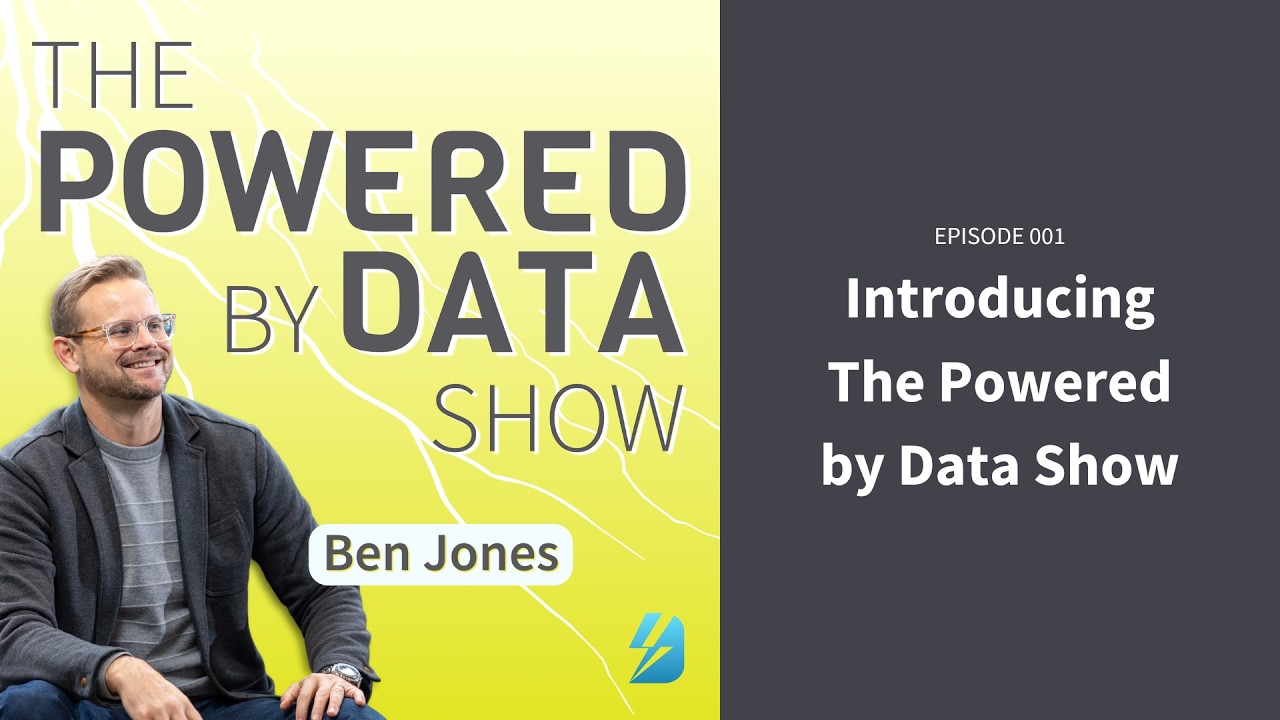
The Powered by Data Show, Episode 002
Ellie Fields helped shape the self-service analytics era at Tableau. Now, as CEO & co-founder of Ridge AI, she’s helping build what comes next. In this episode, Ben Jones and Ellie dig into the big question of whether dashboards are dead, where conversational AI breaks down, and how dashboards plus data agents may work together to create a better analytics experience.
See full show notes page here:
Visit Ellie's LinkedIn page here: https://www.linkedin.com/in/elliefields/
Check out the Ridge AI website: https://www.ridgedata.ai/
Subscribe to our channel:
🔗 https://www.youtube.com/channel/UCo3bzxEm0FSFZsMkAFilY8A?sub_confirmation=1
About Powered by Data:
🔗 https://poweredybdata.com
🌀 Co-founders Ben and Becky Jones, started Powered by Data in 2018, starting with its first manifestation - Data Literacy, whose mission is to help people learn the language of data. Then, the team launched Data Freelancers, an exclusive online marketplace of vetted, talented data & AI experts.
Learn more about our online courses (contact directly for group rates):
🔗https://dataliteracy.com/training
Subscribe to the Data Literacy newsletter for special discounts & offers:
🔗 https://share.hsforms.com/1ubvVCV85T2acOINZ0qWqKQ34aq6
50% off all our courses & books for students and educators:
🔗 https://dataliteracy.com/education
Find us on Social:
🔵 Instagram ~ https://www.instagram.com/dataliteracycom
🔵 LinkedIn ~ https://www.linkedin.com/company/data-literacy
🔵 Facebook ~ https://www.facebook.com/dataliteracycom
#DataLiteracy #Data #DataVisualization #Education #PoweredByData
Subscribe to our channel:
🔗 https://www.youtube.com/channel/UCo3bzxEm0FSFZsMkAFilY8A?sub_confirmation=1
Оглавление (5 сегментов)
Segment 1 (00:00 - 05:00)
All right. Hi everyone. Welcome to the Powered by Data Show. I'm Ben Jones, your host. Well, today I have a real treat. I get to be joined on the show by one of my favorite people in BI, Ellie Fields. She is, you know, someone who's been in the industry for a long time. I have a close personal connection to her. She hired me at Tableau. So, uh, I got a to move up to Seattle and join, uh, Tableau back in 2013. And Ellie was the person who brought me up to, you know, help manage the Tableau public platform. So, Ellie, of course, has moved on to Sales Loft and then very recently has helped found a brand new AI analytics company called Ridgeai at ridgeata. ai. And she's just one of my favorite people in the BI world. So, in the data world. So, Ellie, hi and welcome to the show. — Thanks, Ben. You're one of my favorites as well and I was about a good deal when you uh when you decided to move up. — We had a great run and we had a lot of fun and um it was something special we did then and I was so excited to be a part of it and I have a lot of great memories around all of those years in Fremont and um you know with the whole team and it was a special thing that I think we were all a part of. No. — Yeah. Yeah, it was great. — Yeah, it was. Okay. So, well, you've of course been very busy lately since then. you know, Ellie, just for the listeners, she was heading up product marketing and then at some point made a shift over onto the product development side and kind of has sort of a unique combination of marketing and technical chops in the space. I would say, you know, helped kind of usher in what we've come to call the self analytics or self-service analytics era. So, you know, just a huge impact that you've had, but I want you to tell us a bit about what you've done since then. you know, tell us a little bit about the journey to sales loft and then, you know, I guess most importantly, uh, what you've got going on now, um, at Ridge. — Yeah. Thanks, Ben. You know, I spent 12 years at Tableau and it was special. It was a really special journey and we did a lot there. You know, when I left, I was still trying to work on this idea of data and action in a tight loop. And so I went to this vendor, Sales Loft, which had the this really excellent sales workflow and needed to be expanded from a niche to a platform, but they were really actionoriented. And I thought, wow, if you can put data and action together here, this is going to be really powerful. And so we spent a few years doing that. We made it much more data-rich platform, presented the data in a way that sellers and sales managers could use it very easily. Uh they're not analysts and nor should they be. and really played with this idea uh of those two together. One of the things we had to do there was uplevel our dashboards. I mean, there were a lot of cross tabs that took seconds to page through just painfully. We'd get support tickets. This is funny actually where we we'd have customers say, "Hey, your reports only have my customers with the letter A that start because they didn't realize you had to page through painfully. " So, I was there and I was asking my team to go look for how we uplevel these and I just assumed we'd go and buy Tableau or maybe even Looker or another competitor and the team came back and said, you know, none of them make sense. They're not really fit for purpose for our embedded use case to show our value to end customers and product and uh and they're incredibly expensive. They're slow. The performance is bad. And so we ended up do using data bricks, bringing in data bricks and doing something custom on top — which was okay but it took us you know that whole thing took us over a year to publish our first really good dashboards and then every time we wanted to update them we're getting designers involved and different engineers and these and those and I just thought gosh this is crazy that it's still this hard to put good data on the web. So, I ended up leaving there after a while. You know, we kind of completed the platform and I moved on. I was going to take up to a year just to take some time and see what I wanted to do next. I ended up talking to Jeff Hair who is just one of the most amazing people in this space. He's at UDub and he had been working on a new library to kind of incorporate interactivity into the browser in a really profound way. It's called Mosaic Open Source and folks should check it out. We just started talking about how especially the embedded analytics space, the data on the web space had not changed in over a decade. I mean, it's still the same way it was when we were back at Tableau. And I think we did good work at Tableau, but it was with tool sets that were now a generation old. — Mhm. — And it's still so hard to get data on the web. So, he and I uh kind of couldn't let go of that idea and we founded Rich Data, Ridge AI around it. — I love it. Yeah. Um, so you're kind of reflecting back a bit about the last 1015 years and you know what we did and what we left undone. It sounds like you got to the point in these conversations with Jeffrey Hair and I want to reiterate your re your uh recommendation that people go check out his work. You know, just an amazing researcher and also tool builder in the data world. Um, refer to him all the time at my class at uh University of Washington Foster School of Business and think the world
Segment 2 (05:00 - 10:00)
of him. So I'm excited to see what you know the two of you build. But let's take a bit of a more of a tour through the whole history of self-service analytics. What did Tableau, PowerBI, Looker, what did those tools get right and how what how did they change the world? Cuz I think they did. But then get a little more specific about what they left undone or on the table and what was problem that didn't get solved. It sounds like you came face to face with that some of those problems at Salesoft, right? just about the performance and you know I remember the Tableau founders original vision to make it as easy to put an interactive data graphic on the web as it was to put a cat video or something like that right so tell me a little bit more about that you know kind of the pain point that never got solved by some of these great game-changing drag and drop platforms in visual analytics — yeah Tableau really was a groundbreaking and still is a great product uh today and it was this idea that anyone should be able to work with data and at that time it in a drag and drop way, right? And you still have to understand the data and so on. I think a few things were left undone. One was the learning curve was still high. I mean, we you and I watched Tableau get deployed to many different customers and it still took someone to learn the tool. It data visualization best practice because Tableau tried to support it, but you could certainly make some pretty bad stuff in there and you can make great stuff in there. And that learning curve really stopped people a lot. That was one thing. I think another thing that was left undone by that generation of tools was the performance, you know, interactive performance. It's it was still, you know, we try to optimize down from like a 13 to a 9-second load sometimes with customers at Tableau and that's just what you get with server side performance and what we were doing at the time, but we know people on the web are not hanging around for 9 seconds of anything, right? And so if you know, you put that in your product, it can make your product look pretty bad if you have laggy analytics in there. That was the second and I think the third thing was you know the the age of AI has really shown us that the ability to ask longtail questions is powerful. Now I take a little bit of issue with people who say we will never have dashboards. The dashboard is dead. We will just ask questions because dashboards are excellent at giving you — so much information condensed and doing sense as soon as you drop in. I mean you can get the entire picture and story of something at a high level and then of course interactively filter or drill down or what have you. That initial sensemaking we think is so really important and at Ridge we incorporate dashboards and data agents together. They actually interact with each other and complement each other because you need that ability to tell the story in the data especially if you're telling a story to your own customers. U you know where are you creating value? What should you look at? How do you think about this? And then you need to attach that data agent so someone can say well I had 20 more questions that you didn't answer in the dashboard. And that was a feeling of that generation of tools. um maybe not a failing, it was just what was possible. We'd see dashboard proliferation because every new question would generate a new dashboard and you'd get, you know, you'd get these uh customers that just had thousands of dashboards. They didn't know what was right or what to use. Uh and so I think AI has really given us way to tackle that last problem. — Yeah, it's like the hammer in the hand and everything looks like a nail. I mean, we really applied the dashboard to every BI analytics problem that an organization faced. And to your point, it isn't really well suited for all of the scenarios and use cases, but yeah, let's cool down and not write off the human visual cortex just yet. You know, it's an important thing. It's a great way for us to, like you say, make sense and sort of just get our bearings a bit. And um I love how Tamara Munner, who's at the University of British Columbia, she puts it so well in um in one of her books called Visual Analytics and Design, Visual Analysis and Design. She says the human visual cortex is a very high bandwidth channel to the brain. Meaning we just can take in so much all at once. And you know a dotted line of a chatbot interface would seem to be a little clunky visav a whole you know kind of view of many different angles on the data at the same time. So I don't think it's time to throw the baby out with a bath water either. I think we're still going to use a lot of dashboards. But I really love your framing of the head and the tail, you know, where it's I guess an 8020 rule where you have this um high frequency scenario reporting just making sense of data, what's there, but then to your point, there's this really long tale of these one-off questions that you might want to have based on some unique scenario or based on some kind of maybe more nuance that happens to pop up in a given day or week in business life that might not be relevant next week next month. So tell me a little more about that headtail distribution of analytics and where dashboards fit and maybe where AI fits and is there such a breaking point between those two or is there some way that somehow those two solutions dashboards and AI chat bots can work together?
Segment 3 (10:00 - 15:00)
— Yeah, absolutely. I think there's so much innovation to be done in this space and like you said dashboards were the answer for so long. The dashboard gives you all of that visual information immediately. It's the storytelling and it's the quick look, right? If you're always going to filter by department, you just want to filter afford it. do it. You don't want to always type, hey, now filter by department, right? There are some things that just work better in one form factor than another. And I think we'll discover new form factors as well. Right now, you know, one of the things I see out there is people using an eitheror approach. And I really do see people failing when they just try to throw a data agent on top of their data. I mean, aside from the blank screen problem, you also get the what is in the data and and what are they looking at and are they going to ask questions that they even get reasonable answers to. So, there's there's a lot there. We're trying to think about those two as complimentary. So, a lot of times if you have a product or something you're looking at, there's four or five I call them canonical dashboards, head dashboards, right? So, in my last world in sales workflow, we might look at pipeline as one dashboard. sales productivity, maybe demographics of the customer base. You know, you can think of three or four domains that you'd want to look at and you would create a dashboard for each of those for the sense making and helping people understand, but then you attach a data agent. And one of the things we've been able to do at Ridge, building on some of Jeff's work, is what we call linked interactivity. So imagine you ask four or five questions in data agent. You get those answers and then you go filter the dashboard. You can actually filter across both of those form factors. So while you're looking at different dates or what have you, you're filtering the data agent at the same time. So that's one thing that it can do. Another thing it can do is extend your data. We know that a good dashboard probably doesn't show more than eight or nine fields at a time or you get one of those monster dashboards where you can't figure out what's going on. So you can create a great dashboard with the key information. — You can actually back this. We call these ridges. This dashboard plus data agent form factor. You can back a ridge with 50 columns. And so maybe failure rate isn't in your core dashboard, but you want to actually ask a question about it. You can give users that ability to ask questions of related data, extend the data and so on while still keeping your dashboard really clean and focused — so it doesn't get so bloated and you pack it with everything but the kitchen sink, but it's also readymade to quickly pivot or adjust based on some type of a line of inquiry that an analyst goes down. — Yeah, absolutely. And this is there's so much innovation to happen in this space. — Yeah, it'll be cool to see what gets built. And this actually leads me to my next question for you. You know, because you've spent a lot of time building tools and products in the data space. So, you know, of course, you know, it seems like the way teams are building now with the rise of AI coding assistance is changing. So, I'm curious as you've been building out ridge AI and working with the teams that are doing that and doing a lot of that building yourself, what does that feel like? How is it different? What have you learned in the last let's say maybe even just six months since Opus 4. 6 came out from Anthropic? Like what does it look like in the day-to-day of Ellie Fields working with teams building products? What's the same? What is helpful and you're carrying over and what is maybe totally different? — Yeah, great question. I mean for one you can go faster. I think people have noted that and it is true with a small team you can go fast you can do a lot. Some of the things that have not changed in my mind are some of the core paradigms like how humans understand information. There's a science around that you know it doesn't change with tooling. We still are humans. We are what we are. Some of the questions about what you build like I think about the jobs to be done framework a lot. You can build everything. So the question of what you would build is important. One of the things I think is interesting about developing with AI is there's so much you can vibe code these days and dashboards is one of those things like people tell me all the time I just vibe coded a dashboard. I actually kind of compulsively go use the skills and the tools and the frameworks out there. And one of the things I see is that and I think people are discovering this in different areas of AI development but definitely in the data world. It's about guard rails and harnesses and bringing real information to it. So if you just throw a bunch of data into cloud you're going to get a dashboard. It may not be a good dashboard. The views may not relate to each other. Color may not work. Like all the things that we know about a dashboard. It may not be interactive and well-built and it may not help people understand the information, but you can build one. What we're doing is we're using AI and making it very discreet in different ways and then harnessing that and putting guardrails around it. And one of the big things that we're doing is leveraging the ability of AI to work at a different layer of abstraction. And to me, this is one of the changes. When people say AI native, you're either It means you're doing something fundamentally different. You're not just taking the product you had and putting a little AI agent in the corner that can help you click the right button. The way we're thinking about building dashboards, for example, is going from having the user need to know the front-end tool and know best practice and know the data engineering and all of that to really engaging with them at the business level. So we'll ask questions
Segment 4 (15:00 - 20:00)
like what are you trying to do with the data that you just gave us and what are some key metrics that you care about like do you have KPIs and so on and from that we can actually get down to building a dashboard for them. Now we know it's iterative so you need the ability to edit and so on but we're changing the entire level of engagement with the user from hey do you want a bar chart or a line chart and what do you want on color and you know how do you want to do this to what story are you trying to tell? What are you trying to convey with this data? — Yeah, I feel like that's really in a lot of ways what you're describing. Something that you have deep expertise in. Now is the time to find a way to build a product that includes or that features AI that can tap into those frameworks that you can apply in the way of you know instructions, prompts, like you said guard rails and essentially trying to bake that framework into how the AI interacts with a human because to your point if you just rely on what's out of the box with these foundational model companies like anthrop ropic and open AI while it's amazing. It al also mostly give you something that like you pointed out on LinkedIn the other day is reverting to the mean a bit regressing to the mean. It's sort of what you'll see out there is what you'll get, right? So what you'll see out there isn't always great. So how do you take and provide a um sort of a product that can really deliver with high quality and reliability that great output or at least as soon as possible in less iterations to your point. So yeah, it's an interesting challenge. I'm seeing this across a few domains. You know, true deep experts like yourself and Jeffrey saying, how do we instruct these AI agents to really do it right and really do it well because ultimately I think that's what we own as humans is the purview around well what does good look like, you know, right? — So we have and especially experts have a lot of a lot to add there. any thoughts on that and just like where we as human beings still have um you know the preeminence over these tools that are coming out? — It's a great question. U for sure I mean one of the reasons Jeff and I got together I'll say it's going to sound odd but values we wanted to make data better on the web. We think it's important for people to be able to think with data. We think data is an important part of conversations in a lot of places and like you were saying the level of data on the web is typically pretty poor. So when we got into this, we didn't get into this because AI is cool and we want to make something cool with AI. While AI is cool and we do want to make something cool with AI. We got into this because we saw that this approach AI and plus some thoughtful building around it can actually take the state-of-the-art up. And I that's what humans have to bring to it. purpose and taste and care. And frankly, I think we have to care about what it is doing, what the effects of AR are. You know, we technology is it's just a tool, but it can have good and bad effects. And I think we've seen that in a bunch of areas in the past. And so, you know, we are the humans. We still are the primary sentient intelligence. And even when AI gets more intelligent, I think that the human things are the things we've got to bring to — Yeah, I agree. I mean, you take a look at the desking that can happen if we totally outsource something altogether or you think perhaps about some of the technological leaps in the past 10, 20 years like social media. And you know, you're right, we haven't always done very well at adopting those tools in healthy ways. And so, it'll be interesting to see, you know, as we continue to invest so much of our time and energy in creating these amazing AI tools, what does it mean to use it well? have it truly augment our own abilities as opposed to potentially detracting from what it is that we can offer? Question for you. You are in closed beta right now, right, for Ridge AI. Talk to me a bit about that. You know, what kind of organizations would be wanting to join that and why and how would they do that? — Yeah, thanks for asking. We are looking for typically product companies, software companies, SAS, whatever you want to call them, who have a real need to show their values, their value to end users. So personalized analytics in product typically embedded in product and we can match color schemes and so on and partition by customer. So we're looking for folks who often have a you know something in the backlog that's been there and is just you know they're seeing lost deals around it. They're seeing churn because their customers can't understand the value that they're bringing to the table and they really have a need to um to get that out. And you can sign up right at the website and we'll get you in the closed beta — and that's great. That's ridgedata. ai AI and you know it seems like a lot of organizations have of course have moved to a subscription model or a consumptionbased model. So continuing to uh to make it obvious how much value they're getting out of it and to help them find new ways to get value based on those insights I think is kind of a scenario that a lot of organizations would like to probably improve upon. So check that out folks. And I mean hey where I'm at I just think that whatever Ellie and Jeffrey are doing is something
Segment 5 (20:00 - 21:00)
that I'm going to be paying very close attention to. again, two people I think very highly of and um just have enjoyed, you know, certainly over the years working with you, Ellie, and seeing what you've been doing. And I think we the whole point of this podcast, right, is to talk about the intersection of humans, data, and AI. Well, for a long time, I don't think I've known anyone who has sought that overlap of humans and data more and better than you. you brought that to the table with the Tableau team and the marketing team, the product development teams, certainly Tableau Public, our whole team really took our queue and took uh you know took our queue from your mindset there and really tried to build what I felt was a really meaningful community based on you know those perspectives that you had about just the value of people, the need to treat them with respect and dignity and see the value inherent in everyone. And I think that is why the table a big part of the reason why the Tableau community grew and became such a valuable resource for so many people and of course for the company as well. But um you know that I think stemmed from your uh your approach uh to technology and to people and so thanks for instilling that and yeah you know it made sense to me you know that's one I mean you know like attracts like. I was like yeah that that's exactly how I feel about it too. Um so we made a good team there and of course all the people that we got to work with. So, I'm really curious to see how this Ridge AI project goes along. And again, thanks Ellie for taking the time. Really appreciate any chance I get to talk with you is a good day for me. So, — yeah, it's great. I love what you're doing and I think there's a lot a lot to talk about between humans and data. — Well, maybe we'll uh kick the can down the road a bit and touch base again in a little while to hear how it's all going. Um, you're a person I'd always welcome and love to have on the show, Ellie. So, you take care. All right. — Thanks, Ben. — All right. Talk to you soon. Bye.