What's Up: March 2026 Skywatching Tips from NASA
3:02

What's Up: March 2026 Skywatching Tips from NASA

NASA Jet Propulsion Laboratory 02.03.2026 60 831 просмотров 687 лайков

Machine-readable: Markdown · JSON API · Site index

Поделиться Telegram VK Бот
Транскрипт Скачать .md
Анализ с AI
Описание видео
What are some skywatching highlights in March 2026? A total lunar eclipse blood moon takes centre stage, Venus and Saturn cozy up for a conjunction, and we celebrate the vernal equinox. 0:00 Intro 0:12 Total lunar eclipse 1:22 Venus + Saturn conjunction 1:57 Vernal equinox 2:39 March Moon phases Additional information about topics covered in this episode of What's Up, along with still images from the video, and the video transcript, are available at https://science.nasa.gov/skywatching/.... — Additional Resources — Find events and clubs: NASA's Night Sky Network (https://science.nasa.gov/skywatching/...) Skywatching resources from NASA (https://science.nasa.gov/skywatching)

Оглавление (5 сегментов)

Intro

A total lunar eclipse blood moon takes center stage. Venus and Saturn cozy up for a conjunction and we celebrate the vernal equinox. That's what's up this March. Is it Mars

Total lunar eclipse

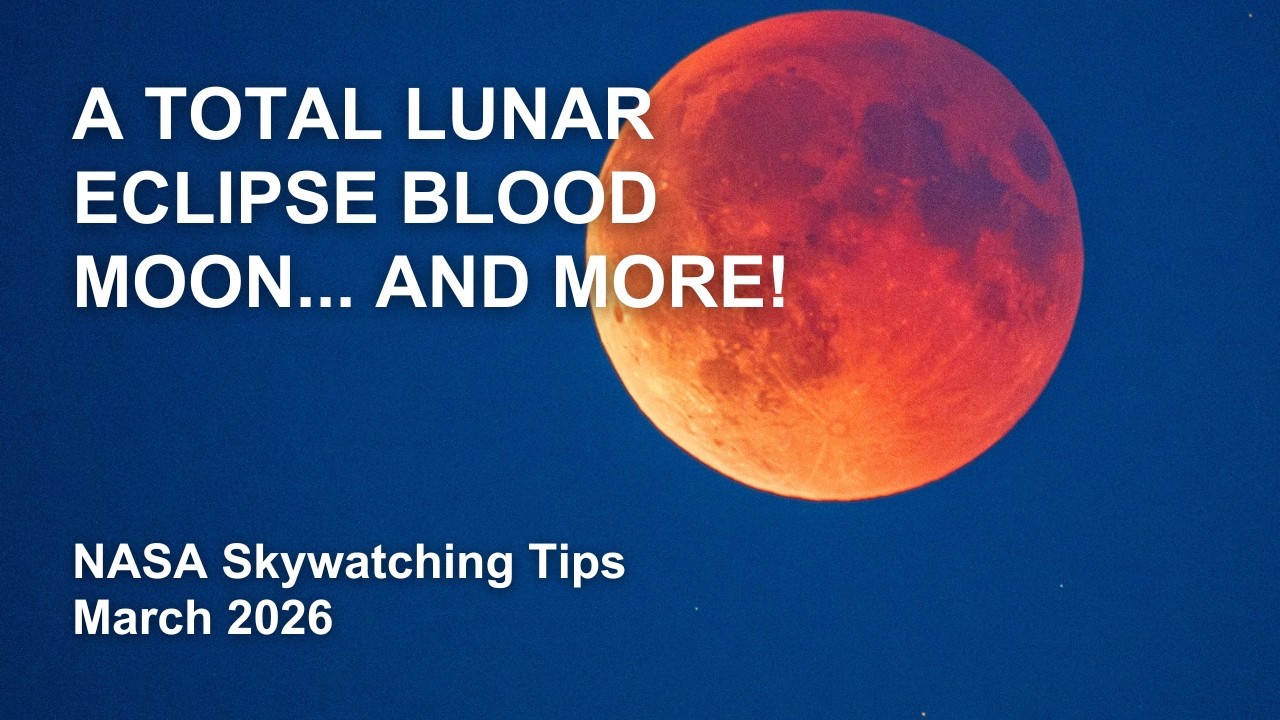
or is it the moon? On March 3rd, a total lunar eclipse will turn the moon bright red. During a lunar eclipse, which can only happen during a full moon, Earth passes between the sun and the moon, casting a shadow on the lunar surface. During a partial lunar eclipse, the moon moves only partially into the dark shadow or umbra cast by Earth. But during a full lunar eclipse, the sun, Earth, and Moon are exactly aligned, leaving the moon completely enveloped in Earth's shadow. When this happens, the moon actually turns blood red. While you might imagine a full lunar eclipse would leave the moon completely dark, Earth's atmosphere scatters the light, illuminating the moon in this orange reddish hue. So look up and bask in the red glow of our lunar companion. This full lunar eclipse will be visible from eastern Asia and Australia in the evening, from the Pacific at night, and from most of North and Central America, as well as Western South America in the early morning.

Venus + Saturn conjunction

On March 8th, Venus and Saturn will cozy up for a conjunction in the evening sky. The pair will be about 1°ree apart, which is roughly the width of a single finger if you hold it at arms length. A conjunction happens when two objects in the night sky appear close together, even if they're far apart in space. In reality, Venus and Saturn are nearly a billion miles apart. But to see the pair get close in the sky from our perspective, look close to the horizon in the western sky just after sunset.

Vernal equinox

On March 20th, we ring in the vernal equinox, marking a transition into the next season. While this is colloquially known as the first day of spring in the northern hemisphere and the first day of autumn in the southern hemisphere, astronomically this equinox occurs when the sun crosses above Earth's equator while traveling from south to north. On this day, northern and southern hemispheres experience roughly equal amounts of sunlight and day and night are also about equal, each lasting almost exactly 12 hours. So enjoy the start of a new season with a day of perfectly balanced sunlight.

March Moon phases

Here are the phases of the moon for March. You can stay uptodate on all of NASA's missions exploring the solar system and beyond at science. mnasa. gov. I'm Chelsea Go from NASA's Jet Propulsion Laboratory. And that's what's up for this month.

Другие видео автора — NASA Jet Propulsion Laboratory

Ctrl+V

Экстракт Знаний в Telegram

Экстракты и дистилляты из лучших YouTube-каналов — сразу после публикации.

Подписаться

Дайджест Экстрактов

Лучшие методички за неделю — каждый понедельник