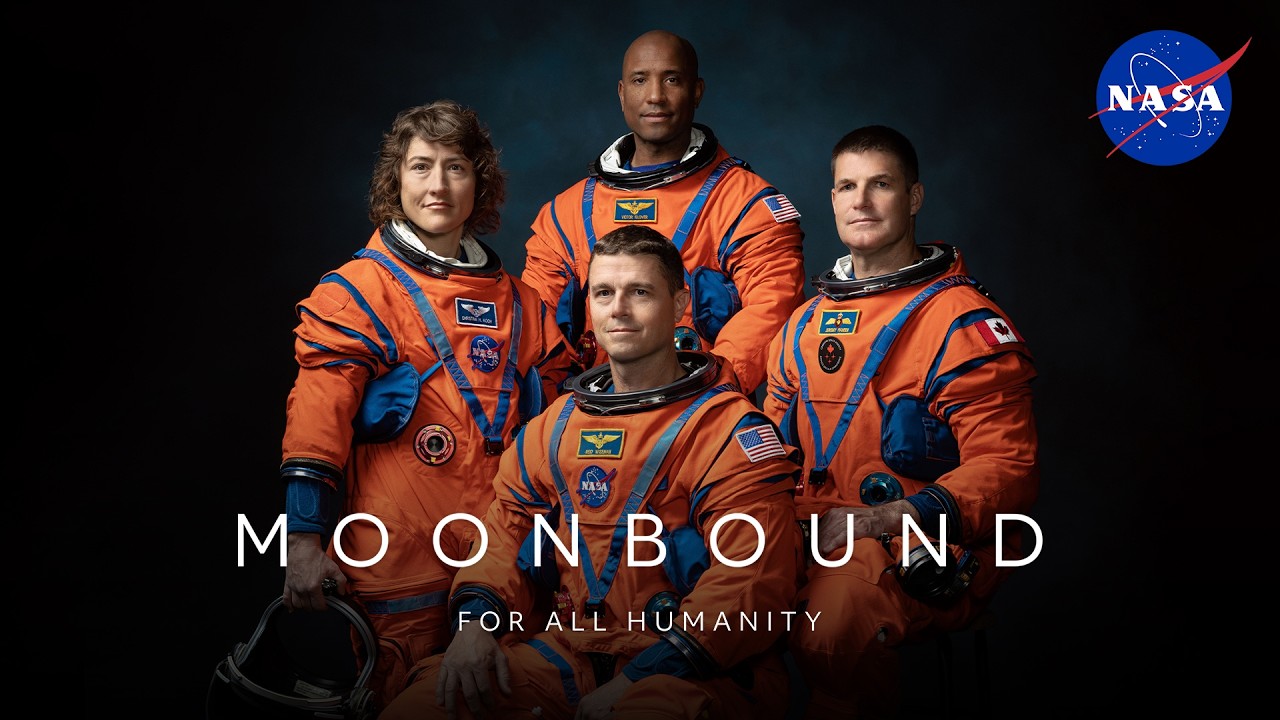
With the Artemis II mission, four astronauts transitioned from years of training to mission-ready reality. The second episode of our NASA+ "Moonbound" series explores the physical and mental challenges of preparing for a crewed flight around the Moon, and the teamwork required to test new systems at the edge of exploration.
Under Artemis, NASA will send astronauts on increasingly difficult missions to explore more of the Moon for scientific discovery, economic benefits, and to build on our foundation for the first crewed missions to Mars.
Credit: NASA
That's awesome thatyou hand me this flag. It flew on STS-1. I know this flag wastaken up on STS-135. There is a good shot of the STS-1 flagthat flew up onboard Atlantis. The Demo-2 SpaceX crew, my friends, greatfriends, brought this thing home. So it's amazing to think of the handsthis thing has gonethrough. It's pretty special. And then it will travel once again on thenext vehicle that leaves low Earth orbit. And here we are in Mission Control inHouston, Texas, andthis flag is in my hands. I don't know about you, but I think weshould send this thing to the moon. Let'stake it to the moon. Human spaceflight isthe ultimate team sport. When these four fly around the moon,they won't be doing it alone. They're part of a team, a team ofastronauts, engineers,scientists, trainers, a team of supportworking around ourcountry and around the globeready day and night. We will help them carrythe incredible weight. And it's a heavy one nowlaid on their shouldersbecause we go together for all humanity. NASA has a rich history of test flights,and we do it for a reason. It goes all the way back to Mercury,to Gemini, to Apollo, to Shuttle, STS-1,station where the twomodules came together,and we put that first crew on. Demo-2 on SpaceX, a lotof work went into that. Starliner for the crew flight test. These are test flights,and they're test flightsfor a reason, because we're making surethat that vehicle's ready to go from anoperational standpoint,from that point further. And Artemis is no different. NASA was established toundertake big, bold endeavorsin air and space toundertake the near impossible. The next stop is America'sreturn to the lunar environment. What we learned from that missionis going to help enable America's returnto the lunar surface. When we arrive to themoon, we're there to stay. Our mission calls for four names. It's difficult to pickjust four, from a groupthat by its very definition attracts thebest and the brightestthat humanity has tooffer, as humanity looks to findits place among the stars. My name is Norm Knight. I'm the directorof flight operations atNASA Johnson Space Center. Well, let me tell you a little bit aboutwhat flight operations does. You could think of us as a serviceprovider to the major programs at NASA,both for low Earth orbit and for ourexploration goals to Moon and Mars. We plan, we train, and we goexecute and fly the missions. Assigning a crew for amission is complicated. I'll tell you that. We look at ourexperience base and we say,all right, here's themission, in this case Artemis 2,higher risk being a test flight. So what complement of experience basedo we want on this mission? With a test flight, wetypically like pilotsthat have test flightexperience, test pilots. In addition to that, you look forcohesiveness with a crew. We need mission specialists on boardthat are able to do a lot of the tasks. We go look at anexperience base within the officeand say, who best can fit these needs? How can they work orwill they work togetherin an environmentthat's cohesive to aligningto the mission? And you end up with anexperience base with those crewthat then provideeverything possible to guaranteemission success going forward. As head of flightoperations, I have the privilegeof getting to knoweach and every astronaut. The best part of my job,is that I'm surroundedby people who inspire,who give hope to those thatmight follow in their footsteps. I want to thank you all forsharing in this moment today. And thanks to our crew, Reid, Victor,Christina, and Jeremy,as they get ready toembark on this journey. It has been an amazing journey the lasttwo and a half years. We have just built a tremendous amount oftrust between the four of us. This crew cohesion, we're at the pointnow where we are ready to go fly. For us, Artemis 2 is about much more thanjust going back to the moon. It is about the pursuit of excellence. If you want to go fast, go alone.
Segment 2 (05:00 - 10:00)
If you want to go far, go together. And we are going together. And our mission success is built onhanding off a starting point to Artemis 3that sets our country and our partners upto go back to the surface of the moon. Sending machinery aroundthe moon, beautiful machines,is a challenge. Adding humans takes ita giant leap forward. And there is a lot of workthat goes into integrating peopleinto the system. This is a very serious endeavor. This is absolutely a test flight. The last time we launchedwas more than three years ago. It did not have crew on it. It was not a completelylike-for-like spacecrafton top of the SLS architecture. We basically invented all of the trainingfor the Orion spacecraft and the rocketand put it all together. And now we're in the middle ofgiving all of that informationto the crew toprepare them for the launch. For me, the heart ofArtemis 2 are the individuals,the people that are onboard that Orion capsule. They are going torepresent us as humanity,going out into space onthis incredible journey. And to me, that's the real piece there,is the human element. I'm Reid Wiseman, a NASA astronaut andcommander of the Artemis 2 crew. I guess if I'm going to answer who I am,first and foremost, I'm a dad. I was a pilot in the Navy. I'm an astronaut. I'm a lover ofnature, lover of the Earth. And in general, I justtry to be nice to people. I've known Reid a long time and just anabsolute great person. He is very strategicin his thought process. I consider him big picture. His leadership style is really obvious. He's looking for waysto let all of his reallytalented, experiencedcrewmates own parts of the mission. Over his career, Wiseman hasspent over 165 days in space. In the office, he was the chiefastronaut, which is a very tough job. More on the personal side. He's just a great guy. I grew up in a small town north ofBaltimore, Maryland,known as Cocky'sville or Hunt Valley. The first time I remember beinginterested in space,I was in elementary school. I was always into carsand trains and planes,and I distinctly remember before thefirst space shuttle flight,I think I was five years old,the 747 flew over witha shuttle on the back. I distinctly remember being on a hillnear a mall with my momand dad watching that thingfly over and all. I was a tiny kid. I graduated high school pretty young. And so I was small. I tried all thestandard little kid sports. I tried soccer. I tried baseball. Those just did not fit with me. While I was at school,I decided that Iwanted to be a Navy pilot. I joined the Navy in collegethrough this thing called ROTC. And then when I graduated from college,that was my road into the Navy. Once I had that testpilot school block met,I knew that I had all thepieces to be an astronaut. I applied once, I got my rejectionletter, it's stillhanging up at home, I looked atit last night. I thought it was handsigned, it wasn't hand signed. And then in 2009, I applied again for mysecond time and luckilysnuck into an interview roundand then I knew it was all up to me andthe dream was going tobe set by me right there. So, are you enjoying your training? Oh, it's awesome so far, absolutelyfantastic, way betterthan I had imagined. Getting to accomplish a dream, getting togo out and seize that,you have to sometimeslook back and just congratulate yourself,just take a minute andsay, "Man, you actually,you did the thingthat you set out to do. "What would I tell eight or nine year oldReed, "Hey, stay thecourse. You're doing great. Havesome confidence. " Because I definitelydidn't have a lot ofconfidence as a kid. So go out and havefun and try to do good every day. While we're looking at everybody, ifyou'll find the lens,just go and look at the lens, everybody. I want to thank God forthis amazing opportunity,because Artemis 2 is more than a missionto the moon and back. It is the next step on the journey thatgets humanity to Mars. Victor Glover, he's aLieutenant Commanderin the United States Navy. He has more than 2,000hours of flight time. He has his bachelor'sdegree in engineering,his master's in flight test engineering. He was a United States test pilotand he was a former military flu F-18s. He came to us from Washington, DC,where he was serving as United StatesNavy Legislative Fellowin the United States Senate. My name is Victor Glover. I'm a NASA astronaut, naval aviator, anda former test pilot. The back of my baseball card, the mostimportant thingswould be right at the top. It'd be a husband and father to fourbeautiful daughters. And then, you know, being able to dabblein the aerospace industry,fly jets off of a carrier, help designand to operate spacecraft,those would be down therein the small print somewhere.
Segment 3 (10:00 - 15:00)
Victor, he is thephilosopher, I would say. He is the one that I've had the mostconversations about whatmakes effective training. When I think of Victor, Ithink of a supercomputer. And I mean that very sincerely. He is so intelligent. And he is thinking about the mission. He's thinking about solutions. And in working with theteams, it's just fun to watch. Victor Glover, he is my classmate. We were both chosen in2013 to become astronauts. He is my Astro brother. He is incredibly talentedand I am basically inawe of him at all times. Victor Glover, he hasbecome a mentor of mine. I love working with him. It is not a relationshipthat peaks and then drops off. This relationship is always increasing. I'm learning moreabout him every single dayand we are working bettertogether every single day. I grew up in Southern California beingfrom a socio-economicallydisadvantaged background,you know, not having a lot of money. Itdefinitely created achallenge, but in all of that,my support and love from my mother and myfather was always clear,that always shone through. I played outside, you know, I would comehome with rocks and woodchips, but also like bugs in mypocket. Just this idea to kind of gobeyond and know what'snext and see what's beyond is,it's just kind of always been there. Sometimes it wound up withme getting bumps and bruises,you know, I took the rain fly off mytent, tied it to my beltloops and jumped off mygrandparents' roof to see if I could makea parachute, you know. As a child, seeing a shuttle launch ontelevision really captivated me. There are points through my childhood andyoung adulthood that just,that feeling was always there. When I wasin college, I was 20 years old,I decided I wanted to join the Navy. And when I told my dad Iwanted to join the Navy,I told him I wanted to be a Navy SEAL. And he said, "Okay,you might enjoy that. "But with anengineering degree from Cal Poly,and being a pilot,you might be able to goon and become an astronaut. My dad made a suggestionthat changed the arc of my life. Literally changed thetrajectory of my life. When NASA announcedthe astronaut pilotingits Artemis 2 mission,Victor Glover Sr. was watching. Obviously I had tears in my eyes,I was wiping the tears away. Deep down inside you knew, you know,he's gonna be a partof something special. Being able to go tospace is just, I think,a sign of thewillingness, the work ethic,and the adventure, and the opportunity,the timing coming together. So many people have poured into my lifethat if anything, I'm actually reflectingfrom so many sources,and again, I am blessed. I've been blessed. Look at this picture. You were in space camp. I was. How old were you? Do you remember? Probably middle school. And look at you now. She has a bachelor's science degreein electrical engineeringfrom North Carolina State University,a bachelor's in physics,and a master's in electrical engineering. She's also done someinteresting expeditionary work,so please welcome Christina. (audience applauding)Christina Cook,one of our missionspecialists, a great person,just a great personality, easy going,very detailed, and task oriented. She is the person that makes surethat everyone walksaway from some trainingwith the right understanding. She speaks up and asks a question,and then usually the whole room is like,"Yeah, I had that question too. "Christina, she brings ascience mind to these activities. I'm so excited that she hasthe chance to go to the moonand help lead the science as a whole. First, she's just a great person. And then second, she is really outgoing,outdoorsy human being. So she is always off doing somethingthat I wish I was off doing. Her background as an explorerand someone that just,I mean, lives to exploreand loves life andadventure, space, she's a natural. Well, I was born inMichigan, family of farmers,and I ended up growingup in North Carolina. My particular family moved there,and both places werejust incredibly importantin terms of formingmy values and who I am. I would describe that little girl assomeone that loved tobe a part of everything. My dad and I werealways working in the shed. We called it shed heaven. He was always teaching me how to fixthings, how to make things. For me, the moments of exploration as achild were ubiquitous. I was always exploring, whether it was onthe farm, goingaround on the trails, underthe trees, climbing thetrees, or in my own backyard. The idea of celestial bodies, the moon,
Segment 4 (15:00 - 20:00)
the stars, what all thatmeant, seeing the MilkyWay, these were thingsthat really drew me in. I myself was inspired by the Earthrisephoto taken on Apollo 8. I had it on my bedroom wall as a kid. And the idea that we can take a pictureof all of humanity at once. That will be a big moment. Christina Cook, you're a record holder. She is out, thumbs up and a huge smile. She returns to Earth as a record holder,the single longeststay in space by a woman. What advice would you give to a girl myage who wanted to become anastronaut when they grew up? You know, I did have those conversationswhere small kids weresurprised that I was an astronautbecause, quote, "I wasn't a guy. I wasn'ta man. " And for me, thatsort of set the bit that it wasimportant to demonstrate byrepresentation that anything is possiblefor anyone who has a passionand who's willing to workhard to achieve that dream. To see that tide changing and torecognize that we can affectthat change by the decisionswe make to go by all and for all isreally inspiring for me. A Canadian is going to the moon. That makes me smile when I say that. I know Canadians could not be more proud. Proud to have for the first timeeight Canadian astronautswho will travel to deep spaceas part of the Archivist's mission. (audience cheers)I'm Colonel Jeremy Hanson,an astronaut with theCanadian Space Agency. Jeremy Hanson, a Canadian F-18 pilot. Hehasn't had anopportunity to fly in space yet. I really look forward to him being ableto see his home planetfrom space for the firsttime after his 15 years of training. It's interesting because when I think ofJeremy, while he's arookie, I don't think of himas a rookie. And that says a lot about Jeremy. He's very prepared. He's a quiet, confident leader. He is maybe the thinker or the observerof the crew, thinkingabout the technical aspectsof whatever we're learning. So he'll have some really insightfulcomment or just somereally great piece of humor toadd at the end. He's one of the funniest human beingsthat you will ever met. He is dry humor and his timing isabsolutely impeccable. You know how many times I show up to aninterview and then I watchthem make the tripod taller? Just about everyone. But the other neat thing about Jeremythat a lot of peopledon't get to see is he isincredibly creative. His creativity in making this spaceshiplike a playground andactually knowing it for itsfundamental capabilities couldpotentially save ourlives on this mission. I've definitely spent some timecontemplating my first launch to space. The first thing that comes to mind for meis what I'm going tofeel like the day before. I imagine I'm going to bevery pensive the day before. I'll be leaving the planet. I'll be leaving my wife and threechildren behind on the planet. I know what's going to happen the nextday is risky, but I alsoknow from my operationalexperiences and flying and challenges Iface that when the daycomes and it's go time,I'll be fired up and I'll be just firingon all cylinders,rotting that rocket to space. I grew up on a farm outside of London,Ontario, and I justhad a great childhood. I really credit my experiences on thefarm with giving mesome of the tools I neededto succeed in life. I went on to join theRoyal Canadian Air Force. I had this passion forwanting to fly fighter jets. And ultimately that preparedme to join the Canadian SpaceAgency and take on thischallenge of being an astronaut. It is kind of full circlefor me flying out to the moonon this mission becausewhen I was a young Canadian,I did see an image in Encyclopedia Aunder Neil Armstrong ofhumans standing on the moon. I looked at that image so many timesthrough my childhood. It was on the bookshelf at home,and I started just thinkingabout being a space explorer. I turned my treehouse into a spaceship. I created all these intricate dials madeout of cardboard and popsicle sticks. I found some switches, circuit breakersin the barn that Imounted to have switches inmy spacecraft. I had a control column Imade out of wood and a hinge. And I was exploringspace in my imagination. As a child growing up, Iwatched Mark Arno fly in space,the first Canadian in space. And seeing that, that's what made meunderstand that it was possiblefor me to actually achieve that dream. I'm driven by the spirit of exploration. I don't even knowthat I can tell you why,but there's just somethingabout going to a new placeand pushing the limits that reallycaptures my passion. super proud that Canada is joining thethe U. S. led mission back to the moon,the Artemis mission, just gratitude forfor what they brought to the challenge.
Segment 5 (20:00 - 25:00)
The moon is like a Rosetta Stone forunderstanding the entire solar system. and where we came from as a result. I used to stare up at the moon. I was just fascinated by that image, thatconsistent image, and try to imagine whatit might be like up there. just thinking kind ofon a mental journey,like I'm just takingthis spiritual flightthrough the cosmos, butthere was just this interestingand significant connection with the moon. Everybody around the world has looked upat that exact same moon. The same side of themoon is always facing Earth,and we are alwayslooking at that same picture. Some people are dreaming of it. For some it's a religioussymbol, a spiritual symbol. calendar, but we are always alllooking at that same moon. It's one thing thatevery human has in common. That thing that looks so far awayis going to be right up close for us. There's this human aspect of flying outand seeing the moon up close. That's gonna be truly extraordinary. But then think about seeing the Earthfrom the perspective of the moon. To have the moon in the foregroundand the Earth risingaround the side of the moonis just anextraordinary thing to imagine. when we were kids, andnow it's becoming reality. My name is Lakisha Hawkins. I currently serve as Acting DeputyAssociate Administratorhere at NASA. We lead the agency'sefforts for human explorationto the moon and todestinations further beyond the moon. I'm one of those kids whowent to elementary schooland we had enrichment programswhere we did some rocketry and somelanding experiments. I remember them rolling theTV cart into the classroom,allowing all of us to watch shuttlelaunches and landings. We were also sitting in front of the TVduring the Challenger incident. That was impactful to me. I was one who wanted to explore,but I also knew that there was riskand I wanted to be able tohelp others do so safely. And so that's alwaysbeen in the back of my mind. That flight means extra risk even morewhen you're flying to the moon. How much more dangerousdo you personally feelgoing into this missioncompared with your previous spaceflights or other high-risk endeavors? And how are you and yourfamily feeling with it? I have a family. You know, I'm a husband and a father. And so my family, we'repreparing the same way. We talk about everything. We talk about how we're feelingand work with them toprepare as much as I train. It's very exciting to flycrew, but it's also daunting,right, because these are peoplewho have families, moms, dads, kids,you know, dreams, aspirations,and they're puttingtheir lives in our hands. You know, I look at this oneas failure is not an option. That's kind of cliche, you know,but I was part of theColumbia accident investigation. And I've always remembered that. I thinkone of the biggest thingsthat my leadership teamand me have to overcomeis the arrogance and the complacency thatcomes with the success that we have hadand to make sure that weleave no stone unturned. We all understandthere's heightened risk with,that's the biggest thing. To put it simply, there's increased riskwith a test mission because you havenever done that before. I already knew goingto the moon was hard. Administrator, you talked about it. Kennedy talked about it. That's why we're doing it. I already knew it was hard, but boy,it's harder than I thought. Space flight's not safe. It's risky. You anticipate issuesin cases of test flightsthat you work through. You've doneeverything you can, but again,it's a test flight. You're doing it for a reason. And so the challenge of that,and what sparks me about that,is this gives us a chanceto really show what we've gotand really show ourability to challenge ourselves. It has been a long, longtime since we have sent humansall the way out to the moon. This is new for myself to experiencespaceflight like thisand I think new to a lot of the world. So it's really exciting. My name is Jackie Mahaffeyand I am the Chief Training Officerfor the Artemis 2 mission. 90% of the space flight--My grandfather went towork for North Americanand Honeywell on Apollo control systems. So flying to the moon isa little bit in my bloodand after anaerospace engineering degree,I made it down here to
Segment 6 (25:00 - 30:00)
Johnson Space Center. I started off as a flightcontroller and mission control. Everything I did was new things. It was inventing and developing. And so in the trainingworld that I'm in now,it's the same thing for me. This is indeed a unique training flow. What's unique about this are the aspectsof going deeper into space. In addition, the waythat we have to communicate,obviously thespacecraft is new and different,but what is the same is theteams that we are utilizingin order to be able todevelop this training flow. Most of the team hereat Johnson Space Centerhave had someexperience with the space shuttleand training crews forspace shuttle missions. A lot of experience in the last 25 yearstraining for the space station,but this whole idea ofthe small spacecraft,small capsule, andsending it as far as we doand making sure that the crew is equippedto handle things on their own if neededis something new for us. Artemis 2 is the first time we're flyingthis spacecraft, so the trainingmaterials have been developed while we'vebeen taking the training. The way we're preparing for Artemis 2 atthis moment is we're going through ourinitial simulations. So we're simulating our groundcontrollers here, our crew over in themock-ups, talking back and forth,and really going through those draftprocedures and flightrules with a fine-tooth comb. We do simulations in segments, but thenwe also do what wecall a long simulation,which is let's actually practice what itactually looks likethrough the entire mission,which means through tanking, throughcountdown, through ascent, the return, aswell as recovery, all ofthe sleeping and awake time. We do all of that in one block. for the Artemis 2 mission. We have nine days to doeverything that we need to doto test the vehicle and to prove outall of the mission objectives. We're much more focusedon the crew understandingexactly the activitiesthat they're going to seethroughout the mission,where they might find things on board,and an understanding, hey,if something does go wrongand it's importantthat both the astronautsand the team that supportsthem on the ground in Houstonare ready to solve the problem quickly. Working with the teams tofigure out the right answerfor everything isliterally a day-to-day activity,and it has been awesome. It's challenging, but it also meansthat this is acompletely different animal. I kind of look at thewhole journey of like,you know, young Jeremyflying space missionsin the treehouse totoday in the simulator,going through failure scenarioswith an incredibleteam and mission control. You know, it has changed a lot. It was a lot simpler when I was youngand I was doing it in my imagination. A lot of people ask me how Ifeel leading up to this missioninside of two months to go. It's not a simple question to answer. You know, there are moments of like, wow,I can't believe likewe're so close to goingand it is super exciting,but then in the next momentyou're like, okay, I alsohave a lot I want to do. I totally feel likewe're going to be ready. Things are going to come together,but I also have that feeling of like,almost like cramming foran exam where it's like,hey, I could use every single momentbetween now and flightto make just double check,triple check. And you never really knowwhen that work is truly done. We are 41,500--We can sit in a simulator all day longand fail different componentsand we can write procedures perfectlyto flesh out all of these issues. But in the end,something is going to failin an unexpected wayand it's the process. How do the four crewmembers think about this? How does missioncontrol the engineeringsupport team think about this? And then how do weall communicate togetherto get through this failure? The Artemis 2 crew and theground teams are cohesive. It takes a lot oftraining for the ground teamto understand the nuancesof the crew and vice versa. At the end of the day,they're mission focused. The Artemis 2 crew in advance of themission have gotten tohelp trail blaze a couple ofthe training pieces that future crewsthat are going to belanding on the moon will getto do. We took the whole crew to Iceland to lookat the geology there and just some of theparallels to the moon. We are here in Iceland trainingastronauts and training other Artemispersonnel in field geology. So we're going to be exploring thevolcanic deposits, teaching them how toexplore a station whenthey're doing EVAs on Artemis,and also how to make good observationswhen they're passing bythe moon on Artemis, too. Iceland is a great analog for the moon ina bunch of different ways. It's got the planetary processes, in thiscase volcanism. It has the landscape. There's no vegetationhere. It looks like the moon. The geologists are really hoping thatthere's some areas of interest that wecan look at with our human eyes,
Segment 7 (30:00 - 35:00)
be able to scan across the moon withdifferent lightingangles as we fly aroundand collect some data that the satellitesorbiting the moonaren't able to get for them. For Artemis, too, our goal is to reallyadvance our understanding of what's goingto happen to the human inthe deep space environment. We have been working for many years toadvance this organ chip technology. And so with that, we're able to reallyunderstand what the deep space radiationimpact has so we can compare directlythat personalized level ofwhat's happening to them. So this is game changing. The research we'll conduct in Artemis 2will lay the groundworkfor us being able to spendmore time at the moon and start thinkingabout our astronauts,humankind, being able to survivelonger trips to places,for instance, like Mars. We got to look inside the simulator andbuilding nine yesterdayand some of us were thinking,"Okay, this isn't Jiminy 7 where two guysspent 14 days in a vehiclethe size of a Volkswagen,but it's four people inside a vehicle thesize of maybe a minivan for nine days. "Can you just talk about the human elementof living in closeproximity with all thisriding on the mission, but just thephysical closeness insidethat cabin and how you guysare going to manage that? As you guys know, we've been trainingtogether for over two anda half years now and withthat comes a closeness that I think isbuilt in for a reason. The importance of bonding as a crew is sothat we can communicate with each other. There are going to be tough days, thereare going to be toughmoments, and there's goingto be great moments. That to me is where thatbonding is so important. Crew camaraderie is really important. I would say it's especially important forthis type of mission. The Orion capsule, I liken it to, you'regoing camping in a tent,but you don't get to getout of your tent. Your bathroom is there, your kitchen isthere, your gym is there. Coexisting in that space, much lesspulling off a successfulmission, requires a reallycohesive team. We are bringing together the world. Weare bringing together an amazingworkforce and they arebringing together an amazing vehicle. So we're going to fly around the moon inthe spacecraft integrity. After a lot of conversations, we namedour vehicle Integrity. It's a value that's shared by NASA,by the Canadian SpaceAgency, by the astronaut office,that of course means to be your best selfin the most general terms. The root of the wordIntegrity is about being a whole. And if you thinkabout it, this spacecrafthas over 350 differentpieces that had to be integratedand make up this one system. In nautical terms, wetalk about whole Integrityor a ship being watertight. When it goes out in theocean, and so in space,I think of that as ourship's ability to hold in pressureand also to keep the hot gases out. It comes from this root of integrated. And that's really how we see our mission. It's gonna be anincredibly integrated team. And we hope that shares the ideathat it's not just ourvehicle, it's everyone's vehicle. Honestly, I just hope Artemis 2 is just apart of thecelebration of this nation overthe next 365 days. I know these milestonesare big for the public. They're going to be huge for the nation. I'll just be proud to be a part of the250th anniversary of America. NASA is incredibly excited to support theFreedom 250celebrations, part of America's250th birthday. But I can't think of anything granderthan America's returnto the lunar environment. This mission means everything to me. I'mso encouraged by it because I see itopening the door for why I'm at NASA andI think everyone else is as well. What I want to say to the men and womenthat built thisArtemis 2 vehicle, simple. Thank you. We've been around the world. We've been across our nation. We have seen the attention to detail. workmanship, the craftsmanship, and it is abeautiful thing to behold. From Europe, ESA and Airbus building theservice module to the team in theNetherlands thatintegrated the solar arraysto the folks at Michoud and Kennedy andArmstrong that have workedtogether to build this system. Integrated, again, integrity. That haveworked to give us integrity. We want to do our part because we knowyou've stepped up and done your part andcontinue to do your part. What I would want to say to anyone thathas contributed to theArtemis missions in anyway is just so muchadmiration and respect for you. You nailed it. You crushed it. We are doing this together because ofyour hard work, becauseyou thought outside ofthe box, because you didn't give up. So I will just saycongratulations on Artemis 2. Reed, Christina, Jeremy, Victor. First, I just want to say thank you. Thank you to you and your commitment,your sacrifices, all ofthe training, all of theplanning, all of the time
Segment 8 (35:00 - 36:00)
that you have spent preparing. Thank you to your families for allowingyou to participate andto be the inspiration ofan entirely new generation. We are with you. You represent us. When you get to theother side of the moon,and you look back, Idon't want you to feel alone. I want you to know thatthere are thousands of usthat are crowded inside that Orionspacecraft right with you. I want to express immenseappreciation for the workforce. I also want to express my appreciation tothe NASA pioneers thathave given us the knowledgeand the tools and the foundation to beable to embark on amission like Artemis 2 fora return to the moon and beyond. So the four of us sitting here, themeasure of success for Artemis 2 isseeing our colleagueson the lunar surface and then seeingpeople that are followingin our footsteps walkingon Mars and coming back to planet Earth. We are here to pushforward with human exploration,open doors that havenever been seen before,being able to take dreams and visionsand turn them into reality. We are going to carry your excitement,your aspirations, yourdreams with us on this mission. Artemis 2, your mission. (air whooshing)