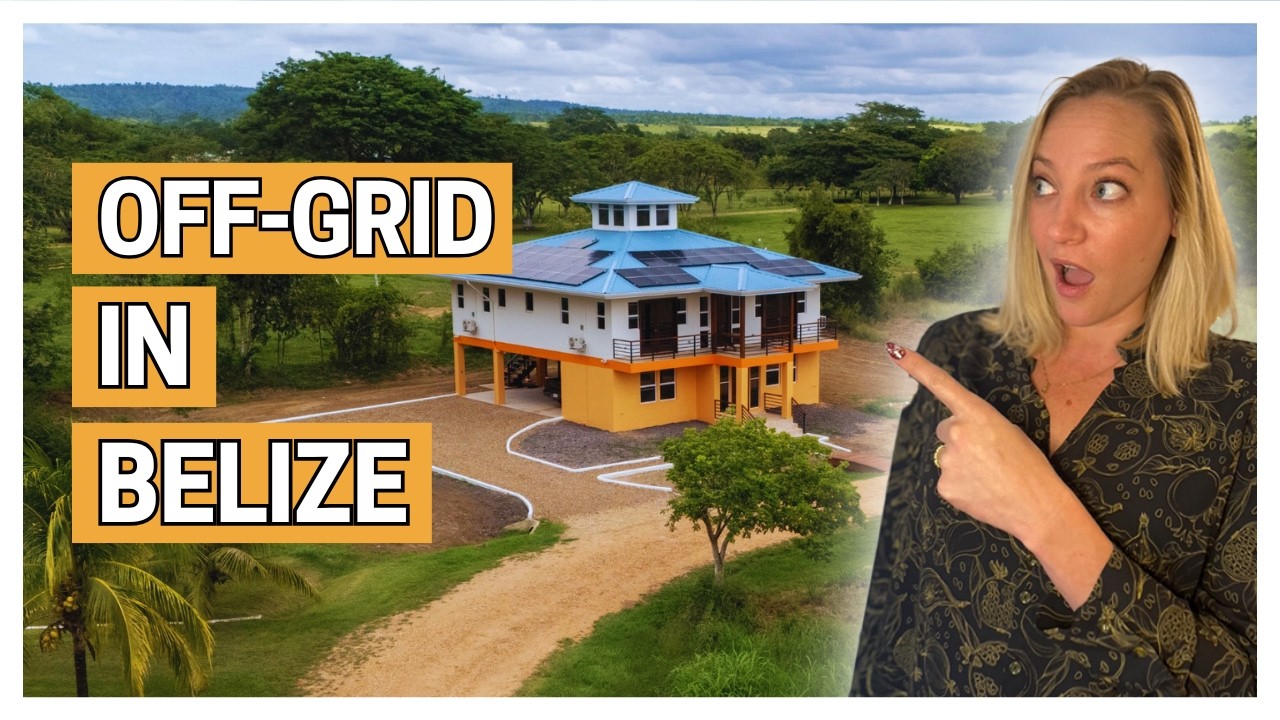
Ever wondered what living off-grid in Belize actually looks like?
In this video, LIOS Editorial Director talks with Phil Hahn to explore his residential community in Cayo Belize.
This place is designed for those who seek independence, more space, and a different lifestyle than the one you would find in Belize’s beach towns.
In this video, we cover:
✨ What life in Cayo, Belize, is like
✨ Why do so many expats choose Belize’s interior instead of the beaches
✨ What “Independent Together” means
✨ How do the off-grid and self-sufficient houses work
✨ The cost of owning a home in Phil’s community
✨ What to expect before moving to this community
If you want an independent and slow lifestyle overseas, full of nature and privacy, this community offers a unique opportunity for you. Keep watching to find out more!
Want to learn more about moving to Belize?
Join our Live and Invest in Belize Virtual Pass TOMORROW and get access to expert insights, real expat experiences, and everything you need to plan your move 👉 https://pages.liveandinvestoverseas.c...
Discover more about the extraordinary community in Belize 👉 https://www.liveandinvestoverseas.com...
Chapters:
00:00 Intro
1:03 What is the lifestyle like in Belize’s Cayo District?
3:18 Why choose inland Belize over the beach areas?
9:10 Can you really live off-grid comfortably?
12:32 What surprises people most when they move here?
13:59 What does daily life actually look like?
16:35 What infrastructure and amenities are in place?
18:57 How much does it cost to build a home?
20:44 What’s available in the community?
21:59 How can you explore this community for yourself?
🌎Follow us!🌎
Instagram: https://bit.ly/3q7D5DM
Facebook: http://bit.ly/3a84OPg
Website: https://bit.ly/3O2owwt
#LiveandInvestOverseas #Belize #OffGridLiving #CayoDistrict #ExpatLife #MoveToBelize #LifeinBelize #CayoBelize
Оглавление (10 сегментов)
Intro
People land in Belize and like you said, they go beaches, you know, islands, reefs and all of that. But, that's not the lifestyle for everybody. In fact, you know, people get island fever and it's also more expensive. Everything on, you know, the island is, has got to be barged in so, it could be twice the cost of houses in Cayo to build out in the Cayes or, you know, down in Placencia along the beach. All right. There. Hello, I'm Kat Kalashian for Live and Invest Overseas. Today we're talking about Belize and a really interesting community in the mainland, which is not what most people think of when they think of Belize. They think of the beaches and the reef and the diving. Inland, it's a completely different world. And today I'm here with Phil Hahn, who I've known for quite some time now, and he has built something really unique and impressive community for people looking for more independence, more space and a little bit of a different way of living on mainland Belize. So, Phil, how would you describe this lifestyle generally in the Cayo District?
What is the lifestyle like in Belize’s Cayo District?
Which is where your project is located. How would you describe this kind of landscape and lifestyle to someone who's never seen it before? Yeah. I think I've mentioned this to you before, that, it's kind of like if you were to take the Midwest, you know, in the U. S. in Florida, and you kind of combine them and you're gonna get this, you know, rolling hills, farmland tropical Paradise kind of feel. And, the vibe is a little different, you know, Spanish Lookout is a Mennonite community. It's kind of the commercial engine of the country, very industrious and very organized. And then you get to San Ignacio and you know, I say Belize is where the, like, Central America and the Caribbean meet and definitely kind of get that vibe and San Ignacio, it's an almost a kind of a bohemian sort of feel to it. It's a cool town. And the Carmelita Gardens vibe is very, you know, peaceful. Relaxed. We're amongst nature. But we're not that far from Spanish Lookout or San Ignacio. So, you know, I like to say, you know. Hey, we want to get away. It's not too far away, you know, and we're in that sweet spot. Nice. And so, yeah, people, you know, their lifestyle, they, you know, there's the river for floating and fishing and there's the Maya ruins. There's the Maya mountains with the waterfalls and all of that. So, those are all things that people do on the regular, daily. But, you know, daily, they're going about their lives, gardening and growing fruit trees and playing games with their neighbors. So, it's a very comfortable lifestyle. And it sounds like it's a very outdoors-oriented lifestyle. So, definitely, not the kind of lifestyle for the culture vulture looking for, you know, a museum every week or the opera. This is for hiking, horse riding, cave tubing. Which, if you've never heard of it, look it up. It's really interesting. I think it only exists in Mexico and Belize, maybe Guatemala. It's a very rare little, activity to do. And then you mentioned the Mayan ruins. I mean, this is definitely a very interesting landscape to explore. And I know you've mentioned in the past
Why choose inland Belize over the beach areas?
that it's also the bread basket. So, I guess that's where the idea of the Midwest comes in, where, yeah, it's really is a place where things are growing all the time. And I guess, your community is really putting that to the test. You know, you can grow so much of your own food. You guys have community gardens or is it. Yes. Okay. Yes. Yeah. We have like community gardens and people have their own, you know, individual personal gardens. So, yeah, it's a great, I mean, the alluvial soil in the Belize Valley is great for farming and, you know, growing crops. And when I started Carmelita, it had been leased out to Mennonites for growing corn and beans. And I wasn't sure if they had used any kind of pesticides or anything like that. So, we just let the land lay fallow. We brought in 80 head of cattle, and they grazed and fertilized and all that. And so, we've got, like, great soil. In fact, I remember the first time that I was showing Carmelita, we didn't, we just put in a road. We don't have anything else there. And, a young lady that was working for me, she was like, you know, hanging on, waiting. Okay, what is it going to say when we drive in the first time? And so, it was the first time I'd seen where they had put in the road. You could see the earth. I was like, wow, look at the dirt. So fertile and rich and, so anyway, that's the, you know, why this is such a popular place. And, you know, Cayo is growing like. And it's the fastest growing area. I mean, people are coming to Cayo. They, you know, people land in Belize and like you said, they go beaches, you know, islands, reefs and all of that. But, that's not the lifestyle for everybody. In fact, you know, people get island fever and it's also more expensive. Everything on, you know, the island is, has got to be barged in so, it could be twice the cost of houses in Cayo to build out in the Cayes or, you know, down in Placencia along the beach. Yeah, absolutely. I think, you know, Carmelita, when I came up with Carmelita, our motto is “Independent together”. So, you know, you could be as independent as you want, be together as you want. And, you know, the idea is that you live in the heartland here. And if you want to go to the reef, go visit the reef. You don’t have to live on the reef. You know, it's like every single day you're going to go scuba diving. No, you just go out there. Now it's an easy hop over there. And I just spent the weekend fishing down in Placentia. Took, some of the construction crew, and, so, at least and I went and we loaded up with fish, and everybody went home happy. And, you know, it's just a little weekend outing. But, you know, back home to peaceful Cayo area and also the one thing that I noticed now is this whole, sargassum weed thing. Yes, is really bad. And, like, as soon as you turn down the Placentia Peninsula, it's like, oh, it hits you. Really? Wow. Yeah. And apparently it's not going to stop anytime soon. And they're saying that the runoff from the agriculture in the Amazon is just created this bloom from Africa to the Caribbean. Yeah. And I've seen that in other places as well even. And you know in the Mediterranean it is definitely a global epidemic. Yeah. Yeah, it is. And so, you know, part of that, you know, not to discourage people from wanting to be on the beach, but, you know, consider that and I don't know what the stability of the real estate, industry will be if this is a plague that is not going to stop. Another thing a lot of people talk about when they talk about the downsides of beach living is rising sea levels. You know, these are places you're not exactly sure if that beach is going to be there in another 10, 20 years. So. Right. It's a bit of a risk. Yes. That sandbar that you live on, you know, maybe isn’t going to be there. Yeah. The good thing about property is that it's a physical asset that you can sit on, you know, you can put up a tent and live on it. Even in the worst instances. That's not really possible on the beach. You know, you can't just put up a tent on the beach and who knows if it'll be there. You know, the thing about owning real estate is that it's an asset that will be there. You know, we call it a legacy asset that you can give to your kids. And that's definitely what you guys are going for, and I love, I want to repeat that saying that you said the “Independent together”, which is such a fascinating idea, seems counterintuitive. But when you think about it, it describes perfectly what so many people, I think, want and are looking for is to have privacy and independence, but not have to go at it alone, you know, not have to pave your road, put in your own electricity, put in your own, you know, your own plumbing and drainage and everything else. You know, you want somebody to lay a bit of a foundation. You want to know that you're not completely alone in all of this. And that you're with like-minded people out there. The people that are thinking the same thing is you, that they want their own little garden. They want to use solar power. They don't want to depend on the grid. At the same time, you don't want to be a hermit living in the jungle by themselves. Creature comforts, a few amenities. Yeah. You know, that's it in the independent together, you know, it applies to the people, but also, you know, our house. You know, we’re completely off-grid. So, each house has its own solar, its own rainwater catchment, filtration pressure system, eco-friendly septic tank. So, we have these, you know, independent, you know, estates together in a community. Right, you're not even dependent on the community's infrastructure. You know, you have your. Right. So, it's really something special. So, I want to dig into this off grid praise a little bit because I feel like it might scare some people. You know, you think of off-grid and you think of, like a porta-potty with sawdust and right on a hammock between two trees. And, you know, like, I don't even know
Can you really live off-grid comfortably?
slaughtering your own cattle. It doesn't have to be quite so extreme. So, what does off-grid actually mean here in your community? Yeah. So, you know, we started, with, wooden cottage, and solar powered system and built in, it was something that I integrated into the architecture right away. I didn't on much of the road. A flash tanks, you know, around. And so, the porches typically are the cisterns. And, so we have that and the pressure system. So, I started off small and then we grew and I really kind of thought that we would have, like, maybe, you know, a half a dozen small little one-bedroom cottages and then somebody would build a two-bedroom on the river. And, you know, that would kind of be the pattern. Well, we went from the little one-bedroom cottage to a two-bedroom house on the river to a luxury, three-bedroom, swimming pool, gourmet kitchen, bar as the third house that we built, and we put it on two lots. I was like, whoa, I didn't I definitely didn't see that coming, but it forced us right at the very beginning to, you know, figure out this, this off-grid thing, you know, how are we going to do, you know, the pool pump to this or that, you know, the refrigerators to dishwashers, the icemaker and the wine cooler. I mean, the luxury living right off-grid. And we did it. And since then, we've refined and technology has moved forward. This is part of the gamble that, you know, I took at the beginning. Is technology going to move forward, or are we going to have these backup generators everywhere? And this cacophony of generators kicking on after a few cloudy days? That's long gone. We, you know, years ago we stopped having to include generators because the battery technology, the storage, now, it's not the old LED cell, dumb batteries that, you know, if it goes down too low, then it affects the lifespan. And it takes a long time to charge up these lithium batteries. And they, the inverters and charge controllers, are just amazing. Panel technology is gone. And we started a 250W. Now it's, you know, 750W. So, it makes for us, luxury off-grid living. Yeah. We also have people that just want the simple life. You can still do that too. If you just want a cottage, a little bungalow, something like that. Yeah, it's up to the individual. It's just, you know, driven by the owner. And we've got a great design team. You know, Louise is the architect that we've been working with for something like five years now. She's just fantastic. And she works with every, you know, single homeowner and takes either a model home or ideas that they have and helps to modify them to be appropriate for the climate, for off-grid living, for their lifestyle, for their budget. And so, yeah, we didn't really do the cookie cutter. We had done a cottage neighborhood, but even the cottages were customized. So, I always, you know, it's the people's, you know, dream home. They, you know, for some, Belize or Carmelita might be like plan B, but for other people, it's plan A, it's like, you know, hey, you know, I'm going to leave the Midwest instead of settling in Florida, I'm going to settle in Belize, once you're on the plane, it's not that much farther. Yeah. Is there anything that you hear from people
What surprises people most when they move here?
that come to visit on tours or people that have just moved in that is surprising that, you know, that kind of is there a big shock, anything that you hear from a lot of people about what surprises them when they arrive? Yeah, I guess it's the pace, you know, that things are slower. And that's hard to adjust to sometimes. The rural aspect. When we first started Carmelita, we were, you know, very remote. So, the roads, you know, that lack of decent infrastructure, you think about Belize in that context. So, it took me a little while when I first came to the place, which was like 22 years ago. And I started, you know, driving around the country and I was like, wow, the lack of infrastructure when you start to think about this small country with 400,000 people that are spread out. So, you've got a village of, you know, a thousand people over here, there's one, you know, 500. And so if you think about the cost per capita to put a mile, a road 30 miles into the bush to service a village of 500 people, I mean, it's really if everybody was together in one city, we’d have beautiful infrastructure, but so Belize is the way that it is for certain reasons, and there's a certain charm to it, but it is sometimes, a little disconcerting for people like, when am I ever going to get there down this dirt road? And so, it's a good advertisement for making sure that you go and visit the places before you see big commitment. Yeah. So, people in your community, what would a typical day look like for somebody living where
What does daily life actually look like?
you're living in your residential community? So, we have a lot of retirees. So, we do have people that still work. We've got a, like a nurse practitioner. She does, you know, online medicine. And, we have people that do day trading. And so, there's some people that, that work day-to-day. And then on the weekends they'll go off on excursions and, you know, they'll go fishing or go out to the Cayes or go scuba diving or go to the mountains, to the waterfalls, things like that. Then we have other people that are really involved with local programs, volunteering, you know, helping out in the primary school, teaching music lessons, teaching sewing, one time, one of our owners, she actually was a missionary in Africa. And so, this is like her life's passion. So, she's also a published author and all of that. But now what she does is all of these different things and volunteering. And she hosted, a whole, like, elder care workshop one time in the village and had other volunteers in the community came out, and they're doing everything from, you know, helping people with hair and eyeglasses and their feet massage and everything. It was just like a wonderful outreach and just something that she just does, you know, and now we have, on-site, an archeological site. We have these Maya mounds. And when I designed Carmelita, I made a park out of that and worked with the director of archeology at the time. Well, now he's at the University of Northern Arizona, and he comes down with students every year. And, this past year we met and there's a new site that they're going to start to excavate in Santa Familia village, like a mile from our place. And they're also going to put a unit on our mounds and start to excavate. And so, one of our owners, Matt Rossano, he’s a retired professor with a real passion for archeology. So, he's kind of spearheading this whole thing, working with. That’s amazing. Yeah, the archeologists. And so, people will be able to get it. This will be a community archeology, so people can go in and dig and, you know, and get the shakers out there and try to find relics and stuff. So, you know, and that just, you know, walk from your house with your cup of coffee and, you know, go do a little, you know, archeological, exploration. Very cool. So, to go back to the homes, because you mentioned a little bit about how customized they are and they're really tailored to each person. But I know there is a certain foundation that you've put in. And so, what systems are in place in general in the community, you know, like what is the level
What infrastructure and amenities are in place?
of infrastructure or amenity that somebody can expect when they're coming in and thinking about building their own home there? Yeah. So, of course, you know, we have all of the roads in, we have a green space. So, one of the things that I did was understanding that we want it to be self-sufficient, to be able to be food secure and all that. I the land utilization authority is the kind of physical planning unit where you apply for subdivision and they require 10% green space. I laid it out to have 20% green space. So, all of the properties, you know, back up to green space or they're on the river or they're just larger properties. And so, the amenity of all that green space, is nice for the gardens, for the orchards, for walks, you know, there's the meadow with the beautiful fireflies and all of that at night. And, then we have a pickleball court. Of course, you know, you can't, you know, anywhere in the world now you got to have a pickleball. You need pickleball, right? So, we have that actually built like a sport court, basketball and soccer goals and all of that. But nobody used that. One of our residents finally, you know, said, hey, can we just paint a pickleball court on it? So, we actually have two pickleball courts now. And, I'm excited to announce that what's coming is a pool and a clubhouse. So, we're going to have this whole community center right now. I have, a facility, that we're using as the gathering spot that's the community center, called the Garden Club. And, so that's where we have our potlucks. We have our town hall meetings. We have, Matt, the professor I was telling you he likes to, every once in a while, do a lecture. I guess he just gets that itch that he's got to scratch, and he says, okay, I want. And so, he's done fun ones about, you know, pirates, about the Flat Earth Society, about Maya culture things. And so, we all get together and, that's where we have, like, today is, muffin day. Thursday, it will be pancakes. Tomorrow is Soup Wednesday. And so have soup. And so that's our gathering place. We have, you know, bingo. And, you know, whatever, different things there. And so, that is a very active community, very active. Yeah. There's always things going on. Yeah. So, we've been talking about how the cost can really, be affected when you go inland versus being on the coast. What kind of budget are we talking about? To build a home here, in this inland part of the country.
How much does it cost to build a home?
Yeah. So again, depending on the, the home, and, you know, it's like a bag of groceries now. Like, how much does cost? Well, depends on what you put in it. So, in our case, we have, cottage models, bungalow models, villas and what we call manor homes, which would be more large custom villas. And our cottages are around the $150 to $180,000 range. The bungalows are $200-250 range. And then the villas would be, you know, $300 plus, depending on what they do. So, recently we built a house for a gentleman that has three bedrooms, it has a fitness room, has a sauna, and again, all off-grid. That's incredible. Yeah, yeah. And so that house today would probably, cost of a little under $500,000 to build. But then, like I said, we have the other ones. And also, introducing what we call hamlet homes. So, these are attached residences. Okay. And so, Louise has come up with a great plan. From the outside, it looks like a villa. But it actually has a two-bedroom, two-bath unit and then two one-bedroom, one-bath units under the same building. And so, they are going for that, you know, $150,000 starting point for the one-bedrooms and then around $230-240, for the two-bedrooms. And we'll be introducing that actually for the first time at the conference coming up next week. Yeah. Okay. So, I know that the community is pretty built up at this point. Is there a number of how many lots or how many homes are
What’s available in the community?
still available in the community right now? Yeah. So, the total lots, which would include the Town Square commercial lots, is 245. And so, there are about 212 residential lots. And we have sold about 160 of them. So, there's still plenty left, but the inventory is dwindling. Right. And, we're not remote out in the boonies anymore. Carmelita Gardens is well known within Belize. They I mean, the government uses as an example of, you know, alternative energies, how to develop, you know, sustainably. So, when the bridge is completed from Santa Elena and the paved road from Spanish Lookout to San Ignacio, it's going to boom. We're going to boom. So, if you want to get ahead of it. Yeah. This is the last chance. Yeah. Like I said, you know, I hear the pile drivers in the bridge “boom boom boom”. It's coming. Progress is coming. Yeah, yeah. All right. Well, that's so great. And thank you so much for taking the time. If anybody is curious about this lifestyle, what's the next step? I
How can you explore this community for yourself?
guess, the good thing would be to take a trip down to Belize. Yes, yes we do virtual tours. So, that's a good start to just kind of get a visual, and we go around, we drive around the community and we look at some of the houses. So, that's a good first step. And we do a Q&A after that, detailed and specific and then, from there, schedule a trip, come down and, we've got places on site to stay, and you just get to know the neighbors and lay of the land and the villages and the towns nearby. We do have a tour after the Live and Invest in Belize conference next week and that basically we do that, we do a tour, we go through Spanish Lookout, get some ice cream, and, you know, get that kind of lay of the land there. And Carmelita. And then we go through San Ignacio on the way back to the conference hotel. Excellent. Well, I hope that everybody watching this has signed up for our Belize conference, and will be on your tour. If not, make sure to get in touch with Phil and take part in a virtual tour. And, in the meantime, I thank you for your time, Phil, and thank everyone for watching.