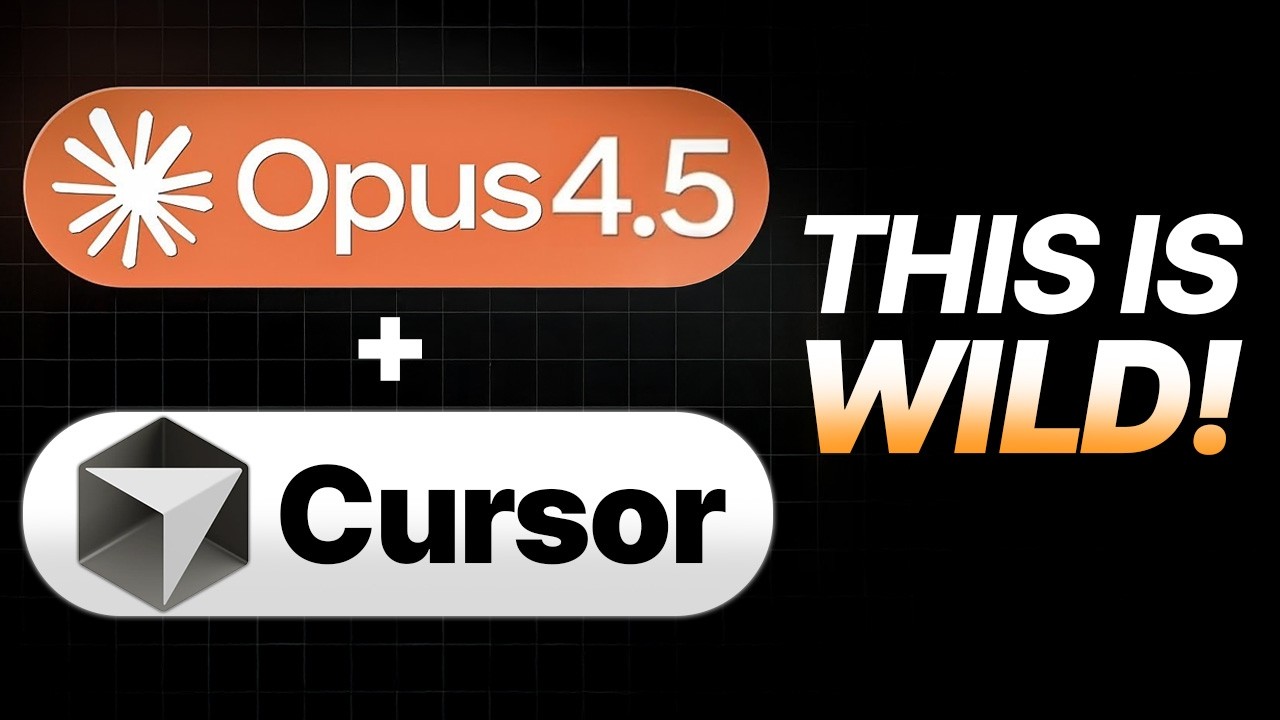
NEW Cursor + Opus 4.5  just CHANGED EVERYTHING!
8:33

NEW Cursor + Opus 4.5 just CHANGED EVERYTHING!

Julian Goldie SEO 29.11.2025 4 582 просмотров 54 лайков обн. 18.02.2026
Поделиться Telegram VK Бот
Транскрипт Скачать .md
Анализ с AI
Описание видео
Want to make money and save time with AI? Join here: https://juliangoldieai.com/ANP12B

Оглавление (2 сегментов)

  1. 0:00 Segment 1 (00:00 - 05:00) 960 сл.
  2. 5:00 Segment 2 (05:00 - 08:00) 632 сл.
0:00

Segment 1 (00:00 - 05:00)

Cursor just dropped something crazy. They added Claude Opus 4. 5 and it's three times cheaper than the old version. This is gamechanging for anyone who codes. I'm going to show you exactly how to use it, why it's faster than anything else right now, how it can refactor your entire codebase in minutes. The setup is super easy. This could save you hundreds of hours. Let me show you why everyone is freaking out about this. Hey, if we haven't met already, I'm the digital avatar of Julian Goldie, CEO of SEO agency Goldie Agency. Whilst he's helping clients get more leads and customers, I'm here to help you get the latest AI updates. So, Anthropic just released Claude Opus 4. 5 on November 24th, and Curser immediately added it to their coding editor. This is huge. Opus 4. 5 is the strongest coding model Anthropic has ever made. It beats everything on the software engineering benchmarks. And here's the crazy part. It's three times cheaper than Opus 4. 1. When you combine that with Curser's new features, you get something insane. Cursor is an AI powered coding editor built specifically for AI. They just released version 2. 1 with multi- aent workflows. That means you can have multiple AI agents working on your code at the same time. So, you've got the best model running in the best environment at a third of the cost. First, let's talk about what Opus 4. 5 actually is. Claude is Anthropic's AI model family. Haiku is the fastest. Sonnet is balanced. Opus is the most powerful. Opus 4. 5 just came out and it's a massive upgrade on the S. S. S. S. S. S. Bench test, which measures how well AI can code, is hitting state-of-the-art numbers. Better than GPT4, better than Gemini, better than everything else right now. But here's what really matters. It uses way fewer tokens. Tokens are how AI models measure the amount of text they process. Fewer tokens means lower cost and faster responses. Anthropic says it's one/ird the cost of Opus 4. 1. That's huge when you're running hundreds of coding tasks. The model is also better at tool use. That means it can interact with your codebase more effectively. It can refactor multiple files at once. It can understand complex dependencies. It can even generate spreadsheets and slides if you need that. Now, let's talk about cursor. Cursor is built by a company called Nyphere. It's built from the ground up for AI coding. They released version 2. 0 back in October with a new feature called Composer. It's their coding model that understands your entire codebase. They also added a multi- aent interface. You can spin up multiple AI agents working on different parts of your project at the same time. Then in November, they released version 2. 1. This added improved plan mode. That's where the AI creates a plan before it starts coding. He also added AI code reviews. So after the AI makes changes, another AI reviews those changes for bugs and issues. They made it so you can choose which AI model you want to use. You can pick Open AI, you can pick Google, you can pick anthropic. And that's where Opus 4. 5 comes in. Here's where it gets really interesting. Cursor tweeted that Claude Opus 4. 5 is now available in their editor and they're offering it at Sonet pricing until December 5th. Sonnet is normally the mid-tier model, so you're getting the most powerful model at a cheaper price, but only until December 5th. And now, let me show you how this actually works. You open cursor, you go to settings, you go to models, you select Claude Opus 4. 5 from the drop down. If you're using your own API key, you plug in your anthropic key there. Then you're ready to go. You load up your codebase. Let's say you have a project with 20 files, you want to refactor one of the core modules. With old AI models, you'd have to break this into small pieces. Do one file at a time, test it, fix the bugs, move to the next file. It could take hours or even days. With Opus 4. 5 in cursor, you just describe what you want. You say, "Refactor module X to use this new architecture. Update all the tests. Make sure it's backward compatible. " Then you hit enter. The model spins up. Because cursor has multi-agent mode, it can work on multiple files at once. Within a minute or two, you get proposals. You can see the diffs. You can see what changed. Then you switch to the AI code review panel. This is Cursor's new feature. Another AI looks at the changes and flags potential issues. Maybe it finds three small bugs. You fix those, then you're done. Compare that to spending hours doing this manually. And it's not just about speed. It's about quality, too. Opus 4. 5 understands context better. It knows how different parts of your code relate to each other. It won't break something in file A when it changes file B. It thinks through the dependencies. It updates your documentation. It keeps your code style consistent. But cursor isn't the only way to use Opus 4. 5. The model is available on other platforms too. You can use it on Amazon Bedrock. Google Cloud's Vertex AI. You can call it directly through Anthropics API. So even if you don't use Cursor, you can still access this model. You can build your own. Now I need to talk about something important. If you're serious about using AI tools like Cursor and Opus 4. 5 to scale your business, get
5:00

Segment 2 (05:00 - 08:00)

more customers, and save hundreds of hours with AI automation, you need to check out my AI profit boardroom at school. com/iprofitlab7462/about. This is where you learn how to actually implement these tools in your business, how to automate your workflows, how to save time on repetitive tasks, and how to use AI agents effectively. We cover tools like Cursor, Claude, and dozens of other AI platforms. So, if you want to take this to the next level, go check out AI Profit Boardroom. The link is in the description. All right, back to Opus 4. 5. Let me give you some things to watch out for. First, cost. Even though it's cheaper than before, it's still more expensive than basic models. If you're running tons of requests, your bill can add up. Make sure you track your token usage. Second, data privacy. When you're using AI in your code editor, you're giving it access to your code base. Make sure you're comfortable with that. If you're working on something confidential, read the privacy policies. Third, security. There's research showing that AI code editors can be vulnerable to attacks. Someone could put malicious code or comments in your repository. Then when the AI reads it, it might execute those commands without you knowing. This is called prompt injection. Opus 4. 5 is better at resisting this than older models, but it's not perfect. You still need to review what the AI does. Fourth, model limitations. No AI is perfect. They can still make mistakes. They can still write buggy code. Always review the output. Always test it. Always have human oversight. The AI is a tool to make you faster. It's not a replacement for thinking. Fifth, the pricing promotion. Remember that Sonic pricing deal ends December 5th. After that, Opus 4. 5 will cost more. It'll still be three times cheaper than Opus 4. 1, but it won't be as cheap as it is right now. So, if you want to experiment, do it soon. Now, let me talk about workflow. If you're going to integrate this into your team, you need some structure. You need policies. You need code review processes. You need test coverage. Cursor's new features help with this. The AI code review catches issues. The plan mode shows you what the AI is going to do before it does it, but you still need human checks. Here's what I recommend. Start small. Pick one project or one module. Use Opus 4. 5 to refactor it to see how it goes. Learn the workflow. Figure out where it's good and where it struggles. Then expand. Use it for more projects. Train your team on it. Build it into your development process. So where does this leave us? You've got a model that's three times cheaper, significantly more capable, and available in the best AI coding environment. That combination is powerful. If you're a developer, this is worth trying. If you're a team lead, this is worth evaluating. The tools are getting better fast. The costs are coming down and the results are improving. Now, let's wrap this up. Opus 4. 5 plus cursor is a big deal. It's faster. It's cheaper. It's more capable. The setup is straightforward. The benefits are clear. But you need to use it responsibly. Review the output. Protect your data. Test everything. If you do that, this can save you hundreds of hours. If you're serious about scaling your business, getting more customers, and saving hundreds of hours with AI automation tools like Curser and Claude Opus 4. 5, you absolutely need to check out my AI profit boardroom at school. com/iprofitlab7462/about. Inside, you'll learn exactly how to implement these cuttingedge tools in your business, automate your workflows, and use AI agents effectively.

Ещё от Julian Goldie SEO

Ctrl+V

Экстракт Знаний в Telegram

Транскрипты, идеи, методички — всё самое полезное из лучших YouTube-каналов.

Подписаться