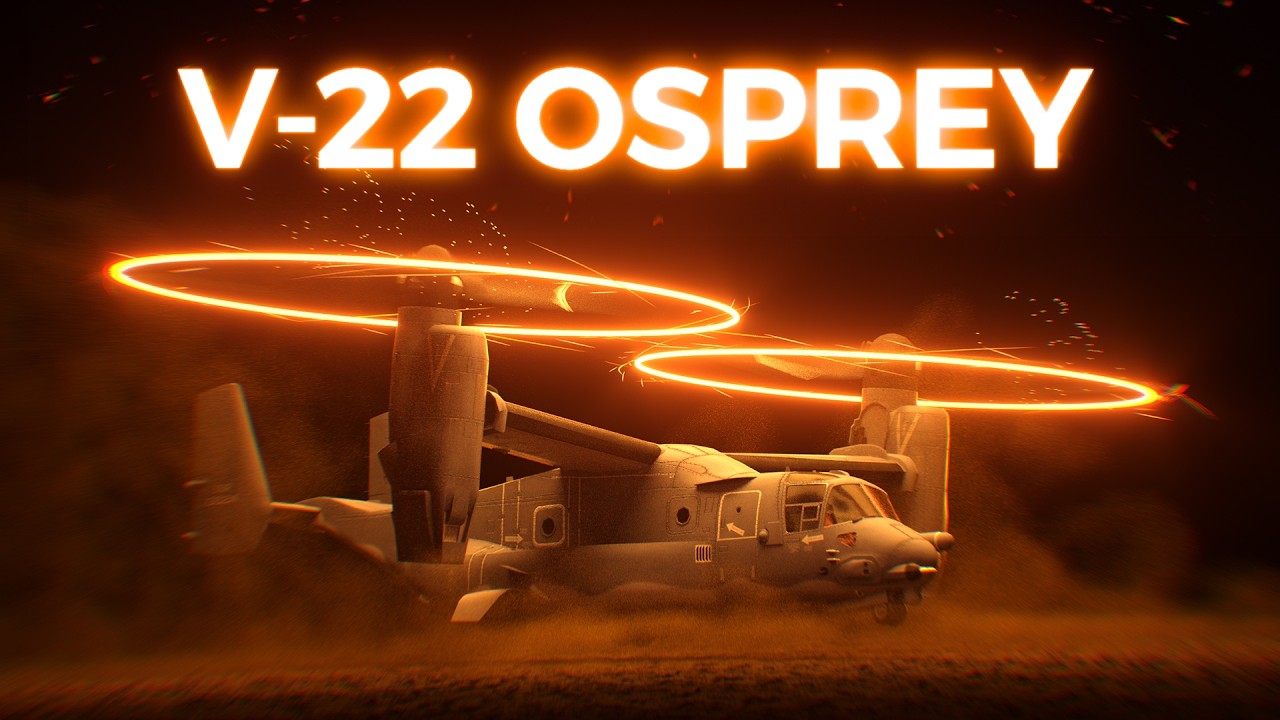
The Insane Engineering of the V-22 Osprey
23:08

The Insane Engineering of the V-22 Osprey

Real Engineering 25.04.2026 775 931 просмотров 27 141 лайков

Machine-readable: Markdown · JSON API · Site index

Поделиться Telegram VK Бот
Транскрипт Скачать .md
Анализ с AI
Описание видео
Get Nebula for 50% off with my link: https://go.nebula.tv/realengineering Watch the Anatomy of the IPod: https://nebula.tv/videos/realengineering-the-anatomy-of-the-nokia-3310 Watch this video ad free on Nebula: https://nebula.tv/videos/realengineering-the-insane-engineering-of-the-v22-osprey Links to everything I do: https://beacons.ai/brianmcmanus Get your Real Engineering shirts at: https://standard.tv/collections/real-engineering Credits: Producer/Writer/Narrator: Brian McManus Head of Production: Mike Ridolfi Editor: Dylan Hennessy Writer/Research: Josi Gold Animator: Eli Prenten Animator: Stijn Orlans Sound and Production Coordinator: Graham Haerther Sound: Donovan Bullen Thumbnail: Simon Buckmaster Head of Moral: Shia LeWoof References: Select imagery/video supplied by Getty Images Thank you to AP Archive for access to their archival footage. Music by Epidemic Sound: http://epidemicsound.com/creator Thank you to my patreon supporters: Abdullah Alotaibi, Adam Flohr, Henning Basma, Hank Green, William Leu, Tristan Edwards, Ian Dundore, John & Becki Johnston. Nevin Spoljaric, Jason Clark, Thomas Barth, Johnny MacDonald, Stephen Foland, Alfred Holzheu, Abdulrahman Abdulaziz Binghaith, Brent Higgins, Dexter Appleberry, Alex Pavek, Marko Hirsch, Mikkel Johansen, Hibiyi Mori. Viktor Józsa, Ron Hochsprung

Методичка по этому видео

Структурированный конспект

Инженерное мастерство: как проектировать сложные системы и анализировать их надежность

Изучение принципов проектирования гибридных летательных аппаратов, анализ их механики и интерпретация данных о безопасности для инженеров и энтузиастов авиации (23 минуты).

Оглавление (5 сегментов)

Segment 1 (00:00 - 05:00)

It is close to midnight when the emergency is called. An F-15 has just crashed in the Libyan desert and its pilot is running for his life. Every passing second gets him further from being a survivor to being a geopolitical bargaining chip. The Arab Spring arrived in Libya in February 2011. What started as small sprouts of localized protest soon erupted into a violent civil war. The population was finally rising against the 42-year rule of Gaddafi. But the dictator's counteroffensive was brutal with radio warnings echoing across the Libyan desert. — We are coming tonight. We will find you in your closets. We will show you no mercy and no pity. — Gaddafi unleashed the country's advanced fighter jets on its own people. and NATO drew a red line there, moving to impose a no-fly zone over the country with the combined air force of NATO. Amidst the chaos, the American pilot crash landed behind enemy lines after a mechanical failure. His life now depends on this, the V22 Osprey. For 30 years, this machine has been plagued by accidents and criticized as a technological Frankenstein, too complex to fly, a controversial hybrid of a plane and helicopter. But tonight, only it could be the hero. Slowly unfurling its massive composite blades, the rings rotate 90° and lock into place. Twin halos appear overhead as its blades thrash the air into submission. The V22 now has to make its most difficult transformation. This aircraft has to operate in two modes, vertical and horizontal flight. two completely different flight modes using the very same controls. This is the thrust control lever. It controls both the collective pitch in vertical flight, allowing the V22 to control altitude in hover, but in forward flight, it controls speed by controlling the engine's thrust, and altitude is controlled by the elevator, which stick. A flybywire system was the only option to allow the control logic to flip like this. And things get even more complicated in the transition. With a turn of this wheel, the pilot effortlessly controls the necessels, tipping them forward, trading vertical rotor wash for forward thrust. As this transition happens, the V22 is neither helicopter or plane. And the computer has to gradually blend both control logics together until the transition is complete. But once complete, the V22 is capable of flying nearly twice the speed of a Blackhawk helicopter. The V22 is now flying low to the water to avoid ground radar detection on the coast. It is sprinting at 500 kmh, reaching the shoreline in less than 30 minutes. The pilots expected the cover of darkness, but they are met with a well-lit, populated sprawl where they could be exposed to thousands of eyes. Forced to improvise, they thread the needle, aiming for the single darkest patch in a sea of city lights. Meanwhile, the situation on the ground is becoming desperate. Enemy vehicles have nearly cornered the pilot and he is forced to call in a dangerlo bombing run from US Harrier jump jets dropping 500lb laserg guided bombs obliterating the trucks and forcing the pursuers to retreat in chaos. The explosions by the crucial seconds needed for the extraction. It would have taken a standard rescue team hours to fly the 300 km, but the V22 arrived in just 41 minutes. As they approached the landing zone, the pilot rolled that dial back, redirecting the V22's thrust at the ground, taking the V22 from 500 km per hour to a standstill, opening its rear ramp amid a chaotic man-made sandstorm, the pilot sprints in from the shadows. A simple thumbs up, and in less than 90 seconds, the Transformer raises its wheels off the ground, vanishing back into the clouds. For all its controversy, the V22 is a miraculous piece of engineering. The V-22, just like any other aircraft, is a tool. It's not the most efficient helicopter, and it's not the best plane. But this rescue mission was exactly what it was designed for. This is the insane engineering of the V22 Osprey. The development of the V22 Osprey began in the early 1950s with the XV3, a clunky aircraft with a piston-powered engine installed in the fuselage behind the pilot with a two-speed transmission allowing the rotors to operate at two speeds for hover and cruise. The rotors were mechanically linked to the engine through the wings with the entire rotor assembly rotating through gaps in the fairings. This was the very first tiltrotor aircraft to transition from vertical to horizontal flight. And to honor its achievements, we've designed this t-shirt screen printed on a 100% cotton shirt and designed to last. It's

Segment 2 (05:00 - 10:00)

available to pre-order for the next 2 weeks with this link. The XV3 worked fine in helicopter mode, but these linkages and pylons lack the stiffness needed to stabilize the intense vibrations and forces of transition to an entirely different mode of flight. These whirling vibrations through the skinny pylons got so intense that it knocked out test pilot Dick Stansbury, severely injuring the man and damaging the first prototype beyond repair. But Bell did not give up on the vision. The XV15 was the next step to turn a prototype into a complete tilt rotor. Unlike the XV3, the XV15 moved the propulsion out to the fuselage and onto the wing tips. On the XV3, the drive shafts and gearboxes had to transmit all of the engine's power out to the wing tips for the entire flight. That required heavy, robust drive shafts designed for long flights at high stress. But the XV15 placed its engines on the wing tips. With the power from the engine being so much closer to the rotor, the pilants could be bolstered with a full nel that provided a lot of extra stiffness. But this created a new problem. How to synchronize the engines. The XV15 developed an engine synchronization system that would carry on through to the V22, a cross shaft through the wings to keep the rotors in sync. The only time they would need to carry a large torque would be if one engine failed, where an automatic clutch disconnects the failed engine, letting the other engine drive both rotors through the cross shaft for a single engine landing. With the smaller load, the shafts and connections could be a lot lighter. Up to the late '7s, these aircraft were mostly proof of concepts. But everything changed with one failed mission. Operation Eagleclaw was a US rescue attempt in April 1980 to free 52 American hostages in Thyan. The plan relied on eight Navy RH53D helicopters, flying in land to a remote desert refueling site, Desert 1, and meeting two C130s before continuing on to the city. Dust storms and mechanical failures cut the helicopter force from 8 to 5, below the minimum to continue, forcing commanders to abort the mission. Operation Eagleclaw highlighted a blunt limitation. Conventional helicopters could land anywhere, but they couldn't reach deep targets quickly without high-risisk refueling stops. So, in 1981, the Pentagon responded by approving a program to design a transport aircraft capable of vertical takeoff and airplane-like crews, setting the stage for the XV15's 7-year long evolution into the V22 Osprey. The core concept of the Osprey depends on one mechanism, the conversion actuator responsible for the tilt that gives the Osprey its tilt rotor status. Even though the V22 can fly with the N cells at any incremental angle, in practice to avoid complex aerodynamics, pilots use one of three modes. Helicopter mode with the NLS around 90°, airplane mode with the N cells locked at 0°, and short takeoff and landing mode typically set around 60°. The actual tilting mechanism has to handle a lot of forces that vary drastically depending on the flight regime. When the NL is in helicopter mode, the engine and rotor sit in front of the pivot. So, gravity wants to roll the NL forward, compressing the actuator. But as the NL tilts down and the Osprey picks up speed, drag wants to push it back into the vertical position. That compression force decreases until around 80°. As it rotates further, the load flips into tension. But once you get past the 45°ree point, the balance shifts again, and the NL starts pushing the actuator down, putting it back into compression as it drives all the way down to the 0° down stop. Now the actuator's job is to keep the NL locked in place. With these changing loads, a gear drive would shove huge torque through small teeth that would wear and crack. A screw drive spreads that load through a larger contact area. But there is one problem with using a large singular screw. The prop rotors reach well below the fuselage of the aircraft in horizontal flight. This means the V22 cannot land like a traditional plane. If one of those screws jammed in horizontal flight, the V22 would have no safe way to land. So instead of having one large screw, the V22 uses a double telescoping screw that saves space and provides jam redundancy. The size of these prop rotors are a great physical representation of the compromises that the V22 had to make. They need to be both helicopter rotor and airplane propeller. And this blend of functions is what gives them their unique shape. Sitting between the 4 m diameter of a military transport propeller like the C130s and the gigantic rotors of the Sea Stallion helicopter. The dual use also demanded a unique twist in the blade profile. Helicopter blades are twisted to adapt to faster flowing air at the tip of the blade, which would result in a disproportionate amount of drag here compared to the slower moving route. So, the blade twists usually around 8 to 14° to lower the angle of attack of the

Segment 3 (10:00 - 15:00)

blade at the tip and balance lift. The V22, however, has a massive twist angle of 47°, an aggressive degree of twist driven by the proprotor's need to adapt to high-speed horizontal flight. These are small helicopter blades but absolutely massive propellers. In high-speed forward flight, the velocity of oncoming air adds to the high-speed rotation of the blades with the air flow at the tips flirting at the boundary of supersonic speeds. The high degree of twist ensures the prop rotor can produce lift efficiently across its full length despite the huge variation of airflow speeds it encounters. These tip air flow velocities limit how big a propeller can get. And that's a problem because the massive propeller is still a small rotor and that really hurts the V22's hover efficiency. Hover efficiency is measured by disc loading, the ratio of an aircraft's weight to the rotor's circular area. A rotor works by pushing air downward to generate upward lift. A helicopter like the Blackhawk has a disc loading of around 50 kg per square meter of its rotor area. The V22 is closer to 150 kg per square meter. That means it needs to push air down much faster to fly. The V22's downwash can reach velocities of up to 150 km/h. That's not just inefficient, that's stronger than Hurricane force winds, which can make ground crew operations a little difficult. Powering the engine are two Rolls-Royce turbo shaft engines mounted right on the wing tips of the aircraft. To prevent the whirling flutter induced oscillations that knocked out the test pilot of the XV3 prototype, the engineers of the V22 needed light and strong materials to stiffen up the structure, and the V22 benefited massively from a decade of composite material development for aircraft. Like the F-14's first of its kind boroncoated tungsten fiber epoxy composite tailoron, composites are everywhere in the V22. 2,700 kg of the aircraft's total 6,000 kg structural weight is taken up by carbon epoxy composites. The wing structure got a stiffer carbon composite than the fuselage or tail, helping it deal with the huge variation of loads it was expected to hold and prevent them vibrating the entire aircraft out of the air. This is fairly standard composite manufacturing now, but back then it was worthy of NASA reports on state-of-the-art manufacturing. I wasn't lying when I said composites are everywhere in this, but on this long list of achievements, the prop rotors and their multiple parts stand out the most. Take the yolk, a part with a fairly simple geometry. An attachment point for the central drive shaft and three more for the gigantic folding blades, but it is constantly being battered by cyclical forces. Picking the wrong material could have it humming like a tuning fork before it cracks and fails. Titanium was tested in the XV15, but it fatigued and cracked too quickly, forcing the engineers to rely on heavier, sturdier stainless steel. By the time the V22 came around, they had figured out how to make it out of a much lighter S2 fiberglass composite, a glass fiber made from magnesia aluminous silicate. Although not as strong as the carbon fiber blades it was securing, this material played a very important role with a unique property, its lower mechanical impedance. It's fantastic at absorbing, flexing, and transferring force without vibrating, which is why it's used in golf clubs and was recently used in the US Olympic team's pole vaults. They added layer after layer of this composite to build up this part to be strong enough to hold the enormous weight of the blades as they swung around and tried to rip free of the restraints while also dampening a constant onslaught of vibrations that would crack another material. A problem they actually encountered further up the blade with a carbon composite part. The blade was made from stiffer, stronger carbon composites, but it also needed to fold over itself during the stowing process. During the development of these hinges, the grips kept delaminating and failing, eventually requiring the addition of a pre-loaded clamp ring to each end of the centrifugal force fitting to react the transverse load. Composites are not tough materials either. High-speed debris strikes can easily shatter them, so they need to be armored. The leading edge is protected with a hotformed titanium strip over the first 3/4 of the blade. Titanium gives a tough erosion resistant surface without adding too much weight. Further out, the impacts get much harsher, so further out they bond an electroformed nickel cap. Nickel is harder and more durable against high-speed impacts, but it's also heavier, so they keep it limited to where it's needed. In the worst conditions, these strips of metal act like the titanium skid plates of F1 cars. The blades impact the hard silica sand at immense speeds, creating two halos of hot metallic debris. The rotational speed of these two prop rotors need to match, particularly in hover, where unequal lift will quickly cause a crash. The problem was the only way to reliably ensure that two engines operate at the same speed is to link

Segment 4 (15:00 - 20:00)

them mechanically. And the path between them was a veritable mechanical obstacle course. Viewing head-on, you'll see the wings tilt up slightly by just 3. 5°. This subtle dihedral angle gives the necessels enough clearance to rotate into the parallel position, but the wings are also swept forward for no other reason than to give the prop rotors enough clearance that they don't shred the fuselage. On top of navigating these angles, this drivetrain had to deal with the necess rotating, the wings flexing, and the entire wing rotating parallel to the fuselage on a giant ring. All the while rotating 6,300 times a minute. and in the event of an emergency be capable of transferring half the engine's torque to the other engine so it could land less aggressively in an engine out situation with a final prayer that they could somehow not make this a nightmare to maintain. Remarkably, the V22's engineers developed an innovative lubricationfree coupling system, replacing the lubricated gear system of the XV15, a flexible coupling that was stiff in torsion and could handle spinning at 6,300 RPM and do it even if the shafts moved 3. 5° out of alignment. This is called a multid-isk convoluted diaphragm flexible coupling. You can buy off-the-shelf versions yourself, but the V22 was an extreme early application of this technology that drove development. Each shaft has a stack of thin 0. 2 mm stainless steel diaphragms with spacers attached. Multiple thin discs offer more flexibility than a single thicker disc like the leaf springs in a car. The convoluted part simply means the discs aren't flat. They have this wave pressed into them. Being lubricant free and a simple disc made replacing them easy, which made the V22 maintenance crews life slightly less of a nightmare. But honestly, this part is remarkable in its simplicity. In 25 hours, this 0. 2 mm thin disc goes through 10 million revolutions and deals with being shoved, shook, and bent out of alignment over and over again. And thankfully, when a disc starts to fail, its squeaking is easy to hear. And even if one failed, the V22 was good to keep flying for another 5 hours at maximum torque. To make things even more difficult, there are fuel tanks located here in the spons. And that fuel has to get to the engines located all the way out here on the other side of a giant rotating coupling. Documents on how this worked are sparse, but from the clues I could piece together, I think this actually worked remarkably similar to this rotating house that appeared in a Tom Scott video. Essentially, you carve sealed grooves into a stationary ring and then cap that with a rotating cover. Our team actually animated this for Tom years ago. And you may have heard recently that Tom Scott has returned from his hiatus and is now releasing new episodes of his new series Tom Scott England early on Nebula every week, which you can sign up for with this QR code or the link in the description. Thankfully, this coupling didn't need to deal with high-pressure hydraulic fluid as the auxiliary power unit, midwing gearbox, and hydraulic pump were all mounted inside the rotating wing. The V22 is truly a mechanical wonder. The drivetrain packed into this rotating wing is bewilderingly complicated. The V22's self-imposed tornado can cause havoc for the engine's compressors, but the engineers went to great lengths to minimize the pain and suffering of the maintenance crews once again. with some clever aerodynamics. As air enters the engine inlet, it's forced to make a sharp turn. Clean air can follow the bend. Heavier grit and sand can't turn as easily, so it separates out and gets rooted away. The engine output is geared down to between 412 RPM for vertical takeoff and 333 RPM in cruise. One prop rotor gearbox gets an extra gear to spin it in the opposite direction. This cancels out the adverse rolling moment that the huge gyroscopes mounted on each wing create. After the turbines, the air flow is pushed through a mixer that deliberately drags in cooler outside air and blends it with the hot exhaust before it exits. So instead of a tight, bright hot plume, the exhaust gets spread out and cooled down. And it's aimed outward away from the fuselage, so the hot flow isn't blasting nearby structures or getting pulled back into other inlets. With all of these complicated mechanics, the Osprey has garnered a reputation for being unsafe. But what does the data say? Since 1991, there have been 25 incidents involving the V22. Nine were caused by pilot error, 10 by mechanical failures, two were a mix of both, and two are still under investigation. This has led to the unfortunate death of 58 service members, and has injured another 52. But how does this compare to two other helicopters, the Sakorski H60 and the Chinuk H47? Since its debut in 1979, the H60 and its variants have had 390 incidents, resulting in 970 deaths. 60 of those deaths happened in the last decade, which is two more than the V-22 has caused over the past 30 years. The H47

Segment 5 (20:00 - 23:00)

has historically had the Army's highest death rate per incident. Between 1966 and 2005, 238 lives were lost in 10 non-combat crashes. But in recent years, the H47 Chinuk has had a huge improvement in safety with 47 incidents and no deaths between 2016 and 2020. Simply comparing the number of deaths does not take into account how many aircraft have been built and how much they fly. In accidents per airframe, the V22 fares quite well with only 0. 0625 0625 incidents per airframe compared to 0. 75 and 0. 11 for the H60 and H47. But if you look by how much flight time, the V22 has more deaths per 100k hours. This data shows a couple of trends. Larger aircraft like the V22 or H47 tend to have higher death rates per incident because they carry more people, increasing the risk per crash compared to smaller aircraft like the H60. Also, more complex aircraft usually see a spike in incidents early on as problems are identified and fixed. But these issues tend to decrease over time as the aircraft matures and systems are improved. These comparisons are not intended to put the V22 above other military aircraft or dismiss its safety record. No aircraft is without flaws, and every accident is a stark reminder of the risks faced by service members. However, the data clearly shows that the V22's safety record is not an outlier. This channel is all about breaking down how things work. And we've developed a new animation technique with Lumafield, whose industrial CT scanners allow us to create these volutric models of anything we can fit inside, allowing us to explore every hidden nook and cranny of some of the most intricate devices ever conceived. We already have two episodes ready for you to enjoy, and they're available exclusively on Nebula. The Nokia 3310 and the first generation iPod. With the help of Nebula, we hired a new animator with a background in electronic engineering to take the technique we developed and help us make one of these videos every month. Next month, we'll be breaking down how charger bricks work and compare a $1 gas station charger to a top-of-the-line charger. A monthly subscription is usually $6, but with my link or the QR code on screen right now, you can get an entire year's membership for just $30. We are currently running the show as a pilot. So if you want to see more of it, you got to sign up now. Or if you are sick of signing up to new subscription services like I am, we created a lifetime membership if you would rather just pay it and forget it. All Nebula subscribers also get a 15% discount code in their account subscription page that you can use to purchase our XV3 t-shirt. In a time when creative work is getting harder and harder to find, Nebula helped me hire a young, talented animator and create a new series. That's what Nebula is about, supporting creative work made by humans.

Другие видео автора — Real Engineering

Ctrl+V

Экстракт Знаний в Telegram

Экстракты и дистилляты из лучших YouTube-каналов — сразу после публикации.

Подписаться

Дайджест Экстрактов

Лучшие методички за неделю — каждый понедельник