A rare leak from the Supreme Court reveals the origins of the disastrous Shadow Docket of the Roberts Court 🚀 Watch our exclusive content on Nebula https://legaleagle.link/getnebula including Cristian’s video on how to abolish ICE. ⚖️⚖️⚖️ Do you need a great lawyer? I can help! https://legaleagle.link/eagleteam
Welcome back to LegalEagle. The most avian legal analysis on the internets.
🚀 Watch my next video early & ad-free on Nebula! https://legaleagle.link/watchnebula
👔 Suits by Indochino! https://legaleagle.link/indochino
GOT A VIDEO IDEA? TELL ME!
▀▀▀▀▀▀▀▀▀▀▀▀▀▀▀▀▀▀▀▀▀▀▀▀▀▀
Send me an email: devin@legaleagle.show
MY COURSES
▀▀▀▀▀▀▀▀▀▀▀▀▀▀▀▀▀▀▀▀▀▀▀▀▀▀
Interested in LAW SCHOOL? Get my guide to law school! https://legaleagle.link/lawguide
Need help with COPYRIGHT? I built a course just for you! https://legaleagle.link/copyrightcourse
SOCIAL MEDIA & DISCUSSIONS
▀▀▀▀▀▀▀▀▀▀▀▀▀▀▀▀▀▀▀▀▀▀▀▀▀▀
Twitter: https://legaleagle.link/twitter
Facebook: https://legaleagle.link/facebook
Tik Tok: https://legaleagle.link/tiktok
Instagram: https://legaleagle.link/instagram
Reddit: https://legaleagle.link/reddit
Podcast: https://legaleagle.link/podcast
OnlyFans https://legaleagle.link/onlyfans
Patreon https://legaleagle.link/patreon
BUSINESS INQUIRIES
▀▀▀▀▀▀▀▀▀▀▀▀▀▀▀▀▀▀▀▀▀▀▀▀▀▀
Please email my agent & manager at legaleagle@standard.tv
LEGAL-ISH DISCLAIMER
▀▀▀▀▀▀▀▀▀▀▀▀▀▀▀▀▀▀▀▀▀▀▀▀▀▀
Sorry, occupational hazard: This is not legal advice, nor can I give you legal advice. I AM NOT YOUR LAWYER. Sorry! Everything here is for informational purposes only and not for the purpose of providing legal advice. You should contact your attorney to obtain advice with respect to any particular issue or problem. Nothing here should be construed to form an attorney-client relationship. Also, some of the links in this post may be affiliate links, meaning, at no cost to you, I will earn a small commission if you click through and make a purchase. But if you click, it really helps me make more of these videos! All non-licensed clips used for fair use commentary, criticism, and educational purposes. See Hosseinzadeh v. Klein, 276 F.Supp.3d 34 (S.D.N.Y. 2017); Equals Three, LLC v. Jukin Media, Inc., 139 F. Supp. 3d 1094 (C.D. Cal. 2015).
Special thanks:
Stock video and imagery provided by Getty Images and AP Archives
Music provided by Epidemic Sound
Short links by dub.co - get a discount here: https://refer.dub.co/legaleaglelink
Maps provided by MapTiler/Geolayers
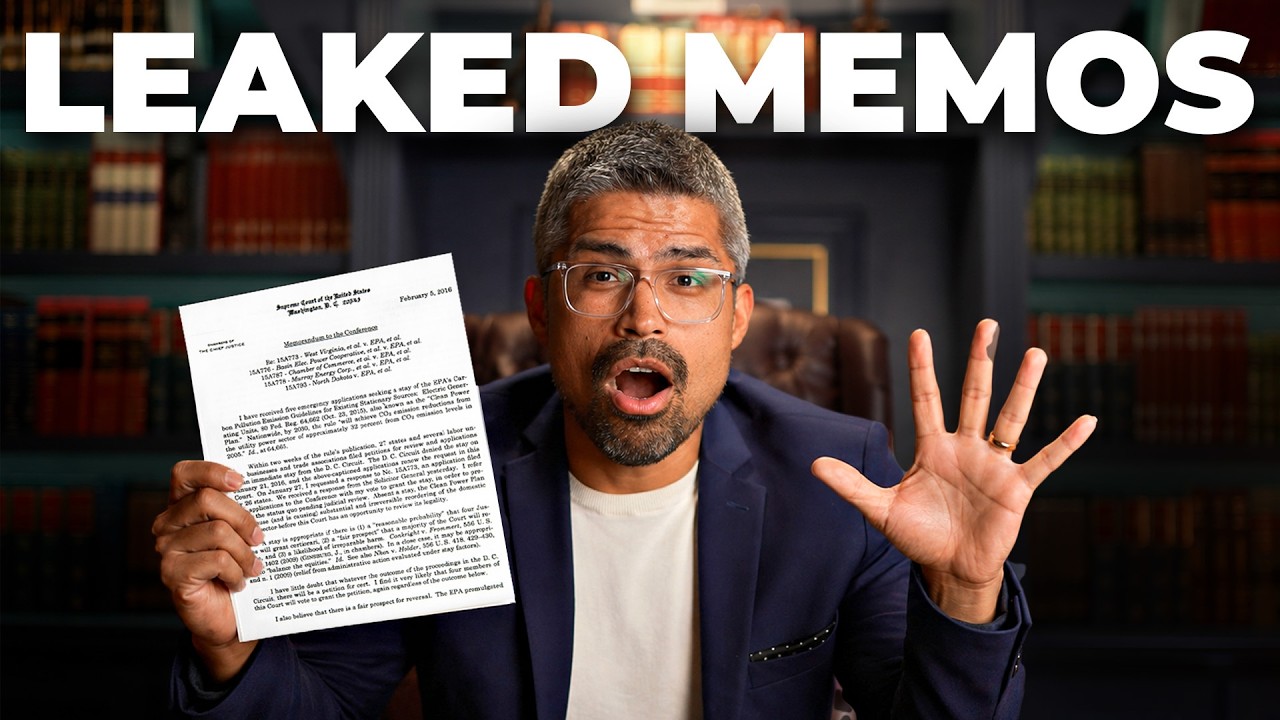
I'm holding 16 pages from inside the Supreme Court that were just leaked to the New York Times. They expose how one case during the Obama presidency let the Roberts court down the path of the infamous shadow docket, a secretive and accountable apparatus to decide politically charged cases outside of the traditional system of argument and public deliberation. With these papers, we now know what motivated Chief Justice John Roberts to append decades of judicial practice and law. And here's what he didn't like. He didn't like Obama's green energy policy and fear that it would be too costly for the fossil fuel industry. That's it. So what did he do? He rallied the four other conservative justices and ruled against the Obama administration on procedural grounds with zero explanation. I think there's a term for what just happened here. — Because activist judges who issue nationwide injunctions based on their personal beliefs undermine democracy and threaten the rule of law. Now, I remember 2016 like the back of my hand because it was a presidential election year and the Supreme Court was in the middle of it. That was the year Justice Antinine Scalia died and Republicans blocked President Obama's nominee for his seat, Merrick Garland. And the Supreme Court was short staffed for much of that year. In the midst of it all, Donald Trump released a list of 11 potential nominees, something that no one had ever done before. And one of them, Neil Gorsuch, replaced Scalia once Trump took office. Now, the reason I bring all of this up is that Scalia actually died just days after casting his vote with John Roberts and the other conservatives to stop Obama's clean power plan. That was a huge deal at the time. Everyone kind of forgot about it because once Gileia passed, our politics became not about stopping Obama's clean power plan, but it became all about stopping Obama from appointing a Supreme Court nominee of his choice. That blockade, led by Senate Majority Leader Mitch McConnell, changed judicial politics forever. Some people are still bitter about it. In fact, if you remember what happened in 2020 when Justice Ruth Bader Ginsburg died, then Senate Majority Leader Mitch McConnell all of a sudden had no problem filling that vacancy right away. Anyway, so this renewed attention on the clean power plan as a result of this huge leak is very welcome. And I want you to look at the stay order stopping it because it's a doozy and it's a classic in the shadow DACA genre. It's only one paragraph long and it reads, "The application for a stay submitted to the chief justice and by him referred to the court is granted. The Environmental Protection Agency's carbon pollution emission guidelines for existing stationary sources, electric utility generating units is stayed pending this position of the applicant's petitions for review in the United States Court of Appeals of the District of Columbia Circuit and this position of the applicant's petition for a rent of certari if such a rate is sought. If a rate of suiari is sought and the court denies the petition, this order shall terminate automatically. If the court grants a petition for a rate of suiari, this order shall terminate when the court enters its judgment. Justices Ginsburg, Brier, Smayor, and Kagan descented. That's a classic 5-4 decision along ideological lines with Chief Justices Roberts and then Scalia, Kennedy, Alo, and Thomas voting to block the main thing, Obama's signature environmental proposal to reduce carbon emissions and contain the effects of climate change. Now, I want you to pay attention to the case caption in this shadow docket order, West Virginia versus EPA. Does that ring a bell? It should because the Supreme Court decided a case by the same name in 2022. You know, the one where John Roberts turbocharged the so-called major questions doctrine, the one from the tariffs case to strike down a zombie version of the clean power plan that wasn't even in effect. From here, let justice Elena Kagan take it away. dissenting in that case in 2022. She reminded us of what everyone forgot the Supreme Court did all the way back in 2016. She wrote, "The court has obstructed EPA's effort from the beginning. Right after the Obama administration issued the Clean Power Plan, the court stated its implementation. That action was unprecedented. Never before had the court stated a regulation then under review in the lower courts. She hadn't forgotten. But what she says next in the middle of the Biden years is extremely important because it's a reminder of how political the Supreme Court can be with climate regulations depending on who's the president at any given moment. She wrote, "The effect of the court's order followed by the Trump administration's repeal of the rule was that the clean power plan never went into effect. The ensuing years though proved the plan's moderation. Market forces alone caused the power industry to meet the plan's nationwide emissions target through exactly the kinds of generation shifting the plan contemplated. So by the time yet another president took office, she means Biden here, the plan become as a practical matter obsolete. For that reason, the Biden administration announced that instead of putting the plan into effect, it would commence a new rulemaking. In other words, they would start over. Yet this court at this time determined to pronounce on the
Segment 2 (05:00 - 10:00)
legality of the old rule anyway. But the court's docket is discretionary and because no one is now subject to the clean power plants terms, there was no reason to reach out and decide this case. The court today issues what is really an advisory opinion on the proper scope of the new rule EPA is considering. That new rule will be subject anyway to immediate pre-inforcement judicial review. But this court could not wait even to see what the new rule says to constrain EPA's efforts to address climate change. That's a mouthful. But what she really means with all of that is that the Supreme Court really, really doesn't like the EPA when a Democratic president is in power. Now, it's really a shame that we don't have audio of this dissenting opinion because, you know, Justice Kagan, she's a bit of a nerd. She likes these things. She could have done an amazing job saying from the bench why this decision against APA is so wrong. She's a former government lawyer and a solicitor general. She really cares about things being done by the book. But West Virginia of EPA was decided days after DOPS. Remember the case that ended Roie Wade? So the Supreme Court was kind of on lockdown and they didn't take the bench to announce any decisions. So our loss West Virginia EPA was decided in 2022, years before Trump took office for a second time, but Justice Gagan's words were a stern warning that the shadow docket was a serious threat to the rule of law and the sanctity of settled legal precedent. Look no further than Noomv Vasquez peromo in 2025 when the Supreme Court used a shadow docket to stay a lower court injunction that prohibited ICE agents from lying on things like appearance and language or where you worked or location and targeting immigrants in the Los Angeles area. In one short document, they gave ICE full permission to stop and detain anybody they wanted for the crime of looking like or working like or sounding like a Latino or an immigrant. So now, how do you abolish ICE? I made a video that explains how ICE took over our immigration system and how we can abolish it. But the only place you can watch it is on Nebula, the sponsor of today's video. Nebula is a streaming service where you can watch all the content from your favorite creators like Jetlag, Maggie May Fish, Real Engineering, Philosophy Tube, Real Life Lore, and of course, Legal Eagle at free and early. Plus, watch countless Nebula exclusive videos made with love, time, effort, and increased budgets that you won't find on YouTube. I highly recommend you check out Lince Ellis's original documentary, The Macob World of Police Body Cam, YouTube. It's a fascinating expose on how this wildly popular genre of true crime content is altering social attitudes about the law and policing. In addition to my Nebula exclusive about how to abolish ICE, make sure to check out Liz's legal analysis of how RFK Jr. Chem banan vaccines or Devon's investigation into the most insane attempts to ban booze in America, just to name a few of our many Nebula exclusive videos. In fact, every Legal Eagle video we make is an extended cut on Nebula, like the legal analysis of improv comedy scenes Devon did with Brendan Lee Mulligan that contains a ton of hilarious additional scenes or Scout Owl's legal analysis of scenes from the pit that had to be cut for the YouTube version because they discuss sexual violence. And if you use my link or code, you can get 50% off an annual subscription. So that's a year's worth of the best content for only 30 bucks. Or you can get 40% off a lifetime of Nebula. Pay once for $300 and never again. It truly is the best deal of all. Either way, click or scan now to continue watching Legal Eagle on Nebula or I'll see you in court. Now, Justice Gagan figures prominently in these leaked shadow docket memos that the New York Times uncovered. She tries to be the voice of reason, the Jiminy Cricket in the ear of John Roberts and the other justices to no avail. And the whole thing was decided in the course of 5 days in 2016. A president's signature regulatory policy framework frozen in the span of less than a week by judges who admit to being kind of politically motivated. They don't say it with so many words, but when you read between the lines, it's evident. And it all began when a bunch of Republican le states, the Chamber of Commerce and industry groups rushed to the Supreme Court to demand that the justices hauled the Clean Power Plant. Let's take a look at what the leaked documents actually show. There are 16 pages of internal communications between the justices, not meant to be seen by the public. Not only are these documents held in their lock and key, the Supreme Court is famously leak proof. This thing doesn't leak like a seieve. It's not like Congress or the Trump White House. Truly, you'll be hardressed to get anything out of anyone who works in that building. I know because I've been there and people don't talk to you, period. He kicks things off on February 5th. I have received five emergency applications seeking a stay of the EPA's clean power plan. He then says, I refer the applications to the conference with my vote to grant the state in order to preserve the status
Segment 3 (10:00 - 15:00)
quo pending judicial review. Now, when the chief says that he's referring the applications to the conference, all that means is that Robert circulated his analysis to the other justices and that he's seeking their views before a final order is issued. Then he gets right to it. Absent a stay, the clean power plan will cause and is causing substantial irreversible reordering of the domestic power sector before this court has an opportunity to review its legality. Now mind you, substantial and irreversible reordering of the domestic power sector is not and has never been the standard by which to grant the stay of a major regulatory action. And to that end, neither is the substantial and irreversible damage caused by climate change. But nobody brings that up. Instead, Robert seems to be in a real rush. He seems concerned that the clean power plant calls for, in the times telling, a systemic regulation of the power grid, including by encouraging coal fire plants to be shut down and replace with one's power by cleaner technologies. And the plan, in Roberts' view, would start taking effect very soon. But in reality, the plan did no such thing. States didn't have to submit compliance plans until September 2016, and they could always apply to the EPA to seek a two-year extension. According to the Times, the first deadline for power plants to reduce their emissions was not until 2022 with full compliance not required until 2030. Now, Roberts doesn't stop there. Remember the major questions doctrine I mentioned earlier? He alludes to it by pointing to a 2014 opinion written by Justice Kalia in which he says, "We expect Congress to speak clearly if it wishes to assign to an agency decisions of vast economic and political significance. " That's the major questions doctrine. Now, in the shadow docket memos, Rubber points to that decision and writes, "As we noted two terms ago, agencies will face high hurdles when they seek to use novel interpretations of a long extent statute to bring about an enormous and transformative expansion in their regulatory authority without clear congressional authorization. " That's a bad signal for the major questions doctrine, which at the time didn't quite exist by that label, but Roberts was already laying the groundwork for it. Then he adds this quip. Solar plants are not built in a day. Okay, we know that. The point here is how is industry being harmed if they're not required to build them right away. Roberts proceeds to needle the Obama administration which apparently angered him with a blog post in which an EPA official said that a recent decision invalidating the rule of mercury emissions was not a big deal because the rule in question remained in effect while the Supreme Court considered the case. Roberts didn't like that one bit. He writes, "Past experience makes the case for irreparable harm. In an earlier case, the absence of a state allowed the agency to effectively implement an important program we held to be contrary to law. " After he fired off his memo, Justice Steven Brier was the very first one to respond that same day. And his characteristic pragmatic tone, he tries to tell the chief to cool it. Now, we don't have to block the program. He suggests, "How about we try a middle ground? What's the rush? He writes, "It is unusual for this court to issue a stay of an AY's order during the time that the court of appeals is considering its lawfulness. " In other words, why get involved now? He even proposed language for an order. He writes, "Let's deny the state, but if any state doesn't get an extension to submit compliance plans to the EPA, they can always come back to us. " Brier writes, "If the EPA grants the request, we will have more than enough time to hear and decide the matter. If the EPA denies the applicant's request, they can quickly return to us. Sounds reasonable, no? Not enough for Roberts, who fires off a seemingly exasperated response just a day later. Without a stay of the EPA's rule, both the states and private industry will suffer irreparable harm from a rule that is, in my view, highly unlikely to survive. He doesn't like Briar's proposed order one bit. And forgive me for saying this, but he also kind of sounds like an industry lobbyist. He writes, "I recognize that the posture of this stay request is not typical, but review is sort of what has been described as the most expensive regulation ever imposed on the power sector. Net costs have been estimated to run as high as $480 billion from 2017 to 2031 in present value. Now, why future expected expenditures over the course of 15 years are relevant to a rule that doesn't require them now is beyond me. Remember, the deadline for compliance is not until 2022. Roberts writes, "The proposed order forces each state to engage his regulatory apparatus and expend resources well before that date and does nothing to limit the ongoing, cumulative, and irreversible harms that private parties are incurring each day under the rule. For example, the EPA's models show that the rule will cause shifts in the nation's power generation.
Segment 4 (15:00 - 20:00)
Now, he then points to an interview then EPA administrator Gina McCarthy gave to the BBC in which she says, "The clean power plan is baked into the system and suggested that it would endure no matter who holds the White House. " Roberts concludes, I am of the mind that a rule designed to transform a substantial swath of the nation's economy should be tested by this court before it is presented as a feda complete. But it seems that the EPA is sufficiently confident of this rule's immediate implications that not even the combined efforts of Congress and the president could reverse its effects. The agency, it would seem, has made a compelling case for the applicant's claims of irreparable harm. So Roberts really hates this thing. And after his retort to Brier a day later comes the voice of reason, Justice Kagan. She's down with Brier's pragmatic approach. The unique nature of the relief sought in these applications gives me real pause. As we often say, we're a court of review, not a first view. As far as I can tell, it would be unprecedented for us to second guessess the DC circuit's decision that a stay is not warranted without the benefit of full briefing or a prior judicial decision. In other words, appellet judges are supposed to be reviewing what prior judges do, and we're completely jumping the gun here. Kagan also throws cold water on the chief's claim that the sky is going to fall for the states and industry. She writes, "The rule imposes no requirement that any plan or class of plan be shut down, nor does it require that any particular type of plan be constructed. Rather, it requires only that states meet an overall emissions target. A goal that gives the state significant discretion to pursue by adopting whatever means they think best, including the adoption of more effective scrubber technology, carbon sequestration techniques, or a cap and trade system. I cannot imagine that a regulated entity would take such extreme measures as shutting down a coal plant in anticipation of state regulations that when promulgated may not require anything of the sort. After Kon weighs in, Sonia Sotomayor submits her own memo agreeing with Elena and Steve. Don't you love the camaraderie? And again drives home the point of how unprecedented blocking the clean power plan would be. She then needles the chief a bit by noting that his point about this being the most expensive regulation ever imposed on the power sector is just smoked. That is one view she writes a likely biased view as the chief's memo recognizes. And from there comes Justice Samuel Alo the author of DOS whose mind like the chief is already made up and he adds this bit of judicial hyperbole. That's the only thing I can call it. A failure to stay this rule threatens to render our ability to provide meaningful judicial review and by extension our institutional legitimacy a nullity. Whether the Cleaner Act gives the EPA the transformative authority it claims here is an important question. If we fail to stay the rule and maintain the status quo, our resolution of the merits will not matter because the regulated parties will have complied. Instead of robust judicial review, our opinion will be a mere postcript. Finally, we get to the end of the memos. This is the last page. I kid you not. And the last person we hear from is Anthony Kennedy. Often the decider and the swing vote in these cases. His memo is both short and peruncter. No, really. It's like four lines. That's all it is. He writes, "The memoranda from the conference have been very helpful. In my view, a stay will be granted in four to 6 months in any event. And fairness to the party's councils that we should grant it now. Therefore, I agree with the recommendation of the chief that the stay applications be granted. Sincerely, AMK Anthony M. Kennedy. The rest is history. And that's it. Three justices, Antinis Scalia, Clarence Thomas, and Ruth Ber Ginsburg, didn't write their memos, or at least as far as we know, they didn't circulate anything. And that's the end of it. So, there you have it, folks. If there is any justification in using in the shadow docket, the justices are admitting that they've already made up their minds about how they're going to rule on certain cases with the very limited information they've received in a very short compressed timeline. And that decision will be the law of the land. And by the way, there will be no public explanation of how they even came to it. And thus began the modern era of the shadow docket. And its defining feature is that the Supreme Court rarely explains its reasoning because they don't have to. They can implicitly rule on important cases by procedure alone. So if the Trump administration wants a case sent back to lower courts, they send it back. If they want a judicial stay, they get it. The same problem in the stay order blocking the clean power plan is present in the numerous shadow docket orders the Supreme Court has issued since, especially during the second Trump administration. In the past 15 months alone, the Supreme Court has bent over backwards to consider how the government is irreparably harmed if it's not allowed to continue slashing and burning
Segment 5 (20:00 - 25:00)
things. And how about the irreparable harm to real people caused by all the slashing and burning of things? Who's to say? Because they never really mention that side of things. They don't have to. And lower court judges are left holding the back without any explanation. They truly are at a loss. For example, in a long-running case involving a challenge to Doge's access to sensitive private information of everyday people, the justices last year green lit access to sensitive Social Security Administration records. The case was returned to the lower courts, but the judges there were left scratching their heads on how to proceed. Why? Because the Supreme Court didn't give them much direction. US Circuit Judge James Wen wrote, "A system in which unexplained orders silently control future cases is not one of uniformity, but of opacity. " In other words, law that cannot be explained cannot be applied consistently, and what cannot be consistently applied cannot sustain public trust. Worse yet, the Trump administration was forced to correct the record in the lower court, which means that the Supreme Court allows Doge to comb through sensitive agency data on patently erroneous information. Worse yet, the courts discovered that the government misrepresented key facts about Doge, forcing the Trump administration to correct the record in the lower court. That means that the Supreme Court allowed Doge to comb through sensitive agency data on patently erroneous information. Here's how Judge King in the same fourth circuit case described this crazy situation. We thus know that the prior rulings in this matter, the district court's issuance of a preliminary injunction, our court's denial of a stay, and the Supreme Court's grant of a stay were rendered on a materially erroneous record. And we know that going forward, we should not accord the defendants, meaning the US government, any benefit of the doubt or readily trust in anything they say. From there, he said that Doge in essence got a hold of a lot of personal information and access to sensitive records that it never should have. He concluded from this confession of error that Doge affiliates are not regular SSA employees working under SSA supervision in accordance with its rules and on its behalf. Rather, and here's the money quote again, they are rogue actors whose activities are hidden from SSA itself. Very legal, very cool. rogue actors all the way down. And as Professor Steve Bladic has documented at length on his indispensable Substack, one first, the real problem with the shadow docket memos in the Clean Power Plan cases is that they show that John Roberts and the other conservative justices take a very different view of irrearable harm when a Democratic president is in power versus when a Republican president is in power. When Obama was president, irrearable harm to Republican le states and the power sector were the chief's concern. Enough to stop a major regulatory program on a nationwide basis. But now that Trump is president, irreparable harm to the government is what matters. By Vlad's count, there have been as many as 25 shadow docket orders greenlighting Trump administration policies that lower courts have previously blocked. These rulings by the Supreme Court have allowed President Trump and his administration to, among other things, refuse to spend $4 billion in mandatory foreign aid, cut the Department of Education in half, kick all transgender service members out of the military, kneecap the federal civil service, revoke temporary protective status for hundreds of thousands of immigrants, remove immigrants to third countries even when they face a curable fear of torture or other persecution there, continue to engage in racial profiling during ICE rates, and on and on and on. There's no need to watch what's happening. The Supreme Court is playing favorites with the shadow docket, depending on who's president. And unless and until Congress and the rest of us demand change or more transparency about how the justices are making these decisions, we should all welcome yet more leaks from the Supreme Court. If the justices are not going to show us their work, let the court keep leaking like a seieve. More sunlight may be the only way John Roberts and their friends will change their ways. Now, all this highlights why it's so important to get a great lawyer when you're dealing with your own case. Now, after I started this channel, every week I'd get hundreds of comments and emails from viewers who are dealing with legal problems. And they'd ask, "Can you help me find a lawyer? How do I know if this attorney is any good? " And there's a massive gap in our justice system. It's that people don't know how to find the right lawyer for their specific situation. They're scared. They're overwhelmed. And they end up doing nothing or hiring the first attorney who calls them back. And that really bothered me. So, I started to wonder, what if there was a different way? What if we could build a law firm that actually lived up to the values that I talk about on this channel? Transparency, accessibility, and putting clients first instead of chasing billable hours. A firm where you don't need to pay anything upfront and your lawyers only get paid if you do to maximize your opportunity for justice. So, a few years ago, I decided to fix that problem. I decided to start my own personal injury law firm. And honestly, it wasn't an easy choice. But I realized I was in this unique position. I had this platform, this community, and the experience. Not to get rich. Trust me, there are easier ways to make money than starting a law practice. But we did it because access to justice shouldn't be a luxury. Because finding the right legal
Segment 6 (25:00 - 26:00)
representation shouldn't feel like playing Russian roulette with your future. And when you work with my firm, you're not just getting a lawyer. You're getting a team that understands that behind every case is a real person with real stakes. If we can't represent you or you're in a state where we don't practice, we'll take the time to try to match you with an attorney in my personal network of lawyers. A national network of some of the best lawyers in the country who actually specialize in what you're going through, located right where you are, not just whoever happens to be available. So, if you're dealing with a personal injury, a car crash, a data breach, sexual harassment, a social security or workers comp issue, give us a call at the number on screen or click on the link below. Now, I can't represent everyone that watches this channel. I wish I could. But what I can do is make sure that when you need legal help, you have somewhere to turn to that you can trust. So, whether it's me handling your case or the incredible attorneys we partnered with, you'll get the same principles of honesty and education that we bring to every video. And if you're dealing with a legal issue and you're not sure where to start, check out the link in the description. Let's have a conversation about how we can help you find not just a lawyer, but the right lawyer for your situation. Because at the end of the day, that's what this is all about. Making sure that when life gets complicated, you don't have to face it alone. Which is why when you need a lawyer, you don't just need a legal team. You need the Eagle team.