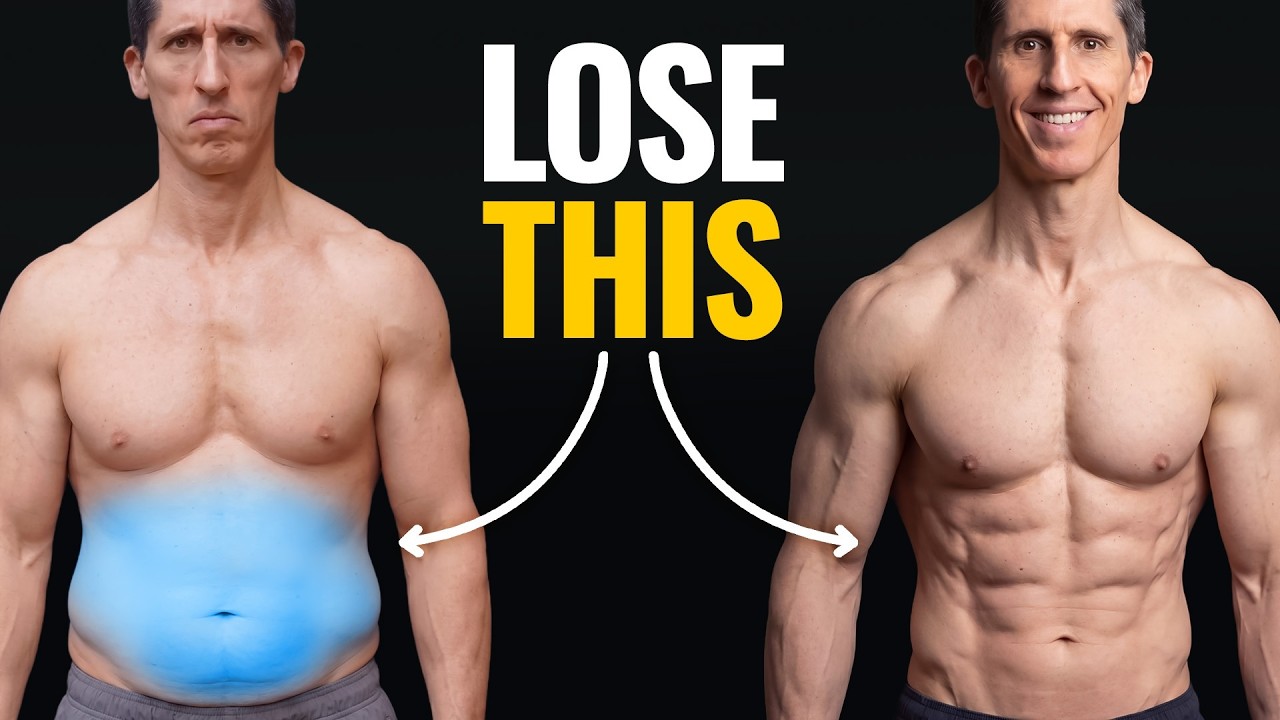
If nutrition keeps tripping you up… if you feel like you can train hard but can’t stay consistent with your diet… then this is the video you need to watch.
Because the truth is — you haven’t failed your diet.
Your diet has failed you.
Get the Flex Factor Meal Plan - https://athleanx.com
And I’m going to show you exactly why.
In this video, I’m breaking down one of the biggest lies in fitness — the idea that you need to follow a rigid, perfect, all-or-nothing meal plan to get lean, build muscle, and stay that way. That’s exactly why most people never make it. They fall off before they ever give themselves a real chance to succeed.
Here’s the reality:
Almost 80% of your ability to stick to a nutrition plan comes down to what happens in the FIRST 10 DAYS.
And most people never even make it there.
Why?
Because they think they have to be perfect. Perfect food choices.Perfect timing.Perfect portions. And the moment something doesn’t go exactly as planned… they quit. That’s the mistake.
Because when you actually understand how nutrition works — and how flexible it really is — everything changes.
In this video, I show you:
• Why nutrition—not training—is the biggest driver of fat loss
• How to set your protein intake correctly based on your goal (fat loss, muscle gain, or maintenance)
• Why most diet plans fail due to perceived rigidity—not actual requirements
• How to use a simple plate division method to build meals that work anywhere, anytime
• Why swapping foods like rice, pasta, potatoes, or vegetables doesn’t matter nearly as much as you think
• How to adjust portion sizes to account for calorie differences in protein sources like chicken, steak, and salmon
• Why fibrous carbs are almost calorically irrelevant—and stressing over them is killing your consistency
• How to structure your eating around your real life schedule (not someone else’s unrealistic plan)
• The truth about intermittent fasting, meal timing, and eating frequency
• And most importantly… how to create a plan you can actually stick to long enough to make it automatic.
Because that’s the goal.
Not perfection.
Consistency.
Once you understand this, you stop starting over.
You stop “falling off.” You stop thinking you need a new diet every 2 weeks.
And you finally build something that lasts.
I’ve done this for over 17 years — not just for myself, but for elite athletes, actors, and everyday people who needed real, sustainable results.
And the ones who succeed?
They’re not the most disciplined.
They’re the ones who stop chasing perfection… and start building consistency.
If you can get through the first 10 days — you’re closer than you think. Most people quit on the 1-yard line. Don’t be one of them. If you’re ready to stop overcomplicating your nutrition and finally take control of it, this video will show you how.
And if you want a system that adapts to YOU — your schedule, your preferences, your goals — I built something called the Flex Factor Meal Plan to do exactly that.
But even if you never use it…
Everything you need to succeed is already in this video.
Watch it.
Apply it. And give yourself the chance to finally get this right.
If you know someone struggling with their nutrition, share this with them.
Subscribe for more science-based training and nutrition videos that actually work. And for step-by-step programs and tools, head to ATHLEANX.com.
What's up guys? Jeff Cavalerex. com. So, if nutrition continues to trip you up, it's the hardest thing for you to get a handle on, then this video is going to be for you. And the good news is this, I'm going to give you the truth because I believe that you've been lied to over and over again. You see, if you needed to hear the truth about something, would you prefer someone to just tell it like it is and not sugar coat it, or would you kind of like a few mistruths mixed in to make you feel a little bit better about yourself? Hopefully, you're more like the first kind of person because that's how I want to give you the information here today. I don't want to sugarcoat anything. I want to give you the respect of the proper information so that you could finally beat this cuz you can. It is not as difficult as you think. Not only have I maintained the same level of leanness for you guys, proof of being able to do this repetitively for 17 years now, but I also do this for other people. I do this for top level athletes. I do it for actors and musicians and people that need to look a certain way. I know how to make it happen and I'm going to show you here today why you probably haven't been able to master it too, but you will be. So, this right here is an important graph. This is the reason why I believe you're not managing to stick that nutrition to stick with it forever. Because if you look at this graph, what this actually means is this is the adoption let's say of a habit 100% able to do whatever it is that you set your mind to. So I can stick to my new plan. This is 100% this is zero. These are days 2 4 6 8 10 12 all the way to 30 days. In the course of the adoption of a habit of a new diet plan, do you know that the majority of the impact of that plan happens by day 10, almost 80% of what you're trying to achieve can be achieved if you can make it past day 10 or at least to day 10. Here's the big problem. Any of these dietary approaches that you're following, and you can name any you want. I don't care. I don't have an axe to grind with any of them, but let's just say Atkins diet or carnivore or keto or whatever it might be. If the rules are too rigid and you perceive the flexibility to be very little, that you have to be quite on point in order to do what it's asking you to do, then you're going to fall off before you ever get to day 10. And the big lie is that there's so much flexibility built into what you can do in this range that I can make this almost a guarantee for every one of you out there that you can stick to this. Here's how. If you look at the different components of what you need to do when you adopt any type of eating plan, you need to start looking at how rigid you feel they are versus how rigid they actually aren't. First thing, what's your goal? Because obviously that can differ. Some might be dieting because they want to lose fat and others want to diet because they want to build muscle. Let me start by giving you one truth there. When it comes to changing the amount of body fat that you carry, 99% of what you're going to do is going to hinge on how you eat. Exercise doesn't matter. And it sounds sacriiggious coming from a trainer. It doesn't matter. You're not going to make a big enough impact from whatever you do. Because even if you said, "Well, Jeff, I could go do CrossFit or IROs and burn tons of calories. " Not if you're 200 lb overweight, the intensity that you can give that workout is usually far lower than what an actual, let's say, high rocks athlete could do. So, you're not really getting the benefits of a huge calorie burning workout because the intensity level that you can go at it is so low. So, it's not the exercise, it's the nutrition. Beyond that, if you had to stick with the nutrition for a long period of time, that's demanding a habit change that you don't have right now. It's not just about the one hour that the hard gainer has to go to the gym and actually put in the work. That's all it takes for the hard gain or go in there and put in the work. Jess is a good example of that. He could get in there with some consistency and do his 1-hour workout. Nutritionally, he had to clean it up a little bit, but he was trying to put on weight so he could actually eat more. When you're trying to lose weight, you got to get into a calorie deficit and you have to then make sure you're good for 23 hours beyond the workout time, that commitment level becomes really, really high. Now, if you're trying to lose weight, you also have to be wary of the fact that you don't lose muscle in the process. So, you have to make sure that you have your protein in place. So, whenever we start these 10 days, your anchor should be protein, right? Protein guides what you do. It's your anchor. You start with your protein needs. You take your body weight and you multiply it by a certain number to determine how many grams of protein you should be targeting in a day if you're trying to gain muscle. You should be on the higher end of things. 1. 2 g per pound of body weight. So if you take a 150 lb person, that's 150 g for the 1*2
Segment 2 (05:00 - 10:00)
is another 30 g. So, it's 180 gram per day at 150 lb person. If you wanted to maintain, you could be at actually 86 gram just maintain your body weight. A lot of you watching right now really aren't really trying to do that, but that would be a lower protein intake. If you wanted to lose fat, you still need to maintain higher protein intake for a few different reasons. But now you're looking at one gram per pound of body weight. that same 100 well let's say this is a heavier person 220 lbs 220 gram of protein in a day to base your meals around. Why is that? Because protein itself is satiating. So it's going to keep you more full and also it has a metabolic cost right to digest that protein actually helps you to burn more calories. But most importantly it's preserving the muscle mass. Now again to look more muscular and to build a muscular physique that is the training and that training also depends upon proper nutrition to fuel those muscles. So it still matters a lot but was just talking about body composition. You're trying to lose fat. You got to have the nutrition in place. So we've got that goal down. If we wanted to make sure that we were more flexible, we'd also start asking you about any preferences of eating. Because here's where people misunderstand what they think I preach. I don't give a rat's ass how you eat. If you want to do carnivore, do carnivore. keto, do keto. You want to be a vegan, do vegan. You want to do what I do, which is a more well-rounded approach, I think. Just I'm not depriving myself of any one nutrition or food category, then do that. But make sure it's something that you enjoy. Because if you don't enjoy it, you'll never stick to it. And then number two, make sure it's something that's healthy for you and your body long term. But I will give you a flexibility in here. Follow whatever you want to follow. If carnivore is going to get you past day 10, then do that. If keto cuz that's more successful for you, then do that. So, we've already knocked off two different parts that usually trip people up. The next thing is when you're structuring your meals themselves, and people completely screw this up. I talk about there being something of a plate, right? A plate division method. This is really important for you to see. So, when I view a meal, I look at it as a plate from the top down. And I look at 9:00 and 9:20. Okay? And what this does is it divides my plate into where my areas of focus are. We're grounding it with protein. In this area here, I'm going to divide the rest up between fibrous carbohydrates and starchy carbohydrates. So, I put my fibrous carbohydrates, the bigger portion down here, my starchy carbohydrates up here. Starches being rice and potatoes and pasta here, the green leafy vegetables or broccoli or cauliflower or asparagus, whatever, right? Those things go down here, protein here, carbs here. It really doesn't matter how you pick your foods. You can take anything in this category. If we do rice, pasta, and my favorite, sweet potatoes. If you take a cup of each of these, you're looking at 210 calories, 220 calories, 100 and 90 calories. Now, some people might look at that and go, "Well, there's a difference there. " Trust me, there's no significant difference there. If you're on a 2500 calorie diet or a 3,000 calorie diet, the difference in here of 30 calories is 1% of your nutritional intake for the day. Trust me, it's a non-factor. So, when I'm looking at this portion of my plate and when you're looking at that, feel free to swap whatever it is. What happens though is you follow a meal plan that says, "Oh, today is rice and this and this. " You're like, "I don't have rice. What am I going to do now? " and you either reach for a wrong choice or because you don't know the equivalence here or you just say I can't follow this plan and you give up. That's what happens in that first 10 days. The flexibility that you didn't perceive to be in here has caused you to just give up. That's bad. The same thing happens with protein, but protein is a little bit different. You've got protein food choices. Again, I don't really care. You have so many options. Let's just say salmon uh filetmanan so steak or grilled chicken breast. What happens here is that if you had the same amount of all three of those foods, then you're going to get the same o almost the same. There's a slight difference in protein
Segment 3 (10:00 - 15:00)
density of these foods, but you're going to get almost the same amount of protein in each of these if you had the same amount. The problem is calorically they're different. And the big difference between these calorically is the fat content that is in these foods. So when you consider the fat content that's in salmon, good healthy omega-3s, or the fat that's in a filt versus the leanness of a grilled chicken, then what you get is a difference in calories. Maybe 450 calories for 10 ounces of the grilled chicken versus 600 or 650 calories of the other two choices. What does that mean? Well, you just have to be conscientious of the fact that when you're selecting your proteins or even your vegetables, how you prepare them, if fats are involved, that's going to be a caloric factor. So, keeping your second anchor on the fat content of the foods that you're choosing is going to be important information for you. Again, all that would do here is just shrink your portion sizes. Maybe your chicken's this big, but your steak is that big. Then you can calorically equate these. But again, there's still some flexibility built in here that allows you to easily swap these once you become a little bit more aware of what those are. Same thing with the fibrous carbohydrates. This is one that's almost laughable. We were doing some of the kind of preparation for this video. And by the way, I was going to do this in a very prepared way and I'm like, no, that. If I do it very prepared, I'm doing exactly what I'm telling you you're doing in your diet and screwing up with that. that is you are preparing everything so rigidly that you can't operate outside of those rules. If I have to follow a specific script and deliver this in a specific way, I'm not just speaking from the heart. And I know this stuff inside and out. I'm telling you what works. So follow what I'm talking about when I speak from my heart rather than some stupid script that makes it too rigid. If you do the fibrous carbohydrates, they talk about the difference in bok choy. I don't remember the serving size amount, but 15 calories. And the astronomical difference, this is according to AI, astronomical difference in calories between that and broccoli. Broccoli has 30 calories, a whopping 30 calories, double the amount of calories. It doesn't matter. Who cares about 30 calories versus 15 calories? Who cares if it's double the amount? That's a misleading statistic. So, even if you ate two cups of Actually, I think that's actually a cup. If you ate two cups of broccoli at 60 calories versus two cups of bok choy, which is 30 calories, it's a rounding error. The 30 calorie difference doesn't matter at all. So, when it comes to these fibrous carbohydrate selections, eat what you like. Who cares what it says on the diet plan you're following when it comes to the fibrous carbohydrates? Eat what you like. They're almost calorically inconsequential in terms of derailing you from the plan. But if you think they're so important, those first 10 days are demanding that it be bok choy and you don't have access. All you have is broccoli. Believe me, the broccoli is not going to do anything to you. It's not going to knock you off that plan. What knocked you off was you thinking the bok choy was so damn important so that you fell off the plan entirely. You didn't make it to 10 days. If you made it to 10 days, that automaticity, right, the fact that the adoption of the habit, you're that close. You probably heard about that saying about people that get to like they stop on the one yard line not even realizing that the goal line is right there. They're not looking up enough to see that they're right there on the edge of the end zone. You're there by day 10. You're there. You're so close. Sure, you got to continue to put the work in over the course of the next 20 days or so, but you are that close because you got through the first 10 days. And 92% of plans are abandoned by day 10 because of the rigidity built in. Beyond that, now let's say you wanted to follow a a different eating pattern, a different eating schedule. Jeff, how do I do this? You eat five times a day, right? I day. It works for me. I work from home. I work in my own gym. I don't have to be in an office. I don't have rules around when I can eat. I don't have lunch hour. I can eat whenever I want to eat. I realize people in a corporate setting don't have that same ability. I realize that even young teenagers who are in school don't have the ability to just eat all day. There's rules in place that restrict some of that eating. So, you have to just work within those rules. And the good thing is you can do that. Some people even like to intentionally restrict their eating windows, right? Intermittent fasting. If you want to set up a fasting period, let's say 18 hours of fasting, six hour eating window, or maybe you want to make the window a little broader, eight hour window to eat, or maybe you want to make it even narrower, 4 hour window to eat. All of that's okay. Just realize a couple things. If you're following a fasting protocol, where is my eraser? Here, right? If I have this 24-hour block, right, and I have just say in the middle of the day, I go 4hour eating window here. And
Segment 4 (15:00 - 20:00)
then I have a different one. This is a 4 hour window. I'm going to do an 8 hour window. It might be here to here. Whatever, whatever period of time. Again, that can shift to whatever works best for you. Early in the morning, in the afternoon, as long as you maintain that window. Just understand you're going to have to get a lot of calories in, especially if you're trying to build muscle. a lot of calories into a short period of time. If you eat foods that aren't calorically dense, right, that are like the healthier food options like let's say even the bok choy and the broccoli, you're going to have to eat so much volume in a short period of time, your stomach probably won't be able to handle it and you'll never get to your daily caloric goals. Same thing is if you're trying to lose weight and you're trying to become a lot more restricted on the caloric side, then yeah, having those high nutrient density, low calorie type foods and in a restricted eating window is going to likely fill you up faster and then restrict your daily caloric intake. So, there's different strategies depending upon what you do, but you have to realize that you're eating within a flexible window. It doesn't matter where you move this or how big it is if it works for you. And again, if you had this in place and this is something that you really worked well for you, you're going to make it past the 10 days. From a training perspective, training does matter ultimately because here we're not just about losing weight. I don't want to create skinny fat people. I want people to become more muscular and lean and healthy, then you're going to have to work your training into this, too. So, build out your training window when it works for you. If I said to you, hey everybody, first meal of the day, this diet requires you eat at 8 o'clock or you eat breakfast at a certain time. But that's your training time, then your training time is going to disrupt your eating time. It also might make you not hungry because you just trained. So you adapt around that. And there's ways to make eating flexible around any workout plan. A matter of fact, I have a tool that we created where you can actually put in your workout times that tells you how to manipulate your meals around that because there's always a way to do that. But the bottom line, guys, is the flexibility is so vast. Trust me, there's so much variety in what we're doing. Even again, the way we do it, it's not just about Jeff Cavalier's way of eating. You'll go watch my video, This is Jeff Cavalier's eating plan. Great. It works for Jeff Cavalier. It does work for a lot of other people, too. But it doesn't have to be your way. I always say, and I endorse, do the thing that makes you happy and successful. And most of all do the thing that gives you consistency because without consistency there is no repeatability. There is no automaticity of a adoption of a habit because ultimately everything you start here that isn't habit is going to become one if you can stick to it long enough. And that's where consistency matters. And again when I talk about the ability to stick to this guys it's very difficult. Nutrition is hard for a reason because it's 23 hours beyond that workout. Like I said, it's a 24-hour a day commitment. You have to go from not getting it right to getting it right almost all the time. But if getting it right didn't mean a specific answer, but a variety of answers, how much more likely would you be to get it right? I'll share one final thing with you. With my workout programs, we have we're known for having workout programs with high levels of consistency. People stick to our programs. The adherence level is off the charts. Do you know what our worst adherence is on a program, but it's not for the reasons that you think? Max Shred. Max Shred is an effective fat loss, fat burning program. Very effective. Why is it hard? Because it's catering to a population of people who are likely needing to lose the most amount of weight. So, in other words, they don't have the habits in place yet to control their weight. And even activity can be challenging when you're at higher levels of weight. But more than that, they don't have the habits to stick to something that they start yet because they've been trained or lied to and been unable to stick to things that feel like a plan. If instead they had something that adapted to them and allowed them to sort of get going, build some momentum and gain some momentum, then they wouldn't have those troubles. They wouldn't fall off that plan. So, it's that same mindset that works its way into training that prevents people from staying consistent, too. Guys, all of this is something that can be conquered. I actually tried to make it super simple. I just made a new meal plan. We call it the flex factor. And it's something that basically asks you all these questions and allows you to find a plan that works specifically around you and make any of the changes that you feel like you might need to make you find this easier to stick to. It's literally all built into an app. It's all something you can actually get right now over at ax. com if you I think order over $75, but that's only for a limited amount of time. But that's not what this is about. All the information I just gave you is here for you. All of this is what you need to hear. Stop being so hard on yourself and allow yourself to be more flexible in terms of the mindset and you will find success once and for all. Nutrition does not have to be complicated. It's so damn
Segment 5 (20:00 - 20:00)
hard right now for everybody. I understand that. But again, as someone who's demonstrated this for you for all these years with not much effort on my part to do it, it's been pretty easy for me at this point. And for all the people that do the same thing when they learn the ways that I'm teaching here, it can the same thing can happen to you. And you don't need any drugs. You don't need anything to make you achieve this. All right, guys. I hope you found this video helpful. Again, if it's someone else you know struggles with the same things, make sure you share this video with them, too. It's a heart-to-he heart talk, but it means something because it's exactly what you need to hear, not necessarily what you want to hear. All right, guys. Subscribe to the channel if you haven't already done so. And again, you can find all that I mentioned over at athletex. com. See you soon.