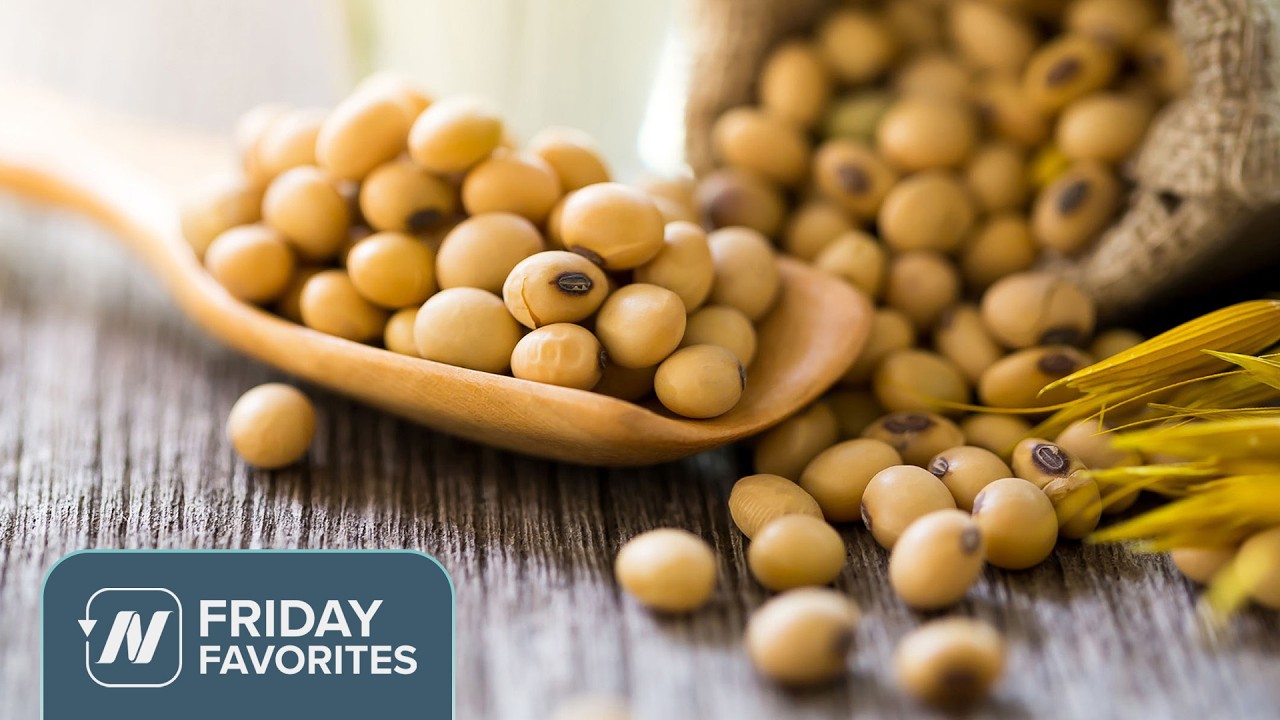
Friday Favorites: Are Menopausal Hot Flashes Inevitable? How Can Soy Foods Help?
8:15

Friday Favorites: Are Menopausal Hot Flashes Inevitable? How Can Soy Foods Help?

NutritionFacts.org 01.05.2026 4 158 просмотров 239 лайков

Machine-readable: Markdown · JSON API · Site index

Поделиться Telegram VK Бот
Транскрипт Скачать .md
Анализ с AI
Описание видео
Why do 85% of menopausal women suffer hot flashes in some countries but only 15% in others? Soy can be considered a first-line treatment for menopausal hot flash and night sweat symptoms. Check out Dietary Approach to Naturally Treating Menopause Symptoms (https://nutritionfacts.org/video/dietary-approach-to-naturally-treating-menopause-symptoms/). I did a series on vaginal menopause symptoms, including: • The Best Moisturizers and Lubricants for Vaginal Menopause Symptoms (https://nutritionfacts.org/video/the-best-moisturizers-and-lubricants-for-vaginal-menopause-symptoms) • Hormone Treatment (Estrogen Pills and Creams) for Vaginal Menopause Symptoms (https://nutritionfacts.org/video/hormone-treatment-estrogen-pills-and-creams-for-vaginal-menopause-symptoms) • Soy Milk for Vaginal Menopause Symptoms (https://nutritionfacts.org/video/soy-milk-for-vaginal-menopause-symptoms) For more on how to live your longest, healthiest life, check out my book How Not to Age (https://nutritionfacts.org/book/how-not-to-age/). (As always, all proceeds I receive from all of my books (https://nutritionfacts.org/books/) are donated to charity.) What about soy and breast cancer? See my video Is Soy Healthy for Breast Cancer Survivors?(https://nutritionfacts.org/video/is-soy-healthy-for-breast-cancer-survivors/). New subscribers to our e-newsletter always receive a free gift. Get yours here: https://nutritionfacts.org/subscribe/. Have a question about this video? Leave it in the comment section at http://nutritionfacts.org/video/friday-favorites-are-menopausal-hot-flashes-inevitable-how-can-soy-foods-help and someone on the NutritionFacts.org team will try to answer it. Want to get a list of links to all the scientific sources used in this video? Click on Sources Cited at https://nutritionfacts.org/video/friday-favorites-are-menopausal-hot-flashes-inevitable-how-can-soy-foods-help. You’ll also find a transcript and acknowledgements for the video, my blog and speaking tour schedule, and an easy way to search (by translated language even) through our videos spanning more than 2,000 health topics. Thanks for watching. I hope you’ll join in the evidence-based nutrition revolution! -Michael Greger, MD FACLM Captions for this video are available in several languages; you can find yours in the video settings. View important information about our translated resources: https://nutritionfacts.org/translations-info/ https://NutritionFacts.org • Subscribe: https://nutritionfacts.org/subscribe • Donate: https://nutritionfacts.org/donate • Podcast : https://nutritionfacts.org/audio • Books: https://nutritionfacts.org/books • Shop: https://drgreger.org • Facebook: https://www.facebook.com/NutritionFacts.org • Twitter: https://twitter.com/nutrition_facts • Instagram: https://www.instagram.com/nutrition_facts_org
Оглавление (2 сегментов)

Segment 1 (00:00 - 05:00)

"Are Menopausal Hot Flashes Inevitable? How Can Soy Foods Help? " SWAN, which stands for Study of Women’s Health Across the Nation, is by far the largest evaluation of menopausal symptoms in history, studying 16,000 American women between the ages of 40 and 55. They found that women over a body mass index of 27 or higher were significantly more likely to suffer from hot flashes or night sweats, stiffness or soreness, and urinary leakage. A BMI over 25 is considered overweight; 30 is obese; and the average U. S. BMI is 29. 8. Since fatty tissue is a source for estrogen one might expect the reverse, but the link between excess body fat and worse menopausal symptoms indeed seems causal since women randomized to a weight loss intervention experience significant improvement in hot flashes, an effect that may extend to bariatric surgery. In the SWAN study, smoking and inactivity were also associated with more frequent symptoms. It’s always a good idea to quit smoking and exercise, but there are no interventional trials on smoking cessation and menopausal symptoms to prove cause-and-effect, and randomized controlled trials of exercise failed to show any symptom relief. Of course you could just take hormone therapy, but at the cost of significantly higher risk of suffering a heart attack, stroke, blood clot, breast cancer, or gallbladder disease. What can we do naturally to avoid the extra clots and cancer? Hot flashes, also referred to as hot flushes, are the most common menopausal symptom for which women seek treatment. They afflict up to 80 to 85 percent of European and American women, lasting, along with night sweats, for an average of more than seven years. But these symptoms are not universal. Though in North America they may be considered inevitable, if you noticed in Japan, for example, only 15 percent may be affected. In fact, there isn’t even a term for hot flash in the Japanese language. The absence of even a word for it in Japan is all the more remarkable because Japanese is said to be “infinitely more sensitive” than English in describing bodily states, with all sorts of extremely subtle distinctions for somatic sensations. For example, there are all sorts of specific terms describing different sensations. In Japanese there are 20 or more words just to describe the state of one's stomach and intestines alone. But hot flashes appear to be so unusual there, researchers had to come up with ways to describe it in Japanese surveys. Investigators suspected it might be the soy. Dietary surveys have estimated that soy isoflavone intake, the phytoestrogens in soy, is at least ten times higher than in Europe or North America. And one comparison of urine metabolites revealed Japanese women have a hundred times more phytoestrogens flowing through their body at any one time. To see if this might be playing a role, researchers followed a thousand Japanese women over time, starting before they reached menopause, to see if soy consumption was linked to whether or not they developed hot flashes. Women eating around four ounces of tofu a day only had half the risk compared to women only eating an ounce or two a day. The researchers concluded, “Our findings suggest that consumption of soy products is a practical strategy for preventing hot flashes. ” But only if interventional trials prove they actually work, which I’ll cover next. Is the consumption of soy the reason why there isn’t even a word for hot flash in Japanese, as I explored in my last video? Approximately 80% of perimenopausal and postmenopausal women surveyed choose to try natural means to deal with symptoms, and the single most common approach was soy. But does it work? Outside of an Asian context, soy milk may be a greater source of isoflavones than soy foods, and that seems ready-made for a randomized trial against dairy milk or another plant milk control. Soy milk consumption has been associated with fewer hot flashes and night sweats and skim milk with worse menopausal symptoms, but when actually put to the test against each other there does not appear to be any difference. There have been studies showing that randomizing women to soy milk can reduce hot flashes and vaginal symptoms as much as 70% compared to the control group, but without a placebo control, we’re not sure how much of that is the placebo effect. To truly blind study subjects, soy isoflavones were extracted out and stuffed into capsules to be pitted against identical looking “sugar pill” placebo capsules. More than a dozen such clinical studies have been performed— randomized double-blind, placebo-controlled trials —and indeed, the equivalent of about two servings of soy foods a day worth reduced hot flash frequency by about 20% more than placebo and hot flash severity by around 25% more than placebo, compared to more like  a 30 to 40% net reduction from estrogen hormone therapy. Soy isoflavones have also been shown to improve other menopausal concerns

Segment 2 (05:00 - 08:00)

including vaginal dryness, bone loss, memory and cognitive functions more generally, as well as depression. There have been a few trials in which soy was pitted head-to-head against hormone therapy. One found their efficacy comparable, in terms of reducing hot flashes, muscle and joint pain, and vaginal dryness. In the other, hormones worked twice as well, a 54% reduction in hot flash scores taking the standard estrogen/progesterone combination compared to 24% over placebo in the soy isoflavone group. Not only did the hormones work better, but they can work quicker. Three months are required for soy isoflavones to achieve half their maximal effect, whereas the same is achieved after just three weeks with estrogen. Of course, soy has the benefit of no increased risk of cancer and clots. In fact, if anything, a reduction in breast cancer risk throughout the lifespan, and lower risk of cardiovascular disease. The bottom line, wrote one consensus panel of experts, is that soy can be considered a first-line treatment for menopausal hot flash and night sweat symptoms. One convenient whole food source of soy is soy nuts, which are dry roasted soybeans. Harvard Medical School’s Center of Excellence in Women’s Health funded a randomized crossover study of a half cup of unsalted soy nuts a day (divided into three or four portions and spaced throughout the day) and achieved a 50% reduction in hot flashes within two weeks. What’s inconvenient about soy nuts is the formation of advanced glycation end products in the roasting process, though about four times less than that of roasted real nuts, or other roasted legumes, and ten times less than a serving of something like roasted chicken, but something like edamame or canned soybeans would be better. Some menopausal women use isoflavone supplements, but most just add soy foods to their diet. I think that’s the way to go. Supplement mislabeling and contamination issues aside, though isolated isoflavones have been shown to improve artery function and decrease high blood pressure. Soy foods can also lower LDL cholesterol which may explain the lower associated cardiovascular disease risk. Besides the lower breast cancer risk, soy eaters are also less likely to get prostate cancer, colorectal cancer, and lung cancer. In a previous video, I noted that those eating plant-based tend to have significantly fewer hot flash type symptoms. What if you combined a plant-based diet and soybeans? Two randomized controlled trials found that reduced-fat plant-based diets with a daily half cup serving of cooked whole soybeans can reduce the number of serious hot flashes by 84 to 88% within twelve weeks. Overall, most randomized to the plant-based group ended up free of moderate- to-severe hot flashes, compared to about 95% still suffering in the control group.

Другие видео автора — NutritionFacts.org

Ctrl+V

Экстракт Знаний в Telegram

Экстракты и дистилляты из лучших YouTube-каналов — сразу после публикации.

Подписаться

Дайджест Экстрактов

Лучшие методички за неделю — каждый понедельник