Want to make money and save time with AI? Join here: https://juliangoldieai.com/A9hH5J
Оглавление (2 сегментов)
Segment 1 (00:00 - 05:00)
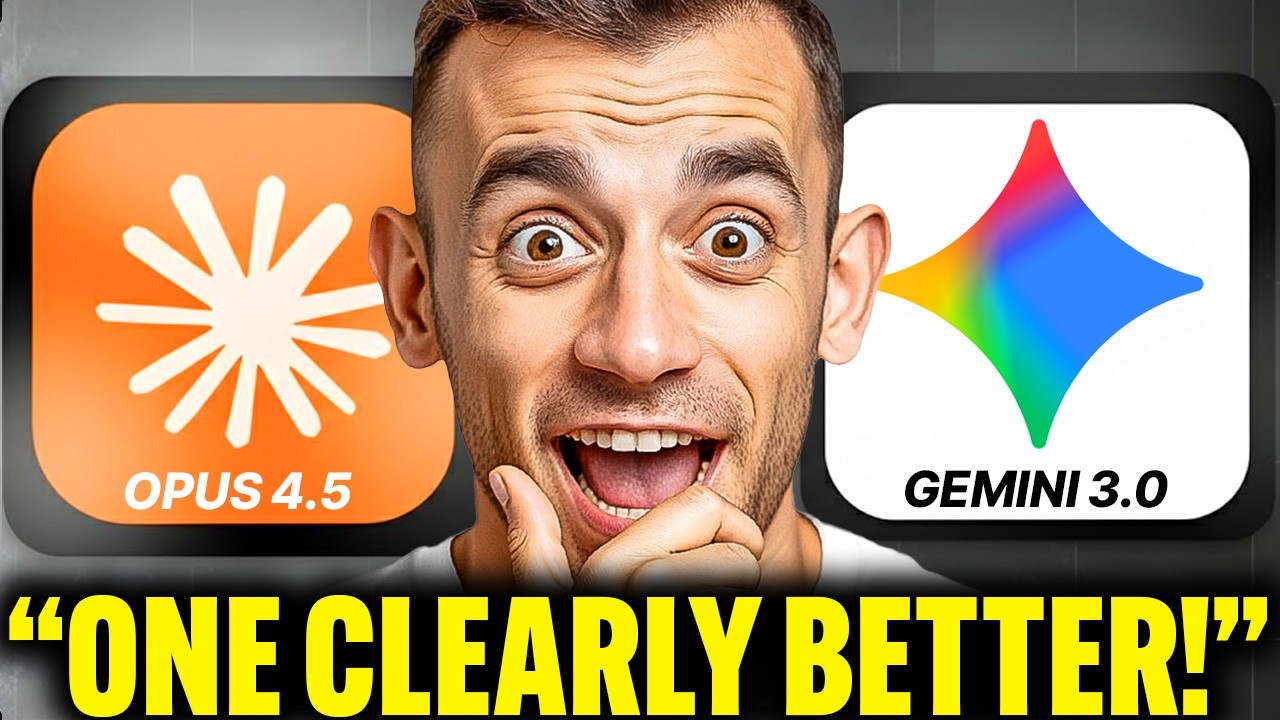
Google just dropped Gemini 3. Anthropic fired back with Opus 4. 5. I tested both so you don't have to. One crushes images and creativity. The other dominates coding and agents. Which one will change your workflow? Look, Google and Anthropic just launched their newest AI models. And everyone's asking the same question. Which one should I actually use? I'm going to break down exactly what each one does best, show you real examples, and tell you which one to pick based on what you actually need. No fluff, just facts. So, Gemini 3 is Google's newest multimodal model. That means it can handle images, text, video, all at once. It's built right into Google products and Vert. Ex AI. Then, you've got Claude 4. 5 from Anthropic. This thing is their smartest model yet, and it's made for coding, agents, and complex computer tasks. Both just came out and both are claiming to be the best. But here's what you need to know. Hey, if we haven't met already, I'm the digital avatar of Julian Goldie, CEO of SEO agency Goldie Agency. Whilst he's helping clients get more leads and customers, I'm here to help you get the latest AI updates. Julian Goldie reads every comment, so make sure you comment below. Let me tell you what really matters here. Gemini 3 shines when you need multimodal work. What does that mean? It means combining images with text, doing creative projects, working inside the Google ecosystem, Opus 4. 5 leads on coding, building agents, and doing advanced spreadsheet work or computer workflows. So, right off the bat, they're built for different things. Here's where you can actually access these models. Gemini 3 is available through the Gemini app, AI Studio, and Vertex AI. You can use it right now through Google's developer API. They've got controls for latency and cost so you can tune it based on what you need. Claude Opus 4. 5 is available through Anthropics API and all the major cloud platforms. Both have free tiers to test and then pay as you go pricing after that. Now let me show you where Gemini 3 actually wins. This model is incredible at multimodal reasoning. You can throw an image at it with a complex text prompt and it just gets it. Early benchmarks show it excelling on multimodal reasoning tests and long horizon planning. That means it can think through multi-step problems that involve different types of content. If you're a designer, a creator, or you work with visual content, this is huge. You can ask it to analyze an image and write a detailed strategy based on what it sees, or combine video with text prompts for content ideas. The integration with Google products means it works seamlessly if you're already in that ecosystem. But here's where Claude Opus 4. 5 pulls ahead. This model is a monster for coding and agentic work. What do I mean by agentic? I mean it can act like an autonomous agent. It can write code, test it, iterate on it, and keep going without you babysitting every step. Anthropic markets it as their smartest model specifically for coding agents and complex computer tasks. In real world tests, developers are praising it for coding accuracy and the ability to handle multifile projects. If you need to automate a spreadsheet workflow or build a tool that does something automatically, Opus 4. 5 is the one. And if you want to scale your business with AI tools like Gemini 3 and Opus 4. 5, you need to check out my AI profit boardroom. This is where I show you how to automate your workflows, save hundreds of hours, and get more customers using the newest AI models. I break down exactly how to use tools like these to grow your business without hiring more people. The links in the description, you'll learn how to plug these models into your actual business and see results fast. Let me be real with you. Independent comparisons are coming out and they vary by task. Some tests show Gemini 3 winning on creative reasoning. Others show Opus 4. 5 dominating on code generation and agent tasks. The answer isn't simple. It depends on what you're actually trying to do. But here's what I found interesting. When it comes to long horizon planning, Gemini 3 scores really well. When it comes to coding success rates and built-in working agents, Opus 4. 5 consistently comes out on top. Now, let's talk about the stuff nobody mentions, but everybody cares about cost and latency. Gemini 3 gives you API controls to adjust for latency and cost. That means you can make it faster or cheaper based on your use case. Google's pricing is competitive and they've got detailed docs showing exactly what you'll pay. Anthropic has similar pricing and they've noted that Opus 4. 5 is built for efficiency even with all that power. Both models have free tiers so you can test before you commit. Here's something else you need to know. Safety and hallucinations. Both companies claim their models are safer and more reliable than previous versions, but do they hallucinate? Do they make stuff up? Independent tests show both models can still hallucinate under certain conditions, but they're better than older models. Gemini 3 has Google safety systems built in. Opus 4. 5 has anthropics constitutional AI approach. In real world testing, both are pretty reliable, but you still need guardrails. Don't trust any AI blindly.
Segment 2 (05:00 - 08:00)
Always verify important outputs. Let me give you three specific recommendations based on what you actually do. If you're a creator or designer, go with Gemini 3. The multimodal capabilities are unmatched. You can combine images, text, and video in ways that Opus 4. 5 just isn't built for. Plus, if you're already using Google products, the integration is seamless. You'll save time and get better creative results. If you're a developer or automation engineer, pick Opus 4. 5. The coding ability is next level. It can write multi file projects, build agents that run autonomously, and handle complex spreadsheet automation. I've seen it write working code that would take a human hours in just minutes. If your job involves any kind of automation or software development, this is the tool. And if you're running an enterprise or a business, test both on your actual workflows, don't just pick based on hype. Run them through real scenarios you deal with every day. See which one actually saves you time. Because here's the truth. Both models are incredible, but one will fit your specific needs better than the other. Now, here's what most people get wrong. They think one model is better overall. That's not how this works. These models are built for different things. Gemini 3 is optimized for multimodal reasoning and creative tasks. Opus 4. 5 is optimized for coding and autonomous agents. Asking which one is better is like asking if a hammer is better than a screwdriver. It depends what you're building. Let me give you the bottom line. If you work with images, video, and creative content, Gemini 3 is your answer. If you write code, build automation, or need an AI agent to do complex tasks, Opus 4. 5 wins. And if you're not sure, start with the free tiers and test them both. See which one actually makes your work easier. The AI space is moving crazy fast right now. Google and Anthropic are competing hard, and that's good for us. It means better models, lower prices, and more features. But you need to know which tool to use for which job. Don't just follow the hype. Pick based on what you actually need to get done. Here's something else I want you to think about. A lot of people are using these AI models wrong. They're not getting the full power because they don't understand what each model is actually built for. I see people trying to use Gemini 3 for a complex coding projects and getting frustrated or people trying to use Opus 4. 5 for multimodal creative work and wondering why it's not as good. Match the tool to the task. That's how you actually get results. And look, both of these models are just the beginning, right? We're going to see more updates, more features, more competition. The companies that win are the ones that figure out how to use these tools right now. Not next month, not next year, right now. While everyone else is still trying to figure out which model is better, you should already be using both for what they're good at. That's the advantage. That's how you stay ahead. So, here's my final take. Both Gemini 3 and Claude Opus 4. 5 are game changers. Gemini 3 dominates multimodal tasks and Google ecosystem integration. Opus 4. 5 leads on coding, agents, and automation. The winner depends entirely on your use case. Don't pick one because it's newer or has more hype. Pick the one that solves your actual problem. And if you want to learn exactly how to use AI tools like these to scale your business, automate your workflows, and get more customers. Join my AI profit boardroom. I'm showing people how to save hundreds of hours using the latest AI models. You'll get step-by-step training on using Gemini 3, Opus 4. 5, and every other major AI tool to grow your business. No theory, just practical systems that work. The links in the description. Try both models. Test them on your real work. Drop a comment and let me know which one you picked and why. I read every single comment. And if you found this helpful, hit that like button and subscribe because I'm dropping new AI updates every week. You don't want to miss what's coming next.