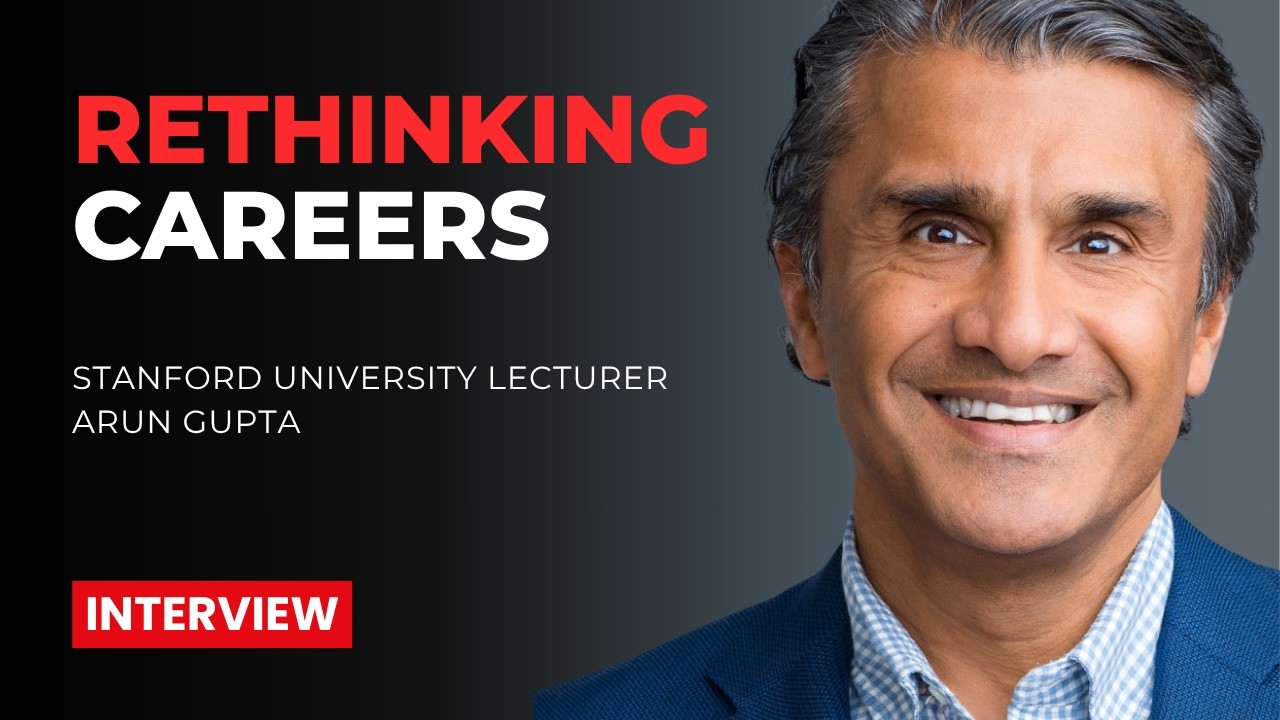
Arun Gupta challenges conventional notions of career stability, arguing that “you should be seeking meaning… in meaning, you’ll find your stability.” As institutions become less reliable anchors, purpose—not title or employer—becomes the more durable foundation: “the constant will be why you’re doing what you’re doing.”
He rejects the idea that clarity must precede action. In fast-changing environments, “start acting… the action will bring you clarity,” as waiting for certainty often leaves decisions outdated. Mission, in this framing, is iterative: “you don’t wake up one day… here’s your mission… you have to go find it.”
The discussion introduces a broader way to evaluate careers beyond compensation, emphasizing forms of capital that compound over time: trust, experience, learning, health, and mission. This supports a shift toward nonlinear careers, where phases of learning, earning, and contributing are integrated rather than sequential.
On AI, Gupta emphasizes practical fluency over technical depth: “people [will be] replaced by people that use AI.” At the same time, human capabilities: judgment, relationships, and diverse experience, become more valuable.
The overarching message is measured optimism. Risk is often misjudged: “we over index on downside and underestimate upside.” In this context, purposeful experimentation and long-term investment in multiple forms of capital offer a more resilient path.
Arun Gupta is CEO of the NobleReach Foundation, a venture capitalist, lecturer at Stanford University, and adjunct entrepreneurship professor at Georgetown University, and a bestselling author of Venture Meets Mission and The Mission Generation. As a partner at Columbia Capital, Arun's investment career spanned eighteen years including initiating the firm's Cybersecurity and Government technology investments with a focus on national security, AI, and SaaS/cloud infrastructure sectors.
Get Arun’s new book, The Mission Generation, here: https://tinyurl.com/ytmkcnmz
Claim your free gift:
Free gift #1
McKinsey & BCG winning resume
www.FIRMSconsulting.com/resumePDF
Free gift #2
Breakthrough Decisions Guide with 25 AI Prompts
www.FIRMSconsulting.com/decisions
Free gift #3
Five Reasons Why People Ignore Somebody
www.FIRMSconsulting.com/owntheroom
Free gift #4
Access episode 1 from Build a Consulting Firm, Level 1
www.FIRMSconsulting.com/build
Free gift #5
The Overall Approach used in well-managed strategy studies
www.FIRMSconsulting.com/OverallApproach
Free gift #6
Get a copy of Nine Leaders in Action, a book we co-authored with some of our clients:
www.FIRMSconsulting.com/gift
Оглавление (11 сегментов)
Segment 1 (00:00 - 05:00)
Welcome to the Strategy Skills podcast. I'm your host Krysta Aparowa and our podcast sponsor today is strategytraining. com. And today we have with us Arun Gupta who is the CEO of the Noble Reach Foundation, a venture capitalist, lecturer at Stanford University, and adjunct entrepreneurship professor at Georgetown University, and the best-selling author of Venture Meets Mission, which you may remember we discussed 2 years ago, and The Mission Generation. Arun, welcome. Thank you, Krysta. It's great to be here with you. So you spent decades doing very, very interesting work before writing the books. What did you see in that work that most people who didn't have your experience haven't seen and haven't [clears throat] realized about life and how things work? Um well, Krysta, thank you for having me. Um you know, for your listeners maybe it's helpful to give them a lens of which I'm answering these questions and you know, cuz we're all about a product of our experiences. Um so my father was in public service for 40 years. Um had one job um there. I um I uh my professional career however was in venture capital. Um so I had one career but across multiple firms. — [gasps and snorts] — Um and then when I um you know, stepped away from venture um I started teaching. I was teaching at Georgetown and Stanford. Um and so I had a window into the public sector um entrepreneurship and then the academic sector. And um I think that was I think one thing that um you know, I think gave me a different lens of how of what I saw um was being in these different silos. And I say silos because there was very limited interaction to some extent between them. Um [clears throat] and what I saw was that um you know, coming the synergies that need to exist but the crosswalks to connect them that haven't been built. Um and that um you know, in with the problems that we are uh facing as a society um national security, environment, energy, health care um that the entrepreneurial energy of um uh an innovation ecosystem is it needs to be married with the scale of government um to solve problems at scale. And that we haven't built the infrastructure to connect those two. And the main infrastructure that we're not connecting is actually talent. And so if you think about our our our best um young folks at universities, they're not thinking about going into public service. trying to solve problems this way. Um but they're also um the fact that we don't have people that have been on both sides um is inhibiting our ability to collaborate. Cuz they actually agree on a lot of things. They just don't use the same language. Um and they don't have a level of trust um having not been in the other one's shoes. And so what we saw was just that um we needed a new way of thinking about how um we rebuild the infrastructure to connect our two, you know, primary superpowers in this country, our ability to create talent and our ability to innovate, but connect them to government so that we can solve problems at scale. I think what that was the basis for the first book. And I think what we've seen transpire since then um you know, in the age of AI and um you know, a lot of what we're seeing in the geopolitical side is the speed at which um this disruption is starting to take place. And with that speed, I think is also coming a greater sense of disorientation for folks um and anxiety. And with that you know, is what really inspired us to write the second book um which is more talking about people. And in in the world we're going into the scripts that we've been given no longer apply in the same way. Cuz those scripts were about how do you seek security? comfort? How do you seek prestige? And in a world that's as you and I were just chatting about, you know, even before we got on, that's changing very rapidly um you can't be looking for stability. You need to be learning how to embrace change. Um and we talk about in the book that, you know, stability is the new risk. Right? And so you in the idea that I had one career, my dad had one job, but going forward my kids will have four to five careers going forward. Like how do we create systems um that really uh enable that? Because I think that's the world we're walking into. Um and um you know, I'm happy to discuss more about it as we continue. Of course. So for
Segment 2 (05:00 - 10:00)
someone listening to us right now thinking, "Hold on. So I should not be seeking stability. " How would you answer? Yeah. It's a great question. And what I would say to that is you should be seeking meaning. Right? And in meaning you'll find your stability. Um but seeking stability without meaning um is a risky proposition. Um because the things that we may as assert as being stable are getting disrupted. And so one way I talk about it or think about it is we've created a system where we ident- people create their identity around who they work for or what they do. Right? It's some proxy for money and power. And the truth is that those are getting disrupted as we speak. But like the constant will be why you're doing what you're doing. Right? That will be your stabilizing force. And um that is meaning. That's purpose. Uh and so I don't know if I say that they're mutually exclusive. What I may argue is that it's hard to find stability if you don't find meaning and purpose. And do you see many people asking themselves this question, "Why am I doing what I'm doing? " If we look at our own parents, so for example, if I think of my father meaning probably was not on top of his mind. But it was a different time. Um so the short answer is yes. I actually think people are asking them this question. Um the second piece of that is do I think people are acting on this question? Um and that one I I I think there the answer is no. Um which is why we try to address in the book like what are the resistances that keep people? If people intuitively know I want to do meaningful work, I want to have impact, contribution, why don't they do it? Right? And so we identify or talk about there's, you know, probably four categories of reasons. One is in your head, you know, inside of you. You know, the sense of can I do it? Imposter syndrome, fear of failure. Um the second is relational. You know, what are the feedback loops that you get from family and friends that all that have the best of intent but you know, they may be telling you don't be don't take that risk. Don't try that. You know, like why would you do that? Um even though that feels right to you. The third is kind of the systemic, you know, things that we assert prestige to. And people then kind of fall into that as a reason. Like, "Oh, people value what I'm doing. " And then the fourth is institutional, you know, lock-in. Like, you know, sometimes once you're inside a track, whether it be academia, government, or industry, like it's hard to leave because you feel like you're locked into like what you know and what you do. Um You know, what I would say for your father's generation, my father's generation, I absolutely think they were looking for meaning. Um you know, but in a stable way their job could provide them the stability to then do the things that maybe have been meaningful for them. Like take care of their family. Right? And we grew up in an era at that time where, you know, I was you had three phases of life. Learn, earn, and return. Like give back. So you learn for your first 30 years of life, you learn a skill, you monetize that, you earn and then you have stability and then you give back. Right? This is your philanthropic piece time of your life. And that's what I think is compressed. Um and what I mean by that is learning is no longer something you just do for your first 20 years because you graduate college you know, whatever skills you learned, they're going to be obsolete in 2 years. So learning is an is a lifelong endeavor. Um likewise, this idea of I'm going to do purpose later I'll find meaning later, I think is also a fallacy. Because later is usually never comes and if things are changing, it is your stabilizing force. So I think people are trying to marry this now at least this you know, the new generation, our next generation, earlier in their careers. And I think partially we we've kind of we've used the language um you know, and the best parody on this is Severance, the TV show you know, where it's we have our work persona and we have our personal persona. And I think people kind of want to have those things come together. Right? Like I I want to enjoy the work I do and I want it to have meaning. That doesn't mean I don't want to have financial security. And that's an important part here. Is that I do also think we've created this language that says um personally ambition Do want to pursue personally ambition or civic responsibility? And I think what we
Segment 3 (10:00 - 15:00)
are writing about in the book and through conversations that we've had, is that people want to do both. And we can highlight people that have done both. And the question is, like how do you make that the norm, not the exception? And what is your advice for people who cannot figure out what should be their purpose, their meaning, their mission? — [clears throat] — It's a great question. Um because I think the part of the what we write about um is in the mission flywheel, is that we've also been, and I think this is how we were all educated in my generation and maybe a few subsequent ones, but it's very different in the way I see my kids. And we were kind of educated in the context of like you learn something, become an expert at it, and then you act on it, right? Until you figured it out, you don't go act on it. Um and if you look at the way this generation operates, especially in the world of AI, they learn a little bit, they try it, they wait for feedback and signals, and then based on those signals, they try something else. And they incorporate that. So it's microlearning versus, you know, holistic learning. And the reason I say that is probably the way in a world that's changing, is that I think for those of us that are used to let me find clarity first, and then I'll go act. By the time you're ready to act in a world that's changing rapidly, the conditions have changed. And so no longer you no longer have the clarity to act on the way the world was, right? However, what we propose is that start acting. Start [snorts] doing. Like try things. In trying things, you will get feedback, and the action will bring you clarity. So it's reversing it. It's reversing the order. Rather than finding clarity and then acting, you know, try a few things, get feedback, and use that to provide you clarity on what feels right to you. And we all noticed, of course, that previous setup where you work hard, you study hard, you get all great grades, and you get a good internship, you get a great job, you work really hard, and you have a successful career, you stay loyal, you have stability, all of that is breaking down. But where did you think breakdown occurred on the side of individuals or side of organizations? Um look, I think it's a combination, honestly. Um you know, I think it's as we write about um in the book, as you go through the you know, '60s, '70s, um and then move into the '80s, there's a sense of like what's the corporate compact with employees. Um you know, you have exogenous events, um like the dot-com bust, or you have the financial crisis. It it begs a level of um distrust in institutions, right? Like the sense that oh yeah, my pension will be there. This company will always be there. And I actually think in some extent many of these cases, um it's been a false promise. Um you know, I think about a lot of my MBAs when they're looking for jobs, and they think about going into institutions that are very much up or out, where like within 2 years only 1/3 of them will continue forward. And I say, would you rather go into a system where you know, if everyone's doing well, only 1/3 of you move on, or a system where if everyone's doing well, all of you stay, and you probably have direct reports? And everyone would, you know, hypothetically say the latter. And then I say, well, that's the entrepreneurial ecosystem. So why do we think this is less risky or more risky than the former? And so I actually think, you know, being a business guy, I kind of I sometimes say like I think we misprice risk in our society. Um I think as humans we under um we underestimate upside in success, and we over-index on risk and downside. So I think part of it's human nature, too. Right? As humans we are wired, um there are studies that show this, that we will pick stability and security over happiness. Um and so I think, you know, there's a biological component to this. Um and that's just gotten reinforced with the systems we create. Yes. And also sometimes we have misunderstanding on what, as you mentioned, is safe. Yeah, what is safe, right. So it makes complete sense that now that our jobs are so unstable, we don't know if we're going to have it tomorrow or not
Segment 4 (15:00 - 20:00)
regardless if you are really good at what you do, it's very hard and people start if they lose a job, they lose their identity. So that search for meaning makes a lot of sense why it will become big and bigger thing now, and it should be for any human who wants to be successful, happy, and contribute at the highest level. But then on the other side, we also have that element that you still have to provide for yourself and your family. How would you recommend someone right now, let's say they work for Microsoft or Amazon or any other major company, they always worked incredibly hard, they thought that they had secure future. Now they feel that at any time they can be laid off, they are relatively senior but not extremely senior. How do they combine search for meaning with dealing with the situation that they can be laid off at any time? Yeah, I mean, I think look, they're not mutually exclusive. Um and you know, in in this context, like you could be working for a large company like that, and it could be very meaningful, right? A lot of this is also searching for where do you find meaning from, where are you contributing to. If I'm a leader of a division, and I'm mentoring a whole group of folks, and giving them new responsibilities, and role-modeling for them, that can be a very meaningful thing. So I want to be careful on like how we think about meaning. Is that it doesn't mean it's not existent in a large company. It doesn't mean it can't exist in the work that large company's doing, or with the how you do the work at a place like that, right? Um so I'm decoupling that um from like there could be uncertainty. And so, you know, thinking about how you could translate the what you're doing inside a large company, and maybe do it in a smaller company, or do it on your own, you know, I tend to look, I'm an optimist by nature. Um as a VC you almost have to be an optimist, cuz otherwise you would never invest in anything. Um and as an optimist, you know, like I see what's happening in AI, and while I can see how jobs um can get affected in some of the larger companies, and we read about this, what I don't think people talk about, cuz I think again, we over-index on downside, but we don't like um we underestimate upside. Um is that I think this could be the beginning of an entrepreneurial renaissance in this country, right? Like the ability to be able to for people that may not have been able to start companies before, um the accessibility of being able to do that, where you don't need 20 people uh uh to do something now that you might be able to do with an AI platform, a few agents, and five people, right? And so, you know, I think that's what excites me. Um and so if I was somebody at a large company, I think I would also be thinking about like I look, if something did happen, you know, what could I go do with the skills that I've acquired, the relationships I built, and the people I know? Um and maybe I do it on my own, right? Um and that's that would be how I would think about it, and do it on issues or problems that I truly care about. I have to ask you this question given your level of expertise when it comes to AI. What do you think the world will look like in 3 to 5 years? And it's very hard to predict. Yeah. But what are your thoughts so far? You know, I think I think the honest answer is this may be the one of the few time or first time in my lifetime that I couldn't give you an honest answer of what I know what I think it would look like in 5 years. And I think that's unsettling for a lot of folks. Right? Is that we don't know. Like usually you can, you know, at the beginning of any decade or any 10-year period stretch you within a you know, relatively, you know, narrow band, could say like this is these are the range of scenarios that the world could look like in in 5 years. Um and I mean that from a technological perspective, a geopolitical perspective. Um you know, what do I So that's the honest answer, like I don't know. The, you know, but if asked to kind of have one of my more optimistic or pessimistic um of what the world looks like in 5 years, I'm an optimist. Um I think the world looks like um we would have gone through a bit of transition around AI, um where, you know, traditional jobs, as we think about them, um may have come down, but like the idea of new jobs getting created in this more entrepreneurial context and new kinds of ways of using it would have increased. I see a world where um you know, look, a lot of the illnesses and um uh that we've had trouble fighting for years, um I think we'll go through a life science revolution. Um, and the ability to be able to um
Segment 5 (20:00 - 25:00)
solve some of these, um, you know, whether it be diseases or things around longevity and things of that sort. Um, I've never been more optimistic about that, especially as you talk to leaders like Eric Topol and others. Like there's uh I think it's really exciting what's coming down the pike. Um you know geopolitically, I am I don't know. Right? I think that's the big question in my mind. Is what does the geopolitics look like in 5 years? Um if it was, you know me having to place a bet um, I'd bet on the US. I'd bet on America. Um, I do that for the following reasons. That I just think we innovate better than anywhere else in the world. I just think what look, we have clearly we have every community, every society has its issues. Um, but I also bet on our spirit of innovation and our spirit of entrepreneurship. Um over and I think those are deeply cultural things that's hard to teach. Um, it's hard, you know, we just need to be in a position to really unlock it. Um, and to me this is about, you know, we have the best talent. Um, innovation. Now it's like can we get it to flow and maximize the potential of both of those things. Um, and which is to me why I think, you know, in the work that we're doing at NobleReach is like how do we create those crosswalks so that academia, government, and industry are collaborating in a way that we can get the best out of what we have here. Um, we're not sub-optimizing talent. Um, and um, you know, in communities that that aren't intersecting. Um, you know, the way we talk about it um in the book is like 250 years ago our founders created a an amazing system for our independence, right? — [gasps] — Um, and here we are celebrating the 250th and um and you know, in this book that we have coming out, we're calling it the mission generation and we say, you know, the opportunity and the challenge for the mission generation is to now take that system of independence — [snorts] — and you know, really um supercharge it but with interdependence. Because it's one we can all be independent, but unless we create [clears throat] the crosswalks for interdependence, we're not going to maximize the benefit of the whole. And um, you know, I think that's the um that's the opportunity and the challenge in front of us right now. Um, I think doing that in the short term can always feel messy. Um, but I think over the long term that system of governing um, you know, gets to non-linear solutions. Um, that um you know, makes me optimistic around where we are as a country. Um, but look, I think things will be disrupted. Um, I think the way we think about education changes dramatically. Um, and you know, I think about the way that we um you know, look, I think the way we think about talent changes. You know, we need people coming in and out of government in a way that we don't have today. If we're we're going to really have a tech forward government. Um, we can't be asking people to come in and just stay there for 30 years. We need to be able to ask them to come and serve for whatever that period of time is. Enable them to leave and go um sharpen their school tools um you know, do other things, but then being able to create pathways where they come back. And so, you know, look, these are all things that we all need to work through. Um but uh I feel like they're solvable and now it's just going to matter do we have both the will and the courage to solve it. Chris and for someone who will read the book, what are the key things you want people to take away? Yeah, I mean, look, I think the um we we discussed some of them, right? That stability is the new risk. So don't think about um looking uh with your initial question for finding this stable and comfort role because um you may be surprised. Um, so lead with purpose and meaning in what you do. Um, two, that purpose and meaning are not divorced from financial independence or security. That those, you know, we have an entire chapter around financial capital and meaning and mission capital needing to be coexisting. Um, and we need, you know, it's equally dangerous language if someone is doing mission-driven work um, and then someone leaves, you know, for financial reasons to do some other things, to be that being looked down on. Um, you know, we don't need, you know, we need to incur we need to understand that these are um, decisions people need to make for themselves. Um, I think third, that we're
Segment 6 (25:00 - 30:00)
entering a world where um we need to embrace non-linear careers. Right? We need language for people to um uh understand that at any point in time you could be investing in different aspects of yourself. And so, you know, what do I mean by that, Chris? You know, we talk about net worth. If wealth is what you accrue, net worth is what you bring to the table. But you look at our society, if anyone says what's your net worth everyone answers with a number. Right? It's unidimensional. And we all know it's more than that, but we the language we use is about one thing. And so our systems reinforce it. And so what we propose in the book and we try to talk about in the book um is that, you know, what are the other capitals, you know? Um, that should serve in your compass as you kind of go through life. You know, so long we acknowledge financial capital is important, but mission capital trust capital, the relationships you build um, experiential capital, the different experiences you have, learning capital, your capacity to continuously um, learn and um be curious and health capital. Like, you know, we need to acknowledge wellness is important. People are going to be working for 60 years. You need to take care of yourself. And we use capital intentionally because these are all things that we need to be investing in like you would, you know, if you had money, you'd put it away in a brokerage account or a investment account hoping that it would compound over time. These other capitals also compound over time and arguably may compound more um expeditiously and more valuable to you than than just the extra few dollars you make coming out of school. And um and so I think we need the language to enable this sense of like how we talk about it. Um, and so that's why we propose that. And so I think that those would be the takeaways we have. I think the final one I would say is just a sense of optimism, right? Like we have the capacity to do this, not because these are new ideas, but that people have already been doing it as outliers, but now how do we create the systems to turbocharge it in a meaningful way. Um, but I think that's what we would like people to be taking away from the book. Um and you know, really kind of a um — [clears throat] — you know, I'm hesitant to call it a playbook, but you know, um a framework of how to use it in your own life. Right? So that it's not just theory. Um, we want to try to tell it through stories of others. And the reason that's important is we're hoping that someone reading the book sees themselves in one of the stories. And if they see stories, they go like, wait a second, that person was feeling what I was feeling. Yet that person made a different decision and that person was able to do something that I would like to go do. Why can't I do it? And if we can unlock that or inspire that, I think that's, you know, that would be um a great gift for us um and you know, why we wrote [clears throat] it. As you were doing research, was there moments of great surprise? Yeah, you know, I think the surprise for me was the um actual agreement from across sectors and generations of people really um looking for a different way to think about um some of these issues. Right? That the when we would talk about the work we're doing what the some of the writing that we're doing um whether be you know, Republicans and Democrats, academics, industry folks, people would have the same question and that is how can we help? Right? Cuz I think people really, you know, are feeling the same unease and they're looking for ways to be able to though engage in these kinds of conversations. Especially when it comes to really um inspiring the next generation. You know, I think that's something that I found uniform um interest in and concern for. Um, and so I think uh that was probably the thing that I kept waiting for that like oh, you don't need this. This doesn't make sense. Why would you do this? We're already you know, this is already happening and I didn't hear that. Um, and so um that surprised me, I'll be honest with you. That's a very good surprise. What do you think people will misunderstand or most likely misunderstand as they're reading the book? Um, that's a great question. The truth is I'll probably find out as people read it and they give me feedback. Um you know, part of what we tried to do, I'll say though if I'm honest about it, is to make sure as we wrote it that it didn't feel like mission was
Segment 7 (30:00 - 35:00)
something that um was only for a subset of people. And that mission and purpose was accessible to everybody. And so something I think that can be a pre-election that people walk into is like, "Hey, that's great. You're talking about this mission and purpose thing, but that's like I need to take care of like just what I got to do. " And we're not saying that you shouldn't take care of what you got to do. We're saying that these should coexist these can coexist. Um and um as opposed to this idea that you have to pick one or the other. And so having the um way of testing that or constantly testing that. That doesn't mean it always has to coexist. There could be times that you just say, "Look, I just need to go create the financial security for my family, so I'm putting my head down for a little bit of time to do that. " But we're trying to say that as over the course of your career, these need to be, you know, again, we need to braid the notion of learn, earn, and return into a career as opposed to a sequential step. And um you know, I think that could get um misunderstood that we're saying like what you know, "Oh, you're just selling me to go flip it and go do, you know, uh you know, meaningful work that doesn't pay anything and how am I supposed to live? " And that's not what we're saying. And that's not absolutely not what we're saying and we you know, hopefully that comes across in the stories that we're telling. And that just shows that there's a additional understanding required when it comes to looking at mission-driven work because you actually can accomplish a lot more if it is your mission versus if you're just in it for money. Yeah, and the reason the compass capitals are important Chris in language we use is that you know, hopefully it also gives um language to decisions people make as to how they're investing their time. Um you know, if someone takes a career break to for caretaking of family members, elderly or young ones. Um right now we call that a break and we treat it like it's a pause and um you know, but like in a world where you have four to five careers, like why isn't that just a mini career, right? And there are skills or capitals that you're investing in during that period of time. Maybe it's not finance, but you know, you you're clearly investing in mission, experience, you're clearly learning a lot during this period of process. Many would say that, you know, it it's allowing them to rejuvenate and clear their minds, so the health capital is also incredibly important. — [clears throat] — Um and so I I think also creating language to enable people to move in and out is important. Um you know, right now if you take a career break, you know, everyone assumes you didn't do much during it. Cuz the concept of a break is you're stopped. Um and so you know, I think you know, thinking about what that language looks like becomes really important. Cuz I think it makes it easier then for people to kind of come back in um and gives them a language to say, "Look, no, actually yeah, I wasn't doing this for 5 years, but here's what I was investing in over these 5 years and what I learned from it. And those skills are being completely transferable to whatever I want to go do next. " Very true. And even just what it means when someone takes time off to go take care of their family member, it says volumes about this person and how lucky you are to have them on your team even if they are leaving for 2 years, for example. Yeah. That's exactly right. And then so you know, part of you know, the inspiration and you know, lived experiences um was thinking about like, you know, why don't we have language around that? Right? Um and then also look if you're like part of it was it as a um a lecturer at a business school, you know, I would have students open up and say like, "Professor, I'd like your time. I'm trying to think of three job offers, which one to take? " And they'd open up their laptop and they'd have a spreadsheet that showed like basically a net present value model of how they think their salary will go over the next 10 years and which one's worth more. And I would look at them and I'd close the laptop and I'd say that's absolutely not how we're going to make this decision. Like tell me about the mentor at each place, right? Tell me about what you're going to get to do and learn at each place. Right? Tell me what you um what experiences you're going to get. Right? Tell me a little bit more about what the lifestyle is going to be like for you. And um and you know
Segment 8 (35:00 - 40:00)
because I I again, we don't give students language to think about that. So what do they do? They compare it on with their starting salary and bonuses. And that that can only be one dimension. Um and I'm not saying it's an not an important dimension. I'm just saying it can't be the only dimension. I would optimize on trust capital and experiential capital all day long when I'm young. Right? Like working with a great mentor that's going to help set me up for my second, third, or fourth job is worth way more than an extra 10 or 20 grand coming out of school. Um the kind of diverse experience that I get and responsibility that I get versus just being another cog in the wheel is worth way more. Um and so but again, we don't have a language that kind of highlights that for folks and we don't show that these are transferable. Right? Um cuz we still think about you know, this is where I think academic institutions do a disservice cuz they still talk to students about like, "We're preparing you for a career. " And I think those days are gone. Like I don't think we are preparing students for a career. You know, I think we're pre- preparing them for a journey of careers. Um and that's a different way of thinking about the skills you build and the mindset resiliency build and the relationships you build especially in a world of AI. And you know, I think the capitals that we lay out there are all things that actually make you are deeply human. Health is human, experience is human, trust and relationships are human. Um your capacity to learn is very human. Um impact and contribution where you get purpose is human. Right? Again, as we think about a world of how we coexist with AI going forward, you know, I think this becomes more important. And in speaking about coexisting with AI and coming back to an example of someone relatively senior at a large organization who is afraid about what will happen to them tomorrow or next month, what skills do you think people should be investing in right now? Yes, I mean look, I think um number one is um being conversant with AI and being versed, right? I — [clears throat] — I just I say it that way cuz I don't mean when you say like, "Oh, you should invest in AI skills. " People immediately think you someone's saying you got to be technical. I'm not saying that. But I'm saying you know, you need to know how to embrace it. what's out there. You need to know how to use it. Um you know, a number of people have said this before, but I agree with the statement. I think it's less about people getting replaced by AI, but people that use AI. Right? So I could be a financial analyst or a financial analyst knows how to use AI. The financial analyst that AI gets ahead. — [clears throat] — Um so investing in that. Like I did I I don't think you can just say like, "Hey, I this isn't for me. I'm not going to learn about it. " Um so I think being versed in that. Um I think second um you know, in a world of AI, I think even more so and this is why trust capital is important, I think relationships. I'd be investing in people. Um and because people will trust people at the end of the day. I mean even in a world of AI. Um and those relationships um I think become even more important in the world we're walking into. Um I think diversity of experiences. You know, I can look at the same data and process it as if I was an MBA or a financial analyst or a you know, a technical expert. But I could look at that data and having had five different experiences, lived abroad, starting a company and I'll look at it and have different insights. That's harder to replicate. Right? Um and so again, I think you know, I'd be investing in a diversity of experiences right now if I was building my career. Um I think AI comes after IQ over EQ, um right? So it goes deep very quickly, but the breadth piece of it is a very still a very human element. Um and I think that's where um you know, I would be investing, you know, time. Um you know, and I and again, honestly, I would be investing on what do I care about? Um you know, you almost need to go in you know, you mentioned the example of someone being in a large company worried about losing their job. That's going to be anywhere. Right? But again, if you're doing something that you find purposeful and that you care about, you're probably in
Segment 9 (40:00 - 45:00)
an ecosystem or working with folks that are of like mind and if you things get disrupted, you will find a way to keep that work going. Um and so that's how we were we are you know, talking about it. You know, I think the other thing is we think about the um you know, why I think the financial capital I mean sorry the compass capitals are important is it you know, when we talk about net worth around one dimension Chris, you know, what's your net worth? What's my net worth? It's immediately a scarcity mindset. Am I worth more or less than you? Um when you talk about it in terms of a multi-dimensional here's six capitals and what's important, like your six could be different than my six. I mean, you know, and that's fine. And that's kind of the way it should be. Like I shouldn't be feeling like I'm comparing myself to you on one metric. Right? Um and I think um I think that's a transition um that we make. But I think at the core those would be um you know, what I'd say to your question. Thank you. And in the book you write that mission is forged not gifted. What does the forging process look like? Um it it it's the experimentation piece. Right? It's the willingness to um you don't wake up one day and someone says, "Aron, here's your mission. " Right? And it's gifted to you and which is what we meant to say. Um you have to go find it. Right? And it's a discovery process. It's an exploratory process. And it's not it could take time. Right? You may you know, it's like going through a maze. You may go through a few false paths and have to come back out and then go try different path until you find that place that kind of gets you to where you want to go. And so I think what we're trying to say or leave people with in saying that is that this needs to be intentional. Right? This is something you have agency for. You know, when someone says, "I don't know what my purpose is. " You know, I can't figure you know, it's usually because they're not trying. Right? When I speak to clients on this topic, I often share with them just imagine you're going up dark stairs and you have a flashlight that only shows you the next step. You always can figure out what you're interested in, what excites you, what makes you feel alive. Just follow that. You make that step then you will be able to see the next step. And sometimes you may need to go back because you got to the wall and then you find another pathway, but you're not going to get anywhere if you just stand in still. Right. Where do you find people struggle when they try to experiment? What leads to them getting stuck and giving up? I think a couple things. I think one um if they feel alone. Um you know, I think it's easy to and that's why we have one of our things is to you know, um find your allies in the process. Right? Identify the people that want to see you find that mission, right? Do the experimentation. Um because I think um with the experimentation comes failure. Um with the failure comes questioning. And with the questioning comes uh you know, lack of confidence sometimes. And having the allies around you that are like, "Hey, just get back up. Try it again. " That means a lot. Right? And it it could be very small things that people say. Um but you know, and this is why I think trust capital is probably the most you know, in my life has been my probably the most valuable one. Um because those small gestures of support lead to big things later. Um and they later because you're like, "All right. Well, I don't know if it's going to work, but let me try it. " Um you know, when I wrote um or thought about writing the first book, um you know, I had friends that would be like, "Why would you write a book? How do you know how to write you know, what would you But I also had friends that were like, "That sounds cool. " Like let's talk about it. And you know, look, I'm forever grateful for those friends in the latter category. And then um you know, the most important in my life then is my spouse, right? You know, and she was always in my corner saying, "Why not? You should try it. That'd be great. " Um but you know, along from that of having your own group of folks um becomes incredibly important. Definitely. 100%. What are some of the things you wanted to share that maybe I didn't ask you about? I think you did a great job asking a you know, a number of the themes and the questions that we we talked about in the book. Um I think the biggest one that I you know
Segment 10 (45:00 - 50:00)
again will come back to is um why are we optimistic? Right? Cuz um it could sound like we are deaf, you know, not hearing the uncertainty and the swirl of what people are feeling, right? Um and you know, and the reason I feel that optimism is that I feel like more and more folks are kind of getting to the same spot. And they feel a bit adrift. Right? They feel a little bit like you know, and um you know, I was just at a event with I know Arthur Brooks um it's a friend and he's got his book coming out um today in fact. Um You know, the meaning of life. The more we have people talking about this and normalizing these kinds of discussions and then we can have hopefully you know, people seeing themselves as not being alone. Um like these questions can feel like you're isolated cuz you're not doing what everyone else you're not thinking what everyone else is thinking. You're not doing doing. Um but if we can then have people feel like actually there's a whole community out there that feels the same way. It can feel hopefully feels empowering. Right? And I think in the discussions we've been having with folks, I've seen that. Um and I've seen that through the programs, you know, like we now have scholars that we've placed and they've come out and they're just like, "This has changed my life. I'm thinking about things differently. " You know, I just feel that ripple effect. So I think we're in the very early innings of this ripple effect becoming a small wave and then hopefully a big wave. Um and you know, I think you've got you know, some really credible leading voices kind of really um bringing it into the forefront. And um you know, so I I that would be the only thing I'd say is that you know, the why we're optimistic. I guess actually we have few minutes left. I will ask you one more question that I think will be extremely interesting for people. To the level you feel comfortable sharing, could you share how you use AI personally, professionally so people who feel behind, they at least have some points they can hold on to and start catching up. Yeah. Um look, I feel like I'm probably still in the you know, I think I'm tech forward in how I use AI. Um but then I meet my I see my kids and um I feel like a tech laggard. Right? Um and so you know, look, I use it um now as my you know, place of research. You know, um to identify I use it to challenge my own thoughts and my own writing. Um so you know, like even when we were writing the book, you know, like put a thesis out there and say, "What would be the five things you'd say that you know, people would disagree on? " Um so I'm not saying that's the only answer, but what I find is that it's a great way to challenge my own thinking. Right? Um it's a great way for me in the absence of being out there and being able to talk to 100 people um and be able to get some level of opinions. Um and it's a great ideation tool. Um you know, in ideating about thoughts and ideas and um so I don't use it to solve my problems, but I use it to help me ideate on potential solutions. Um and then kind of work from there. Um you know, now used it to um you know, do you know, just custom workflows, things that I do on my own with all the you know, the workflow tools that are out there right now and not naming any specific ones, but um you know, I use it um you know, entirely as my companion in meetings and note-taking and synthesizing takeaways. Um and um you know, I find it extremely it makes me better in that. Um and I find that it hears things that I missed in the meeting. Right? Like um it's another set of ears. And not as a recording device but in a synthesis device. Um and so I find that um very helpful. But I think the biggest one has been in this like the velocity of ideation. You know, like the idea like when I have something I'm trying to solve for or something I'm working through that I can you know, on my own ideate you know, with um
Segment 11 (50:00 - 54:00)
with the AI um in the various tools that are out there and sharpen my thinking and sharpen my thesis and question my foundational basis in a safe space, too. Right? Um you know, cuz sometimes, you know, you want to challenge your own biases. Um without being judged um and it's a great way for me to understand that. And um uh that's why I think it'll be a great human development tool. I was chatting with, you know, Eric Topol and we're doing a podcast. And we asked him, "What do you think you were wrong about with AI? " You know, cuz he wrote about AI early about its transformation in medicine and things of that sort. And he said, "You know, the thing I was probably wrong on is I had said in early on that I thought, you know, the one thing is humans would always be more empathic. And empathy [clears throat] would be the thing. " And you know, now there are studies out there that show that um frankly, the AI patients would say the AI is more empathic than the doctors. Um it listens better. It synthesizes what you're saying um and responds accordingly. And that's not a bad thing, but what that can do then is it's a great human development tool. Right? It It's a great tool for then professions if you're willing and open to be able to learn from it. Like, you know, and it will tell you like, "Hey, you know, the person patient said X and you immediately jumped to Y and Z conclusion you know, as opposed to listening to what they were really saying. And you know, that's a good lesson for all of us. Um and so you know, that's why I think where the uh there'll be plenty of places where we'll be revolutionary, but I think one will clearly be its impact on education and um human capital development. Thank you. Where can our listeners learn more about you, buy your book, and anything you want to share? So, the new book uh The Mission Generation, uh you can go to uh uh the missiongeneration. com. Um and there'll be uh information about the book. Um you know, uh folks that we profiled, folks that have supported it and blurred it. Um and places to order it if you're interested um as well. Um it regarding Noble Reach um and the foundation and the work we're doing which is tied um to The Mission Generation, go to www. noblereach. org, o r g. Um and you can find more about the work we're doing um around scaling talent and scaling innovation in collaboration with government to go solve big problems. Um and those would be the two places I'd send you or your listeners um to learn more about um the work. Um you know, my proceeds from the book are really going back to um uh supporting uh young folks going in and serving. Um and that could be at the federal, state, and local levels. So, there's no personal remuneration here. For us, this is about amplifying the message. Um we think this is an important time to get the the message out. Um we've been very um — [clears throat] — humbled but uh excited about the folks that have decided to lend their name to the book. Um and um you know, welcome your audience um supporting in that capacity and uh sharing it with their networks. Um that would mean a lot. Thank you, Aaron. Our guest today was Aaron Gupta, the CEO of the Noble Reach Foundation, a venture capitalist, lecturer at Stanford University, and adjunct entrepreneurship professor at Georgetown University. And I hope you guys enjoyed our discussion. Our sponsor today is strategytraining. com. You can get some gifts from us. You can get five reasons why someone is ignored in a meeting at firmsconsulting. com/ontheroad. You can access episode one of how to build a consulting practice at firmsconsulting. com/build. And you can get McKinsey and BCG being a resume at firmsconsulting. com/resume. pdf. Thank you so much for tuning in and I'm looking forward to connect with you all next time.