Sponsor: ID-Cooling Frozn A720 Black on Amazon https://geni.us/VDnou4Y
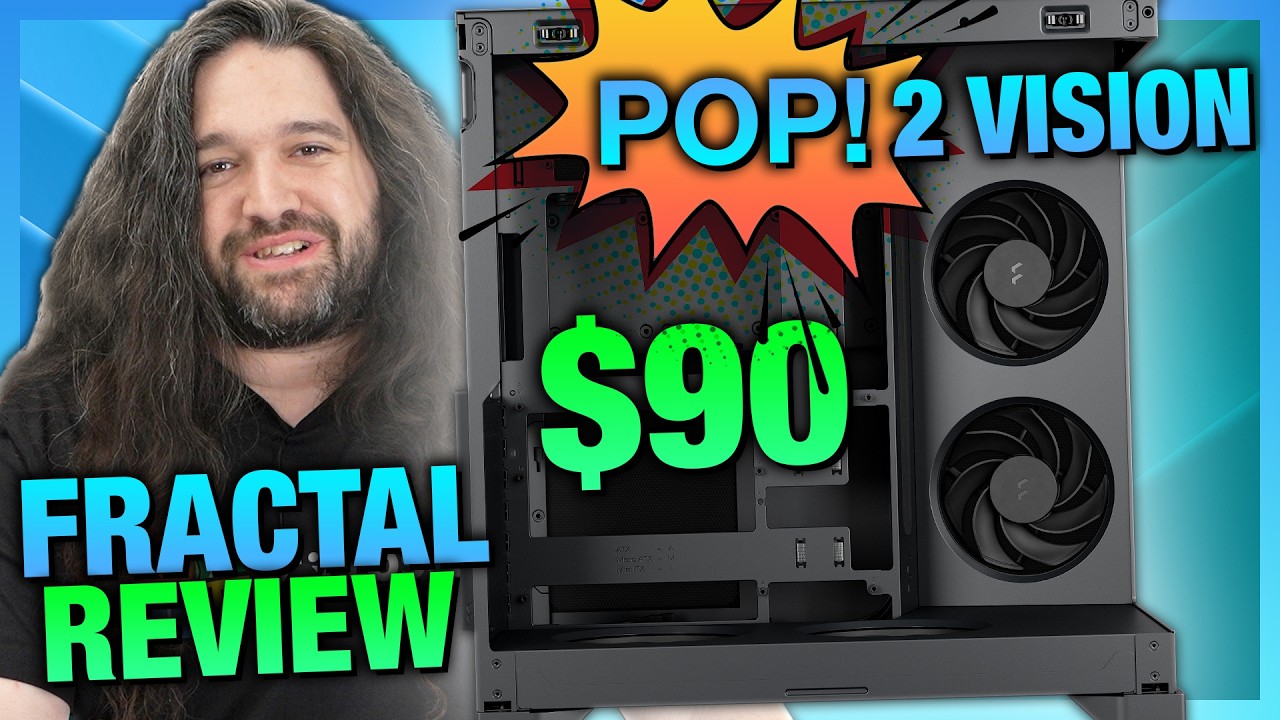
Fractal today is launching its Pop 2 Vision gaming PC case at $90 and $100 models, making it one of the cheapest cases we've seen this year. The Pop 2 Vision includes 4 fans, targets the more affordable end of the case market, and follows-up on the Fractal Pop Air that we previously reviewed positively. For this review and benchmarks, we look at thermal performance, cable management, build quality, and strategy as case companies contend with lower sales volume due to DRAM pricing.
Check out our review of the Noctua x Antec Flux Pro: https://www.youtube.com/watch?v=PeP7VGCH3D4
Watch our recent Steam Controller tear-down: https://www.youtube.com/watch?v=hVRfie61QyE
Watch our HAVN BF 360 Flow review: https://www.youtube.com/watch?v=-wIP4Q9PdY0
The best way to support our work is through our store: https://store.gamersnexus.net/
Like our content? Please consider becoming our Patron to support us: http://www.patreon.com/gamersnexus
RELATED PRODUCTS [Affiliate Links]
Fractal Pop 2 Vision on Amazon (when it lists): https://geni.us/5x4Ow0h
Fractal Pop 2 Air on Amazon: https://geni.us/bEca5X
Antec Flux Pro on Amazon: https://geni.us/CaPv
Fractal Meshify 3 Ambience Pro RGB on Amazon: https://geni.us/BjOq5
Hyte X50 on Amazon: https://geni.us/CEBL
HAVN BF 360 Flow on Amazon: https://geni.us/PRsOyke
Lian Li Lancool 207 on Amazon: https://geni.us/HILbWU
Corsair FRAME 4000D RS ARGB on Amazon: https://geni.us/mfBx6F
TIMESTAMPS
00:00 - Fractal Pop 2 Vision Case Review
02:35 - Cost-Cutting Pros and Cons
04:51 - Cable Management, Fans, Radiators
12:08 - Test Plan and Methodology
14:25 - CPU Thermals: Noise-Normalized
15:40 - GPU Thermals: Noise-Normalized
16:27 - CPU Thermals: Full Speed
17:48 - GPU Thermals: Full Speed
18:37 - VRM and DDR Thermals: Noise Normalized
19:05 - Conclusion
** Please like, comment, and subscribe for more! **
Links to Amazon and Newegg are typically monetized on our channel (affiliate links) and may return a commission of sales to us from the retailer. This is unrelated to the product manufacturer. Any advertisements or sponsorships are disclosed within the video ("this video is brought to you by") and above the fold in the description. We do not ever produce paid content or "sponsored content" (meaning that the content is our idea and is not funded externally aside from whatever ad placement is in the beginning) and we do not ever charge manufacturers for coverage.
Follow us in these locations for more gaming and hardware updates:
t: http://www.twitter.com/gamersnexus
f: http://www.facebook.com/gamersnexus
w: http://www.gamersnexus.net/
Our policies, processes, and ethics statements relating to review samples, advertising, travel, errors, and more are transparently and publicly available on this page: https://gamers.nexus/ethics-statements
Steve Burke: Host, Writing, Test Lead
Patrick Lathan: Testing, Writing
Mike Gaglione: Testing
Vitalii Makhnovets: Editing, Testing
Tim Phetdara: Camera
Andrew Coleman: Camera
This is Fractal's $90 Pop 2 Vision, which comes with four fans, some impressively sturdy materials, and some obvious cost cutting measures. The case is the first we've reviewed in a long time that makes use of DC fans rather than PWM in a clear money-saving move alongside its choice to combine one USB type A 5 Gbit per second and one USB type-C on the same cable. And you're going to see a lot more of that type of thing going deeper into the year as case companies in particular are getting hit really hard right now by the RAM prices because reducing sales volume by a lot. We have a separate video coming up on that. But there's a lot of positives we like about this case in Fractal's attempt to serve the cheaper case market. The angled front wall for the embedded fans should improve thermals by angling the fans more toward the components. It also just looks different, branching out from the height inspired motif of the Y series. The Form Ffit fan should also benefit from improved performance as a result of their chambered design and chamered edges. The back is also enormously deep for extremely easy cable management. There's also the unusual but very welcomed addition of the bottom filter being a stamped steel sheet. It's actually oddly high build quality for a bottom dust filter. We like the way they did this. Fractal also released the Pop 2 Air recently, a follow-up to the colorful budget Pop Air that we reviewed positively back in 2022, and now it's adding the Pop 2 Vision to the family. It's an O1D inspired dualchamber fish tank of a PC case. And the only thing it really shares in common with the Pop family originally is the price where they're targeting $90 with the model we're reviewing today, the blackout simple steel glass and no RGB version. And then for the RGB version, it's $100 for otherwise uh the same thing just with lights. As you'd expect for a case named Vision, Fractal isn't offering a steel panled version of this case. It's just all glass. Let's get into the review. Before that, this video is brought to you by ID Cooling and the Frozen A720 cooler. The A720 air cooler performed well in our testing last year. The A720 is a relatively high-end dual 140mm air cooler with seven heat pipes. We found the use of larger fans can be beneficial to acoustic performance given the thermals, although you'll want to check your case for compatibility given the taller nature of the cooler and its fans. ID Cooling uses an all black look for its A720 and includes mounting hardware for all modern sockets. Learn more at the link in the description below. We've been wanting Fractal to
Cost-Cutting Pros and Cons
release a new sub $100 case for a while now. The Pop Air was $80, $90 with RGB. were positive on the case. It was kind of strange in good ways, like optical drive support, which was abnormal, but good to see on a case every now and then. Uh, this case though, this is difficult to achieve right now because the case companies truly are in pretty dire straits by and large. Uh, and a lot of them are going to be forced into cost cutting moves as they race to the bottom, which could have benefits on the consumer side shortterm where you get a lot of cheaper cases. The downside is it's going to kind of reset the expectations because we're seeing things like DC fans on this. There be a lot of pullback on higherend, higher quality features that you've gotten used to seeing as companies try to scrape the bottom of the barrel for whatever pennies they can shave off of the case uh to try and make up for the reduced volume. And that'll reset expectations. It means that as this period of reduced sales for the companies goes on because the RAM prices are so high and the GPU prices, people will get more and more used to the reset floor of what you expect out of a budget case. So that's the downside. On the positive side, for this case specifically, it is one of the sturdiest that we have worked with for the front corner ever, which is impressive, especially for the pricing of the case. I mean, this is fully unsupported right now. It's taken the companies a while to figure out like basic I don't know what you'd do in a bridge model building class in middle school or something, but Fractal's done a good job here. This is like crazy well supported compared to some of the original fish tank cases we saw where they just if you pushed on the I mean the trikes Luca L70, you push on that corner, falls out of the case. So this was well done. Also, the top panel being well, the top filter being a stamped sheet of steel rather than a flimsy, you know, magnetic filter you typically see. This was another area where Fractal improved upon the build quality. So, it seems like they've gone for increasing the build quality, the perceived build quality of the structure of the case, which is all stamped steel for the most part, uh, some bends in there, rather than going for all the other features. The two glass panels
Cable Management, Fans, Radiators
don't contact each other, but the panel gap is consistent top to bottom, which is at least good. Each of the panels only requires light pressure to unsnap, but all of them, including the steel panel, have tabs that can be screwed down for shipping, which is something we always prefer to see. The fractal tag on the front panel looks like a pull tab, which is how we used the tag on the original Pop Air, but it's supposed to be purely decorative here. The front panel instead has to be pulled out from its top edge or from the inside once you've removed the side panel. Again, that bottom filter is highly unusual among cases we reviewed. You have to remove the side panel to get access to it. It's better than having to pull the case away from the wall to pull it from the back. There are alternatives though. Uh but because the way they did a stamp sheet of steel, they wanted to socket it in cleanly under the side panel. One of the things we noticed when building on this, so uh each of us kind of worked on this a bit. My tin foil hat has fallen over where, uh, Patrick and Mike worked on early setup. Mike did test prep. I worked on it at the end of the process. And one thing Mike and I noticed in particular was that because of the way the cable channels are uh situated in the bottom of the floor of the case, it is often easiest to get access to these bottom cable channels by tilting the case kind of like this to run the wires, which is a little unusual. It's not the worst. You deal with it really no problem at all, of course, but uh it is a bit of a negative just because the access is somewhat restricted down there. Although the upside is that was the best way they could run the cables fractal that is without making the case taller and while kind of hiding them behind that single sheet for the fans in the bottom. So some ease of access challenges for the bottom of the case. The other side of that though is the back of the case is ridiculously deep for cable management because it's a dualchambered design and there's not a whole lot going on back there. The flat blank plates that surround the four stock fans are visually distinctive. And overall, we think it was a good choice to make the Vision stand out and angle the fans, adding an interesting Y70ish cut off to the corner internally. The downside is that the side and bottom fan mounts are 120 mm only and only in dimensions of Fractal stock fans, resulting in a highly restrictive build from a fan and liquid cooler mounting standpoint. differing from what we expected at first glance looking at how sort of in case the fans are access to the fans is at least better than we thought where access to the side fans which in this instance are serving as intake the reverse blade requires only taking off the side panel and then you've got full access to them access to the bottom fans. You remove the dust filter and then you've got full access to those. And these are all held in with radiator style mounting screws. It's all intake here. So, all four of these are reverse blade. The end result of that is that you're pulling in air from the side and the front and the air is going to exhaust wherever there's a hole in the case, mostly at the top and the back. Gets interesting though is the PCIe slots, but we'll come back to that one. The only real radiator mount in the case is at the top, which can theoretically fit up to 360 mm, although it would be an extremely tight squeeze. We would strongly recommend limiting radiators to 280 mm. Now, for us, the obvious elephant in the room is that this really has nothing to do with the Pop series, other than the price. The Pop Air was defined by its brightly colored variance, the inclusion of a five and a quarter bay in a modern case, and its mesh front. Only the mesh front made it to the Pop 2 Air, but as it turns out, that's irrelevant. The Pop 2 Vision is a different size, layout, and from what we can see, uses different tooling from the POP 2 Air. Our best guess is that Fractal just didn't want to launch and brand build another case family. A hallmark of dualchamber cases is that there's a huge amount of space for routing and storing power cables, and the Vision is no exception. There are five Velcro straps pre-installed in the case and convenient locations, making it easy to bundle everything together. Unfortunately, the main cutout for routing cables to the bottom edge of the motherboard is really hard to reach with the power supply installed, especially if it's a large power supply. The CBI power cutouts for normal non-back connect motherboards are high up towards the roof of the case, which puts them in conflict with any top-mounted fans or radiators. This is one of the weakest aspects of the case, especially since the top mount is the only good location for radiators. We think Fractal tucked the cutouts away to maintain the flat and featureless aesthetic, but we'd rather be able to actually reach them easily. There's one type-C and one type A port among the front IO, but both are routed from a single internal USB 3 header. In the original Pop Air, Fractal's cost cutting solution was to include two type A ports and a blank spot for an optional $10 type-C addin kit. At least the new POP 2 Visions have a type-C port by default, but we honestly prefer the original Pop Air's more featurefilled IO. of course, Sans type-C, which was optional. The more expensive RGB skew of the Vision also includes RGB button controls, which helps to fill in the IO more similarly to the Pop Air. The Vision comes directly from the Lean Lee O1 dynamic school of dualchamber case thought, even down to the alternate PSU mounting location above the stock mount. One of the biggest tells of cost cutting is the fact that all of the case fans are three pin DC controlled. They work fine. is just voltage. But it's weird to see reverse blade fans, which are typically more expensive due to lower production volume, paired with three pin headers. The fans in the original Pop Air were three pin as well to be fair. So, at least this isn't a downgrade. The drive bracket and the power supply can trade places. There's not much reason to do this aside from using a back connect board, but it doesn't hurt anything to have the extra option. The drive bracket can also keep stray cables in place, which is useful. We appreciate its simplicity. It's a single piece of metal that can fit one 3 and 1/2 in drive and three 2 and 1/2 in drives simultaneously while also helping with cable management. The hard drive mount has rubber vibration dampers. So, they didn't skimp here. And this is an area where we've seen higherend cases just simply forget to include them. So, that was good to see. The hard drive screws are knurled for handtightening. Another nice and unexpected touch on an otherwise simple case. The expansion slot covers are unventilated, which usually has a negative effect on aircooled GPU thermals because air can't enter the case from that location. Contrary to common belief, typically the air comes in through the rear PCIe slot covers into the GPU rather than going out. But in this positive pressure setup where everything else is intake, it more likely act as exhaust. Three of the slot covers are merged together into one big plate. So, if you want to install add-in cards beyond a GPU, odds are you'll have to remove the big plate and leave some gaps. So-called EATX clearance is claimed up to 274 mm, but that's an arbitrary number here. There's nothing to obstruct larger boards than that, but anything greater than 1 cm beyond normal ATX will overhang the edge of the motherboard tray without support. You will, however, be able to install the port. Normally, we might not bother mentioning the Vision's rubber cable grommet, but it's an unexpected touch in a case that's fighting hard to stay below 100 bucks. We kept thermal testing
Test Plan and Methodology
really simple for this case, and it's for the simple reason that there's just not a lot of reconfiguration options on this one because of how they've built the bottom and the sides. We did do our standardized fan testing, but we're going to skip the results because the layout of the fan slots and how they've sized them forced us into a nonsense layout for the standardized fan test. It just doesn't make any sense to compare it. So, we're basically testing it out of the box because for the most part, if you buy this case, you should probably keep the fans as they're configured for the bottom and the side. do whatever you want for the back of the top. But as soon as you start reconfiguring those four fans, you probably should look at a different case instead. That's mostly because you'd be kind of ripping apart the entire point of this particular case, the aesthetic they tried to build. There's a lot of alternatives if you want just to put whatever fans you want in the bottom of the side. Of course, we're going to compare the Pop 2 Vision to the Pop 2 Air because they're similar prices and are presented to consumers as part of the same line, but again, they really have nothing to do with each other in terms of the style. More logical comparisons are budget fish tank cases like the Montek HSO2 Pro, which we've reviewed, as well as the more expensive options like the Anttech C8 ARGB, also reviewed, and the older height 60, also reviewed. Corsair also has some options like the Air5400 and the 6500D, the latter of which we've tested, and obviously there's the Lean Lee O1 family in its entirety, which includes a vision of its own, but those are in another price class entirely. With fans, the Pop 2 Vision is cheaper than every one of those cases at $90 for the nonRGB option. There's also the new and cheap 3200D from Corsair, but we haven't tested that one just yet. and otherwise the frame series would be another in a line of competition in terms of price. So really you're kind of there's two common classes here where there are direct price competitors $90 to $100, but most of them are not dual chamber and that's fine as long as you don't want dual chamber. Something like the Frame 400D is an excellent case and it's on the more affordable side. Uh and then there's dual chamber cases which tend to be more expensive or are the same price but don't have fans or don't have as many fans. It's kind of divided that way. Fractal slots us in the middle. We'll start our thermal testing
CPU Thermals: Noise-Normalized
with noise normalized benchmarks where we use our Hemiian quick chamber to measure noise levels at 1 meter. Then adjust down the fan speeds to hit a total of 27 dBA system noise level for the target. CPU temperatures averaged 50° C over ambient on the peak cores and 47° overall for the POP 2 vision. That's not good placement on the chart overall, but other bottom intake fish tank cases usually don't perform well here either. The side intake should help the CPU and does which is why the POP 2 Vision is ahead of some competitors. The HSO2 Pro averaged 52 on the PC course. The C8 ARGB was at 54 and the Y60 was at 57. So, it's better than these. The Fractal case is okay, but other similarly priced cases include the $83 Lanc 207, which is both cheaper and better performing at 44 1. 5° on the Peores. That's a significant improvement. It has downsides like cable management complaints from us in the review. Oh, we don't have those with the Pop 2 Vision. And obviously the 207 isn't dual chamber, so it's not strictly the same. The Corsair Frame 4000 DRS also isn't dual chamber. It's $90, though. And it has great build quality, and that runs at 47° over ambient. If you want dual chamber, though, the POP 2 Vision remains one of the best options on this chart at its price, possibly the best overall at its price. As we work
GPU Thermals: Noise-Normalized
through this, GPU thermals are next. Still noise normalized. The Pop 2 Vision's layout is better suited to GPU cooling. It averaged 44° C above ambient for the GPU itself, while the VRAMm averaged 49. Its competitors have the same advantage in GPU cooling and put up more of a fight here as well with the HSO2 Pro at 43° on the GPU and the C8 ARGB at 42 over ambient. Although the Y60 stock performance was comparatively abysmal at 53, the two reverse blade 120s do an adequate job of GPU cooling, but not great. And this isn't a case where swapping fans makes a whole lot of sense. Again, the non-dual chamber 207 for slightly cheaper did better. The Lancoo 207 is nearly the best on the chart. The Frame 4000D falls slightly below the POP 2 Vision in this one, as does the Anttech nonpro Flux. Moving on
CPU Thermals: Full Speed
to full speed case fans, the POP 2 Vision was fairly quiet for a case with four stock fans at 34 dBA. So, this is a major positive for Fractal. The four aspect 12X reverse fans included with the case are rated for 1650 RPM. And in testing, we observed speeds well within tolerances between 1600 and 1700 RPM. Its competitors were louder and hotter for the most part with the HSO2 Pro at 36 dBA and 49° above ambient on the PC cores and the C8 ARGB at 37 dBA and 49° as well. The Y60 was quieter at 30 dBA, but still the hottest on the entire chart at 55°. We don't have a noise number for the POP 2 Air right now, but it did manage a 45 degree average delta T for the P corores. For a dual chamber case at this price, the POP 2 Vision is overall doing well. Again, more standard towers remain competitive. The AntFlux 9 Pro runs louder at 41. 9 dBA, but also cooler. The Lancold 207 is also louder at 41. 6, but way cooler at 41. 6 over ambient. We already know it's better noise normalized as well. The Frame 4000D only outdoes the Pop 2 Vision by a few degrees here and is significantly louder. So overall, the Pop 2 Vision is relatively well positioned. The 207 is somewhat of an outlier in its price category. Lean Lee is ruthless competition at the budget side of cases
GPU Thermals: Full Speed
and we see that here. Again, also at full speed, GPU thermals are a stronger competitive point for a bottom intake configuration like the Visions. The GPU averaged 42 degrees above ambient, and the VRAM averaged 46. It effectively tied the HSO2 Pro and the C8 ARGB with the C8 performing just a little better. Although both of these cases had slightly better VRAMm temperatures at 45°, the Y60 is completely out of the running here at 52 on the GPU. The Pop 2 Air actually had significantly warmer GPU temperatures than the Vision at 46°. That makes some sense with the Vision's bottom intake configuration, but it also means that the Air doesn't have much of an overall thermal advantage versus the Vision, at least with the stock fans at full speed. For standard layout cases, the 207 remains at the top. The Frame 4000D ties roughly the Pop 2 Vision, and the Anttech Nonp Pro falls below it.
VRM and DDR Thermals: Noise Normalized
Returning briefly to noise normalized testing, the Pop 2 Vision had unusually good VRM and DAM temperature readings for a layout with active intake at the bottom of the case. The VRM averaged 31 degrees above ambient, which places it in the middle of the chart. As for the SPD hub average, it was 22 degrees above ambient, matching the Torrent and the Flux Pro. There's an unusually large gap between the top of the motherboard and the roof of the case, which may contribute to better thermals among the components in that area. We went back
Conclusion
and forth on this case where when Fractal originally offered it to review, we almost said no. And that was because when we looked at the renders of it, it looked like every other fish tank case on the market. And we've reviewed a lot of them at this point. We the$1red to $120 mark and it just it didn't really seem from a glance like it would be doing that much different. We decided to get it in anyway. Took a look and the thing that jumped out at us that we were happy, you know, we had said yes to look at it for was the way they did the fans were the angled front side intake. That's pretty that's different. We've seen it before on more expensive cases, but it's pretty rare to see an attempt at angling the fans for better cooling, including the fans, and being $90. So, that made it interesting. The bottom also pretty interesting. Now, the biggest downside to both of these, again, as we keep kind of pointing out, is that these really heavily restrict your options for what makes any sense to do with this case. So, as long if you're going for like you want it to look like this dual chamber and you want it to be cheap and there's kind of no room for compromise otherwise, then this case starts to make sense. If you want to really customize it and you want to have a lot of radiator options or custom fan options or just more fan positions because these are pretty fixed, although the positions at least make sense, you know, where they're pointed, then this case isn't going to work for you because it doesn't have that. it's just not as open to customization or it makes a lot less sense to customize because you're starting to rip the case apart in core ways for what the case is selling itself as. So, it's really this is a uh they're going for the budget market, which is great. We need more of that. You just need to be aware that really what you're sacrificing is some of the extra customization options. And you know, if you're on a strict budget and you want to use the four fans it comes with, then great. That helps because it keeps the price down. So, just be aware of that restriction in exchange for the lower price. The thermal results are middling in overall. It's not impressive. It's okay, but they're just they're not doing a ton with this. Uh, and for $90, maybe that's what you could expect. Overall though, our final opinion is that because of the price basically only, this is one of the best options out there for a budget dualchamber ATX fish tank. If you cut the dual chamber requirement out of your case needs and you just buy a normal case, there's a ton of other options that have really high performance for airflow cooling. Other cases at the same or similar price would include the Anttech Flux Nonp Pro, which we've tested on our charts, but that's almost a given. The Vision has a sealed glass front, so not a big surprise. There are also nicer glass cases with much better liquid cooling support if you were going that direction, but budget builds probably typically aren't other than closed loop liquid coolers. The Lean Lee O1 family would be among them. A lot of those though are significantly more expensive. Other options again include the Corsair Frame 4000D, which is an excellent case for thermals and is often available around the same price, but there's kind of the asterisk of whether or not the version with all the fans is on sale or not. We've seen it as low as $100 or so. But the Frame 4000D, if you don't want a fish tank, is one of the better options that we could recommend right now. There's also the Lancold 207, which is one of the best performing cases on the charts, period. and it's stupid cheap for what it is, but that case is way different from this one as well. So, if it's really if the size and sort of the shape doesn't matter to you, you have a ton of options open. The 207 is much narrower. The cable management, unlike this one, it's like the opposite problem. The 207 can be kind of hard to close the side panel. There's not a lot holding it on if you have a lot of cables to deal with or if you have a non-modular power supply, if they're thicker cables or something like that, or thicker sleeves at least. Uh, so that's the downside for that one. thermal performance that was excellent. So, uh that would be another alongside the frame series that we'd recommend for a non dualchamber case. But back to dual chambers, the alternatives around this price point are the HS2 Pro or maybe the Corsair 3500X if they're on sale. And Fractal's sturdy build quality for at least the chassis itself makes it our main choice among those three. Corsair also has its new 3200D, which poses serious competition in the non-dual chamber cases again, but we haven't tested that one yet. We didn't test the RGB version of the POP 2 Vision. This might be one of the few cases in a long time where the RGB tax might be worth it because for this one in particular, the $10 extra includes an RGB controller with bakedin lighting patterns and also external controls for RGB fans. And then the RGB case is also available in white in addition to black. So maybe that 10 bucks is worth it for you if that's what you're looking for. Um, we still wish the POP two generation included some of the alternative colors and skew complexity that the first one did, but just like with the fan DC versus PWM choice and the fact that there's a grommet in here is impressive. Uh, skew complexity is expensive right now and you're going to see a lot less of that because specifically of the uh dire straits that a lot of these case companies are in and cooler companies, power supplies as well, but not as bad. uh because people can't buy computers like they used to because of RAM prices. I mean, this is a we'll talk about it in depth in an upcoming piece. Uh but anyway, that's the Pop Two Vision. And overall, there's things that impressed us with it that we didn't expect to be impressed by. There's also way better cooling options on the market for about the same price, sometimes slightly cheaper, sometimes slightly more. Uh we've listed all those, so depends what you're looking for. If you have your heart set on something that looks like this case, dual chamber and everything, then it's fine. It kind of serves that purpose. Uh, just be aware of the restriction that you're exchanging for the price. So, that's it for this one. Thanks for watching. Subscribe for more. As always, go to store. gamersex. net to support us directly and patreon. com/gamers & if you'd like to help us out there as well. We have another case review coming up shortly also with a CrossFlow fan. That'll be interesting. So, check back for that and subscribe for more. We'll see you all next time.